What's inside
- Where to Buy a 6-Burner Gas Range, and How to Tell a Home Range From a Restaurant One
- Key Takeaways
- Quick Picks
- How Did We Separate Home Ranges From Commercial Ones?
- Six Burners, Two Worlds: The Comparison
- What Does the Sixth Burner Actually Buy You on a Tuesday?
- How Do You Feed and Vent Six Burners in a House?
- How Do You Keep a Six-Burner Top Clean Without a Closing Crew?
- Which Home Pick Matches Which Kind of Cook?
- How Should You Arrange Six Burners Across a Cooking Week?
- What Does a Gas Oven’s Character Mean for Your Baking, Honestly?
- How Do You Read Burner Numbers Without Being Misled by Them?
- What Should Arrive in the Same Week as the Range?
- Mistakes That Turn Six Burners Into a Burden
- Final Recommendation
- Frequently Asked Questions
- Related Guides
As an Amazon Associate I earn from qualifying purchases. This post may contain affiliate links at no extra cost to you.
cottageverdict.com is reader-supported. When you buy through links on our site, we may earn an affiliate commission.
Where to Buy a 6-Burner Gas Range, and How to Tell a Home Range From a Restaurant One
The best 6-burner gas ranges answer a simple frustration: four burners are not enough for the way some households actually cook. Six rings across a 36-inch top let a sauce, a sauté, a kettle, a simmer, and a finishing pan hold their places at once, over a gas oven sized for the meals that need that much stovetop in the first place. Five of the six picks below are home and pro-style ranges built for exactly that life. The sixth is something else entirely, and this guide labels it plainly: the Kratos is a true commercial restaurant range, included so buyers can see the boundary clearly rather than discover it after delivery. Every linked pick is sold through Amazon, and each name leads to its listing so you can check price on Amazon and confirm the configuration, the fuel variant, and the delivery terms before the order hardens into a delivery date.
That boundary matters more than any other fact here, more than any burner total or oven figure, because it decides whether the appliance and the building are allowed to keep each other. A commercial range is built for a restaurant’s duty cycle, clearances, and gas supply, and it expects a commercial setting — different installation clearances, no home insulation assumptions, and a appetite for gas that a domestic line may not feed. Homeowners are sometimes tempted by commercial power figures; the honest advice is to admire them from the correct side of the counter, and this guide’s Kratos entry explains why in full.
Within the home five, the differences are the ones that shape daily cooking: oven capacity from 5.2 to 6.1 cu. ft., convection in most, a storage drawer in one, air fry and steam clean in another, a timer display here and lit knobs there, and styling that runs from plain stainless workhorse to gold-accented showpiece, so the shortlist is really a personality test administered in stainless steel. All six picks are 36 inches wide and burn gas above and below — this is the gas-only counterpart to our dual fuel guides, for cooks who want flame in the oven too and accept its character in exchange. That character — moist, rising heat that roasts magnificently — is a feature with a long pedigree, not a flaw awaiting a fan, and the guide judges these ovens by how honestly each design manages it.
Key Takeaways
- Five picks are home or pro-style ranges; one, the Kratos, is a commercial restaurant range and is labelled as such everywhere it appears.
- Oven capacity across the home picks runs from 5.2 to 6.1 cu. ft. — all comfortably full-size under a six-burner top.
- Convection appears in most home picks, helping a gas oven bake more evenly across its wide cavity.
- Two Cosmo models divide the honours: the Lumin for oven capacity and timer display, the Haven for its storage drawer and lit knobs.
- LP convertibility is stated on the AAOBOSI and both Cosmos, keeping propane households inside the shortlist.
- Six burners reward many-pan cooking; households with two favourite pans should measure before they multiply.
Quick Picks
| Pick | Badge | Why it earns its place |
|---|---|---|
| AAOBOSI 36-Inch Gas Range, 6 Burners, 6.0 Cu. Ft. | Best feature-loaded six-burner | Six burners over a 6.0 cu. ft. convection oven with touch air fry, steam clean, and NG/LP conversion. |
| VEVOR 36-Inch Gas Range Oven, 6 Burners | Best straightforward six-burner value | A 6.0 cu. ft. oven under six sealed burners, with easy reach racks and a halogen light. |
| Cosmo Lumin 36-Inch 6-Burner Gas Range COS-GRC366KB | Best oven room of the home picks | The largest home-pick cavity at 6.1 cu. ft., with convection, cast iron grates, and a timer display. |
| Cosmo Haven 36-Inch 6-Burner Gas Range COS-EPGR366 | Best drawer-and-details pick | Six burners, convection, knob LED indicators, mirror finished knobs, and a storage drawer. |
| ZLINE Autograph Paramount 36-Inch Gas Range, 6 Burners SGRZ-36-G | Best styled six-burner gas range | ZLINE’s Autograph design with polished gold accents over a 5.2 cu. ft. convection gas oven. |
| Kratos 36-Inch Commercial Gas Range, Natural Gas | Best true commercial range — for restaurants | A commercial unit with a stated 210,000 BTU output, built for restaurant duty, not a home kitchen. |
How Did We Separate Home Ranges From Commercial Ones?
We read each listing for its intended setting before anything else. Home and pro-style ranges describe themselves in domestic language — convection ovens, storage drawers, air fry modes, finishes — and are built to residential clearances and insulation expectations. The Kratos describes itself as a commercial range and oven for restaurants, with a total output figure in a different league from the home picks, and we present it exactly as that: a legitimate product in its own arena, included here as the reference point that defines the category’s edge.
Within the home five, we compared what the listings state: oven capacity, convection, grate and burner details, fuel flexibility, and the extras that distinguish siblings — the two Cosmos differ by a drawer, a display, and a tenth of a cubic foot, and those small differences are precisely what a buyer chooses between. Where a brand fields two models, we kept both only because their stated differences are real; near-duplicate variants of one model were excluded elsewhere in this batch’s pool for the same reason in reverse.
We also kept the guide’s promise about fuel honesty, the same promise that structured the dual fuel guides: a range is what its oven burns, and the label follows the oven, never the photograph. These are gas ranges with gas ovens; the VEVOR here, for instance, is the same class of appliance that our dual fuel guide excluded for not having an electric oven — and in this guide, that gas oven is the point. Cooks downsizing their ambitions to the opposite extreme — small, propane, and independent of the grid — will find their guide in our companion piece on the Best 24-Inch Gas Ranges for Off-Grid Kitchens.

AAOBOSI 36-Inch Gas Range, 6 Burners, 6.0 Cu. Ft. — Best feature-loaded six-burner
The AAOBOSI arrives with the longest feature list among the home picks: six burners over a 6.0 cu. ft. convection oven, a stated 73,500 BTU power burner figure, touch air fry, steam clean, and NG/LP convertibility, all in stainless steel. Read together, those are the requests home cooks actually make of a modern gas range — crisping without a countertop appliance, a freshening cycle that is not a full self-clean ordeal, and a convection fan to even out the gas oven’s natural gradients.
Air fry in a 6.0 cu. ft. cavity is a family-scale proposition: a full tray of wings or fries crisps at once rather than in basket-sized instalments, and the same fan that drives it steadies roasting and baking the rest of the week. Steam clean earns its place in the opposite register — the weekly freshen-up. A gas oven that hosts six burners’ worth of roasts will soil itself honestly, and a steam cycle that loosens the light layer before it becomes the heavy layer is the difference between maintenance and archaeology.
The touch controls deserve a balanced word. A touch panel for the oven’s functions suits cooks who like precise, tappable settings and a flat surface that wipes clean; it is also an electronic layer in an appliance class many buyers choose for its mechanical simplicity. Neither reaction is wrong, but you should know which cook you are before this range arrives, because the panel is the interface you will touch at every meal.
Fuel flexibility completes the specification: NG/LP convertible as listed means the range can follow a household between natural gas and propane with a proper conversion, which at 36 inches is a freedom many rivals reserve for smaller models. For a feature-first buyer who wants the modern list inside a gas-throughout range, the AAOBOSI is the most complete answer in this guide.
Picture the Saturday it was built for: a tray of wings air frying in the cavity while six rings above carry a brunch in full — eggs, bacon on a griddle section, beans at a simmer, a kettle, and a pan of mushrooms finishing in butter. No countertop appliance is competing for socket or surface, and no pan is waiting in exile for a ring. That simultaneity, repeated across a year of family cooking, is what the feature list is actually purchasing; the modes are merely its vocabulary.
- Width stated in the listing: 36 inches
- Oven capacity stated in the listing: 6.0 cu. ft. convection oven
- Burners stated in the listing: 6 burners
- Figure stated in the listing: 73,500 BTU power burner
- Extras stated in the listing: touch air fry, steam clean
- Where to buy: the AAOBOSI 36-Inch Gas Range, 6 Burners, 6.0 Cu. Ft. listing on Amazon — check price on Amazon
Strengths
- The fullest modern feature list here: air fry, steam clean, and convection together.
- Stated NG/LP convertibility keeps both gas supplies in play at this width.
- A 6.0 cu. ft. cavity matches the largest home ovens in the guide.
Trade-offs
- Touch controls add electronics that knob purists deliberately avoid.
- A newer brand’s long-term parts trail is less proven than the legacy names’.
- Air frying family trays will soil the cavity faster than basket frying does.
Best for: feature-first households wanting air fry and convection inside a gas range. Not suited for: cooks who want an entirely mechanical, knob-only appliance.
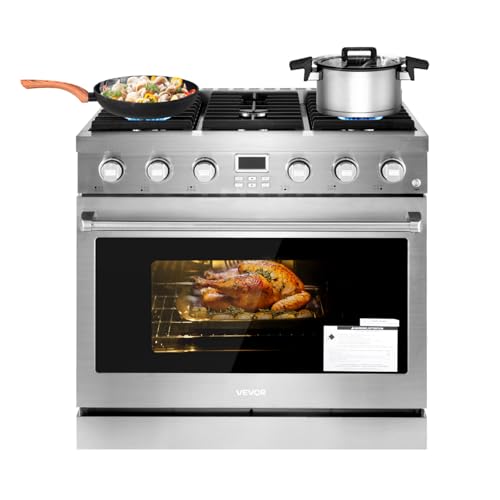
VEVOR 36-Inch Gas Range Oven, 6 Burners — Best straightforward six-burner value
The VEVOR takes the opposite editorial line from the AAOBOSI: a 36-inch freestanding stainless body described as a 2-in-1 stove and oven unit for home and apartment kitchens, six sealed cooktop burners, a 6.0 cu. ft. capacity, easy reach racks, and a halogen light. That is the whole pitch, and its plainness is the appeal — the essential six-burner specification without a feature list competing for your attention.
Easy reach racks are the detail to dwell on, because in a wide gas oven they are a daily kindness: racks designed to come forward make loading and basting a heavy tray less of a lean into heat. The halogen light partners with the oven window to keep the door closed during a bake, which in a gas oven — whose temperature recovers more slowly than an electric’s — protects the very evenness cooks complain gas lacks. Small features, honestly chosen, aimed at the oven’s real weaknesses.
Sealed burners keep the top’s cleaning on the surface, and six of them at this width give the parallel layout that defines the category: the preserving kettle, the sauce, the sauté, and the kettle for tea can coexist. VEVOR’s wider catalogue leans toward equipment value, and this range follows that instinct — specification first, story second. Buyers who comparison-shop by the stated numbers will find this listing unusually willing to be compared.
Set expectations by the same plainness. The listing does not claim convection, air fry, or a display; the oven is a gas oven in the traditional mould, with the character that implies — rich heat for roasting, gradients to manage for delicate baking. If your cooking is roasts, braises, and stovetop abundance, the VEVOR’s honesty fits. If your baking is ambitious, the convection picks around it exist for you.
There is a second audience the VEVOR serves quietly well: the serious second kitchen. A basement canning kitchen, a guest-house range, a rental property whose tenants cook properly — settings where the brief is a big, capable, replaceable workhorse rather than a beloved centrepiece. Plain specification, standard format, and an equipment brand’s pricing logic make the VEVOR the pick a practical buyer can justify twice, once for the main house and once for everywhere else cooking happens.
- Width stated in the listing: 36 inches
- Oven capacity stated in the listing: 6.0 cu. ft.
- Burners stated in the listing: 6 sealed cooktop burners
- Oven details stated in the listing: easy reach racks, halogen light
- Format stated in the listing: freestanding 2-in-1 stove and oven unit
- Where to buy: the VEVOR 36-Inch Gas Range Oven, 6 Burners listing on Amazon — check price on Amazon
Strengths
- The essential six-burner, 6.0 cu. ft. specification without feature-list inflation.
- Easy reach racks and a halogen light target a gas oven’s real daily frictions.
- Sealed burners keep six rings’ worth of spills on the wipeable surface.
Trade-offs
- No convection is stated, so delicate baking must manage gas gradients manually.
- The listing’s brevity leaves finish and control details to the product page.
- An equipment-value brand means a thinner hand-holding service experience.
Best for: value-led buyers who want six burners and a big gas oven, plainly specified. A poor fit for: ambitious bakers who need convection’s evenness in the cavity.

Cosmo Lumin 36-Inch 6-Burner Gas Range COS-GRC366KB — Best oven room of the home picks
The Lumin holds the home picks’ capacity crown by a tenth: 6.1 cu. ft. of convection oven under six burners, with sealed burners, fan circulation, cast iron grates, a digital display with timer, and liquid propane convertibility, all stated in its listing. A tenth of a cubic foot is not a marketing gulf, but the pattern matters — Cosmo specified this range generously in every direction at once, and the result is the most complete all-round home specification in the guide.
Convection with fan circulation is doing important work in a gas oven this wide. Gas heat rises and pools; a fan redistributes it, so a 6.1 cu. ft. cavity bakes more like its size promises instead of like a tall chimney with racks. The digital display with timer answers the gas range’s other classic gap — timing visibility — giving the cook a glanceable countdown instead of a phone buried under flour. Cast iron grates complete a top that heavy pots can trust.
The Lumin also illustrates why two Cosmos earned places here. Against its Haven sibling, the Lumin trades the storage drawer for the timer display and the extra sliver of oven — a choice between kitchen storage and cooking information. Households short on cupboards will feel the drawer’s absence; households who bake by the clock will feel the display’s presence at every tray. Neither is the better range in the abstract; each is the better range for a specific kitchen’s scarcest resource.
LP convertibility, stated plainly, rounds out a listing that seems designed by someone who reads comparison guides: nearly every question a shopper brings to this category is answered in the title itself. If your shortlisting method is evidence-based, the Lumin is the pick that keeps passing its own exam.
The timer display deserves its final word, because it changes a habit beyond timing. A cook who can see the oven’s countdown from across the kitchen stops opening the door to check, and a gas oven whose door stays shut keeps the temperature the recipe assumed. Small behavioural loops like that — glance instead of open, trust instead of disturb — are where even baking actually comes from, more than from any single specification. The Lumin simply builds the loop into the range’s face.
- Width stated in the listing: 36 inches
- Oven capacity stated in the listing: 6.1 cu. ft.
- Burners stated in the listing: 6 burners, sealed
- Oven help stated in the listing: convection with fan circulation
- Extras stated in the listing: cast iron grates, digital display with timer, LP convertible
- Where to buy: the Cosmo Lumin 36-Inch 6-Burner Gas Range COS-GRC366KB listing on Amazon — check price on Amazon
Strengths
- The largest home-pick oven at 6.1 cu. ft., steadied by fan convection.
- A timer display fixes the gas range’s classic timing-visibility gap.
- Stated LP convertibility and cast iron grates complete a thorough specification.
Trade-offs
- No storage drawer, so pans must find cupboard room elsewhere.
- The display adds an electronic element to an otherwise mechanical class.
- Six burners over cast iron make the top heavy to strip for a deep clean.
Best for: evidence-led buyers wanting the biggest home oven plus convection and a timer. Not the right match for: kitchens where pan storage is scarcer than oven space.
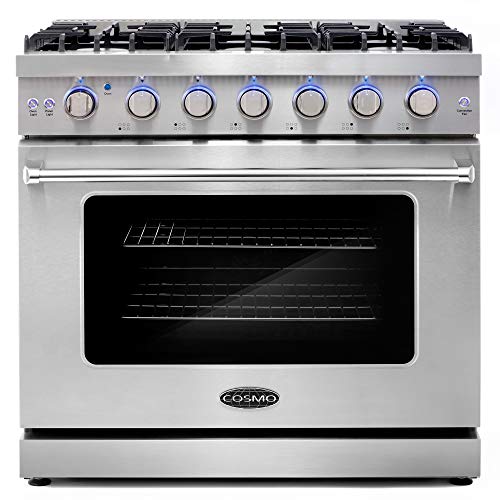
Cosmo Haven 36-Inch 6-Burner Gas Range COS-EPGR366 — Best drawer-and-details pick
The Haven is the Lumin’s sibling with the opposite priorities: six burners over a 6 cu. ft. convection oven, knob LED indicators, mirror finished knobs, a storage drawer, and liquid propane convertibility in the listing. Where the Lumin spends its difference on a display and a sliver of oven, the Haven spends it on the two things a cook touches and a kitchen lacks — controls that show their state at a glance, and somewhere to put the pans.
Knob LED indicators solve a real gas-range ambiguity. On a knob-only top, a burner turned low can be hard to confirm at a glance across a steamy kitchen; a lit indicator at the knob states plainly which rings are live. It is a safety feature wearing a styling feature’s clothes, and in a household with teenagers, guests, or a grandparent cooking, that glanceable certainty is worth more than its modest billing. The mirror finished knobs complete a control row designed to be read, not merely turned.
The storage drawer returns the favour the Lumin declined: in a 36-inch kitchen, the drawer under the oven is where the sheet pans, the roasting rack, and the big skillet live, inside the cooking zone instead of across the room. Convection keeps the oven honest, LP convertibility keeps the fuel options open, and the Haven emerges as the domestic-detail pick — the range for the household whose complaints about its current cooker are about storage and certainty rather than capacity.
Choosing between the two Cosmos is the guide’s happiest problem. Both are six-burner, convection, LP-convertible, stainless ranges from the same maker at the same width. Read your own kitchen’s scarcities — display or drawer, a tenth more oven or a place for pans — and the answer selects itself. Few categories offer a fork this clean, and Cosmo deserves credit for making the two models genuinely different rather than cosmetically so.
The Haven also suits the household that cooks by ear as much as by eye. A busy kitchen is loud — extraction, conversation, a radio — and a burner left low under a lidded pan can be genuinely uncertain in that noise. Lit indicators restore certainty without a hand hovered over every ring, and for the cook training children at the stove, that visible state is a teaching tool: the top announces what it is doing. Details like that rarely headline a listing, and they are exactly what ownership feels like in year three.
- Width stated in the listing: 36 inches
- Oven capacity stated in the listing: 6 cu. ft.
- Burners stated in the listing: 6 burners
- Oven help stated in the listing: convection oven
- Details stated in the listing: knob LED indicators, mirror finished knobs, storage drawer
- Where to buy: the Cosmo Haven 36-Inch 6-Burner Gas Range COS-EPGR366 listing on Amazon — check price on Amazon
Strengths
- Knob LED indicators make live burners glanceable — a quiet safety upgrade.
- The storage drawer solves pan storage inside the cooking footprint.
- Convection and LP convertibility keep the core specification complete.
Trade-offs
- No timer display, so baking timing lives on a phone or a separate clock.
- Mirror finished knobs will show every fingerprint a cooking hand leaves.
- At 6 cu. ft. it cedes the capacity headline to its own sibling by a tenth.
Best for: households short on pan storage who value glanceable burner certainty. Poorly suited to: bakers who want an on-range timer display above all.
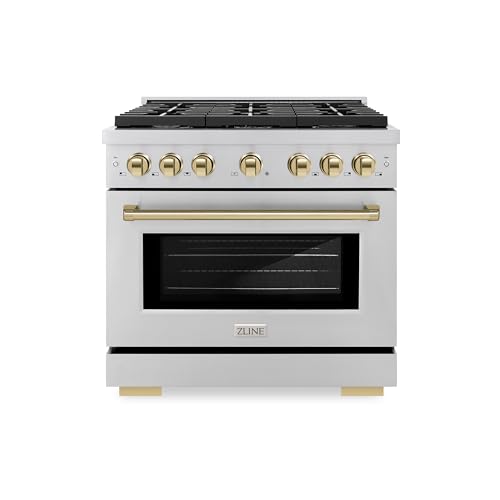
ZLINE Autograph Paramount 36-Inch Gas Range, 6 Burners SGRZ-36-G — Best styled six-burner gas range
The ZLINE Paramount is the guide’s design statement: an Autograph Edition range in stainless steel with polished gold accents, six burners over a 5.2 cu. ft. convection gas oven. The gold is not shy, and it is not meant to be — this is a range for kitchens being designed around a centrepiece, where hardware, lighting, and the range’s accents are chosen as one palette. In such a room the Paramount does what no plain stainless pick can: it finishes the design.
Beneath the styling sits a serious specification. Six burners give the parallel layout the category exists for, and convection in the gas oven addresses the one technical criticism gas ovens fairly receive, evening the cavity’s heat for baking. At 5.2 cu. ft. the oven is the smallest among the home picks — the design’s budget went to the statement rather than the cavity — yet it remains a full-size oven by any ordinary standard, swallowing holiday roasts that would defeat the compact ranges elsewhere in this series.
Buyers should choose the Paramount with their eyes open in both directions. The accents that thrill in the showroom will organise every later decision — replacement hardware, the kettle, even the utensils crock will be judged against the gold. Households who enjoy that coherence will find the range a daily pleasure; households who redecorate restlessly may find a plainer pick more forgiving. ZLINE’s Autograph line exists for the first household, and this is its six-burner gas expression.
It is worth distinguishing this range from its dual fuel cousin in our other guide: the RA36 there pairs six burners with an electric oven, while the Paramount here keeps gas in the oven as well. Same badge family, same width, opposite oven philosophy — choose by the baking behaviour you want, not by the silhouette, because the silhouette is the one thing they share.
Gold accents also age interestingly, and the Paramount’s buyer should know it. Polished metal in a working kitchen gathers the week’s evidence faster than brushed steel, and keeping the accents bright is a small weekly ritual — a soft cloth, thirty seconds, no abrasives. Owners who enjoy that ritual describe it as caring for the room’s jewellery; owners who would resent it should hear the warning now, while the plainer picks are still on the page and the choice costs nothing.
- Width stated in the listing: 36 inches
- Oven capacity stated in the listing: 5.2 cu. ft.
- Burners stated in the listing: 6 burner cooktop
- Oven stated in the listing: convection gas oven
- Finish stated in the listing: stainless steel with polished gold accents
- Where to buy: the ZLINE Autograph Paramount 36-Inch Gas Range, 6 Burners SGRZ-36-G listing on Amazon — check price on Amazon
Strengths
- Polished gold accents give a designed kitchen its centrepiece and palette.
- Convection steadies the gas oven for more even baking.
- Six burners keep the parallel layout fully intact beneath the styling.
Trade-offs
- At 5.2 cu. ft. the oven is the home picks’ smallest.
- Statement accents will organise — and constrain — later kitchen choices.
- No LP convertibility is stated in the listing, so propane buyers must confirm.
Best for: design-led kitchens wanting a six-burner gas range as their centrepiece. Not suited for: capacity-first cooks or rooms that redecorate often.

Kratos 36-Inch Commercial Gas Range, Natural Gas — Best true commercial range — for restaurants
The Kratos is in this guide to be understood, not to be smuggled into a home shortlist. Its listing states its identity without decoration: a 36-inch commercial gas range and oven with six burners and a full-size oven, natural gas, a stated 210,000 BTU output, freestanding, for restaurants. That output figure is roughly triple the home picks’ world — commercial burners are built to bring restaurant volumes to temperature at restaurant speed, all day, every day, in a kitchen built around them.
A commercial kitchen is a different building from a home kitchen. It has the gas supply sized for that output, the clearances and non-combustible surroundings commercial codes require, extraction engineered for continuous duty, and staff who clean the range as a closing ritual. A home kitchen has wooden cabinets at domestic clearances, a domestic gas line, and a household’s insurance policy written for residential appliances. The Kratos in the second setting is not a bargain or a hack; it is a mismatch that installers and insurers will both have opinions about.
So who should buy it? Exactly who it names: a restaurant, a café, a catering operation, a food truck commissary — any genuinely commercial kitchen that needs six burners and a full-size oven in a 36-inch commercial body, fuelled by natural gas as listed. For those buyers the Kratos is a straightforward, honestly specified tool, and its presence here respects them too: a commercial buyer landing on this guide deserves to find their appliance labelled correctly rather than buried among home ranges.
Home cooks who feel the pull of that output figure should translate it honestly. Power you cannot feed, clearances you cannot meet, and a duty cycle you will never use are not performance; they are specifications for someone else’s kitchen. The five home picks above offer six burners in bodies built for your clearances, your gas line, and your insurance — which is to say, they offer the part of the commercial dream that was ever really yours.
One legitimate home-adjacent case deserves naming: the farm kitchen, hall kitchen, or church kitchen that operates as a genuine communal cooking space may fall under commercial expectations in its jurisdiction, and there a unit like the Kratos can be the correct, code-appropriate purchase — specified with the local inspector’s blessing rather than against it. The distinction was never the building’s postcode; it is the setting’s clearances, supply, and supervision. Where those are commercial, buy commercial without hesitation.
- Width stated in the listing: 36 inches
- Setting stated in the listing: commercial range for restaurants
- Output stated in the listing: 210,000 BTU
- Burners stated in the listing: 6 burners with a full-size oven
- Fuel stated in the listing: natural gas
- Where to buy: the Kratos 36-Inch Commercial Gas Range, Natural Gas listing on Amazon — check price on Amazon
Strengths
- A stated 210,000 BTU output serves genuine restaurant duty cycles.
- An honestly labelled commercial specification — no home-kitchen ambiguity.
- Six burners and a full-size oven in the commercial 36-inch standard body.
Trade-offs
- Commercial clearances, gas supply, and codes make it unsuitable for home kitchens.
- Its output assumes extraction and surroundings a house does not have.
- Residential warranties and insurance generally do not contemplate commercial units.
Best for: restaurants, cafés, and catering kitchens needing commercial six-burner duty. Not the right match for: any home kitchen, however ambitious its cook.
Six Burners, Two Worlds: The Comparison
| Model | Intended setting | Oven space | Signature detail |
|---|---|---|---|
| AAOBOSI 36-Inch Gas Range, 6 Burners, 6.0 Cu. Ft. | Home | 6.0 cu. ft. | Touch air fry and steam clean |
| VEVOR 36-Inch Gas Range Oven, 6 Burners | Home | 6.0 cu. ft. | Easy reach racks |
| Cosmo Lumin 36-Inch 6-Burner Gas Range COS-GRC366KB | Home | 6.1 cu. ft. | Timer display |
| Cosmo Haven 36-Inch 6-Burner Gas Range COS-EPGR366 | Home | 6 cu. ft. | Storage drawer, lit knobs |
| ZLINE Autograph Paramount 36-Inch Gas Range, 6 Burners SGRZ-36-G | Home | 5.2 cu. ft. | Polished gold accents |
| Kratos 36-Inch Commercial Gas Range, Natural Gas | Restaurant | Full-size commercial oven | 210,000 BTU stated output |
What Does the Sixth Burner Actually Buy You on a Tuesday?
Not a bigger dinner — a calmer one. With four burners, a three-pan meal plus a kettle forces a rotation: something must come off the heat and wait, cooling, while something else takes its ring. With six, the whole meal holds its places simultaneously, and the cook stops being a traffic controller. The sixth burner also creates the dedicated low ring — the sauce that lives at a bare simmer for an hour without evicting anything — which is the quiet luxury professionals take for granted and home cooks discover with delight.
The geometry helps beyond the count. Six burners across 36 inches usually arrange as three pairs or a grid with a centre presence, and either way two large pans stop being a negotiation. A stockpot and a wide skillet — the pair that defeats most four-burner tops — sit side by side with room to stir both. Add a long griddle across one pair and breakfast becomes a single-surface production rather than a relay.
The discipline is to buy the count your pans support. Six small-to-medium vessels is the layout’s native repertoire; two enormous ones will still crowd, and a household whose cooking is built on a single giant wok should spend its money on one fierce burner instead. Count your typical simultaneous pans on your busiest night, add one for the kettle, and let that arithmetic — not the showroom’s symmetry — decide whether six is your number.
How Do You Feed and Vent Six Burners in a House?
A home six-burner top asks the house for two things a four-burner top asks more gently. The first is gas supply: six burners lit together draw meaningfully, and while the home picks are built for residential lines, an older or long-run supply should be confirmed by your fitter at installation, especially in propane homes where regulator sizing matters. The second is extraction. Six rings of steam, smoke, and combustion by-products will overwhelm a decorative hood; size the extractor to the top, duct it outside where possible, and the kitchen will stay a room you want to eat in.
Clearances follow the manufacturer’s word, and they are not decorative. Home ranges are insulated and tested for residential cabinetry at stated distances; keep those distances, keep combustibles off the backguard’s heat path, and the range will behave as its certification promises. This is precisely the line the commercial Kratos sits beyond — its clearances assume a commercial room — and respecting the line is what keeps a powerful home range a pleasure rather than a project.
Garage and outbuilding cooks should note a related point while planning utilities: appliances that live in hot, unconditioned spaces need ratings for those spaces, a theme our guide to the Best Refrigerators for a Hot Garage explores for the cold side of the outbuilding kitchen.
How Do You Keep a Six-Burner Top Clean Without a Closing Crew?
Restaurants degrease nightly because grease compounds; the home version of that wisdom is a two-minute wipe while the top is still warm. Sealed burners — stated on the VEVOR and Lumin — keep the day’s spills on the surface where that wipe reaches them. Cast iron grates lift off in sections, so clean the sections you used; a full strip-down is a monthly event, not a nightly sentence, provided the daily wipe happens.
The oven’s routine depends on its features. Steam clean, stated on the AAOBOSI, turns the weekly freshen into a low-effort cycle; convection cavities soil evenly and wipe predictably; and every gas oven rewards the habit of a tray under anything likely to bubble over. Racks soak best while the cavity is still warm from dinner. None of this is heroic — it is the domestic translation of the closing ritual, scaled to a household that also has to wash the pans.
Knobs and indicators collect the week’s evidence fastest, because every adjustment is made mid-cooking with busy hands. The Haven’s lit knobs and the Lumin’s display both live exactly where the splashes land, so a soft cloth kept by the range — used nightly, rinsed often — is the accessory no listing sells and every owner needs. Two minutes, warm top, damp cloth: the whole liturgy, and it keeps a six-burner range looking like its first month for years.
Which Home Pick Matches Which Kind of Cook?
The feature maximiser lands on the AAOBOSI: air fry for the family’s crisping habit, steam clean for the oven’s upkeep, convection for the baking, and fuel flexibility for the future. The specification purist lands on the VEVOR or the Lumin — the VEVOR for plain, honestly stated essentials, the Lumin for the most complete evidence-led specification with its timer display and the largest oven. The storage-starved land on the Haven, whose drawer answers the complaint their current kitchen makes daily.
The design-led land on the Paramount, and they should do so joyfully rather than apologetically: a range is the kitchen’s largest visible object, and choosing it as a centrepiece is a legitimate brief provided the specification beneath — six burners, convection, a full-size oven — still serves the cooking, which here it does. And the commercial buyer lands on the Kratos, in a commercial room, where its output figure finally means what it says.
What unites the five home picks is that none asks the house to change its nature. They fit residential clearances, residential gas, and residential cleaning habits, and they differ in the details a household feels daily. Furnishing the rest of a hard-working room follows the same fit-first logic — our guide to the Best College Student Desk Chairs makes the case for the desk corner that so many kitchen-adjacent spaces now contain.
How Should You Arrange Six Burners Across a Cooking Week?
Give each ring a job and the top organises itself. Most six-burner households settle into a geography: a fierce front ring for searing where the cook stands, a gentle back ring for the day’s simmer, a middle pair that hosts the griddle on weekends and the everyday skillets between times, and a free ring that stays free — the landing strip for a pan coming off the boil or a kettle waiting its moment. The free ring feels like waste for exactly one week, after which it feels like sanity.
Batch cooking exploits the layout differently. A preserving day or a freezer-filling Sunday runs the top as a production line: stock reducing at the back, jars’ contents cooking in sequence at the front, a water bath holding its temperature at the side. The oven below joins the line for roasting the next batch while the top finishes the current one. Six burners plus a wide oven is a small factory when the household wants it to be, and an ordinary stove when it does not — the same range, two tempos, chosen by the day.
Teach the geography to everyone who cooks. A household where three people use the range will develop three private systems unless the layout is shared, and shared systems are safer: everyone knows which ring runs hot, where the griddle lives, and which knob feels loose. Five minutes of household agreement at installation saves a year of small surprises.
What Does a Gas Oven’s Character Mean for Your Baking, Honestly?
Gas ovens carry two traits no fan fully repeals: their heat is moist, because combustion produces water vapour, and it stratifies, because hot air rises within the cavity. Roasting adores both traits — meats baste in the humid air and brown at the top where the heat gathers. Delicate baking negotiates with them: meringues dry more slowly, pastry can soften at the edges, and two racks bake at two speeds unless convection intervenes.
The home picks here mostly answer with convection, and the answer works — moving air flattens the gradients and dries the cavity’s feel. What convection cannot do is turn a gas oven into an electric one, and the dual fuel guides in this series exist for bakers who want that full conversion. The six-burner gas buyer is choosing flame’s character knowingly: superb roasting, stovetop supremacy, and baking that rewards an oven thermometer, a rotation habit, and recipes robust enough for real fire.
There is no shame in either philosophy, and considerable frustration in confusing them. The cook who wants patisserie precision should buy the electric oven; the cook who wants a roast with crackling and a top that answers like a struck match should buy this page. Both are serious kitchens. They are simply serious about different dishes, and the range is where that seriousness becomes hardware.
How Do You Read Burner Numbers Without Being Misled by Them?
Output figures in this category arrive in incompatible dialects: one listing states a power burner’s figure, another a top’s total, and the commercial entry states a whole-appliance output that dwarfs both. Comparing those numbers directly is comparing a sprinter’s top speed with a train’s — the units rhyme and the meaning does not. Read each figure for what it claims to be, and treat unstated totals as unknown rather than as zero or as parity with a rival that published.
The practical translation happens in your kitchen, not the listing. What matters is whether the fiercest ring boils your largest pot at a pace your patience accepts, and whether the gentlest ring holds your most delicate sauce without scorching it between stirs. Both are layout questions disguised as power questions, and every home pick here arranges six rings across a sensible spread of sizes precisely so that range, rather than a headline, does the work.
When a listing does state a figure, honour its precision by repeating it precisely — as this guide does — and distrust any summary, including a salesperson’s, that rounds a power burner into a total or a total into a promise. Numbers in appliance listings are load-bearing; treat them like measurements, not adjectives.
What Should Arrive in the Same Week as the Range?
A six-burner range rewards a small supporting cast ordered alongside it. A griddle that fits the top’s centre span, if your layout invites one, turns the purchase’s promise into the first weekend’s breakfast. A spare oven rack doubles the wide cavity’s usefulness for two-tray nights. An oven thermometer — inexpensive, unglamorous — teaches you your individual unit’s temperament within a fortnight, knowledge that improves every bake afterwards. And a surface-appropriate cleaning kit, bought before the first boil-over rather than after it, keeps the top’s first month from setting its permanent complexion.
The unglamorous companion is the fitter’s visit itself, booked before the range ships: gas connection checked, supply confirmed, anti-tip bracket fitted, and every burner and the oven lit and observed while responsibility is still in the room. A range this size does not get casually re-delivered, so the installation appointment is the moment to catch every rattle, uneven flame, and door that sits a degree off true. Photograph the model plate before the range slides home; the number will serve every future parts conversation.
Mistakes That Turn Six Burners Into a Burden
The gravest mistake is the category error: installing a commercial range in a home kitchen for its output figure. Clearances, gas supply, extraction, insurance, and warranty all assume their own worlds, and the Kratos entry above explains why the worlds must not be swapped. The second mistake is the mirror image — buying a home range for a genuinely commercial operation, where its duty cycle will be spent in a season.
Third, buyers count burners and forget pans: six rings under two wide pans and a stockpot is a crowd, not a workstation, so sketch your own vessels onto the layout before ordering. Fourth, the hood gets forgotten until the ceiling yellows — extraction sized to the top is part of the purchase. Fifth, propane households skip the convertibility check and discover at installation that their chosen model needs an arrangement the listing never promised.
Finally, do not let a sibling model’s features migrate in your imagination. The Lumin’s display is not the Haven’s drawer; the AAOBOSI’s air fry is not the VEVOR’s simplicity. Each pick here is a specific bargain, and the listing — read closely, model number matched — is the only version of it that will arrive at your door.
Final Recommendation
For most households the Cosmo Lumin is the centre of gravity: the largest home oven, convection, a timer display, and LP flexibility in one thoroughly stated specification. Choose the AAOBOSI when air fry and steam clean will be weekly tools, the VEVOR when plain value in the essential specification is the brief, the Haven when pan storage and glanceable knobs answer your kitchen’s real complaints, and the Paramount when the range is the room’s designed centrepiece. Choose the Kratos only for a restaurant, and choose it there with confidence. Six burners, honestly matched to the room they will serve, turn the daily traffic jam of dinner into something closer to conducting — and that calm, repeated nightly, is what the extra two rings were always for.
Buy the setting first and the specification second: a home range for a home, a commercial range for a business, and within the home five, the details your own kitchen complains about loudest. The range will stand in the room for a decade; the choosing deserves the hour it takes to read the listings as carefully as they were written.
Frequently Asked Questions
Can I put a commercial range like the Kratos in my home kitchen?
You should not. Commercial ranges assume commercial clearances, gas supply, extraction, and surroundings, and they are built and certified for those settings. Home insurance and local codes generally contemplate residential appliances in houses. The five home picks in this guide deliver six burners within residential assumptions, which is the version of the idea a house can safely hold.
Do six burners need a bigger gas line?
Home six-burner ranges are designed for residential supplies, but an older line, a long run, or a propane regulator can each become the limiting factor when all six burners run together. Have your fitter confirm the supply at installation — it is a five-minute conversation that prevents a lifetime of weak flames on the far burners.
Is convection in a gas oven worth having?
For baking, generally yes. A gas oven’s heat naturally stratifies, and a fan evens it, so trays brown more uniformly and two racks behave more alike. Roasting is more forgiving and thrives either way. If your oven life is mostly roasts and braises, a non-convection pick like the VEVOR serves happily; if you bake, convection earns its place.
What is the difference between the two Cosmo models?
Emphasis. The Lumin offers the larger oven at 6.1 cu. ft. and a digital display with timer; the Haven answers with a storage drawer, knob LED indicators, and mirror finished knobs at 6 cu. ft. Both are six-burner convection ranges with stated LP convertibility, so the choice is between cooking information and kitchen storage.
Can these ranges run on propane?
Several state it directly: the AAOBOSI is listed as NG/LP convertible, and both Cosmo models state liquid propane convertibility. The Kratos is listed for natural gas in a commercial setting. For any model, conversion work belongs to a qualified fitter, and the configuration should be confirmed on the product page before ordering.
A note on noise and company belongs here too. Six burners under a working hood is not a quiet appliance, and a kitchen that doubles as the home’s social centre should expect the range’s busiest hour to raise its voice. That is not a defect to apologise for — it is the sound of a household cooking at full stretch — but open-plan homes might schedule the searing before the guests settle, which is what restaurants, with their separate kitchens, never had to learn.
How many pans can six burners really hold at once?
Six modest pans, or four generous ones, or two very large ones with room to spare. The honest test is your own batterie: lay your busiest night’s vessels out and count. The layout rewards many-pan cooking styles — sauces, sides, and simmers in parallel — more than it rewards sheer pan diameter.
Related Guides
For the laundry that a big cooking household inevitably generates, our guide to the Best Top-Load Washers for Large Families covers capacity-first machines. Within this range series, the dual fuel guides cover the electric-oven alternative at 36 and 48 inches, and the compact and off-grid guides cover the small end of gas cooking.


