What's inside
- Where to Buy a Quiet Tumble Dryer — Beginning With What Nobody Will Tell You
- Key Takeaways
- Quick Picks
- How Did We Build a Quiet Guide Without a Single Decibel to Stand On?
- Six Compacts Compared on the Only Numbers Their Sellers Published
- Where Should a Compact Dryer Stand to Stay Out of Your Evening?
- How Do You Level and Load a Dryer So It Runs at Its Quietest?
- Which Noises Are Normal, and Which Are a Dryer Asking for Help?
- What Do Buyers of Quiet Dryers Most Commonly Get Wrong?
- How Does Dryer Noise Travel Through a Home — and Where Can You Stop It?
- What About the Neighbours? A Short Guide to Laundry Diplomacy
- How Should You Test a New Compact Dryer in Its First Week?
- Does the Time of Day Change Which Dryer You Should Buy?
- How Do Open-Plan Homes Change the Quiet Calculation?
- What Maintenance Keeps a Compact Dryer at Its Quietest?
- Why Do Small Dryers Suit Modern Small Homes Beyond Noise Alone?
- How Should You Choose Between Two Compacts That Both Fit?
- A Note on Children, Pets and the Sounds a Household Stops Hearing
- Final Recommendation
- Frequently Asked Questions
- Related Guides
As an Amazon Associate I earn from qualifying purchases. This post may contain affiliate links at no extra cost to you.
cottageverdict.com is reader-supported. When you buy through links on our site, we may earn an affiliate commission.
Where to Buy a Quiet Tumble Dryer — Beginning With What Nobody Will Tell You
Nobody will tell you how loud these dryers are, and this guide will not pretend otherwise: not one of the six listings below publishes a decibel figure. The best quiet tumble dryers are therefore not ranked by a number nobody measured; they are chosen from the class of machines that noise-sensitive households actually live with — compact, portable electric dryers — and judged by the things that genuinely decide how much noise reaches your evening: drum size, load weight, motor scale, placement, levelling and the floor beneath. A small dryer tumbling a small load in a well-chosen spot is, in lived experience, a quiet appliance. The same machine on a hollow floor, unlevelled, overloaded, becomes a percussion instrument. This guide covers both halves of that truth: six picks, and the method that makes any of them quiet.
One boundary deserves drawing immediately. This site already publishes a guide to compact portable dryers organised by size and installation. This page is organised by noise — where the machine stands, what it stands on, how it is loaded and levelled — and readers should treat the two as companions, not duplicates. Households that also want the dryer to report to their phone can continue afterwards to our guide to Best WiFi Dryers; a finished-cycle alert, after all, is the other way to stop a dryer from disturbing an evening — by ending the need to listen for it.
Every linked name below leads to its Amazon listing, where you can check price on Amazon and verify wattage, capacity and dimensions. No prices are printed here, and no decibel claims are invented here, however convenient an invented league table would be to write — or to read. Hair dryers appeared in the product research for this guide, as they always do when the word dryer is searched loosely; they dry hair, not laundry, and none appears below.
Key Takeaways
- No listing in this set publishes a decibel rating — the guide says so plainly and judges noise by class, load and placement instead.
- All six picks are compact portable electric dryers, the class noise-sensitive spaces actually adopt.
- Wattages run from 800W to 1700W and capacities from 1.6 to 3.5 cu. ft.; smaller drums move less mass and generally disturb less.
- Levelling, load balance and floor choice decide more of the noise you hear than the badge on the machine.
- Stainless steel tubs appear across most of the set, a smoothness and durability point for machines that tumble daily.
Quick Picks
| Model | Badge | Noise-relevant character |
|---|---|---|
| Panda 3.5 Portable Clothes Dryer | Fullest-Featured Quiet Candidate | 3.5 cu. ft. and 13.2 lbs at 1500W, 120V — the largest here, for a separate laundry corner. |
| COSTWAY 1700W Electric Portable Dryer | Strongest-Wattage Compact | 13.2 lbs capacity with the set’s highest wattage and a low-mounted control panel. |
| ROVSUN 2.6 Portable Dryer Stainless Steel | Knob-Simple Mid-Size | 2.6 cu. ft. at 110V and 1400W, controlled by a single knob. |
| Stopsad 1.6 Portable Clothes Dryer | Smallest Drum, Lightest Work | 1.6 cu. ft. at 800W with five modes — the least mass in motion here. |
| Auertech 12lbs Portable Dryer | LED-Controlled Twelve-Pound Class | 12 lbs with six drying modes and an LED panel for precise, shorter cycles. |
| Effidry 110V Portable Clothes Dryer | Low-Wattage Apartment Pick | 2 cu. ft. and 12 lbs at 830W on 110V, sized for apartments, RVs and dorms. |
How Did We Build a Quiet Guide Without a Single Decibel to Stand On?
By refusing to fake the measurement and working with the physics instead. Dryer noise comes from identifiable sources: the motor and fan, the drum rollers and belt, the load itself slapping and thudding as it lifts and falls, and the cabinet’s resonance against its floor. Of those, only the load and the floor are fully in the buyer’s control — which is why this guide’s how-to sections matter as much as its picks. The picks themselves were chosen as the compact class’s credible representatives across its size range, each with its capacity and wattage stated in its title, each a real tumble dryer with a stainless tub in most cases, and none burdened with claims its seller never made.
Search discipline mattered too. Queries around quiet dryers surface hair dryers, pet dryers and replacement parts in volume; all were excluded. What remains is six laundry machines whose shared trait is scale — small drums, small motors, small loads — the only honest foundation a quiet-dryer guide can build on without laboratory numbers. The washer half of a quiet laundry deserves the same rigour, and readers speccing a whole low-noise laundry room should pair this page with our guide to Best Washers With Low Vibration, since a washer’s spin is usually the loudest event in the building.

Panda 3.5 Portable Clothes Dryer — Fullest-Featured Quiet Candidate
The Panda is the largest machine in this guide — 3.5 cubic feet, 13.2 lb capacity, 1500W on 120V, a vented front-load design with a stainless steel tub, described by its title as ideal for apartments, dorms and small laundry spaces. In a noise guide, the largest pick needs its logic stated: capacity is a noise feature when it prevents overloading. A drum with room for its load tumbles that load in a loose, rolling cascade; a drum stuffed past its comfort bangs the same clothes against its walls in a packed, thudding mass. Households whose laundry volume sits at the top of the compact class will hear less noise from this Panda, loaded properly, than from a smaller machine loaded desperately.
Panda is also the portable category’s most established name, a brand that has specialised in compact laundry long enough for its machines to be unremarkable in the best sense — known quantities with known behaviour. The 1500W element is the joint-strongest among the true portables here, shortening the exposure window: a cycle that finishes sooner disturbs an evening less than a gentler cycle that drones on, a trade-off noise shoppers should weigh honestly rather than assuming lower wattage always means lower disturbance.
Placement advice for this pick is specific: it earns its quiet in a laundry corner, a large bathroom or a utility closet — a defined space with a door — rather than in the living room’s corner. Vented operation means its moisture and its fan note travel down the exhaust path; route that path thoughtfully and even its working sound stays where the work is.
For one or two people with real laundry volume and a closable door between the dryer and the sofa, this is the guide’s most complete answer.
- Capacity, from the listing title: 3.5 cu. ft., 13.2 lbs
- Power, from the listing title: 1500W, 120V
- Format, from the listing title: vented front-load compact electric dryer
- Tub, from the listing title: stainless steel tub
- Intended spaces, from the listing title: apartments, dorms and small laundry spaces
- Where to buy: the Panda 3.5 Portable Clothes Dryer listing on Amazon — check price on Amazon
- Largest compact drum here; proper loading replaces overloaded thudding.
- Strong 1500W element shortens each cycle’s disturbance window.
- The portable category’s most established specialist brand.
- Largest motor and load mass here; placement discipline matters most.
- Vented design needs an exhaust route planned in advance.
- Overkill for a single person with a tiny weekly load.
- Capacity, from the listing title: 13.2 lbs
- Power, from the listing title: 1700W
- Format, from the listing title: front-load compact tumble dryer, electric
- Tub, from the listing title: stainless steel tub
- Controls, from the listing title: button control panel, low-mounted
- Where to buy: the COSTWAY 1700W Electric Portable Dryer listing on Amazon — check price on Amazon
- Highest wattage here; short, businesslike cycles disturb briefly.
- Floor-level operation encourages the levelling that keeps dryers quiet.
- Full 13.2 lb class capacity with a stainless tub.
- Strong motor punishes poor levelling more than weaker machines.
- Mode list is described as varied but not enumerated in the title.
- 1700W deserves a sound outlet, not a tired extension lead.
- Capacity, from the listing title: 2.6 cu. ft.
- Power, from the listing title: 1400W, 110V
- Tub, from the listing title: stainless steel tub
- Controls, from the listing title: control knob
- Intended spaces, from the listing title: apartment, dorm, RV
- Where to buy: the ROVSUN 2.6 Portable Dryer listing on Amazon — check price on Amazon
- Knob interface is itself quiet: no chimes, menus or fanfares.
- Mid-size drum balances loose tumbling against motor scale.
- Stainless tub keeps the drum’s sound smooth across years.
- No timed precision of an electronic panel for fussy loads.
- 2.6 cu. ft. still asks couples to dry in smaller, oftener loads.
- No modes or programmes are enumerated in its title.
- Capacity, from the listing title: 1.6 cu. ft.
- Power, from the listing title: 800W
- Modes, from the listing title: 5 modes
- Tub, from the listing title: stainless steel tub
- Format, from the listing title: front-load mini electric dryer
- Where to buy: the Stopsad 1.6 Portable Clothes Dryer listing on Amazon — check price on Amazon
- Least mass in motion here; the smallest absolute disturbance.
- Five modes keep tiny loads on short, correct cycles.
- Stainless tub at the smallest size in the set.
- Bedding and family loads are simply beyond its drum.
- 800W means patience for anything heavier than light garments.
- Its quiet is bought with capacity; growing households outgrow it.
- Capacity, from the listing title: 12 lbs
- Modes, from the listing title: 6 drying modes
- Controls, from the listing title: LED control panel
- Tub, from the listing title: stainless tub
- Intended spaces, from the listing title: apartment, RVs, dorms
- Where to buy: the Auertech 12lbs Portable Dryer listing on Amazon — check price on Amazon
- Six modes plus LED precision shorten cycles to what loads need.
- 12 lb ceiling lowers the worst-case unbalanced-load noise.
- Complete, comparable specification in its own title.
- Interface beeps may need muting for true quiet.
- Wattage is not stated in its title.
- A step below the 13.2 lb class for heavy compact loads.
- Capacity, from the listing title: 2 cu. ft., 12 lbs
- Power, from the listing title: 830W, 110V
- Tub, from the listing title: stainless steel tub
- Format, from the listing title: compact electric laundry dryer
- Intended spaces, from the listing title: apartment, RVs, dorms
- Where to buy: the Effidry 110V Portable Clothes Dryer listing on Amazon — check price on Amazon
- Gentlest electrical appetite among the larger compacts here.
- Roomy drum for its wattage lets loads tumble loosely and calmly.
- 110V specification suits RV and older-apartment wiring.
- 830W means longer cycles; time is the price of gentleness.
- Pound rating is generous for the drum; load it with judgement.
- Title gives no mode count or control detail.
One more consideration separates this pick from the rest of the page: it is the only one whose capacity honestly serves as a small household’s sole dryer, week in and week out, including the towel-heavy days. That completeness changes its noise profile across a year. A household running one correct cycle a day in a closed utility space hears less total dryer than a household running three strained cycles in an undersized machine beside the sofa. Quiet, measured across a year rather than a minute, favours the machine that finishes the work in fewest, best-placed sessions — and for households at the compact class’s upper edge, that is this Panda’s deepest claim on a noise shopper’s attention.
Strengths
Trade-offs
Best for: small households with full laundry volume and a door to close between dryer and living space. Not suited for: open-plan studios where the dryer must share air with the bed.
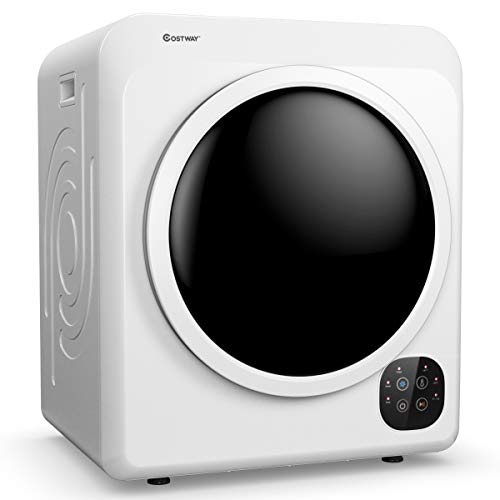
COSTWAY 1700W Electric Portable Dryer — Strongest-Wattage Compact
The COSTWAY brings the highest wattage in this set — 1700W — to the same 13.2 lb capacity class as the Panda, in a front-load compact with a stainless steel tub and a control panel mounted low, described in the title with the endearing phrase easy control button panel downside. That low panel is an ergonomic tell: the machine is designed to sit on the floor or a low stand and be operated from above, which also happens to be the placement that keeps a compact dryer stable and therefore quietest. A dryer operated at floor level gets levelled properly, loaded evenly and left alone — three quiet virtues disguised as a control layout.
The wattage argument mirrors the Panda’s, sharpened: 1700W dries a 13.2 lb load briskly, and brisk cycles are short intrusions. Noise-sensitive households often fixate on how loud a machine is and forget to ask for how long; a compact that finishes in a businesslike span and then falls silent can be the better neighbour than a weaker machine murmuring through the whole film. COSTWAY’s broader catalogue in home appliances gives the model a support context, and the stainless tub repeats the set’s durability theme.
Its title names a variety of drying modes without enumerating them, so this review claims the variety and skips the enumeration. What matters for noise is that modes exist to separate the heavy load from the light one, because nothing in compact drying is louder than delicates and denim sentenced to the same tumble.
Choose the COSTWAY if your compact laundry is heavy for its class and your evenings are worth shortening; level it carefully, because a strong motor on an unlevelled cabinet announces itself.
The low-mounted panel carries a second, subtler implication worth drawing out. Machines designed to be read from above are machines designed to be loaded from above, standing squarely in front of the user — and a user standing squarely loads evenly, notices a stray trainer wedged against the drum wall, and closes the door with the load settled rather than slumped. Even loading is quiet loading. It sounds like a small thing until you have heard the alternative: one wet shoe’s worth of imbalance orbiting a drum at full speed, in a flat whose walls were built for privacy of sight rather than of sound. The COSTWAY’s ergonomics quietly prevent the loudest five minutes in compact laundry.
Strengths
Trade-offs
Best for: compact households with heavy loads who value short cycles and floor-level operation. A poor fit for: anyone planning to perch a dryer on a wobbly counter or shelf.

ROVSUN 2.6 Portable Dryer Stainless Steel — Knob-Simple Mid-Size
The ROVSUN occupies the set’s middle: 2.6 cubic feet, 1400W on 110V, a stainless steel tub, and a control knob as its entire interface philosophy. In a noise guide, the knob deserves respect beyond nostalgia. A knob machine has no beeping menu, no electronic chime announcing each selection, no end-of-cycle fanfare unless a simple buzzer is fitted — the interface itself is acoustically modest. It also invites the most underrated quiet habit: choosing a shorter, appropriate cycle by feel, because turning a dial to a known position is faster than navigating a programme tree, and appropriately-sized cycles are shorter and quieter than default ones.
ROVSUN’s portable range is a familiar sight in apartment laundry, and this model’s specification is the class’s centre of gravity — mid drum, mid wattage, standard voltage. For noise, the mid-size has a genuine claim: enough drum for a couple’s ordinary load to tumble loosely, not so much motor and mass that the machine dominates a small room’s soundscape. Its title addresses apartments, dorms and RVs, the three habitats where dryer noise is a neighbour-relations issue as much as a comfort one.
The stainless tub, again, is not decoration in a machine that may run daily: a smooth drum is a quieter drum across years, because snags, rust patches and worn spots each add their small percussion to every revolution.
Households that want a dryer to be an appliance rather than a device — turn, dry, done — will find this the most congenial pick in the guide.
There is also a generational comfort in this machine’s plainness that noise-anxious buyers should not underrate. Anxious ownership is loud ownership: the household that trusts its appliance stops listening to it. A knob dryer with a mid-size drum and no connected features asks for no vigilance — no app, no alerts, no interface to interpret — and within a fortnight it fades into the flat’s ordinary sounds, the way a fridge does. Several owners of connected appliances report the paradox that monitoring made them more aware of the machine, not less. The ROVSUN offers the older peace: a dryer that is simply there, turning, warm, unremarkable, finished when the dial says so.
Strengths
Trade-offs
Best for: apartment and RV households wanting mid-size capacity with the simplest, quietest interface here. Not the right match for: users who programme cycles precisely for varied fabrics.

Stopsad 1.6 Portable Clothes Dryer — Smallest Drum, Lightest Work
The Stopsad is the guide’s smallest true tumble dryer: 1.6 cubic feet, 800W, five modes, a stainless steel tub, front-loading, and a title that promises fast drying for apartment, home and dorm use. Translate those numbers into noise terms and its case writes itself. Eight hundred watts drives the smallest motor-and-fan assembly here; 1.6 cubic feet caps the load mass that can possibly thud; five modes let that small load be dried on its own terms rather than on a big load’s. If the question is purely which machine can make the least disturbance in absolute terms, the smallest machine is the honest answer.
Fast drying, in the title’s phrase, is scale-relative and worth interpreting kindly: small loads of light garments do dry fast in a small drum, because there is little water to remove and the whole load stays in the airflow. The Stopsad’s natural cargo is the daily trickle — a person’s work clothes, a baby’s rotation, gym kit, the dorm resident’s weekly basket split into two civilised loads. Asked to dry a family’s bedding, it would not be loud so much as endless, which is its own kind of disturbance.
Five modes at this scale is a generous spread, and modes matter for noise in a way spec sheets never mention: the right mode ends the cycle when the small load is done, instead of the machine running a default duration out of proportion to its cargo. Short, correct cycles are the quiet household’s whole strategy, and this little machine is built around it.
Singles, dorm residents and anyone drying in the same room they sleep in should start their shortlist here and only move up the page if the load arithmetic refuses to fit.
Its scale also rewrites the placement map. A 1.6-cubic-foot machine can live where no other pick here fits: a large bathroom’s corner, a dorm room’s alcove, a hallway cupboard with an air gap, even a dedicated shelf in a utility closet. Proximity cuts both ways in acoustics — a small machine near the bed must be genuinely unobtrusive, and this one’s small motor and capped load mass are the only credentials on the page that qualify it for that post. Buyers in studio flats, where every appliance shares the room with sleep, should weigh that qualification heavily: the Stopsad is the pick designed for the hardest acoustic assignment in the guide.
Strengths
Trade-offs
Best for: singles, dorms and same-room drying where absolute quiet outranks volume. Poorly suited to: couples with heavy weekly laundry or any bedding ambitions.

Auertech 12lbs Portable Dryer — LED-Controlled Twelve-Pound Class
The Auertech specifies 12 lbs of capacity, six drying modes, an LED control panel and a stainless tub, addressed to apartments, RVs and dorms. Its noise argument is precision. Six modes governed by a readable LED panel let the user match cycle to load with a granularity the knob machines cannot offer — and matched cycles end sooner, with the drum turning only as long as the cargo requires. In a small flat where the dryer shares the evening with conversation, those saved minutes at the end of every cycle accumulate into the machine’s real quiet credential.
The 12 lb figure sits a step below the Panda and COSTWAY class, and that step is meaningful in a thin-walled context: less maximum load means a lower worst-case thud when a load runs unbalanced, the moment every tumble dryer is at its loudest. Households whose laundry is mostly light-to-medium garments will rarely approach even this capacity, which means the machine spends its life in its calmest operating region — loosely loaded, evenly tumbling, finished promptly.
Auertech is a compact-appliance specialist name in this category, and the specification’s completeness — capacity in pounds, mode count, panel type, tub material, all in the title — suggests a seller who expects to be compared. Noise shoppers comparing on this page’s terms will find everything they are allowed to know stated, and nothing they are not.
One caution belongs to every LED-panel compact: electronic interfaces beep unless muted, and the first setup task in a noise-sensitive home is finding the signal-volume or mute setting if the machine offers one. The drum may be quiet while the interface chirps; silence is a whole-machine property.
Six modes also serve a household rhythm that pure capacity numbers miss. Small flats rarely dry one standard load; they dry fragments — the work shirt and trousers for tomorrow, the child’s school kit, the towels from a swim — at scattered hours, often while someone works or studies in the next room. A machine with a mode for each fragment dries each at its proper intensity and duration instead of subjecting every fragment to a full programme’s noise and time. The Auertech’s breadth is therefore not feature inflation; it is an instrument panel for fragmented laundry life, and fragmented laundry is the native pattern of the small homes this guide serves.
Strengths
Trade-offs
Best for: apartment households wanting precise, short cycles and a readable panel. A weak match for: buyers who prefer a knob’s total simplicity.

Effidry 110V Portable Clothes Dryer — Low-Wattage Apartment Pick
The Effidry closes the set with the gentlest electrical appetite of the larger compacts: 830W on 110V, moving a 2-cubic-foot drum rated at 12 lbs, with a stainless steel tub, for apartments, RVs and dorms. Low wattage in a noise guide is a two-part argument. The motor and fan assembly of an 830W machine is modest in scale, and modest assemblies have less mechanical voice to project. And a household circuit that is never strained — older apartment wiring, an RV’s managed supply — avoids the ancillary hums and strained-fan behaviours that overloaded electrical contexts can coax out of small appliances.
Two cubic feet with a 12 lb rating is a roomy claim for the wattage, and the honest reading is that this machine dries its loads with patience: the drum gives garments room to tumble loosely — itself a quiet virtue — while the element takes its time. For the noise-sensitive buyer, that trade can be exactly right. A longer, softer cycle in a closed utility space disturbs less than a short, vehement one in the living area, and households that run laundry during the working day, away from the machine, may never hear it at all.
The Effidry’s title is the set’s most exuberant, mixing languages and enthusiasm; beneath the exuberance the specification is coherent — voltage, wattage, volume, pound rating, tub material, habitats. It is the pick for buyers whose priority order runs quiet, gentle, inexpensive to run, and who accept time as the currency they pay in.
RV owners should note the 110V specification with particular approval: it matches the managed electrical reality of the road without adapters or improvisation.
Gentleness, finally, is a fabric argument as well as an acoustic one. Lower wattage means less aggressive heat, and a household whose wardrobe leans delicate — the clothes that timed, fierce drying ages fastest — may find the Effidry’s patience showing up as a wardrobe that lasts. Noise shoppers rarely arrive via fabric care, but the two virtues share a root: a machine that treats its contents softly tends to treat its surroundings softly too. For the dorm resident, the RV traveller and the apartment dweller whose evenings are their own, that double gentleness is a coherent philosophy in a two-cubic-foot box.
Strengths
Trade-offs
Best for: noise-first households and RV owners who accept longer, gentler cycles. A mismatch for: anyone whose laundry must turn around quickly.
Six Compacts Compared on the Only Numbers Their Sellers Published
| Dryer | Drum or load | Wattage in title | Control style | Quiet strategy |
|---|---|---|---|---|
| Panda 3.5 Portable Clothes Dryer | 3.5 cu. ft., 13.2 lbs | 1500W | Not stated | Room to tumble; behind a door |
| COSTWAY 1700W Electric Portable Dryer | 13.2 lbs | 1700W | Low button panel | Short, brisk cycles |
| ROVSUN 2.6 Portable Dryer Stainless Steel | 2.6 cu. ft. | 1400W | Knob | Silent interface, mid scale |
| Stopsad 1.6 Portable Clothes Dryer | 1.6 cu. ft. | 800W | 5 modes | Least mass in motion |
| Auertech 12lbs Portable Dryer | 12 lbs | Not stated | LED panel, 6 modes | Precision ends cycles early |
| Effidry 110V Portable Clothes Dryer | 2 cu. ft., 12 lbs | 830W | Not stated | Gentle, longer, softer cycles |
Where Should a Compact Dryer Stand to Stay Out of Your Evening?
Placement is the loudest decision in this entire guide. Sound falls with distance and dies against soft, massive barriers, so the hierarchy of locations runs: a separate utility room with a door first; a large bathroom or kitchen corner second; a hallway alcove third; the living room last, and the bedroom only for the smallest machines in this set. Inside any location, the floor decides the bass note. A compact dryer on a solid ground floor or a concrete slab is a appliance humming to itself; the same dryer on a suspended timber floor upstairs is a drum the whole house can feel, because the floor becomes its loudspeaker.
Walls matter as much as floors. A machine hard against a stud wall shares its vibration with the wall’s other side — the neighbour’s bedroom, in terraced and apartment life — while a small gap and a level stance keep the energy in the room where the laundry is. Exterior walls radiate less into other lives than party walls do. And the vent route is an acoustic route as well as a moisture one: a fan’s note travels down ducting, so exhaust thoughtfully, away from the window your evenings gather beside. Households drying bedding for a large bed, meanwhile, should accept the honest limit of this whole class and read our guide to Best Washers for King Bedding for the washer-side scale that bedding actually demands — compact dryers and king duvets are not a partnership any placement can rescue.
How Do You Level and Load a Dryer So It Runs at Its Quietest?
Levelling is a ten-minute ceremony with an outsized acoustic payoff. Set the machine where it will live, place a spirit level across its top in both directions, and adjust its feet until the bubble sits centred and all four feet bear weight — rock the cabinet diagonally to prove it. An unlevelled dryer walks, knocks and amplifies its own load imbalance; a levelled one spends its energy on tumbling. Anti-vibration pads under the feet are the one accessory this guide endorses without reservation: dense rubber or cork pads interrupt the path between cabinet and floor, and on timber floors they are the difference between hearing the dryer and feeling it.
Loading is the second discipline. Distribute the load evenly, mix heavy and light items so no single sodden mass orbits the drum, and never exceed the class’s honest capacity — an overloaded compact does not merely dry badly, it thuds in a rhythm the whole flat learns. Shake garments out as they go in; a balled sheet becomes a swinging weight. And keep the lint filter clean, because a fan straining against a furred filter works louder to move less air, the worst bargain in the appliance world.
Which Noises Are Normal, and Which Are a Dryer Asking for Help?
Normal has a vocabulary worth learning. A soft, rhythmic thump in time with the drum usually reports a heavy seam or a trainer tumbling — load character, not fault character; it fades as the load dries and loosens. A steady fan hum is the machine breathing. Clicks at cycle changes are controls doing their office. These sounds form the background of compact drying, and a household at peace with them will find every pick in this guide acceptable.
Help has a different vocabulary. Squealing that rises with drum speed suggests a belt or roller wearing; a new rattle suggests a coin, button or zip pull trapped between drum and cabinet; a grinding note is an instruction to stop the machine, not to finish the load. Vibration that has grown over months usually reports feet that have settled unevenly or pads that have compressed — re-level before condemning the machine. Compact dryers are simple mechanisms, and their distress signals are correspondingly plain; the owner’s task is only to learn the difference between a machine talking and a machine complaining.
What Do Buyers of Quiet Dryers Most Commonly Get Wrong?
The first error is hunting for a decibel figure that does not exist and filling the vacuum with a salesperson’s adjective. This guide’s position is the corrective: no listing here publishes a dB rating, so judge by class, placement and method. The second error is buying by size axis alone — choosing the smallest machine for quiet and then overloading it nightly, manufacturing more noise than a larger, properly loaded drum would ever make. The third is placing a compact dryer on an upstairs timber floor or a hollow counter and blaming the machine for the building’s acoustics.
Fourth, buyers forget the interface: chimes, beeps and end-of-cycle signals are noise too, and a machine whose drum is modest but whose buzzer is imperial will disturb more evenings than its specification suggests. Fifth, they run the dryer at the day’s most sensitive hour when a timer or a load’s worth of foresight could move the cycle to a forgiving one. Noise is a schedule as much as a specification.
How Does Dryer Noise Travel Through a Home — and Where Can You Stop It?
Sound reaches you by two roads, and quieting a dryer means working on both. The airborne road is the obvious one: fan and drum noise radiating into the room, passing through doors and along hallways, weakening with distance and dying against heavy, soft surfaces. The structural road is the sneakier: vibration entering the floor and walls, travelling through the building’s frame, and re-emerging as a hum in rooms the airborne sound never reached. Upstairs neighbours hear your dryer structurally; your own sofa feels it through the floorboards. This is why the same machine can be a good citizen in one flat and a feud in another — the building is half the instrument.
The countermeasures map onto the roads. Airborne noise yields to doors, distance and placement away from party walls. Structural noise yields to levelling, anti-vibration pads and solid floors — to breaking the mechanical handshake between cabinet and frame. Buyers in flats should spend as much thought on the second road as the first; it is the one that generates letters from neighbours, and it is almost entirely solvable with pads, patience and a spirit level.
What About the Neighbours? A Short Guide to Laundry Diplomacy
In attached housing, a dryer is a shared appliance whether the neighbours consented or not. Diplomacy begins with hours: compact dryers run best, socially, inside the day’s active band, and a load finished by evening is a load nobody negotiates about. It continues with honesty about the building: if the floor is timber and the wall is shared, say so to yourself at purchase and buy the pads the same day, rather than after the first knock on the wall. And it includes the small courtesy of maintenance — a levelled, clean-filtered machine in good repair is measurably better-mannered than the same machine neglected, so the diplomacy and the upkeep are the same act performed for two audiences.
Households that work nights invert the problem and deserve a sentence of their own: their sleep hours are the building’s active hours, and the smallest machines in this guide — run in the furthest room, on pads, behind a door — exist for exactly that inversion. Quiet is always relative to someone’s rest; plan around the rest that matters in your home.
How Should You Test a New Compact Dryer in Its First Week?
Run three deliberate auditions before the return window closes. First, the empty-room test: run a medium load and listen from the room where evenings happen, door open and door closed, and learn the machine’s true reach. Second, the neighbour test: stand on the other side of the party wall or the floor below if you can, and hear what you are asking others to live with. Third, the worst-load test: dry your heaviest ordinary cargo — towels, denim — properly distributed, and note whether imbalance thumps appear and whether re-levelling or a pad settles them.
A machine that passes all three auditions has earned its place; a machine that fails the first two despite levelling and pads is telling you its scale and your building disagree, and the honest response is an exchange within the class rather than a year of resentment. Keep the packaging until the auditions are done.
Does the Time of Day Change Which Dryer You Should Buy?
More than most buyers expect. A household that launders at midday, in an empty house, can buy almost entirely on capacity and speed — the COSTWAY’s brisk wattage disturbs nobody at noon. A household whose only laundry window is the evening, in a flat where a child sleeps beyond a thin wall, should buy almost entirely on disturbance: the Stopsad’s minimal mass or the Effidry’s gentle draw, run behind the best door available. Shift workers, whose window is the building’s morning, sit between the two and should weight pads and placement as heavily as the machine itself.
Map your real laundry hours before reading the picks again, and the shortlist will often reorder itself. The right dryer at the wrong hour is still the wrong experience; the modest dryer at a kind hour is a household at peace. Schedules, in small homes, are a specification.
How Do Open-Plan Homes Change the Quiet Calculation?
Open-plan living removes the dryer’s oldest ally: the door. Without rooms to close, distance and soft furnishing do all the work, and both are weaker than a door. Open-plan households should therefore buy a class smaller than their load arithmetic suggests and dry more often in smaller batches — the counterintuitive move that keeps each cycle short, light and low in the room’s soundscape. They should also exploit vertical and peripheral space honestly: a dryer in a bathroom off the open area, even without a door of its own, gains the bathroom’s tiled separation and the household’s distance.
There is a furnishing dividend too. Rugs, upholstered furniture and curtains are not merely decor in an open-plan flat; they are the acoustic treatment that decides whether a compact dryer’s hum reads as background or as intrusion. Households that soften the room find every machine in this guide quieter, without changing a single appliance.
What Maintenance Keeps a Compact Dryer at Its Quietest?
Compact machines age acoustically before they age functionally, and the maintenance that prevents it is the maintenance this guide has repeated in other keys: the lint filter cleared every load, because a straining fan is a louder fan; the feet and pads checked each season, because settlement unlevels a cabinet by degrees and degrees become knocks; the vent path kept short, straight and clear, because airflow resistance is noise wearing a disguise. Add two compact-specific habits: wipe the drum’s interior monthly, since residue and a forgotten zip pull each add their percussion, and run an occasional empty hot cycle in machines that see heavy softener use, to keep the whole system breathing as designed.
None of this requires tools beyond a cloth and a spirit level. What it requires is the recognition that quiet is not a property a dryer has on delivery day; it is a property a household maintains, a few minutes at a time, for as long as the machine serves.
Why Do Small Dryers Suit Modern Small Homes Beyond Noise Alone?
The compact class’s rise is not really about decibels; it is about the shape of modern housing. Homes have shrunk, laundry has fragmented into smaller and more frequent loads, and households increasingly dry for one or two people in spaces carved from bathrooms, kitchens and hallways. A full-size dryer in such a home is not merely loud — it is unplaceable, which is why the compact class exists at all. Noise is simply the pressure that small homes apply most honestly, because in a small home there is nowhere for any appliance to be far away. Every quality a compact dryer needs — modest scale, efficient cycles, tolerance of improvised placement — is a small-home quality, and quiet follows from them as a consequence rather than a feature.
That framing should reassure buyers who feel a compact is a compromise they are settling for. For the homes most readers of this guide actually live in, the compact is not the smaller choice; it is the correct-sized one, and its quiet is the sound of a machine that fits its life.
How Should You Choose Between Two Compacts That Both Fit?
When two picks share your capacity class — Panda against COSTWAY at the top, Stopsad against Effidry at the gentle end — decide on the secondary axis your household feels daily. Interface is one: a knob household and an LED household rarely convert, and the wrong interface will be touched twice a day for years. Cycle character is another: brisk and done, or gentle and long, is a temperament question disguised as a wattage question. Brand ecosystem is a third: a specialist’s parts and documentation, against a generalist’s breadth. Run those three axes honestly and the tie usually breaks itself; if it does not, choose the machine whose placement story in your home is simpler, because placement — this guide’s refrain — will matter more than any of them by the second month.
A Note on Children, Pets and the Sounds a Household Stops Hearing
Every household has an acoustic baseline it no longer notices — the fridge’s cycle, the boiler’s sigh — and a dryer that joins that baseline has, for practical purposes, become quiet. Children and animals read the baseline differently. A baby whose nap room shares a wall with the laundry corner experiences the dryer as an event, not a background, which is why nap-hour scheduling and the smallest-class machines matter in young households. Pets, famously, form their own opinions: some sleep through anything, others appoint themselves the dryer’s supervisor, and a household with a noise-reactive dog may find the pet, rather than any human, casting the deciding vote on placement.
The reassuring truth is adaptation. Machines that are level, maintained and predictably scheduled fade from a household’s attention within weeks — children sleep through them, pets ignore them, adults stop hearing them. The dryers that never fade are the neglected ones: unlevelled, overloaded, complaining. Keep yours in the first category and its sound becomes what it should be — the faint evidence of work being done elsewhere.
Final Recommendation
Choose by habitat first and load second. The smallest households, and anyone drying in the room they sleep in, should start with the Stopsad’s minimal mass or the Effidry’s gentle wattage, accepting longer or smaller cycles as the price of peace. Mid-size apartment laundry belongs to the ROVSUN’s knob-quiet balance or the Auertech’s LED precision, whichever interface the household prefers. The top of the compact class — real volume for one or two people, behind a closable door — is the Panda’s or the COSTWAY’s, chosen by whether you value the established specialist or the briskest cycle.
Then do the unglamorous work that actually delivers the quiet: level the machine on a solid floor, pad its feet, load it loosely and evenly, route its vent away from your evenings, and keep its filter clean. A compact dryer chosen well and placed well will not be silent — no honest guide can promise that — but it will recede into the household’s background, which is what quiet has always meant in practice: the laundry getting done without asking for your attention while it happens.
Frequently Asked Questions
Why does no dryer here list a decibel rating?
Because the sellers do not publish one. Compact portable dryers are sold on capacity, wattage and habitat, and this guide refuses to invent laboratory figures. Judge quiet by class, load discipline and placement — the factors that decide what you will actually hear.
Is a lower-wattage dryer always quieter?
Not always. Lower wattage usually means a smaller motor assembly, but it also means longer cycles. A stronger machine that finishes briskly can disturb an evening less in total. The honest comparison weighs loudness and duration together.
Will an anti-vibration mat really help?
Yes, particularly on timber or upstairs floors, where the floor itself becomes the sound’s amplifier. Dense pads under levelled feet interrupt that path. They are the highest-value accessory in this entire category. Fit them before the first load rather than after the first complaint, because a machine that has spent a month walking across a floor will have loosened its own feet and taught the household to expect noise; a machine padded and levelled from day one simply joins the home’s background, which is the entire object of this guide.
Can a compact dryer handle a king-size duvet cover?
Not gracefully. Every pick here is a compact machine for compact loads; large bedding belongs to full-size drums. Split bedding across loads where possible, and expect the duvet cover itself to be a load of its own.
What is the quietest time strategy if my flat is small?
Run the dryer when the household is out or active rather than resting, keep the machine behind whatever door exists, and favour the shorter correct cycle over the long default one. Scheduling is a genuine noise control, and it costs nothing. Households that batch laundry into two planned sessions a week, both in forgiving hours, consistently report less dryer disturbance than households running small loads ad hoc at random sensitive moments — even when the total machine time is identical. The calendar, in a small flat, is an acoustic device.
Related Guides
Readers whose quiet problem is the laundry room itself — heat, moisture and a machine that must not vent at all — should continue to Best Heat-Pump Tumble Dryers, the live guide to the ventless class whose sealed, recirculating design changes the noise conversation entirely. Between this page’s placement-and-method approach and that guide’s ventless technology, most noise-sensitive households will find their answer; the households that need both — a ventless machine, placed with this guide’s discipline — will end up with the quietest laundry their building allows, which is the only finish line this category honestly offers.


