What's inside
- Where to Buy a Speed Queen Dryer — From the Brand That Builds for Laundromats
- Key Takeaways
- Quick Picks
- How Did We Assemble a Guide From Three Listings and Three Classes?
- Three Linked Machines and Three Classes: The Range on One Page
- Why Does Commercial Heritage Matter in a Home Dryer?
- What Does ADA Design Actually Change About Using a Dryer?
- How Should You Buy a Dryer You Intend to Keep for Decades?
- What Mistakes Do Buyers of This Brand Most Often Make?
- How Does This Brand’s Range Compare With the Feature-Led Mainstream?
- What Should a First-Time Buyer of This Brand Ask a Dealer?
- How Does a Dryer Like This Fit a Household That Is Downsizing?
- What Does Owning One Actually Look Like Across Fifteen Years?
- Why Do Laundromat Owners and Landlords Keep Choosing This Name?
- How Should You Maintain a Dryer Built to Outlast Its Peers?
- A Word About Buying the Washer Half of a Brand-Loyal Laundry
- What Separates a Long-Lived Dryer From a Merely Old One?
- How Does This Guide’s Short List Reflect the Brand Itself?
- When Should a Household Choose a Different Brand Entirely?
- Final Recommendation
- Frequently Asked Questions
- Related Guides
As an Amazon Associate I earn from qualifying purchases. This post may contain affiliate links at no extra cost to you.
cottageverdict.com is reader-supported. When you buy through links on our site, we may earn an affiliate commission.
Where to Buy a Speed Queen Dryer — From the Brand That Builds for Laundromats
The best Speed Queen dryers come from the one major name in this category that built its reputation somewhere harsher than the home: the commercial laundromat. Speed Queen’s domestic dryers are the residential expression of machines engineered for coin-op floors, rental fleets and institutional laundry — built heavy, specified plainly and expected to serve for decades rather than product cycles. This guide reviews the three Speed Queen dryers verified in its pool: the DR7000WE electric standard, an ADA-compliant sanitizing electric model with Pet Plus, and an ADA gas model with steam. Three further entries are prose-only — the non-steam gas ADA variant, the commercial on-premise class and the stacked laundry-centre class — because those machines reach buyers through dealers rather than the listings pooled here, and this guide does not invent links it cannot verify.
One exclusion deserves stating at the top. Product searches for Speed Queen dryers return a blizzard of replacement parts — belts, rollers, heating elements, control boards. Parts are not dryers, and none appears below as a pick, however prominently a marketplace ranks it. Readers planning the matching washer half of a Speed Queen laundry should begin with our guide to Best Front-Load Clothes Washers for the wider front-load field, then narrow to the brand’s own top-load tradition from there.
Every linked name below leads to its Amazon listing, where you can check price on Amazon and confirm the specification. This guide prints no prices. What it prints is an honest account of a small, serious range: three machines you can order, three classes you should understand, and the ownership philosophy that connects them. Readers accustomed to longer shortlists should treat the brevity as the first fact about the brand: it does not multiply models to fill a page, and a guide that padded its range with parts, variants mislabelled as models or machines from other makers would be lying in the brand’s own language before the first review began.
Key Takeaways
- Three linked picks: the DR7000WE electric, an ADA sanitizing electric with Pet Plus, and an ADA gas model with steam — all at 7 cu. ft.
- Three prose entries cover the non-steam gas ADA variant, the commercial on-premise class and stacked laundry centres, sold through dealers.
- Replacement parts flooded the product research and were excluded entirely; a belt is not a dryer, however prominently a marketplace chooses to rank it.
- The DR7000WE’s title cites Extreme Tested Electronic Controls — durability language typical of this brand’s commercial heritage.
- ADA designations on two picks signal control heights and reach designed for accessibility, valuable far beyond compliance, for every member of the household across every year of the machine’s long service.
Quick Picks
| Machine | Badge | Defining point |
|---|---|---|
| Speed Queen DR7000WE Electric Dryer | The DR7 Electric Standard | 27-inch, 7 cu. ft. electric dryer with Extreme Tested Electronic Controls, in white. |
| Speed Queen ADA Sanitizing Electric Dryer Pet Plus | ADA Electric With Pet Plus | ADA 7 cu. ft. electric dryer with sanitizing and a Pet Plus designation for pet households. |
| Speed Queen ADA Gas Dryer with Steam | ADA Gas With Steam | ADA 7 cu. ft. gas dryer — fuel stated plainly — with steam, in white. |
| Speed Queen Gas ADA Dryer Without Steam (variant entry) | The Plainer Gas Sibling | Prose entry: the non-steam gas variant class, for households that want gas and accessibility without steam plumbing. |
| Speed Queen Commercial On-Premise Dryers (class entry) | The Laundromat Originals | Prose entry: the commercial class these home machines descend from, bought through laundry dealers. |
| Speed Queen Stacked Laundry Centres (class entry) | The Vertical Pairing | Prose entry: factory stacked washer-dryer units for closets and small utility rooms, via dealers. |
How Did We Assemble a Guide From Three Listings and Three Classes?
By respecting what each channel is for. The marketplace listings pooled for this guide verified exactly three complete domestic dryers, and those three carry the links, the images and the detailed reviews. Around them sits a range that Speed Queen sells substantially through its dealer network — variants, commercial machines and stacked centres — and a buyer’s guide that ignored those would misrepresent the brand as badly as one that fabricated listings for them. The prose entries therefore describe each class’s character, route to purchase and deciding questions, with no invented model numbers and no prices.
Parts were the research’s noise floor: for a brand this serviceable, the parts catalogue is enormous and commercially prominent. Every parts listing was excluded on sight. Households that already own the brand’s washers will find the natural companion thinking in our guide to Best Speed Queen Top-Load Washers, which applies this same listings discipline to the washing side of the family’s laundry.

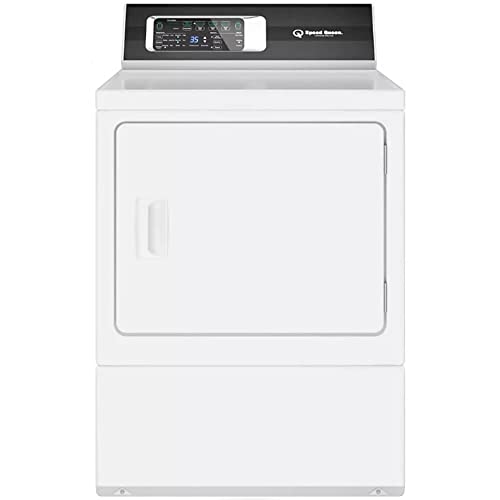
Speed Queen DR7000WE Electric Dryer — The DR7 Electric Standard
The DR7000WE is the reference point of the domestic range: a 27-inch electric dryer with 7 cubic feet of capacity and, in its title’s distinctive phrase, Extreme Tested Electronic Controls, in white. Begin with that phrase, because it is the brand in miniature. Consumer dryers advertise cycles; this one advertises that its controls were tested extremely — a claim aimed at the buyer’s tenth year rather than their first week, from a manufacturer whose commercial machines log more cycles in a month than a home dryer sees in years.
Seven cubic feet in a 27-inch cabinet is the classic full-size American format, sized for the complete output of a family washer and built to the footprint the country’s laundry rooms were framed around. Electric heat keeps installation to the familiar pair of requirements — a proper dryer circuit and a vent — without gas trades. The electronic controls, rather than a purely mechanical timer, place this model in the brand’s current domestic generation: the durability philosophy of the commercial line, expressed with a modern interface instead of a coin slide.
Who is it for? The household that buys appliances the way it buys roofs — infrequently, seriously, and with the intention of forgetting about them. Speed Queen ownership is a deliberate rejection of the feature race: no app, no ecosystem, no annual redesign, in exchange for a machine whose manufacturer expects it to be repaired rather than replaced when its first component eventually tires. That expectation is the product. The 7-cubic-foot drum and the tested controls are merely how it is delivered.
Record the full model designation at purchase. With a machine intended to serve for decades, the rating-plate photograph taken on delivery day is the first entry in a long and honourable service file.
- Fuel: electric
- Capacity, from the listing title: 7 cu. ft., 27 inch cabinet
- Controls, from the listing title: Extreme Tested Electronic Controls
- Model, from the listing title: DR7000WE, white
- Format, from the listing title: full-size domestic dryer
- Where to buy: the Speed Queen DR7000WE Electric Dryer listing on Amazon — check price on Amazon
- The domestic standard of a commercial-grade line; built to be serviced, not replaced.
- Extreme Tested controls language signals durability as the design brief.
- Classic 27-inch, 7 cu. ft. format fits standard laundry spaces and loads.
- No steam, sanitize or connectivity is claimed in its title.
- White is the finish this listing describes.
- The brand’s premium positioning prices it above feature-led rivals.
- Fuel: electric
- Capacity, from the listing title: 7 cu. ft.
- Design, from the listing title: ADA compliant design
- Cycle of note, from the listing title: sanitizing
- Household feature, from the listing title: Pet Plus
- Where to buy: the Speed Queen ADA Sanitizing Electric Dryer listing on Amazon — check price on Amazon
- ADA design makes every load easier for every user, not only those who require it.
- Sanitizing designation answers the illness-week load class directly.
- Pet Plus names the pet household’s weekly reality in the specification.
- Households without pets pay for a designation they will not use.
- No steam or connectivity is claimed in its title.
- Sanitize cycles run hot and long by design; delicates need other settings.
- Fuel: gas, delivered by a household gas line, with venting to outside
- Capacity, from the listing title: 7 cu. ft., white
- Design, from the listing title: ADA compliant design
- Finishing, from the listing title: steam
- Brand line, from the listing title: Speed Queen ADA dryer range
- Where to buy: the Speed Queen ADA Gas Dryer listing on Amazon — check price on Amazon
- The brand’s durability on gas fuel, with ADA ergonomics included.
- Steam finishing on a commercial-heritage platform.
- Full family capacity; no size compromise for the accessibility design.
- Gas line, vent and installer visit are prerequisites.
- Steam adds a water-supply arrangement to the install.
- No sanitizing or Pet Plus designation appears in its title.
- Class character: ADA gas dryer variant without the steam system, same range architecture
- Typical route to buy: Speed Queen dealers, who can order the exact variant and document its designation
- Installation: gas supply, venting and a water-free install — no steam plumbing
- Where to buy: the non-steam gas ADA variant through a Speed Queen dealer — ask for the variant’s own model documentation before ordering
- Fewest systems of any gas pick discussed here; simplicity as durability.
- ADA ergonomics and gas fuel without steam’s plumbing.
- Dealer purchase includes installation guidance.
- No marketplace listing in this guide means no click-and-order path.
- No steam refresh for stored or creased garments.
- Variant availability varies by dealer and region.
- Class character: commercial tumble dryers for laundromats, institutions and multi-housing
- Typical route to buy: commercial laundry dealers, with site survey and service terms
- Design language: maximum serviceability, heavy construction, decades-long parts support
- Where to buy: the commercial class through a laundry equipment dealer — begin with the site’s utilities and expected daily cycles, not with a model number
- The durability ceiling of the entire dryer category.
- Built for stranger-proof, all-day, multi-user operation.
- Service ecosystems measured in decades.
- Commercial utilities and installation expectations exceed most homes’.
- Procurement is a dealer process, not a purchase click.
- Domestic comforts and finishes are not the class’s priority.
- Class character: factory-built stacked washer-dryer units in one cabinet
- Typical route to buy: Speed Queen dealers, with room measurements taken first
- Format virtue: full laundry in the floor area of one machine
- Where to buy: the stacked centre class through a Speed Queen dealer — bring the closet’s height, depth and vent position to the conversation
- A complete laundry in a single machine’s footprint.
- Factory engineering beats stacking separate machines improvisationally.
- The brand’s durability philosophy in its most space-efficient form.
- Capacities run moderate; family mountains need the full-size picks.
- One unit means one service event can idle the whole laundry.
- Dealer channel only, within this guide’s verified pool.
There is an economics paragraph that belongs to this machine alone in the guide. A dryer bought for decades rearranges the household’s arithmetic: the relevant figure stops being the ticket and becomes the cost per year of service, a number that collapses as the years accumulate — provided the machine is actually kept, actually serviced and actually suited to the household that bought it. That proviso is why this review keeps returning to fit. The DR7000WE rewards the household whose needs are stable and whose laundry room is settled; it punishes, with decades of mild resentment, the household that bought endurance and then discovered it wanted steam, apps and a black finish. Buy endurance only if endurance is what you value, and then it is the best bargain on this page.
Its whiteness, too, is a philosophy: the laundry room as a workplace, finished in the colour of every commercial laundry on earth, where scuffs are honest and cleanliness is visible at a glance.
Strengths
Trade-offs
Best for: households buying a dryer once, seriously, for the long term. Not suited for: buyers who want steam refresh, smart features or the lowest ticket in the category.
Speed Queen ADA Sanitizing Electric Dryer Pet Plus — ADA Electric With Pet Plus
The second linked pick adds two designations to the same 7-cubic-foot electric foundation: ADA, and a title that names it a Sanitizing Electric Dryer with Pet Plus. Take the ADA designation first, because its value reaches beyond compliance. An ADA-designed dryer places its controls and door within reach ranges and operating forces planned for seated users and limited strength — which in a family home translates to a machine that grandparents, children and anyone nursing a bad back can operate without negotiation. Accessibility, designed-in, is ergonomics for every body the household will ever contain.
Sanitizing, as titled, addresses the loads households worry over: the illness rotation, the cloth and bedding that served a sickroom, the towels whose history nobody wants to examine. This review reports the designation in the listing’s own language, without inventing cycle temperatures. Pet Plus, the title’s third claim, speaks to the pet household’s defining laundry problem — hair, and the dander-laden textiles that accumulate it. A dryer line that names pet ownership in its specification understands that for a large share of homes, the dog’s bedding is a weekly load class of its own, not an edge case.
Electric fuel keeps this model installable wherever a dryer circuit and vent exist, and the 7-cubic-foot drum keeps it honest as the household’s only dryer, pets and all. Against the DR7000WE above, the choice is philosophical: the standard model’s tested-controls purity, or this model’s accessibility and household-specific systems layered over the same brand foundation.
Households without pets and without accessibility needs should still read the ADA point carefully before dismissing it — reach and control force are the two specifications every user touches on every load, long after cycle lists are forgotten.
Pet households should think through what Pet Plus membership in this range really promises across a year. It is not a single load type but a rhythm: the dog’s bedding weekly, the throws that live on the sofa permanently, the towels conscripted for muddy paws, the car blanket after every trip. A dryer whose specification acknowledges that rhythm — in a line built to survive it — suits the pet household’s actual laundry far better than a feature-led machine that treats pet loads as an occasional embarrassment. Pair that acknowledgement with sanitizing for the post-illness rotation and this model becomes, quietly, the family-health member of the range: the one bought for the loads nobody photographs.
The ADA design and the pet designations also combine in an unadvertised way: both are about a household whose members have different bodies and different needs, sharing one machine without friction. That is most households, described honestly.
Strengths
Trade-offs
Best for: pet households and multi-generational homes wanting accessibility and sanitizing on the brand’s durable foundation. A poor fit for: pet-free buyers seeking the plainest possible specification.

Speed Queen ADA Gas Dryer with Steam — ADA Gas With Steam
Fuel in the first line, as this batch of guides insists: this Speed Queen is a gas dryer. Its title specifies an ADA 7-cubic-foot white gas dryer with steam — the range’s accessibility design and its finishing system on the brand’s alternative fuel. For gas households loyal to this manufacturer, it is the pick that asks for no compromises in either direction: the fuel the house already serves, the reach design the household values, and steam for the wardrobe’s presentation.
Steam in a dryer of this lineage deserves a sentence of context. Speed Queen’s identity is commercial durability, and steam is the domestic refinement that identity adopted latest; its presence here signals the brand dressing its workhorse for homes where a dryer must also revive a shirt, relax a stored dress’s wrinkles and freshen what a full wash would over-serve. The title claims steam without a cycle list, and this review claims no more on its behalf — buyers for whom steam specifics are decisive should read the listing’s full text.
The ADA design carries the same whole-household ergonomics described in the electric model above: controls and access planned for reach and force, benefiting every user on every load. Gas installation discipline applies in full — supply line, venting, clearances confirmed by the installer — and the 7-cubic-foot drum keeps the machine honest as a family’s sole dryer.
Between the two ADA picks, fuel and finishing divide the decision cleanly: electric with sanitizing and Pet Plus, or gas with steam. Households rarely need both stories; the house’s fuel supply usually casts the deciding vote before features are even consulted.
Gas households choosing within this brand should also weigh a point of infrastructure: a gas dryer from a commercial-heritage maker is the combination rural and small-town servicers know best. The platform’s burners, valves and controls descend from machines those technicians maintain in laundromats and institutions across their territory, which means the service conversation for this model starts further along than for almost any rival. When the nearest alternative is a feature-led gas dryer that local hands rarely open, the ownership experience across fifteen winters can diverge sharply — not in the showroom, where both gleam, but in the third January, when one is repaired by Friday and the other awaits a part and a learning curve.
Steam, accessibility and that service depth together make this the most complete of the three linked picks for a gas household intending to age in place on this brand.
Strengths
Trade-offs
Best for: gas households wanting this brand’s build with accessible controls and steam finishing. Not the right match for: electric homes, or pet households prioritising the Pet Plus designation.
Speed Queen Gas ADA Dryer Without Steam (variant entry) — The Plainer Gas Sibling
This prose entry covers the variant the linked gas pick implies: the ADA gas dryer in its non-steam form. Ranges like this one are built as families — a shared cabinet, drum and control architecture, with finishing systems layered by model — and the non-steam gas variant is the family member for households whose reasoning runs: gas fuel, yes; accessible design, yes; steam plumbing and its additional system, no thank you. That reasoning is respectable. Every system omitted is a system that cannot leak, scale or fail, and a household that irons or sends out its occasion wear may never spend the steam it paid for.
The variant reaches buyers through the brand’s dealer channel rather than the marketplace listings pooled for this guide, so no link, image or model number is offered here — the honest consequence of a verified-pool discipline. At the dealer, apply this guide’s questions: confirm the exact model’s designation from its own documentation, verify the ADA specification against the household’s reach needs, and price the steam difference with clear eyes. If the steam premium buys nothing your wardrobe will use, the plainer sibling is the connoisseur’s choice: the same bones, fewer organs.
Fuel and installation mirror the linked gas model exactly — line, vent, clearances, a qualified fitter — and the 7-cubic-foot class keeps it a whole-household machine rather than a compromise.
There is a broader lesson in this variant’s existence that buyers of any brand can use: ranges are ladders, and the correct rung is the one whose systems your household will actually spend. Steam is the rung most often bought aspirationally and used biannually. A buyer honest enough to skip it deserves a guide honest enough to present the skipping as a first-class choice rather than a compromise — which is why this variant stands in this guide as an entry in its own right, with its own badge, instead of as a footnote under its steam-bearing sibling. At the dealer, let the same honesty price both machines side by side, and take the one whose specification reads like your laundry rather than your intentions.
Strengths
Trade-offs
Best for: gas households that value the brand and the accessibility, and can live without steam. Poorly suited to: buyers who need a dryer delivered from an online listing this week.
Speed Queen Commercial On-Premise Dryers (class entry) — The Laundromat Originals
Every domestic machine above descends from this class, and understanding it explains the brand. Commercial on-premise dryers serve laundromats, hotels, care homes, salons and multi-housing laundry rooms — environments where a dryer is not an appliance but a revenue asset or a service obligation, run by strangers, all day, for years. Their design language follows: heavy cabinets, serviceable everything, controls that survive indifference, and parts ecosystems measured in decades. When a domestic Speed Queen advertises tested controls, this is the world the testing imitates.
Most homes should not buy one, and this entry says so plainly. Commercial machines may expect commercial venting, drainage and electrical or gas provisions, coin or card payment hardware in some forms, and a service relationship rather than a warranty hotline. The households for whom the class is genuinely right are the ones whose laundry resembles an institution’s: large multi-generational homes, homes running rental units or care arrangements, and properties whose laundry room serves several dwellings. For them, the dealer conversation that this class requires is not friction but the correct procurement process — capacity planning, utility specification and service terms included. Readers furnishing exactly such high-volume laundry should also see our guide to Best Large-Capacity Washers and Dryers, where domestic large-capacity pairs are compared for the biggest household loads.
No link or model is offered here, deliberately: commercial procurement begins with a site survey, not a checkout button.
Even households that will never buy from this class should understand its pricing logic, because it explains the domestic range’s tickets. Commercial machines are priced against downtime: a laundromat dryer that fails on a Saturday loses revenue by the hour, so its buyer pays for margins, serviceability and parts depth without blinking. The domestic machines inherit those margins at a gentler duty, and their prices — high beside feature-led rivals — are the residue of that inheritance. Judged as consumer electronics, they look expensive; judged as small commercial assets on a fifteen-to-twenty-five-year horizon, they look like what they are: the same purchase a business would make, wearing a domestic badge.
Strengths
Trade-offs
Best for: multi-unit properties, care settings and households whose laundry is genuinely institutional in volume. A weak match for: ordinary family homes, which the three linked picks serve better.
Speed Queen Stacked Laundry Centres (class entry) — The Vertical Pairing
The final prose entry covers the brand’s stacked format: washer and dryer built as one vertical unit, the laundry centre. For small utility rooms, closets and apartments where two separate machines cannot stand side by side, a factory-stacked centre is the honest solution — engineered as a single appliance, with the dryer’s controls placed for the format rather than stretched toward. In this brand’s hands, the format inherits the family virtues: heavy construction, serviceable design, an expectation of long life in a small footprint.
The class reaches buyers through dealers, and no verified marketplace listing for a Speed Queen laundry centre sat in this guide’s pool; hence prose, no image, no model number. The deciding questions at the dealer are format questions: the unit’s total height against the closet’s, the door swing in the room available, the vent path from a stacked dryer’s position, and whether the household’s load sizes suit a centre’s typically moderate capacities. Households whose loads are family-large should weigh the linked full-size picks instead; the centre’s virtue is verticality, not volume.
Bought with open eyes, a stacked centre from this manufacturer is the small-space expression of the same philosophy as the DR7000WE: fewer, heavier, longer-serving machines, in the shape the home can actually hold.
One household type should weigh this class more heavily than its moderate capacities suggest: the household that expects its members to age in a small home. A single vertical unit, from a brand whose design language includes ADA thinking, concentrates the whole laundry into one reachable column in one small room — no carrying baskets between floors, no separate machines in separate spaces. For a couple downsizing into a cottage or an apartment they intend to keep for decades, that concentration is not a compromise at all; it is the feature around which the rest of the home’s ease is organised. Bring that intention to the dealer conversation explicitly, and let it steer the model choice within the class.
Strengths
Trade-offs
Best for: closets, small utility rooms and apartments needing the brand’s build in vertical form. A mismatch for: households whose weekly loads demand full-size drums in both machines.
Three Linked Machines and Three Classes: The Range on One Page
| Entry | Fuel | Capacity | Signature designation | Route |
|---|---|---|---|---|
| Speed Queen DR7000WE Electric Dryer | Electric | 7 cu. ft. | Extreme Tested Electronic Controls | Linked listing |
| Speed Queen ADA Sanitizing Electric Dryer Pet Plus | Electric | 7 cu. ft. | ADA, sanitizing, Pet Plus | Linked listing |
| Speed Queen ADA Gas Dryer with Steam | Gas | 7 cu. ft. | ADA, steam | Linked listing |
| Gas ADA variant without steam | Gas | Range class | Simplicity | Dealer, prose |
| Commercial on-premise class | Either, commercial spec | Commercial class | Institutional durability | Dealer, prose |
| Stacked laundry centres | Either, by model | Moderate, vertical | Single-footprint laundry | Dealer, prose |
Why Does Commercial Heritage Matter in a Home Dryer?
Because the failure modes are different. A consumer dryer is engineered against a duty cycle of a few loads a week and a price point set by showroom competition; a commercial dryer is engineered against strangers — users who overload, slam, ignore filters and run the machine back-to-back for twelve hours. Designing for strangers produces margins: heavier hinges, serviceable panels, components chosen for availability in fifteen years rather than novelty this year. When that engineering culture builds a domestic machine, the home buyer inherits the margins at a duty cycle so much lighter that the machine’s expected life stretches accordingly.
The trade is visible in this guide’s own tables. Nowhere will you find the brand competing on app features, cycle counts or finishes refreshed annually. The range is small, stable and specified in the language of endurance. Households that find that language boring should buy elsewhere with this guide’s blessing; households that find it beautiful are the brand’s natural citizens, and they tend to remain citizens for thirty years.
What Does ADA Design Actually Change About Using a Dryer?
Reach, force and posture. Controls sit where a seated user or a shorter user can see and operate them without stretching across a hot door; handles and buttons ask for grip and pressure that arthritic hands can supply; the door’s swing and the drum’s height respect a user who cannot lean and lift in the old way. None of these changes announce themselves to an able-bodied user in a showroom — the machine simply feels unreasonably easy — but across a household’s life they compound: the grandparent who keeps doing their own laundry independently, the parent with a baby on one hip and a basket in the other hand, the teenager whose growth spurt has not yet delivered the reach the old machine assumed.
Two of this guide’s three linked picks carry the designation, which says something about where the brand sees its domestic future: long-lived machines for households that intend to age in place, in homes that must keep working as their owners’ bodies change. That is a design philosophy worth more than any single cycle.
How Should You Buy a Dryer You Intend to Keep for Decades?
Slowly, and on paper. A decades-long purchase justifies what a five-year purchase does not: measuring the room twice, interviewing a local servicer about the brand’s parts availability in your region, reading the warranty’s actual text rather than its banner, and confirming the installation — circuit or gas line, vent route, floor strength — as a planned project rather than a delivery-day discovery. Ask the servicer one question above all: when this machine is twelve years old and something wears, can you get the part and is it worth fitting? For this brand, in most regions, the answer is the reason people buy it.
Then keep the file: rating-plate photograph, purchase record, installation documentation, and every service note thereafter, in one place in the laundry room. A machine expected to serve for decades accumulates a biography, and the households that keep the biography get the decades — because every future repair decision, made from records rather than guesses, lands on the side of keeping the machine alive.
What Mistakes Do Buyers of This Brand Most Often Make?
The first is buying the badge for the wrong war: choosing commercial heritage and then mourning the absence of an app, a steam wardrobe programme or a dozen finishes — features the brand deliberately does not sell. Read the three linked specifications above; if their plainness disappoints you in the reading, it will disappoint you for fifteen years in the laundry room, and another guide on this site serves you better. The second mistake is the parts trap in reverse: owners so pleased with the brand’s serviceability that they attempt repairs beyond their competence. Serviceable means a technician can fix it economically, not that gas and electrical work became hobbies.
Third, buyers under-specify the installation. A heavy, long-lived machine deserves a level floor, a clean vent run and correct utilities from day one; skimping there taxes every one of the thousands of cycles ahead. Fourth, they forget the dealer channel exists — the prose entries in this guide cover real members of the range that no marketplace listing will ever show them, and for the non-steam gas variant or a stacked centre, the dealer is not the alternative route but the only one.
How Does This Brand’s Range Compare With the Feature-Led Mainstream?
Walk the category’s showroom in your mind and the contrast organises itself. The mainstream sells breadth: dozens of models, finishes refreshed with fashion, cycles named like cocktails, connectivity layered over everything, and prices engineered around promotional weekends. This brand sells depth: a handful of models that change slowly, one finish that changes rarely, cycles sufficient rather than theatrical, and prices that sit still while the engineering amortises across decades. Neither showroom is dishonest; they are selling different goods that happen to share a drum. The mainstream sells the first year of ownership, richly. This brand sells years five through twenty-five, plainly.
The buyer’s task is to know which good they are shopping for before the showroom decides for them. Households that replace appliances eagerly and enjoy each generation’s features should buy the mainstream with a clear conscience. Households that experience appliance shopping as a chore to be postponed for as long as physics allows should be reading this guide — and should notice how short its linked list is, because brevity, in this range, is the point.
What Should a First-Time Buyer of This Brand Ask a Dealer?
Ask about the service map before the specification sheet. Which models does the dealer stock parts for locally? Who in the area services the brand, and how long have they done so? What does the installed base look like within fifty miles — because a machine surrounded by siblings gets faster, cheaper repairs than an orphan. Ask about the variant ladder in the fuel you need, including the non-steam gas model this guide covers in prose, and have the dealer price the rungs side by side with installation included, since installation honesty is where dealer purchases justify themselves.
Ask, finally, the unfashionable question: what do owners of this machine complain about in year eight? A dealer who sells the brand seriously will answer without flinching, and the answer — usually a short list of wear items and their costs — is the most valuable information in the entire purchase. It converts a promise of durability into a maintenance budget, which is what durability actually is.
How Does a Dryer Like This Fit a Household That Is Downsizing?
Downsizing households face a specific temptation: to treat the smaller home as a reason to buy smaller, cheaper appliances across the board. The laundry argues otherwise. The downsized home is often the forever home — the place where the household intends to age — and its dryer may be the last one the owners ever buy, which makes it precisely the wrong place to economise on build. A full-size machine from this range, or its ADA variants with their reach-friendly design, fits that intention: capacity undiminished by the move, controls that will meet ageing hands kindly, and a service file that will outlast several sets of neighbours.
The stacked-centre prose entry serves the downsizers whose new home genuinely cannot hold a full-size pair. Between those two answers — full-size endurance or vertical endurance — this brand covers the downsizing map more completely than its short range suggests, which is another way of saying its designers think in decades and households, not in product cycles.
What Does Owning One Actually Look Like Across Fifteen Years?
Year one is unremarkable, which is the design’s intention: loads dry, the machine is wiped, the file gains its first page. Somewhere around the middle years a wear item announces itself — a belt’s squeal, a roller’s rumble — and the ownership philosophy faces its examination. On a feature-led machine, that examination often ends in replacement, because the repair costs approach a promoted successor’s ticket. On this brand’s machines, the examination usually ends in a fitted part and another half-decade, because the machine around the part was built to be worth repairing. That difference, repeated once or twice, is the entire economic case, and it is why the brand’s owners describe their dryers the way other people describe their trucks.
By year fifteen the machine has become furniture in the best sense: known, trusted, beneath notice. The household’s laundry has flowed through it in every season of family life, and its continued service is not a surprise but a kept promise. Few purchases in a home keep a promise that long; the ones that do are remembered, and recommended, exactly as this brand has been for generations.
Why Do Laundromat Owners and Landlords Keep Choosing This Name?
Professional buyers are the category’s least sentimental customers, and their loyalty is data. A laundromat’s dryer earns or loses money every hour it stands in the row; a landlord’s dryer either survives a decade of tenancies or becomes a recurring line in the maintenance budget. Both buyers converge on the same arithmetic: purchase price divided by years of stranger-proof service, minus downtime, minus the repairs that were worth doing. This brand wins that arithmetic often enough to have become the default wall of machines in American laundromats — a fact any reader can verify by walking into one and reading the badges at eye level.
The domestic buyer is, in effect, free-riding on that professional verdict. The home versions are not identical to the coin-op machines, and this guide does not pretend otherwise; but they are designed, built and supported by the company that wins the professional argument, in the same factories of thought. For a purchase meant to last decades, borrowing the judgement of the people who buy dryers by the row is not a bad strategy.
How Should You Maintain a Dryer Built to Outlast Its Peers?
The maintenance philosophy matches the machine: little, regular, recorded. The lint filter every load, because airflow is the whole machine’s health in one habit. The vent run inspected yearly, because a dryer built for decades will happily push against a clogging duct for years while its performance quietly taxes every cycle. The cabinet level checked when floors settle, the door seal wiped, the exterior vent flap confirmed free. None of it differs from any dryer’s care — what differs is the payoff horizon. On a five-year machine, maintenance buys a little time; on a machine engineered for decades, the same habits buy years, and the service file that records them becomes the evidence that persuades a future technician — or a future buyer of the house — that this particular machine is worth its next repair.
Keep the file in the laundry room, as this guide has advised for every pick, and add one habit unique to long-life ownership: note the date and nature of every service event on the file’s first page. Fifteen years in, that page is the machine’s biography, and biographies are what get machines repaired instead of replaced.
A Word About Buying the Washer Half of a Brand-Loyal Laundry
Most households that arrive at this guide are really planning a laundry, not a dryer, and the brand’s gravity pulls the washer decision along with it. The reasoning is sound as far as it goes: one servicer for both machines, one parts ecosystem, one design language in the room, and controls whose philosophies match across the pair. The caution this guide adds is sequence: choose each machine on its own evidence, because a pair is two purchases wearing one coat. The washer guides linked from this page exist to give the washing half its own honest examination — its capacities, its agitator or impeller character, its own titled claims — before brand loyalty is allowed to cast the deciding vote.
Households that follow that sequence usually end with the matched pair anyway. They simply own it for better reasons, and can say what each machine earned.
What Separates a Long-Lived Dryer From a Merely Old One?
Longevity has two ingredients that marketing routinely confuses. The first is construction: the gauge of the steel, the quality of the bearings and belts, the honesty of the cabinet’s assembly. The second is support: whether parts, documentation and knowledgeable hands remain available when the construction eventually needs them. A dryer can possess the first and die of the second — a superbly built orphan, retired by an unavailable control board — and the category’s graveyards hold several such machines. This brand’s claim, examined across this guide, is that it supplies both: commercial-grade construction and a commercial-grade support culture that treats a fifteen-year-old machine as a current customer.
Buyers can test the second ingredient before purchase with the servicer interview this guide recommended earlier. Ask about a model a decade old, not the one you are buying; the ease of that answer is the truest preview of your own machine’s old age. Few shopping rituals repay their ten minutes as reliably.
How Does This Guide’s Short List Reflect the Brand Itself?
Three linked machines is, by the standards of this site’s guides, a strikingly short list — and it is accurate. Where rival brands field dozens of dryer variants across finishes, tiers and feature permutations, this manufacturer fields a range a buyer can hold in their head: the electric standard, the accessible electric with its household designations, the accessible gas with steam, and the dealer-sold variants and classes around them. That brevity is not a limitation of the research; it is the brand’s strategy made visible, and for the households this guide serves it is a genuine convenience. A short list can be understood completely — every fuel, every designation, every trade — in a way a forty-model range never can.
It also disciplines this guide’s prose entries into honesty. The classes around the three linked machines are part of the real range, and a buyer deserves their map even where no listing can be linked. What you are holding is therefore the whole territory, surveyed at two levels of detail — which is more, in the end, than a longer list of shallower reviews would give you.
When Should a Household Choose a Different Brand Entirely?
Honesty about a favourite means naming its exits. Choose elsewhere if your laundry life is genuinely feature-led — if steam programmes for a varied wardrobe, app coordination with a smart washer, or a finish that anchors a designed room are the substance of your satisfaction rather than its garnish; other guides on this site serve those priorities with machines built around them. Choose elsewhere if your budget is a hard wall this brand’s tickets cannot fit under, because a dryer bought by stretching is a dryer resented, and resentment is a poor foundation for a fifteen-year relationship. And choose elsewhere if your region’s service map for the brand is genuinely empty — durability without a local pair of hands is a promise with no one to keep it.
Notice that none of those exits is a judgement on the machines. They are judgements about fit, which is the only judgement this guide has ever really made: the best dryer is the one whose virtues are the ones your household will spend, in the place your household actually lives.
Final Recommendation
Most households should start — and most will finish — with the three linked machines. The DR7000WE is the default: the electric standard of a commercial-grade line, bought for decades and forgotten between loads. The ADA sanitizing electric is the family variant, for homes with pets, illness-week loads and bodies that appreciate controls designed for reach rather than for showrooms. The ADA gas model serves the same philosophy on gas fuel, with steam for the wardrobe’s finishing. Choose among them by fuel and household, in that order, and the decision is honestly made.
Beyond them, let the prose classes do their work only if your situation truly calls: the non-steam gas variant for the simplicity connoisseur, the stacked centre for the vertical room, the commercial class for laundry that is genuinely institutional. Buy the machine your life matches, keep its file, service it when it asks — and expect, as this brand’s owners have expected for generations, that the dryer will simply still be there, drying, long after flashier machines have been replaced twice over.
Frequently Asked Questions
Why are there only three linked dryers in a six-entry guide?
Because only three complete domestic dryers were verified in this guide’s pool. The other three entries describe real classes in the brand’s range that are sold through dealers; rather than fabricate listings, the guide covers them in prose with the questions to take to a dealer.
Are Speed Queen replacement parts worth buying as an upgrade path?
Parts are for repairing a machine you own, and several surfaced prominently in this guide’s research. They are not dryers and not upgrades; no parts listing appears here as a pick, deliberately.
What does Extreme Tested mean on the DR7000WE?
It is the listing title’s own phrase for the machine’s electronic controls — durability testing language consistent with the brand’s commercial heritage. This guide reports it as titled and treats it as a statement of design intent rather than a measured figure.
Is the gas ADA model suitable for a home without a gas line?
No. It is a gas dryer, stated plainly in its review. Homes without gas service should choose between the two electric picks — the DR7000WE or the ADA sanitizing electric with Pet Plus.
Does ADA design reduce capacity or performance?
Both ADA picks here are full 7-cubic-foot machines. The designation concerns reach, control placement and operating force — how the machine meets its user — not the size of its drum. Households sometimes assume an accessibility designation implies a smaller, gentler appliance built down to a specification; in this range it implies the opposite, the full-size platform with its human interface rethought. That is precisely why the designation is worth having even in households where no member currently requires it: bodies change across a machine’s twenty-year service, and the dryer that already meets its users at their reach will never need replacing for ergonomic reasons alone.
Related Guides
Readers drawn to this brand’s longevity philosophy but shopping the wider electric field should continue to Best Long-Lasting Electric Dryers, the live guide that applies the same buy-it-for-decades reasoning across brands. Read together, the two pages let a longevity shopper compare the specialist’s answer with the generalists’ best efforts — construction, parts culture and warranty philosophy weighed brand by brand. Some households will conclude that a rival’s long-life model suits their room or budget better; others will return to this page’s three machines with their conviction confirmed by the comparison. Either outcome is a success for the method: a dryer chosen for decades should be chosen against the whole field, deliberately, once.


