What's inside
- Where to buy these receiving blankets
- Quick picks at a glance
- How these picks were chosen
- The six receiving blanket packs, reviewed one by one
- Side-by-side comparison
- How to choose receiving blankets for the first year?
- The second life of a receiving blanket
- Washing rhythms for very small laundry
- Setting up blanket stations around the house
- For grandparents, childminders and the second time around
- How the three fabrics actually feel at 3 a.m.
- Common mistakes when buying receiving blankets
- A season-by-season way to use the same drawer
- When a title does not state the size: a two-minute check
- The photographs are a legitimate feature
- Twins, multiples and the mathematics of enough
- What experienced parents would tell you at the shop
- Final recommendation
- Frequently asked questions
As an Amazon Associate I earn from qualifying purchases. This post may contain affiliate links at no extra cost to you.
As an Amazon Associate, cottageverdict.com earns from qualifying purchases.
A receiving blanket is usually the first textile a baby ever touches, which makes choosing the best receiving blankets feel momentous — but one safety frame must come before any fabric talk. Receiving blankets are for holding, cuddling and supervised wrapping while an adult is right there; a baby’s sleep space itself should stay clear of loose blankets, and no blanket in this guide should be left loose in a cot or crib with a sleeping infant. Used the way they are meant to be used — in arms, on laps, during feeds and supervised swaddling — these six packs are among the hardest-working purchases in the nursery, rotating through the day at a pace that justifies buying them in multiples.
The six packs split into three fabric families, and the split is the story. Three are cotton flannel — brushed, grippy, traditional — in packs of seven, seven and five. Two are muslin — open-weave, breathable, softer with every wash — in packs of three and five. The last is the hospital classic: 100% cotton with the familiar stripe, in a pack of twelve. Every dimension, fibre and count quoted in this guide comes from the listing titles themselves, and where a title is silent, the spec boxes say so rather than guessing. And because bath time becomes a daily ritual within weeks, some parents reading this guide are also renovating around it, which is where our companion research on Best Insulated Freestanding Bath Tubs may unexpectedly earn its place on the same project list.
Where to buy these receiving blankets
All six packs are sold through Amazon, each with its own sentence. Luvable Friends offers seven cotton flannel blankets in a unisex elephant design for the classic rotation. Simple Joys recolours the seven-pack flannel idea in grey, white and mint for coordinated nurseries. Gerber states 100% cotton outright and adds a dinosaur print across its five-pack. The first muslin option brings three large 38-by-40-inch swaddle cloths in bright colours. The second muslin pack extends the rotation to five in a neutral leaf design. Avalon Bedding closes the list with twelve hospital-stripe cotton blankets, sized and machine washable, for households that want depth above all.
Quick picks at a glance
| Pick | Best for | Standout detail from the listing title |
|---|---|---|
| Luvable Friends Flannel Receiving Blankets 7-Pack | A seven-pack of cotton flannel basics with an elephant design | Unisex baby cotton flannel receiving blankets, Basic Elephant design, 7-pack, one size |
| Simple Joys Flannel Receiving Blankets 7-Pack | A seven-pack in grey, white and mint | 7-pack flannel receiving blankets in Grey/White/Mint, one size |
| Gerber Flannel Receiving Blankets Dinosaur 5-Pack | 100% cotton flannel with a dinosaur print, pack of 5 | 100% cotton flannel receiving swaddle blanket, Dinosaur Blue, pack of 5 |
| Muslin Swaddle Blankets 3 Pack | Large muslin swaddles, 38 x 40 inches, pack of 3 | Muslin swaddle blankets, 3 pack, breathable and soft, large 38 x 40 inches, bright colours |
| Muslin Receiving Blankets 5 Pack | Muslin cotton five-pack in a neutral leaf design | Muslin receiving blankets 5 pack, breathable skin-friendly muslin cotton, neutral Bright Leaves design |
| Avalon Bedding Hospital Receiving Blankets 12-Pack | Hospital-style stripe blankets, 100% cotton, 30×40, pack of 12 | Hospital stripe receiving blankets, 100% cotton, 30×40 inches, machine washable, 12-pack |
Notice the two axes that organise the table: fabric family and pack count. Flannel grips and warms, muslin breathes and drapes, hospital cotton endures — and the count, from three to twelve, decides how often the washing machine becomes part of your night.
How these picks were chosen
The first criterion was fabric honesty. Each pack’s title had to name its material story clearly enough to classify — cotton flannel, muslin, muslin cotton, or 100% cotton hospital style — and the reviews preserve those distinctions rather than flattening six different textiles into the word soft. Flannel, muslin and hospital cotton behave differently against newborn skin, in the wash and across seasons, so the final six deliberately include all three families.
Pack arithmetic came second. Receiving blankets are consumables in motion, so counts were weighed as a primary feature: three large muslins, fives, sevens and a twelve were each assessed against the laundry rhythm they imply. Stated dimensions were the third filter, credited where titles provide them — 38 by 40 for the large muslin, 30 by 40 for the hospital pack — and recorded as unstated where they do not, because a parent planning to swaddle a large baby needs to know which listings require a second look. Finally, design was treated as a legitimate but last-ranked factor: prints and palettes matter for photographs, gifting and morale, and each pack’s look is described, but no pack earned its place on pattern alone.
The six receiving blanket packs, reviewed one by one

Luvable Friends Flannel Receiving Blankets 7-Pack
Luvable Friends opens the list with the workhorse format of the receiving-blanket world: seven cotton flannel blankets in a unisex elephant design, one size, sold as a pack built for rotation. Flannel is the traditional receiving fabric for good reasons — it is soft without being slippery, warm without bulk, and grippy enough that a wrapped baby feels held rather than polished. A seven-pack acknowledges the arithmetic of newborn life, where blankets rotate through feeding, burping, pram duty and the washing basket at a speed that surprises every first-time parent.
Mini spec box
- Type: Receiving blankets, cotton flannel
- Pack count: 7 blankets
- Design named in title: Basic Elephant
- Sizing: One size
- Audience: Unisex baby
- Dimensions: Measurements do not appear in the listing title
Strengths
- Seven blankets is a genuinely useful rotation for the laundry realities of the first months
- Cotton flannel is soft, breathable and easy to wash repeatedly
- A unisex elephant design suits unknown-gender gifting and hand-me-downs
Trade-offs
- The title gives no dimensions, so check the listing if you plan to swaddle a larger baby
- Flannel pills gradually over many washes, softening further but looking worn
- One design across all seven means no variety if prints matter to you
Judge a flannel pack by its boring virtues, because those are what you will use. Cotton flannel takes hot, frequent washing without complaint, folds flat into a changing bag, and works as a pram shade, a feeding cover, a tummy-time mat and a swaddle in the supervised early weeks. The elephant motif is gentle enough for photographs without being so precious that a blanket becomes too good for floor duty. Where this pack asks for a decision is size: with dimensions absent from its title, parents of bigger newborns should confirm the measurements on the listing before relying on it as a primary swaddle, since a too-small receiving blanket is the one purchase that fails loudly at 3 a.m.
There is a reason hospitals and grandmothers converge on flannel. Its brushed surface creates friction against itself, so a simple tuck holds better than it would in a silky fabric, and its cotton body absorbs the small spills that muslin sometimes lets slide. The Luvable Friends pack leans entirely on that tradition, adding nothing experimental, and that conservatism is its charm: you are buying the known behaviour of a fabric that has wrapped babies for generations. Keep two in the changing bag, two by the feeding chair, two in the wash cycle and one in reserve, and the seven-pack stops looking generous and starts looking precisely calculated.
Best for: parents who want a dependable flannel rotation and a sweet unisex print. / Not suited for: anyone who needs stated dimensions before buying a swaddle.
See the Luvable Friends 7-pack on Amazon
Simple Joys Flannel Receiving Blankets 7-Pack
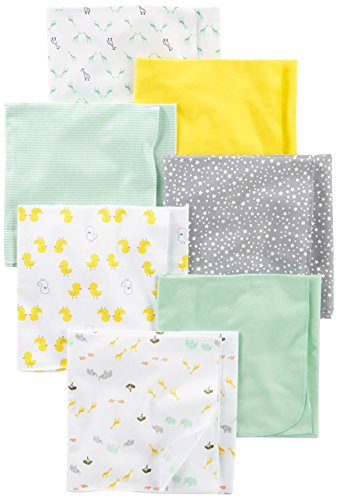
Simple Joys takes the same seven-pack flannel formula and recolours it for the modern nursery: grey, white and mint, a palette that sits quietly beside contemporary prams, car seats and nursery furniture. Where the elephant pack leads with a motif, this one leads with coordination — three calm colours that can be mixed across a week without a single clash, and that photograph beautifully against the pale backgrounds new parents favour. The format is otherwise the familiar one-size flannel receiving blanket, bought in a bundle sized for real laundry intervals.
Mini spec box
- Type: Flannel receiving blankets
- Pack count: 7 blankets
- Colours named in title: Grey, white and mint
- Sizing: One size
- Fabric fibre detail: The fibre content is not spelled out in the listing title
- Dimensions: No measurements are given in the title
Strengths
- The grey-white-mint palette coordinates with modern nursery gear effortlessly
- Seven blankets support a realistic wash rotation from day one
- Colour variety within the pack makes it easy to assign blankets to places — bag, pram, chair
Trade-offs
- The title does not state the fibre, so check the listing’s materials if cotton content matters to you
- Pale colours show stains more readily than prints do
- No dimensions in the title, as with its flannel rival above
Colour-coding turns out to be a genuine organisational tool in a newborn household, and this pack enables it accidentally: mint for the changing bag, grey for the pram, white for feeding, or any system your sleep-deprived brain can sustain. The flannel itself does the same work as any good flannel — wrapping, catching, covering, washing — and the absence of a strong print means these blankets transition gracefully into toddlerhood as comfort cloths and doll blankets without looking babyish. The one homework item is fibre: the title says flannel without naming its content, so parents set on a specific fibre should read the listing’s material details before ordering, a thirty-second check that this review flags rather than hides.
There is also a gifting calculation here. Grey, white and mint is the palette least likely to collide with a nursery’s chosen theme, which makes this pack the diplomat of the list — the present that fits a Scandi nursery, a traditional one and a hand-me-down household with equal ease. Because the colours are pale, they also reveal their wash state honestly, a small virtue when blankets cycle this fast: you can see at a glance which are fresh. Pair the pack with a muslin set from further down this guide and a new parent owns the two fabrics that between them cover nearly every blanket task of the first year.
Best for: style-conscious parents and gift buyers who want calm, coordinating colours. / Not suited for: buyers who require the fibre content stated in the title itself.
Look at the Simple Joys colour pack on Amazon

Gerber Flannel Receiving Blankets Dinosaur 5-Pack
Gerber’s pack makes the fibre promise the Simple Joys title leaves open: 100% cotton flannel, stated plainly, in a Dinosaur Blue print, five blankets to a pack. The dinosaur theme gives this set the most playful personality in the flannel group — a print that earns its keep in photographs and makes a particular blanket easy to identify across a room, a bag or a laundry pile. Five is a slightly leaner rotation than the seven-packs above, which suits households with quick laundry turnarounds or anyone buying a second pack to top up an existing supply.
Mini spec box
- Type: Receiving and swaddle blanket, flannel
- Fibre: 100% cotton, stated in the title
- Pack count: 5 blankets
- Design named in title: Dinosaur Blue
- Audience in title: Newborn, infant and toddler nursery use
- Dimensions: Measurements are absent from the listing title
Strengths
- The 100% cotton content is stated outright, removing fibre guesswork
- A dinosaur print is distinctive enough to track individual blankets through the wash
- Gerber’s nursery framing spans newborn to toddler, matching the blanket’s long useful life
Trade-offs
- Five blankets rotate faster than seven, so laundry must keep pace
- A strongly themed print may not suit every nursery’s palette
- Dimensions still require a trip to the full listing to confirm
The honest comparison in the flannel trio is pack size against print against fibre clarity, and Gerber wins the third of those outright. Parents who read labels — and newborn parents become label-readers quickly, because skin this new reacts to surprises — will value a title that commits to 100% cotton without asterisks. The dinosaur print, meanwhile, is not trivial: a recognisable blanket becomes the blanket, the one a baby is photographed with monthly and a toddler later claims as a favourite, and themed prints survive that sentimental promotion better than anonymous pastels. Just budget the laundry honestly. Five blankets in heavy rotation means washing every couple of days in the early weeks, which many households do anyway; if yours does not, buy the bigger pack or buy two of these.
Flannel weight is the unspoken variable across all three flannel packs, since no title here quantifies it. In practice, receiving flannels cluster around a similar light-to-medium weight, and the differences parents actually notice are softness after washing and edge finishing rather than dramatic warmth gaps. Gerber’s long history in baby basics is relevant context the brand brings to a nursery staple, though the review rests on what the title states: cotton, flannel, five, dinosaurs. Treat this pack as the characterful all-rounder of the flannel group — the one most likely to be remembered in the baby book and the one whose fibre line needs no footnote.
Best for: parents who want stated 100% cotton and a print with real personality. / Not suited for: households needing a seven-deep rotation or a neutral palette.
Check the Gerber dinosaur pack on Amazon

Muslin Swaddle Blankets 3 Pack
The muslin chapter of this guide begins with the only flannel-free dimensions stated so far: 38 by 40 inches, a genuinely large swaddle cloth, in a three-pack of bright colours. Muslin’s open weave behaves oppositely to flannel — it breathes, it drapes, it lets air move — which makes it the fabric of warm rooms, summer babies and parents who worry about overheating during supervised wrapping and cuddling. The title also names burping among its roles, and that versatility is muslin’s essence: one cloth that swaddles, catches, shades and wipes across a whole day.
Mini spec box
- Type: Muslin swaddle and receiving blankets
- Pack count: 3 blankets
- Dimensions: Large 38 x 40 inches, stated in the title
- Fabric character in title: Breathable, soft muslin
- Extra roles named: Swaddle wrap and burping cloths
- Colourway: Bright Colors
Strengths
- Stated 38×40 dimensions give real swaddling material for growing babies
- Muslin’s breathability suits warm weather and heated homes
- Bright colours are cheerful and help individual cloths stay identifiable
Trade-offs
- Three cloths is a slim rotation for a product that also serves as burp cloths
- Muslin’s loose weave snags more easily than flannel’s tight surface
- The weave feels less cosy than flannel in cold rooms
Size transforms muslin from a cloth into a tool. At 38 by 40 inches there is enough fabric to swaddle securely, to double over a shoulder for burping, to drape a pram against glare while air still circulates, and later to become a tummy-time surface or a picnic cloth for a weaning baby. The breathability claim in the title is inherent to muslin’s weave rather than a coating or treatment, which is why the fabric has been trusted for generations in hot climates. The pack size is the discipline: three large cloths ask you to wash promptly or to pair this set with a flannel pack, a combination many experienced parents recommend anyway — flannel for cool days and secure tucks, muslin for warmth, layering and everything in between.
Muslin also improves with age in a way few textiles do. Each wash softens the weave and increases its absorbency, so a cloth that feels merely pleasant in week one feels genuinely lovely by month three, provided it is washed without harsh treatment that breaks its open structure. The bright colourway suits that long life, since muslin’s job expands as the baby grows — from swaddle to comforter-substitute to the cloth a toddler drags everywhere. Buy this three-pack as the warm-weather and layering half of a two-fabric system and its size will be a daily pleasure; buy it as your only blankets and its count, not its quality, will be the thing you notice.
Best for: warm homes, summer babies and parents who value stated, generous dimensions. / Not suited for: anyone wanting a one-pack-does-everything solution in a cold house.
View the large muslin 3-pack on Amazon

Muslin Receiving Blankets 5 Pack
The second muslin option trades the first one’s stated dimensions and bright colours for a bigger rotation and a calmer look: five muslin cotton receiving blankets in a neutral Bright Leaves design, described as breathable and skin-friendly, for newborn boys and girls alike. The leaf motif in neutral tones is the aesthetic opposite of the dinosaur flannel — a print that whispers — and it suits parents building a soft, natural-toned nursery or buying before a baby’s arrival is announced. Five cloths also answer the main criticism of the three-pack above.
Mini spec box
- Type: Muslin receiving blankets and swaddle wraps
- Pack count: 5 blankets
- Fabric: Muslin cotton, described as breathable and skin-friendly
- Design named in title: Bright Leaves, in a neutral palette
- Audience: Newborn boys and girls
- Dimensions: The title does not state measurements for this pack
Strengths
- Five muslin cloths give a workable rotation without a second purchase
- Neutral leaf design fits calm, natural nursery palettes and suits any baby
- Muslin cotton’s breathability carries the same warm-weather virtues as its rival
Trade-offs
- No dimensions in the title, so swaddle sizing needs confirming on the listing
- A pale neutral palette shows feeding stains more than brights do
- Muslin remains the lighter, less insulating choice for cold rooms
This pack is the muslin choice for parents who think in systems. Five cloths distribute across the geography of newborn care — cot side, changing table, pram, bag, wash — without any location running dry, and the neutral leaves keep every one of those locations looking composed. The skin-friendly language in the title points at muslin cotton’s smooth, breathable contact, which is the quality that matters during long, warm cuddles and supervised wraps. What you give up against the three-pack is certainty about size, and that trade should be made consciously: if your baby is measuring large or you plan to swaddle for months, confirm this pack’s dimensions on the listing first; if your use leans toward receiving, layering and everyday cloth duty, the count and the palette will serve you better than two extra inches.
Neutral designs have a practical afterlife that brighter prints sometimes lack. A leaf-patterned muslin in soft tones graduates into a pram blanket for a second child of any sex, a grandparent’s-house staple, or a photography backdrop for monthly milestone pictures, without ever looking like it belonged to a particular baby or a particular year. Muslin’s softness curve rewards that longevity, growing more pleasant with every wash. Households choosing between this pack and the brighter three-pack are really choosing between two philosophies — maximum stated size in vivid colours, or maximum rotation in calm ones — and either philosophy, honestly followed, ends with a well-equipped nursery.
Best for: parents who want a five-deep muslin rotation in a serene, neutral print. / Not suited for: buyers who need dimensions confirmed in the title before purchasing.
See the muslin leaves 5-pack on Amazon

Avalon Bedding Hospital Receiving Blankets 12-Pack
The final pick is the one many parents meet first, in the delivery room itself: the hospital receiving blanket, white cotton with the unmistakable stripe, here in a twelve-pack of 30-by-40-inch, 100% cotton, machine-washable blankets from Avalon Bedding. Twelve is not excess; it is the hospital’s own logic brought home. These blankets are the utility players of the nursery — swaddling in the first days, lining changing mats, protecting shoulders, mopping feeds, cushioning car-seat gaps under supervision — and their plain, hard-wearing cotton is designed to be washed constantly without ceremony or grief when one is eventually lost.
Mini spec box
- Type: Hospital-style receiving blankets with the classic stripe
- Fibre: 100% cotton, stated in the title
- Dimensions: 30 x 40 inches
- Pack count: 12 blankets
- Care: Machine washable, per the title
- Colourway: Neutral, with the hospital stripe
Strengths
- Twelve blankets end rotation anxiety completely, at home and in the bag
- Stated 100% cotton and stated 30×40 dimensions leave nothing to guess
- Machine washable and unprecious — built for constant, practical use
Trade-offs
- The hospital aesthetic is purely functional; there is no print charm here
- 30 inches is the shortest width in this guide, so swaddling range is narrower than the big muslin
- A dozen identical blankets is more than a minimalist household may want to store
There is a deep practicality in owning blankets you never have to protect. The Avalon pack turns receiving blankets into infrastructure: one in every room, two in every bag, a stack that absorbs the chaos of the early weeks without anyone rationing or hand-washing at midnight. The 30-by-40 size is the classic hospital proportion — ample for newborn swaddling and for the hundred secondary jobs, while the larger muslins above take over as babies grow. Cotton with a stripe also washes and dries fast, which at this pack size becomes an industrial virtue. Buy these as the foundation layer of a blanket system and add one character pack — dinosaurs, elephants, leaves — for the photographs and the sentiment; that two-tier approach is exactly how experienced parents quietly organise it.
The hospital stripe carries an emotional footnote worth acknowledging: for many families it is the pattern in their very first photographs, and owning the same blankets at home extends a sense of continuity from the ward to the nursery. Beyond sentiment, the design’s neutrality is strategic — it matches nothing and clashes with nothing, works for every subsequent child, and can be lent, donated or repurposed as household cloths years later without looking like baby gear. Of the six packs in this guide, this is the one whose value compounds most quietly, measured not in softness peaks but in problems that simply never occur: no empty drawer, no missing blanket, no laundry emergency at the worst hour.
Best for: parents who want hospital-grade practicality in depth — twelve, cotton, sized and washable. / Not suited for: anyone seeking a decorative print or the largest swaddle dimensions.
Look at the Avalon hospital 12-pack on Amazon
Side-by-side comparison
| Pick | Pack count | Type | Best for |
|---|---|---|---|
| Luvable Friends Flannel Receiving Blankets 7-Pack | 7 blankets | Receiving blankets, cotton flannel | A seven-pack of cotton flannel basics with an elephant design |
| Simple Joys Flannel Receiving Blankets 7-Pack | 7 blankets | Flannel receiving blankets | A seven-pack in grey, white and mint |
| Gerber Flannel Receiving Blankets Dinosaur 5-Pack | 100% cotton, stated in the title | Receiving and swaddle blanket, flannel | 100% cotton flannel with a dinosaur print, pack of 5 |
| Muslin Swaddle Blankets 3 Pack | 3 blankets | Muslin swaddle and receiving blankets | Large muslin swaddles, 38 x 40 inches, pack of 3 |
| Muslin Receiving Blankets 5 Pack | 5 blankets | Muslin receiving blankets and swaddle wraps | Muslin cotton five-pack in a neutral leaf design |
| Avalon Bedding Hospital Receiving Blankets 12-Pack | 100% cotton, stated in the title | Hospital-style receiving blankets with the classic stripe | Hospital-style stripe blankets, 100% cotton, 30×40, pack of 12 |
Read across the table and a sensible nursery system assembles itself: a hospital or flannel base for volume, a muslin set for warmth and layering, and one printed pack for character. Few households need all six; most need two rows chosen from different fabric families.
New parents padding quietly around the house at night may also appreciate our guide to Best Noise Reducing Slippers, written with exactly those hours in mind.
How to choose receiving blankets for the first year?
Flannel, muslin or hospital cotton — which fabric family fits your home?
Choose by climate and temperament. Flannel’s brushed cotton grips itself, making supervised wraps feel secure, and suits cool rooms and winter babies. Muslin’s open weave breathes, drapes and layers without trapping heat, suiting warm homes, summer arrivals and parents who run anxious about overheating during cuddles. Hospital cotton is the neutral all-rounder: plain, absorbent, endlessly washable, indifferent to season. Many families end up owning two families of fabric and reaching for each by weather, which is why this guide’s packs were chosen to combine rather than merely compete. If you buy only one family, let your home’s temperature decide it, not the print.
How many blankets does a newborn actually use?
More than the gift registries suggest. A single day can consume blankets for the morning feed, the pram walk, the visitor cuddle, the tummy-time session and the evening bath routine, while yesterday’s set sits in the wash. That is why the packs here run from three to twelve, and why count is a feature rather than packaging. Households with daily laundry can thrive on five; households washing twice a week should look at seven or twelve; and the three-pack of large muslins works best as one half of a two-fabric system. Count your laundry rhythm honestly and the pack size chooses itself.
Do dimensions really matter in a receiving blanket?
For pure receiving — holding, draping, catching — almost any size serves. For swaddling, dimensions become the product: a wrap needs enough fabric to tuck securely around a growing body, and babies outgrow small swaddles in weeks. That is why this guide credits the titles that state their measurements — the 38-by-40 muslin and the 30-by-40 hospital cotton — and flags the ones that do not, directing you to the full listing before you commit a swaddling plan to an unmeasured blanket. When in doubt, larger cloths do more jobs; a big muslin can be folded down, while a small blanket cannot be folded up.
What should gift buyers prioritise?
Neutrality, count and fibre clarity, in that order. A unisex design or a calm palette survives unknown genders and unknown nursery themes; a generous count is useful to every parent regardless of taste; and a stated fibre, like the 100% cotton on the Gerber and Avalon titles, removes the one question a gift recipient cannot politely ask. Prints are the joyful extra, not the foundation — though a dinosaur pack given alongside a plain base set may be the present that gets photographed most.
The second life of a receiving blanket
Few baby products outlast their brief as gracefully as these cloths. When swaddling ends, the same blankets become pram liners, car-seat side supports on supervised journeys, picnic squares, doll bedding, comfort objects with a familiar smell, and eventually the household’s softest cleaning and polishing cloths. Flannel’s grip makes it a fine under-layer for a wobbly highchair cushion; muslin’s drape turns it into a summer pram shade and later a superhero cape of exactly the right weight; hospital cotton simply refuses to die and will be found in garages and craft boxes a decade on. Buying with that long arc in mind softens the pack-size decision: a twelve-pack is not twelve weeks of supply, it is years of household service wearing a baby pattern first.
Washing rhythms for very small laundry
Receiving blankets thrive on simple care: wash them with the baby’s other cotton items, dry them fully, and keep a clean stack at each station where they are used so a fresh one is always closer than the dirty one. Muslin rewards gentle handling early, growing softer as its weave relaxes, while flannel and hospital cotton tolerate a more industrial approach from the first wash. The titles here are mostly quiet about care specifics — the Avalon pack’s machine-washable note is the exception — so treat each product’s own label as the authority and this section as rhythm rather than instruction. The real system is placement: blankets stored where feeds, changes and cuddles happen get used and rotated; blankets stored in one distant drawer become a single overused favourite and five forgotten spares.
Setting up blanket stations around the house
Experienced parents stop thinking of receiving blankets as a drawer item and start thinking of them as a distributed system. A small stack lives wherever the baby is held, fed or changed, because the moment a blanket is needed is never a moment when walking to another room is welcome. The feeding chair keeps two: one under the baby, one over your shoulder. The changing area keeps two more, rotated as surface protectors and post-bath wraps. The pram basket carries one permanently, where it serves as shade, layer and emergency clean-up in a single cloth. The changing bag mirrors the pram. Even the car, for supervised journeys, keeps a spare for the inevitable feed that happens in a car park.
Count those stations and the pack sizes in this guide stop looking arbitrary. A twelve-pack populates every station and still leaves a wash reserve; a seven-pack covers the main stations with discipline; a five-pack works when two stations share; and a three-pack of large muslins is best deployed as specialists — pram, bag and warm-day swaddle — while a flatter fabric handles the stationary posts. Assigning designs to stations also ends the daily hunt: the dinosaur blanket lives at the chair, the leaves live in the pram, the stripes live everywhere else. When a blanket’s home is fixed, its absence is noticed instantly, which is exactly what a tired household needs from its systems.
For grandparents, childminders and the second time around
Receiving blankets travel between households more than almost any other baby item, and a few of these packs are quietly perfect for the satellite nurseries at grandparents’ homes and childminders’ houses. A modest flannel or hospital pack kept at a grandparent’s house removes a whole category of packing from every visit, and because these designs are unisex and unprecious, they serve successive grandchildren without ceremony. Childminders, who may hold several babies across a week, benefit from the same logic at scale: identifiable prints per child, or identical stripes washed in bulk, are both rational systems, and this list contains both philosophies.
Second-time parents read this category differently from first-timers. They know which fabric their first baby preferred against the skin, they know their true laundry rhythm rather than their aspirational one, and they know that the blankets from the first child that survived are the quality benchmark. What they usually need is not education but replenishment with intent: replace the worn flannels, add muslin if the new baby is due in summer, and let the hospital stripes quietly multiply. If that is you, the reviews above can be read as a stock check rather than a discovery — and the twelve-pack exists precisely for households that have learned, once already, how fast twelve blankets can be in motion.
How the three fabrics actually feel at 3 a.m.
Product categories are usually compared in daylight language, but receiving blankets do their defining work in the dark, by touch, one-handed. Flannel announces itself by grip: it stays where it is tucked, its brushed surface reads as warmth instantly, and a half-asleep parent can identify it without light. Muslin announces itself by drape: it falls over a shoulder and stays there, light enough to forget, and its weave can be felt as a fine, cool grid that suits a warm room’s night feed. Hospital cotton is the neutral handshake — smooth, familiar, neither grippy nor draping, the texture of competence rather than comfort theatre.
Those tactile signatures decide preferences more honestly than any softness ranking, because softness converges after a dozen washes while handling character does not. A parent who likes a wrap to feel secure will keep reaching for flannel in the dark. A parent who overheats during night feeds will keep reaching for muslin. A parent who wants to stop choosing will reach for the stripe. When you test a new pack, test it the way it will be used: lights low, baby in one arm, blanket managed with the other hand, and judge what your fingers report before your eyes get a vote.
Common mistakes when buying receiving blankets
Leaving loose blankets in the sleep space. The most important mistake is a safety one: receiving blankets belong in arms and laps, not loose in a cot with a sleeping baby. Build the cuddle routine around supervised use from the first day.
Washing a favourite blanket a toddler now refuses to surrender.
Buy the rotation before the attachment forms if you possibly can, because two identical blankets, washed in alternation so both carry the same softness and smell, is the oldest trick in the nursery — and the packs in this guide, with their multiples of a single design, make that trick available from the very first week rather than as a rescue mission attempted later, when the beloved original has already been discontinued by its maker, faded beyond easy recognition, or lost somewhere between the car seat and a grandparent’s front door on a wet afternoon.
Buying one small pack because it looks complete. A pretty three-pack can be an excellent muslin set and still leave a household short by Wednesday. Match the count to your laundry rhythm, not to the photograph.
Assuming all soft blankets are the same fabric. Flannel grips, muslin breathes and hospital cotton endures; treating them as interchangeable leads to a too-warm wrap in July or a too-slippery one in January.
Ignoring dimensions when swaddling is the plan. A blanket that cannot wrap and tuck securely is a receiving blanket only. Check stated sizes, and check the listing where the title gives none.
Saving the nicest blanket from use. The printed favourite kept for best will be outgrown unworn. Rotate everything; the memories attach to the blankets that actually did the work.
A season-by-season way to use the same drawer
Winter makes flannel the default and muslin the layer. A flannel wrap over a sleep-suitable outfit during supervised cuddles gives the grippy warmth cold rooms demand, while a muslin folded beneath a baby on a changing mat adds a washable barrier without bulk. In heated modern homes the difference between seasons is smaller than the calendar suggests, which is why the fabric-by-temperature rule in the choosing section refers to rooms, not months: a well-heated January nursery can be muslin territory, and a draughty June cottage can be flannel’s.
Spring and autumn are rotation seasons, when both fabrics earn their drawer space across a single day — flannel for the morning’s cool feed, muslin by the warm afternoon. This is the strongest argument for owning two smaller packs of different fabrics rather than one large pack of a single kind: the drawer adapts by the hour. Summer belongs to muslin almost entirely, with flannel demoted to air-conditioned rooms and travel, and hospital cotton continuing its year-round utility work regardless, because a cloth whose job is catching, lining and wiping does not care about the weather at all.
When a title does not state the size: a two-minute check
Three of the six titles in this guide leave dimensions unstated, and since this review refuses to invent numbers, the check falls to you — so here is how to do it well. On the full listing, look for the product dimensions in the specifications rather than in lifestyle photographs, which routinely show blankets folded, draped or held by small adults in ways that distort scale. Compare the stated length against your baby’s current length plus growing room; a swaddle needs meaningful surplus beyond the body to wrap and tuck. Check whether the dimension given is for the blanket flat and new, and expect cotton to relax and shift slightly across its first washes. Finally, weigh what you find against the pack’s other virtues: a beloved print in a slightly smaller blanket still serves beautifully as a receiving cloth even if its swaddling career is short, provided you buy it knowing that rather than discovering it at midnight.
The same two-minute discipline applies to fibre where a title is general. One pack here says flannel without naming its content, and the listing’s material line is where that question is answered. None of this homework is a criticism of the packs; titles are short, and the honest ones — which these are — simply leave the long answers one click deeper. A guide that invented the missing numbers would be easier to read and worse to trust.
The photographs are a legitimate feature
It is easy to be sniffy about prints, as if a serious parent should care only for fibre and dimensions, but the first year of a child’s life is the most photographed year of it, and the receiving blanket is in a remarkable share of those frames. The blanket under the baby in the first hospital picture, behind the monthly milestone shots, draped over the grandparent’s shoulder — its pattern becomes part of the family’s visual memory, which is a real function and worth a real moment of choice. This is why the printed packs in this guide are reviewed with the same seriousness as the plain ones: an elephant, a dinosaur or a leaf motif chosen with pleasure will be looked at, fondly, for decades, long after its laundry performance is forgotten. Choose the workhorse packs for the system, by all means — and then choose one print for the story.
Twins, multiples and the mathematics of enough
Everything in this guide doubles with twins, except the adults available to do the washing. Two babies consume blankets at a rate that makes single-baby pack advice look quaint: two wrap rotations, two feeding stations, two pram baskets and a laundry cycle that never truly empties. For multiples, the twelve-pack stops being the maximalist option and becomes the sensible foundation, ideally joined by one printed pack per baby so that each child’s blankets, and eventually each child’s comfort cloth, can be identified at a glance by any helper walking into the room.
The fabric logic sharpens too, because two babies rarely share a temperature preference. One twin runs warm and lives happily in muslin; the other seeks the grip and warmth of flannel at every feed. A drawer stocked with both families in the deeper counts lets each baby be wrapped according to their own small thermostat rather than a household rule, and that flexibility, at 3 a.m. with two babies vocal about it, is worth every penny of the extra pack.
What experienced parents would tell you at the shop
Ask a room of second-time parents about receiving blankets and a consensus forms quickly, and it is worth recording because it matches the structure of this guide. Buy more than feels reasonable, because the shortfall always announces itself at the least convenient hour. Buy two fabrics, because the weather inside a home changes more than the weather outside it. Keep one pack deliberately plain and hard-wearing, because sentiment should not be asked to absorb every spill. And let one blanket be chosen purely for joy — a print that makes you smile in the photographs — because morale is a genuine parenting resource and textiles, oddly, contribute to it.
They would also tell you to lower your standards for what counts as a blanket emergency and raise them for what counts as a blanket system. A muslin pressed into service as a changing-mat cover is not a misuse; it is the product working as designed across its second job. A flannel that becomes a toddler’s cape has not been wasted; it has completed the full arc these cloths are bought for. The packs that disappoint are never the ones that were used too variously — they are the ones bought too few, in the wrong fabric for the house, or in a size nobody checked.
Final recommendation
Build the nursery on a base of volume and a layer of character. The Avalon twelve-pack is the foundation buy — cotton, sized, washable, everywhere at once — while the Luvable Friends and Simple Joys seven-packs serve flannel households that prefer prints or palettes to the hospital look, and the Gerber five-pack is the fibre-clear, dinosaur-bright alternative. Add muslin for warmth and breathability: the large three-pack where dimensions matter, the five-pack where rotation and calm design matter more. However you combine them, keep the safety frame from the top of this guide — blankets for holding, clear space for sleeping — and these humble cloths will earn their drawer many times over. Parents furnishing the hallway those night-time walks pass through might also browse Best Runner Rugs For Hallway for the route between nursery and kitchen.
Frequently asked questions
How many receiving blankets should I register for?
Across all packs, most households land between ten and fifteen individual blankets once laundry rhythm is counted. That might be one twelve-pack, two seven-packs in different fabrics, or a five plus a seven. The packs in this guide are sized so that any two of them, from different fabric families, make a complete system.
What is the difference between flannel and muslin receiving blankets?
Flannel is brushed cotton with a grippy, warmer hand, traditionally used for wrapping and layering in cooler rooms. Muslin is an open-weave cotton that breathes and drapes, softening with every wash, and suits warm weather and layering. Neither is better in the abstract; they are tools for different temperatures, which is why many nurseries keep both.
Can receiving blankets be used for swaddling?
Yes, during supervised use, provided the blanket is large enough to wrap and tuck securely — which is why stated dimensions matter and why the 38-by-40 muslin is the swaddle-leaning pick here. As babies grow stronger and begin rolling, swaddling routines change, and loose blankets should never be part of a sleeping baby’s space.
Why do hospitals use the striped blankets?
The classic design — plain cotton, a simple stripe, a practical 30-by-40 size like the Avalon pack — is cheap to replace, easy to launder industrially and instantly identifiable as a receiving blanket among hospital linen. Parents who loved that practicality on the ward can buy the same logic for home in the twelve-pack reviewed above.
Are these blankets suitable as gifts?
They are among the safest baby gifts available, because every parent uses them daily and extras are never wasted. Choose a unisex or neutral design when the nursery’s theme is unknown, favour packs with clearly stated fibres, and consider pairing a character print with a plain base pack for a present that is both charming and genuinely useful.
Can I use receiving blankets as cot bedding to save money?
No — and this answer matters more than any other in the guide. A baby’s sleep space should be kept clear of loose blankets; receiving blankets earn their place in arms, laps and supervised routines, and the money they save across a year of feeding, changing and cuddling is already considerable without asking them to do a job that belongs to fitted, sleep-appropriate bedding designed for the cot itself.
Twelve, seven, five or three — count the washes, choose the fabric, and the smallest blankets in the house will quietly carry its biggest year.


