What's inside
- Where to Buy, and How to Read This Guide
- Key Takeaways
- Quick Picks
- What Separated These Six From the Rest of the 0.9 Class?
- Why Do So Many Kitchens Settle at 0.9 Cubic Feet?
- How Do the Six 0.9 Cu Ft Picks Compare at a Glance?
- Which Foods Show the Jump From 700 to 900 Watts Most Clearly?
- How Should You Set Up a 0.9 Microwave for Even Cooking?
- When Is 0.9 Cubic Feet Not Enough, Honestly?
- What Should You Check on Delivery Day?
- How Do You Keep a Compact Microwave Cooking Evenly for Years?
- How Do Auto Menus and Sensor Programmes Differ in Daily Use?
- What Is the Best Way to Defrost Meat in a 0.9 Cu Ft Machine?
- How Should You Position a Countertop Microwave in a Small Kitchen?
- When Should You Repair a Compact Microwave, and When Replace It?
- How Energy-Efficient Is a 0.9 Cu Ft Microwave in Real Terms?
- What Changes When a Household Steps Up From 0.7 to 0.9?
- How Do You Get Restaurant-Quality Results From a Home 0.9 Machine?
- How Should a 0.9 Machine Be Cleaned and Descaled of Odours?
- Which Mistakes Shorten a 0.9 Microwave’s Life or Spoil Its Cooking?
- Final Recommendation
- Frequently Asked Questions
- Related Guides
As an Amazon Associate I earn from qualifying purchases. This post may contain affiliate links at no extra cost to you.
cottageverdict.com is reader-supported. When you buy through links on our site, we may earn an affiliate commission.
Where to Buy, and How to Read This Guide
Somewhere between the tiny dorm boxes and the family-sized countertop ovens sits the class a great many kitchens actually need. The best 0.9 cubic foot microwaves pair a meaningfully larger cavity with 900 watts of output, which is enough pace for everyday cooking rather than reheating alone, while still fitting the apartment counters, office kitchens and first-home worktops that rule out anything grander.
That extra fifth of a cubic foot sounds trivial on paper and behaves generously in practice. A 10.6-inch turntable swallows a full dinner plate with room to spare, a mixing bowl can stand inside for melting and steaming, and two mugs fit side by side for the morning round of tea. Couples and small households feel the difference daily, because the machine stops dictating which dishes may be used.
All six models below share the 900-watt, 0.9 cubic foot formula, so this guide concentrates on the separators: control style, mute and eco features, door design and the small engineering choices that decide whether an oven feels cheerful or cheap after a year of breakfasts. Every pick links to its listing so you can check price on Amazon and confirm measurements against your own counter before committing.
It is also the class of the second kitchen and the growing household: the annexe, the garden office, the first flat that becomes a couple’s flat, the family kitchen whose main oven queue at six o’clock has become a domestic incident. A 0.9 machine absorbs those pressures without demanding a remodel, and the six below were chosen for households in exactly those transitions, where the appliance must be capable today and unobtrusive every day.
Key Takeaways
- 900 watts is the sweet spot for small households: fast enough for vegetables, rice and ready meals without the bulk of family ovens.
- A 10.6-inch turntable is standard in this class and comfortably takes full dinner plates and most mixing bowls.
- Mute functions and eco modes, once novelties, now appear on several models and transform life in open-plan flats.
- Ten power levels across the board means gentle work like softening ice cream or melting chocolate is properly controllable.
- This class still will not roast a chicken or feed six; it is a two-to-three-person machine at heart.
- Stainless finishes dominate, but black stainless and plain black options hide smudges better in busy kitchens.
Quick Picks
| Pick | Badge | Why it earned a place |
|---|---|---|
| BLACK+DECKER 0.9 (900W) | Best All-Round 0.9 | Six auto presets, ten power levels and a push-button door make it the easiest recommendation in the class. |
| TOSHIBA 0.9 (Black Stainless) | Best for Apartments | Black stainless styling, a mute function and LED interior lighting tailored to apartment living. |
| West Bend 0.9 (Black) | Best No-Nonsense Value | Electronic controls, ten power levels and a glass turntable in a plain black box that just gets on with it. |
| GE 0.9 (Stainless) | Best Convenience Controls | Seven convenience cook settings and one-touch controls from a brand with a service network behind it. |
| Sharp SMC0962KS 0.9 | Best Carousel Turntable | Sharp’s long microwave heritage shows in a smooth 10.6-inch carousel and clean, unfussy controls. |
| Chefman 0.9 (Black) | Best Quiet Features | A mute button, eco mode and express cook presets make it the most considerate budget-friendly option. |
What Separated These Six From the Rest of the 0.9 Class?
We began with verified listings in the true 0.9 cubic foot, 900-watt class and discarded the many near-misses that quietly turn out to be 0.7 or 1.1 cubic foot machines wearing optimistic marketing. Capacity honesty matters because buyers choose this size for a specific shelf or a specific bowl, and a mislabelled cavity wastes everyone’s time.
Next we scored the everyday interface. Express cooking, sensible auto menus, a clock that is easy to set and a door that opens without a wrestling match all sound mundane until you multiply them by three uses a day for five years. Models whose panels demanded menu-diving for a simple thirty-second blast fell behind simpler rivals, however impressive their feature lists looked.
Finally we weighed the ownership layer: child locks for houses with small children, mute options for open-plan living, eco modes for standby costs, and interior lighting that actually lets you watch milk before it boils over. The six survivors each win on a slightly different blend of those virtues, which is why the detailed sections below argue for different households rather than pretending one machine suits everybody.
Why Do So Many Kitchens Settle at 0.9 Cubic Feet?
The size persists because it matches the standardised objects of ordinary cooking. Dinner plates are roughly ten inches, cereal bowls and mixing bowls assume a certain clearance, and supermarket ready meals are portioned for cavities like this. Step down to 0.7 and those objects start failing at the door; step up to 1.4 and the oven begins colonising counter space that smaller kitchens cannot spare. The 0.9 class threads that needle, which is why manufacturers keep refining it rather than abandoning it.
The 900-watt output completes the compromise. It is close enough to full household power that recipe timings printed on packaging land near the truth, so a newcomer following box instructions is rarely misled. Vegetables steam crisply, rice reheats without turning to paste, and a frozen meal for one finishes in a time that feels civilised. For singles, couples and downsizers, this is the smallest class that stops feeling like a compromise at all.
Downsizers deserve a specific mention, because this class is where many of them land after decades with cavernous family ovens. The adjustment is smaller than feared: the dishes that matter still fit, the power still behaves the way recipes assume, and the counter handed back to the kitchen is measured in feet rather than inches. Several owners describe the move not as a loss but as a correction, the appliance finally matching the household it serves.
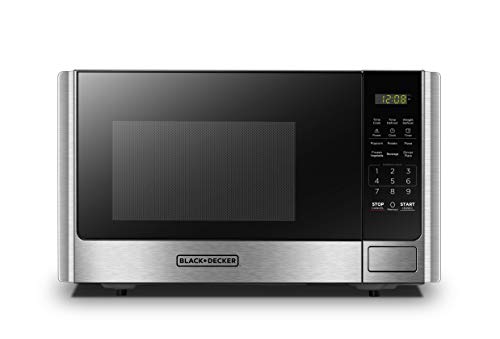
BLACK+DECKER 0.9 Cu Ft Microwave 900W — Best All-Round 0.9
If the 0.7 class has a default answer, this BLACK+DECKER is its bigger sibling’s equivalent: the machine to buy when analysis paralysis threatens a simple purchase. Six auto cook presets cover the reheating greatest hits, the push-button door opens without hauling the oven across the worktop, and the stainless front looks at home beside other appliances rather than apologising for existing. Ten power levels handle the gentle jobs, from softening butter to warming baby food, with proper gradation.
Living with it is uneventful in the best sense. The turntable stays seated, the controls respond first time, and the child safety lock reassures households where a toddler has discovered buttons. It lacks a mute, so the end-of-cycle beeps announce themselves in the traditional manner, and that is the main reason light sleepers in studio flats should read on. For everyone else, this is the balanced, fairly priced centre of the category, and the one we would replace like-for-like if it vanished from a test kitchen counter.
What settles this BLACK+DECKER into so many kitchens is the absence of a single annoying day. The clock sets without a manual, the express keys behave as fingers expect, the interior light lets you catch milk at the brink, and the whole machine has the composed feel of a design that has been built in large numbers and quietly improved. Couples equipping a first kitchen together could do far worse than to stop researching at this model, and the energy saved by ending the search here is better spent learning what the machine does to a jacket potato.
There is a resale and hand-me-down angle to this BLACK+DECKER worth a sentence: mainstream models in stainless pass between flats, siblings and house-shares for years, and a machine everyone already knows how to use is a machine nobody needs to explain. When this one eventually moves on to a younger household, it will arrive with its reputation pre-installed, which is a form of value no specification sheet records.
- Capacity: 0.9 cu ft, stainless steel body
- Output: 900 watts with 10 power levels
- Programs: 6 auto cook presets
- Door: push-button release
- Safety: child safety lock fitted
Strengths
- Balanced feature set with no weak area
- Push-button door suits one-handed use
- Presets match real reheating habits
Trade-offs
- No mute for the end-of-cycle beeps
- Stainless front shows fingerprints
- Interior light is adequate rather than bright
Best for: couples and small households wanting the safe, central choice.
Not suited for: studio dwellers who reheat late at night beside a sleeping partner.
Confirm the current dimensions for your counter run and Check price on Amazon.

TOSHIBA 0.9 Cu Ft Microwave Oven — Best for Apartments
Toshiba aims this model squarely at apartment kitchens and hits the target. The black stainless finish resists the fingerprint swirl that plagues brighter steel, the mute function silences beeps for early starts and late snacks, and LED lighting inside the cavity makes it genuinely possible to watch soup rise and catch it before the boil-over. Six auto menus handle routine work without fuss.
The 10.6-inch removable turntable is the class-standard size, so plates and bowls behave as expected, and the child lock is present for visiting grandchildren or curious toddlers. Heating performance follows the 900-watt script: brisk reheats, competent defrosting with a pause and a turn, and vegetables that keep some bite. What distinguishes the Toshiba day to day is thoughtfulness about its environment, an oven designed by people who pictured a small flat rather than a showroom, and priced for first homes rather than forever homes.
Apartment life also means entertaining in the same room you cook in, and the Toshiba’s manners extend to its looks across an open-plan space: the black stainless reads as furniture rather than appliance from the sofa, and the muted beeps do not puncture a film night when someone reheats popcorn at the interval. Those are not specifications a showroom demonstrates, yet they are the ones open-plan households mention after a year, which is why this model’s apartment billing is earned rather than painted on.
Toshiba’s LED interior light has a second, sneakier benefit: it makes the machine easier to clean, because a cavity you can actually see into is a cavity whose splashes get noticed while they are still wipeable. Owners of dim-cavity rivals discover month-old sauce archaeology; Toshiba owners discover Tuesday’s splash on Tuesday. Small design choices compound into maintenance outcomes, and this is one of the clearest examples in the class.
- Capacity: 0.9 cu ft, black stainless steel
- Output: 900 watts
- Programs: 6 auto menus
- Lighting: LED interior light
- Extras: mute function and child lock
Strengths
- Mute function suits flats and early risers
- Black stainless hides smudges well
- LED light makes boil-overs easier to prevent
Trade-offs
- Dark finish shows pale dust
- Panel styling is understated to a fault
- No multi-stage cooking sequences
Best for: apartment cooks who value quiet and easy-clean looks.
Not suited for: buyers wanting a bright, traditional stainless centrepiece.
Check the finish against your other appliances and Check price on Amazon.

West Bend 0.9 Cu Ft Microwave Oven 900W — Best No-Nonsense Value
West Bend’s entry strips the category back to essentials and spends nothing on theatre. Electronic controls with ten power levels, a glass turntable and a black finish that matches anything and offends nobody: the specification reads plainly because the machine is plain, in the honourable sense. It heats, defrosts and reheats at the full 900-watt pace of the class, and it asks for no admiration while doing so.
That honesty suits second homes, rental properties, workplace kitchens and buyers who regard a microwave as infrastructure rather than furniture. There is no mute, no eco flourish and no designer trim to polish, so households wanting those touches should look at the Toshiba or Chefman instead. What you get here is the class’s core competence in its most direct form, from a brand with a long history in American kitchens, and for a great many counters that is precisely the correct answer.
Renters in particular should note the West Bend’s virtues, because a machine that asks nothing of its surroundings suits homes you do not own. It needs no special circuit, no ventilation project and no learning curve for the flatmate who arrives in month two; it simply occupies its rectangle of counter and reheats dinner. When the tenancy ends it moves without ceremony, and when it eventually retires it will have cost its owners less per reheat than almost any appliance they have owned. Utilitarian is not an insult in this class; it is a business model.
The West Bend’s electronic panel deserves a defence against the dial romantics. Touch controls wipe clean in one pass, with no knob shafts for grease to colonise, and in a rental kitchen that has hosted a decade of tenants that hygiene argument is decisive. The panel’s layout is the standard grammar of the category, so the flatmate who has used any microwave anywhere already speaks it fluently.
- Capacity: 0.9 cu ft, black finish
- Output: 900 watts with 10 power levels
- Controls: electronic touch panel
- Turntable: glass, removable for cleaning
- Programs: standard auto settings
Strengths
- Straightforward controls anyone can use
- Full class power without frills
- Black finish blends into any kitchen
Trade-offs
- No mute or eco extras
- Styling is purely utilitarian
- Fewer presets than feature-led rivals
Best for: rentals, second homes and buyers who prize simplicity.
Not suited for: feature hunters wanting quiet modes and smart touches.
Compare the standard feature list with your needs and Check price on Amazon.

GE 0.9 Cu Ft Countertop Microwave 900W — Best Convenience Controls
GE brings its appliance-division polish to this size class. Seven convenience cook settings are tuned around the foods people genuinely microwave, popcorn, potatoes, vegetables and the like, and the one-touch controls mean most jobs start with a single press rather than a negotiation. The stainless body feels a fraction more substantial than budget rivals, and the child lock technology is properly implemented rather than a token line in the manual.
The ownership argument matters here too. A major manufacturer’s model tends to mean clearer documentation, easier parts conversations years later and controls laid out by people who test them on real households. Performance is the expected 900-watt competence, with even reheats and a turntable that behaves. Kitchens already running GE appliances will appreciate the visual match, and anyone who has suffered a baffling control panel elsewhere will appreciate how little thought this one demands at breakfast.
The GE’s convenience settings repay a week of attention. Each is tuned around a real food’s awkwardness, the potato’s density, popcorn’s narrow window between unpopped and scorched, vegetables’ eagerness to overcook, and using them as starting points rather than autopilot produces the most consistent results this side of a much larger machine. Households that cook the same five things on rotation, which is most households, will find the panel begins to feel personalised, as if the machine had learned the family’s repertoire, when in fact the family has learned the machine.
Brand support is the GE’s long game, and it is worth pricing into the decision even if it never gets used. A manufacturer with a national service operation, published manuals and parts channels is a manufacturer whose machine can be repaired economically in year six, and that option value is real even when it expires unexercised. Buyers planning to keep a machine for a decade, rather than until the next house move, should weigh it accordingly.
- Capacity: 0.9 cu ft, stainless steel body
- Output: 900 watts
- Programs: 7 convenience cook settings
- Controls: one-touch operation
- Safety: child lock technology fitted
Strengths
- One-touch controls minimise morning friction
- Convenience settings match real-world foods
- Backed by a major appliance brand
Trade-offs
- Brand polish costs more than basic rivals
- No dedicated mute function
- Stainless needs regular wiping to stay smart
Best for: households wanting trusted-brand ease and quick controls.
Not suited for: shoppers hunting the absolute lowest entry price.
Look through the convenience settings on the listing and Check price on Amazon.

Sharp SMC0962KS 0.9 Cu Ft Countertop Microwave — Best Carousel Turntable
Sharp helped invent the home microwave carousel, and this compact model carries that heritage quietly. The removable 10.6-inch carousel turntable rotates smoothly and stays centred, which sounds like a footnote until you have lived with a plate that wanders and clunks against the cavity wall at every revolution. Even rotation is even heating’s first requirement, and Sharp’s execution here is the class benchmark.
The rest of the machine is deliberately restrained: 900 watts, a stainless front, clear controls and no novelty features competing for your attention. Defrosting and reheating follow the familiar pattern, with results that reward a halfway stir like every microwave ever built. Buyers who believe an appliance should do a few things excellently rather than many things adequately will recognise the philosophy, and in a category drifting towards gimmicks, the Sharp’s focus on the rotating plate at its heart feels almost radical.
Sharp’s carousel deserves one more paragraph because turntable behaviour is where cheap microwaves confess. A wandering plate does not merely clunk; it parks food in the cavity’s cold zones for part of every revolution, and the cook blames the recipe. The SMC0962KS keeps the plate centred and turning at a steady rate, so the energy pattern the engineers intended is the one your dinner receives. It is an unfashionable excellence, invisible in a feature list, and it is exactly the kind that separates a machine you keep from a machine you tolerate.
Sharp’s restraint extends to its sound: the end-of-cycle signal is businesslike rather than theatrical, and the machine does not nag with repeated reminder beeps every minute until attended, a behaviour some rivals adopt and light sleepers learn to resent. In a small flat the acoustic footprint of an appliance is part of its footprint, and the Sharp’s is the smallest here that does not rely on a mute button to achieve it.
- Capacity: 0.9 cu ft, stainless steel finish
- Output: 900 watts
- Turntable: removable 10.6-inch carousel
- Controls: straightforward electronic panel
- Design: compact countertop footprint
Strengths
- Carousel runs smoothly and stays centred
- Even rotation supports even reheating
- Uncluttered controls suit all ages
Trade-offs
- Feature list is shorter than rivals
- No mute for night-time use
- Styling is conservative
Best for: buyers who value mechanical refinement over gadgets.
Not suited for: anyone wanting the longest preset menu available.
Confirm the carousel size suits your largest plate and Check price on Amazon.

Chefman 0.9 Cu Ft Countertop Microwave — Best Quiet Features
Chefman loads this compact with the courtesy features that used to appear only on pricier machines. The mute button silences the beeper entirely, eco mode trims standby consumption between uses, and six cooking presets include one-touch express options for the thirty-second blast of warmth that is half of all real microwave use. Ten power levels give the gentle range for melting and softening without scorching.
The black body is compact and modern, the child safety lock is fitted, and day-to-day heating matches the class standard, which is to say quick enough and even enough with a stir. Where the Chefman wins is the accumulation of small mercies: no beeping at midnight, no vampire draw on the meter, no menu maze for a quick reheat. Shared houses, studio flats and nurseries-adjacent kitchens will feel those mercies weekly, long after the novelty of any stainless finish has faded.
The Chefman’s eco mode deserves a fairer hearing than such features usually get, because standby draw is the one cost a microwave incurs twenty-three hours a day. In a house-share where the meter is watched, or an annexe used at weekends, a machine that effectively switches itself off between sessions removes a small but constant leak from the household budget. Combine that with the mute and the express keys, and the Chefman emerges as the considerate housemate of the category: quiet, frugal and quick when called upon, which is more than can be said for most housemates.
Chefman’s express cook has a subtle ergonomic gift: the most common action in all of microwaving, adding thirty seconds, is the easiest action on the panel, reachable without looking. Cooks carrying a hot bowl in one hand and a child’s schedule in the other do not need a menu tree; they need one faithful button. Design that respects the frequency of real actions over the glamour of rare ones is design that survives contact with real kitchens.
- Capacity: 0.9 cu ft, black body
- Output: 900 watts with 10 power levels
- Programs: 6 cooking presets with express cook
- Extras: mute button and eco mode
- Safety: child safety lock fitted
Strengths
- Mute and eco modes rarely found together here
- Express cook speeds up quick reheats
- Compact modern styling suits small kitchens
Trade-offs
- Black finish shows splashes in bright light
- Brand is less established than GE or Sharp
- Panel lettering could be larger
Best for: shared houses and studio flats that reheat at odd hours.
Not suited for: buyers loyal to legacy appliance brands.
Check the preset and eco details on the listing and Check price on Amazon.
How Do the Six 0.9 Cu Ft Picks Compare at a Glance?
| Pick | Key specification | Standout trait |
|---|---|---|
| BLACK+DECKER 0.9 (900W) | 0.9 cu ft, 900W, 6 presets | Balanced all-rounder |
| TOSHIBA 0.9 (Black Stainless) | 0.9 cu ft, 900W, mute fitted | Apartment-friendly black stainless |
| West Bend 0.9 (Black) | 0.9 cu ft, 900W, 10 power levels | Plain, proven simplicity |
| GE 0.9 (Stainless) | 0.9 cu ft, 900W, 7 settings | One-touch convenience cooking |
| Sharp SMC0962KS 0.9 | 0.9 cu ft, 900W, carousel plate | Smooth, centred turntable |
| Chefman 0.9 (Black) | 0.9 cu ft, 900W, eco mode | Mute button plus express cook |
The table makes the class’s truth visible: capacity and wattage are constants, personality is the variable. Choose the Toshiba or Chefman if noise discipline matters, the GE if one-touch convenience is your daily pleasure, the Sharp if mechanical smoothness persuades you, and either the BLACK+DECKER or the West Bend if you simply want the job done without ceremony.
Also compare what the table cannot show: exterior dimensions differ slightly between brands despite the shared class, and the distance from the back of the machine to the wall plug matters on shallow counters. Take your measurements from the listing of the exact model you intend to order, because a class average has never yet fitted a real kitchen.
Which Foods Show the Jump From 700 to 900 Watts Most Clearly?
Vegetables are the honest test. At 900 watts, broccoli and green beans steam in their own moisture in a few minutes and keep their colour and bite, where a weaker machine leaves them limping towards grey. Rice and grains reheat without the gummy patches that come from long, slow warming, and a frozen ready meal reaches a safe, steaming temperature throughout in the time its packaging promises, which makes weekday dinners noticeably calmer.
Baked potatoes remain a patience game in any microwave, but at this wattage a medium potato cooks through in a reasonable span if you turn it once, and the skin can be crisped afterwards under a grill. Popcorn pops more completely, with fewer sullen unpopped kernels sulking at the bottom of the bag. None of this is culinary magic; it is simply enough power that ordinary techniques work the way cookbooks assume they will.
How Should You Set Up a 0.9 Microwave for Even Cooking?
Start with placement. The machine needs air around its vents, a level surface so the turntable runs true, and a socket it does not share with a kettle on the same strained circuit. Inside, the habits that matter are arrangement and patience: food in a ring or an even layer heats more uniformly than a central mound, and dense items belong near the rim where energy is strongest.
Use the tools the cavity gives you. A microwave-safe cover traps steam and speeds the centre, turning or stirring halfway redistributes hot and cold zones, and standing time after the beep lets conduction finish the work gently. The power levels earn their keep here too: reheating a delicate sauce at seven-tenths power for longer beats blasting it into splatters at full tilt, and defrosting at low power with rests produces meat that is thawed rather than half-cooked at the edges.
When Is 0.9 Cubic Feet Not Enough, Honestly?
Family cooking exposes the ceiling quickly. A whole chicken will not fit with any dignity, a large casserole dish may not clear the door, and cooking for five means sequential batches that keep the first portions waiting and cooling. If your household regularly microwaves big joints, party quantities or oversized serving dishes, the honest advice is to shop the 1.4 cubic foot class and give it the counter space it demands.
The other honest limit is ambition. Microwaves at any size reheat, steam, melt and defrost; they do not brown, crisp or roast. A cook whose week revolves around those techniques needs an oven or an air fryer alongside, not a bigger microwave. Judged within its true remit, though, 0.9 cubic feet serves one to three people completely, and most owners who size up later do so for dish clearance rather than cooking power.
What Should You Check on Delivery Day?
Unbox on a clear counter and inspect before the packaging leaves the house. Check the door closes flush and latches with a positive click, run the turntable empty for twenty seconds and listen for grinding or wandering, and boil a mug of water to confirm the machine heats at the expected pace. Test the child lock and, where fitted, the mute, while the manual is still in your hand rather than at midnight a month later.
Keep the receipt and register the warranty if the brand offers it, because small appliances earn their keep over years of daily cycles. Photograph the model plate inside the door frame; that number is what any future parts or support conversation will ask for, and it is much easier to capture on day one than by torchlight in year three. A machine that passes these simple checks will very likely settle into the background hum of the kitchen, which is the highest praise this category offers.
How Do You Keep a Compact Microwave Cooking Evenly for Years?
Cleanliness is performance in a microwave. Splattered food absorbs energy meant for your dinner and eventually bakes into odorous armour, so a weekly wipe with a damp cloth, plus a steam-clean with a bowl of water and lemon when smells linger, keeps the cavity honest. Wash the turntable and its ring in the sink, and check the little wheels still turn freely before they are replaced.
Treat the door gently, because its seals and latches are both a safety system and the part most often abused. Never run the machine empty, which stresses the magnetron, and avoid slamming, which this size class tolerates poorly over thousands of cycles. Finally, if the interior light fails or the plate stops rotating, fix it promptly rather than adapting: both are cheap repairs early and symptoms of neglect if left to compound.
How Do Auto Menus and Sensor Programmes Differ in Daily Use?
Preset menus are educated guesses: the manufacturer has timed a typical portion at a typical power and stored the result behind a button. They work well for standardised foods, popcorn, frozen entrées, a single potato, and poorly for anything idiosyncratic, because your portion is never the laboratory’s portion. Treat presets as the first draft of a cooking time and keep your eyes and nose employed for the final edit.
Machines in this class mostly live by presets rather than true humidity sensors, and that is no tragedy at this size, because the portions are small enough for a cook’s judgement to close the gap. The skill worth building is calibration: learn what your machine’s vegetable setting does to your broccoli, your mug, your bowl, and the presets become personal rather than generic. Two weeks of attention converts the panel from a lottery into an instrument, and that conversion is the real difference between owners who love this class and owners who merely own it.
What Is the Best Way to Defrost Meat in a 0.9 Cu Ft Machine?
Remove packaging and any metal ties, place the meat on a microwave-safe plate to catch drips, and use the defrost setting by weight where the model offers it, turning and separating pieces at each pause the machine requests. The pauses are the point: they let the thawed outer layers shed their heat into the frozen centre instead of cooking, which is the whole art of microwave defrosting at any size.
Plan the landing as carefully as the flight. Meat defrosted in a microwave should be cooked promptly, not returned to the fridge for tomorrow, because its outer surfaces have spent time in the temperature range bacteria enjoy. Cook it, chill the cooked dish if needed, and the sequence is safe and convenient. Households that defrost several times a week should also consider whether batch planning, thawing tomorrow’s meat in the fridge tonight, would quietly retire most of the problem the defrost button exists to solve.
How Should You Position a Countertop Microwave in a Small Kitchen?
The ideal spot balances three claims: the vents’ need for air, the cook’s need for a landing zone, and the room’s need for a socket that is not already serving a kettle and a toaster on the same strained run. A heatproof surface beside the machine for hot dishes is the detail most often forgotten, and its absence is how worktops acquire scorch rings and cooks acquire burns while hunting for somewhere to put a casserole down.
Height matters more than owners expect. A machine at worktop level is easy to load; the same machine on a high shelf turns every bowl of soup into a small mountaineering exercise with a hot, sloshing summit. If a shelf is unavoidable, choose a low one, keep the machine’s front flush with the shelf edge so bowls travel horizontally, and never place it above the hob, where steam and grease wage war on its vents and electronics alike.
When Should You Repair a Compact Microwave, and When Replace It?
The honest economics: turntable motors, interior bulbs, door switches and plates are cheap faults on a young machine and worth fixing, while magnetron failure on an older unit usually writes it off, because the part and labour approach the cost of a new machine with a fresh warranty. Age is the pivot; the same repair that is sensible in year two is nostalgia in year eight.
Safety draws a hard line through the economics. A damaged door, a latch that no longer engages positively, or a machine that runs with the door ajar is not a repair-or-replace question at all: stop using it immediately, because the door system is the containment that makes microwave cooking safe. Everything else is arithmetic, but the door is physics, and physics does not negotiate with household budgets.
How Energy-Efficient Is a 0.9 Cu Ft Microwave in Real Terms?
Microwaves are among the most efficient cooking devices in the home for small portions, because they heat the food rather than a cavity, a pan and a room. A 0.9 machine reheating a single meal uses a fraction of the energy an oven spends preheating to do the same job, and for the one-to-three-person households this class serves, that fraction is the daily reality rather than an edge case. The eco modes fitted to some models here trim the standby side of the ledger, which for an appliance used minutes per day can rival the cooking side over a year.
The honest comparison is against the hob and the oven for the same dish. Steaming vegetables for two in the microwave beats boiling a pan of water that mostly heats the kitchen; reheating a casserole beats relighting an oven; boiling a single mug of water, by contrast, belongs to the kettle, which remains the efficiency champion of its one job. Use each appliance at its strong suit and the 0.9 on the counter pulls its weight in the household’s energy story as well as its dinner story.
What Changes When a Household Steps Up From 0.7 to 0.9?
Owners making this exact move describe the same three liberations. First, the dishes: the big pasta bowl, the family mixing bowl and the wide dinner plates all come back into service, ending the decanting ritual the smaller cavity imposed. Second, the timings: packaging instructions start telling the truth at 900 watts, which removes a small daily tax of guesswork and checking. Third, the cooking itself: vegetables and grains graduate from reheated to genuinely cooked in the machine, expanding what a weeknight can include.
What does not change is worth noting too. The counter footprint grows by less than the imagination fears, the habits of stirring, covering and standing still apply, and the machine remains a one-to-three-person tool rather than a family caterer. The step from 0.7 to 0.9 is the step from personal appliance to household appliance, and households who understand they are making that step, rather than merely buying a bigger box, are the ones who report the upgrade as transformational.
How Do You Get Restaurant-Quality Results From a Home 0.9 Machine?
The gap between adequate and excellent microwave cooking is almost entirely technique, and the techniques are learnable in a week. Start with temperature: food taken straight from the fridge heats unevenly because its centre begins twenty degrees behind its edges, so a five-minute rest on the counter before cooking is worth more than any feature on the panel. Continue with geometry: shallow, wide containers beat deep, narrow ones every time, because microwave energy penetrates a limited depth and a shallow layer puts all of the food inside the zone where the energy actually reaches.
Seasoning strategy changes too. Salt draws moisture, which in a microwave becomes steam in the wrong place, so delicate vegetables often fare better salted after cooking; sauces, by contrast, welcome being cooked slightly loose, because the microwave reduces them as it heats and a sauce that starts perfect ends pasty. Herbs and aromatics bloom in the trapped steam of a covered dish, which is why a lidded bowl of rice with a knob of butter and a bay leaf emerges tasting deliberately cooked rather than merely reheated, and why the cover is the most undervalued tool in this entire category.
Finally, learn your own machine’s map. Every cavity has stronger and weaker zones, and a simple test, a layer of marshmallows or a sheet of thermal paper in the laboratory tradition, or simply noting where cheese melts first on a plate of nachos, reveals yours in one session. Cook with the map rather than against it: dense pieces to the strong zones, delicate ones to the gentle corners, and the same machine that produced uneven dinners begins producing even ones without a single new part. Technique is the upgrade that costs nothing, and at 900 watts it is the upgrade that matters most.
Resting, the technique this guide has praised in every section, deserves its final word here because it is where home cooks most often surrender the advantage. A dish rested under its cover for two minutes finishes cooking in its own heat, its temperatures equalise, its sauces settle to their intended consistency, and its flavours, given a moment out of the violence of boiling, compose themselves. Restaurants rest everything as a matter of doctrine. The home microwave cook who adopts the doctrine closes most of the remaining distance between their kitchen and the professional one, two patient minutes at a time.
How Should a 0.9 Machine Be Cleaned and Descaled of Odours?
Microwaves do not scale like espresso machines, but they do accumulate odour, and the cure is the steam ritual this guide has mentioned in passing: a bowl of water with lemon or a splash of vinegar, run until the window fogs, left closed for five minutes, then wiped out with a soft cloth that reaches the ceiling of the cavity where splashes retire to bake. The waveguide cover, the small mica panel on the cavity wall, should be wiped gently and never soaked or scrubbed, because it protects the magnetron behind it and resents water like a letter resents rain. Smells that survive two steamings usually live in the turntable ring’s wheels or under the plate, so lift both out, wash them in the sink, dry them properly and reassemble, and the machine will smell of nothing again, which is the only smell a microwave is ever supposed to have.
Which Mistakes Shorten a 0.9 Microwave’s Life or Spoil Its Cooking?
Cramming the cavity is the perennial error. An oversized dish that scrapes the walls blocks the turntable, creates cold shadows and can chip the interior paint, after which rust follows. If a dish cannot rotate freely with clearance, it does not belong in this class of machine, whatever the recipe insists.
Metal remains the dramatic mistake: foil seals, twist ties, gold-rimmed plates and forgotten forks all spark enthusiastically in a microwave field. The compact size tempts people to use small metal-rimmed containers that a bigger oven might forgive, and the physics forgives nothing at any size. Check every container as it goes in, every time.
Ignoring standing time spoils more meals than any other habit. Food pulled out the second the beep sounds will have a scalding rim and a lukewarm centre, and the cook concludes the oven is faulty when the technique is. Sixty patient seconds under a cover transforms results, particularly with rice, pasta and reheated roasts.
Lastly, buyers often skip the mute and eco settings their machine already owns, then complain about noise and standby costs that were solved in the manual’s third chapter. Spend ten minutes with the settings on the first evening; a compact microwave configured to its household runs quieter and cheaper for its entire life.
Add one more to the charge sheet: heating baby food or milk without stirring and testing. Microwaves heat unevenly by nature, and a bottle or bowl that feels warm at the surface can hide a scalding pocket beneath. Stir, stand, and test on the inside of your wrist every time; the ten seconds are the cheapest safety device in the kitchen.
Final Recommendation
For most small households the BLACK+DECKER 0.9 (900W) is the recommendation to act on: balanced presets, a stay-put door and no weak spots. Flats that reheat at antisocial hours should look hard at the TOSHIBA 0.9 (Black Stainless) for its mute, while the West Bend 0.9 (Black) is the honest buy when the budget matters more than the badge.
Whichever model you choose, you are buying into the most sensible size in the microwave world, big enough for real dishes, small enough for real counters, and powerful enough that the packaging instructions finally tell the truth; a 0.9 on the worktop is one of those rare purchases that quietly suits almost every weeknight you will ever cook.
Frequently Asked Questions
Will a 0.9 cu ft microwave fit a large mixing bowl?
Most mixing bowls of moderate size stand inside comfortably, because the cavity height in this class clears typical bowl rims, and the 10.6-inch turntable takes wide bases. Very tall stockpot-style bowls still fail, so compare your tallest regular bowl against the listed interior height before ordering.
Is 900 watts enough for cooking raw vegetables and rice from scratch?
Yes for vegetables, which steam quickly and keep their colour, and yes for reheating cooked rice. Cooking raw rice from dry is possible in a deep microwave-safe dish with a lid, though a dedicated rice cooker or hob pan gives fluffier, more predictable results for large quantities.
What is the difference between mute and simply unplugging the machine?
A mute silences the beeper while leaving the oven ready for instant use, clock set and settings saved. Unplugging achieves silence at the cost of resetting the clock every time and losing the convenience that makes a countertop microwave worth owning in the first place.
Can two people’s dinners reheat at the same time in this size?
Two modest plates will not fit side by side, so dinners reheat in sequence, which at 900 watts is quick enough that the first plate, covered, stays hot while the second runs. Households that routinely serve four or more should consider the next size class up.
How long should a 0.9 cubic foot microwave last?
With ordinary care, daily wiping, gentle door treatment and no empty running, several years of daily service is a fair expectation from the established brands in this guide. Turntable motors and door latches are the usual first wear points, and both are cheaper to address early than late.
Does eco mode affect cooking performance?
No. Eco modes act on standby, reducing the power drawn while the machine waits, clock dimmed or off depending on model. The moment you open the door and set a programme, full cooking power is available exactly as on any other setting.
Can this size of microwave hold a whole raw chicken?
A small chicken may physically fit in some models, but microwaving a whole bird is poor practice at any size: the shape cooks too unevenly for safety and the skin never browns. Roast the chicken in an oven and use the microwave for the vegetables and gravy, where it genuinely excels.
Why does the turntable need to be removable?
Because it is the part that catches every spill. A removable plate washes in the sink in seconds, while a fixed one forces you to mop inside a cavity at an awkward angle. Removability also lets you check the ring and rollers beneath, where crumbs and grease quietly gather and eventually stop the plate turning smoothly.
Does a 0.9 cu ft microwave need a dedicated circuit?
In most homes, no: its draw sits comfortably within what an ordinary kitchen socket supplies, and it coexists happily with the room’s other small appliances provided they are not all run at once on the same ring. Older properties with strained wiring deserve a moment’s thought, and any machine that repeatedly trips a breaker is telling you something about the circuit rather than about itself, which an electrician, not a new microwave, should answer. Kitchens that run a kettle, a toaster and a microwave through one ageing extension lead are the exception that proves the rule, so give the machine a proper wall socket and the question answers itself for a decade.
Related Guides
Once the microwave is sorted, the rest of the counter deserves the same care. Best Alternatives to Microwaves, Best Electric Pressure Cookers, Best Kitchen Sinks.



[…] beyond a single small oven, our companion guides cover the next size up and the wider counter. Best 0.9 Cubic Foot Microwaves, Best Cheap Pressure Cookers, Best Kitchen and Bath Faucets, Judged by Lab-Test […]