What's inside
- Key Takeaways
- Quick Picks
- How Did We Choose These Cleaners for Private Pools?
- How Do the Six Picks Compare Side by Side?
- What Makes a Private Pool Different from an Above-Ground Pool?
- Should You Choose a Cable or a Battery for a Private Pool?
- How Well Do These Cleaners Handle Walls and the Waterline?
- How Do You Match a Cleaner to Your Pool’s Size and Shape?
- What Does Filtration Fineness Mean for Water That Looks Clean?
- How Should a Private Pool Cleaner Fit Your Weekly Routine?
- What Maintenance Does an Automatic Cleaner Still Need?
- When Is a Robot Not the Right Answer for a Private Pool?
- How Does the Season Change What Your Cleaner Must Do?
- What Should You Check in the First Fortnight of Ownership?
- How Do Running Costs Compare Across the Four Robots?
- How Do You Read a Pool Cleaner Listing Without Being Misled?
- What Does Good Pool Coverage Actually Look Like from the Deck?
- How Should You Pair a Robot with Skimming and Brushing by Hand?
- Which Pool Surfaces Suit Which Kind of Cleaner?
- How Do You Troubleshoot a Cleaner That Seems to Miss Spots?
- A Short Word on Safety Around Automated Cleaners
- One Last Check Before You Order
- What Mistakes Do Private Pool Owners Make When Buying a Cleaner?
- Final Recommendation
- Frequently Asked Questions
- Related Guides
As an Amazon Associate I earn from qualifying purchases. This post may contain affiliate links at no extra cost to you.
cottageverdict.com is reader-supported. When you buy through links on our site, we may earn an affiliate commission.
Where to buy: the four robotic cleaners reviewed in detail below are sold on Amazon, and their linked names lead to the listings where you can check price on Amazon and confirm the stated pool length against the longest dimension of your own pool before ordering.
A private pool changes the cleaning equation in ways a shared or above-ground pool never quite does. The water is yours alone, which means the debris load is predictable, the schedule is yours to set, and nobody else will rescue a neglected floor before the weekend guests arrive. The best automatic pool vacuums for private pools are the machines that fit that ownership pattern: robotic cleaners that scrub walls, work the waterline, and run on a timer while the house gets on with other things. This guide is written for inground and larger private pools specifically, not for the soft-sided above-ground pools covered elsewhere in our series.
The distinction matters because private inground pools punish the wrong purchase. A floor-only robot leaves a visible tide mark of sunscreen and fine dust at the waterline of a tiled pool. A cleaner sized for a compact plunge pool will spend its whole battery re-crossing a long lap lane and still miss the deep-end corners. Cable length, climbing ability and filtration fineness stop being brochure adjectives and become the difference between a pool that looks maintained and one that merely looks vacuumed.
We have therefore judged the four linked robots on the work a private pool actually generates: leaf fall from garden planting, fine silt that settles overnight, algae film on shaded walls, and the grit that bathers carry in on their feet. Two further options are discussed in prose only — suction-side cleaners and in-floor cleaning systems — because both are legitimate parts of the private-pool landscape, yet neither is a single purchasable robot you can sensibly link and compare on equal terms.
One more framing note before the picks. Automatic does not mean unattended forever. Every robot below still needs its filter basket emptied, its brushes inspected, and its running time matched to the season. What automation buys you is the daily and weekly labour: the slow pole work, the hose priming, the missed corners. Owners who understand that bargain tend to keep their robots for years; owners who expect a sealed, magical appliance tend to blame the machine by midsummer.
Key Takeaways
- Private inground pools need wall and waterline scrubbing, not floor-only coverage, because sunscreen film and fine dust collect exactly where the water meets the tile.
- Corded Dolphin robots suit owners who want set-and-forget weekly schedules without ever thinking about a battery; cordless Aiper and WYBOT models suit pools where a trailing cable would cross decking people walk on.
- Size the cleaner to the pool’s longest dimension first and its surface area second — a robot that cannot reach the far wall cannot clean it, whatever its runtime claims.
- Suction-side cleaners and in-floor systems remain rational choices for some private pools, but both tie cleaning performance to the main pump and to plumbing decisions made at build or renovation time.
- Filter fineness decides how a private pool looks between cleans: coarse baskets catch leaves, while finer cartridges are what remove the silt that clouds an otherwise clean-looking floor.
Quick Picks
| Pick | Badge | Why it earns its place |
|---|---|---|
| Dolphin Nautilus CC Plus Wi-Fi | Best for scheduled weekly cleaning | A corded, wall-climbing Dolphin with Wi-Fi scheduling that suits in-ground pools up to 40 feet, so the weekly clean happens whether or not anyone remembers to start it. |
| Dolphin Nautilus CC Robotic Pool Cleaner | Best straightforward Dolphin | The long-running Nautilus CC climbs and scrubs walls with top-load filtration for pools up to 33 feet, without the app layer some owners never use. |
| Aiper Scuba S1 Robotic Pool Cleaner | Best cordless for larger pools | A cordless robot with smart navigation, wall and waterline scrubbing and four cleaning modes, rated for pools up to 1,600 square feet. |
| WYBOT C1 Cordless Robotic Pool Vacuum | Best long-runtime cordless value | A cordless inground-pool robot advertising up to 160 minutes of runtime with app control and smart navigation across floor, walls and waterline. |
| Suction-Side Pool Cleaners | Prose-only: pump-powered alternative | Cleaners that run off the pool’s own suction line — no separate power, no battery, but performance rises and falls with the main pump and filter. |
| In-Floor Cleaning Systems | Prose-only: built-in system | Pop-up heads built into the pool floor that push debris toward the drain in zones — invisible, elegant, and only installable at build or major renovation. |
How Did We Choose These Cleaners for Private Pools?
The shortlist began with a simple filter: only robotic cleaners whose listings explicitly support inground pools, wall climbing and waterline work were eligible for a linked place. Floor-only above-ground robots, however good in their own category, were excluded from the linked four because recommending one for a private inground pool would set the reader up for the exact disappointment this guide exists to prevent. Each surviving model then had to offer a plausible ownership story for a household pool — parts availability, a filter the owner can service without tools, and a cleaning pattern that covers a rectangular residential pool without constant rescue.
We weighted scrubbing hardware more heavily than headline suction. In a private pool the visible failures are almost never large objects left behind; they are the biofilm sheen on a shaded wall, the grey line at the waterline, and the crescent of silt that gathers where the floor curves into the deep end. Active brushes that agitate those surfaces matter more than raw flow numbers, which is why both Dolphin models and the Aiper Scuba S1 score well here despite very different power arrangements.
Finally, we deliberately kept the two prose-only sections in the guide. A private-pool owner researching automation often already has a suction port plumbed in, or is mid-renovation and could still choose in-floor heads. Pretending robots are the only answer would be dishonest. The robots win the linked places because they are the only options a reader can buy this week, install in an afternoon, and judge on their own water — but the alternatives are presented fairly, with their genuine advantages stated plainly.

Dolphin Nautilus CC Plus Wi-Fi — Best for scheduled weekly cleaning
The Nautilus CC Plus Wi-Fi is the pick for the private-pool owner whose real enemy is not dirt but forgetting. Because it draws power through its cable rather than from a battery, a cleaning cycle never ends early, and the Wi-Fi connection lets the weekly schedule live in an app instead of in somebody’s memory. Set the days, drop the robot in, and the pool receives the same wall-climbing, waterline-scrubbing attention in a wet October week as it does in July. For a household pool that hosts grandchildren, neighbours and the occasional unannounced swim, that reliability is worth more than any single performance figure.
Its cleaning pattern suits the classic residential rectangle. The robot climbs, scrubs at the waterline where sunscreen and dust accumulate, and works the floor in systematic passes rather than wandering. The top-access filter is the detail owners feel weekly: lift the basket, rinse it under a tap, and the machine is ready again without turning the unit over or hunting for a latch on the underside. In a private pool with planting nearby, that basket will fill with leaf fragments and fine silt in roughly equal measure, and the ease of emptying it decides whether the routine survives the season.
- Format: corded robotic pool cleaner for in-ground pools
- Pool fit: in-ground pools up to 40 feet in length, per the listing
- Cleaning path: floor, walls and waterline scrubbing
- Power: mains supply through floating cable — no charging downtime
- Control: Wi-Fi app scheduling for recurring weekly cleans
- Filtration: top-load filter basket, rinsed by hand
Strengths
- Scheduled cleans run identically all season because mains power never fades mid-cycle
- Waterline scrubbing attacks the sunscreen tide mark that floor-only robots leave behind
- Top-access basket makes the one weekly chore genuinely quick
Trade-offs
- The cable must be laid out and stored with some care to avoid tangles and deck trips
- App features add nothing for owners who prefer to press one button and walk away
- A caddy is a separate consideration if the robot will live far from the pool edge
Best for: Owners of mid-size inground pools who want a fixed weekly routine and rarely think about the cleaner between swims.
Not suited for: Pools where a cable crossing the deck is a genuine hazard, or very large pools beyond the stated length guidance.
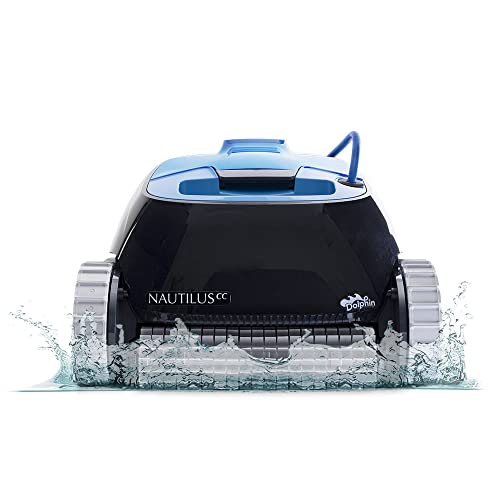
Dolphin Nautilus CC Robotic Pool Cleaner — Best straightforward Dolphin
If the Wi-Fi model is the scheduler’s choice, the original Nautilus CC is the pragmatist’s. It offers the same essential Dolphin proposition — an active scrubbing brush, genuine wall climbing, and a filter you reach from the top — in a simpler package that has been in private pools for years. That track record matters in a category where a robot lives outdoors, works underwater and is expected to survive seasons of chlorine, sunlight and being hauled out by its cable despite every manual saying not to.
The 33-foot guidance defines its territory honestly: the majority of domestic inground pools, plunge pools and courtyard pools sit comfortably inside it. Within that territory the Nautilus CC behaves predictably, which is a compliment. It climbs until the waterline, scrubs sideways along it, and returns to the floor without the random pinball pattern of cheaper cleaners. Owners upgrading from a suction-side cleaner will notice the difference in the corners first, because a robot carries its own pump and filtration and does not weaken as the main filter loads up.
- Format: corded robotic cleaner with active scrubbing brush
- Pool fit: above and in-ground pools up to 33 feet, per the listing
- Cleaning path: floor and wall climbing with waterline work
- Filtration: top-load filter access for quick rinsing
- Power: mains supply via cable, independent of the pool pump
- Operation: simple on-unit start, no app required
Strengths
- Long production history means brushes, filters and parts are easy to source
- Independent pump keeps suction steady even when the main pool filter is dirty
- Simple controls suit households where several people share pool chores
Trade-offs
- No scheduling app, so cleans start when somebody presses the button
- The stated size ceiling excludes longer lap-style private pools
- Cable management is the owner’s job, as with every corded robot
Best for: Owners of small to mid-size private pools who value a proven, uncomplicated machine over connected features.
Not suited for: Anyone wanting unattended weekly scheduling, or pools longer than the listing’s guidance.

Aiper Scuba S1 Robotic Pool Cleaner — Best cordless for larger pools
The Scuba S1 answers the objection that stops many private-pool owners buying a robot at all: the cable. Around a pool used by children, dogs and barefoot adults, a cord snaking from a power unit to the water is both a trip hazard and an eyesore, and in pools with wide surrounding decking the nearest weatherproof socket may be awkwardly placed. The S1 removes the cord entirely and still climbs walls and scrubs the waterline, which until recently was a combination cordless cleaners rarely managed with any conviction.
Its four cleaning modes give the owner a vocabulary for the pool’s actual week. A floor-only pass after a windy day, a wall-focused clean when the shaded end starts to feel slippery, a full routine before guests — the modes map onto real private-pool situations rather than existing as menu decoration. Smart navigation helps the battery go further, because a cordless robot that wanders wastes the one resource it cannot replenish mid-clean. The 1,600-square-foot rating places it in genuinely large domestic pools, well beyond plunge-pool territory.
- Format: cordless robotic cleaner, battery powered
- Pool fit: inground and above-ground pools up to 1,600 sq ft, per the listing
- Cleaning path: floor, wall and waterline scrubbing
- Modes: four cleaning modes including floor-focused and full routines
- Navigation: smart route planning to conserve battery
- Retrieval: parks for hook retrieval at the wall when the cycle ends
Strengths
- No cable across the deck, which suits family pools and awkward socket positions
- Mode choice lets owners match effort to the week’s actual debris
- Wall and waterline ability is rare at this level of cordless convenience
Trade-offs
- A forgotten charge means a missed clean; the routine needs a charging habit
- Runtime is finite, so heavily soiled large pools may need two cycles
- Battery longevity over many seasons is a consideration corded rivals avoid
Best for: Owners of larger private pools who dislike cables and will happily plug the robot in after each clean.
Not suited for: Set-and-forget households that know a charging routine would quietly collapse by August.

WYBOT C1 Cordless Robotic Pool Vacuum — Best long-runtime cordless value
The WYBOT C1 makes its case on endurance. A stated runtime of up to 160 minutes is substantial for a cordless machine, and in a private pool it changes how the cleaner gets used: instead of rationing the battery across a quick floor pass, the owner can let the robot complete a full floor, wall and waterline routine in one immersion. For pools that collect a weekend’s worth of debris between cleans — the holiday-home pool, the rental property, the house whose owners travel — that single-session completeness is the whole point.
App control and smart navigation round out a package aimed at owners who manage the pool partly from their phone already, alongside the pump timer and the heater. The C1’s four-in-one positioning covers the surfaces a private pool presents, and its suction is aimed at the mixed diet of leaves, grit and fine dust that garden pools collect. As with every cordless cleaner, the honest caveat is that maximum runtime figures describe favourable conditions; a pool bottom carpeted in wet leaves will ask more of the battery than a routine maintenance pass.
- Format: cordless robotic vacuum for inground pools
- Runtime: up to 160 minutes per the listing, mode dependent
- Cleaning path: floor, walls and waterline in one routine
- Control: app control with smart navigation
- Power: rechargeable battery, charged out of the water
- Filtration: internal basket emptied and rinsed by the owner
Strengths
- Long runtime supports complete single-session cleans of neglected pools
- App control fits owners already running pool equipment from a phone
- Cordless format keeps decks clear for swimmers and furniture
Trade-offs
- Best-case runtime shrinks under heavy debris and wall-heavy modes
- Needs a dry, sensible charging spot near the pool equipment
- Newer name than the Dolphin line, so long-term parts depth is less proven
Best for: Owners of intermittently used private pools who need one long, thorough clean rather than daily top-ups.
Not suited for: Daily-clean households better served by a scheduled corded robot that never needs charging.
Suction-Side Pool Cleaners — Prose-only: pump-powered alternative
Suction-side cleaners deserve their place in a private-pool guide because thousands of pools were plumbed for them. The cleaner connects to a suction port or the skimmer, and the pool’s own pump pulls it around the floor, sending debris into the main filter or a leaf canister. There is no battery to age, no cable to store and no electronics living underwater, and the purchase cost of the class is generally the lowest route into automatic cleaning. For a simple rectangular pool with a healthy pump, a suction cleaner can keep the floor respectable for years.
The compromises are structural. Most suction cleaners are floor specialists with limited wall ability, so the waterline scrubbing that distinguishes the robots above is largely absent. Their movement patterns range from programmed gear-driven routes to frankly random wandering, and their suction weakens exactly when the filter needs cleaning — which is when the pool is dirtiest. They also add runtime to the main pump, so the energy comparison with a self-contained robot is less favourable than the purchase price suggests. Discussed here as a class, in prose only, because models and fittings vary too much by plumbing to crown one fairly.
- Format: prose-only — cleaner class powered by the pool pump’s suction
- Pool fit: pools with a suction port or skimmer connection
- Cleaning path: predominantly floor, limited wall work
- Filtration: debris passes to the main filter or an inline leaf canister
- Power: no separate supply; adds load and hours to the main pump
- Tier: generally the budget route into automatic pool cleaning
Strengths
- No batteries, cables or underwater electronics to maintain
- Low entry cost where the plumbing already exists
- Runs whenever the pump runs, with nothing to schedule
Trade-offs
- Wall and waterline cleaning is minimal compared with scrubbing robots
- Performance fades as the main filter loads with debris
- Extra pump hours carry an ongoing energy cost
Best for: Owners with existing suction plumbing, a strong pump and a floor-focused cleaning need.
Not suited for: Pools where waterline film and wall algae are the visible problem.
In-Floor Cleaning Systems — Prose-only: built-in system
In-floor cleaning is the option private-pool owners daydream about: no robot in the water, no hose, nothing to store. Pop-up heads set flush into the pool floor rise in programmed zones and push water — and with it leaves, grit and silt — toward the main drain, while circulation improves as a side effect. In a new build designed around it, the system is genuinely elegant, and it suits architectural pools where a visible cleaner would spoil carefully composed lines.
It appears in this guide in prose only for an obvious reason: it is a construction system, not a product. Retrofitting means draining, cutting and re-plumbing the pool shell, a project whose cost dwarfs any robot in this guide and which only makes sense alongside a major renovation. Performance also depends on the original zone design and head placement; a poorly planned layout leaves quiet corners that no adjustment fully cures, and repairs to buried plumbing are disruptive. If you are building or rebuilding, discuss it seriously with your pool builder. If your pool already exists, the robots above are your realistic route to the same clean water.
- Format: prose-only — built-in pop-up head system, professionally installed
- Pool fit: new builds or pools undergoing major renovation
- Cleaning path: floor zones sweep debris toward the main drain
- Filtration: debris handled by the main filter at the drain
- Power: driven by the circulation pump through a distribution valve
- Tier: premium construction investment rather than an appliance purchase
Strengths
- Nothing visible in the water and nothing to store or charge
- Improves circulation and chemical distribution alongside cleaning
- No appliance to replace at the end of a product lifespan
Trade-offs
- Effectively impossible to retrofit without major construction
- Cleaning quality is fixed by the original design and head layout
- Buried plumbing faults are expensive and disruptive to repair
Best for: Owners designing a new private pool or planning a deep renovation anyway.
Not suited for: Anyone with a finished pool who wants cleaner water this season.
How Do the Six Picks Compare Side by Side?
| Pick | Type | Standout trait | Watch out for |
|---|---|---|---|
| Dolphin Nautilus CC Plus Wi-Fi | Corded robotic cleaner | App scheduling on a mains-powered robot that never needs charging | The power cable needs a sensible route from the supply unit to the water |
| Dolphin Nautilus CC Robotic Pool Cleaner | Corded robotic cleaner | Proven wall-climbing design with simple, durable controls | Sized for pools up to 33 feet, so longer private pools should step up |
| Aiper Scuba S1 Robotic Pool Cleaner | Cordless robotic cleaner | Cable-free wall and waterline cleaning for pools up to 1,600 sq ft | Battery discipline — it must be charged between cleaning days |
| WYBOT C1 Cordless Robotic Pool Vacuum | Cordless robotic cleaner | Long stated runtime for a cordless cleaner, with app control | Runtime depends on mode and pool condition; heavy leaf loads shorten it |
| Suction-Side Pool Cleaners | Prose-only alternative class | Uses existing pool plumbing and the main pump | Cleaning power depends entirely on pump condition and filter state |
| In-Floor Cleaning Systems | Prose-only built-in system | No visible cleaner in the water at all | A construction decision, not a product you can buy and drop in |
Read the comparison with your pool’s shape in mind. The two Dolphins trade app features against simplicity on the same corded, wall-climbing foundation, while the Aiper and WYBOT remove the cable at the cost of a charging habit. The prose-only rows are not lesser entries; they are different categories of decision — one exploits plumbing you may already own, the other belongs in a builder’s specification rather than a shopping basket.
What Makes a Private Pool Different from an Above-Ground Pool?
Construction changes everything about cleaning. A private inground pool has rigid walls of concrete, fibreglass or vinyl over a solid structure, finished with tile, plaster or liner that a climbing robot can grip and scrub. An above-ground pool’s walls flex, its liner is thinner, and many robots simply cannot climb it safely. That is why this guide insists on wall-rated machines: the private pool can accept them, and its surfaces reward them, because the grime line forms exactly at the waterline those machines reach.
The debris profile differs too. Private pools sit in landscaped gardens, often permanently, accumulating leaf litter, soil splash, pollen and the fine dust that blows off planting beds. They are also used more deliberately — morning laps, evening swims, weekend gatherings — so bathers notice a gritty floor and a filmed wall far sooner than in a paddling pool. The cleaner for a private pool is therefore judged on finish quality, not just debris removal.
Should You Choose a Cable or a Battery for a Private Pool?
The cable question is really a lifestyle question. A corded robot like either Dolphin can run long, repeated cycles on a schedule, draws modest power, and will still be working in a decade with nothing more exotic than brush and filter replacements. Its cable, floated on the water and routed from a power unit at the poolside, is a minor management task that most owners solve in the first week by choosing where the unit lives.
A cordless robot removes the cable and the poolside power unit from the picture, which suits pools surrounded by entertaining space and households that hate visual clutter. The exchange is a new chore — lifting the machine out, rinsing it, and putting it on charge — plus a battery that will eventually hold less than it did. Neither answer is wrong. The owners who regret their choice are usually those who bought cordless convenience while living a scheduled-routine life, or bought a scheduled corded machine for a pool whose deck made the cable a daily irritation.
How Well Do These Cleaners Handle Walls and the Waterline?
Wall cleaning is where private-pool robots earn their premium. Algae begins as an invisible film on shaded walls; left alone it becomes the slippery footing and green tint that make a pool feel neglected even when the floor is spotless. A climbing robot’s brush agitates that film on every pass, keeping the surface ahead of the problem. The waterline is the other critical band, because body oils, sunscreen and airborne dust concentrate there into a visible scum line that no floor cleaner touches.
All four linked robots climb and scrub at the waterline, which is precisely why they are the linked four. Judge any alternative you consider against that standard. A cleaner that stays on the floor may keep a private pool hygienic, but it will leave the two most visible surfaces — the wall you see through the water and the line you see at eye level from the deck — to your own brush and arm.
How Do You Match a Cleaner to Your Pool’s Size and Shape?
Start with the longest dimension, because a robot’s stated pool length assumes it can physically traverse the water it claims to clean. Then consider surface area for the cordless models, whose batteries budget energy by the square foot. A long, narrow lap pool and a square leisure pool of identical area ask different things of navigation: the lap pool rewards methodical lengthwise passes, while the square pool with steps, benches and a tanning ledge rewards a cleaner that recovers gracefully from interruptions.
Features matter as much as dimensions. Roman steps, swim-out benches, raised spas and beach entries all break a cleaning pattern into segments. Robots with smarter navigation handle that fragmentation better, while simpler machines may need the owner to start them from different points on different days. None of this is a defect; it is the normal matching work of buying for a specific pool rather than for a category average.
What Does Filtration Fineness Mean for Water That Looks Clean?
A private pool can pass a debris test and still look dull, because the last element of sparkle is fine-particle removal. Silt, dead algae and dust small enough to drift will settle overnight into a grey veil on the floor. A coarse basket catches leaves beautifully and lets that veil straight through, so the owner sees a cleaner that works hard while the water never quite gleams.
Finer filtration — whether a pleated cartridge option or a well-sealed basket system — is what closes that gap. It also loads faster, which is the honest trade: the better a robot filters, the more often its filter deserves rinsing. In a private pool used for evening swims under lights, where every particle shows, that trade is almost always worth making, and it is why filter design weighed heavily in our choosing.
How Should a Private Pool Cleaner Fit Your Weekly Routine?
The sustainable routine is the one matched to how the household actually lives. A scheduled corded robot suits the pool that must simply be ready — the family that swims after school, the grandparents expecting visitors, the owner who travels and returns to water that has been maintained in their absence. Its routine is set once and audited occasionally.
A cordless robot suits the ritual-minded owner who is at the poolside anyway: skimming after a storm, checking the water, putting the cleaner in as part of a Saturday circuit and charging it beside the other garden equipment. Both routines fail the same way when they are aspirational rather than real. Before choosing, ask which version of yourself — scheduler or ritualist — has actually shown up for the last three summers.
What Maintenance Does an Automatic Cleaner Still Need?
Automation removes labour, not stewardship. Filters need rinsing after debris-heavy cleans and inspecting for tears each month. Brushes wear, and a worn brush quietly converts a scrubbing robot into a merely sucking one, so check them at the season’s start and midpoint. Cables should be coiled loosely rather than wound tight, stored out of harsh sun, and never used as the handle for lifting a water-filled robot from the pool.
Cordless models add battery care: charge after use rather than storing the machine empty, keep contacts clean and dry, and follow the maker’s guidance on winter storage. In-floor and suction systems shift the burden to the main filter and pump instead. Whichever route you choose, ten attentive minutes a week is the realistic price of a cleaner that lasts — far less than the manual vacuuming it replaces, but not zero.
When Is a Robot Not the Right Answer for a Private Pool?
Honesty requires naming the cases. A pool mid-renovation, where in-floor cleaning can still be designed in, should not rush into a robot that construction would make redundant. A pool with a failing pump and existing suction plumbing may get more clean per unit of spending by fixing the pump and running a suction cleaner well. And a pool used twice a summer may not justify any automation beyond a manual head and an hour of somebody’s time.
There is also the shape problem: very freeform pools with tight coves, islands and dense water features can defeat any robot’s pattern, leaving the owner to finish by hand often enough that the automation premium stops making sense. In those pools, a hybrid approach — robot for the open water, manual brush for the architecture — is the grown-up answer, and it is how many owners of elaborate pools actually live.
How Does the Season Change What Your Cleaner Must Do?
Spring opening asks the most of any cleaner. A private pool waking from winter carries settled silt, early algae and whatever the cover let through, and the first cleans should be treated as restoration rather than maintenance. Run the robot repeatedly, rinse its filter between cycles without fail, and expect the waterline to need the scrubbing passes more than the floor. Owners who judge a new robot by its spring-opening weekend alone judge it at the hardest moment of its year.
High summer shifts the burden to biology and bathers. Warm water grows film faster, sunscreen loads the waterline daily, and storms deliver sudden leaf falls that can choke a basket in a single cycle. This is the season where scheduling proves itself, because a pool cleaned three times a week never accumulates the backlog that makes a cleaner look inadequate. Short, regular cleans beat heroic weekend sessions in every month the water is warm.
Autumn is a debris race. Leaf fall can exceed any basket’s capacity, and the wise owner skims the surface before sending the robot down, so its filtration is spent on the fine material it handles best rather than on a sodden mat of leaves. As temperatures fall, reduce the cadence gradually, keep the waterline scrubbed while the pool is still in use, and plan the cleaner’s own winter preparation before the first frost rather than after it.
What Should You Check in the First Fortnight of Ownership?
The first two weeks with a new robot teach you your pool’s geography. Watch where the machine hesitates: the step corner it climbs awkwardly, the bench it treats as a wall, the cove where silt gathers because no pattern quite reaches it. Most pools have one such spot, and learning yours early lets you compensate — starting the cleaner from a different edge on alternate days, or accepting a thirty-second manual touch-up as part of the routine rather than a verdict on the machine.
Check the filter after every early clean, not to judge the robot but to learn the pool. A basket full of fine grey silt tells a different story from one full of leaf fragments: the first suggests your filtration fineness is doing real work, the second suggests surface skimming before cleans will pay. Note what the waterline looks like after a week of scrubbing passes, because that band is the most honest report card a private-pool cleaner receives.
Finally, settle the logistics while enthusiasm is high. Decide where a corded power unit lives permanently, where a cordless machine charges, where the rinsed filter dries, and who in the household owns the routine. Cleaners fail socially before they fail mechanically: the robot nobody is responsible for is the robot that stops being used, whatever its specifications promised.
How Do Running Costs Compare Across the Four Robots?
A corded robot’s running costs are the easiest to predict: modest electricity per cycle, replacement brushes and filters on a seasonal rhythm, and no major component with a built-in lifespan. Spread across years of weekly cleans, the cost per clean falls steadily, which is why long-owned Dolphins develop such loyal followings among private-pool households that track what things actually cost them.
Cordless ownership front-loads convenience and back-loads a battery question. The electricity is trivial; the real figure is the eventual battery replacement or the machine replacement it triggers, divided by the seasons of cable-free cleaning it bought. Owners who clean frequently and store the battery sensibly stretch that figure furthest. Neither route involves the ongoing pump hours that suction-side cleaning quietly adds to a household’s electricity bill, a cost in-floor systems also carry through their dependence on the circulation pump.
The comparison that matters is against the alternatives in your own life: a weekly service visit, your own hours with a pole, or a pool that gets used less because it looks less inviting. Against any of those, a robot that runs for years is inexpensive. The expensive cleaner is the one bought twice — first the wrong size or type, then its replacement — which is why this guide keeps returning to measurement and routine.
How Do You Read a Pool Cleaner Listing Without Being Misled?
Every figure in a pool robot listing describes a favourable version of reality, and the private-pool owner should translate rather than simply believe. A runtime measured on a clean floor in a test pool becomes shorter against algae film and leaf litter. A coverage figure assumes an unobstructed rectangle, while your pool offers steps, benches and a ladder. None of this makes the figures useless; it makes them ceilings. Buy the cleaner whose ceiling sits comfortably above your pool’s reality and the machine will feel strong in daily use.
Pay closer attention to the unglamorous lines: filter access, brush type, cable length, stated pool length, and whether wall climbing is claimed in plain words. Those details predict ownership satisfaction far better than the headline numbers, because they describe the machine you will handle weekly. A robot with top-load filtration and an active brush will please its owner on an ordinary Tuesday in a way a slightly faster wanderer never will.
What Does Good Pool Coverage Actually Look Like from the Deck?
Watch a full cycle once, properly, before deciding any cleaner is failing. A methodical robot revisits areas deliberately, and early overlap is not wasted motion; it is how systematic patterns guarantee the corners. What should concern you is repetition of the same miss — the crescent behind the ladder, the step tread, the deep-end curve — appearing cycle after cycle. A single missed patch after a storm is weather; the same patch in three consecutive cleans is information.
Judge the walls at the end of the cycle, not during it. A climbing robot may work the floor first and the walls later, and the waterline band only shows its improvement once the scrubbing passes finish and the loosened film is filtered. The deck-level test the next morning — clear water, clean line, grit-free footing — is the verdict that counts, and it is the test every cleaner in this guide was chosen to pass.
How Should You Pair a Robot with Skimming and Brushing by Hand?
The robot does not abolish the other tools; it demotes them to supporting roles. A surface skim before a clean keeps leaves out of the basket and lets filtration concentrate on fines. A hand brush still owns the tight architecture — behind ladders, inside skimmer throats, along grout details a robot’s brush cannot reach — but it now appears for five targeted minutes instead of an hour of full-pool labour.
Think of the division as heavy versus detailed work. The machine supplies hours, coverage and consistency. You supply judgement: noticing the stain that needs treatment, the corner that needs a nudge, the filter that needs rinsing before rather than after a cycle. Owners who keep that small supervisory role get pools that look professionally kept; owners who abdicate it entirely eventually meet a problem the machine quietly worked around for weeks.
Which Pool Surfaces Suit Which Kind of Cleaner?
Plaster and pebble finishes tolerate vigorous scrubbing and reward it, because their texture holds film in tiny recesses that suction alone cannot clear. Tile is smoother and shows the waterline band most starkly, so climbing and scrubbing matter there for appearance as much as hygiene. Fibreglass presents a slick surface that some climbers grip less confidently on steep walls, making a watched first cycle worthwhile. Vinyl asks for the gentlest judgement: confirm the maker’s surface guidance, keep brushes supple and undamaged, and treat any trapped grit under the machine as the real enemy rather than the machine itself.
A private pool’s surface also ages, and an older plaster finish with rough patches will slow any robot and wear brushes faster. That is not a reason to avoid automation; it is a reason to budget brushes as consumables and to value the models whose replacement parts are easiest to obtain. The Dolphins score quietly well here, because long production runs leave deep parts pipelines behind them.
How Do You Troubleshoot a Cleaner That Seems to Miss Spots?
Begin with the filter, because a loaded basket or clogged cartridge strangles suction and climbing grip alike, and owners routinely diagnose navigation faults that vanish after a thorough rinse. Next, inspect the brushes for wear and for wound hair, string or fibrous debris that changes how the machine sits on the surface. Then look at the pool itself: a new obstacle, a shifted ladder, a toy left on the floor can redraw a robot’s map of its world.
If the misses survive those checks, change the starting point. Dropping the cleaner in from a different edge alters its pattern enough to cover a stubborn zone in many pools, and alternating start points across the week is a legitimate technique rather than an admission of defeat. Persistent failure on one wall, especially a sunny wall where film grows fastest, usually means that wall needs a manual brush pass before the robot’s maintenance rhythm can hold it — a five-minute intervention that restores the partnership.
A Short Word on Safety Around Automated Cleaners
Water and electricity deserve their usual respect. Corded robots use low-voltage power in the pool with the supply unit kept at the poolside, and that arrangement only stays safe when the unit is positioned as the maker directs, kept dry, and connected through a properly protected outdoor socket. Nobody should be in the water during a cycle, and the cable should be lifted clear before swimmers return, so the deck goes back to being a barefoot place.
Cordless machines remove the socket from the scene but add charging discipline: charge them dry, away from the water, on a surface that tolerates a dripping machine being set down nearby. Store both types where children cannot treat them as ride-on toys and where their weight — considerable when full of water — will not be lifted carelessly. These are ordinary precautions, quickly habitual, and they are the whole safety story when the equipment is used as designed.
One Last Check Before You Order
Walk the pool’s longest dimension with a tape, count the features that interrupt the floor, decide honestly whether a cable or a charging lead fits your household’s habits, and only then choose between the four linked robots. That ten-minute audit, done before ordering rather than after delivery, is what separates the owners who praise their cleaner for years from those who return a perfectly good machine that was simply bought for a different pool and a different life.
What Mistakes Do Private Pool Owners Make When Buying a Cleaner?
The commonest mistake is buying for the pool you wish you had. Owners measure nothing, order a cleaner rated below their pool’s length, and then blame its navigation for the far end it was never sized to reach. Measure the longest dimension, count the steps and benches honestly, and buy the rating that covers the pool as built.
The second mistake is ignoring the waterline. A household that entertains sees its pool from deck chairs, at waterline eye level, and the scum line is the first thing guests notice. Choosing a floor-only cleaner to save money, then hand-scrubbing the tile band weekly, is a false economy that this guide’s linked four exist to prevent.
The third mistake is neglecting the filter routine until performance collapses. A robot with a choked basket cleans badly and gets reviewed unfairly in the owner’s mind. Rinse after heavy cleans, deep-clean the filter monthly, and replace worn brushes on schedule; the machine you maintain is a different machine from the one you neglect.
Final Recommendation
For most private pools, the Dolphin Nautilus CC Plus Wi-Fi is the recommendation we would defend at the poolside: mains-powered, wall-climbing, waterline-scrubbing and scheduled, it delivers the specific luxury a private pool promises, which is water that is ready whenever you are. Owners who want the same Dolphin virtues without the app should take the Nautilus CC without hesitation, while cable-averse households are genuinely well served by the Aiper Scuba S1 for larger pools and the long-running WYBOT C1 for pools cleaned in thorough, less frequent sessions.
Choose by routine first and specification second, because the cleaner that fits your habits will still be working for you in five summers while the theoretically superior machine gathers dust in the equipment shed.
Frequently Asked Questions
Can a robot cleaner replace my pool service entirely?
For routine floor, wall and waterline cleaning, a good robot covers most of what a weekly service visit does mechanically. It does not test or balance water chemistry, inspect the pump and heater, or notice a failing seal. Many private-pool owners pair a robot with less frequent professional visits for chemistry and equipment, which is usually the sensible middle path.
Will a wall-climbing robot damage a vinyl liner?
Robots designed for inground pools are built to work on vinyl as well as plaster, tile and fibreglass, but the owner should confirm the listing’s surface guidance and keep brushes in good condition, since a damaged brush or trapped grit is what marks liners. Pleated or patterned liners with deep creases deserve a test run watched from the deck.
How often should a private pool robot run?
Two to three full cleans a week suits most household pools in season, rising after storms, heavy leaf fall or parties. Scheduled corded models make that cadence effortless; cordless owners should tie runs to their charging routine so the habit survives busy weeks.
Why does my pool still look cloudy after the robot has run?
Cloudiness is usually a chemistry or main-filtration issue rather than a vacuuming failure. The robot removes settled debris from surfaces; suspended particles and unbalanced water belong to the circulation filter and the test kit. Run the pump, check the chemistry, and clean the main filter before blaming the cleaner.
Can I swim while the robot is cleaning?
Makers generally advise against swimming during a clean, and corded models add an obvious electrical reason to keep the water empty. Treat the cycle as a closed session: put the robot in after the morning swim, retrieve it before the afternoon one, and the rule costs nobody anything.
What should I do with the cleaner over winter?
Rinse it thoroughly, let it dry out of the water, clean its filter, and store it in a sheltered place away from frost and direct sun. Cordless models should follow their maker’s storage charge guidance. A cleaner stored clean starts the spring season working; one stored dirty starts it as a repair project.
Related Guides
Pool care at a private home rarely stops at the water itself, and neither do our guides. If the same household also wrestles with tracked-in grit in the car, family vehicles and everyday floors, these companion guides cover the neighbouring jobs with the same evidence-first approach: Best Car Vacuums for Pet Hair Best Affordable Shark Bagless Vacuums Best Vacuums Overall Best Robotic Vacuums for Above-Ground Pools


