What's inside
- Key Takeaways
- Quick Picks
- How Did We Approach a Category Where Bagless Is the Exception?
- How Do the Six Picks Compare Side by Side?
- Why Are Most Backpack Vacuums Bagged in the First Place?
- What Would a Genuinely Bagless Backpack Have to Prove?
- How Do You Fit and Wear a Backpack Vacuum Correctly?
- How Should Crews Service Backpacks Between Shifts?
- What Does the Backpack Format Mean for Domestic Users?
- How Do Running Costs Compare Across These Machines?
- How Does Backpack Cleaning Change Times on Real Buildings?
- What Training Does a New Backpack Operator Need?
- How Should Buyers Read Capacity Figures on Backpacks?
- A Note on Hearing, Posture and the Long Career
- How Do Backpacks Compare with Canisters for the Same Buildings?
- What Should a Small Cleaning Business Buy First?
- How Does the Bagless Question Play Out over Five Years?
- What Accessories Actually Matter for a Backpack?
- How Should You Trial a Backpack Before Committing a Crew?
- How Do You Store and Transport a Backpack Vacuum?
- Why Does This Guide Refuse to Fake a Longer Bagless List?
- How Do Seasonal and Event Workloads Test the Format?
- What Does a Sensible Specification Sheet Ask For?
- How Should a Household Share a Backpack with Different-Sized Users?
- One Last Check Before You Order a Backpack Vacuum
- How Do You Clean the Backpack Itself?
- A Brief Word on Trying the Format Before the Fleet
- Why Operators Develop Loyalty to One Harness
- What Mistakes Do Buyers Make in This Category?
- Final Recommendation
- Frequently Asked Questions
- Related Guides
As an Amazon Associate I earn from qualifying purchases. This post may contain affiliate links at no extra cost to you.
cottageverdict.com is reader-supported. When you buy through links on our site, we may earn an affiliate commission.
Where to buy: the three backpack vacuums reviewed in detail below are sold on Amazon, and their linked names lead to the listings where you can check price on Amazon and confirm the stated capacity and configuration before ordering.
This guide begins with the honest fact its title tries to wish away: most backpack vacuums are bagged. The best bagless backpack vacuums are a narrow, specialised corner of a market that overwhelmingly chose disposable filter bags, and it chose them for reasons — dust control, filtration consistency and fast servicing between shifts — that any fair guide must explain. What follows is therefore two things at once: a review of the closest genuine options a bagless-minded buyer can purchase, presented without pretending their dust systems are something they are not, and a clear account of the bagged mainstream against which they compete.
Backpack vacuums exist because some cleaning cannot be done at upright speed. Stairwells, theatre rows, office floors dense with desks, aircraft cabins, school corridors between lessons — these are environments where the cleaner must move continuously, turn in tight spaces, and carry the machine rather than push it. The backpack format trades the upright’s planted power for mobility, and its users are overwhelmingly professionals: cleaning crews, facilities teams, and a minority of homeowners with large, stair-heavy houses who have adopted the professional tool.
That professional heritage explains the bagged dominance. A crew emptying a vacuum mid-shift wants a sealed bag swapped in seconds, not a cup shaken out over a bin; a facilities manager wants filtration that performs identically on day one and day thirty of a bag’s life. Bagless backpack design must answer those users or find different ones — homeowners tired of bag costs, small crews cleaning dusty rather than fine debris, operators who value a washable, reusable system. The three linked machines below are assessed for exactly those readers, with their dust arrangements described precisely.
We have linked only three products rather than padding the list to a false symmetry, and the remaining places are prose-only discussions of the bagged benchmarks — the Hoover Commercial Shoulder Vac Pro and HushTone backpacks — plus the commercial use-cases that decide whether any backpack, bagged or bagless, belongs in your life at all. A short list with honest labels serves the reader better than a long one with borrowed claims.
Key Takeaways
- True bagless backpack vacuums are rare because professional users prize sealed bag swaps and consistent filtration; buyers should verify any model’s dust system on its listing rather than trusting category labels.
- The ProTeam Super Coach Pro line anchors this guide, but its intercept filter system is bag-based — we present it as the benchmark backpack platform, honestly labelled, not as a bagless machine.
- The Sanitaire Transport is the cordless direction of travel: battery freedom for crews, with servicing discipline deciding its real-world cost.
- Hoover’s Shoulder Vac Pro and HushTone, discussed in prose, show what the bagged mainstream does best — light weight, quiet running and HEPA media filtration.
- Choose a backpack for mobility-critical spaces: stairs, dense offices, venues and transport, where an upright’s turning circle is the bottleneck.
Quick Picks
| Pick | Badge | Why it earns its place |
|---|---|---|
| ProTeam Super Coach Pro 10 Backpack Vacuum | Benchmark backpack platform — bag-based filtration, stated plainly | The 10-quart commercial benchmark with a two-piece wand kit; its intercept micro filter system uses disposable bags, which we flag honestly rather than calling it bagless. |
| ProTeam Super Coach Pro 6 Backpack Vacuum | Lighter ProTeam for tighter spaces — bag-based, stated plainly | The six-quart sibling with a telescoping wand kit, lighter on the back and nimbler in furnished spaces; like its brother, it uses intercept filter bags. |
| Sanitaire Transport Cordless Backpack Vacuum | Best cordless backpack direction | A battery backpack with dual 24-volt batteries, adjustable wand and handheld controls — the cable-free route for crews moving through complex spaces. |
| Hoover Commercial Shoulder Vac Pro Backpack | Prose-only: the bagged mainstream, lightweight champion | A lightweight, chiropractor-endorsed-design bagged backpack with HEPA media filtration — the comfort benchmark of the bagged mainstream. |
| Hoover Commercial HushTone Backpack Vacuum | Prose-only: the bagged mainstream, quiet specialist | A two-speed bagged backpack with HEPA filtration and an ergonomic harness, built for cleaning occupied spaces without announcing itself. |
| Commercial Cleaning Use-Cases: When a Backpack Earns Its Place | Prose-only: the decision framework | The prior question — whether your spaces reward mobility over planted power — decided by stairs, seating, desk density and shift length. |
How Did We Approach a Category Where Bagless Is the Exception?
Our first task was definitional honesty. A backpack vacuum’s dust system is a fact stated on its listing — disposable intercept bags, a cloth shake-out bag, or a cup — and we resolved to describe each linked machine’s arrangement exactly as its maker specifies, flagging where a model often swept into ‘bagless’ round-ups is in truth a bagged design. Readers shopping under this title deserve to learn that from us before purchase, not from the box afterwards.
Eligibility for a linked place required three things: a genuine backpack format from a recognised commercial maker, availability as a single purchasable machine, and a defensible reason for a bagless-minded buyer to consider it — whether that is a reusable filtration path, unusually low consumable dependence, or a platform whose servicing economics approach bagless running. The ProTeam pair qualify as the category’s reference platforms, with their bag-based intercept systems stated in plain words in their sections. The Sanitaire qualifies as the cordless option crews actually deploy.
The prose-only places went to the two Hoover benchmarks, because no honest account of backpack vacuums can omit the machines that define the bagged mainstream, and to a discussion of commercial use-cases, because the prior question — backpack or not — matters more than any contest within the format. This structure is unusual, and deliberately so: the category is unusual, and the guide mirrors it rather than disguising it.

ProTeam Super Coach Pro 10 Backpack Vacuum — Benchmark backpack platform — bag-based filtration, stated plainly
Accuracy first: the Super Coach Pro 10 cleans through an intercept micro filter bag system, so it is not a bagless vacuum, and this guide will not pretend otherwise. It earns the lead position because it is the platform against which every backpack — bagged or bagless — is measured, and because a reader researching this category needs to understand what the mainstream benchmark looks like before judging the exceptions. Its ten-quart capacity is the largest here, sized for long shifts across big floor plates without a servicing stop.
As a working tool it is exemplary. The harness distributes the load across the hips rather than the shoulders, the two-piece wand kit covers floors and above-floor work, and the machine’s filtration stages protect both the motor and the room’s air. For a buyer whose real priority is lowest lifetime fuss in dusty commercial debris, the honest recommendation may be this bagged benchmark rather than a nominally bagless rival — and a guide that cannot say so is not worth its title. Bag costs are real but modest per shift, and the sealed swap is the cleanest emptying action in this entire article.
- Format: corded commercial backpack vacuum, 10-quart capacity
- Dust system: disposable intercept micro filter bags — bagged, not bagless
- Kit: two-piece wand tool kit for floors and above-floor work
- Harness: ergonomic load distribution for long shifts
- Filtration: multi-stage, protecting motor and room air
- Use pattern: large offices, schools, venues and contract crews
Strengths
- Huge capacity minimises servicing stops on big floor plates
- Sealed bag swaps are fast and dust-free between shifts
- Deep professional ecosystem of parts, bags and harnesses
Trade-offs
- Bagged by design — consumable bags are a permanent running cost
- Corded format ties the operator to a moving cable route
- Ten-quart size is more machine than small homes need
Best for: Facilities teams and large-space cleaners who want the proven benchmark and accept bags.
Not suited for: Buyers committed to bagless running on principle or for consumable cost reasons.

ProTeam Super Coach Pro 6 Backpack Vacuum — Lighter ProTeam for tighter spaces — bag-based, stated plainly
The Super Coach Pro 6 applies the same honest labelling: its intercept system is bag-based, and we describe it as such. What the six-quart model offers is the ProTeam platform tuned for density rather than acreage — furnished offices, classrooms, healthcare waiting areas and hospitality floors where the operator turns constantly and a smaller canister clears chair legs, door frames and their own fatigue more easily. The telescoping wand kit adjusts to the operator rather than the other way round, a detail that matters across a four-hour shift.
For the bagless-minded reader, the Pro 6’s lesson is about where the consumable argument is weakest. In tight, furnished, people-adjacent spaces, the sealed bag’s dust control and the platform’s filtration consistency are doing real work, and the bag cost per clean is small against the labour it supports. A homeowner with a large, stair-heavy house — the domestic user this format quietly serves — will find the Pro 6 the most liveable of the big professional machines, provided they accept the bag system with open eyes.
- Format: corded commercial backpack vacuum, 6-quart capacity
- Dust system: disposable intercept micro filter bags — bagged, not bagless
- Kit: telescoping wand tool kit, adjustable to the operator
- Harness: ergonomic, sized for manoeuvrability in furnished spaces
- Filtration: multi-stage system shared with the Pro line
- Use pattern: offices, classrooms, hospitality and large stair-heavy homes
Strengths
- Lighter, nimbler package for furnished and populated spaces
- Telescoping wand suits multiple operators sharing one machine
- Same parts and bag ecosystem as the larger Pro 10
Trade-offs
- Bagged system, with bags as an ongoing purchase
- Six quarts fills faster on construction-adjacent debris
- Cord management in furnished rooms takes practice
Best for: Crews and homeowners working furnished, obstacle-rich spaces for long stretches.
Not suited for: Anyone whose brief is strictly bagless, or very large open floor plates.
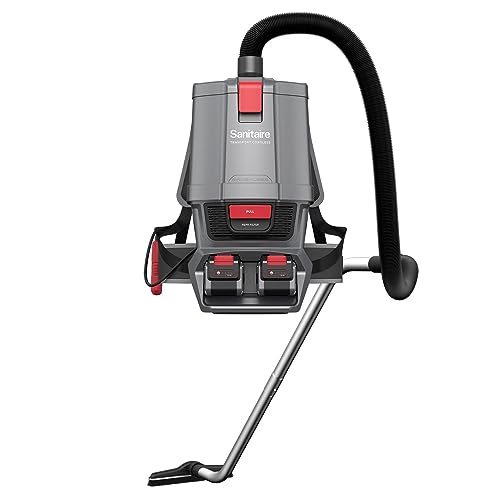
Sanitaire Transport Cordless Backpack Vacuum — Best cordless backpack direction
The Sanitaire Transport removes the backpack’s last tether. A corded backpack frees the operator from pushing a machine but still trails a cable through the very stairwells and seating rows the format exists to conquer; the Transport’s dual-battery system cuts that cord, and the working difference in theatres, transport and multi-level venues is immediate. Handheld controls keep the operator’s hands on the wand rather than reaching for the canister, and the adjustable wand preserves the ergonomic argument that justifies wearing a vacuum at all.
Buyers should confirm the current dust configuration on the listing before ordering, as commercial lines revise filtration arrangements, and should think in systems: batteries rotating through chargers, a servicing point, spare consumables stocked where the machine lives. Cordless commercial cleaning rewards organised operators and punishes improvisers, because a flat battery at hour three is a logistics failure, not a product failure. For a small crew or a large home where cable routes are genuinely hostile, the Transport is the most forward-looking machine in this guide.
- Format: cordless commercial backpack vacuum
- Power: dual 24V batteries, rotated and charged between sessions
- Controls: handheld controls on the wand
- Wand: adjustable length for operator fit
- Dust system: confirm current configuration on the listing before ordering
- Use pattern: venues, transport, stairwells and cable-hostile spaces
Strengths
- Complete freedom of movement in complex, multi-level spaces
- Dual batteries support a rotation system for longer work
- Handle controls keep operation fast and eyes-up
Trade-offs
- Battery logistics must be organised or the machine sits idle
- Cordless commercial pricing sits above corded equivalents
- Dust configuration should be verified at purchase time
Best for: Crews working stairs, seating rows and venues where cables are a genuine obstacle.
Not suited for: Single-operator users who would not maintain a battery rotation habit.
Hoover Commercial Shoulder Vac Pro Backpack — Prose-only: the bagged mainstream, lightweight champion
The Shoulder Vac Pro is what the bagged mainstream looks like when it concentrates on the operator. It is notably light for a backpack vacuum, its harness design was developed with chiropractic input to keep the load off vulnerable backs, and its HEPA media filtration suits the schools, clinics and offices where air quality is specified rather than hoped for. Crews who wear a vacuum all day choose machines like this for reasons that have nothing to do with bags and everything to do with still standing comfortably at the shift’s end.
We discuss it in prose only, clearly labelled bagged, because it is a benchmark rather than a candidate for a bagless buyer — and because its existence disciplines the whole category. Any genuinely bagless backpack must eventually answer the Shoulder Vac Pro’s question: can you match this weight, this filtration and this operator comfort without the bag? Until the answer is plainly yes, the mainstream’s choice remains rational, and this guide’s honesty about that is the service it exists to provide.
- Format: prose-only — corded bagged backpack vacuum
- Dust system: disposable bags with HEPA media filtration
- Design focus: lightweight carry, ergonomic harness
- Floor range: carpet and hard floors in commercial settings
- Use pattern: schools, clinics, offices and daily crew work
- Status: bagged mainstream benchmark, not a bagless option
Strengths
- Among the lightest full backpacks to wear for a shift
- HEPA media filtration suits air-quality-specified buildings
- Ergonomic design reduces the format’s main occupational cost
Trade-offs
- Bagged — bags are a permanent consumable
- Corded, with the usual cable-route management
- Capacity is modest beside the ProTeam Pro 10
Best for: Operators who wear a backpack daily and prioritise their back and the building’s air.
Not suited for: Bagless-committed buyers; this is the alternative, not the answer.
Hoover Commercial HushTone Backpack Vacuum — Prose-only: the bagged mainstream, quiet specialist
The HushTone’s defining idea is temporal: it lets cleaning happen while a building is in use. Its two-speed motor offers a quieter mode for occupied offices, hotels, healthcare and education settings where the traditional contract — cleaning happens after hours — is breaking down. HEPA filtration and an ergonomic harness complete a specification aimed at professional reality rather than at any single headline figure.
Like the Shoulder Vac Pro, it appears here in prose, labelled bagged without apology, because it defines a standard the bagless corner has yet to meet. Daytime cleaning is the industry’s direction of travel, and noise is its gatekeeper. A reader who came for bagless and leaves understanding that their true requirement is quiet daytime operation has been given the more valuable answer, even if it arrives wearing a bag.
- Format: prose-only — corded bagged backpack vacuum
- Motor: two-speed, with a quieter mode for occupied spaces
- Filtration: HEPA filtration with disposable bags
- Harness: ergonomic design with extension wand
- Floor range: carpet and hard floors, commercial settings
- Status: bagged mainstream benchmark for noise-sensitive work
Strengths
- Quiet mode enables cleaning in occupied buildings
- Two speeds let operators trade power against discretion
- HEPA filtration suits sensitive environments
Trade-offs
- Bagged consumables continue for the machine’s life
- Quiet mode cleans more gently by design
- Corded format, with cable management as usual
Best for: Daytime cleaning teams in hotels, offices, schools and healthcare.
Not suited for: Bagless seekers, or night crews for whom noise is irrelevant.
Commercial Cleaning Use-Cases: When a Backpack Earns Its Place — Prose-only: the decision framework
Backpacks earn their premium where movement is the work. A cinema’s stepped aisles, a school’s corridor-and-classroom rhythm, an open-plan office’s forest of desk legs, a church’s pews, a train’s carriage — in each, an upright or canister spends its shift being parked, turned and repositioned, while a backpack simply walks and cleans. Time studies in the industry consistently favour the format in dense spaces, which is why contract cleaners specify it despite the training a harness requires.
The counter-case deserves equal clarity. Open, empty floors — warehouses, halls between events, large retail plates at night — reward wide uprights and ride-on machines, and a backpack there is an affectation that tires an operator for no gain. Homes sit between: a large, stair-heavy, furniture-dense house can justify a backpack handsomely, while a compact flat cannot. Decide from your floorplan and your shift pattern, and the bagged-versus-bagless question becomes the second decision rather than the first — which is the order this guide has argued for throughout.
- Format: prose-only — use-case framework, not a product
- Backpack wins: stairs, seating rows, dense desks, transport, pews
- Backpack loses: open empty floors better served by wide uprights
- Home fit: large, stair-heavy, furnished houses only
- Deciding factors: turning density, shift length, operator training
- Sequence: format first, dust system second
Strengths
- Prevents the costliest error — buying the format for the wrong building
- Explains the professional market’s actual purchasing logic
- Gives homeowners a fair test for their own floorplan
Trade-offs
- No product to buy at the end of the reasoning
- Time savings depend on operator training with the harness
- Dense-space advantages vanish in open-plan emptiness
Best for: Any buyer, commercial or domestic, before they compare individual models.
Not suited for: Readers who have already matched format to building and need model detail only.
How Do the Six Picks Compare Side by Side?
| Pick | Type | Standout trait | Watch out for |
|---|---|---|---|
| ProTeam Super Coach Pro 10 Backpack Vacuum | Corded backpack vacuum (bag-based intercept filtration) | Large 10-quart capacity and a mature professional ecosystem | It uses disposable intercept bags — budget and stock them as consumables |
| ProTeam Super Coach Pro 6 Backpack Vacuum | Corded backpack vacuum (bag-based intercept filtration) | Same platform virtues in a smaller, more agile package | Smaller capacity means more frequent bag checks on debris-heavy sites |
| Sanitaire Transport Cordless Backpack Vacuum | Cordless backpack vacuum | Dual-battery cordless freedom with controls on the handle | Confirm the dust configuration on the listing and plan battery rotation for full shifts |
| Hoover Commercial Shoulder Vac Pro Backpack | Prose-only bagged backpack | Exceptionally light carry with HEPA media filtration | Bagged by design; discussed here as the honest counterpoint, not a bagless pick |
| Hoover Commercial HushTone Backpack Vacuum | Prose-only bagged backpack | Quiet two-speed running for daytime, occupied-space cleaning | Bagged by design; a benchmark for noise, not a bagless candidate |
| Commercial Cleaning Use-Cases: When a Backpack Earns Its Place | Prose-only decision guide | Matches the format to the buildings that justify it | A backpack bought for open, empty floors solves a problem nobody had |
Read this comparison as a map of a mostly bagged market with a cordless frontier. The ProTeam pair define capacity and agility within the bag-based mainstream, the Sanitaire points where the format is heading, and the Hoover benchmarks hold the standards for weight and quiet that any future true-bagless design must meet.
Why Are Most Backpack Vacuums Bagged in the First Place?
The bag solves three professional problems simultaneously. It seals debris for a dust-free swap that takes seconds and can happen anywhere, including in the building being cleaned. It presents a huge filtration surface that keeps performance consistent from the first hour to the last of its life, which matters when a contract specifies results rather than effort. And it protects the motor from the fine dust that commercial work generates in quantities domestic machines never meet.
Bagless design answers with consumable cost and waste — real arguments, stronger in domestic and light-duty settings than in contract cleaning. The professional market weighed both cases over decades and chose bags; the domestic buyer importing a backpack into a home is entitled to re-weigh them, but should do so knowing the original verdict was reasoned, not habitual.
What Would a Genuinely Bagless Backpack Have to Prove?
It would have to empty without a dust event, in a stairwell, in seconds — the bag swap’s home ground. It would have to filter consistently across a shift of fine debris without the performance fade that plagues small cyclonic systems under load. And it would have to match the harness comfort and weight of machines like the Shoulder Vac Pro, because the operator’s back is the format’s scarcest resource.
No current mainstream model proves all three at once, which is the factual core of this guide. Designs approach from different sides — reusable cloth systems, compact cyclones, hybrid arrangements — and buyers should interrogate any ‘bagless backpack’ claim against those three tests on the listing itself. A claim that survives the interrogation is a product worth buying; most, today, are category labels doing marketing work.
How Do You Fit and Wear a Backpack Vacuum Correctly?
The harness is a tool and must be fitted like one. The hip belt carries the load, sitting on the pelvis and cinched firmly; the shoulder straps stabilise rather than support; the chest strap keeps the assembly centred when the operator bends and turns. A backpack worn on the shoulders alone will hurt within the hour and will be blamed on the format rather than on the fitting.
Operators should also rehearse the working pattern: wand length set so the head stays flat without stooping, cable — where present — routed over the shoulder and trailed behind the cleaning path, and a planned direction through the space that never requires stepping backwards over the cord. Ten minutes of fitting and rehearsal at the start of ownership repay themselves on every subsequent shift, domestic or commercial.
How Should Crews Service Backpacks Between Shifts?
The professional rhythm is inspect, swap, charge, store. Bags are checked and changed before they overfill, because an overfilled bag costs suction and stresses the motor; filters are inspected on a calendar, not on a hunch. Cordless fleets rotate batteries through chargers so a charged set is always waiting, and machines are stored with harnesses loosened and wands docked rather than dangling.
Domestic owners should steal this rhythm entire. A backpack kept at home still benefits from a servicing point — bags or consumables stocked beside it, a hook for the harness, a charger in place — because the machine that is ready gets used, and the machine that needs three things found first gets postponed. Professional discipline is not bureaucracy; it is how equipment survives contact with real schedules.
What Does the Backpack Format Mean for Domestic Users?
The domestic backpack buyer is usually solving stairs. A large house with multiple staircases, landings and furnished rooms makes an upright’s stop-start rhythm genuinely painful, and a backpack converts the whole upper house into one continuous walk. Add a household member who cleans professionally and already trusts the format, and the domestic case becomes strong.
The domestic cautions are storage and scale. A backpack and its harness want a cupboard of their own, and the format’s power is wasted on small homes where a stick vacuum covers everything in minutes. Domestic buyers should also decide the bag question with unusual honesty, because at home the bag cost is visible in a household budget in a way it never is on a facilities invoice — and that visibility is precisely why the bagless question arises here at all.
How Do Running Costs Compare Across These Machines?
Bagged backpacks convert running cost into a predictable consumable line: bags on a rhythm set by debris volume, filters on a calendar, and very little else. The ProTeam ecosystem’s depth keeps those consumables competitively supplied. The cordless Sanitaire converts cost into battery stewardship — electricity is trivial, but batteries are capital items whose lifespan depends on rotation and storage discipline.
A hypothetical true-bagless backpack would minimise consumables and maximise attention: washing, drying, inspecting. That is the same bargain domestic bagless uprights offer, and households already fluent in it — who rinse filters without resentment — are the natural early adopters when the category matures. Until then, the honest ledger in this guide favours the bagged benchmarks for most professional work and reserves its enthusiasm for buyers whose circumstances genuinely invert the calculation.
How Does Backpack Cleaning Change Times on Real Buildings?
The format’s advantage compounds across a shift. Each avoided parking, turning and repositioning of a floor machine saves seconds; across hundreds of desks, pews or seats, the seconds become the difference between a contract that profits and one that merely survives. This is why facilities managers, who are not sentimental about equipment, specify backpacks for dense buildings despite the training investment a harness demands.
Domestic owners experience the same arithmetic in miniature on stair-heavy houses: the clean becomes one walk rather than a series of expeditions, and work that flows gets finished while work that fragments gets postponed. Measure your own building by its interruptions — every piece of furniture an upright must be steered around is a small vote for the backpack — and the format decision usually makes itself.
What Training Does a New Backpack Operator Need?
An hour of supervised practice covers it: harness fitting, wand length, the over-shoulder cable route, turning without sweeping the wand through furniture, and the servicing routine at the shift’s end. Crews that skip the hour pay for it in weeks of minor collisions, strained shoulders and machines blamed for their operators’ unfamiliarity.
Homeowners should give themselves the same hour, ideally on a day when the clean itself does not matter, because learning and cleaning simultaneously teaches neither. Practise the stairs empty-handed first if the machine is heavy, learn where the canister sits relative to door frames, and discover your turning circle before the house is full of people. The format rewards the rehearsed and embarrasses the improviser, in homes exactly as in hotels.
How Should Buyers Read Capacity Figures on Backpacks?
Capacity describes the dirt container, but usable capacity is set by the dust system: a bag’s performance fades as it fills, so its practical change point arrives before its physical limit, while a cup’s limit is the fill line itself. A ten-quart machine changed at its efficient point may service no more floor per stop than a six-quart machine used fully — one reason the Pro 6 holds its own against its larger brother in real buildings.
Match capacity to debris type as well as area. Bulky, light debris — packaging areas, entrance grit and leaf litter tracked into lobbies — fills volume fast and favours the Pro 10. Fine, dense dust fills slowly and favours filtration quality over raw quarts. The listing’s single number cannot make that judgement; your building’s dirt must.
A Note on Hearing, Posture and the Long Career
Commercial cleaning is a career, and the backpack format touches its two chronic hazards: backs and hearing. The harness, fitted properly, is a posture tool as much as a carrying device, keeping the load centred and the spine neutral through thousands of turns. Noise is the slower hazard, which is why the HushTone’s quiet mode matters beyond politeness — it reduces the dose its operator absorbs across a working life.
Domestic users cleaning an hour a week face these hazards in miniature, but the principles scale down intact: fit the machine, mind the noise in enclosed stairwells, and treat any ache as information about fitting rather than as the price of a clean house. Equipment should leave its operator as it found them, only with cleaner floors to show for the hour.
How Do Backpacks Compare with Canisters for the Same Buildings?
The canister is the backpack’s closest rival: a body that trails on wheels, a wand in the hands, similar tools and filtration. In open rooms the canister is restful — its weight rides on the floor — and its larger body can house bigger motors and bags. In dense or vertical spaces the trailing body becomes the liability, catching on chair legs, balking at stairs, and demanding to be hauled up each flight by hand, at which point the operator is carrying the machine anyway, badly, by a handle never designed for the purpose.
The backpack simply starts where the canister ends up on stairs: worn. Its cost is the operator’s constant load, which the harness manages but never abolishes. Buildings therefore sort themselves — flat and open to canisters, dense and vertical to backpacks — and mixed buildings often run both, deploying each where its geometry wins. A buyer choosing between them should walk their worst staircase mentally with each machine and trust the image that results.
What Should a Small Cleaning Business Buy First?
A first backpack purchase for a small firm should favour ecosystem over novelty: the ProTeam line’s bags, harnesses and parts are stocked everywhere the work is, and a machine down for want of a bag size is a contract at risk. Start corded unless the client list is dominated by stairs and seating, keep one spare harness and a month of consumables in the vehicle, and train every operator on the same fitting routine so any crew member can wear any machine.
Add the cordless Transport when a venue’s geometry demands it, not when its novelty appeals, and let the HushTone’s lesson — quiet machines win daytime contracts — inform the second purchase as the business grows into occupied-space work. Equipment strategy in a small firm is sequencing: benchmark first, specialists as the work proves it needs them, consumables always ahead of demand.
How Does the Bagless Question Play Out over Five Years?
Stretch the horizon and the arithmetic sharpens. A bagged backpack’s five-year consumable bill is predictable and, for a business, tax-visible and contract-recoverable; for a homeowner it is a slow drip that some households feel and others never notice. A genuinely bagless machine’s five-year bill concentrates in attention — washing, drying, seal and filter replacement — and in the risk that a neglected washable system degrades filtration quietly.
The deciding variable is rarely money at all. It is whether the operator experiences the servicing ritual as a burden or as a non-event, multiplied by hundreds of repetitions. Choose the system whose ritual you will still be performing cheerfully in year five, because the machine that is serviced is the machine that cleans, whichever side of this guide’s central question it sits on.
What Accessories Actually Matter for a Backpack?
The floor tool defines daily results more than any accessory: a combination tool that crosses from carpet to hard floor without a change keeps the operator moving, while dedicated tools reward buildings with uniform surfaces. A crevice tool and an upholstery nozzle cover the edges and seating where backpack work concentrates, and an extension for high ledges and vents converts the format’s mobility into reach that floor machines cannot match.
Spares are the unglamorous accessories that decide uptime — belts where fitted, a spare harness strap, bags or consumables in depth, and for cordless work a second battery set in rotation. A caddy or wall hook where the machine lives completes the system. Buyers should price the accessory kit their building implies at the same time as the machine, because the professional total is the system, never the canister alone.
How Should You Trial a Backpack Before Committing a Crew?
One building, one week, honest stopwatch. Run the candidate machine over a representative dense floor and a representative staircase, time it against the incumbent method, and ask the operator — not the purchaser — to score the harness at the end of each day. Log consumable use and any servicing friction while the trial is small enough to see whole.
Extend the trial’s verdict cautiously: a machine that wins in a furnished office may lose in a school corridor, and a crew of one build is not a crew of every build. The trial’s purpose is to surface fitting and workflow problems while they are still cheap, and a supplier confident in the format will usually support one. Commit the fleet only when the operators, who will wear the decision, have voted with their backs.
How Do You Store and Transport a Backpack Vacuum?
A backpack wants to hang or stand as a unit — harness, canister and wand together — in a dry cupboard where its shape is respected rather than crushed under other equipment. Vehicles should carry it secured, because a canister that slides across a van floor arrives with a cracked housing or a harness full of grit. Keep consumables in the same place as the machine, in both settings, so readiness is a glance rather than an inventory.
Before storage after wet or dusty work, empty or swap the dust system and wipe the housing; a machine stored dirty corrodes its own seals and greets its operator with last month’s smell. Cordless batteries store best under the maker’s guidance, neither in the machine in a freezing vehicle nor forgotten on a charger for a season. These are small disciplines, identical in spirit to those this guide’s other categories demand, and they are what five-year machines have in common.
Why Does This Guide Refuse to Fake a Longer Bagless List?
Because the reader’s money follows the list. Padding these pages with bagged machines relabelled as bagless, or with obscure imports whose dust systems cannot be verified, would manufacture exactly the disappointment the category already produces too often. A shorter, accurately labelled guide leaves the reader with something more useful than a ranking: a method. Verify the dust system, test the claim against emptying, filtration and weight, and let the building decide the format.
That method will outlast every model named here. When a manufacturer finally ships a mainstream backpack that empties cleanly without a bag, filters consistently across a shift and wears as lightly as the Shoulder Vac Pro, it will pass the tests in this article on its first reading — and readers who learned the tests will recognise it before the marketing does.
How Do Seasonal and Event Workloads Test the Format?
Backpack fleets earn their keep at peaks: the conference centre turning rooms between sessions, the school deep-cleaned in a holiday week, the venue restored after a festival weekend. Peak work compresses servicing into the open — bags swapped in corridors, batteries rotated at a charging station, operators handing machines across shifts — and it exposes every weakness in a fleet’s logistics that ordinary weeks forgive.
Plan peaks as systems rather than efforts. Consumable stock should be counted against the peak, not the average; spare harnesses and a backup machine protect the schedule when one unit fails at the worst hour; and the quiet machines should be assigned to the spaces that will be occupied soonest. A fleet that survives its peaks gracefully is simply a fleet whose ordinary discipline was designed with the peak already in mind.
What Does a Sensible Specification Sheet Ask For?
When a facilities manager writes a backpack specification, the revealing lines are not suction figures. They ask for weight as worn, capacity and dust system in plain words, filtration standard, noise in the working modes, harness adjustability across the crew’s range of builds, and the consumables’ supply position over the contract’s life. Runtime and battery rotation appear for cordless work; cord length and strain relief for corded.
Domestic buyers can steal the sheet whole. Asking those questions of a listing — and declining to buy when the listing will not answer the dust-system question plainly — is the entire skill this category demands. The machines in this guide answer most of them well; the discipline is in refusing to waive the ones they leave open.
How Should a Household Share a Backpack with Different-Sized Users?
A shared machine must fit its smallest and largest users, which makes harness adjustability a purchase criterion rather than a detail. Set the telescoping wand and straps for each user the first time they wear it, and mark or note the settings so refitting takes seconds rather than a fresh negotiation with every buckle. Households that skip this step end up with a machine fitted to one person and avoided by everyone else.
Teach the fitting as part of handing over the chore: hip belt first, load settled, straps stabilising, wand flat on the floor without stooping. A teenager given a properly fitted backpack and a defined territory — the stairs and the landing, say — will usually outperform the same teenager handed an upright and a sigh. The format, introduced well, has a way of making its share of the work feel like the skilled share.
One Last Check Before You Order a Backpack Vacuum
Stand in your building’s most interrupted space — the stairwell, the desk forest, the seating rows — and picture the clean. Then read the chosen listing one final time for its dust system in plain words, its capacity against your debris, and its harness against your frame. If all three answers survive that picture, order with confidence; if the dust system will not declare itself, walk away from that listing however attractive its headline, because in this category the unlabelled detail is always the one that arrives in the box.
How Do You Clean the Backpack Itself?
The machine that cleans buildings accumulates their dust in its own crevices: harness webbing traps grit, exhaust vents cake, and the wand’s joints stiffen with the fine fraction of a hundred rooms. A monthly wipe-down, harness straps brushed or vacuumed with the machine’s own hose, and a check of seals and latches keep the tool honest. Filters and bags follow their own schedule, but the housing and harness are the owner’s visible responsibility.
Operators notice a maintained machine in the first minute of a shift — straps that adjust smoothly, a wand that extends without force, a canister that closes with a clean click. That minute sets the tone for the hours after it, which is why professional fleets treat the clean-down as part of the clean rather than as an optional courtesy to the next shift.
A Brief Word on Trying the Format Before the Fleet
Individual buyers can borrow the professional trial in miniature: many suppliers and some employers’ fleets allow a machine to be handled, worn and walked around a real staircase before purchase, and ten minutes wearing a loaded backpack teaches more than a specification sheet ever will. Pay attention to the hip belt’s behaviour on the stairs and to where the canister sits when you turn in a doorway, because those two sensations predict your thousandth hour with the machine far better than its first impression on a showroom floor.
Why Operators Develop Loyalty to One Harness
Ask experienced crew about their machines and the conversation turns, surprisingly quickly, to straps and padding. A harness that fits a particular back disappears from consciousness, leaving attention free for the work, while a poor one taxes every minute. That loyalty is rational, and purchasers for crews ignore it at the cost of machines left in cupboards while a favoured older unit is signed out daily. When a fleet replaces its backpacks, carrying the harness design forward — or trialling its successor properly — protects the invisible asset that operator trust represents.
What Mistakes Do Buyers Make in This Category?
The first mistake is trusting a category label over a listing’s specification. ‘Bagless backpack’ is a search term before it is a product description, and buyers have received bagged machines they then blamed on the maker. Read the dust-system line on the listing, every time, as this guide has modelled with its own linked picks.
The second mistake is buying the format for the wrong building. A backpack on open, empty floors tires its operator to achieve what an upright does planted and calm; a backpack bought for stairs and dense furniture transforms the same operator’s shift. The floorplan decides, and it should decide before any model comparison begins.
The third mistake is wearing the machine badly. An unfitted harness converts the most ergonomic format in cleaning into a back injury with a motor attached. Fit the hip belt, set the wand, rehearse the route — the ten minutes are the cheapest performance and safety upgrade in this entire category.
Final Recommendation
Our recommendation is deliberately two-handed, because the category is. For most professional and large-home buyers, the ProTeam Super Coach Pro 6 — honestly bagged, superbly made — is the backpack we would actually purchase, with the Pro 10 serving larger floor plates and the Sanitaire Transport serving cable-hostile venues. The Hoover benchmarks define the weight and quiet standards for readers whose priorities point that way. A buyer whose commitment to bagless running is absolute should verify any candidate’s dust system on its listing with the three tests this guide sets out, and accept a narrower, more carefully verified choice.
The backpack you wear for a thousand hours should be chosen for your building, your back and your servicing habits — in that order, and with its dust system described in plain words before money changes hands.
Frequently Asked Questions
Is there a truly bagless backpack vacuum?
Genuinely bagless backpacks — cup or washable cyclonic systems with no disposable bag in the dirt path — are rare and mostly niche or regional products rather than mainstream commercial lines. Most machines surfaced by that search term are bagged designs like the ProTeam and Hoover models discussed here. Verify the dust system on the specific listing before buying, and apply the emptying, filtration and weight tests from this guide.
Why do professionals accept the cost of bags?
Because the bag buys them sealed, seconds-fast servicing anywhere, consistent filtration across the bag’s life, and motor protection in fine-dust environments. Spread across a shift’s labour cost, the bag is a small line; spread across a domestic budget, it is more visible, which is why the bagless question is asked most sharply by home users of the format.
Can a homeowner use a commercial backpack vacuum?
Yes, and in large, stair-heavy, furnished houses it can be the best tool in the building. The requirements are storage for the harness, willingness to fit and wear the machine properly, and acceptance of the chosen dust system’s servicing rhythm. In small homes the format is simply oversized for the work.
How heavy is a backpack vacuum to wear all day?
Weight varies by capacity, and the harness matters more than the number: a well-fitted hip belt transfers load to the pelvis, where the body carries weight happily for hours. The lightweight Hoover Shoulder Vac Pro exists precisely because operators differ, and any buyer planning long shifts should weight fit and total load as heavily as suction.
Corded or cordless for a backpack?
Corded machines offer unlimited runtime and lower cost, at the price of managing a cable through the spaces the format serves. Cordless machines like the Sanitaire Transport remove that management entirely and demand battery logistics instead. Stairwells, seating rows and transport favour cordless; long, simple floor plates favour corded.
What should I check before ordering any backpack vacuum?
The dust system in plain words, the capacity against your debris volume, harness adjustability for your frame, the consumables’ availability and cost, and — for cordless — the battery rotation the runtime implies. Those five checks, done on the listing, prevent nearly every disappointment this category produces.
Related Guides
Backpack cleaning connects to several neighbouring questions — what the bags and filters cost, how budget floors get cleaned, and where lightweight bagged machines fit — and these guides take up each thread: Best Vacuum Bags and Bag Filter Systems Best Affordable Vacuums for Floors Best Lightweight Bagged Upright Vacuums Best Affordable Bagless Upright Vacuums



[…] the backpack format, the budget end of the category and the air that hair and dander leave behind: Best Bagless Backpack Vacuums Best Affordable Vacuums for Pet Hair Best Budget Pet Vacuums Best Air Purifiers for Allergies and […]