What's inside
- Key Takeaways
- Quick Picks
- How We Chose These Picks
- What Does Garage Ready Actually Mean?
- Designations and Descriptions, Side by Side
- How Do You Prepare a Garage for a Freezer?
- Upright in the Garage: Why the Format Earns Its Place
- Which Garage-Freezer Mistakes Cost Households Most?
- The Garage Through the Seasons: What the Cabinet Endures
- Organising an Upright Garage Store So the Kitchen Trusts It
- Second Lives: What a Garage Upright Becomes
- Reading the Fine Print of a Garage Claim
- Delivery Day and the First Week in the Garage
- Two Cabinets, One System: Pairing a Garage Upright With the Kitchen
- Final Recommendation
- Frequently Asked Questions
- Related Guides
As an Amazon Associate I earn from qualifying purchases. This post may contain affiliate links at no extra cost to you.
**cottageverdict.com is reader-supported. When you buy through links on our site, we may earn an affiliate commission.**
Where to buy: every model in this guide to the best upright garage-ready freezers is linked to its Amazon listing from the Quick Picks table and from its review heading, where you can check price on Amazon and confirm the current finish, shelving and door configuration before ordering.
A garage is the hardest room in the house to keep food cold in. It bakes in summer, freezes in winter, and swings between the two while a freezer inside it is expected to hold one steady temperature through all of it. The best upright garage-ready freezers are built for exactly that fight — and this guide is specific about what that phrase means. Garage Ready, capitalised, is a manufacturer’s designation: the maker is stating that the cabinet is designed to keep working across the wide ambient temperature swings of a garage environment. That designation is claimed in this guide only where a listing states it — on the Kenmore 17, the Midea 7.1 and the KoolMore 7. The other three picks carry their listings’ own garage wording, which is quoted as written and never upgraded into a rating the maker did not print.
Note, too, the format in the title: these are uprights. This guide is not a general essay about putting any freezer in a garage, and it is deliberately distinct from chest-freezer coverage of garage storage. An upright gives the garage something a chest cannot — shelved, eye-level storage against a wall, in a footprint that leaves the floor free for the car, the bench and the bikes. Six verified uprights, from a 17 cubic foot family store down to compact 3.2 cubic foot cabinets, make up the ladder below.
Key Takeaways
- The manufacturer Garage Ready designation is claimed only where listings state it: the Kenmore 17, the Midea 7.1 and the KoolMore 7.
- The ICEVIVAL 7 is framed by its listing as ideal for garage use among its settings, and the two compact 3.2 cu ft models carry their listings’ own garage wording — none of the three is credited with a rating beyond those words.
- Every pick is an upright, spanning 17 down to 3.2 cubic feet, so the ladder covers family stores and compact top-ups alike.
- Convertible freezer-refrigerator operation appears across the Kenmore, Midea, KoolMore and ICEVIVAL listings, giving garage cabinets a second role across the year.
- Defrost honesty matters in a garage: the Kenmore states auto defrost, while the KoolMore states manual defrost in its title — both are quoted as written.
- A garage-ready designation describes the cabinet’s design for ambient swings; it does not repeal the basics of level floors, sensible power and ventilation clearance.
Quick Picks
| Pick | Badge | Why it is here |
|---|---|---|
| Kenmore 17 Cu Ft Upright Freezer | Designated flagship | Seventeen cubic feet with the Garage Ready designation, auto defrost and convertible operation as listed. |
| Midea 7.1 Cu Ft Upright Freezer | Glass-shelf mid-size | A garage-ready convertible with four adjustable glass shelves and an ADA design note as listed. |
| KoolMore 7 Cu Ft Garage Ready Upright Freezer | Stainless manual-defrost | Garage Ready in its very name, a convertible stainless cabinet with manual defrost stated plainly. |
| ICEVIVAL 7 Cu Ft Upright Freezer | Garage-positioned convertible | Convertible modes and a reversible door, with the listing naming the garage among its ideal settings. |
| Novadexor 3.2 Cu Ft Upright Freezer | Compact and quiet | A small upright whose listing pairs garage-kitchen placement with a stated quiet operation and temperature reach. |
| 3.2 Cu Ft Compact Upright Freezer | Simple mechanical compact | Adjustable shelves, a reversible door and a mechanical thermostat in a stainless compact for home and garage use. |
How We Chose These Picks
The selection rule mirrored the article’s honesty rule. Models whose listings state the Garage Ready designation were admitted as designated picks and are described with that phrase. Models whose listings use garage language without the designation — ideal for a garage, for home and garage use, garage-kitchen placement — were admitted as garage-positioned picks and are described in exactly their listings’ words. Anything with no garage language at all was excluded, however good a freezer it might be indoors, because a guide about garage-ready uprights owes its readers a paper trail for every pick’s presence.
Format and ladder came next. All six are uprights, by the article’s definition, and they step from 17 cubic feet down through a trio at the useful 7 cubic foot mark to two compacts at 3.2 — because garage storage is not one job. One household needs the family store that frees the kitchen; another needs a compact overflow that fits between the bench and the bikes. Convertible operation, shelving and defrost method were recorded from each listing as written, including the KoolMore’s manual defrost, which this guide states as plainly as the Kenmore’s auto defrost: in a garage, a defrost method is a fact to plan around, not a flaw to hide.
Finally, we kept the class-level explanation separate from the model-level claims. What a garage-ready designation means in general — a cabinet designed to keep operating across a garage’s ambient swings rather than only in a climate-controlled kitchen — is explained in the section below as background. That background is never used to assign a temperature range, a rating or a capability to a specific pick whose listing does not state one. Readers planning the whole garage around the freezer, appliances and all, will find the same measure-first thinking in our guide to Best 24-Inch Wall Ovens applied to the kitchen’s hardest-working wall.
What Does Garage Ready Actually Mean?
Start with the problem. A freezer’s refrigeration is designed around the temperature of the room it stands in: it must reject heat into that room in summer and coax its system to run properly in the cold of winter, when a garage can sit near or below the temperatures that make ordinary cabinets behave strangely — running too little, or letting the freezer compartment drift because the thermostat’s world has confused it. Kitchen freezers live in the narrow band of room temperatures a house maintains for people. Garage freezers live in the weather, one wall removed.
A manufacturer’s Garage Ready designation is the maker’s answer to that problem, stated as a design claim: this cabinet has been built and set up to keep doing its job across the wide ambient range a garage presents, hot summers and cold winters alike. The precise ambient band a given maker designs for is that maker’s specification, found in the model’s documentation — which is why this guide does not print ambient numbers for any pick. What the designation tells a buyer, at the level a listing supports, is intent and testing: the cabinet was made for this room, not merely tolerated by it.
Everything else with garage wording sits a rung below that claim, and the rungs matter. A listing that calls a model ideal for the garage, or names garage use among its settings, is telling you the maker pictures it there — a positioning statement, weaker than a designation. A listing that says nothing about garages is making no promise at all, and a household that parks such a cabinet in a cold garage is running an experiment. This guide’s six picks occupy the top two rungs, each described in its own words, so you can weigh a designation against a positioning statement with your eyes open.

Kenmore 17 Cu Ft Upright Freezer — Designated flagship
The Kenmore is the guide’s anchor: 17.0 cubic feet of convertible refrigerator-freezer storage in white, with four shelves, the Garage Ready designation stated in its listing, meat storage among its named uses, and auto defrost. Seventeen cubic feet is a family’s main store moved out of the kitchen — the batch cooking, the bulk proteins, the preserving season — and the combination of the designation with auto defrost is exactly what a garage flagship wants, because a garage cabinet is visited in armfuls, not browsed daily, and a self-defrosting one stays honest between visits.
Four shelves across seventeen cubic feet gives tall, generous levels, and the loading strategy should match: proteins low, where the listing’s meat-storage nod points; prepared meals and vegetables in the middle; bread and light goods high. In refrigerator mode the same volume becomes the garage’s party engine — drinks, platters and overflow for gatherings — which is the convertible argument at its most persuasive, since a garage fridge is a luxury few households will buy standalone but many will use weekly once it exists inside their freezer.
The placement discipline is the standard one, executed seriously: a level patch of floor, power that is not shared with a straining workshop circuit, clearance for the door to open fully so the tall shelves can be loaded without choreography. Households stepping up from a kitchen freezer will notice the upright’s garage virtue immediately — everything visible at eye level, in a cabinet that takes a wall’s width rather than a room’s floor. As listed, designated and auto-defrosting, this is the most complete garage proposition in the guide.
- Capacity as listed: 17.0 cu ft
- Modes as listed: convertible refrigerator/freezer
- Placement designation as listed: Garage Ready
- Defrost as listed: Auto Defrost
- Shelving as listed: 4 shelves
- Finish as listed: white
- Where to buy: the Kenmore 17 Cu Ft listing on Amazon — check price on Amazon
Strengths
- The full flagship package: designation, auto defrost and convertible volume at family scale.
- Four tall shelves suit joints, trays and batch containers.
- Convertible mode turns the garage cabinet into event-scale refrigeration.
Trade-offs
- Seventeen cubic feet needs a surveyed route and a permanent garage position.
- Four shelves is coarse subdivision; fine organisation needs your own bins.
- White finish in a working garage will show the room’s honest wear.
Best for: families moving their main frozen store into the garage under a stated Garage Ready designation.
Not suited for: households whose garage need is a compact top-up rather than a main store.
Midea 7.1 Cu Ft Upright Freezer — Glass-shelf mid-size
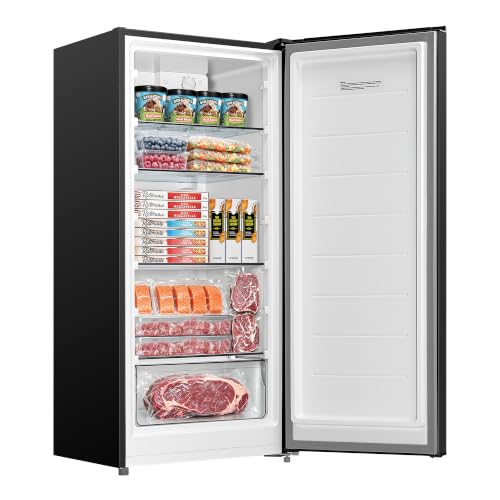
The Midea occupies the guide’s most useful middle: 7.1 cubic feet, a black convertible fridge-freezer with four adjustable glass shelves, the Garage Ready designation as listed, and an ADA design note. Seven cubic feet is the overflow size that changes a household’s shopping — a month of proteins, a serious ice-cream and batch-cooking reserve — without demanding the garage be reorganised around it. Glass shelves in a garage cabinet earn their keep the same way they do in a kitchen: spills stay on one level, contents read clearly, and a wipe restores order in seconds.
Adjustability is the quiet headline. Four adjustable shelves means the interior can be re-spaced as the store changes — tall levels for holiday birds and stock pots in one season, even levels for portioned flat packs in another — and a garage freezer’s store changes more than a kitchen’s, because it absorbs the household’s surges. The black finish suits the garage’s working aesthetic and hides the room’s scuffs better than white. The ADA design note, as listed, speaks to accessible design considerations that households with mobility needs in the family may value in any room.
Choose the Midea when the Kenmore’s seventeen is more cabinet than your garage life needs but a compact would merely postpone the problem. It carries the designation that defines this guide, converts when the season asks, and organises itself around adjustable glass rather than fixed wire. In a ladder of honest listings, it is the balanced rung — the one most households, measuring their actual overflow, will land on.
- Capacity as listed: 7.1 cu ft
- Modes as listed: fridge freezer convertible
- Placement designation as listed: Garage Ready
- Shelving as listed: 4 adjustable glass shelves
- Design note as listed: ADA design
- Finish as listed: black
- Where to buy: the Midea 7.1 Cu Ft listing on Amazon — check price on Amazon
Strengths
- Designated garage-ready at the most versatile overflow size in the guide.
- Adjustable glass shelves re-space with the seasons and wipe clean easily.
- Black finish suits working garages and hides scuffs gracefully.
Trade-offs
- Defrost method is not stated in the listing provided; confirm on the product page.
- Seven cubic feet will not absorb a whole provisioning season for larger households.
- Glass shelves ask for sensible loading with the heaviest crates.
Best for: households wanting a designated garage-ready overflow with flexible, easy-clean shelving.
A poor fit for: bulk provisioners who need the Kenmore’s seventeen cubic feet instead.

KoolMore 7 Cu Ft Garage Ready Upright Freezer — Stainless manual-defrost
The KoolMore wears the designation in its name: a 7 cubic foot Garage Ready convertible upright in stainless steel. And it states its defrost method with a plainness this guide wishes were universal — manual defrost, printed in the title. That pairing is not a contradiction; it is a specification. A household that chooses this cabinet is choosing the designation, the stainless build and the convertible format, and accepting the seasonal defrost ritual as the price — a ritual a garage cabinet, visited in planned trips rather than lived beside, accommodates more easily than a kitchen one does.
Manual defrost in a garage has its own practical rhythm. Choose a cool day, work from the inventory, hold the contents in insulated boxes in the garage’s own cold ambient if the season allows, and let the cabinet clear in hours rather than the day a kitchen defrost can consume. The KoolMore’s maker sells into food-service as well as homes, and the stainless finish fits that heritage: a working surface for a working room, wiped down in seconds and indifferent to the garage’s knocks. At seven cubic feet it matches the Midea’s useful middle size, and the choice between them is philosophical — adjustable glass shelves and an unstated defrost method to confirm, against stainless steel and a defrost method stated in the title itself.
Buyers who know their own habits should make this call honestly. If the defrost will happen, on a calendar, without resentment, the KoolMore is a designated, convertible, stainless cabinet at a fair size. If it will not — if the household’s history says the chore will slide — the auto-defrost Kenmore or the glass-shelved Midea will serve the same garage more kindly. The listing has told you the truth about the cabinet; the remaining truth to consult is your own.
- Capacity as listed: 7 cu ft
- Placement designation as listed: Garage Ready
- Modes as listed: convertible freezer/refrigerator
- Defrost as listed: manual defrost
- Finish as listed: stainless steel
- Where to buy: the KoolMore 7 Cu Ft listing on Amazon — check price on Amazon
Strengths
- Garage Ready designation carried in the model’s very name.
- Stainless steel build suits a working garage and wipes down fast.
- Defrost method stated plainly in the title — no surprises after purchase.
Trade-offs
- Manual defrost is a real seasonal chore that the owner must actually perform.
- Shelving details are not elaborated in the listing provided.
- Households that neglect defrosting will be served better by the auto-defrost Kenmore.
Best for: organised households that want a designated stainless cabinet and will keep a defrost calendar.
Not the right match for: anyone whose honest history says manual defrosting will be postponed indefinitely.
ICEVIVAL 7 Cu Ft Upright Freezer — Garage-positioned convertible
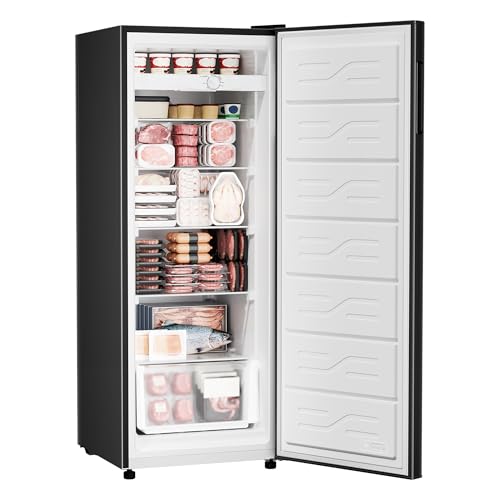
Precision first, because this guide’s promise depends on it: the ICEVIVAL’s listing does not use the Garage Ready designation, and this review does not lend it one. What the listing says is that this 7 cubic foot convertible freezer-refrigerator, with a reversible door, is ideal for garage, apartment and kitchen storage. That is the maker’s positioning — the garage named as an intended home — and it is quoted here exactly so, as a rung below a designation and a rung above silence. Readers weighing this model against the designated three should hold that distinction clearly; it is the difference between a cabinet designed and warranted for ambient swings and a cabinet its maker pictures in the room.
Within its honest framing, the ICEVIVAL has real virtues. Seven cubic feet matches the guide’s useful middle, convertible modes give it the seasonal flexibility the format is loved for, and the reversible door matters disproportionately in garages, where the cabinet must fit the wall that is free — beside the door, at the bench’s end — and swing the way the room allows rather than the way a factory default assumes. Apartment and kitchen settings in the same listing make it the most placeable of the 7 cubic foot trio: a cabinet that can start life in a flat and retire to a garage when the household moves.
Choose it with the placement maths done. If your garage is insulated, shaded or mild-climated, a garage-positioned convertible may serve you perfectly well, and its flexibility is a genuine asset. If your garage bakes and freezes at the extremes and the freezer will hold a season’s provisioning, the designated models above exist for exactly your room, and their listings say so. The ICEVIVAL’s own words are not a weakness in this guide’s eyes — they are the information a careful buyer prices in.
- Capacity as listed: 7 cu ft
- Modes as listed: convertible freezer and refrigerator modes
- Door as listed: reversible
- Settings as listed: ideal for garage, apartment and kitchen storage
- Note: the listing does not state a Garage Ready designation, and none is claimed here
- Where to buy: the ICEVIVAL 7 Cu Ft listing on Amazon — check price on Amazon
Strengths
- Convertible flexibility and a reversible door make it the most placeable 7 cu ft pick.
- Garage named among its intended settings by the maker itself.
- Equally at home in apartments and kitchens if plans change.
Trade-offs
- No Garage Ready designation is stated, so extreme garages should choose a designated model.
- Defrost and shelving details are not elaborated in the listing provided.
- Buyers must weigh positioning language honestly rather than reading it as a rating.
Best for: households with mild or insulated garages who value convertible, reversible-door flexibility.
Poorly suited to: uninsulated garages at temperature extremes holding a season’s provisioning.

Novadexor 3.2 Cu Ft Upright Freezer — Compact and quiet
The ladder’s small end begins with a compact that talks about the garage in its own terms: the Novadexor’s listing describes a 3.2 cubic foot upright in silver for garage and kitchen, with a stated temperature reach down to -13°F across its settings, operation described as under 40dB quiet, three flip-top lids organising its interior, a stated daily energy figure, and a one-year warranty. Those are the listing’s words and numbers, quoted as printed — including the temperature reach, which belongs to this model alone in this guide and is not lent to any other pick.
Three flip-top lids inside a compact upright is a thoughtful answer to a small cabinet’s problem: in a 3.2 cubic foot space, one open interior turns every retrieval into a rummage, while lidded sections keep the ice-cream economy, the portion bags and the ice packs in their own compartments. The quiet operation the listing describes suits the garage-kitchen borderland where these compacts live — near doors, near living space — and the small footprint fits the gaps a garage actually offers: the end of a bench, the wall beside the internal door, the corner the car does not need.
As a garage proposition, read it as its listing frames it: a compact for garage and kitchen use, with stated numbers a buyer can verify on the product page — not a designated cabinet, and not reviewed as one. Households needing a modest, organised top-up that can live on the garage’s kitchen-side wall will find its specification unusually complete for its size. Households needing designated protection for a hard garage should step up the ladder to the models whose listings carry the designation itself.
- Capacity as listed: 3.2 cu ft
- Settings as listed: garage, kitchen
- Temperature as listed: settings reaching to -13°F
- Noise as listed: under 40dB quiet
- Interior as listed: 3 flip-top lids
- Finish as listed: silver
- Warranty as listed: 1 year
- Where to buy: the Novadexor 3.2 Cu Ft listing on Amazon — check price on Amazon
Strengths
- Flip-top lidded sections organise a compact interior better than an open box.
- Stated temperature reach and quiet operation give buyers verifiable numbers.
- Small footprint fits the genuine gaps a garage offers.
Trade-offs
- No Garage Ready designation is stated in the listing.
- At 3.2 cu ft it is a top-up cabinet, not a household store.
- Compact sections suit small items; bulky boxes will not fit its lids’ world.
Best for: households wanting a small, sectioned, quiet top-up freezer for the garage’s kitchen-side wall.
A weak match for: anyone needing designated ambient protection or bulk capacity.

3.2 Cu Ft Compact Upright Freezer — Simple mechanical compact
The second compact keeps things deliberately simple: a 3.2 cubic foot upright in stainless steel whose listing addresses it to home and garage use, with adjustable shelves, a reversible door, a mechanical thermostat, and basement use among its named settings. A mechanical thermostat is a philosophy in a dial — no panel, no modes, just a control that owners set once and a cabinet that gets on with it — and in a garage or basement top-up role, that simplicity is a feature households consistently underrate until they have lived with both kinds.
Adjustable shelves and a reversible door repeat the flexibility theme at compact scale: re-space the interior between the drinks-party month and the batch-cooking month, and hang the door to suit the wall the garage actually offers. The stainless finish keeps it presentable if it later migrates indoors, which compacts often do — the garage top-up of one year becomes the utility-room cabinet of the next, and a finish that suits both rooms is a small, real economy.
Its garage framing, quoted honestly, is use-language — for home and garage use — rather than a designation, and this guide prices it accordingly. For a mild garage, a basement corner or a household whose overflow need is genuinely small, it is a straightforward, adaptable compact. For an extreme garage holding serious value in frozen food, the designated Kenmore, Midea and KoolMore above are the listings that make the promise this room demands. Simplicity is this pick’s argument, and within its honest limits it is a good one.
- Capacity as listed: 3.2 cu ft
- Settings as listed: home and garage use; basement
- Shelving as listed: adjustable shelves
- Door as listed: reversible
- Thermostat as listed: mechanical
- Finish as listed: stainless steel
- Where to buy: the 3.2 Cu Ft Compact listing on Amazon — check price on Amazon
Strengths
- Mechanical simplicity: a set-once thermostat and no panels to learn.
- Adjustable shelves and a reversible door adapt it to room and season.
- Stainless finish travels well between garage, basement and utility placements.
Trade-offs
- Garage language in the listing is use-positioning, not a Garage Ready designation.
- Compact capacity serves top-up duty only.
- No defrost description is stated in the listing provided; confirm before relying on one.
Best for: households wanting a simple, adaptable compact for a mild garage or basement corner.
Weakest fit: extreme garages where a stated designation should carry the purchase.
Designations and Descriptions, Side by Side
| Model | Capacity | Garage language in its listing | Defrost as listed |
|---|---|---|---|
| Kenmore 17 | 17.0 cu ft | Garage Ready designation | Auto Defrost |
| Midea 7.1 | 7.1 cu ft | Garage Ready designation | Not stated in listing provided |
| KoolMore 7 | 7 cu ft | Garage Ready designation | Manual defrost |
| ICEVIVAL 7 | 7 cu ft | Ideal for garage, among its settings | Not stated in listing provided |
| Novadexor 3.2 | 3.2 cu ft | Garage and kitchen placement | Not stated in listing provided |
| Compact 3.2 | 3.2 cu ft | For home and garage use | Not stated in listing provided |
How Do You Prepare a Garage for a Freezer?
Choose the wall before the cabinet. The best garage freezer position is level, dry and out of the direct sun path through windows or the main door’s opening arc, with the maker’s ventilation clearances respected and the door able to open fully. Interior walls — the ones shared with the house — are usually the kindest, since they borrow the house’s thermal moderation; a cabinet against a sun-baked external wall in a metal-roofed garage works against the weather at its worst angle. Keep the cabinet clear of the car’s exhaust path and the workshop’s dust plume where you can; a freezer breathes the room it stands in.
Power deserves a grown-up conversation. A garage circuit often already serves tools, chargers and a door opener; a freezer that shares a straining circuit will meet nuisance trips at the worst moment — mid-heatwave, fully loaded. Where the run allows, give the freezer a circuit with headroom, protect the outlet from the room’s knocks and moisture, and never run a freezer from a coiled extension lead as a permanent arrangement. Households that treat the electrical question with the same seriousness as the capacity question — the way our guide to Best Dishwashers for Hard Water Areas treats water quality as part of an appliance’s real specification — rarely meet the warm-cabinet disaster that haunts garage storage stories.
Finally, plan the working space in front of the door: room to stand with a crate, to swing a full basket out, to clean the floor patch the cabinet guards. A garage freezer is visited with armfuls, often in the dark, sometimes in a hurry. A small light over the cabinet’s wall and a clear path from the house door will do more for its daily usefulness than any feature printed on a listing.
Upright in the Garage: Why the Format Earns Its Place
The garage already has a horizontal problem: cars, benches, bikes, bins and the archaeology of every hobby compete for floor. An upright freezer joins the walls instead of the floor fight, taking a vertical slice — in the compacts’ case, a slice barely wider than a person — and returning shelved storage that can be surveyed in one glance. For the household’s working store, that visibility is the format’s whole argument: the garage freezer stops being a place food disappears into and becomes a cold pantry with a door, organised by shelf and readable at arm’s length.
Retrieval physics favour the upright in this room, too. Garage visits are usually purposeful and brief — fetch the joint, grab the ice cream, restock the kitchen’s daily supply — and an upright serves a purposeful visit perfectly: open, take from a known shelf, close. The cold spilled in those seconds is the format’s known tax, paid gladly by households whose alternative is kneeling into a chest among the paint tins. Households whose garage store is instead a deep reserve, opened weekly and loaded in bulk, should weigh the chest format honestly — the two formats divide garage households by visiting pattern more than by any specification.
There is also a growth argument. An upright’s shelves invite a system — a shelf per family of food, a door-side mental map — and systems scale as households grow into their garages. Start with a compact top-up, learn the household’s true overflow volume across a year, and step up to the designated 7 or 17 cubic foot models with evidence in hand. The ladder in this guide is built for exactly that journey, each rung described in its listing’s own words.
Which Garage-Freezer Mistakes Cost Households Most?
The costliest is buying an ordinary kitchen upright for a hard garage because the capacity looked right and the listing said nothing either way. Silence is not a promise; in an extreme garage the experiment can end with a cabinet that cannot hold its temperature in a heatwave or behaves erratically in a freeze, and a store of food discovered too late. The second mistake is the mirror reading error: treating positioning language as a designation — buying an ideal-for-garage model for a garage that needed the designated engineering, because the two phrases felt equivalent in a hurried skim. This guide has kept the rungs separate in every paragraph; keep them separate in your shortlist too.
Third, households place the cabinet in the garage’s worst microclimate — the sun-struck corner, the damp wall, the exhaust’s path — and blame the designation when physics wins. Fourth, they share the freezer’s circuit with the workshop’s hungriest tools and learn about trips during a holiday. Fifth, they forget the household system: a garage freezer without an inventory becomes a rumour, and its contents age uncounted — the same failure our guide to Best Dishwashers for Septic Systems warns about in a different utility system, where an appliance’s real performance is decided by the household routine wrapped around it. The designation buys the cabinet; the routine is what buys the result.
The Garage Through the Seasons: What the Cabinet Endures
High summer is the examination every garage freezer either passes or fails. The room’s air climbs through the afternoon, the roof space above it becomes an oven, and the cabinet must reject its heat into air that is already hot while holding its interior steady for the food inside. This is the condition the Garage Ready designation exists for, and the condition under which an ordinary kitchen cabinet’s compromises surface — longer running, warmer drift, a store discovered softening at the edges. Households in hot regions should weight the designation in this guide’s top three picks as the headline fact it is, and give the cabinet its best summer position: shaded wall, clear vents, no heat sources for company.
Deep winter examines the opposite virtue. A garage can sit colder than the cabinet’s interior ambitions for weeks, and an unprepared freezer can behave oddly in the cold — cycling strangely, or letting its compartment drift because the room has confused its assumptions. A designated cabinet is built with that season in mind as surely as with the summer. For the garage-positioned models without the designation, winter is the season to watch most carefully in the first year: check the store on your weekly rounds, and let the cabinet’s own behaviour in your actual garage, rather than anyone’s general claim, be the evidence you trust.
Spring and autumn, the swing seasons, test the seals and the routine: wide daily temperature ranges, damp air arriving with the rains, dust and pollen on every surface. Wipe the seals as the seasons turn, sweep the cabinet’s floor patch, and confirm the door still closes with the same clean finality it had in summer. A garage freezer’s life is written by these four examinations in rotation, and the households that inspect at the season’s turns — briefly, on a calendar — are the ones whose cabinets pass all four for years.
Organising an Upright Garage Store So the Kitchen Trusts It
A garage freezer fails socially before it fails mechanically: the moment the household stops trusting what is in it, it stops being used as a store and becomes a rumour with a door. The cure is a system simple enough to survive a tired Tuesday. Shelves by family — proteins on one, prepared meals on another, vegetables and bread sharing a third, treats and ice in the most visible spot — with the map held in every user’s head because it never changes. New stock behind old on every shelf, labels facing out, and a strict rule that nothing enters unlabelled, because an unlabelled garage package is a package nobody will ever volunteer to defrost for dinner.
Keep a paper inventory on the garage wall beside the cabinet, or a shared note on the household’s phones — the medium matters less than the updating. Strike items as they leave, add lines as they arrive, and let the weekly shop be planned from the list rather than from memory in the supermarket aisle. The inventory is also the outage document and the defrost plan; three jobs done by one honest list. Households that run it discover the garage freezer’s real capacity is larger than its cubic feet suggest, because nothing is duplicated by forgetfulness and nothing is wasted by burial.
Stage the traffic, too. A crate or basket that lives by the house door — the shuttle between kitchen and garage — turns restocking from an armful-juggling expedition into a single carried load, and keeps the cabinet’s door-open time to seconds. Small logistics, again: the difference between a garage store that serves the kitchen daily and one that is visited monthly with a sigh is rarely the cabinet, and almost always the path, the list and the crate.
Second Lives: What a Garage Upright Becomes
Households change, and the convertible design shared by four of this guide’s six picks is an acknowledgement of that fact written into the appliance. The family store of the children’s school years becomes the party fridge of the empty-nest years at the turn of a control. The batch-cooking freezer of a keen cook’s decade becomes the drinks and overflow cabinet of the next, without a purchase, a sale or a trip to the tip. When you choose among the convertible models here, you are not only buying this year’s freezer; you are buying the household’s cold-storage answer to several of its future selves.
Even the compacts have second acts. A 3.2 cubic foot upright that began as a garage top-up migrates happily to a utility room, a workshop’s drinks duty, a grown child’s first flat, or a holiday-let’s welcome store. The mechanical simplicity of the unnamed compact and the sectioned design of the Novadexor both travel well because neither depends on a particular room’s infrastructure. Buying a compact with a stainless finish and a reversible door — features that read as minor in the garage — is what makes those migrations graceful rather than apologetic.
Plan the second life loosely and the first life well. The mistake is buying for a hypothetical future at the expense of the measured present: the right cabinet is the one your current garage, current volume and current routine nominate, chosen from listings whose words you have read as carefully as this guide has tried to read them. Futures are served best by appliances that were right for their present — they are the ones still in the house, still working, when the future arrives.
Reading the Fine Print of a Garage Claim
Before any model in this guide is ordered, its product page deserves the same close reading its listing received here — and the garage claim deserves the closest reading of all. If a designation matters to your purchase, find it in the model’s own documentation: the ambient conditions the maker designs for, any placement conditions attached to the claim, and the warranty’s treatment of garage installation. Some makers warrant garage use explicitly for designated models and are silent for others; that warranty language, more than any headline, is the claim’s enforceable form, and it is worth ten minutes of any buyer’s evening.
Read the rest of the page with the same care. Confirm the defrost method where the listing was silent — the Midea and the ICEVIVAL among this guide’s picks — because a garage household planning around auto defrost should not discover a manual cabinet on delivery day. Confirm shelving counts and materials, the door’s swing and whether it truly reverses, and the electrical requirements against your garage’s actual circuit. None of these checks requires expertise; they require only the refusal to let a headline do a specification’s job. This guide has modelled that refusal on every page, declining to credit any model with a fact its listing did not state — carry the same standard into the final click, and the cabinet that arrives will be the cabinet you chose.
Keep the documentation once it arrives: the manual, the warranty terms and a note of the delivery condition, filed where the household keeps appliance papers. A garage freezer’s questions tend to arrive years later — a seal, a shelf, a claim — and the household that can produce the document answers them in minutes.
Delivery Day and the First Week in the Garage
Survey the route before the cabinet ships: a 17 cubic foot upright is a tall, heavy piece of furniture, and garage access that looks generous to a person can be exacting for a cabinet on a trolley — check the side door’s width, the step heights, and the turn from driveway to final wall. Clear the position completely before the day, including the floor patch’s honest levelling: garages slope, deliberately, toward their doors, and a freezer standing on a slope will strain its seal along one edge for its whole life unless its feet are adjusted to meet the floor as it is. The adjustable details matter here more than anywhere else in the house.
Let the cabinet settle and run empty until it holds its temperature steadily before the first load crosses the door — a few patient hours that establish the baseline your weekly checks will compare against. Load in the organised order from the first shelf, start the wall inventory the same evening, and resist filling the cabinet to its seals in week one; a three-quarters load, well mapped, teaches the household its system faster than a heroic stock-up. Note the cabinet’s ordinary sounds in its first days, while they are new to you, so that a change in its voice in year three registers as information rather than passing unnoticed.
Finally, brief the household. Everyone who will use the garage store should know the shelf map, the label rule and the inventory’s home, because a system known by one person is a system that fails on that person’s holiday. Ten minutes of showing and telling, in the garage, with the door open and the shelves filling — that is the whole ceremony, and it is what turns a delivered appliance into the household’s cold pantry by the end of its first week.
Two Cabinets, One System: Pairing a Garage Upright With the Kitchen
Most households in this guide’s audience will run the garage upright as one half of a two-cabinet system, and the pairing works best when the roles are assigned rather than allowed to blur. The kitchen freezer — usually a fridge-freezer’s compartment — holds the week: tonight’s ingredients, this week’s portions, the ice and the immediate treats. The garage upright holds the month and the season: the bulk proteins, the batch archive, the preserving store, drawn down into the kitchen in a weekly shuttle. Each cabinet stays in its virtue — the kitchen’s small and instant, the garage’s large and patient — and neither is asked to be the other.
The shuttle is the system’s moving part, and it deserves the crate-and-list discipline described earlier: one trip, one crate, planned from the wall inventory, restocking the kitchen shelf by shelf. Households that run the shuttle on a fixed day find the garage freezer’s door opens a fraction as often as an unsystematic one, which the food, the cabinet and the electricity all quietly appreciate. When guests, holidays or a preserving surge arrive, the system flexes in the right direction — the garage absorbs the surge, the kitchen keeps its calm — and that flex, more than any single specification, is what a well-chosen garage upright was actually bought for.
Final Recommendation
Let your garage’s severity choose the rung. If the room bakes and freezes in earnest and the store matters, buy a designation: the Kenmore 17 for a main store with auto defrost, the Midea 7.1 for designated overflow on adjustable glass shelves, or the KoolMore 7 for a designated stainless cabinet whose manual defrost you will honestly keep. If your garage is mild, insulated or borrowed from the house’s warmth, the ICEVIVAL’s convertible flexibility and the two honest compacts — the sectioned Novadexor and the simple mechanical 3.2 — will serve you well at their listings’ own word. Prepare the wall, respect the circuit, keep a list of what the cabinet holds, and your garage will stop being the room appliances fear and become what it should have been all along: the coldest, calmest, best-organised pantry in the house, standing upright against the wall with its door opening on exactly the dinner you came for.
Frequently Asked Questions
What is the difference between Garage Ready and a freezer that mentions garages?
Garage Ready, as the Kenmore, Midea and KoolMore listings use it, is a manufacturer’s designation: the cabinet is designed to keep working across a garage’s wide ambient swings. A listing that calls a model ideal for a garage, or names garage use among its settings — the ICEVIVAL and the two compacts here — is positioning the product for the room without that designation. Both are quoted in this guide exactly as written, and buyers in extreme garages should weight the designation accordingly.
Why choose an upright for the garage instead of a chest?
Floor space and visibility. An upright takes a wall’s width rather than a room’s floor, leaves the garage free for cars and benches, and presents its contents on shelves at eye level for the brief, purposeful visits garage storage usually involves. Chests suit deep-reserve, bulk-first households better. This guide covers the upright format specifically; choose by your visiting pattern as much as by capacity.
Does a garage-ready freezer still need a good position?
Yes. The designation describes design for ambient swings, not immunity to bad placement. Keep the cabinet level, dry, out of direct sun and exhaust paths, with ventilation clearances respected and a circuit that is not already straining. A designated cabinet in a kind position will out-serve any cabinet in a cruel one, and the preparation section in this guide walks through the details.
Is manual defrost a problem in a garage freezer?
It is a chore to plan, not a disqualification — the KoolMore 7 states manual defrost in its title and pairs it with the Garage Ready designation. Garage cabinets are visited in planned trips, which suits a seasonal defrost rhythm, and a cool garage day makes the operation easier than a kitchen defrost. Households that know the chore will slide should choose the auto-defrost Kenmore instead and be honest about why.
What size upright suits a typical garage?
Match it to the job. A compact 3.2 cu ft model tops up a kitchen freezer and fits a bench-end gap. The 7 cubic foot class — three distinct models in this guide — is the versatile overflow most households land on. Seventeen cubic feet is a main store moved out of the kitchen, justified when the household’s frozen volume genuinely lives in the garage. Audit a season of your own overflow before choosing, and let the count decide.
Can these convertible models serve as a garage refrigerator?
The Kenmore, Midea, KoolMore and ICEVIVAL listings all describe convertible freezer-refrigerator operation, so each can take a season as the garage’s drinks and party fridge. Treat the switch as a planned event — empty, clean, let the cabinet settle into its new mode, reload appropriately — rather than a weekly flip, and the same cabinet will earn its wall in both halves of the year.
Related Guides
Garage cold storage usually pairs a freezer with fresh storage, and our guide to Best Refrigerators for a Hot Garage covers the refrigerated half of exactly this problem — appliances chosen for the room that tests them hardest. Read together, the two guides will let you spec a complete garage cold wall with the same honesty about what each listing actually promises.


