What's inside
- Key Takeaways
- Quick Picks
- How Did We Choose These 9,000 BTU Split System Air Conditioners?
- What Does SEER2 Mean, and How Much Does It Matter Here?
- What Does Installing a Mini Split Actually Involve?
- How Do the Six 9,000 BTU Split Systems Compare?
- How Quiet Is a Mini Split, Really?
- What Does a Mini Split Cost to Own Over a Decade?
- Which Rooms Deserve a 9,000 BTU Split?
- How Do You Choose an Installer and Protect the Warranty?
- What Changes When Cooling Becomes Permanent?
- What Mistakes Do Mini Split Buyers Make?
- Final Recommendation
- Frequently Asked Questions
- Related Guides
As an Amazon Associate I earn from qualifying purchases. This post may contain affiliate links at no extra cost to you.
cottageverdict.com is reader-supported. When you buy through links on our site, we may earn an affiliate commission.
Where to buy: the best 9,000 BTU split system air conditioners in this guide are sold on Amazon as complete ductless mini split kits, and each pick’s name links to its listing so you can confirm the SEER2 rating, the voltage and exactly what the installation kit contains before ordering. Read the voltage line twice: this class contains both 115V machines and one 208/230V machine, and they are not interchangeable.
A mini split is the end of the argument that runs through this whole series. Instead of a box in a window or a hose through a sash, the system divides itself: a quiet indoor air handler on the wall, a compressor outside where compressors belong, and a refrigerant line set through a small hole connecting them. The result is the quietest, most efficient and most permanent cooling in these guides, and the 9,000 BTU size, three quarters of a ton, is its smallest standard step, built for one room of up to roughly 450 square feet served properly and permanently.
Six kits compete here, and their listings speak a different language from the window classes: SEER2 ratings from 19 to 22, heat pumps throughout, inverter drive as the universal assumption, and voltages that split the shelf in two. Four of these machines run on ordinary 115V household supply; the Senville works on 110/120V; and one COSTWAY, the efficiency runner-up at 21 SEER2, requires 208/230V, which in most homes means an electrician and a dedicated circuit before it means cooling. That single line in a listing decides budgets and timelines, and this guide will keep returning to it.
Installation honesty is this article’s founding promise, so let it be stated before any pick is praised. A mini split kit with a pre-charged condenser and an included installation kit is not a plug-in appliance. Fitting one means mounting the indoor unit, drilling through the wall, running and connecting a line set, evacuating air and moisture from the lines with a vacuum pump in most conventional installations, and completing electrical work that codes and warranties care about. Some confident owners do much of this themselves; many makers nonetheless expect or require professional installation for warranty cover, and refrigerant handling carries legal requirements in many places. Budget for a professional, or research the job completely before assuming otherwise.
With that said plainly, the rewards are the largest in this series. No window surrendered, no hose, no infiltration tax, a compressor’s voice removed to the garden, and efficiency figures, 19 to 22 SEER2, that make window units look thirsty and portables look medieval. For the room a household intends to keep, the bedroom suite, the garden office, the converted garage, the flat that will be home for a decade, a 9,000 BTU split is not an extravagance. It is the grown-up answer, and the six below are its current contenders.
Key Takeaways
- Every pick is an inverter heat pump: cooling and heating from one wall-mounted system, with no ducts and no window lost.
- SEER2 runs from 19 to 22 across the shelf; the Temprium’s 22 is the efficiency peak, the COSTWAY 21 its nearest rival.
- Voltage divides the class: most picks run on 115V, but the 21 SEER2 COSTWAY needs 208/230V and an electrician’s visit.
- Installation is a project, not an unboxing: line set, wall penetration, vacuuming and electrical work, with professional fitting the safe assumption.
- Pre-charged condensers and included kits reduce the job; they do not abolish it, and no pick here should be read as plug-and-play.
- Coverage claims reach 450 square feet, realistic for one well-insulated room rather than a whole floor.
Quick Picks
| Pick | Badge | Why it earns its place |
|---|---|---|
| Senville LETO Mini Split 9000 BTU | Best Established Name | A 0.75-ton inverter heat pump on 110/120V that works with Alexa, from the shelf’s most established specialist. |
| ROVSUN 9000 BTU Wifi Mini Split 20 SEER2 | Best Value With Full Kit | 20 SEER2 at 115V with a pre-charged condenser and installation kit included, plus WiFi control. |
| Temprium 9000 BTU Mini Split 22 SEER2 115V | Best Efficiency on 115V | The shelf’s peak 22 SEER2, on 115V, with R32 refrigerant, WiFi and a complete installation kit to 450 square feet. |
| COSTWAY 9000 BTU Mini Split 21 SEER2 | Best Efficiency With 230V | 21 SEER2 with WiFi and Alexa, heat pump and installation kit, for homes that can feed it 208/230V. |
| Mountman 9000 BTU Mini Split 19 SEER2 | Best Pre-Charged Value | 19 SEER2 at 115V with WiFi and a pre-charged condenser, cooling up to 450 square feet. |
| COSTWAY 9000 BTU Mini Split 19 SEER2 115V | Best 115V COSTWAY | The brand’s standard-voltage answer: 19 SEER2, wall-mounted inverter heat pump for up to 450 square feet. |
How Did We Choose These 9,000 BTU Split System Air Conditioners?
Admission required a complete 9,000 BTU ductless mini split system verified in the site’s product pool: indoor handler, outdoor condenser, heat pump function and inverter drive, with the listing stating its SEER2 and voltage plainly enough to plan an installation from. That last condition mattered most, because in this class the listing is not merely advertising; it is the first page of an installation contract, and kits that hide their voltage or their efficiency have no place in a permanent fitting.
The six were composed to span the class’s real decisions. The Senville LETO brings the established name and Alexa compatibility at the shelf’s accessible end; the Temprium brings the peak 22 SEER2 on a 115V supply with R32 refrigerant; the two COSTWAYs split the voltage question between them at 21 and 19 SEER2; and the ROVSUN and Mountman contest the pre-charged, kit-included value ground at 20 and 19 SEER2. Every buyer of a permanent system will find their own trade-off argued somewhere below.
What Does SEER2 Mean, and How Much Does It Matter Here?
SEER2 is the current seasonal efficiency standard for split systems, measuring delivered cooling across a representative season against the electricity consumed, under test conditions revised to be less flattering than the old SEER’s. Higher numbers mean cheaper, cooler summers, and the spread in this guide, 19 to 22, is meaningful across a permanent installation’s life: a system fitted for a decade will run thousands of hours, and each point of SEER2 quietly refunds part of the installation bill in avoided electricity.
Context keeps the numbers honest. Even the shelf’s lowest figure, 19 SEER2, stands far above the efficiency of any window unit in this series, whose CEER values translate to a much thirstier class of machine, and the portables are not in the conversation at all. A household graduating from either will feel the split’s economy in the first summer’s bills, particularly in a room cooled daily, and the inverter drive shared by all six picks is what delivers those figures in real rooms rather than only in laboratories.
Chasing the peak number regardless of context is still a mistake. The Temprium’s 22 SEER2 on 115V is a genuinely impressive combination, yet a household that must pay for a new circuit to run a 21 SEER2 rival has not necessarily lost the economic argument, and a lightly used room will take decades to repay small efficiency gaps. SEER2 should rank the finalists, after voltage, room and installation have decided which finalists are realistic, and that ordering discipline runs through every analysis below.
What Does Installing a Mini Split Actually Involve?
The physical job has four movements. First, the indoor air handler is mounted on an interior wall, level, with clearance for airflow and for the condensate drain that must fall continuously to outside or to a pump. Second, a hole of roughly two to three inches is cored through the wall, through which the line set, two insulated copper refrigerant lines, the communication cable and the drain all pass to the outdoor unit. Third, the condenser is sited on a pad, a wall bracket or a stand outside, with air space around it and a route for its own condensate in heating season.
Fourth comes the part that separates this class from every other in this series: the connections. The line set is joined with flare fittings that must be clean, aligned and torqued correctly, the lines are pressure-tested and then evacuated with a vacuum pump to remove air and moisture that would poison the system’s life, and only then are the pre-charged condenser’s valves opened to release refrigerant into the circuit. Electrical work completes the job: a dedicated circuit, a disconnect within sight of the outdoor unit in most codes, and connections whose correctness decides whether the system runs for fifteen years or fails in its second summer.
None of this is beyond a skilled and properly equipped owner, and the kits here help by pre-charging the condenser and including installation materials. But the honest sentence is the one this guide opened with: tools such as a vacuum pump, gauges, a torque wrench and a core drill are required for a conventional installation, refrigerant work is regulated in many jurisdictions, and several manufacturers condition warranty cover on professional installation. Price a professional quote before buying, treat any saving from doing it yourself as earned rather than automatic, and never let a listing’s cheerful kit photograph talk you out of either.
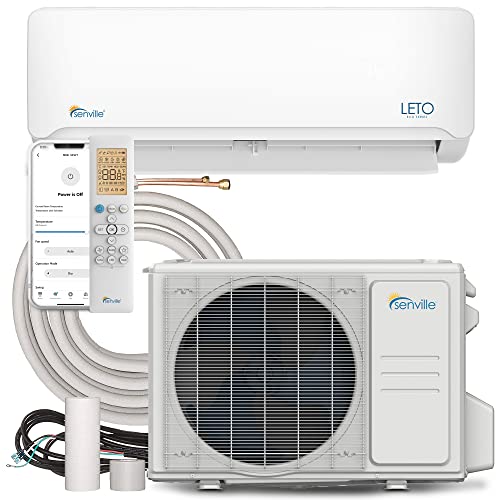
Senville LETO Mini Split 9000 BTU — Best Established Name
The Senville LETO is the name this class is known by, a ductless mini split line that has introduced more households to split systems than any rival, and the 9,000 BTU version carries the formula intact: a wall-mounted inverter heat pump of 0.75 tons, running on ordinary 110/120V supply, with quiet operation as a stated character and Alexa compatibility for voice control. For a buyer taking the permanent step for the first time, there is real comfort in choosing the machine whose installation videos, parts and community knowledge fill the internet.
That ecosystem is the LETO’s deepest specification. A permanent appliance’s life includes the remote lost in year four, the filter question in year two, the error code in year seven, and on each occasion the LETO owner benefits from a decade of other owners having asked first. Senville sells little else but split systems, and the LETO’s longevity in the catalogue is evidence of a design that installers know and households keep.
Its listing is quieter about SEER2 than the challengers’, which print their 19s and 20s and 22s proudly, and buyers for whom the efficiency table is the whole argument should compare the Temprium and COSTWAY figures below before deciding. The LETO’s counter-argument is risk: at the accessible end of a permanent purchase, the known machine on the standard voltage, with heating and cooling both aboard, is frequently the wisest money in the room.
Installation follows the class pattern this guide described in full: line set, wall penetration, evacuation, dedicated electrics, with the 110/120V supply sparing most homes a panel upgrade. Commission it properly, register the warranty with whatever installation documentation the maker asks for, and the LETO becomes what its owners describe: the room’s climate simply stops being a topic, in summer and in winter alike.
The LETO’s quietest virtue appears in heating season, when its heat pump warms the room without the window-rattling drama of the portable heaters it replaces. Owners who bought it for August routinely report that January is when they fell for it, because a room that is simply always comfortable stops generating the small daily negotiations that colder, hotter households accept as normal.
- Capacity (listing): 9,000 BTU, 0.75 ton
- Supply: 110/120V
- Type: ductless wall-mounted heat pump
- Drive: inverter, energy efficient positioning
- Controls: works with Alexa
Strengths
- Deepest owner and installer knowledge base
- Standard voltage simplifies electrics
- Specialist split-system maker
Trade-offs
- SEER2 not headlined in the listing
- Professional installation still the norm
- Accessible price reflects its tier
Best for: first-time split buyers wanting the known quantity. Not suited for: efficiency maximalists chasing the highest SEER2.
Confirm the current listing’s SEER2 and warranty installation terms before ordering. Check price on Amazon.

ROVSUN 9000 BTU Wifi Mini Split 20 SEER2 — Best Value With Full Kit
ROVSUN’s 9,000 BTU split states the value proposition of the modern kit market in one listing: 20 SEER2 efficiency, an inverter heat pump on ordinary 115V, WiFi control, a pre-charged condenser and an installation kit in the box. The pre-charging matters because it removes refrigerant charging from the installer’s critical path, leaving the line set connections and evacuation as the skilled core of the job, and the included kit removes the accessory hunt that delays so many first installations.
Twenty SEER2 at this voltage and price tier would have been flagship territory not long ago, and it changes the running-cost story of a permanently cooled room: a bedroom suite or garden office held at temperature daily will sip rather than gulp, while the heat pump covers the cold months with the same machinery. WiFi control suits the permanent installation particularly well, since a system that serves a garden building or a guest suite can be started before the walk across the lawn or the guests’ arrival.
ROVSUN appears elsewhere in this series as a value challenger in window units, and the same diligence protocol applies with higher stakes, because a split is not returned in a box when week one disappoints. Choose the installer as carefully as the machine, verify every kit component against the listing on delivery, and confirm the warranty’s installation conditions in writing before the wall is drilled. A permanent purchase deserves permanent-grade paperwork.
For the household that has priced professional installation and wants the machine itself to carry a strong efficiency figure without a flagship tariff, the ROVSUN is the class’s sweet spot made visible. It concedes the Temprium two points of SEER2 and the Senville its ecosystem, and counters with the complete kit and the honest arithmetic of value, which in a project whose total includes an installer’s day rate is often the arithmetic that wins.
ROVSUN’s WiFi, in a permanent installation, graduates from novelty to infrastructure the first time the household starts the guest suite from the airport or warms the garden office before the walk down the path. Connectivity on a machine that will serve fifteen years should be judged by that horizon, and a system whose app is a convenience layered over full local control, as this one is, ages the most gracefully.
- Capacity (listing): 9,000 BTU
- Efficiency: 20 SEER2
- Supply: 115V
- Condenser: pre-charged, installation kit included
- Controls: WiFi enabled, inverter heat pump
Strengths
- Strong SEER2 on standard voltage
- Pre-charged with kit included
- WiFi suits outbuildings and suites
Trade-offs
- Installer choice is critical
- Challenger brand at a permanent tier
- Warranty terms need written confirmation
Best for: value-focused permanent installations with a good local installer. Not suited for: buyers wanting the deepest brand ecosystem.
Inventory the installation kit against the listing on delivery day. Check price on Amazon.

Temprium 9000 BTU Mini Split 22 SEER2 115V — Best Efficiency on 115V
Temprium’s listing assembles the combination efficiency hunters dream about in this class: 22 SEER2, the highest figure among the six, delivered on a standard 115V supply, so no panel work stands between the buyer and the class’s most economical running. Add R32 refrigerant, the newer generation with a lower global-warming profile than the R410A it succeeds, WiFi smart control, a complete installation kit and a coverage claim of 450 square feet, and the machine reads as the shelf’s technical summit.
The 115V detail deserves emphasis because it is where rivals compromise. High efficiency is easier to reach at 208/230V, as the COSTWAY below demonstrates, yet most single rooms in most homes have ordinary circuits nearby and no desire to fund an electrician’s panel visit for one appliance. A 22 SEER2 machine that plugs into the home’s existing electrical geography removes the largest hidden cost in the class and makes its efficiency claim spendable by ordinary households.
R32 carries one handling note that honesty requires: it is mildly flammable by classification and its servicing belongs to equipped professionals, which in practice changes little for owners, since refrigerant work on any of these systems already belongs with professionals, but it belongs in a complete account of the machine. Temprium as a brand is a newer name than Senville’s, so the ecosystem argument runs the other way, and the warranty’s terms deserve the same written confirmation this guide keeps recommending.
Choose the Temprium when the room will be cooled and heated daily for years, because that is the usage in which two points of SEER2 compound into real money and the machine’s refinement is felt nightly. In a rarely used room its summit specification is harder to repay. In the main bedroom suite, the full-time garden office, the flat’s only living space, it is the most defensible efficiency purchase in this guide.
The Temprium’s R32 refrigerant deserves a forward-looking sentence: as regulations continue to favour lower-impact refrigerants, a system already running on the newer gas sits comfortably with the direction of servicing and parts. Future-proofing is a slippery claim in any appliance, yet refrigerant choice is one of the few places it can be made with a straight face, and Temprium makes it.
- Capacity (listing): 9,000 BTU
- Efficiency: 22 SEER2
- Supply: 115V
- Refrigerant: R32
- Kit: complete installation kit, WiFi, up to 450 sq ft
Strengths
- Highest SEER2 in the guide
- Peak efficiency without 230V work
- R32 refrigerant, complete kit
Trade-offs
- Newer brand, thinner ecosystem
- R32 servicing is professionals-only
- Premium within the value tier
Best for: daily-use rooms where efficiency compounds for years. Not suited for: occasional rooms that cannot repay the premium.
Confirm R32 servicing availability with your chosen installer. Check price on Amazon.

COSTWAY 9000 BTU Mini Split 21 SEER2 — Best Efficiency With 230V
This COSTWAY is the class’s conditional champion: 21 SEER2, a point behind the Temprium’s peak, with WiFi and Alexa compatibility, a heat pump and an installation kit for rooms up to 450 square feet, all of it gated behind one requirement printed plainly in its listing, a 208/230V supply. Homes with that supply available, a suitable circuit near the installation, a panel with capacity, an electrician already booked for the project, will find this an excellent machine. Homes without it should keep reading to its 115V sibling below, because no efficiency figure refunds an unwanted electrical project.
The 230V requirement is not a defect; larger split systems commonly run on it, and it brings real advantages in current draw and in the company the machine keeps, since an installation already involving an electrician tends to be an installation done completely, disconnect, dedicated circuit and all. For new builds, renovations and outbuildings being wired anyway, specifying this machine alongside the electrical work is tidy planning rather than extra cost.
COSTWAY fields two machines in this guide, and the pair together make the voltage lesson concrete: same brand, same capacity, same room claim, separated by two points of SEER2 and an entire electrical standard. A buyer who understands why both exist understands the class. The 21 SEER2 machine is for the project that controls its electrics; the 19 SEER2 sibling is for the home that must use the electrics it has.
WiFi and Alexa control complete a specification with no soft lines, and the installation kit’s inclusion keeps the project’s accessory list short. As with every permanent fitting here, the installer’s quality will decide more of the ownership experience than the badge will, so spend the diligence there, verify the kit on delivery, and this COSTWAY will repay its electrical demands with a decade of economical, voice-summoned comfort.
For the 230V COSTWAY, the electrician’s visit has a hidden dividend: the installation’s electrical side is inspected, dedicated and documented as part of the project, which strengthens both the warranty file and the home’s own records. Projects that must do electrical work anyway often discover that the machine which requires it produces the tidiest installation of all.
- Capacity (listing): 9,000 BTU
- Efficiency: 21 SEER2
- Supply: 208/230V
- Controls: WiFi, Alexa compatible
- Kit: installation kit, heat pump, up to 450 sq ft
Strengths
- Near-peak efficiency
- Voice and WiFi control
- Suits projects already doing electrical work
Trade-offs
- Requires 208/230V supply
- Electrician adds project cost
- Unusable where only 115V is practical
Best for: renovations and new wiring projects with 230V available. Not suited for: homes limited to ordinary 115V circuits.
Have an electrician confirm 208/230V availability before ordering. Check price on Amazon.

Mountman 9000 BTU Mini Split 19 SEER2 — Best Pre-Charged Value
Mountman’s entry competes on the complete value checklist: 19 SEER2, a 115V supply, WiFi control, an inverter heat pump with a pre-charged condenser, and a coverage claim of 450 square feet. Nothing in that list is the class’s best, and everything in it is the class’s substance, which is precisely the proposition. A household that wants a permanent, efficient, connected split without paying for summit figures will find the Mountman arguing that the last two points of SEER2 are the most expensive comfort in the catalogue.
The pre-charged condenser matters to the installation budget, because it simplifies the refrigerant side of the job to connection and evacuation rather than charging, and at 115V the electrical side stays within an ordinary dedicated circuit. The project’s total, machine plus installer, is where this machine wins its comparisons, and in permanent installations the total is the only honest price, a lesson the window classes never had to teach.
Mountman is the least storied name in this guide, and the analysis should neither hide that nor exaggerate it. The mitigations are the ones this series has standardised: an installer chosen for competence rather than convenience, a kit inventoried on delivery, warranty terms confirmed in writing, and registration completed while the paperwork is warm. A permanent appliance from a young brand, installed beautifully, will out-serve a famous one installed carelessly every year of its life.
For the garage conversion, the rental’s main room where the landlord has agreed to a permanent fitting, the workshop that must hold temperature for its contents as much as its people, the Mountman offers the class’s essential experience, quiet, efficient, ductless, four-season, at its most accessible complete price. That is not a consolation tier; for many projects it is the correct one.
Mountman’s pre-charged condenser and the installer’s vacuum pump between them illustrate the class’s division of labour honestly: the factory does what factories do best, and the craft happens on site. Owners who understand that division choose their installer with the same care they gave the machine, and it is that pairing, more than any figure in any listing, that predicts a satisfied decade.
- Capacity (listing): 9,000 BTU
- Efficiency: 19 SEER2
- Supply: 115V
- Condenser: pre-charged
- Controls: WiFi, inverter heat pump, up to 450 sq ft
Strengths
- Complete specification at value pricing
- Pre-charged condenser simplifies fitting
- Standard voltage, WiFi included
Trade-offs
- Least established brand here
- Lowest SEER2 on the shelf
- Ecosystem and parts depth unproven
Best for: conversions and workshops wanting permanent cooling affordably. Not suited for: buyers who prioritise brand depth over project total.
Choose the installer before choosing this machine, and register it promptly. Check price on Amazon.

COSTWAY 9000 BTU Mini Split 19 SEER2 115V — Best 115V COSTWAY
COSTWAY’s second machine in this guide exists to answer its sibling’s condition: the same brand, the same 9,000 BTU, the same 450-square-foot claim and wall-mounted inverter heat pump format, delivered at 19 SEER2 on an ordinary 115V supply. For the majority of homes, where the electrical panel is full, the installation wall is far from 230V, or the project simply has no appetite for an electrician’s line item, this is the COSTWAY that can actually be bought, and its specification loses nothing essential in the translation.
Nineteen SEER2 deserves its context repeated: it remains efficiency territory no window unit in this series approaches, delivered by an inverter that will hold a bedroom suite or home office at temperature while drawing a fraction of what the portable classes spend. The two points conceded to the 230V sibling are real but slender, and they are repaid in installation simplicity every day the project does not spend waiting on electrical work.
The listing’s emphasis is the class’s standard virtues, energy efficiency, wall-mounted discretion, heat pump versatility, without the voice-control fanfare of its sibling, so buyers for whom Alexa integration is essential should note the difference and choose accordingly. What remains is the essential permanent appliance, and there are households, particularly those furnishing a first split for a child’s room, a parent’s suite or a rental’s main space, for whom essential and attainable beat maximal and deferred.
Judge this machine, as with its brand-mate, by the project it enables: a competent local installer, the kit verified on delivery, the warranty registered, and a room transformed for every season at a total the household can approve without a meeting. COSTWAY’s pair, read together, teach the class’s central lesson better than any single machine could: in split systems, the right voltage is the first specification, and everything else is commentary.
The 115V COSTWAY’s role in a household is often diplomatic: it is the split that a landlord can approve, that a full panel can accommodate, that a modest project budget can carry without a summit meeting. Diplomacy is not a specification, yet in real homes it decides more installations than SEER2 ever will, and a machine that solves the politics as well as the physics earns its place in this guide.
- Capacity (listing): 9,000 BTU
- Efficiency: 19 SEER2
- Supply: 115V
- Type: wall-mounted ductless inverter
- Modes: cooling and heat pump heating, up to 450 sq ft
Strengths
- Standard voltage attainability
- Full heat pump versatility
- Efficiency far beyond window classes
Trade-offs
- Two SEER2 below its sibling
- Voice control not headlined
- Brand ecosystem still young
Best for: homes limited to 115V wanting a permanent system. Not suited for: projects already wired for 230V efficiency.
Compare its project total against the 230V sibling’s, electrician included. Check price on Amazon.
How Do the Six 9,000 BTU Split Systems Compare?
| Pick | Listing headline | Room fit | Defining trait |
|---|---|---|---|
| Senville LETO Mini Split 9000 BTU | 9,000 BTU, 110/120V | Single rooms | Established LETO line |
| ROVSUN 9000 BTU Wifi Mini Split 20 SEER2 | 9,000 BTU, 20 SEER2 | 115V supply | Pre-charged, kit included |
| Temprium 9000 BTU Mini Split 22 SEER2 115V | 9,000 BTU, 22 SEER2 | 115V, 450 sq ft rooms | Efficiency peak of the class |
| COSTWAY 9000 BTU Mini Split 21 SEER2 | 9,000 BTU, 21 SEER2 | 208/230V, 450 sq ft coverage | High efficiency, wired projects |
| Mountman 9000 BTU Mini Split 19 SEER2 | 9,000 BTU, 19 SEER2 | 115V, rooms to 450 sq ft | Pre-charged value kit |
| COSTWAY 9000 BTU Mini Split 19 SEER2 115V | 9,000 BTU, 19 SEER2 | 115V, 450 sq ft claimed | Standard-voltage sibling |
Read this table by its voltage column first and its SEER2 column second, and the shelf sorts itself: the Temprium leads on efficiency without electrical drama, the 230V COSTWAY follows a point behind for wired projects, the ROVSUN holds the value-efficiency centre, and the Senville and the 19 SEER2 pair trade summit figures for ecosystem and attainability. In permanent cooling, that ordering discipline is the whole game.
How Quiet Is a Mini Split, Really?
Quiet is the split system’s birthright, because the machine’s loud half lives outdoors. What remains inside is an air handler moving air across a coil, a sound closer to a gentle fan than to any compressor, and at the low speeds these inverter systems favour for holding temperature, the room’s dominant sound is usually the room itself. This guide assigns no decibel figures the listings do not publish, yet the architectural fact needs no number: separating the sleeper from the compressor by a wall and a garden is the most effective noise control in this entire series.
The outdoor unit’s placement becomes the new acoustic question, and it is a neighbourly one. A condenser under a bedroom window, one’s own or the house next door, can hum through a summer night, so site it with the same care given to the indoor handler: away from sleeping windows where the plot allows, on a pad or bracket that does not turn a wall into a sounding board, and with the airflow its manual specifies. Installers who think about sound at the siting stage prevent the only complaints this quiet class ever really generates.
Inside, the handler’s own manners reward correct sizing. A 9,000 BTU system in its proper room spends its life at low and medium fan speeds, where it is at its most discreet; the same system stretched across too large a space runs at its loudest setting to survive. The 450-square-foot claims in these listings assume reasonable insulation and ceilings, and a room that respects them will be rewarded with the silence the format promises.
What Does a Mini Split Cost to Own Over a Decade?
The purchase price of the kit is the smallest honest number in this class, and the only one the listings show. The true first cost adds installation: an installer’s day, electrical work whose scope the voltage choice decides, and any extras the building demands, a long line set run, a condensate pump for a handler below drain level, a pad or bracket for the condenser. Households should gather that total before choosing among these six, because a machine that is cheaper by a little and dearer to install by a lot is not cheaper.
Running costs then reverse the story. At 19 to 22 SEER2 with inverter manners, a split cools and heats its room for a fraction of the electricity the window and portable classes spend, and across a decade of daily use that fraction compounds into the largest number in the whole calculation. Maintenance is modest but real: filters rinsed at the handler, the outdoor coil kept clear, and a professional service every year or two to check refrigerant, electrics and drains, the small rent a permanent system charges for its permanence.
Longevity completes the ledger. A well-installed split is a fifteen-year class of appliance, outliving two or three window units in the same room, and its presence adds to a home’s equipment in a way a box in a window never does. Spread across that life, the installation that looked expensive in the first summer becomes the cheapest cooling the household ever bought, which is the economic form of the same argument the quiet sections make in acoustic form.
Which Rooms Deserve a 9,000 BTU Split?
The class’s ideal room is defined by permanence and by a single room’s boundaries: the primary bedroom suite whose occupants will sleep there for a decade, the garden office that is now a career’s headquarters, the converted garage that became a studio, the granny flat whose resident deserves climate without negotiation. In each, the installation cost is amortised by daily use, the quiet is spent on sleep or concentration, and the heat pump retires the room’s second appliance, the winter heater, in the same stroke.
Rooms with no suitable window are this class’s special constituency. A basement room, an interior room, a room whose only window is a heritage frame that must not carry a cabinet: the window classes cannot serve them at all, and a portable serves them badly through a venting compromise, while a split asks only for a wall and a route outside. For such rooms the comparison is not split versus window unit; it is split versus nothing, and the decision makes itself.
Conversely, rooms in flux argue against permanence: the rental with a year to run, the spare room awaiting a renovation that will move its walls, the house being prepared for sale where the buyers’ tastes are unknown. A split is a commitment to a room’s geography, and the households that thrive with one are those whose geography is settled. Where it is not, this series’ window and portable guides exist precisely to bridge the unsettled years gracefully.
How Do You Choose an Installer and Protect the Warranty?
In this class the installer is half the product, so choose with the seriousness given to the machine. Seek quotes from firms that install mini splits routinely rather than occasionally, ask what the quote includes, line set length, evacuation, electrical scope, condensate routing, commissioning, and treat a suspiciously bare quote as information about corners. The cheapest installation of a permanent system is a false economy measured in callbacks, and the most expensive machine installed badly will lose to the humblest installed well.
Paperwork is the second half of protection. Before work begins, confirm in writing what the manufacturer’s warranty requires, since several makers condition full cover on professional installation and on registration within a stated window, and keep the installer’s invoice, the commissioning details and the serial numbers together. Photograph the line set route and the data plates. These unglamorous acts decide, years later, whether a warranty conversation is a formality or an argument.
Commissioning day deserves the owner’s presence and a checklist: every mode run, cooling, heating, dry and fan; the remote and any app paired; the drain observed flowing; the outdoor unit listened to at the property line. A system accepted with that ceremony begins its life verified, and the household begins its ownership knowing its machine, which is the correct foundation for a fifteen-year relationship with any appliance.
What Changes When Cooling Becomes Permanent?
The room’s status changes first. A space with a split system is no longer the room that is hot in summer; it is simply a room, usable in every month, and the household’s mental map quietly redraws itself around that fact. Studios get let, offices get careers, spare rooms become nurseries, because the climate objection that silently governed their use has been removed by a white handler high on the wall.
The window returns to being a window, and owners consistently underestimate how much that restoration matters until they live it: light in the morning, a view at the desk, air on the mild evenings when the system rests. The window classes spend their ingenuity compensating for the window’s loss; the split simply never takes it, and a season of that innocence recalibrates what a household expects from cooling.
Silence becomes the room’s default rather than its achievement. Work calls, recordings, a baby’s nap, a partner’s early night: the split’s discretion serves all of them without being asked, and the household stops organising its life around an appliance’s voice. That is the deepest difference between this class and everything before it in this series, deeper even than the efficiency tables.
Responsibility changes too. A permanent system is maintained like a boiler rather than stored like a fan: filters on a rhythm, an annual professional glance, an outdoor unit kept clear of the garden’s ambitions. Owners who accept that small liturgy get the fifteen-year life; owners who treat a split like a window box, fitted and forgotten, are the ones writing the disappointed reviews of a blameless format.
And the household’s ambitions change last. One successful split teaches the format so persuasively that second systems follow, room by room, in later years, which is how ductless homes are actually built: not in one grand project but in a series of well-chosen 9,000 and 12,000 BTU decisions, each placed where permanence pays. This guide’s six are where that education most affordably begins.
A permanent system also changes a home’s relationship with weather forecasts. Heatwaves stop being threats and become merely warm weeks; cold snaps lose their power over the one room that matters most. That psychological dividend, the forecast demoted from anxiety to information, is mentioned by long-term owners more often than any efficiency figure, and it may be the truest measure of what the installation bought.
There is a craft appreciation that grows around a well-installed split: the line set’s tidy run, the handler’s perfect level, the outdoor unit’s quiet competence in the rain. Owners find themselves showing the installation to visitors the way earlier generations showed a boiler, because competence, made visible, is satisfying in a house. Choosing the installer who works that way is choosing that satisfaction for fifteen years.
And the series closes its cooling arc where it should: with the recognition that every class in it, portable, compact window, mid-size, medium and split, is the right answer somewhere, and the buyer’s real task was never finding the best machine but finding their machine. The household that reads its own rooms honestly will find it on one of these shelves, and will sleep cool, in every sense, thereafter.
The handler’s placement within the room repays thought that outlasts the installation day. High on the wall is standard because cold air falls and warm air rises to be collected, yet the thoughtful installer also considers the bed’s position, the desk’s glare and the door’s swing, because a system that blows directly onto a pillow will be turned down by its owner and blamed for a geometry it did not choose. Fifteen years of comfort are positioned in that one decision.
Seasonal changeovers acquire a ritual calm in a split-served home. There is no unit to fetch from storage, no window to surrender or reclaim; the same machine simply changes its mind from cooling to heating as the year turns. Households describe the first autumn in which the room stayed comfortable without any appliance being moved as the moment the installation’s value became fully visible.
A split also speaks well of a house to its future occupants. Unlike the window classes, which leave with their owners, a well-documented system remains as part of the home’s equipment, its manuals and service history a small dossier of care. Estate agents have learned to name such systems in listings for the same reason this guide names them here: permanent, efficient, quiet cooling is a feature of the property itself.
For multi-generational homes the format solves a delicate problem elegantly. The grandparent’s suite, the adult child’s flat within the house, the carer’s room: each can hold its own climate without negotiation with the whole building’s system, because a split is a sovereign little climate of its own. That sovereignty, purchased once, prevents a thousand small thermal diplomacies.
Finally, the split teaches patience as a purchasing virtue. It is the class that most rewards the buyer who measures twice, quotes twice and orders once, and most punishes the heatwave panic purchase. The household that plans its installation in spring, at leisure, with choices intact, will meet the summer with the quietest room in this entire series, and will have earned it in the most literal sense.
What Mistakes Do Mini Split Buyers Make?
Permanent systems punish permanent mistakes, so this class’s classic errors are about voltage, installation and paperwork rather than about the machines themselves.
- Ordering the 208/230V COSTWAY for a home with only 115V practically available, discovering the electrician’s quote after the kit arrives.
- Believing a pre-charged condenser and an included kit make installation a casual afternoon, without vacuum pump, torque discipline or electrical work.
- Choosing the installer on price alone, then living for fifteen years with the line set route, drain slope and commissioning that the cheapest quote buys.
- Skipping the warranty’s installation and registration conditions until a claim in year three turns paperwork into the whole conversation.
- Siting the outdoor unit beneath a bedroom window, one’s own or a neighbour’s, and purchasing a decade of avoidable night hum.
Final Recommendation
Let voltage cast the first vote and efficiency the second. On an ordinary supply, the Temprium 9000 BTU Mini Split 22 SEER2 115V is the class’s technical summit and the ROVSUN 9000 BTU Wifi Mini Split 20 SEER2 its value centre, with the Senville LETO Mini Split 9000 BTU standing as the established name for buyers who rank ecosystem above figures. Where a project commands 208/230V, its COSTWAY sibling waits with near-peak efficiency; where attainability rules, the 115V COSTWAY answers.
End with the thought this whole series has been travelling toward: a split system asks the most of its buyer before the purchase and the least ever after, so do the installation honestly, and the quietest room in the house will also be the one whose climate nobody mentions anymore.
Frequently Asked Questions
Can I install a mini split myself?
Parts of the job, mounting the handler, siting the condenser, even running the line set, are within a skilled owner’s reach, and the kits here help with pre-charged condensers and included materials. The complete job, however, involves flare connections, pressure testing, vacuum evacuation and electrical work, is regulated for refrigerant handling in many places, and is a stated condition of warranty cover with several makers. The honest default is a professional installation, with DIY reserved for owners who have researched the whole process and accepted its risks in writing to themselves.
Why does one pick need 208/230V when others use 115V?
Manufacturers design platforms around either standard, and higher-voltage models draw less current for the same work. The 21 SEER2 COSTWAY is this shelf’s 208/230V machine; the rest run on ordinary household supply. Neither is better in the abstract, but they are not interchangeable in a given house, so the supply available at the installation wall must be confirmed before ordering, ideally by the electrician who would do the work.
How large a room can 9,000 BTU really serve?
The listings claim up to 450 square feet, and in a well-insulated room with standard ceilings that is a fair working figure for this capacity, roughly three quarters of a ton. Poor insulation, high ceilings, big glass or a kitchen’s heat all shrink it, sometimes to nearer 300 square feet of honest service. A load calculation by the installer, matched to the actual room, is the professional way to confirm the size before the wall is drilled.
Is a mini split worth it over an 8,000 BTU window unit?
For a settled room used daily across years, the split wins on quiet, efficiency, heating and the returned window, and its installation cost is amortised across a much longer life. For a temporary room or a short tenancy, the window unit’s reversibility wins just as clearly. The two classes in this series are not rivals so much as answers to different lengths of commitment, and the household’s horizon, not the specification table, should decide.
Does a mini split also dehumidify?
Yes. Every system here cools through a cold coil that condenses moisture as it works, and the dry modes these inverter systems carry can hold humidity down without overcooling, which suits bedrooms and instruments alike. The condensate leaves by the drain installed with the handler, one more reason that drain’s slope and routing deserve the installer’s full attention on day one.
How long does a mini split last, and what maintenance does it need?
A properly installed system is a fifteen-year class of appliance. Its maintenance is light but non-negotiable: rinse the handler’s filters regularly, keep the outdoor unit’s coil and airflow clear, and have a professional service every year or two to verify refrigerant, electrics and drainage. Systems that receive that rhythm routinely outlive the window units they replaced by a factor of two or three.
Related Guides
For flexible cooling where permanence is not possible, and for the rest of the home’s hardworking appliances, see: Best Affordable Portable Air Conditioners for 500 Square Feet, Best ADA-Compliant Dishwashers and Best Materials for Teapots.


