What's inside
- Key Takeaways
- Quick Picks
- How Did We Choose Air Conditioners That Suit Rented Homes?
- How Do the Six Compare for Tenants, Room by Room?
- What Should Renters Check Before Choosing a Format?
- How Can You Keep the Peace With Neighbours While Staying Cool?
- How Do You Install a Window Unit Without Risking the Deposit?
- Where Does a Portable Make More Sense Than a Window Unit in a Flat?
- How Should You Store Cooling Equipment in a Small Flat Over Winter?
- What Does Apartment Cooling Cost to Run Across a Summer?
- How Do You Cool a Flat When Working From Home All Day?
- Which Features Matter Least, Despite the Marketing?
- How Should You Handle Moving Day With Cooling Equipment?
- How Do You Split Cooling Costs Fairly in a House Share?
- What Changes When the Flat Is a Top-Floor or Period Conversion?
- How Do You Decide Between Cooling the Bedroom or the Living Room First?
- What Mistakes Do Renters Most Often Make With Air Conditioning?
- Final Recommendation
- Frequently Asked Questions
- Related Guides
As an Amazon Associate I earn from qualifying purchases. This post may contain affiliate links at no extra cost to you.
cottageverdict.com is reader-supported. When you buy through links on our site, we may earn an affiliate commission.
Where to buy: the six machines below are sold through Amazon, and their names in the Quick Picks table, the detailed reviews and the comparison table all link to their listings so you can check price on Amazon and confirm dimensions before ordering. Choosing the best air conditioners for apartments is a different exercise from cooling a house you own, because the best machine on paper is worthless if your lease forbids it, your window will not hold it, or your neighbours can hear it through the wall.
Apartment cooling lives under other people’s rules. Building managers worry about window units falling, dripping or spoiling a facade. Landlords worry about overloaded circuits in older wiring. Neighbours worry about compressor hum travelling through shared walls at midnight. Any honest guide for renters has to weigh those constraints alongside cooling power, which is why this roundup mixes window machines and portables rather than crowning a single format.
The six picks span the realistic renter spectrum: a U-shaped window design that lets the window still open, two small mechanical window units that ask almost nothing of the building, a 6,000 BTU remote-controlled window model for a proper bedroom, and two 12,000 BTU portables for renters whose leases ban window units entirely or whose windows will not accept one. Between them they cover studios, one-bedroom flats and shared houses without requiring a single screw in a landlord’s frame.
What follows judges each machine the way a tenant actually experiences it: how it installs, how it sounds through a partition wall, how it stores in October, how it behaves on a shared circuit, and how completely it can be removed on moving day, leaving the flat exactly as the inventory clerk photographed it in spring.
Our Top Picks
Key Takeaways
- Check the lease and building rules before the specifications — permission decides the format, and the format decides everything else.
- U-shaped window designs keep the window usable and put most compressor noise outside the glass.
- Small mechanical window units are the easiest to install, store and explain to a landlord.
- Portables need no window permission but cost more to run and still need a venting window nearby.
- Noise matters twice in a flat: once for your sleep, once for the neighbour on the other side of the wall.
- Measure the window opening and the storage cupboard with the same tape — both decide whether a unit survives the year.
Quick Picks
| Pick | Badge | Why it earns its place |
|---|---|---|
| Midea U-Shaped Window AC 10000 BTU | Best All-Round Apartment Pick | U-shaped 10,000 BTU design cools up to 450 square feet while the window still opens and closes |
| Midea 5000 BTU EasyCool Window AC | Simplest Small-Flat Choice | Mechanical 5,000 BTU EasyCool for a single small room, with a reusable filter and no app to configure |
| BLACK+DECKER Smart Portable AC 12000 BTU BPACT12WT | Best Portable for Larger Rentals | 12,000 BTU portable with a published 8,000 BTU SACC figure for rooms up to 550 square feet |
| DREO Portable Air Conditioner 515S 12000 BTU | Best Portable for Studios | Drainage-free DREO portable with app, voice and remote control for one-room living |
| GE Window Air Conditioner 5000 BTU | Most Landlord-Friendly Window Unit | Compact GE 5,000 BTU machine with manual controls, two cooling modes and an easy install kit |
| Frigidaire 6000 BTU Window AC with Remote | Best Bedroom Upgrade | Frigidaire 6,000 BTU window unit with remote, Eco Mode and three fan speeds for rooms to 250 square feet |
How Did We Choose Air Conditioners That Suit Rented Homes?
We started with permission, because renters must. Every pick here installs without structural alteration: window units that sit in the frame with an included kit, and portables that vent through a panel any tenant can fit and remove. Nothing in this list requires drilling a facade, cutting a wall or hard-wiring a circuit, and that was a hard filter, not a preference.
Next came the neighbour test. In a detached house, noise is a private matter; in a block of flats it is a social one. We favoured designs that place the compressor outside the living space where possible, models whose makers position them for quiet operation, and formats whose vibration can be managed with sensible mounting. A machine that cools beautifully but generates a complaint to the building manager has failed at its actual job.
Storage and departure shaped the final cut. Renters move, and a unit that cannot be lifted by one person, stored in a standard cupboard or resold easily becomes a liability at the end of a tenancy. Smaller window units score heavily here, while the portables earn their place by rolling away rather than needing to be uninstalled. We also weighed circuit friendliness: all six run from ordinary household outlets, an essential trait in older buildings.
We also read each listing the way a cautious tenant should — for what it actually promises about room size, controls and installation — and we have kept every claim in the reviews below tied to those published details rather than to assumptions borrowed from other models in the same brand family.

Midea U-Shaped Window AC 10000 BTU — Best All-Round Apartment Pick
The Midea U-shaped design solves the oldest renter complaint about window air conditioning: the window itself. A conventional unit seals the opening shut for the season, sacrificing fresh air, the view and, in some buildings, a required ventilation route. The U shape drapes over the sill so the window can still open and close around it, while the compressor — the noisy part — sits outside the glass. For a flat where one window serves a whole living room, that flexibility is transformative.
The specification suits real apartment footprints. The listing rates it at 10,000 BTU for spaces up to 450 square feet, describes inverter control and claims substantial energy savings against conventional designs, and it works with Alexa and Google Assistant for voice control. A studio or open-plan one-bedroom flat is exactly the 450-square-foot problem this machine was shaped for, and the inverter’s habit of running steadily rather than lurching on and off suits both electricity bills and neighbourly quiet.
Installation deserves a calm afternoon rather than a rushed evening. The U design needs its support bracket fitted correctly and the foam sealing done carefully, and renters should confirm their lease allows a window unit at all before ordering — no design, however considerate, overrides a clause. But for tenants with permission, this is the window machine that behaves least like an imposition and most like part of the home.
- Cooling rating: 10,000 BTU as listed
- Maker-stated coverage: up to 450 square feet
- Design: U-shaped, window retains open-and-close function
- Compressor control: inverter, per the listing
- Smart control: Alexa and Google Assistant compatible
- Maker positioning: ultra-quiet operation, notable energy savings
Strengths
- Window still opens, which renters and building rules appreciate
- Compressor noise sits largely outside the glass
- Output honestly matches studio and one-bedroom sizes
Trade-offs
- Costs more than basic mechanical window units
- Bracket fitting takes longer than a simple sash install
- Still needs lease permission like any window unit
Best for: tenants in studios and one-bedroom flats whose main window must stay usable all summer.
Not suited for: renters whose leases ban window units outright — a portable below is your route.
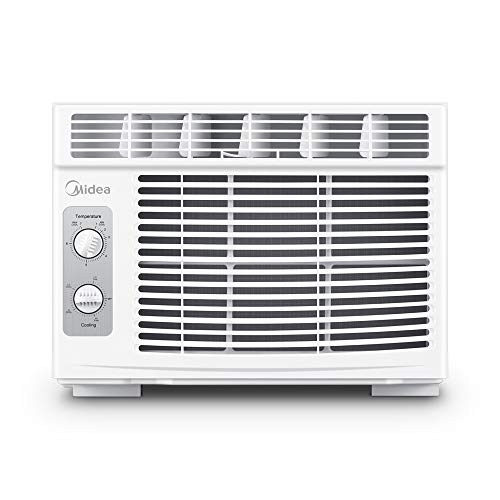
Midea 5000 BTU EasyCool Window AC — Simplest Small-Flat Choice
Midea’s 5,000 BTU EasyCool is the window unit for the smallest version of the apartment problem: one room, one window, one tenant who wants to be cooler tonight without a project. Mechanical controls — a dial, essentially — mean there is nothing to pair, nothing to update and nothing to fail. The listing pitches it at rooms up to 150 square feet, which describes a box bedroom, a study or a tiny studio’s sleeping corner with unusual honesty.
That honesty is the review. A 5,000 BTU machine will not cool a whole flat, and pretending otherwise sets buyers up to hate a perfectly good appliance. What it does superbly is hold one small room at a civilised temperature through the night, sipping electricity compared with the larger machines here and making so little fuss that it suits buildings where anything grander would draw attention. The reusable filter washes under a tap, keeping tenancy costs at zero beyond the electricity itself.
For renters in house shares it has a further virtue: it is explainable. A small mechanical unit in your own bedroom window, on your own meter or fairly accounted for, causes none of the communal arguments that a roaring portable in a shared living room can start. Buy it for the room you sleep in, close the door, and let the rest of the flat stay warm without you.
- Cooling rating: 5,000 BTU as listed
- Maker-stated coverage: up to 150 square feet
- Controls: mechanical, deliberately simple
- Filter: reusable and washable
- Intended rooms: small bedroom, living room corner, home office
- Format: compact window-mounted unit
Strengths
- Nothing to configure — a dial and cool air
- Modest electricity draw suits shared bills
- Small enough to store in a wardrobe in winter
Trade-offs
- One small room only; it will not serve a flat
- No remote or scheduling features
- Mechanical controls mean no precise temperature setting
Best for: house-share tenants and small-studio sleepers who need one room cooled well.
Not suited for: anyone hoping a single small unit will cool an open-plan flat.

BLACK+DECKER Smart Portable AC 12000 BTU BPACT12WT — Best Portable for Larger Rentals
When the lease says no to window units — and many do — the BLACK+DECKER BPACT12WT is the portable answer for a larger rental. Its listing publishes both the 12,000 BTU headline and an 8,000 BTU SACC figure, with coverage stated up to 550 square feet, which means a renter can size it against a real floor plan instead of a hope. In an open-plan rented living space, that published honesty is worth more than any smart feature.
The smart control matters in rentals for a specific reason: pre-cooling. Tenants who are out all day in a flat that bakes in afternoon sun can start the machine from the train home, arriving to a room that is already civilised instead of spending the evening catching up. Used that way, the portable’s inherent efficiency penalty shrinks, because the alternative — a window unit left running in an empty flat — is often forbidden by conscience, contract or the electricity tariff.
Remember the portable bargain, though. The window still hosts a vent panel, the hose wants a short straight run, and the compressor lives indoors with you, so film nights involve a volume compromise. Casters let it retire to a corner or a spare room when the tenancy’s social calendar demands floor space. For renters barred from the window route, this is the most defensible large-room compromise in the group.
- Cooling rating: 12,000 BTU, with 8,000 BTU SACC published
- Maker-stated coverage: rooms up to 550 square feet
- Modes: cooling, fan and dehumidifying, 3-in-1
- Control: smart connectivity plus onboard panel
- Format: floor-standing portable on casters
- Venting: window panel kit, removable without trace
Strengths
- No window-unit permission needed from the landlord
- Published SACC figure supports honest sizing
- Smart start suits flats that overheat while empty
Trade-offs
- Compressor noise stays inside the room
- Running costs exceed an equivalent window unit
- Hose and panel still occupy the window area
Best for: renters in larger open-plan flats whose leases forbid window units.
Not suited for: light sleepers in studios where the machine must share the sleeping space.

DREO Portable Air Conditioner 515S 12000 BTU — Best Portable for Studios
A studio flat is the hardest cooling brief in renting: one room that is simultaneously bedroom, office, kitchen and cinema, served by a machine that must be tolerable in all four roles. The DREO 515S fits that brief because its design priorities — drainage-free cooling, app and voice control, a maker-stated 12,000 BTU ASHRAE output with 8,000 BTU on the DOE scale — all point at a machine meant to run all day in lived-in space without demanding attention.
Drainage-free operation matters more in a studio than anywhere. There is no spare room to hide a draining routine in, no utility sink necessarily nearby, and a tenant who must babysit condensate in the same room where they sleep will quickly stop using the machine on humid nights — precisely when it is needed. DREO’s approach removes that friction, and the app control means the unit can be quietened for a call or a film from the desk or the bed without a trek across the room.
Place it thoughtfully and the studio works. The portable wants the window corner; the bed wants the far wall; the desk wants the middle distance where the air has mixed. Spend one evening arranging those three claims and the DREO becomes background infrastructure — which, in a one-room home, is the highest praise any appliance can earn.
- Cooling rating: 12,000 BTU ASHRAE as listed
- DOE figure: 8,000 BTU, published by the maker
- Water handling: drainage-free cooling design
- Modes: cooling, fan and dehumidifier in one unit
- Control: app, voice and remote
- Intended setting: bedroom-capable indoor positioning
Strengths
- No draining routine inside a one-room home
- Full remote control from bed or desk
- Published figures on both rating scales
Trade-offs
- Premium position within this apartment group
- Single-hose efficiency penalty still applies
- Needs the window corner permanently in season
Best for: studio tenants who live, work and sleep in one cooled room.
Not suited for: renters with a separate bedroom who could use a cheaper window unit there instead.

GE Window Air Conditioner 5000 BTU — Most Landlord-Friendly Window Unit
The GE 5,000 BTU window unit is the machine least likely to start an argument with a landlord. It is compact, mechanically controlled and sold with an easy install kit for small spaces up to 150 square feet, per its listing, with manual controls and two cooling modes. Nothing about it protrudes unusually, drips unusually or draws unusual power. In buildings where permission is granted grudgingly and remembered at inspection time, that unremarkability is a genuine feature.
Manual controls suit the way small rented bedrooms are actually used: on at bedtime, off in the morning, adjusted by a dial in the dark without a phone’s glare waking a partner. Two cooling modes plus fan operation cover the realistic range of a small room’s nights, from the first warm week of June to the sticky peak of August, and the unit’s modest appetite is kind to the older wiring that period conversions so often hide.
Choose it with clear eyes about scale. This is a one-room, door-closed appliance for sleeping and working comfort, not a whole-flat solution, and the listing’s 150-square-foot guidance should be believed. Within that honest remit — a bedroom in a shared flat, a nursery, a study where a knowledge worker spends the summer — it is the lowest-drama cooling money can rent-friendly buy.
- Cooling rating: 5,000 BTU as listed
- Maker-stated coverage: small spaces up to 150 square feet
- Controls: manual, with two cooling modes
- Installation: easy install kit included
- Format: compact window unit in white
- Best role: single-room night-time cooling
Strengths
- About as unobjectionable as window cooling gets
- Simple controls anyone can use half-asleep
- Easy kit suits temporary, damage-free fitting
Trade-offs
- Smallest coverage in this roundup
- No remote, timer or smart features
- Not a whole-flat answer at any setting
Best for: tenants who need permission-friendly cooling for one small room.
Not suited for: open-plan flats needing a single machine for the whole space.

Frigidaire 6000 BTU Window AC with Remote — Best Bedroom Upgrade
Frigidaire’s 6,000 BTU window unit is the step up for renters whose bedroom is a real room rather than a cupboard: the listing states coverage up to 250 square feet, adds a remote control, Eco Mode, three fan speeds and auto restart. That combination reads like a checklist written by someone who has actually slept under a window unit — the remote for midnight adjustments, the eco setting for bills, the restart for buildings where the power blips during storms.
Auto restart deserves its sentence. In older apartment blocks, summer storms and strained grids produce brief outages; a unit that resumes its settings afterwards protects a sleeping tenant from waking at 3 a.m. in a room that has quietly returned to sauna conditions. It is an unglamorous feature that owners appreciate exactly twice a summer and would not trade away afterwards.
The 250-square-foot reach also makes this the window pick for larger master bedrooms and modest studio sleeping zones where a 5,000 BTU machine would run flat-out and still lose ground on hot afternoons. It remains a window unit, with the usual permission and fitting questions, but for a tenant with a cooperative landlord and a proper bedroom to defend, it is the balanced end of this roundup’s window range.
- Cooling rating: 6,000 BTU as listed
- Maker-stated coverage: up to 250 square feet
- Controls: remote control included
- Modes: Eco Mode among its settings
- Fan: three fan speeds
- Behaviour: auto restart after power interruption
Strengths
- Remote and eco settings suit real bedroom life
- Coverage fits proper bedrooms, not just box rooms
- Auto restart guards sleep through summer outages
Trade-offs
- Needs the same window permission as any unit
- Larger and heavier to store than the 5,000 BTU picks
- Overkill for a genuinely tiny sleeping space
Best for: renters with a medium bedroom and a landlord comfortable with window units.
Not suited for: studio tenants who need the window left free for light and air.
How Do the Six Compare for Tenants, Room by Room?
| Pick | Badge | Format and output | Apartment-relevant trait |
|---|---|---|---|
| Midea U-Shaped Window AC 10000 BTU | Best All-Round Apartment Pick | Window, U-shaped, 10,000 BTU | Window stays usable; suits up to 450 sq. ft. |
| Midea 5000 BTU EasyCool Window AC | Simplest Small-Flat Choice | Window, mechanical, 5,000 BTU | Dial controls; rooms to 150 sq. ft. |
| BLACK+DECKER Smart Portable AC 12000 BTU BPACT12WT | Best Portable for Larger Rentals | Portable, 12,000 BTU / 8,000 SACC | No window-unit permission required |
| DREO Portable Air Conditioner 515S 12000 BTU | Best Portable for Studios | Portable, drainage-free | App and voice control for one-room living |
| GE Window Air Conditioner 5000 BTU | Most Landlord-Friendly Window Unit | Window, manual, 5,000 BTU | Easy install kit; smallest footprint |
| Frigidaire 6000 BTU Window AC with Remote | Best Bedroom Upgrade | Window, remote, 6,000 BTU | Eco Mode; rooms to 250 sq. ft. |
What Should Renters Check Before Choosing a Format?
Read the lease first, and read it like a lawyer rather than a shopper. Clauses about window obstructions, exterior appearance, appliance installation and electricity sub-metering decide which formats are even available to you. Where the lease is silent, a short written message to the landlord or agent — describing a removable unit, professionally sensible installation and full reinstatement at departure — earns permission far more often than tenants expect, and the written answer protects your deposit later.
Then audit the window itself. Sash windows accept standard kits; sliders accept them vertically; casements usually push you toward a portable with a fabric seal. Measure the opening’s width and height, check the sill’s condition, and look for the nearest socket — an air conditioner on a long extension lead is both a safety problem and, in many leases, a rule breach waiting to be noticed.
Consider the building’s electrical temperament. Older blocks may share circuits across rooms or even across flats, and a compressor’s start-up draw arriving on top of a kettle and a hairdryer can trip breakers at the worst moment. The smaller window units here are gentle citizens in that environment; the big portables deserve a circuit of their own where the wiring allows it.
Finally, think about the neighbours as a design constraint rather than an afterthought. Thin partition walls transmit vibration, and a unit mounted firmly, level and cushioned behaves far better than the same unit rattling in a loose frame. Portable owners should park the machine on carpet or a mat, not bare boards above a neighbour’s bedroom ceiling.
How Can You Keep the Peace With Neighbours While Staying Cool?
Most cooling complaints are about vibration and timing, not temperature. A window unit that is slightly out of level buzzes against its frame; shimming it true and tightening every screw in the kit takes ten minutes and changes its social footprint completely. Check the mount again after the first week, because materials settle and a silent installation in June can become a droning one by July if nobody looks.
Portables ask for floor diplomacy. The compressor sits in the room, and its vibration travels through floorboards into the flat below. A rug or anti-vibration mat under the unit, and a position away from the party wall, are courtesies that cost almost nothing. Running the machine steadily at a moderate setting is also kinder than dramatic on-off cycling through the night, since start-up transients are what wake people.
Timing is the third courtesy. Pre-cooling in the early evening, when ambient building noise masks the machine, lets you turn it down or off earlier at night. Tenants who cool the room before bed and coast on fan mode often sleep as well as those who refrigerate until dawn — and they halve both the noise and the bill in the process.
If a complaint does arrive, treat it as information rather than war. Often the fix is positional — a moved unit, a tightened panel, a changed schedule — and a tenant who responds quickly and visibly keeps both the cool air and the goodwill. In shared buildings, goodwill is a utility as real as electricity.
How Do You Install a Window Unit Without Risking the Deposit?
The deposit-safe installation begins before the box opens: photograph the window frame, sill and surrounding wall, and keep those pictures with your move-in inventory. Any mark the installation might make can then be proven pre-existing or, if genuinely yours, assessed fairly. Lay a blanket over the sill, work with a helper for anything above the smallest size, and never let a unit rest its full weight on a frame it was not designed to load.
Follow the kit rather than improvising around it. The side panels, foam seals and brackets in the box exist to carry weight and block air; screws into a uPVC or landlord-owned timber frame are where deposits go to die, so where the kit offers a no-drill path, take it. If your window genuinely needs a support bracket, choose one that clamps or rests rather than one that must be screwed into masonry you do not own.
Seal for air, not for permanence. Foam tape and removable weatherstrip close the gaps that waste cooling, and both peel away cleanly in autumn. Avoid construction adhesives, expanding foam and anything that requires a scraper at move-out; the goal is a summer of cool air followed by a window that looks untouched in the departure photographs.
At the end of the season, reverse the process with the same care: clean the filter, drain any collected moisture, let the unit dry before storing it upright, and keep the kit’s screws and panels together in a labelled bag. Next year’s installation — in this flat or the next one — becomes a twenty-minute job instead of an archaeological dig through a parts box.
Where Does a Portable Make More Sense Than a Window Unit in a Flat?
The portable’s first stronghold is the prohibited window. Many modern leases and most managed blocks ban window units for appearance or safety, while saying nothing about an appliance that stands on the floor and vents through a removable panel. For those tenants the portable is not the second-best format; it is the only format, and the two portables in this roundup exist precisely for them.
Its second stronghold is the unsuitable window. Fixed panes, crank casements, internal secondary glazing in listed buildings and windows positioned over a bed or a desk can all defeat a window unit. A portable needs only a window that opens somewhere in the room and floor space near it, which describes almost every flat ever built.
The third case is the short tenancy. A tenant on a six-month contract, a student in a summer let or a worker on assignment gains little from fitting a window unit they will remove before the season ends. A portable arrives, works the same evening, and leaves in the boot of a car. Its higher running cost, spread over a short stay, is a fair price for that elasticity.
None of this makes the portable the universal answer. Where a window unit is allowed and the tenancy is long, the window format’s efficiency and quieter operation repay its installation effort many times over. The renter’s skill is not loyalty to a format but honesty about which constraints — lease, window, neighbours, time — actually bind.
How Should You Store Cooling Equipment in a Small Flat Over Winter?
Storage begins with cleaning, because a unit put away dirty deteriorates quietly for eight months. Wash the filter, wipe the cabinet and grilles, and for portables, run the fan mode for an hour to dry the internals before the machine is moved. A dry unit stored upright in a cool cupboard emerges in June ready to work; a damp one emerges with a smell that takes a week of running to forgive.
Small window units have a hidden apartment advantage here: at 5,000 BTU they are light enough for one person to carry and small enough for a wardrobe shelf or the top of a kitchen cupboard run. Keep the install kit in a bag taped to the unit, and the window seals with it, so the whole system hibernates as one object rather than dispersing into drawers.
Portables store standing in a corner, ideally with the hose loosely coiled rather than kinked and the window panel kept flat where it cannot warp. Cover the machine with a breathable cloth if it lives anywhere dusty. In the smallest studios, the portable’s winter footprint is a real cost of ownership, and it is worth pacing out that corner before ordering rather than discovering the problem in October.
Finally, note what the season taught you. A sentence in your phone — the setting that worked, the neighbour who mentioned noise, the window that leaked air — turns next summer’s setup from a repeat of this year’s experiments into a refinement. Renters repeat this ritual annually; a small memory makes each repetition cheaper.
What Does Apartment Cooling Cost to Run Across a Summer?
The arithmetic is dominated by hours. Window units in this size range draw modest power and, crucially, their honest output is not taxed by a hose penalty, so they reach temperature and cycle off. Portables draw more for the same felt comfort and run longer to hold it. Over a full summer in a hot flat, that difference is real money — worth paying for lease compliance or window reality, but worth choosing knowingly rather than discovering on a September bill.
Tariff structure changes the answer by household. Tenants on time-of-use tariffs can pre-cool cheaply in the afternoon and coast through the expensive evening peak; tenants on flat tariffs gain less from scheduling and more from simply using less. Either way, the Eco Mode on the Frigidaire and the inverter behaviour of the Midea U are not marketing garnish — they are the features that decide what the season costs.
Shared houses add a fairness dimension to cost. A unit cooling one bedroom on a shared meter invites negotiation; the honest solutions are a plug-in energy monitor, a rough hours-based split agreed in advance, or choosing the smallest unit that does the job so the sum in dispute stays small. Cooling arguments in house shares are rarely about money itself — they are about surprises, and a monitor removes the surprise.
The cheapest summer of all belongs to the tenant who combines a right-sized machine with free techniques: curtains closed against afternoon sun, doors managed, the fan mode used on mild nights, and the thermostat set for comfort rather than for a number that feels virtuous. Equipment matters, but habits compound daily.
How Do You Cool a Flat When Working From Home All Day?
The home worker’s problem is duration. Eight or nine hours at a desk in a warming room erodes concentration long before it threatens health, and the cooling that serves a workday is steadier and quieter than the blast that serves a returning commuter. Window units earn their keep here: the Midea U’s inverter steadiness or a small unit holding a study at a constant temperature lets you forget the machine exists, which is the entire requirement.
Video calls add an acoustic test that evening cooling never faces. A portable beside the desk will announce itself to every meeting; place it across the room, let the space pre-cool before the first call, and use fan-speed discipline during calls. Colleagues forgive many things, but a compressor’s start-up thump under your quarterly report is not among them.
Zoning saves the home worker money. There is no prize for cooling the bedroom, kitchen and hallway while you sit in one room; close the doors, cool the office, and let the rest of the flat warm harmlessly until evening. The small window units in this guide are almost purpose-built for that pattern — one room, held well, all day, at a cost a freelancer can expense without wincing.
Breaks are part of the system too. A room held at a civilised temperature makes the rest of the flat feel survivable during lunch and coffee, whereas a room refrigerated to arctic levels makes every trip to the kitchen feel like stepping into an oven by contrast. Aim for comfortable and constant, and the working day stops being a negotiation with the weather.
Which Features Matter Least, Despite the Marketing?
Colour displays and elaborate light shows contribute nothing to a cooler flat and can actively harm a bedroom, where a bright panel at 2 a.m. is a small glowing enemy. If a unit’s lights cannot be dimmed, a strip of tape is the traditional renter’s fix — but it is better to value the feature’s absence when choosing. Similarly, a remote control matters in a bedroom and barely at all in a study where the unit sits within arm’s reach of the desk.
App ecosystems divide tenants. For a renter who will move within a year or two, an account-bound appliance is a small administrative debt: another password, another pairing ritual at the next flat. The mechanical picks in this roundup will work identically in any home on earth with a suitable window, and that portability of operation — not just of hardware — is worth real money to mobile people.
Dehumidifier modes, by contrast, are underrated in flats. Laundry dried indoors, showers without extractor fans and cooking all load a small home with moisture, and a machine that can pull water from the air on a muggy evening solves the sticky feeling that temperature alone does not explain. Renters in older, damper buildings should weight this mode far above any smart feature.
The lesson generalises: choose for the constraints of your actual tenancy — its walls, windows, wiring and neighbours — and let the brochure’s theatre fall where it may. A flat cooled quietly, legally and cheaply beats a showcase of features that the building will not let you use.
How Should You Handle Moving Day With Cooling Equipment?
Decide the machine’s fate early, because heat and haste make bad logistics. A window unit you plan to keep should be removed the day before the move, while you still have time, light and a helper; the window can then be cleaned and photographed for the inventory with the frame bare. Leaving removal to moving morning guarantees scratches, arguments or an abandoned unit that the landlord bills you to dispose of.
Portables travel kindly but not carelessly. Drain and dry the unit before it is tipped into a vehicle, transport it upright where possible, and let it stand for a few hours at the new home before running it, so its refrigerant circuit settles. The window panel and hose should ride with the machine, not in a separate box that vanishes into storage.
If the unit is not coming with you, sell it early in the season rather than late. A working air conditioner listed in a June heatwave sells in days at a fair price; the same machine listed in September competes with every other departing tenant’s unit. That timing difference alone can recover a meaningful share of the purchase, and it is the renter’s version of the storage problem solved in advance.
Finally, leave the flat’s windows as you found them. Remove tape residue, refit any panel or screen you displaced, and keep your photographs. The deposit conversation goes best when the cooling chapter of the tenancy is visibly closed — no marks, no missing parts, and a landlord who will say yes faster the next time a tenant asks.
How Do You Split Cooling Costs Fairly in a House Share?
Shared houses run on agreements made before anyone is hot and tired. Decide in spring how cooling will be paid for: a plug-in energy monitor on the unit gives an honest number, and even a rough hours-based estimate agreed in advance beats a September argument reconstructed from memory and resentment. The monitor costs little and, more importantly, converts a moral argument about fairness into a simple reading nobody has to dispute.
Placement is part of the negotiation. A machine cooling one person’s bedroom is that person’s expense in any reasonable house; a machine cooling the shared living room is a house expense, and housemates who benefit from film nights in cool air should expect to share its cost. Naming that distinction early — private rooms private, shared rooms shared — prevents the slow grievance that builds when one tenant quietly funds everyone’s comfort.
There is also the question of who owns the machine when the house dissolves. If housemates split a purchase, agree at the time who keeps it and what the others receive, or whether it will be sold and divided. These conversations feel excessive in the shop and invaluable at the end of the tenancy, when the same object is either an asset with a plan or a problem with casters.
Finally, keep the agreement proportionate. The sums involved in cooling one room for one summer rarely justify spreadsheets and signatures; a monitor, a monthly glance and a round of drinks usually settle it. The goal is not accounting perfection — it is that nobody in the house associates the cool air with being quietly exploited.
What Changes When the Flat Is a Top-Floor or Period Conversion?
Top-floor flats collect the building’s heat. The roof above them bakes all day, the rooms below send their warmth upward, and the result is a home that can be several degrees hotter than the flat at ground level on the same street. Cooling such a space is a fight against a continuous load, and the honest responses are the larger picks in this guide, blackout curtains fitted before the season, and acceptance that the machine will work harder here than the same model would downstairs.
Period conversions add draughts and odd windows to the battle. Sash windows with tired cords may not bear a heavy unit safely; casements in a listed facade may forbid anything visible from the street; skylights pour in heat while offering no wall for a conventional install. In these homes the portable often wins by default, venting through whichever window the building allows, while draught-proofing the worst gaps repays its tiny cost within a fortnight.
Heat also rises within the flat itself. A mezzanine sleeping platform or a raised bed area sits in the warmest layer of the room’s air, which is why loft-style tenants feel underserved by machines that satisfy the sofa. Directing airflow upward, or sleeping lower during the worst weeks, sounds undignified and works completely — a reminder that in difficult buildings, arrangement is a cooling technology too.
Tenants in such flats should also negotiate from knowledge. A top-floor flat that is demonstrably hard to cool is a reasonable subject for a conversation about landlord-provided shading, external blinds or a contribution toward running costs. Not every landlord agrees, but the tenant who arrives with measurements and a specific, modest request fares better than the one who simply complains about the heat.
How Do You Decide Between Cooling the Bedroom or the Living Room First?
Most flats can afford one good machine before they can afford two, and the order of purchase should follow suffering rather than square footage. For most tenants the bedroom wins: sleep is the function heat damages first and most completely, and a cool bedroom quietly improves work, temper and health in ways a cool sofa does not. The exception is the home worker, whose living room is also the office and whose daytime hours are spent exactly where the heat gathers.
Whichever room loses the first round is not abandoned — it is scheduled. The cooled room’s door, opened an hour before the household migrates, lends its air generously, and a fan in the doorway formalises the loan. Many one-machine flats discover that this evening ritual covers the second room well enough that the second purchase can wait for a sale, a move or a genuinely hotter summer.
What Mistakes Do Renters Most Often Make With Air Conditioning?
Buying before checking the lease. The finest window unit in this guide is worthless in a building that bans it, and returning a fitted, run machine is nobody’s idea of a relaxing weekend. Permission first, specifications second, always.
Assuming a portable needs no window at all. Every portable here still vents hot air through a window panel; a room with no openable window cannot host one, whatever the product photographs imply.
Cooling the whole flat from one small unit. A 5,000 BTU machine with the bedroom door open is not cooling the flat — it is failing in several rooms at once instead of succeeding in one. Close the door and let it win where it can.
Screwing brackets into frames you do not own. Deposit deductions for damaged uPVC and timber are entirely avoidable with the clamping, resting and foam-based methods the kits intend. If a fitting needs a drill, it needs the landlord’s written blessing first.
Ignoring the neighbours until they complain formally. A mat under a portable, a level window mount and civilised hours cost almost nothing in June and are worth a great deal by August.
Storing a damp unit in autumn. The musty smell that greets you next June is this autumn’s skipped drying hour, faithfully preserved. Clean, dry, upright, complete — four words that protect the whole investment.
Final Recommendation
Match the format to the tenancy before matching the model to the room. Tenants with window permission and a main living space should look first at the Midea U-shaped unit, whose window-friendly design and 450-square-foot reach solve the studio problem elegantly; smaller bedrooms are served honestly by the Midea EasyCool or the GE, and the Frigidaire suits a proper bedroom with its remote and Eco Mode. Renters barred from window units should choose between the BLACK+DECKER for larger spaces and the DREO for one-room living where drainage-free, app-managed running earns its premium.
In concrete terms, that means the Midea U-Shaped Window AC 10000 BTU for window-permitted main rooms, the Frigidaire 6000 BTU Window AC with Remote for a proper bedroom, and the DREO Portable Air Conditioner 515S 12000 BTU when the lease sends you down the portable road.
Whichever route your lease allows, install carefully, seal generously, keep the neighbours in mind and photograph everything for the inventory. The tenants who sleep coolest are rarely the ones who bought the most powerful machine — they are the ones whose cooling was permitted, level, quiet and still running perfectly on the last hot night of the year, in a flat they will hand back without a single mark to explain.
Frequently Asked Questions
Do I need my landlord’s permission for a window air conditioner?
In most tenancies, yes — window units alter the building’s appearance and load its frame, and many leases address them directly or through general installation clauses. Ask in writing, describe the removable kit and your reinstatement plan, and keep the reply. Portables usually need no permission since nothing is installed, but they still vent through a window panel, so check any clause about window obstructions.
Will a portable air conditioner work in a flat with casement windows?
Yes, with the right seal. Casement windows crank outward and cannot close against a rigid panel, so portable owners use a fabric seal kit that fits around the frame and zips open for the hose. It is inexpensive and renter-friendly since it attaches with adhesive hook-and-loop rather than screws. Standard sliding panels work directly with sash and sliding windows.
How can I stop my window unit annoying the neighbours?
Mount it level and tight so it cannot buzz against the frame, add the foam sealing the kit provides, and recheck the fixings after the first week. Run the unit steadily rather than in dramatic cycles, pre-cool before quiet hours, and if your bedroom shares a wall with a neighbour’s, favour the lowest fan setting that holds the temperature overnight.
Is a 5,000 BTU unit worth buying, or is it too small to matter?
It matters enormously in the right room. In a bedroom of up to about 150 square feet with the door closed, a 5,000 BTU unit holds a comfortable sleeping temperature at modest running cost. Its failure mode is ambition: asked to cool an open-plan flat, it will run constantly and satisfy nobody. Sized honestly, it is the best-value sleep a renter can buy.
Can I run an air conditioner on an extension lead in an older flat?
Avoid it. Air conditioners draw sustained high current, and extension leads — especially coiled ones or multi-way adapters shared with other appliances — can overheat. Plug the unit directly into a wall socket; if the only suitable window is far from a socket, that is a genuine reason to choose a different room layout or discuss the problem with the landlord rather than improvise.
What should I do with the unit when my tenancy ends?
Clean and dry it thoroughly, keep the installation kit together with it, and decide early whether it moves with you or gets sold. Units sell fastest at the start of the hot season. Remove any tape or seal residue from the window, refit anything you displaced, and photograph the restored window for your records before the final inspection.
Related Guides
Renters weighing noise and measurement will also enjoy our standards-led look at cooling, our guide to dishwashers quiet enough for open-plan flats, and our compact oven picks for small kitchens — begin with Best Air Conditioners, Judged by Lab-Test Standards, Best Quiet Dishwashers, Best Compact Toaster Ovens.


