What's inside
- Key Takeaways
- Quick Picks
- What Earned a Freezer a Place in an Off-Grid Guide?
- The Six Picks at a Glance, Labeled Honestly
- How Does Absorption Cooling Actually Work?
- Propane or Solar DC — Which Fuel Philosophy Fits Your Land?
- How Should You Plan the Installation Before the Freezer Arrives?
- What Does a Winter With an Off-Grid Freezer Teach You?
- Where Do Off-Grid Buyers Most Often Go Wrong?
- How Big Is a Harvest, in Cubic Feet?
- What Does Venting a Propane Appliance Really Require?
- How Do You Watch a Freezer You Cannot Hear Running?
- What Maintenance Does an Absorption Circuit Ask For?
- How Does Propane Actually Reach a Remote Freezer?
- Is a Generator a Third Answer?
- Why Do the Freezer-Only Picks All Wear the Chest Format?
- Final Recommendation
- Frequently Asked Questions
- Related Guides
As an Amazon Associate I earn from qualifying purchases. This post may contain affiliate links at no extra cost to you.
cottageverdict.com is reader-supported. When you buy through links on our site, we may earn an affiliate commission.
Each pick below is sold on Amazon and links to its own listing there, so when you have settled your fuel and your size you can check price on Amazon for the exact model. Off-grid appliances are bought once and lived with for years, so read the fuel sections twice.
The best freezers for off-grid living begin with an admission most appliance guides never have to make: off the grid, electricity is a ration, not a utility. A freezer that sips from a battery bank all night is spending tomorrow’s lights, tomorrow’s water pump, tomorrow’s radio. That is why the verified field for this guide looks so different from a household freezer roundup. Of the six picks, four burn propane through absorption cooling — a silent flame doing the work a compressor does elsewhere — one pairs propane with household current, and one is a solar DC refrigerator with a top freezer, built to run straight from panels and batteries. There is no ordinary plug-it-in chest freezer here, because on a homestead without poles and wires, ordinary is the one thing a freezer cannot be.
A second honesty point shapes everything below. Two of the six picks — both from Smad — and the Unique solar unit are refrigerator-freezer combinations, not standalone freezers, and this guide calls them combos every time they are named. That is not a demotion. Off-grid households usually need refrigeration more than they need a dedicated freezer chest, and a combo that freezes a modest top section while chilling a large fresh-food cabinet matches how cabins, RVs, chalets, and food trucks actually eat. But a buyer hunting a true freezer-only box should know exactly which picks are which, so the labels stay precise: the SMETA, the Techomey, and the small 2.4 cubic foot unit are freezer-only chests; the Smads and the Unique are combos with freezer sections.
Finally, a discipline this guide will not break: no consumption figures are invented for any pick. Absorption and DC appliances live or die by their fuel appetite, but where a listing title does not state a rate, this guide does not assign one. What the titles do state — capacities, fuel pairings, locks, baskets — is quoted faithfully, and the fuel-planning sections below teach you how to interrogate a listing for the numbers your own system design needs.
Key Takeaways
- The verified off-grid field splits by fuel: propane absorption chests (SMETA, Techomey, and the 2.4 cubic foot three-way), propane refrigerator-freezer combos (two Smad sizes), and one solar DC combo from Unique.
- Three picks are true freezer-only chests; the Smad 9.3, Smad 19.5, and Unique 14 are fridge-freezer combos and are labeled as combos throughout this guide.
- Two-way fuel pairing is the class’s signature: propane for the off-grid days, 110V electric for the days a generator, shore power, or a grid hookup is available.
- The small 2.4 cubic foot pick is the only three-way unit here, adding 12V DC to propane and 110V — a vehicle-friendly flexibility the bigger chests do not claim.
- No consumption rates are stated in the verified titles, so fuel budgeting must be confirmed on each listing before you size a tank or a battery bank around a pick.
- Capacity spans 2.4 to 19.5 cubic feet, but combo capacity includes the fresh-food section — compare freezer-only figures with freezer-only figures.
Quick Picks
| Pick | Badge | Why it earned its place |
|---|---|---|
| SMETA 7.1 Cu Ft Propane Chest Freezer | The absorption standard-bearer | A 7.1 cubic foot freezer-only chest running gas or 110V electric, lockable, built on silent absorption cooling for cabins and camper vans. |
| Techomey 7 Cu Ft Propane Chest Freezer | The boondocker’s twin brief | Seven cubic feet of freezer-only space on 110V or LPG with a lock — aimed squarely at homes, camps, and long boondocking stays. |
| 2.4 Cu Ft 3-Way Propane Freezer (110V/12V/LPG) | Three fuels, smallest footprint | The only pick that also runs on 12V, with a removable basket and lock — the food-truck and RV freezer in miniature. |
| Smad 9.3 Cu Ft Propane Refrigerator With Freezer | The mid-size combo | A propane refrigerator with a freezer section at 9.3 cubic feet total — a combo, honestly labeled, for garages, RVs, and chalets. |
| Smad 19.5 Cu Ft Propane Refrigerator With Freezer | The full-size cabin combo | Nineteen and a half cubic feet with a top freezer on 110V or LPG — household-scale refrigeration that never asks the grid’s permission. |
| Unique 14 Cu Ft Solar DC Refrigerator With Top Freezer | The solar-native combo | A 14 cubic foot retro-styled refrigerator with top freezer, powered by solar DC — the pick for systems built around panels and batteries. |
What Earned a Freezer a Place in an Off-Grid Guide?
The entry test was fuel, full stop. A pick had to keep food frozen without depending on a continuous grid supply — by burning propane through an absorption circuit, by running natively on DC from a solar-charged bank, or by pairing those fuels with an electric mode for the days power is plentiful. Ordinary compressor freezers, however efficient, failed the test: their appetite is designed for a world where the wall always provides, and off-grid that assumption is the most expensive one a household can make. Each pick also had to state its capacity and its fuel pairing in its own listing title, because a homestead buyer planning a tank, a vent, and a level pad cannot work from folklore.
We also insisted on labeling discipline, and held ourselves to it as firmly as the picks. Where a unit is a refrigerator with a freezer section, the guide says combo; where it is a freezer and nothing else, the guide says freezer. The distinction decides real purchases — a family preserving a whole harvest needs freezer-only volume, while a couple in a cabin needs a fridge that happens to freeze. Shoppers whose cold storage lives at the end of a driveway rather than the end of a dirt road may find the gas-versus-electric thinking here echoes a smaller kitchen question in Best 30-Inch Gas Wall Ovens, where flame cooking survives as a deliberate niche for exactly the households this guide serves.

SMETA 7.1 Cu Ft Propane Chest Freezer — The absorption standard-bearer
The SMETA is the pick that defines the class for most buyers: a 7.1 cubic foot chest freezer — freezer-only, no fridge section diluting the claim — that runs on propane gas or 110V electric, as its title states. The cooling method named in the title is absorption, the century-old silent circuit in which a small flame’s heat drives refrigerant around a sealed loop with no compressor and no moving parts to wear. On a homestead, that silence is not a luxury detail; it is the sound of an appliance with almost nothing in it that can break, asking only for fuel and a level floor.
The title also states a lock, which reads as a small thing until you picture the freezer’s actual homes: a cabin porch, a camper van, a garage that doubles as a workshop, a camp where the chest holds a season’s meat. A lockable lid protects the harvest from wildlife, weather-blown debris, and curious hands alike. The two-way fuel pairing is the working heart of the purchase — propane as the default diet, 110V as the opportunistic one, for the weekends a generator runs anyway or the freezer winters somewhere with power. Buyers should plan the installation with absorption’s two non-negotiables in mind: the unit must sit level for its circuit to circulate, and its combustion needs proper ventilation, both discussed in the planning sections below. Within those honest constraints, this is the freezer the off-grid class is built around.
- Capacity: 7.1 Cu.Ft as stated in the listing
- Format: chest freezer, freezer-only
- Cooling: absorption, 2-way as stated in the listing
- Fuel: propane gas or 110V electric as stated in the listing
- Security: lockable as the listing states
- Stated homes: outdoor, RV, camper van, off-grid living
- Where to buy: the SMETA 7.1 Cu Ft listing on Amazon — check price on Amazon
Strengths
- Freezer-only volume: every cubic foot serves the harvest, not the salad.
- Absorption cooling has no compressor to wear out and runs in silence.
- Two-way fuel pairing covers both the off-grid week and the powered weekend.
Trade-offs
- Absorption demands a level installation and respect for ventilation.
- No consumption rate is stated in the title; fuel budgeting needs the listing’s figures.
- Cool-down from warm is a patient process compared with compressor machines.
Best for: homesteads and cabins wanting a true freezer chest that answers to a propane tank.
Think twice if: your site cannot offer a level, ventilated home — absorption will not forgive either omission.

Techomey 7 Cu Ft Propane Chest Freezer — The boondocker’s twin brief
The Techomey arrives with nearly the SMETA’s brief written a degree more plainly: a 7 cubic foot propane chest freezer, 110V/LPG two-way, off-grid gas deep freezer with lock, in white. Its title names its intended habitats without embarrassment — home, outdoor, camping, boondocking — and that last word tells you the design center. Boondocking means weeks on public land with no hookups, where the freezer’s job is to make a vehicle’s or a camp’s provisions last between rare town runs. Seven cubic feet of freezer-only space is a month of meat, bread, and frozen vegetables for a careful couple, held by flame alone.
Between the two big chests, the honest differences are slender: a tenth of a cubic foot here, a word in a title there. The Techomey does not name its cooling method in the title the way the SMETA names absorption, so this guide describes it by its stated facts — propane and electric two-way power, chest format, lock — and leaves the circuit question for the listing page, where a careful buyer will confirm it before purchase. That restraint is worth modeling, because off-grid buyers shop in a category where a wrong assumption costs a season. What can be said plainly: two verified seven-foot propane chests give this class something rare, a genuine choice at its most useful size, and the deciding factors between them will be the listing-level details — dimensions, venting requirements, and the consumption figures each states there.
- Capacity: 7 Cu.Ft per the listing
- Format: chest deep freezer, freezer-only
- Fuel: 110V/LPG 2-way as listed
- Security: lock as its title states
- Finish: white per the title
- Stated homes: home, outdoor, camping, boondocking
- Where to buy: find the Techomey 7 Cu Ft listing on Amazon to check price on Amazon
Strengths
- Freezer-only seven-foot volume aimed at long unplugged stays.
- Two-way fuel pairing with a locking lid, stated plainly.
- Gives the class a real alternative at its most practical size.
Trade-offs
- Its title does not name the cooling circuit; confirm the mechanism on the listing.
- No fuel-consumption figure is stated in the title.
- White finish only, as titled — plan the setting accordingly.
Made for: boondockers and camp households measuring their town runs in weeks.
A poor match for: buyers who need refrigeration too — a combo further down this list serves that brief.
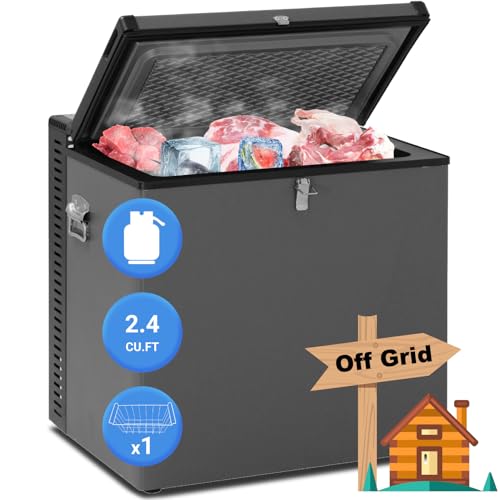
2.4 Cu Ft 3-Way Propane Freezer (110V/12V/LPG) — Three fuels, smallest footprint
Every other pick in this guide pairs two fuels; this little chest claims three. Its title states 110V, 12V, and LPG in one breath — three-way power — and that third input changes the unit’s whole biography. On propane it is a cabin or garage freezer. On 110V it is a plug-in anywhere power exists. On 12V it rides in a vehicle, freezing on the road between the other two lives. At 2.4 cubic feet it is unambiguously a small appliance — a removable basket’s worth of essentials, the frozen core of a food truck’s menu, an RV’s overflow, a garage’s bait-and-ice reserve — and its title states both the basket and a lock, the working kit of a unit meant to be opened often and left in semi-public places.
The honest framing for a three-way unit is that flexibility and depth trade against each other. A small absorption chest will not pull a warm load down like a household compressor freezer, and 2.4 cubic feet fills in a single serious shopping trip. But no other pick here can follow its owner across all three power worlds, and for the food-truck operator, the fishing guide, or the RV traveler whose freezer must work at the dock, on the highway, and at the propane-equipped camp, that portability of diet is the entire purchase. It is the class’s utility player: smallest, humblest, and the only one that never has to ask what kind of power the day offers.
- Capacity: 2.4 Cu.Ft as titled
- Format: small chest freezer, freezer-only
- Fuel: 3-way 110V/12V/LPG from the listing
- Organization: removable basket as printed in its title
- Security: lock the listing states it
- Stated homes: off grid, garage, RV, food truck
- Where to buy: the 2.4 Cu Ft 3-Way listing on Amazon — check price on Amazon for this listing
Strengths
- The only three-way fuel flexibility in the field, 12V included.
- Small enough to move between vehicle, garage, and camp roles.
- Basket and lock suit commercial, high-open-frequency use.
Trade-offs
- 2.4 cubic feet is a supplement, not a household’s whole freezer strategy.
- Absorption-class patience applies: plan loads ahead of need.
- No consumption figures are stated in the title for any of its three fuels.
Choose it if: your freezer must work in three power worlds and small is a feature, not a compromise.
Less happy in: a homestead preserving bulk harvests — the seven-foot chests exist for that arithmetic.

Smad 9.3 Cu Ft Propane Refrigerator With Freezer — The mid-size combo
Now the combos, named as combos. The Smad 9.3 is a propane refrigerator with a freezer section — 9.3 cubic feet in total across both cabinets, as its title states — powered by propane or 110V, and aimed by its own listing at garages, RVs, food trucks, and chalets. Read that habitat list and the product explains itself: these are dwellings that need a real refrigerator first — milk, eggs, produce, leftovers — with a freezer section sized for ice, a week of meat, and the frozen essentials, rather than a harvest archive. Judged as a combo, 9.3 cubic feet is a serious apartment-scale refrigerator that happens to be free of the grid.
The mistake to avoid is arithmetic: do not compare its 9.3 against the SMETA’s 7.1 as if both numbers measured freezer space. The chest’s figure is all freezer; the Smad’s is fridge and freezer together, with the fresh-food cabinet claiming the larger share, as fridge-first design dictates. Households that understand which of those they need will find this pick deeply sensible — it is the difference between a cabin that eats like a home and a cabin that camps with better scenery. Its two-way fuel pairing mirrors the chests’: propane as the standing diet, 110V for powered days and pre-cooling before a trip.
- Total capacity: 9.3 cu.ft as the title has it
- Format: refrigerator with freezer section — a combo, not a standalone freezer
- Fuel: 110V/propane per its listing title
- Stated homes: garage, RV, food truck, chalets
- Freezer-only volume: not separated in the title — confirm the split on the listing
- Where to buy: shop the Smad 9.3 listing on Amazon and check price on Amazon
Strengths
- A real refrigerator’s fresh-food space, freed from the grid entirely.
- Propane or electric diet matches the two-way rhythm of cabin life.
- Apartment-scale total capacity in a single off-grid appliance.
Trade-offs
- The freezer section is a section, not a chest — bulk preserving overflows it quickly.
- The title does not split the capacity between fridge and freezer.
- No consumption rate is stated in the title.
Suits best: cabins, chalets, and RVs that need everyday refrigeration with a working freezer section.
Not the one for: harvest-scale freezing — that brief belongs to the freezer-only chests above.

Smad 19.5 Cu Ft Propane Refrigerator With Freezer — The full-size cabin combo
If the 9.3 is apartment scale, the Smad 19.5 is household scale wearing off-grid clothes. Its title states 19.5 cubic feet with a top freezer, powered by 110V or LPG, for garages, RVs, cabins, food trucks, and cottages — and again, the label discipline applies in full: this is a refrigerator-freezer combo, and its headline capacity is the whole appliance. A top-freezer layout is the classic household arrangement, freezer at eye level over a large fresh cabinet, and at this size it supports the thing off-grid families actually struggle with — eating a varied, fresh diet far from a store, with a freezer section that handles the weekly frozen rotation rather than a token ice tray.
The purchase logic here is replacement logic. This is the pick for the off-grid home whose kitchen is a real kitchen, where the refrigerator runs every day of the year and its fuel bill is a line in the household budget. That is precisely why the missing figure matters and why this guide keeps pointing at it: no consumption rate appears in the title, and at this scale the listing’s stated appetite should anchor your propane planning — tank size, delivery cadence, and the honest yearly cost of cold. Verify it, along with the fridge-to-freezer split, on the listing before the pad is poured. What the title does verify is the proposition itself: full-size refrigeration, top freezer, two fuels, no grid required.
- Total capacity: 19.5 cu.ft as given in the listing
- Format: refrigerator with top freezer — a combo, not a standalone freezer
- Fuel: 110V/LPG as the listing states
- Stated homes: garage, RV, cabin, food truck, cottages
- Freezer-only volume: not separated in the title — confirm on the listing
- Where to buy: the Smad 19.5 listing on Amazon — check price on Amazon
Strengths
- Household-scale refrigeration that never consults the grid.
- Top-freezer layout matches the habits of a full-time kitchen.
- Two-way fuel pairing suits permanent off-grid homes.
Trade-offs
- Its freezer section serves a rotation, not a harvest archive.
- Fuel appetite at this scale must be verified on the listing before tank planning.
- A large absorption appliance needs its level, ventilated placement planned like furniture.
The right anchor for: a full-time off-grid kitchen that cooks fresh daily and freezes weekly.
Skip it if: your cold problem is purely frozen volume — a chest answers that at a fraction of the footprint.

Unique 14 Cu Ft Solar DC Refrigerator With Top Freezer — The solar-native combo
The Unique is the field’s other philosophy made visible. Where the propane picks burn fuel in an absorption circuit, this 14 cubic foot refrigerator with a top freezer — a combo, labeled as such — runs on solar powered DC, as its title states, sipping electrons from the same panels and battery bank that light the cabin. Its Classic Retro styling, in Marshmallow White as titled, is a deliberate piece of design: off-grid appliances spend their lives in small rooms where they are always in view, and Unique dresses the machine like furniture from a farmhouse kitchen rather than equipment from a utility closet.
The system logic differs from propane in ways a buyer must plan around. A DC fridge’s running cost is measured against your bank’s capacity and your array’s winter output, not against a tank’s gauge; it asks for electrical headroom instead of fuel deliveries, and it rewards the household whose solar system was sized with refrigeration as a first-class load. In exchange, it removes combustion from the room entirely — no flame, no venting question — and pairs naturally with the silent, fume-free house that solar owners are usually building. Its title names bedrooms, campsites, and off-grid locations as its habitats; read the bedroom note as a statement about manners. For the solar-first homestead, this is not the alternative pick. It is the native one.
- Total capacity: 14 cu./ft. per the listing
- Format: refrigerator with top freezer — a combo, not a standalone freezer
- Power: solar powered DC as listed
- Style: Classic Retro, Marshmallow White as its title states
- Stated homes: bedroom, campsite, off-grid locations
- Where to buy: find the Unique 14 listing on Amazon to check price on Amazon
Strengths
- Runs natively on solar DC — no fuel deliveries, no flame in the room.
- Full combo capacity at a between-the-Smads size.
- Retro styling suits the small, always-visible off-grid kitchen.
Trade-offs
- Its freezer is a top section of a combo, not a freezer-only chest.
- Your array and bank must carry refrigeration as a planned, permanent load.
- No consumption figure is stated in the title; size your system from the listing’s data.
Pick it when: your homestead’s energy plan is solar-first and the fridge should speak the same language.
A weaker fit for: sites where propane is already plumbed and solar capacity is spoken for.
The Six Picks at a Glance, Labeled Honestly
| Pick | Format | Stated capacity | Fuel or power as titled |
|---|---|---|---|
| SMETA Propane Chest Freezer | Freezer-only chest | 7.1 Cu.Ft | Propane gas / 110V, absorption 2-way |
| Techomey Propane Chest Freezer | Freezer-only chest | 7 Cu.Ft | 110V / LPG 2-way |
| 3-Way Propane Freezer | Freezer-only chest, small | 2.4 Cu.Ft | 110V / 12V / LPG 3-way |
| Smad Propane Refrigerator 9.3 | Fridge-freezer combo | 9.3 cu.ft total | 110V / propane |
| Smad Propane Refrigerator 19.5 | Fridge-freezer combo, top freezer | 19.5 cu.ft total | 110V / LPG |
| Unique Solar DC Refrigerator | Fridge-freezer combo, top freezer | 14 cu./ft. total | Solar powered DC |
How Does Absorption Cooling Actually Work?
Absorption is refrigeration’s elder technology, and its elegance is its silence. Heat — from a small, carefully regulated propane flame, or from an electric element in the two-way picks — drives a sealed circuit of refrigerant, absorbent, and water through a cycle of evaporation and reabsorption. There is no compressor, no piston, nothing that vibrates or wears in the mechanical sense; the flame is the engine. That is why absorption units dominate wherever noise, fumes management, and decades-long mechanical simplicity matter more than raw pull-down speed: RVs, boats, cabins, and the off-grid world generally.
The trade-offs are physical, not defects. Absorption cools more slowly than a compressor, so loading a warm chest with a season’s harvest is planned in stages rather than dumped in an afternoon. The circuit depends on gravity-fed circulation, which is why level installation is a requirement rather than a suggestion — a unit parked carelessly on a slope cools poorly and can strain its circuit. And the flame, however small, is a combustion source that produces exhaust needing a proper path out of the living space. Respect those three facts and absorption repays you with the quietest, longest-lived cold in this guide. Ignore them and no brand name will save the purchase.
Propane or Solar DC — Which Fuel Philosophy Fits Your Land?
The propane path buys independence from weather. A tank does not care about December’s short days or a week of storm cloud; it burns the same in a blizzard as in July, and its capacity can be extended by simply keeping a spare bottle. Its costs are logistics and combustion: fuel must be hauled or delivered, the appliance needs venting, and the flame wants periodic, respectful attention. The solar DC path buys independence from logistics. Once the array and bank exist, the Unique’s diet arrives free with the sunrise, with no deliveries and no exhaust — but its capacity is the system’s capacity, and a fridge added to an undersized bank spends the household’s lights. Households often discover the honest answer is seasonal: solar carries the summer easily, while propane’s indifference to darkness earns its keep in winter, which is one reason two-way and three-way fuel pairings recur throughout this field.
Brand-level thinking helps here too, the way it does in any mature appliance class: makers build families, and a household standardizing on one maker’s absorption line gains shared parts, shared manuals, and shared habits. The same family logic that organizes a mainstream purchase — the reasoning a reader would use in Best GE Dishwashers to stay inside one brand’s ecosystem — applies at the cabin, where the nearest service visit may be measured in days of driving rather than hours.
How Should You Plan the Installation Before the Freezer Arrives?
Start with the floor. Absorption units need a genuinely level pad — check with a real level, in both directions, where the appliance will stand, and shim the platform rather than the appliance’s feet alone. Then plan the air: the combustion side of a propane unit needs its exhaust path and its clearance from combustibles exactly as the manufacturer specifies, and the cabinet needs room air around it to shed the heat the circuit rejects. A freezer tucked into an airless closet will cool badly and age quickly, whatever fuel it burns. Finally, plan the fuel run: the shortest, safest line from tank to appliance, with a shutoff you can reach without moving the chest, and a tank placement that respects both code and the delivery driver’s winter boots.
Electrical planning is lighter but real. Two-way units want their 110V feed on a circuit that exists when you want it — a generator changeover, an inverter, or shore power — and the Unique wants its DC feed wired with the thickness and fusing that a permanent load deserves. Do this planning before delivery day, on paper, with the listing’s dimensions in hand. Off-grid installations forgive slowly; the freight alone on a returned seven-foot chest will teach the lesson once, thoroughly.
What Does a Winter With an Off-Grid Freezer Teach You?
That cold is easy and access is hard. A propane chest in an unheated outbuilding spends winter barely sipping fuel, since the room does half its work — owners routinely find the freezer is the least of their winter worries. The real curriculum is logistics: the lid buried under the week’s stored gear, the path to the outbuilding drifted shut, the harvest buried in its own success with the oldest packages at the bottom. Chest discipline — baskets by category, a written map on the lid’s underside, newest loads to the bottom in deliberate rotation — sounds like fussiness in September and reads like wisdom in February. The removable basket stated on the small three-way pick, and the locks stated across the chest picks, belong to this same practical world: organization and security are features precisely because the freezer lives where life happens.
Winter also teaches the combo lesson from the other side. A fridge-freezer combo in a room that falls below freezing can confuse a household refrigerator’s thermostat logic, since the fresh-food section may stop calling for cooling while the freezer section still needs it — one more reason cabins so often pair a combo indoors with a freezer-only chest in the outbuilding, each where its physics is happiest. The field in this guide supports that pairing naturally: a Smad or the Unique inside, a SMETA or Techomey outside, and a small three-way riding along for everything mobile in between.
Where Do Off-Grid Buyers Most Often Go Wrong?
The costliest error is comparing capacities across formats — reading a combo’s total cubic feet as freezer space and discovering, at harvest, that the freezer section holds a third of the plan. The second is skipping the consumption homework: titles in this class often stay silent on appetite, and a buyer who sizes a tank or a battery bank on a guess will meet the truth in the coldest week. The third is installation optimism — a sloped floor, a vent run that almost meets specification, a fuel line routed for convenience rather than safety. The fourth is expecting compressor manners from absorption physics: these appliances reward planned, staged loading and punish the warm dump-load. And the fifth is forgetting that off-grid cold is a system, not an appliance — the tank, the array, the pad, and the path to the door are all part of the purchase, exactly as much as the machine itself. Renters and movers face a lighter version of the same planning in ordinary housing, where the rolling appliances in Best Mobile Dishwashers solve a different flexibility problem with similar foresight.
How Big Is a Harvest, in Cubic Feet?
Freezer sizing off the grid is harvest arithmetic, and it punishes optimism. A garden’s tomato glut becomes sauce in flat bags that stack like books; a side of beef becomes a geometry problem of roasts, steaks, and grind that no basket system fully civilizes; a fishing season’s catch freezes flat and stores dense. As a working translation, one cubic foot holds roughly 30 to 35 pounds of frozen food packed with intent — which puts a seven-foot chest in the neighborhood of a serious garden year plus a hunting season, and explains why homesteads so often end up with the chest and a combo both, each absorbing the overflow the other cannot. The 2.4 cubic foot three-way, by the same arithmetic, is a deliberate supplement: the ice, the bait, the butter, and the two weeks of meat that bridge town runs.
Packing density is a skill with a learning curve. Flat-freezing liquids and sauces in bags, removing the air that insulates and bulges, and freezing in meal-sized units rather than monument-sized blocks can gain a household the effective equivalent of another cubic foot inside the same chest. Air is the enemy twice over: it wastes space and it insulates the load, making the appliance work to cool pockets of nothing. The off-grid buyer’s size decision should therefore be made against packed volume, not against the raw produce pile — and should still err a size up, because the cost of one size too large is a little fuel, while the cost of one size too small is a harvest with nowhere to go in the week it must be frozen.
What Does Venting a Propane Appliance Really Require?
Combustion makes exhaust, and exhaust needs a designed path out of the living space — this is the sentence around which propane refrigeration safety is built. The manufacturer’s instructions for the specific unit govern: clearances to walls and combustibles, the flue arrangement where one is specified, and the room ventilation that keeps the small flame’s byproducts from accumulating indoors. Carbon monoxide awareness belongs in the same paragraph without drama: any fuel-burning appliance in a tight modern cabin deserves a working CO alarm in the space, tested like the smoke alarms, as a matter of household routine rather than fear. These are not reasons to avoid propane — generations of RV and cabin owners run absorption refrigeration safely as a matter of course — but they are reasons to install it as a fuel appliance rather than as furniture.
Placement choices can make all of this easier. An exterior wall shortens the exhaust story; a utility room or enclosed porch with its own ventilation keeps combustion at the household’s edge rather than its center; and keeping the appliance out of sleeping rooms is a widely followed prudence. The freezer-only chests’ locks, stated in their titles, pair naturally with such placements — a chest on a porch or in a utility space can be secured in a way a kitchen appliance never needs. Plan the placement with the same seriousness as the purchase, and the propane picks in this guide settle into the background hum of a safe household: silent, in their case, in the most literal sense.
How Do You Watch a Freezer You Cannot Hear Running?
Compressor appliances announce themselves; absorption appliances are silent and DC appliances nearly so, which creates the off-grid owner’s distinctive anxiety — a failure can proceed in perfect quiet, discovered at the smell stage. The countermeasure is cheap and absolute: a freezer thermometer inside every cold box, read as part of the daily rounds, and ideally a min-max thermometer that remembers the warmest excursion since you last looked. That memory matters because food safety is a history, not a snapshot; a chest that warmed overnight and recovered by morning looks innocent at noon and lies about it.
The same logic argues for labeling loads with dates in a hand you can read by lantern light, and for freezing in the flat, stackable shapes that make a chest auditable at a glance. An off-grid freezer is a small warehouse at the end of a supply line, and warehouses run on inventory discipline: what is in it, where it sits, and how long it has been there should be answerable without emptying the building onto the porch in January.
Rhythm helps as much as instruments. Off-grid households build the freezer into the day’s circuits — the morning pass that checks the tank gauge, the battery monitor, and the thermometer in one motion — so anomalies surface within hours rather than days. Keep a written log if your memory is human; a month of readings teaches you your appliance’s normal behavior in your room’s seasons, and a departure from normal is then visible at a glance. The picks in this guide are built for decades of service, but the households that get those decades are the ones whose owners would notice a problem on its first day. Silence is absorption’s great virtue. Instrumented attention is its price.
What Maintenance Does an Absorption Circuit Ask For?
Very little, and mostly at the flame. The burner and flue of a propane unit want periodic cleaning — dust, rust flakes, and the occasional insect architecture can disturb the small, precise flame on which the whole circuit depends — performed as the manufacturer’s instructions direct, with the fuel off and the appliance cool. The door and lid seals want the same care as any freezer’s: kept clean, kept supple, and checked with a paper strip for grip. The cabinet’s exterior coils and vents, where fitted, want dust removed so the circuit can shed its heat. Beyond that, the sealed cooling unit itself is not a service item in ordinary life; it either works or, after long years, is replaced as a unit by a technician.
DC ownership trades that list for an electrical one: terminals kept clean and tight, the battery bank maintained on its own schedule, and the array’s output watched for the slow declines that shading, soiling, or a failing panel can cause. In both philosophies the theme is identical — the appliance is simple, and the system around it is where the care goes. Budget an hour a season for the freezer’s small liturgy and it will repay the attention the way well-kept tools do: by disappearing into reliability, season after season, while the household’s attention goes to the garden, the woodpile, and everything else the off-grid life asks of a day.
How Does Propane Actually Reach a Remote Freezer?
The romance of off-grid life meets its logistics at the tank. Propane arrives at a remote property by one of three roads: a delivery truck filling a stationary tank on a schedule, the owner’s own truck hauling exchangeable cylinders, or — at the far end of remoteness — boat, sled, or ATV freight where every pound is planned. Each road argues for a different installation. Delivered propane suits a stationary tank sized to bridge the longest gap between visits, including the winter gap when the road is a rumor; hauled cylinders suit smaller appetites and argue for a two-bottle manifold, so the freezer never waits on an empty bottle’s trip to town. The freezer’s own appetite, verified from its listing, is the input every one of these calculations needs — which is why this guide has refused, on principle, to guess it for you.
Storage discipline completes the picture. Cylinders live upright, outdoors or in ventilated storage, never in the living space; the spare is stored as carefully as the one in service. A gauge or a simple hot-water test on the cylinder’s side keeps the household informed, and the wise house keeps its reserve policy in writing — when the working bottle empties, the swap happens the same day and the empty joins the next town list. None of this is burdensome once it is routine, and it is the true operating system of the propane picks: the flame is tiny, but the habits around it are what make flame-kept cold as dependable as the grid ever was.
Is a Generator a Third Answer?
Many off-grid homes already own the middle path: a generator that runs a few hours a day for tools, pumps, and charging. It is fair to ask whether an ordinary electric freezer could live on those hours, cooling hard while the generator runs and coasting between. The honest answer is that it can be made to work and usually should not be the plan. A household freezer’s temperature rides a daily sawtooth under such a regime, its compressor endures the hardest starting conditions in appliance life, and the whole arrangement collapses the first week the generator is down for repair. The two-way picks in this guide exist precisely to civilize that reality: burn propane as the baseline, and let the 110V mode harvest the generator’s hours or the inverter’s surplus as a bonus rather than a lifeline. The Unique’s DC design makes the same peace with a solar household’s rhythm. Design the baseline around the fuel that never sleeps, and let every other source be gravy.
Why Do the Freezer-Only Picks All Wear the Chest Format?
Look at the three true freezers in this field and a pattern asserts itself: every one is a chest. That is physics wearing a design. Cold air is heavy; a chest’s lid lifts against gravity’s wishes and the cold stays pooled in the box where the food is, while an upright’s door swings open and pours its cold onto the floor at every visit. In a grid home that difference is a modest efficiency note. Off the grid, where every unit of cold is paid for in hauled propane or in December sunlight, it is close to a moral position: the chest wastes the least of what you worked hardest to make. The chest also freezes its contents into a single deep, stable mass whose thermal inertia shrugs off lid openings, brief fuel interruptions, and the day the door gasket iced — stability being the quality a freezer is actually for.
The upright’s counter-arguments — visibility, no digging, organization without archaeology — explain why the combos wear that format instead: a refrigerator is opened twenty times a day and must present its contents at a glance, while a freezer is opened twice and must merely keep its promises. The field’s shape, chests for freezing and uprights for combo duty, is therefore not a market accident but the correct answer arrived at twice. Buyers tempted to wish for a propane upright freezer-only unit will find the wish understandable and the shelf bare; the class has voted with its physics, and the chest’s inconvenience — the deep reach, the buried package — is managed with baskets and maps rather than wished away. Accept the format’s terms and it will keep a harvest through winters that test every other system on the property.
There is one more chest virtue specific to the off-grid map: a chest rides out a fuel gap with the most grace. Should a delivery fail or a bottle run dry at the wrong hour, a full, rarely opened chest holds its cold for a long, forgiving stretch while arrangements are made — longer if the load is dense and the room is cool, longer still if blankets ride on the lid as insulation rather than as storage. That forgiveness is unquantifiable from a listing title, so this guide states it as a property of the format rather than a promise about any pick: deep, still, pooled cold is the most patient cold there is, and patience, at the end of a long road, is the whole game.
Final Recommendation
Decide your format before your fuel, and your fuel before your brand. If the mission is frozen volume and nothing else, the freezer-only chests are the honest tools: the SMETA 7.1 for its stated absorption circuit and lock, the Techomey 7 as its boondocking twin, and the little three-way 2.4 wherever a freezer must live three power lives at once. If the mission is a whole kitchen off the grid, say the word combo without embarrassment and choose your scale — Smad 9.3 for the modest cabin, Smad 19.5 for the full-time household — or choose your philosophy, and let the Unique 14 run on sunlight where the panels already rule. Get the pad level, the vent honest, and the consumption figures from the listing before the tank is sized, and the freezer you choose will still be keeping a harvest cold, quietly, long after the road to your place has washed out and been rebuilt twice.
Frequently Asked Questions
Are the Smad and Unique picks actually freezers?
They are refrigerator-freezer combinations, and this guide labels them that way every time. Each has a freezer section — a top freezer on the Smad 19.5 and the Unique — inside a total capacity figure that also includes the fresh-food cabinet. If you need freezer-only volume, the SMETA, Techomey, and 2.4 cubic foot picks are the true standalone freezers in this field.
How much propane does an absorption freezer burn?
The verified titles in this guide do not state consumption rates, and no figure is invented here. Absorption units are known for modest appetites, but your tank sizing deserves the exact number: find the consumption data on the pick’s listing, in the fuel units stated there, and plan your tank and delivery cadence from that figure rather than from any roundup’s estimate.
Why does an absorption freezer need to sit level?
Its sealed circuit circulates by gravity and heat-driven flow rather than by a pump. Tilt the appliance far enough and the circulation falters — cooling weakens and the circuit can be stressed. A level pad, checked in both directions, is a functional requirement of the technology, not a cosmetic preference.
Can these freezers run on electricity when power is available?
Most of them, yes — that is the two-way design. The SMETA, Techomey, and both Smads state propane plus 110V operation, and the small chest adds 12V as a third way. The exception in spirit is the Unique, which is a solar DC appliance: it belongs to a battery bank rather than to a wall outlet.
Is a solar DC fridge-freezer practical through winter?
It is practical when the system was sized for it. Short days and storms shrink an array’s harvest, so the battery bank and panel area must carry refrigeration as a planned winter load, with the household’s other draws budgeted honestly around it. Where that headroom does not exist, a propane pick’s indifference to weather is the safer foundation.
Should an off-grid home own both a chest and a combo?
Many end up doing exactly that, and the pairing is logical rather than extravagant. The combo lives indoors and handles daily life — fresh food, drinks, the week’s frozen rotation — while the freezer-only chest in an outbuilding absorbs the harvest, the hunt, and the bulk-buy overflow that would otherwise overwhelm any freezer section. Each appliance then works at the duty its format suits, and the failure of either one leaves the other standing. Households starting with a single purchase should buy for the pain they feel today: spoiled fresh food argues for the combo first, lost harvests argue for the chest.
Related Guides
For the household end of independent living — the appliances a propane kitchen adds once the cold is solved — the year-round companion read is Best Propane Dryers, covering the laundry side of life beyond the reach of the grid.


