What's inside
- Where to buy these washable kitchen rugs
- Quick Picks
- How these picks were chosen
- The six rugs, reviewed one at a time
- Side by side: sets, pairs, singles, and the runner
- How do you choose a washable kitchen rug that fits your floor?
- Washing day: keeping a kitchen rug worth keeping
- Placement, zone by zone
- What the word washable quietly demands
- Common mistakes
- Colour, honestly considered
- Final recommendation
- Frequently asked questions
As an Amazon Associate I earn from qualifying purchases. This post may contain affiliate links at no extra cost to you.
As an Amazon Associate, cottageverdict.com earns from qualifying purchases.
A kitchen floor asks a lot of anything you lay on it. Sauces land beside the stove, coffee drips travel from the counter to the sink, and the strip of floor in front of the dishwasher collects a fine mist of water every single day. That is why washable kitchen rugs have moved from a nice idea to a practical necessity in so many homes: a rug that cannot go through a wash cycle eventually becomes a record of every spill it ever met, while a rug built to be cleaned can be lifted, laundered, and put back down looking like itself again. The search, though, is not as simple as typing a phrase and taking the first result. Some listings sell a coordinated set of three pieces, others sell a single cushioned mat for the spot where you stand, and one entry on this page is a long low-pile runner that behaves more like hallway carpeting than a sink mat. Treating those as interchangeable leads to disappointment, because the right answer for a galley kitchen with one wet zone is rarely the right answer for an open-plan space with a sink, a stove line, and a doorway all asking for coverage at once.
This guide sorts the six options by shape and job first, and by pattern second. Three of the picks are multi-piece sets that let you dress several spots in matching fabric. One is a two-piece cushioned pair in brown. One is a single chenille mat sized for a sink front. The last is a two-by-six runner. Every one of them is described as washable or machine washable in its own listing title, and every one pairs that claim with a non-slip element, because a washable rug that wanders across tile is solving one problem while creating another. Where a title gives dimensions, those dimensions are quoted exactly. Where a title stays silent about something, this guide says so rather than filling the gap with a guess, because the gap itself is useful information when you are comparing listings side by side.
One more distinction matters before the details. A set spreads thinner fabric across more floor, while a single cushioned mat concentrates padding in the one place your feet spend the most time. Neither approach is automatically better. Cooks who move constantly between fridge, stove, and sink often prefer coverage that follows them. Someone who washes dishes by hand for twenty minutes at a stretch may care far more about what is under their heels than about what is near the pantry door. Keep your own traffic pattern in mind as you read, because the verdicts below are written around how each piece actually gets used, not around which photograph looks tidiest.
Where to buy these washable kitchen rugs
All six picks are sold through Amazon, and each review below carries a direct link on the pick’s name area so you can open the listing and confirm the current colour, size, and configuration before ordering. The beige three-piece set with a runner opens the list for households that want matching pieces at the sink, the floor, and the entryway in one purchase. The JTJ set in dark green follows for anyone drawn to a vintage floral botanical pattern rather than a plain weave. Third comes a grey three-piece set that talks about water absorbency and standing comfort in the same breath. The SUMLANS pair narrows the idea down to two cushioned brown mats in two stated lengths. StepRite’s chenille mat after that is the lone single-piece sink mat, grey and compact. Closing the list, the two-by-six runner stretches the format into a hallway-friendly strip with a stain resistant, low-pile surface. Reading the set pieces against the single pieces is the fastest way to see which philosophy fits your kitchen.
Quick Picks
| Pick | Best for | Standout detail from the listing title |
|---|---|---|
| 3-Piece Kitchen Rug Set with Runner | Matching coverage across sink, floor, and entryway | Three beige pieces sized 2×3, 2×4, and 2×5 in a boho style |
| JTJ Dark Green Kitchen Rug Set | A patterned set with a runner for several rooms | Dark green vintage floral botanical design, low pile, set of three |
| 3 Piece Washable Kitchen Rugs Set | Grey coordination plus absorbency near water | Water absorbent wording and a standing comfort mat angle, in grey |
| SUMLANS Kitchen Mats Set of 2 | Cushioned standing at two work stations | Two brown mats, 17.3 by 47 inches and 17.3 by 30 inches, described as cushioned |
| StepRite Chenille Kitchen Rug | One absorbent mat at a single sink | Chenille surface, 32 by 20 inches, machine washable, non-slip backing |
| Machine Washable Kitchen Runner Rug | A long strip for hallways and galley runs | Two by six feet, low-pile, stain resistant, farmhouse styling |
How these picks were chosen
The first filter was the washable claim itself, taken straight from each listing title. A kitchen rug that can only be spot cleaned was not considered, however attractive its pattern, because the whole premise of this category is that tomato sauce and cooking oil eventually win against surface wiping. Titles here use slightly different wording — washable, machine washable — and the reviews keep that wording attached to the pick it belongs to instead of smoothing every claim into one identical promise. The second filter was grip. Each title names a non-slip quality, a non-slip backing, or both, and that mattered because kitchen floors are hard, smooth, and frequently damp near the sink. A rug that slides on wet tile is worse than no rug at all.
Configuration came third. Rather than filling the page with six near-identical single mats, the list deliberately mixes three-piece sets, a two-piece cushioned pair, a single chenille mat, and a runner, so that readers with different floor plans can find their shape without leaving the page. Dimensions were the fourth check, and they are reported only where a title states them: the beige set gives all three of its sizes, the SUMLANS pair gives both of its, the StepRite mat gives its single footprint, and the runner gives its length and width. The JTJ set and the grey three-piece set do not state dimensions in their titles, and that absence is flagged in their reviews rather than quietly patched over. Finally, each pick had to plausibly earn its place in a kitchen rather than merely mentioning one among many rooms, though several titles also name entryways, hallways, bathrooms, laundry rooms, and offices as secondary homes — a sign of how these flat, grippy textiles migrate around a house.
Colour and pattern were treated as honest tiebreakers, not as decoration sprinkled on top. A dark green floral set and a beige boho set can share a configuration and still suit completely different cabinets, worktops, and floors. Absorbency claims were read carefully, too: the grey set and the SUMLANS pair and the StepRite mat all use the word absorbent in their titles, while the beige set and the runner do not, and the runner instead leans on stain resistance. Those wording differences hint at different surface constructions, and the reviews treat them as hints to weigh, not as laboratory measurements. Nothing in this guide invents a thickness, a material blend, or a washing temperature that a title does not provide.
The six rugs, reviewed one at a time
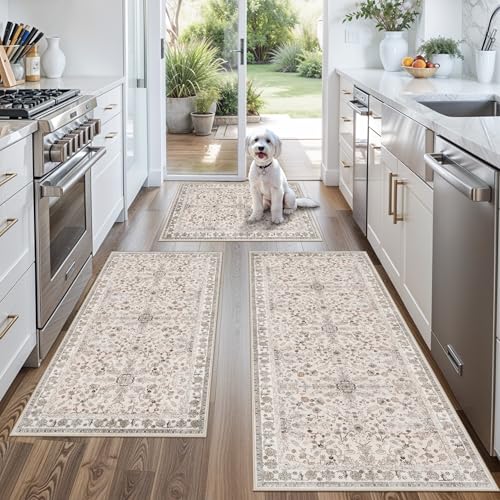
3-Piece Kitchen Rug Set with Runner
Buying three loose rugs that happen to look alike is surprisingly hard; buying them as one coordinated set removes the guesswork entirely. This beige set bundles pieces sized 2×3, 2×4, and 2×5, and the listing frames the trio for the sink, the floor, and the entryway, with the hallway and bathroom also named. The boho styling and the soft small throw area rug language in the title place it at the decorative end of this category — it wants to be seen as part of the room’s look, not hidden as a purely functional pad. Because the three sizes graduate rather than repeat, you can assign the longest piece to the run in front of the cabinets, the middle piece to the sink, and the smallest to the door where shoes and paws first land. That graduated logic is the real product here, more than any single piece on its own.
- Pieces: three, sized 2×3, 2×4, and 2×5
- Colour and style: beige, boho
- Grip: described as non slip in the title
- Washing: described as washable in the title; a specific machine cycle is not given there
- Rooms named: sink area, floor, entryway, hallway, bathroom
Strengths
- Three graduated sizes cover three separate zones without a second purchase.
- Matching beige fabric keeps a multi-rug kitchen from looking pieced together.
- The runner-length piece suits the long cabinet runs common in galley layouts.
Trade-offs
- No cushioning or comfort wording appears in the title, so long standing sessions rest on a thinner profile.
- Beige shows dark spills plainly between washes, however washable the fabric is.
- Homes needing only one mat pay for two extra pieces they may never place.
Think about how this set behaves across a week of real cooking. The sink piece takes the water, the long piece takes the foot traffic between stove and fridge, and the small piece catches the grit at the door before it migrates inward. When one piece gets dirty, the others still hold the room together visually, and because the set shares one colour and pattern family, swapping a freshly washed piece back in never clashes with its neighbours. The trade is thickness: nothing in the title promises a cushioned standing surface, so a cook who spends long stretches at one station may still want a dedicated comfort mat layered into their routine elsewhere. For households whose kitchen problem is scattered mess across several spots rather than sore feet at one spot, that trade usually lands in the set’s favour.
Best for: households that want one purchase to dress the sink, the main floor run, and the doorway in matching beige. Not suited for: a single small sink zone, where two of the three pieces would end up folded in a cupboard. If the graduated trio matches your floor plan, Check price on Amazon on the set’s listing and confirm the three sizes against your own measurements before ordering.

JTJ Dark Green Kitchen Rug Set
Pattern does heavy lifting in a kitchen, because it decides whether the crumbs of an ordinary Tuesday show at a glance or disappear into the design until wash day. The JTJ set leans into that idea with a dark green, vintage floral botanical pattern across three washable pieces, one of them a runner, all described as low pile. Low pile matters more than it first seems: cabinet doors and dishwasher doors swing close to the floor, and a flatter rug clears those swings while also letting a vacuum pass over it without a wrestling match. The title spreads this set’s ambitions wider than the kitchen, naming the entryway, bathroom, hallway, and laundry room, which makes it a candidate for anyone who wants the same botanical thread running through several connected spaces rather than a pattern that lives and dies at the sink.
- Pieces: set of three, including a runner
- Colour and pattern: dark green, vintage floral botanical
- Pile: low pile, per the title
- Grip: non-slip, per the title
- Dimensions: none stated in the listing title
Strengths
- The busy botanical pattern hides everyday crumbs and splashes between washes.
- Low pile sits flat under swinging doors and feels stable underfoot.
- Dark green pairs naturally with wood cabinets, brass fittings, and houseplants.
Trade-offs
- With sizes not given in the title, measuring your spaces before ordering becomes essential homework.
- A strong floral pattern commits the room; it will not quietly blend into a minimalist scheme.
- Three matching pieces in several rooms can feel repetitive if your spaces are small and adjoining.
The honest way to judge this set is to picture your own light. Dark green reads rich and calm in a bright kitchen with white walls, and moodier in a small north-facing one. The floral botanical motif suits farmhouse and traditional cabinetry more readily than glossy contemporary fronts, though rules like that bend whenever a homeowner simply loves a pattern. Practically, the low-pile surface is the workhorse trait: spills sit on top briefly rather than sinking into deep fibres, chairs and stools slide across it without catching, and the whole set can rotate through the wash as different rooms get dirty at different rates. Just do the measuring the title leaves to you, because a runner that stops six inches short of the sink looks like an accident rather than a choice.
Best for: pattern lovers who want a dark, forgiving design carried through the kitchen and beyond. Not suited for: anyone who needs confirmed dimensions from the title alone before they will consider a purchase. Gardeners of indoor herbs and owners of green cabinetry tend to land here — Check price on Amazon and read the listing’s own size details closely, since the title leaves that box blank.

3 Piece Washable Kitchen Rugs Set
Grey is the diplomat of kitchen colours: it gets along with stainless appliances, white cabinets, dark cabinets, and nearly every worktop that has ever been installed. This three-piece grey set pairs that safe colour with two functional claims in its title — water absorbent and standing comfort — plus a soft area runner rug description and a non slip washable build. The absorbency wording deserves attention, because not every washable rug even attempts it; many flat kitchen textiles are content to be wiped and washed while letting water pool on their surface. A set that advertises absorbing water is aiming at the sink and dishwasher zone specifically, where splashes are a daily certainty rather than an occasional accident. The title also widens the map to the office, doorway, and laundry room, suggesting the maker expects these pieces to wander.
- Pieces: three, including a runner-style piece
- Colour: grey
- Surface claims in title: water absorbent, soft, standing comfort mat wording
- Grip: non slip, per the title
- Dimensions: not given in the listing title
Strengths
- Absorbency is named outright, which suits splash-heavy sink and dishwasher zones.
- Grey hides the pale flour dust and dark coffee drip spectrum better than most colours.
- Standing comfort language signals the set was designed for time spent on your feet, not just decoration.
Trade-offs
- An absorbent surface also absorbs spills into itself, so washing frequency matters more here.
- Sizes are absent from the title, so the fit of all three pieces needs checking on the listing page.
- Grey on grey — grey rugs over grey tile — can flatten a room that already runs cool-toned.
Consider where each piece would earn its keep. The absorbent claim points the first piece at the sink. The runner shape suits the stretch between counter and island where two people pass each other carrying hot pans. The third piece can take the doorway or migrate to the laundry room the title mentions, standing guard in front of a machine that occasionally weeps water onto the floor. The standing comfort angle is harder to verify from a title alone, and this guide treats it as the maker’s framing rather than a measured fact — but its presence at least tells you the set was not designed as a purely decorative flatweave. If your kitchen’s biggest annoyance is the dark crescent of water that forms in front of the sink by mid-morning, this set’s priorities line up with your problem more closely than any other pick here.
Best for: grey-schemed kitchens where sink splashes are the main enemy and one coordinated set should cover several spots. Not suited for: cooks who want a single thick pad and nothing else. The absorbency-first design is the draw, so Check price on Amazon and scan the listing for the piece dimensions the title omits.

SUMLANS Kitchen Mats Set of 2
Two mats, two lengths, one job: standing. The SUMLANS pair comes in brown, sized 17.3 by 47 inches and 17.3 by 30 inches, and the title returns to comfort language again and again — comfort standing, cushioned, absorbent, easy to clean. That repetition tells you where the design effort went. The longer mat belongs in front of the stove or along the main prep counter, the shorter one at the sink, and together they cover the two stations where kitchen time actually accumulates. Unlike the three-piece fabric sets above, this pair reads as purpose-built standing equipment that happens to be washable, rather than decorative rugs that happen to tolerate a wash. Brown is a pragmatic colour choice for the format, sitting comfortably in warm-toned kitchens and shrugging at the sight of spice dust and sauce freckles alike.
- Pieces: two mats
- Sizes: 17.3 by 47 inches and 17.3 by 30 inches
- Colour: brown
- Surface claims in title: absorbent, cushioned, comfort standing, easy to clean
- Grip and washing: non slip and washable, per the title
Strengths
- Both sizes are printed in the title, so you can measure your stations before spending anything.
- Cushioning is the headline trait, aimed squarely at cooks who stand for long stretches.
- Two different lengths map neatly onto a stove run and a sink front.
Trade-offs
- Two mats leave the doorway and the fridge zone bare, unlike the three-piece sets.
- The width is modest, so a cook who steps back from the counter may step off the mat entirely.
- Brown limits the colour story to warmer kitchens; it will argue with cool grey cabinetry.
Feet notice time more honestly than eyes do. Ten minutes of dishwashing on hard tile is a chore; forty minutes of holiday cooking on the same tile becomes a backache with a deadline. A cushioned pair like this one addresses that arithmetic directly, and its washable claim keeps the comfort from becoming a hygiene compromise, since a mat that soaks up kitchen splashes needs a real cleaning route rather than a hopeful wipe. Place the long mat where your longest task happens — for most households that is the prep counter or the stove — and let the shorter one handle the sink. If your kitchen has a third station where someone regularly stands, you will feel the gap this two-piece set leaves, and that is the moment to look back at the three-piece options instead.
Best for: cooks whose feet complain before their floors do, working at two defined stations. Not suited for: anyone trying to cover three or more separate zones in one order. Station cooks, start here — Check price on Amazon and picture the 47-inch mat against your own counter run.

StepRite Chenille Kitchen Rug
Sometimes the whole problem is one wet rectangle of floor in front of one sink, and the correct purchase is a single mat that does that job properly. The StepRite entry is exactly that: a chenille mat, 32 by 20 inches, in grey, with absorbent chenille named in the title, a non-slip backing, and an explicit machine washable claim. Chenille’s soft, tufted texture drinks surface water in a way flat weaves do not attempt, which is why chenille shows up so often in bathroom mats; the title indeed lists the entryway, laundry room, and office alongside the kitchen sink as candidate homes. Its footprint is the smallest on this page, and that is a feature for compact kitchens, flats, and galley layouts where a runner would crowd the floor and a three-piece set would be pure surplus.
- Pieces: one mat
- Size: 32 by 20 inches
- Colour: grey
- Material named in title: chenille, described as absorbent
- Backing and washing: non-slip backing, machine washable
Strengths
- Chenille texture is built to take up sink splashes rather than let them pool.
- The modest footprint fits small kitchens where sets and runners overwhelm the floor.
- Machine washable is stated plainly, with no ambiguity about the cleaning route.
Trade-offs
- One mat covers one spot; the stove line and doorway stay bare.
- A textured absorbent surface holds crumbs in its pile until it is shaken or washed.
- At 32 inches wide it may fall short of double-bowl sink fronts, leaving the edges exposed.
There is a quiet discipline to buying the small thing on purpose. A single chenille mat can be lifted with one hand, carried to the machine without a folding ceremony, and returned to its post the same day, which makes frequent washing realistic rather than aspirational. That rhythm suits the sink zone, the dirtiest square metre of most kitchens. The mat’s grey colouring keeps it visually calm against both pale and dark flooring, and its listed second homes mean a household can reassign it to a laundry room later without it looking lost. Just be honest about coverage: if your kitchen regularly wets the floor in two places, one mat forces you to choose which place matters, and the other place will keep reminding you of the decision.
Best for: small kitchens and single-sink households that want absorbent, washable coverage in exactly one spot. Not suited for: open-plan kitchens with several wet zones. Minimalists with one sink to serve can Check price on Amazon and be done with the search in a single order.

Machine Washable Kitchen Runner Rug
A runner thinks in lines instead of spots. This two-by-six-foot piece is a low-pile, stain resistant, machine washable runner with a non slip build and farmhouse styling, and its title sends it down hallways and entryways as readily as along a kitchen counter. Six feet of continuous coverage changes how a galley kitchen feels: instead of stepping on and off small mats, you walk a single padded path from fridge to stove to sink, and the floor’s cold spots stop interrupting the journey. Low pile keeps that long surface lying flat and vacuum-friendly, while the stain resistant wording addresses the runner’s obvious vulnerability — a long rug in a working kitchen will meet dropped food, and a surface that resists staining buys time between the drop and the wash.
- Pieces: one runner
- Size: 2 by 6 feet
- Pile: low-pile, per the title
- Surface claim in title: stain resistant, soft
- Washing and grip: machine washable, non slip
Strengths
- Six continuous feet cover a whole galley run in a single piece with no gaps.
- Stain resistance suits a long rug that cannot dodge dropped ingredients.
- Low pile keeps doors swinging freely and chairs moving without snagging.
Trade-offs
- A six-foot rug is the bulkiest wash load on this page; check your machine’s appetite first.
- One long piece cannot split itself between a sink zone and a separate doorway.
- No absorbency claim appears in the title, so standing water is not its stated specialty.
Runners also carry a visual argument. A long patterned or textured strip pulls the eye down the length of a kitchen and can make a narrow room feel deliberately designed rather than merely narrow. The farmhouse styling named in the title leans into that effect for country-leaning interiors, though a plain runner in a modern galley does the same spatial trick. Practically, measure the run before anything else: a runner should end before the fridge door’s swing and start after the main door’s swing, floating in the walkway like a rug in a hallway rather than wedging under appliances. Households comparing this shape with the sets might also browse Best Hand Woven Rugs for the living areas beyond the kitchen, where longer textiles are chosen for looks first and washing second.
Best for: galley kitchens and hallway-style layouts that need one unbroken washable path. Not suited for: L-shaped kitchens whose wet zones sit around a corner from each other. If your kitchen is really a corridor with appliances, Check price on Amazon and measure your run twice before the runner ships.
Side by side: sets, pairs, singles, and the runner
| Pick | Configuration | Sizes in title | Surface note from title |
|---|---|---|---|
| 3-Piece Kitchen Rug Set with Runner | Set of three with runner | 2×3, 2×4, 2×5 | Soft, boho styling |
| JTJ Dark Green Kitchen Rug Set | Set of three with runner | Sizes not stated there | Low pile, vintage floral botanical |
| 3 Piece Washable Kitchen Rugs Set | Set of three with runner | Sizes not stated there | Water absorbent, standing comfort wording |
| SUMLANS Kitchen Mats Set of 2 | Pair of mats | 17.3×47 and 17.3×30 inches | Cushioned, absorbent |
| StepRite Chenille Kitchen Rug | Single mat | 32×20 inches | Absorbent chenille |
| Machine Washable Kitchen Runner Rug | Single runner | 2×6 feet | Low-pile, stain resistant |
Read down the configuration column and the page’s logic shows itself. Sets solve scattered mess. The cushioned pair solves sore feet at two stations. The chenille single solves one wet sink front. The runner solves a long walk. Most kitchens actually have two of those problems at once, which is why combinations — a set plus a cushioned mat at the main station, say — are common in real homes even though each listing is sold separately. Start from your worst problem, buy for that, and let the second problem wait a week; living with the first purchase will tell you more about the second than any guide can.
How do you choose a washable kitchen rug that fits your floor?
Should you buy a set or a single mat?
Count your wet and busy zones honestly. A zone is any place where water lands, food drops, or a person stands still for minutes at a time. Most kitchens have at least two: the sink and the stove. Many have a third at the dishwasher or the door. If your count is three, the sets on this page were built for you, because their pieces were sized to graduate across zones. If your count is one — a compact kitchen where the sink and stove stand side by side — a single mat or the cushioned pair will serve you better and wash more easily. Buying coverage for zones you do not have just gives you extra laundry and extra edges to trip over, while under-buying leaves the uncovered zone quietly damaging the floor you were trying to protect.
What size should each piece be?
Measure the zone, then leave a border. A sink mat should span the sink’s width plus a hand’s breadth on either side, because splashes do not fall in neat lines. A mat in front of a stove run should cover the length of the cooking zone where you actually shift your weight, which for most people is about two stove widths. Runners need their ends checked against door swings and appliance doors. The listings that print sizes in their titles — the beige set, the SUMLANS pair, the StepRite mat, and the runner — let you do this arithmetic before ordering. For the two sets whose titles stay silent on dimensions, treat the listing page’s size details as required reading, and keep a tape measure beside the keyboard while you read. A rug that arrives two inches too long for its gap will curl against the cabinet toe-kick forever, announcing the mistake daily.
Does pile height change daily life?
More than colour does. Low-pile pieces like the JTJ set and the long runner lie flat, clear swinging doors, let stools roll, and give up their crumbs to a vacuum without protest. Their trade is a firmer feel underfoot and less capacity to soak up a spill before it spreads. Textured and cushioned pieces — the chenille mat, the SUMLANS pair — reverse that trade: they drink splashes and soften standing, but they hold onto crumbs, ask more of the wash, and can catch a door that swings low. Kitchens with toddlers crawling or elderly relatives shuffling usually favour the flattest option that still grips, because an edge or a ridge that a young adult never notices can matter a great deal to less steady feet. Pet owners often land in the same place, since low pile releases hair in the wash more willingly than deep texture does.
Washing day: keeping a kitchen rug worth keeping
A washable rug only stays washable-looking if the washing actually happens, so build the habit before the first spill forces it. Shake the piece outside or over a bin first; a surprising share of kitchen grime is dry — flour, crumbs, pet hair, grit from shoes — and sending that into the machine dry just makes mud inside the drum. Check the listing’s own care directions for the piece you bought, because the titles on this page promise washability without printing temperatures or cycles, and the maker’s instructions are the authority for your specific rug. Wash kitchen textiles separately from clothing; the grease load in a sink mat does not belong anywhere near a shirt. After washing, get the rug flat and dry before it goes back down, since a rug returned to the floor while still damp underneath can trap moisture against the flooring it was meant to protect. Households that cook daily often settle into a weekly rhythm for the sink piece and a slower one for doorway pieces, rotating a spare if they own one. The sets quietly help here: while one piece is in the wash, its siblings keep the kitchen looking intentional instead of half-dressed.
Keep a simple record for the first month if your household is new to washable rugs: which piece was washed, when, and what prompted it. Patterns emerge quickly. Many families discover the doorway piece needs attention after wet weekends, the sink piece after batch-cooking days, and the stove piece after frying-heavy weeks, and once those triggers are visible, washing stops being a vague intention and becomes a response to events you can predict. The record also settles arguments about whether a rug is wearing out or simply overdue, because a piece washed eleven times in two months that still looks tired is telling a different story from one washed twice.
Between washes, small habits stretch the interval. Wipe a sauce spill when it happens rather than letting it set through three more meals. Lift the rug during a floor mop instead of mopping around it, because the crescent of untouched grime that forms along a rug’s edge eventually transfers onto the rug itself. If your household is also fighting damp smells in the bathroom linen cupboard, the thinking in Best Towels For Resisting Mildew follows the same principle: textiles that dry fully between uses stay pleasant far longer than textiles stored damp.
Placement, zone by zone
Start at the sink, because that is where water behaves worst. A mat here should extend beyond the sink cabinet on both sides, catching the arc of drips that fall when hands move from basin to towel and when a wet pan travels to the drying rack. Centre it on the faucet rather than on the cabinet doors; the faucet is where the water originates, and the drips follow the person, who stands in front of the tap. If two people share washing-up duty, favour width over depth — the second person stands beside the first, not behind them, and a mat that only covers the primary standing spot leaves the helper on cold, wet tile.
The stove zone plays by different rules. Here the enemy is not water but fat, flung in microscopic droplets every time something fries, plus the occasional dropped spoonful that lands whole. A rug in front of the stove should sit far enough forward that the cook’s natural standing position lands fully on it, yet not so close that a pulled-out oven rack or a swung oven door rides over its edge. This is the zone where washable construction proves itself most ruthlessly, because grease that would permanently season an unwashable rug can be lifted out of a washable one. It is also the zone cooks most often forget when they count their zones, because the floor in front of the stove looks clean right up until the light catches it at an angle.
Doorways and fridge fronts form the third family of zones. The doorway piece is a grit trap: its job is to intercept whatever shoes carry in before that grit grinds across the rest of the floor, scratching finishes and embedding itself in every other rug it meets. The fridge front, meanwhile, collects a strange mixture — drips from the water dispenser, condensation from frozen goods, the splash when a milk carton fumbles. Sets earn their keep precisely here, because a household that buys a single mat almost always assigns it to the sink and leaves these two zones to fend for themselves. When you read the three-piece listings, picture the smallest piece at the door and ask whether your doorway’s width welcomes it; a small rug centred in a wide doorway, with bare floor streaming past both sides, intercepts almost nothing.
Finally, walk the finished layout before you commit to it in daily life. Carry an imaginary hot pan from stove to sink and notice where your feet want to land. Open every door and drawer that swings near the floor. Stand at the counter where you chop and look down: are your heels on fabric or on the bare strip behind the mat? Small shifts of ten centimetres transform how a layout feels, and they cost nothing in the first hour and a great deal of annoyance when repeated daily for a year. The best kitchen rug arrangement is invisible in use — you stop noticing it entirely, which is the surest sign that every zone got the coverage it was asking for.
What the word washable quietly demands
Washable sounds like a single trait, but in practice it bundles three separate promises. The surface must release stains rather than bonding with them. The structure must survive agitation and water without curling, cracking, or shedding its backing across your machine’s filter. And the grip must still be there afterwards, because a rug that washes beautifully and then slides like a tea tray has failed at its second job. The titles on this page make the washable promise in slightly different words, and none of them prints the full care recipe, so treat the first wash of any new rug as a supervised experiment: check on it, note how it comes out, and confirm the grip on your own floor before the rug returns to full duty in front of the sink.
Frequency changes what washing can achieve. Grease washed out within the week leaves willingly; grease that has been walked on for a season has effectively become part of the rug. This is why the sink piece and the stove piece deserve different calendars even when they belong to the same set, and why owning a set with interchangeable-looking pieces can mislead — the pieces age at different speeds according to their zones, and rotating them deliberately evens the wear. A doorway piece ground with grit benefits from a hard shake far more often than it needs a full wash, while a chenille mat drinking sink water benefits from washing more than shaking, since what it holds is mostly liquid-borne. Matching the cleaning method to what each zone actually deposits is the difference between rugs that last and rugs that merely survive.
Drying deserves the same respect as washing. A rug put back damp will dry eventually, but the hours it spends damp against the floor are hours in which the floor cannot dry either, and hard floors with sealed finishes tolerate that far better than timber does. Give the washed piece air on both sides when you can, and resist the temptation to speed things along by draping a dripping rug over a cabinet door, which concentrates the water along one crease. Households that build this small drying pause into the routine — wash in the morning, relay the rug in the evening — rarely meet the musty underside smell that gives washable rugs an undeserved bad name.
Common mistakes
Buying the photograph instead of the floor plan. A styled listing photo shows a rug in a kitchen that is not yours, with zones in places your kitchen does not have them. Shoppers fall for the look, order the set, and then discover their sink and stove stand in a line the pieces were never shaped to cover. Sketch your own zones first, even roughly, and let the sketch — not the photograph — choose the configuration.
Assuming washable means maintenance-free. Washable is a capability, not a schedule. A rug washed twice a year will look tired and smell like old cooking oil no matter how well it was made, and its grip can suffer as grease builds into the backing. The households that love these rugs longest are the ones that treat washing as a small recurring errand, like emptying the crumb tray of a toaster.
Ignoring the door swing test. Measure the gap under your dishwasher door, your oven door, and the main kitchen door before ordering anything with texture or cushioning. A mat that a door catches will fold, bunch, and eventually tear at the fold, and the person who catches a toe on the bunched edge will blame the rug rather than the measurement nobody took.
Putting one small mat in a two-zone kitchen. The uncovered zone does not stay clean out of sympathy. Water and grease simply concentrate where the rug is not, and within months the bare patch of floor looks worse than the protected patch by a margin that makes the whole purchase feel pointless. Match coverage to the number of zones, even if that means a cheaper configuration spread correctly.
Forgetting the floor underneath. A non-slip rug on a dusty or waxy floor can still skate, because grip needs a clean surface to hold. Wipe the floor and let it dry before laying a new rug down, and re-check the grip after the first wash, since a freshly laundered backing settles differently than a factory-fresh one.
Colour, honestly considered
Colour advice for kitchen rugs usually stops at matching the cabinets, which is the least useful thing to know. The more useful question is what your kitchen throws at the floor. Households that fry often, brew dark coffee, and cook with turmeric, tomato, and soy should look at the darker and busier end of this page — the JTJ botanical pattern and the SUMLANS brown — because those surfaces let a working week pass without narrating every spill. Households that bake with flour, cook pale food, and drip mostly water can live happily with the beige set, and will actually benefit from its honesty: a light rug shows dirt early, which prompts the washing that keeps it fresh, while a dark rug can conceal a grease load long past the point where washing restores it fully.
Grey, carried by two picks here, sits in the middle of that spectrum and misleads in its own way. It hides flour and water marks gracefully, shows dark drips moderately, and pairs with almost any appliance finish — but it also shows pet hair of every colour equally, since hair is either darker or lighter than mid-grey but never the same. Multi-pet households learn this quickly and tend to migrate either toward a pattern that breaks up the contrast or toward a colour matched to the animal that sheds most. None of this is a reason to reject a pick; it is a reason to choose with your eyes open about which kind of mess your rug will display and which it will forgive.
Light also rewrites colour after purchase. A beige that looked warm under a shop’s lighting can read cool under north-facing windows, and the dark green JTJ pattern deepens considerably in a kitchen lit by a single pendant. When a listing offers the same design in more than one colourway, ordering with your own lighting in mind — and checking the piece against your floor at different times of day before removing any packaging you might need — saves the particular disappointment of a rug that is right in every way except the way it looks at breakfast.
Final recommendation
For most households reading this page, the beige three-piece set is the safest first purchase: its graduated sizes are printed in the title, its pieces map onto the sink, the floor run, and the doorway, and its plain colouring forgives a wide range of kitchen styles. Choose the JTJ set instead when pattern is a priority and you want crumbs to disappear visually between washes. The grey three-piece set earns its place where sink splashes dominate and absorbency is the trait you keep coming back to. If standing comfort outranks coverage, the SUMLANS pair is the honest answer, and the StepRite chenille mat is the tidy solution for one sink in a small kitchen. The runner stands apart for corridor kitchens — nothing else here covers six feet in one gesture. Whichever shape you pick, extend the same washable logic to the rest of the house’s hard-working textiles; readers working through a whole-home refresh often pair this page with Best Non Shedding Rugs for the rooms where shedding, not splashing, is the complaint.
Frequently asked questions
How often should a washable kitchen rug actually be washed?
The sink piece in a busy kitchen earns a wash about weekly; doorway and runner pieces in lighter traffic can go longer. Let visible spills and cooking smells set the rhythm rather than the calendar alone — a rug that smells like last week’s frying is telling you it was due days ago. Always follow the care directions on the listing you bought, since the titles here confirm washability without printing the cycle details.
Will a non-slip rug damage my floor?
Nothing in these titles makes claims about floor finishes, so the careful route is to check the listing’s detail sections for backing material information and to lift the rug periodically during the first weeks to confirm nothing is sticking or marking. Keeping the floor clean and dry beneath the rug, and letting both dry fully after washing, prevents most of the problems people attribute to backings.
Can these rugs go in rooms other than the kitchen?
Several titles say so themselves. The beige set names the entryway, hallway, and bathroom; the JTJ set adds the laundry room; the StepRite mat lists the entryway, laundry room, and office. Flat, grippy, washable textiles are naturally migratory — just measure the new room with the same care you measured the kitchen.
What if a title does not list the rug’s dimensions?
Then the dimensions live on the listing page instead, and reading them there is not optional homework. Two of the six picks here — the JTJ set and the grey three-piece set — keep sizes out of their titles. Measure your zones first, compare against the listing’s stated sizes, and only then order; guessing at fit is how rugs end up curling against cabinet bases.
Do washable kitchen rugs work on textured or uneven floors?
Flat pieces follow a floor’s contours more faithfully, which helps grip on slightly uneven tile or older boards, while cushioned mats can bridge small dips and feel steadier than their footprint suggests. On deeply textured stone or heavily grooved decking-style flooring, test grip in a dry corner first and re-check after the first wash, because backing contact — not the rug’s weight — is what keeps any of these picks where you put them.
Is a cushioned mat or a flat rug better in front of the sink?
They solve different halves of the sink problem. Cushioning, like the SUMLANS pair advertises, helps the person standing; absorbency, like the StepRite chenille and the grey set advertise, helps the floor stay dry. Long dishwashing sessions argue for cushion; a splashy faucet and a household that hand-washes everything argue for absorbency. Some kitchens honestly need both traits and layer their choices accordingly over time.
Choose the shape that matches your floor’s busiest line, wash it like you mean it, and the right washable kitchen rug quietly turns the hardest-working floor in the house into the easiest one to forgive.


