What's inside
- Key Takeaways
- Quick Picks
- How Did We Decide Which Machines Deserve a Denim Label?
- What Makes Denim a Different Animal From Every Other Fabric in the Basket?
- Which Needle, Thread and Stitch Length Actually Survive a Pair of Jeans?
- Why Do Feed and Foot Pressure Decide Whether Thick Cloth Sews Straight?
- Rigid Denim and Stretch Denim Are Two Different Sewing Problems
- What Does Denim Do to a Machine Over a Year of Regular Use?
- Putting the Six Head to Head on Denim
- How Do You Hem a Pair of Jeans Without the Wavy, Twisted Result?
- Where Do Denim Sewers Most Often Go Wrong?
- Repairing Jeans and Making Jeans Are Not the Same Purchase
- Final Recommendation
- Frequently Asked Questions
- Related Guides
As an Amazon Associate I earn from qualifying purchases. This post may contain affiliate links at no extra cost to you.
cottageverdict.com is reader-supported. When you buy through links on our site, we may earn an affiliate commission.
Where to buy: every machine in this guide is sold through its own Amazon listing, linked at the pick’s name in the table below and again in its review section, so you can check price on Amazon and read the seller’s full specification before deciding. Denim is where ordinary sewing machines go to be found out. The best sewing machines for denim are not the ones with the longest stitch menus; they are the ones that keep feeding when a seam stack turns into a folded ridge of twill eight layers deep, that punch a needle through a flat-felled intersection without skating sideways, and that do it again on the next pair of jeans, and the next. This guide reads the six verified listings in this class the way a person who actually hems jeans would: power claims first, stitch counts second, and honest notes about where each machine’s ceiling sits.
A word about what denim asks that cotton lawn never does. Denim is a warp-faced twill, woven tight, and its weight runs from shirt-weight cloth around four or five ounces per square yard up to the fourteen-ounce fabric in raw work jeans. The fabric itself is only half the problem. The real test lives at the intersections: the point where a hem fold crosses a side seam, where a waistband meets a belt loop, where a pocket bag is caught into a seam allowance. At those crossings the needle must pierce a stack that can be three or four times thicker than the single layer it cruised through a moment earlier, and the feed dogs must keep the whole stack moving at the same rate so the stitches stay even instead of shrinking into a knotted wad. Machines that fail denim almost always fail at those crossings, not in open field.
So the picks below were judged on the evidence their own listings put in writing: piercing power claims, motor descriptions, frame construction, and top speed where stated. Four of the six are SINGER heavy-duty models from two generations of that line, one is a mechanical machine from SewLaVie whose title names multi-layer denim outright, and one is a compact VASPOW unit that earns its place honestly as a mending machine rather than a jeans factory. If your sewing life is mostly hemming, tapering and repairing jeans you already own, this class is your home. If it drifts toward hides and straps, the neighbouring guide to Best Sewing Machines for Leather covers the walking-foot machines built for that different problem.
Key Takeaways
- Denim failure happens at seam intersections, not on flat cloth, so piercing power and steady feeding matter more than stitch variety.
- Four picks state 1,100 stitches per minute in their titles; treat speed as headroom for long straight runs, not as a quality score.
- Two generations of SINGER heavy-duty design appear here — the classic mechanical line and the Next Evolution models with DC motors — and they sew differently enough to deserve separate verdicts.
- The SewLaVie 996P is the only pick whose title promises multi-layer denim sewing outright, and it pairs that claim with an extension table.
- The compact VASPOW belongs to mending and light denim work; this guide does not pretend it is a substitute for a full heavy-duty frame.
- Needle choice does half the work: a denim needle, the right thread, and a slower hand at crossings will rescue marginal machines and make good ones sing.
Quick Picks
| Machine | Badge | The case for each |
|---|---|---|
| SINGER 4423 Heavy Duty Sewing Machine (Meltwater Blue) | The reference point | The classic heavy-duty formula with its power claim aimed at denim and canvas by name, a metal frame, and a one-step buttonhole for jeans hardware. |
| SINGER 4411 High Speed Heavy Duty Sewing Machine (Pink) | Stripped to essentials | Eleven stitches and the same stated pace as its sibling — the choice for sewers who hem and repair rather than decorate. |
| SINGER Heavy Duty 4552 Next Evolution Sewing Machine | Broadest stitch bench | Thirty-two built-in stitches and a DC motor described as smoother, plus bonus presser feet in the box. |
| SINGER Heavy Duty 500 Sewing Machine Super Bundle | The travelling kit | A carrying case and accessory bundle wrapped around a machine whose title leads with strong piercing power. |
| SewLaVie 996P Mechanical Sewing Machine | Denim named outright | Its listing promises multi-layer denim sewing in so many words and adds a wide extension table for bulky jeans work. |
| VASPOW Portable Sewing Machine for Home Mending & Denim | The mending drawer pick | A small free-arm machine for patching, hemming and rescuing jeans at home, sized for people without a sewing room. |
How Did We Decide Which Machines Deserve a Denim Label?
Marketing departments stick “heavy duty” on machines the way cafés stick “artisan” on bread, so this guide started from the listing text itself and asked what each title was willing to commit to. A denim claim in writing counted. A power claim in writing counted. A metal frame counted, because frame flex is what turns a hard piercing moment into a deflected needle and a snapped tip. Speed figures counted for what they are — a ceiling, useful on the long straight run down an inseam — and no machine was credited with features its title kept quiet about. Where a title stays silent on something a denim sewer cares about, the spec boxes below say so plainly and point you to the manufacturer’s documentation rather than guessing.
The second filter was role honesty. A denim guide that only lists full-size heavy-duty machines pretends every reader has a dedicated table and a jeans-production habit. Real denim sewing splits into camps: people altering every pair they buy, people running a small repair side-business, people who patch work jeans twice a year and store the machine in a closet between times. The six picks map onto those camps deliberately, and the verdict lines under each pick name the camp it serves and the camp it would frustrate. A compact mending machine is not a failed heavy-duty machine; it is a different tool, and it is reviewed as one.
One more principle governed the ordering: no machine was punished for honesty. A title that prints its motor wattage, its speed ceiling or its layer claim gives a buyer something checkable, and checkable claims are the currency of this whole guide. Where two machines looked equal on paper, the one whose listing committed to more verifiable specifics ranked higher, because a seller willing to be specific in the title is usually specific in the manual too — and the manual is where denim sewers end up living.
Finally, each pick had to survive the intersection test on paper: does anything in its verified description — power claim, motor description, frame, feed arrangement — speak to the moment the fabric stack triples? Machines whose listings talked only about decorative stitches and light crafts were left out of this guide entirely, however pleasant they might be on quilting cotton.
What Makes Denim a Different Animal From Every Other Fabric in the Basket?
Start with the weave. Denim is a twill, which means the threads run in a diagonal rib you can see if you look at your jeans closely. That diagonal structure is why denim drapes the way it does and why it frays into those soft white threads at a worn hem. It also means the needle is never passing through a uniform grid; it meets angled resistance, and on cheaper machines you can watch the needle flex a fraction with each penetration. Over a long seam that flex becomes skipped stitches, and skipped stitches on a hem become a hem that lets go in the wash.
Weight multiplies everything. Sewers talk about denim in ounces per square yard, and the spread is enormous. A denim shirtdress might be five-ounce cloth that behaves almost like a sturdy cotton. The jeans most people picture are twelve to fourteen ounces, stiff enough to stand up when new, and a folded hem in that fabric puts four layers under the foot before you count the seam it crosses. Workwear and raw-denim enthusiast jeans go heavier still. A machine that breezes through the shirtdress may stall, whine and chew thread at the fourteen-ounce hem fold, which is why this guide keeps returning to the same question: what happens at the thickest point of the job, not the average point?
Then there is abrasion. Denim is dyed cotton, and cotton twill of that density is quietly hard on needles. A needle that was fine for the first pair of jeans is a burred, heat-blunted tool by the third, and a dull needle pushes fabric down into the needle hole instead of piercing cleanly, which puckers the seam and stresses the thread. Denim sewers who swear their machine “suddenly got worse” are usually sewing on a needle that should have been retired two projects ago. The machine gets blamed; the consumable did it.
Which Needle, Thread and Stitch Length Actually Survive a Pair of Jeans?
The denim needle — sold as a jeans needle — has a reinforced shaft and a sharp, slim point designed to slip between the tight twill threads rather than shove them aside. Swapping to one is the single cheapest upgrade in this entire guide, and it matters more than the difference between several of the machines listed here. Size up for heavier cloth: the needle must carry the thread through the stack without the thread shredding in the needle’s eye, which is the classic symptom of an undersized needle on heavy fabric.
Thread is the second half of the pairing. Ordinary all-purpose polyester thread handles most denim work, but the visible topstitching on jeans — the ochre double rows everyone recognises — is traditionally done with a heavier topstitch thread that needs the bigger needle eye just mentioned and a longer stitch to sit properly on the surface. If your topstitching looks sunken and apologetic, the fix is usually a longer stitch length and the right thread, not a different machine. Stitch length on denim generally wants to open up compared with light cotton: short stitches perforate heavy fabric into a tear line and bunch at intersections, while a longer stitch rides over the stack and reads as the confident spacing you see on factory jeans.
Backstitching at the start and end of a hem deserves a mention too, because denim’s stiffness works seams hard in wear. A hem that is not locked at both ends will creep open at the side seam first. And when you reach the crossing where the hem fold meets the inseam — the famous hump — the old tailor’s tricks still apply: level the presser foot with a folded scrap or a hump-jumper tool so the foot stays flat, slow right down, and if the machine hesitates, walk the needle through the worst three stitches by turning the handwheel toward you. Every pick in this guide benefits from that technique; none of them is exempt from the physics.

SINGER 4423 Heavy Duty Sewing Machine (Meltwater Blue) — The reference point
The 4423 is the machine this whole category gets measured against, and its listing states the formula plainly: twenty-three stitches delivering ninety-seven applications, fifty percent more power aimed at denim and canvas, a top speed of 1,100 stitches per minute, a metal frame, and a one-step buttonhole. Read that title as a job description. The power claim names the fabrics this guide is about. The buttonhole style matters more than it looks, because jeans work eventually means replacing a waistband buttonhole or building a jeans-style fly, and a one-step buttonhole removes the fiddliest manual stage from that job.
On the table, the appeal is the absence of drama. The metal frame keeps the machine planted when a hem stack pushes back, and the stitch set covers the working wardrobe of denim sewing — straight stitch for construction, zigzag for finishing raw edges inside a repair, stretch options for the elastane-blended jeans that dominate shops now — without burying the controls in menus. The Meltwater Blue finish is cosmetic, but cosmetics matter in a machine that lives on a kitchen table rather than in a studio; you will look at it daily, and this one is pleasant to look at.
- Stitch count: 23 stitches, stated as 97 applications in the listing title
- Top speed: 1,100 stitches per minute, as stated in the listing title
- Power claim: 50% more power for denim and canvas, as the title states it
- Frame: metal frame, in the listing’s own wording
- Buttonhole: one-step style, the title confirms
- Presser foot pressure adjustment: not mentioned in the listing title — confirm in the manufacturer documentation
- Where to buy: the SINGER 4423 Heavy Duty Sewing Machine (Meltwater Blue) listing on Amazon — check price on Amazon
Strengths
- Its power claim names denim directly, which is the promise this category lives or dies on.
- The one-step buttonhole genuinely speeds up waistband and fly work.
- Metal-frame steadiness shows up exactly where denim sewing needs it: at seam crossings.
Trade-offs
- Twenty-three stitches is a working set, not a decorative library; embroidery-minded sewers will feel the ceiling.
- The title gives no presser-foot pressure detail, a setting denim sewers use often on mixed thicknesses.
- Like every mechanical here, it asks you to manage speed with foot control rather than a dial.
Best for: the home alterer who hems, tapers and repairs jeans weekly and wants the category’s benchmark under the needle. Not suited for: sewers whose projects lean decorative, or anyone wanting a machine that slows itself down automatically at thick crossings.

SINGER 4411 High Speed Heavy Duty Sewing Machine (Pink) — Stripped to essentials
The 4411 makes an argument more machines should make: most denim sewing uses three stitches, so why pay for sixty? Its title lists eleven stitches delivering sixty-nine applications, the same fifty-percent-more-power claim for denim and canvas as its sibling, the same 1,100 stitches per minute, a metal frame, and a four-step buttonhole. The differences from the 4423 are honest ones — a smaller stitch library and a buttonhole you sew in four guided stages rather than one — and for a large group of denim sewers those differences will never once matter in practice.
Think about who that group is. The person who buys jeans off the rack and takes up every hem. The parent shortening school jeans twice a year as legs lengthen. The repair enthusiast darning worn thighs and re-stitching blown inseams. Their sewing is straight stitch, the occasional zigzag, and a buttonhole once in a blue moon. For them the 4411’s simplicity is not a compromise; it is fewer dials between the idea and the finished hem, and the high-speed motor means the long runs down a leg go quickly when the cloth is flat and cooperative.
- Stitch count: 11 stitches, stated as 69 applications in the listing title
- Top speed: 1,100 stitches per minute, per the seller’s title
- Power claim: 50% more power for denim and canvas, as printed in the title
- Frame: metal frame, as the listing title has it
- Buttonhole: four-step style, per the listing title
- Included feet beyond the standard set: the listing title does not enumerate them — check the manufacturer documentation
- Where to buy: the SINGER 4411 High Speed Heavy Duty Sewing Machine (Pink) listing on Amazon — check price on Amazon
Strengths
- Full heavy-duty pace and power claim with the shortest learning curve in this guide.
- The eleven-stitch set covers hemming, mending and edge finishing without clutter.
- A sensible second machine for a workshop that already owns a feature-rich model.
Trade-offs
- The four-step buttonhole asks for patience on jeans waistbands.
- Stretch-fabric options are limited, which matters for skinny-jean repairs.
- The pink finish will delight some owners and quietly annoy others for years.
Choose it for: no-nonsense hemming and repair work where the budget should go on needles and thread instead. Pass if: you sew stretch denim constantly or want one-step buttonholes for jeans-making from scratch.

SINGER Heavy Duty 4552 Next Evolution Sewing Machine — Broadest stitch bench
The Next Evolution models are SINGER’s attempt to civilise the heavy-duty formula, and the 4552’s title tells that story: thirty-two built-in stitches, a metal frame, a one-step buttonhole, bonus presser feet in the box, and a new DC motor credited with more power, more speed and smoother sewing. That last phrase — smoother — is the interesting one for denim. A DC motor’s character shows at low speed, in the controlled creep over a seam intersection where older motors pulse and lurch. If your denim work involves a lot of short, careful manoeuvres around pockets, belt loops and waistband corners, smoothness at walking pace is worth more than any top-speed figure.
The thirty-two stitches also change the machine’s second life. Between jeans jobs it can finish raw edges, sew the stretch denim that dominates modern wardrobes, and handle the tote bags and cushion covers that drift into a heavy-duty machine’s orbit. Bonus presser feet widen that further, though the listing does not enumerate them, so treat the exact foot wardrobe as something to confirm on the product page rather than assume. As a household’s only machine that must also be its denim machine, the 4552 makes the most rounded case in this guide.
- Stitch count: 32 built-in stitches, as the title states it
- Motor: new DC motor, described in the title as giving more power, speed and smoother sewing
- Frame: metal frame, in the listing’s own wording
- Buttonhole: one-step style, the title confirms
- Extras: bonus presser feet included, listed in the title
- Top speed figure: not printed in the listing title — see the manufacturer documentation for the rated figure
- Where to buy: the SINGER Heavy Duty 4552 Next Evolution Sewing Machine listing on Amazon — check price on Amazon
Strengths
- DC-motor smoothness is a real denim advantage at crossings and corners.
- The widest stitch selection here keeps the machine useful between jeans projects.
- Bonus feet in the box soften the true cost of getting set up.
Trade-offs
- The title withholds a top-speed number, so straight-line pace is unverified from the listing alone.
- More stitches means more settings to learn before the machine feels automatic.
- It shares this guide with cheaper siblings that match it on plain straight-stitch denim work.
Right for: one-machine households whose denim sewing sits inside a wider sewing life. Wrong for: purists who want the simplest possible mechanical and will never touch the extra stitches.
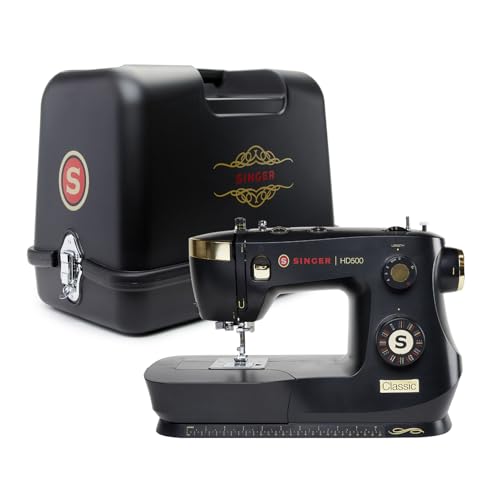
SINGER Heavy Duty 500 Sewing Machine Super Bundle — The travelling kit
Some denim sewing does not happen in a sewing room. It happens at a market stall doing alterations on the spot, in a student house where the machine lives under a bed, at a parent’s kitchen table during a weekend of fixing everyone’s jeans. The Heavy Duty 500 Super Bundle is built for that life: its title leads with a carrying case and accessories, then lists twenty-three built-in stitches, a high-speed motor, strong piercing power, a one-step buttonhole, a metal frame and an LED light. The phrase “strong piercing power” is doing the heavy lifting in that sentence, and it is exactly the claim a denim buyer should look for, because piercing — not cruising — is where denim is won.
The case deserves more respect than bundle marketing usually earns. Denim machines are heavy enough that they tend to stay wherever they were last used, and a fitted case turns “the machine lives in the spare room” into “the machine comes to the jeans.” The accessory bundle likewise matters in this category specifically: denim sewing eats needles and demands spares of everything, and a kit that arrives stocked shortens the distance between unboxing and the first finished hem. The LED light, easy to dismiss as garnish, earns its keep when you are guiding dark indigo cloth under the foot at night and the seam line is a shade darker than the fabric around it.
- Stitch count: 23 built-in stitches, per the seller’s title
- Power claim: strong piercing power, as printed in the title
- Motor: high-speed motor, from the listing title
- Frame: metal frame, as the listing title has it
- Buttonhole: one-step style, in the seller’s title
- Bundle contents: carrying case and accessories, per the listing; the exact accessory list is not enumerated there — verify against the manufacturer documentation
- Where to buy: the SINGER Heavy Duty 500 Sewing Machine Super Bundle listing on Amazon — check price on Amazon
Strengths
- Piercing power is the headline claim, which is the right priority for denim.
- The carrying case suits market alterers, students and anyone sewing away from a fixed table.
- LED lighting genuinely helps on dark indigo cloth.
Trade-offs
- Bundle value depends on accessories you may partly duplicate if you already sew.
- The title states no numeric top speed, so pace comparisons stay qualitative.
- A case invites travel, but the machine’s weight still makes it a deliberate carry.
Suits: mobile menders and space-poor sewers who need the whole kit to pack away as one unit. Skip it if: your machine will never leave one table, making the case dead weight in the cupboard.

SewLaVie 996P Mechanical Sewing Machine — Denim named outright
Every other title in this guide implies denim capability through power claims; the SewLaVie 996P simply says it. Its listing promises multi-layer denim sewing in plain words, backed by a 60W motor, a durable metal frame, thirty-six stitches and a wide extension table described as being for quilting. That combination sketches a particular sewer: someone whose denim work is bulky. Breaking down thrifted jeans into patchwork, building denim quilts and throws, sewing tote bags from reclaimed legs — projects where the fabric is not just thick but physically large, sliding around, dragging off the edge of a small machine bed and pulling stitches crooked with its weight.
The extension table is the quiet hero for that work. Denim’s stiffness means a jeans leg or a half-assembled quilt panel does not drape politely; it levers. A wide, flat surface keeps the work level with the needle plate so the feed dogs, not gravity, decide where the fabric goes. The mechanical layout will suit sewers who distrust electronics near a workhorse machine: dials, a motor with a stated wattage, and a stitch set of thirty-six that is generous for a mechanical. The wattage figure is worth noting precisely because it is stated — most titles in this class keep motor numbers to themselves, and a printed 60W at least gives you a fixed point to compare against the manufacturer’s documentation.
- Stitch count: 36 stitches, as the title states it
- Motor: 60W motor, in the listing’s own wording
- Denim claim: multi-layer denim sewing, stated outright in the listing title
- Frame: durable metal frame, the title confirms
- Work surface: wide extension table included, per the title
- Buttonhole style: not specified in the listing title — verify with the manufacturer documentation before relying on it for waistbands
- Where to buy: the SewLaVie 996P Mechanical Sewing Machine listing on Amazon — check price on Amazon
Strengths
- The only title here that commits to multi-layer denim in so many words.
- The extension table transforms bulky reclaimed-denim projects.
- A stated motor wattage gives buyers a concrete figure to weigh.
Trade-offs
- Buttonhole details are absent from the title, a gap for from-scratch jeans making.
- A newer brand name carries less long-term parts-and-service certainty than the heritage makers.
- The table that helps so much also demands storage space when the machine is packed away.
Best for: upcyclers and denim quilters wrestling large, heavy work across the machine bed. Not suited for: buyers who want a long-established service network behind a daily workhorse.

VASPOW Portable Sewing Machine for Home Mending & Denim — The mending drawer pick
Honesty section: this is not a heavy-duty machine, and this guide will not dress it up as one. The VASPOW’s title describes a portable machine for home mending and denim, with a 12V 24W motor, sixteen built-in stitches, a metal frame, a free arm, a foot pedal and an accessories kit. A 24W motor is a fraction of the SewLaVie’s stated output, and nobody should buy this expecting to flat-fell fourteen-ounce seams all afternoon. What it offers instead is presence. It is small enough to live where the mending pile lives, quick enough to set up that a torn pocket or a fallen hem gets fixed the day it happens instead of joining a six-month backlog waiting for the big machine to come out.
The free arm is the detail that lifts it above toy-class minis for denim specifically. Jeans hems, cuffs and waistband repairs are tube-shaped jobs; sliding the leg over a free arm beats fighting a flat bed and a bunched-up pair of jeans. Sixteen stitches cover the mending repertoire — straight stitch for seams, zigzag for patching and edge rescue — and the metal frame claim, if modest, at least signals an intention beyond an all-plastic shell. Set expectations at shirt-weight denim, chambray, worn-soft jeans and single-layer repairs, and this little machine will meet them. Ask it to build jeans from raw selvedge and it will tell you, quickly and audibly, that you have brought the wrong tool.
- Stitch count: 16 built-in stitches, per the seller’s title
- Motor: 12V 24W motor, as printed in the title
- Frame: metal frame, as the listing title has it
- Free arm: included, listed in the title — the feature that makes jeans cuffs manageable
- Controls: foot pedal included, from the listing title
- Maximum fabric weight: the listing title sets no layer or ounce figure — check the manufacturer documentation and stay within light-to-mid denim
- Where to buy: the VASPOW Portable Sewing Machine for Home Mending & Denim listing on Amazon — check price on Amazon
Strengths
- Small enough to stay out, which is how mending actually gets done.
- The free arm handles jeans cuffs and hems in a way flat mini machines cannot.
- A gentle way into denim repair for someone not ready to commit to a heavy-duty frame.
Trade-offs
- The 24W motor sets a hard ceiling: thick seam stacks are beyond its brief.
- Sixteen stitches serve mending, not garment construction at scale.
- Portability trades away the planted, vibration-free feel of the full-size picks.
Choose it for: the household mending basket — hems, patches, pocket corners, soft worn denim. Pass if: your denim is new, heavy and multi-layered, which is precisely the work the five machines above exist for.
Why Do Feed and Foot Pressure Decide Whether Thick Cloth Sews Straight?
Under the needle plate sits a set of ridged metal teeth — the feed dogs — that rise, grip the fabric, carry it backward by exactly one stitch length, and drop away again. On a single layer of cotton the system is nearly invisible. On denim it becomes the whole story, because the dogs only touch the bottom layer of the stack. The presser foot holds the top. When the stack is thick and slightly spongy, as a folded hem is, the bottom layer travels at the dogs’ pace while the top layer lags, dragged by friction against the foot. The visible result is a seam where the layers have crept relative to each other: the hem that ends up a quarter-inch longer on one layer than the other, the pocket that sits subtly skewed.
Presser-foot pressure is the counterweight. More pressure marries the layers so they travel as one; too much, and the foot itself starts ploughing the fabric, marking soft denim and fighting the dogs on very thick stacks. Machines differ in how they let you manage this — some offer a pressure dial, some a presser-foot lifter with extra height for sliding thick work underneath, some neither — and, as the spec boxes above note honestly, several of these listings do not discuss the setting in their titles at all. That silence is worth respecting rather than papering over: if you sew mixed thicknesses constantly, confirm the adjustment range in the manufacturer documentation for the exact model before you buy, because it is a feature you will touch on nearly every denim job.
Feeding technique from the chair matters as much as the mechanism. Let the dogs do the transporting; your hands are guides, not engines. Pushing fabric through faster than the dogs are carrying it produces long, sloppy stitches and bent needles; hauling it backward from behind the foot stretches the seam and snaps thread. On long runs, rest your palms flat either side of the work and steer the way you would guide a sheet of plywood through a saw — present in the cut, gentle in direction, never forcing the pace. Denim rewards that patience with seams straight enough to look factory-made, which on a fabric whose factory seams are the style benchmark is the entire point.
Rigid Denim and Stretch Denim Are Two Different Sewing Problems
Walk into a jeans shop and most of what hangs there is no longer the rigid, all-cotton cloth this category was built on. Elastane has moved in — one or two percent is enough to change how a fabric behaves under the needle completely. Stretch denim feeds more willingly but fights back differently: it wants to ripple as it passes under the foot, because the fabric elongates under the pressure of sewing and then relaxes afterward, leaving a wavy seam that no pressing fully cures. It also chews ordinary thread at flex points, which is why stretch jeans blow out at the inner thigh and the seat seam first.
The sewing answers differ by fabric. Rigid denim asks for piercing power, a sharp denim needle, and longer stitches. Stretch denim asks for a stitch with give in it — a narrow zigzag or a dedicated stretch stitch from the machine’s library — a ballpoint or stretch needle that parts the knit-like structure rather than cutting fibres, and a lighter hand on the fabric so you are not pre-stretching the seam as you sew. This is where the stitch-count differences among the picks stop being brochure decoration: the 4552’s thirty-two stitches and the SewLaVie’s thirty-six give a stretch-denim sewer more recovery options than the 4411’s eleven, while a rigid-denim purist may never touch the extra patterns in a decade of hemming. Neither answer is wrong; they are answers to different wardrobes. Check your own jeans labels before you decide which kind of machine you are shopping for — the fibre content printed inside the waistband is a better buying guide than any advertisement.
What Does Denim Do to a Machine Over a Year of Regular Use?
Cotton twill sheds. Every seam releases a fine blue-grey lint that migrates into the bobbin area, packs around the feed dogs, and coats the thread path until tension starts drifting and stitches lose their tidiness. A denim machine needs its bobbin case lifted out and brushed clean far more often than a machine that lives on dress cottons — after every big project is a sane rhythm, with a drop of oil where the manufacturer’s manual directs and never where it does not. The lint is also faintly abrasive, one more reason denim needles are consumables rather than heirlooms: plan on a fresh needle per garment-scale project and treat any needle that has struck a pin, a zipper stop or the needle plate as finished, however straight it looks.
Belts, motors and frames age differently under denim duty. The metal frames in this guide resist the racking forces that thick work applies, which is part of why they dominate the category. What the home sewer controls is workload honesty: sewing within the machine’s layer capacity, stopping when the motor note turns strained, and letting a hot machine rest during marathon alteration days. A heavy-duty machine is not an industrial machine — a distinction the leather guide explores in depth — and treating a domestic heavy-duty model as if it were built for a factory shift is the fastest way to shorten its life. Used at the pace it was designed for, though, a machine from this class will outlast the fashion cycle of the jeans it hems by a comfortable margin.
Putting the Six Head to Head on Denim
| Machine | Stitches (per title) | Speed or motor (per title) | Denim signal in its title |
|---|---|---|---|
| SINGER 4423 Heavy Duty (Meltwater Blue) | 23 stitches / 97 applications | 1,100 stitches/min | 50% more power for denim and canvas |
| SINGER 4411 High Speed (Pink) | 11 stitches / 69 applications | 1,100 stitches/min | 50% more power for denim and canvas |
| SINGER Heavy Duty 4552 Next Evolution | 32 built-in stitches | DC motor — more power, speed, smoother sewing | Heavy-duty line with bonus presser feet |
| SINGER Heavy Duty 500 Super Bundle | 23 built-in stitches | High-speed motor | Strong piercing power, carrying case bundle |
| SewLaVie 996P Mechanical | 36 stitches | 60W motor | Multi-layer denim sewing, extension table |
| VASPOW Portable for Mending & Denim | 16 built-in stitches | 12V 24W motor | Named for home mending and denim; free arm |
How Do You Hem a Pair of Jeans Without the Wavy, Twisted Result?
The classic home-hem failure is a hem that ripples like a lettuce edge and a leg that slowly twists around the ankle. Both are technique problems, and both are fixable on any machine in this guide. The ripple comes from the feed dogs moving the bottom layer faster than the top layer through the fold; easing the fabric rather than stretching it, and never pulling from behind the needle, keeps the layers married. The twist comes from cutting and folding against the twill’s natural bias of wear — pin the hem while the jeans are worn, with shoes on, because denim stacks and breaks differently standing than it measures lying flat on a table.
Work in this order. Try the jeans on and pin the new length at the back of the heel. Measure twice around the leg, not once, because legs differ. Press the fold before you sew a stitch; a hard crease is a guide rail. If you are keeping the original factory hem — the “original hem” method that preserves the faded edge — measure, fold and stitch just above the existing hem stitching, then trim the excess inside. Match thread to the original topstitching as closely as your thread box allows, lengthen the stitch, and sew from the outside so the visible line is the one you control. At the side seams, where your new stitching crosses the old seam bulk, slow down, level the foot, and hand-crank the crossing if the motor note changes. Then press again, hard, with steam. Half of a professional-looking hem is the pressing, and it costs nothing.
A note for readers whose sewing ambitions run past alterations into decoration: the stitch libraries on the fuller machines here will handle the construction side of denim happily, but turning jeans into embroidered art is a different discipline with its own machines, and the guide to Best Entry-Level Embroidery Machines is the right doorway into it — hooping stiff denim and stabilising it well is a craft of its own, best learned on equipment designed for the hoop rather than adapted to it.
Where Do Denim Sewers Most Often Go Wrong?
The first mistake is sewing heavy denim on a general-purpose needle and concluding the machine is weak. The needle is the cheapest component in the system and the one in actual contact with the cloth; a fresh denim needle transforms reluctant machines. The second mistake is speed at crossings. A stated ceiling of 1,100 stitches a minute is for open runs, and flying at a seam intersection at full pace is how needles snap — the deflection has nowhere to go at speed. Slow down, or hand-crank, at every hump.
One more household note, because denim sewing sheds: clipped threads, indigo lint and the grit that falls out of work jeans end up ground into whatever floor surrounds the machine, and a sewing corner that shares space with a living room carpet needs a cleanup plan as much as a stitch plan — the guide to Best Portable Carpet Cleaner Machines covers the spot-cleaning machines that suit that corner-without-a-studio life. Third, people fight the fabric instead of supporting it. A jeans leg dangling off the back of the table drags the work sideways with real force, and the sewer unconsciously steers against the drag, producing the wandering seam they then blame on the feed. Support the weight — a table, a book, your lap arranged level — and seams straighten themselves. Fourth, thread mismatch: heavy topstitch thread through a standard needle shreds, and standard thread asked to do structural work on fourteen-ounce denim snaps in wear. Match the thread to the job and the needle to the thread. Fifth, skipping the test scrap. Two minutes sewing the actual fabric stack — fold, crossing and all — on an offcut from the cut-off hem tells you tension, stitch length and needle adequacy before the real leg is under the foot. The scrap is free; the unpicking is not.
Repairing Jeans and Making Jeans Are Not the Same Purchase
Before spending anything, sort your denim ambitions into the two honest piles. Pile one is repair and alteration: hems, tapering, waist adjustments, patching worn thighs, rescuing pocket corners, re-stitching seams that have let go. This work is short-seam work. It happens in bursts, at odd angles, often inside a tube of fabric, and it prizes a free arm, a reliable reverse lever, and a machine that starts and stops obediently at low speed. Nearly everything in this guide does pile one well, including — for the lighter end of it — the little VASPOW.
Pile two is construction: sewing jeans from cut cloth, with flat-felled seams, a fly front, rivet-adjacent bartacks, a waistband built in layers, and long topstitched runs that must stay parallel and unhurried for the full length of a leg. Construction multiplies the thick crossings by an order of magnitude and adds operations — the one-step buttonhole for the waistband, the bartack at pocket corners — where machine features stop being conveniences. If pile two is your real destination, weight your choice toward the picks whose titles promise piercing power and one-step buttonholes, budget for a hump jumper and a proper jeans foot alongside, and expect your first pair to be a tuition payment rather than a triumph. The second pair is where construction sewers start saving serious money against boutique raw-denim prices, and it is also where a machine bought honestly for the job pays its way fastest.
Plenty of sewers live in pile one for years and visit pile two once, for a single ambitious pair. For them the sensible strategy is the mid-list pick with the broad stitch bench, bought once, rather than a specialist bought twice. Ambition is a fine thing in a sewing room; it just should not be allowed to write the shopping list unaccompanied.
Final Recommendation
Most readers should start at the benchmark: the SINGER 4423 states the denim case in its own title — power aimed at denim and canvas, a metal frame, real pace — and it will alter and repair jeans for years without asking you to think about it. Choose the 4411 if your denim life is hems and repairs and you would rather keep the controls minimal. Choose the 4552 if one machine must cover a household’s whole sewing life and you value low-speed smoothness at crossings. The Heavy Duty 500 bundle suits sewers who work in more than one place; the SewLaVie 996P suits makers whose denim arrives as thrifted yardage and leaves as quilts and bags; the VASPOW keeps the mending basket honest. Buy the machine that matches the thickest job you actually do, keep a packet of denim needles beside it, and your jeans will start fitting the way the changing-room mirror promised they would.
Frequently Asked Questions
Can a regular sewing machine sew denim at all?
Yes, within limits. Most decent machines will sew two layers of mid-weight denim with a denim needle and a longer stitch, especially if you avoid the thickest intersections or flatten them first. What regular machines struggle with is repetition and bulk: folded hems crossing seams, waistband stacks, and heavy cloth day after day. The heavy-duty picks in this guide exist for that territory — stronger power claims, metal frames, and motors built to keep pace through the stack rather than merely survive a single encounter with it.
What do I do when the needle reaches the thick part of the hem and the machine stalls?
Stop with the needle down, lift the foot, and slide a folded scrap of the same denim — or a purpose-made hump jumper — under the back of the foot so it sits level instead of tilted uphill. Lower the foot and sew slowly, turning the handwheel toward you by hand for the worst few stitches if needed. A level foot lets the feed dogs grip properly, which cures most stalls. If stalling is constant even on flat double layers, the fabric is beyond that machine’s honest capacity.
Why does my topstitching thread keep shredding on jeans?
Shredding usually means the thread is too heavy for the needle’s eye, so it saws against the eye’s edge with every stitch. Move up to a topstitch or denim needle with a larger eye, lengthen the stitch a little, and check the thread path for burrs. Also confirm the thread is feeding smoothly off the spool — heavy topstitch thread on a horizontal pin sometimes snags, and a vertical pin or a thread stand fixes what looks like a machine fault.
Is the stated top speed important for denim?
Only partly. It speeds the long, flat runs — down an inseam, around a hem — where the fabric offers little resistance, and on a big alteration workload that time saving is real. But denim quality is decided at low speed: the crossings, corners and waistband work where you should be sewing slowly regardless of the machine’s ceiling. Treat the figure as headroom, and value the power and frame claims more.
How heavy a denim can these machines handle?
The listings do not print ounce ratings, and this guide will not invent them. As a working rule drawn from the claims they do make: the heavy-duty picks are built for the standard jeans range including folded hems and seam crossings, the SewLaVie states multi-layer denim outright, and the VASPOW should be kept to light and mid-weight cloth and repairs. For a specific ounce weight or layer count, the manufacturer documentation for the model is the authority — check it before a project that lives at the extreme.
Can I sew denim on a machine I also use for delicate fabrics?
Yes, and most households do exactly that. The courtesies run both ways: change the needle when you change fabric families, because a denim needle’s reinforced point is unkind to silk and a ballpoint is useless on twill; brush the bobbin area out after denim sessions so indigo lint does not migrate into a white blouse project; and run a few stitches on scrap after swapping, to clear any oil or fibre the last job left in the thread path. A heavy-duty machine that lives a double life this way will serve both wardrobes well.
Should I wash new jeans before hemming them?
Yes — wash and dry them the way you will launder them in future, at least once and ideally twice, before marking the hem. Denim, especially unsanforized or raw denim, shrinks in length, and a hem sewn to pre-shrink measurements becomes a flood-water hem after the first wash. The five minutes of patience also softens stiff fabric, which your machine will thank you for at the seam crossings.
Related Guides
Denim care continues after the sewing stops: how you launder jeans decides how long both the fabric and your new hems survive, and our guide to Best Washers Gentle on Clothes looks at machines that treat hard-wearing garments with a lighter touch in the wash. Readers building a fabric-by-fabric sewing shelf will also find the leather and upholstery companions to this guide linked from the sections above, each written around the very different demands those materials place on a machine.


