What's inside
- Key Takeaways
- Quick Picks
- How We Chose These Picks
- How Do the Six Compare at a Glance?
- Where Does an Apartment Dryer Actually Live?
- How Does the Exhaust Work in Practice?
- How Should Loads Be Sized and Sorted for a Small Drum?
- What Does It Cost to Run a Compact Dryer, Qualitatively?
- How Do You Care for a Portable Dryer?
- What Is It Like to Live With One, Week to Week?
- How Do Compact Dryers Pair With Compact Washers?
- What Should RV and Cabin Owners Know?
- How Quiet Are They, Really?
- When Should You Buy a Bigger Category Instead?
- What Accessories Are Worth Buying With the Machine?
- How Does Winter Change Compact Drying?
- How Do You Choose Between the Two COSTWAYs?
- What Does Unboxing and Setup Actually Involve?
- How Does Each Size Class Behave With Real Loads?
- Which Mistakes Make Apartment Dryers Disappoint?
- Final Recommendation
- Frequently Asked Questions
- Related Guides
As an Amazon Associate I earn from qualifying purchases. This post may contain affiliate links at no extra cost to you.
cottageverdict.com is reader-supported. When you buy through links on our site, we may earn an affiliate commission.
Where to buy: the six dryers below are sold through Amazon, and the linked names throughout this guide lead to each model’s listing, where you can check price on Amazon and confirm wattage, dimensions, and venting details before ordering. The best apartment-size dryers are a study in scaled-down honesty. None of the six pretends to be a family machine; each is a compact electric dryer, between 1.5 and 2.65 cubic feet, that plugs into an ordinary outlet, dries modest loads with heated air, and exhausts that air through a hose — to a window, or into an indoor vent kit where the room suits it. Apartment-size, in this guide, describes the footprint and the load, and the venting is stated plainly because a small dryer still moves real moisture.
Who are these for? The renter whose lease allows a portable appliance but not an installation. The dorm resident, the RV traveller, the cabin owner, the single professional whose laundry is three loads a week of ordinary clothes. The household whose alternative is a laundromat across town in February. For those readers, a compact dryer beside a compact or portable washer — or even beside a bathtub-and-rack washing routine — is not a compromise appliance. It is the difference between laundry as an errand and laundry as a background fact of the home.
The six divide by capacity and temperament. The BLACK+DECKER is the near-full-size contender at 2.65 cu ft; the ROVSUN follows at 2.6; the Auertech, Stopsad, and the two COSTWAYs step down through 1.8 and 1.6 to 1.5 cu ft, trading drum room for price, weight, and shelf-friendliness. Wattage climbs with size, from the small machines’ gentle heat to the larger COSTWAY’s 1700W. Choosing among them is mostly a matter of measuring your loads and your corner honestly — the sections below are written to help you do both.
Key Takeaways
- All six are compact vented electric dryers: plan a window hose or an indoor vent kit for each.
- Capacities run 1.5 to 2.65 cu ft — sized for singles, couples, and small frequent loads.
- Every model runs from a standard household outlet; none needs an installation or a vent cut into a wall.
- Higher wattage generally means faster drying of heavier loads; small wattage means gentler, slower cycles.
- The two COSTWAYs split the difference differently — one LED-controlled and compact, one the power option at 1700W.
- Load discipline is the whole skill: small, sorted, and shaken out before the door closes.
Quick Picks
| Pick | Badge | Why it earns its place |
|---|---|---|
| BLACK+DECKER BCED26 Portable Dryer | Largest Drum of the Six | At 2.65 cu ft with a stainless drum, it is the closest thing here to a small household’s only dryer. |
| COSTWAY 1.5 cu ft LED Dryer | Smallest with Modern Controls | LED control and five drying modes in the tiniest full-featured package of the group. |
| COSTWAY 1700W Portable Dryer | Power Option | The strongest heater here behind a 13.2 lb capacity — the choice when heavier loads must dry promptly. |
| Stopsad 1.6 cu ft Mini Dryer | Fast-Dry Mini | An 800W compact with a fast-drying function, aimed at apartments and dorms with small daily loads. |
| Auertech 1.8 cu ft Smart Dryer | Mode-Rich Middle Size | Eight smart modes and LED control in a 1.8 cu ft drum that even lists boot drying among its talents. |
| ROVSUN 2.6 cu ft Knob-Control Dryer | Simple Big-Drum Alternative | Nearly the BLACK+DECKER’s size with a plain control knob — no menus, no fuss. |
How We Chose These Picks
Apartment-size was enforced as a physical fact, not a marketing mood: every pick had to be genuinely compact in cabinet and drum, light enough for one or two people to position, and content with a standard outlet. From that pool we selected for spread — the largest and smallest useful drums, the strongest and gentlest heaters, the most and fewest controls — because apartment shoppers’ constraints differ more than their budgets do. A machine that duplicates another’s exact brief, only worse, helps nobody choose.
We also read the listings for the venting sentence, and required it to exist. Each of these six is a vented design whose listing says so or whose type makes it plain, and this guide describes them that way throughout. In the affordable compact tier, the difference between a happy purchase and a returned one is usually that sentence — the buyer who planned a window hose loves the same machine the buyer who expected ventless operation sends back.
Finally, controls were judged by the setting. A dryer that lives in a bedroom closet or a studio corner will be operated half-asleep, mid-evening, by people who did not read its manual; the six below divide between honest knobs and legible LED panels, and none buries its everyday cycle under a menu expedition.
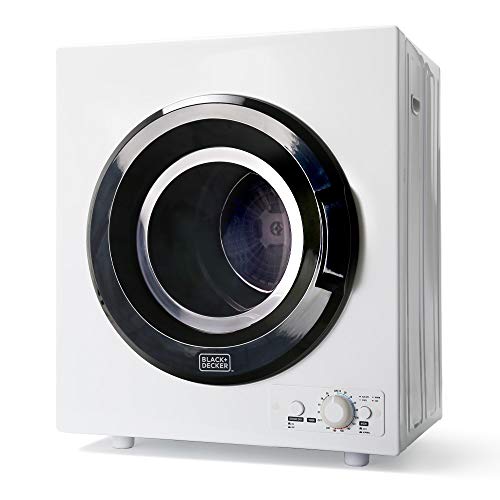
BLACK+DECKER 2.65 cu ft Portable Dryer BCED26 — Largest Drum of the Six
The BCED26 is the apartment dryer for people who would buy a bigger machine if the building allowed it. Its listing describes a 2.65 cu ft portable dryer with an 8.8 lb capacity, a stainless steel drum, and 1400W of heat on a standard 120V outlet. That drum swallows a proper load — a couple’s two-day clothing, a set of sheets with their pillowcases, the towel rotation of a small bathroom — in a single cycle, which is the threshold at which a compact dryer stops feeling like a toy and starts feeling like the laundry solution it was bought to be.
The stainless drum is worth its sentence: it is the surface that treats clothes gently across years of tumbling, resists the rust and snagging that age cheaper interiors, and signals that the maker built this as an appliance rather than a gadget. BLACK+DECKER’s portable laundry line has served the apartment market long enough that hoses, filters, and window kits in its ecosystem are easy to source, which matters for a machine whose entire installation is a hose and a plan.
The plan, to repeat the guide’s refrain, is exhaust: the BCED26 vents, and its home is within hose reach of a window or beside a room suited to an indoor vent kit. It also wants a stable station — a floor, a sturdy stand, a counter built for the weight of a wet load in motion. Give it those two things and it will dry a small household’s laundry for years without ever asking the landlord a single question, which is the entire proposition of its category in one sentence.
- Capacity: 2.65 cu ft, loads to 8.8 lbs
- Heat: 1400W electric, 120V outlet
- Drum: stainless steel
- Venting: hose exhaust — window or indoor kit
- Format: largest cabinet of the six, still portable class
Strengths
- Drum size handles real household loads in one cycle.
- Stainless interior ages better than coated drums.
- Established portable-laundry ecosystem of parts and kits.
Trade-offs
- Needs the most station space of the group.
- Vented operation requires the exhaust plan, as with all six.
- Heavier to move between homes than the minis.
Best for: couples and small households wanting one compact dryer that behaves like a real appliance. Not suited for: shelf or countertop placement in the smallest studios.

COSTWAY 1.5 cu ft Portable Dryer LED Control — Smallest with Modern Controls
The small COSTWAY makes the opposite argument from the BLACK+DECKER: that the right dryer is the one that fits the life already being lived. The listing describes a 1.5 cu ft vented electric dryer with LED control, an 8 lb capacity, 850W of heat, a notably large inner drum door for its class, and five drying modes on a standard 120V supply. At this size the machine can live on a sturdy counter, in a closet’s corner, or in the RV’s designated bay, and it dries the loads its owner actually generates — a day’s clothes, a uniform rotation, the baby’s endless small laundry — rather than the loads a catalogue imagines.
LED control at this tier is more than cosmetics. Five named modes replace the guesswork of a timer dial with programmes matched to fabric weights, which matters disproportionately in a low-wattage machine: the correct mode extracts the most drying from a modest heat budget, while a guessed timer wastes it in both directions. The wide drum opening earns its mention too, because loading a compact dryer is a daily physical interaction, and a generous door is the difference between feeding laundry in and stuffing it.
Expect the physics of 850 watts with equanimity: light loads dry well, heavy cottons take their time, and the machine rewards the household rhythm of little and often that this whole category assumes. As the smallest full-featured dryer here, it is the natural pick for the dorm, the studio, and the spare-room nursery — places where the laundry is small, frequent, and close at hand, and where a bigger drum would be furniture rather than function.
- Capacity: 1.5 cu ft, loads to 8 lbs
- Heat: 850W electric, 120V outlet
- Controls: LED panel with five drying modes
- Drum access: wide inner door for the class
- Venting: hose exhaust required
Strengths
- Tiniest footprint among the full-featured picks.
- Named modes make a small heat budget go further.
- Easy loading through a generously sized door.
Trade-offs
- Heavy towels and denim test its patience.
- Capacity excludes couple-sized loads in one cycle.
- Counter placement needs a genuinely sturdy surface.
Best for: dorms, studios, nurseries, and single-person daily laundry. Not suited for: drying a family’s weekly wash in any reasonable number of cycles.
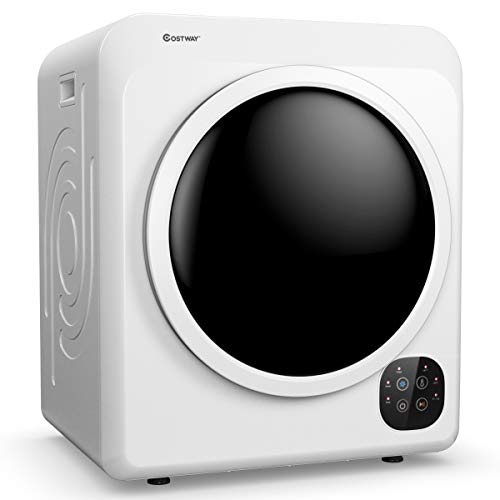
COSTWAY 1700W Portable Clothes Dryer 13.2 lbs — Power Option
If the small COSTWAY is the category’s whisper, this one is its raised voice. The listing describes a 1700W electric portable dryer with a 13.2 lb capacity, a front-load stainless steel tub, and a button panel arranged along the machine’s lower front — a control placement owners of floor-standing units appreciate, since it reads at a glance without crouching theatre. Seventeen hundred watts is the strongest heat in this guide by a wide margin, and it changes the machine’s character: this is the compact dryer for loads with ambition, the towels and denim and workwear that make gentler machines sigh.
Power in a portable is a bargain with the room, and the terms should be read. A 1700W heater draws seriously on its circuit, so the machine wants an outlet that is not simultaneously feeding a kettle or a space heater, and it returns its energy as fast, hot airflow that the vent hose must carry away competently. Within those terms, the payoff is real: cycles shorten, heavy loads finish in one pass, and the dryer behaves less like an appliance of compromise and more like a small professional tool.
COSTWAY offering both this and the 850W model is the category in miniature — the same brand selling patience and power at two sizes of the same idea. Choose this one when your laundry leans heavy and your schedule leans tight, and when the dryer’s station is a floor or a serious stand rather than a shelf. It is the pick most likely to be mistaken, at a glance, for a shrunken household dryer, and in performance it works hard to sustain the impersonation.
- Capacity: 13.2 lb loads
- Heat: 1700W — strongest in this guide
- Drum: stainless steel tub, front load
- Controls: low-mounted button panel
- Venting: hose exhaust; give the circuit room to breathe
Strengths
- Power shortens cycles on heavy, dense loads.
- Generous capacity for the portable class.
- Stainless tub suits years of regular use.
Trade-offs
- Highest draw on its household circuit of the six.
- Floor or stand placement, not countertop.
- More heat than delicate-heavy wardrobes need.
Best for: heavier laundry — towels, denim, workwear — in compact living spaces. Not suited for: shared circuits already carrying other hungry appliances.

Stopsad 1.6 cu ft Portable Clothes Dryer — Fast-Dry Mini
Stopsad’s entry is the sprinter of the small class. Its listing describes a 1.6 cu ft portable dryer with an 800W heater, five modes, a stainless steel tub, and a fast-drying function, positioned for apartments, homes, and dorms. The fast-dry emphasis is the tell: this machine is designed around the small urgent load — the work shirt needed tomorrow, the gym kit needed tonight, the child’s outfit that exists in a rotation of three — and its modes are arranged to serve that urgency at a scale where 800 watts can genuinely be quick.
That framing matters because wattage comparisons mislead at the extremes. Eight hundred watts into a drum holding two kilograms of synthetics is a brisk appliance; the same wattage under a load of bath towels is a lesson in thermodynamics. Stopsad’s design brief, fairly read, is the first of those, and households whose laundry is dominated by small frequent loads of light fabrics will find the machine honestly matched to their basket. The stainless tub at this size is a pleasant seriousness — the machine is built as an appliance, not a novelty.
Placement follows the mini pattern: a counter, a stand, a closet shelf rated for the weight and the vibration of a spinning drum, with the vent hose routed to its window or kit. The dorm and first-apartment audience the listing names is exactly right. For a single occupant establishing a first laundry corner, this is the low-ceremony route in — one box, one outlet, one hose, and the laundromat’s phone number deleted.
- Capacity: 1.6 cu ft
- Heat: 800W electric
- Modes: five, including a fast-drying function
- Drum: stainless steel tub
- Audience: apartments and dorms, per the listing
Strengths
- Fast-dry focus suits small urgent loads perfectly.
- Stainless tub at a mini’s price point.
- Minimal footprint and ceremony to install.
Trade-offs
- Heavy cottons stretch its heat budget thin.
- Capacity is a single person’s, firmly.
- Less established name for long-term parts.
Best for: dorms and singles with light, frequent, time-sensitive loads. Not suited for: towel-heavy or family laundry of any volume.

Auertech 1.8 cu ft Portable Clothes Dryer — Mode-Rich Middle Size
The Auertech occupies the thoughtful middle: a 1.8 cu ft drum, 850W of heat compatible with 110 or 120 volts, eight smart modes behind LED control, and — the listing’s charming outlier — a talent for drying boots. Eight modes in a compact dryer invites a raised eyebrow, but the logic is the same as the small COSTWAY’s, extended: when heat is modest, programme intelligence is how a machine spends it well, matching temperature and time to the load’s actual composition instead of applying one blunt cycle to everything from silk to canvas.
The boot-drying mention deserves more than a smile. Wet footwear is a genuine domestic problem — the hiker’s boots, the children’s snow boots, the work boots after a wet shift — and a dryer that accommodates them solves in an evening what radiators solve in two days with collateral damage to the leather. Households in wet climates or outdoor occupations will find that single feature cited, months later, as the reason this machine earned its corner. It is a reminder that compact appliances win loyalty through specific usefulness, not specification volume.
At 1.8 cu ft the drum takes a single person’s full load or a couple’s light one, and the LED interface keeps the eight modes navigable rather than archaeological. The Auertech is the pick for the buyer who reads mode lists with pleasure and whose laundry is varied — delicates on Monday, kit on Wednesday, boots whenever the weather has been itself. Generalists in small spaces rarely do better than a machine designed by people who enumerated the loads first.
- Capacity: 1.8 cu ft
- Heat: 850W, 110V/120V compatible
- Modes: eight smart programmes with LED control
- Speciality: boot drying among its listed talents
- Venting: hose exhaust to window or kit
Strengths
- Programme range spends modest wattage intelligently.
- Boot drying solves a real wet-climate problem.
- Middle capacity suits singles and light couples.
Trade-offs
- Eight modes are more than minimalist users will touch.
- Wattage still limits heavy-load pace.
- Newer brand, thinner service story.
Best for: varied small loads and outdoor households with wet footwear. Not suited for: buyers who want exactly one dial and no decisions.

ROVSUN 2.6 cu ft Portable Clothes Dryer — Simple Big-Drum Alternative
ROVSUN’s proposition is subtraction: a 2.6 cu ft drum — within a whisker of the BLACK+DECKER’s class-leading size — a stainless steel tub, 1400W of heat, and a control knob. No LED, no mode library, no interface to learn. The listing positions it for apartments, dorms, and RVs, and the knob is the philosophy made visible: select a time and a heat, close the door, and the machine dries. For households that regard appliance software as a tax, this is not a lesser machine; it is the honest one.
The drum size at this simplicity is the surprise. Buyers usually trade capacity for minimalism or pay for both with complexity; the ROVSUN offers family-credible volume with a control scheme a grandparent masters in one demonstration — a real consideration for machines bought for relatives, rental units, or holiday homes where the operator changes weekly and the manual is a rumour. A knob also fails gracefully across years in ways touch panels occasionally do not, and in the affordable tier that durability argument carries weight.
The owner’s side of the bargain is judgement: without sensor programmes, the knob’s time is your estimate, and the skill of estimating — by load weight, fabric, and season — is one the household develops in the first month. Slightly under-run and re-run beats habitually over-running, for the clothes and the bill alike. Give the ROVSUN its window hose, its stable floor, and an operator willing to learn its drum’s moods, and it will do the week’s laundry for a small household with the least ceremony of any machine in this guide.
- Capacity: 2.6 cu ft
- Heat: 1400W electric, 110V
- Drum: stainless steel tub
- Controls: single knob — timed cycles
- Audience: apartments, dorms, RVs per the listing
Strengths
- Near-largest drum with the simplest controls here.
- Knob interface suits rentals and multi-user homes.
- Strong wattage for the size class.
Trade-offs
- Timed drying depends on the operator’s judgement.
- No sensor to rescue a misjudged load.
- Basic feature set beside the LED rivals.
Best for: knob loyalists, landlords, and holiday homes with rotating operators. Not suited for: buyers who want the machine to decide everything.
How Do the Six Compare at a Glance?
| Model | Drum | Heat | Control style |
|---|---|---|---|
| BLACK+DECKER BCED26 | 2.65 cu ft | 1400W | Conventional panel |
| COSTWAY 1.5 cu ft LED Dryer | 1.5 cu ft | 850W | LED, five modes |
| COSTWAY 1700W Portable Dryer | 13.2 lb class | 1700W | Button panel |
| Stopsad 1.6 cu ft Mini Dryer | 1.6 cu ft | 800W | Five modes, fast-dry |
| Auertech 1.8 cu ft Smart Dryer | 1.8 cu ft | 850W | LED, eight modes |
| ROVSUN 2.6 cu ft Knob-Control Dryer | 2.6 cu ft | 1400W | Single knob |
Two axes organise the table: how much drum, and how much help. The big drums ask for floor space and give back single-cycle loads; the small drums fit anywhere and ask for rhythm. The LED machines spend modest heat cleverly; the knob spends the operator’s experience instead. Your corner and your temperament pick the quadrant.
Where Does an Apartment Dryer Actually Live?
In the corner the household can defend: beside the portable washer in a bathroom, on a stand in the closet, on a reinforced counter in the kitchen’s dead zone, in the RV’s utility bay. The non-negotiables are a stable, level surface that tolerates a spinning drum’s vibration, an outlet within cord reach that is not already heroic with other appliances, and the exhaust route — the window within hose distance, or the room that can host an indoor vent kit without turning into a sauna with opinions.
Height deserves a thought, because compact dryers are loaded by people, not by specification. A machine on the floor is loaded kneeling; on a stand or counter, at waist height, loading becomes a civilised act performed daily without resentment. Many owners buy the stand in month two, after a month of floor-level laundry taught them the ergonomics the catalogue omitted. Budget the stand — or the shelf, or the reinforced surface — as part of the machine, and choose the corner by where you will happily stand twice a day.
How Does the Exhaust Work in Practice?
The hose is short, flexible, and undramatic: it carries warm, moist, lint-filtered air from the dryer’s back to its destination. To a window, it meets a window kit — a panel that fills the sash gap and accepts the hose — which fits for the cycle and removes after, leaving the window a window. To an indoor kit, it meets a reservoir box that traps lint in water and releases the air to the room; that arrangement suits cool, dry, sizeable rooms and poor ones that are small, humid, or mould-prone, and the kit’s water and lint want regular attention.
Route the hose like you mean it: gentle bends, no kinks, no low loop where condensate can pool, and the run kept as short as the room allows. A well-routed hose is the difference between the dryer the listing promised and the dryer that seems to take forever — most slow compact dryers are, on inspection, fast dryers breathing through a crushed or tangled exhaust. Check the route before blaming the wattage; the hose is the cheapest performance upgrade in the category.
How Should Loads Be Sized and Sorted for a Small Drum?
Fill the drum the way you would fill a teapot’s patience: generously but with room for the contents to move. Laundry needs to tumble through the airflow, and a drum packed to the door dries its outer layer while steaming its core. In practice the working load of these machines is a modest basket, loosely loaded — and two such loads, run back to back, finish faster and drier than one act of optimism. Weigh your typical load once; the listings’ pound ratings will suddenly read as friendly, specific advice.
Sorting by weight matters more in a small drum than in a large one, because the small drum’s heat budget cannot bully a mixed load into uniformity. Towels with towels, synthetics with synthetics, and the odd mixed load shaken out piece by piece so nothing enters balled inside something else. A pillowcase carrying three socks into the drum as a sealed parcel will emerge with its cargo still damp, in this category as in physics generally. Thirty seconds of shaking at loading is the highest-value time in the whole cycle.
What Does It Cost to Run a Compact Dryer, Qualitatively?
Small heaters on household outlets produce small bills per load — the arithmetic of a modest wattage running for an hour or so is gentle compared with full-size laundry, and the true comparison for most owners is not the utility tariff but the laundromat: the coins, the travel, the waiting, the other people’s detergent residue. Against that ledger, every machine in this guide is inexpensive to live with, and the differences among them — a stronger heater finishing sooner, a gentler one running longer — wash out to modest sums across a month.
The costs that do deserve attention are the behavioural ones. Overloading doubles cycles; a kinked hose lengthens them; a clogged filter taxes every minute. The compact dryer’s economy is therefore mostly housekeeping, and the household that keeps the filter clean and the hose honest will find its machine cheap in the only currency that compounds, which is time — theirs, reclaimed from the laundromat run, week after week.
How Do You Care for a Portable Dryer?
The lint filter, after every load, is the entire first chapter — in a small machine the filter is small, fills fast, and throttles airflow the moment it mats. The second chapter is the hose and its destination: window kit seals checked, indoor kit reservoir emptied and rinsed, the hose inspected for the lint that escapes every filter eventually. The third is the drum’s interior, wiped occasionally, and the moisture path where the design exposes it. None of this needs a technician; all of it needs a rhythm, and the rhythm is lighter than any other laundry category’s.
Portability adds one care item of its own: machines that move — between rooms, between homes, down from counters — suffer their injuries in transit and placement rather than in operation. Lift with help, keep the drum door secured in a move, and re-level at the new station before the first load. A portable dryer treated as furniture during moves and as an appliance during laundry will serve both roles for years.
What Is It Like to Live With One, Week to Week?
The first week is calibration. Loads come out slightly damp or slightly baked while the household learns its machine’s dialect — which mode flatters the work shirts, how the towels behave, what the drum considers a load. By the third week the calibration is a bodily knowledge, and the machine recedes into the household’s furniture of habits: laundry dries while dinner cooks, the gym kit turns around overnight, the Sunday laundromat expedition quietly leaves the calendar and is not mourned.
The texture owners report most is not speed but sovereignty. Laundry stops being weather-dependent, queue-dependent, and building-dependent; it happens in the home, on the household’s schedule, in the background. For renters especially — people whose housing offers them so little control — an appliance that returns an entire chore to their own four walls carries a satisfaction out of proportion to its cubic footage. That is the product actually being sold in this category, and the drum sizes are merely its denominations.
There are frictions, and they are the category’s known ones: the hose to wrangle, the filter to remember, the heavy load that must be split with a sigh. Households that priced those frictions in at purchase describe them as the machine’s manners. Households that expected a full-size dryer in a small box describe them as betrayals. The guide’s whole effort, section by section, is to move its readers from the second group to the first before money changes hands.
How Do Compact Dryers Pair With Compact Washers?
Beautifully, provided the spin is respected. A compact washer’s spin speed is the dryer’s silent partner: a load spun fast arrives at the dryer with a fraction of its water already gone, and every cycle shortens accordingly. Households shopping the pair together should read the washer’s spin figure as a dryer specification, because functionally it is one. Where the washer is a portable twin-tub with a spinner, the same logic applies with knobs on — a well-spun load is half-dried before the dryer is switched on.
Placement of the pair is the second consideration. Side by side on a stand, stacked where the maker allows, or washer in the bathroom and dryer in the closet — the floor plan decides, and the hose’s reach audits the decision. The pair’s combined footprint remains smaller than a single full-size machine’s, which is why this category colonises bathrooms and kitchens that could never host conventional laundry. Measure the two stations and the route between them, because wet laundry travels that route in your arms, weekly, forever.
What Should RV and Cabin Owners Know?
That these machines were practically designed for them, with two cautions. The first is power budgeting: an RV’s electrical system or a cabin’s modest service must carry the dryer’s draw alongside whatever else is running, which argues for the gentler wattages on the road and reserves the 1700W COSTWAY for sites with generous hookups. The second is the exhaust’s destination in a vehicle or a small structure — a window kit suits most installations, and the hose’s route in a confined bay deserves the same kink-free respect as in a flat.
Against those cautions, the benefits compound in recreational settings. Laundry on a long trip stops dictating the itinerary’s laundromat stops; a wet week’s hiking kit dries in the cabin instead of festooning its porch; the machine’s small size fits the utility spaces these buildings actually have. Several of the six name RV use in their own listings, and for once the marketing and the reality are in full agreement. Secure the machine for travel, drain and stow the hose as the manual directs, and the dryer becomes part of the vehicle’s ordinary competence.
How Quiet Are They, Really?
Compact dryers sound like what they are: a drum turning, a fan moving air, a heater’s faint presence — at volumes a household notices in the same room and forgets through a door. They lack the deep mechanical bass of a full-size machine, which makes them easier neighbours in thin-walled buildings, and their smaller drums carry smaller imbalances, which makes their worst moments gentler. The station matters more than the model: a machine on a hollow counter drums where the same machine on a solid stand merely hums, and a mat beneath the feet is the cheapest decibel in the category.
Scheduling completes the courtesy. These are machines with timers and short cycles, easily run at sociable hours, and the overnight load — tempting for its convenience — should be weighed against the bedroom wall it shares. Most households settle into a rhythm of evening cycles finished before the building sleeps, and find the category’s noise a settled question within the first week. If your walls are exceptionally thin, the smaller drums run shorter and softer, which is one more argument the minis make without raising their voice.
When Should You Buy a Bigger Category Instead?
When the household’s laundry outgrows the drum’s dignity: three or more people producing daily laundry, a bedding rotation that includes comforters weekly, a home business’s worth of towels, or a cloth-nappy service running around the clock. In those houses a compact dryer becomes a bottleneck appliance, running all day to stand still, and the correct purchase is a full-size machine with the installation it demands — or, where installation is impossible, a stacked compact pair from the category covered elsewhere in these guides.
The test is the week’s arithmetic. Count your loads honestly for one ordinary week, multiply by the seasons, and ask whether a drum of two-odd cubic feet, cycling at household pace, clears that volume with room for the household to have a life. If the answer is comfortably yes, buy from this guide with confidence. If the answer requires optimism, believe the arithmetic instead — it is the only reviewer who will be present for every load.
What Accessories Are Worth Buying With the Machine?
Three, and the rest can wait. The window vent kit, if your station is a window, because improvising the sash seal with towels and optimism wastes the dryer’s heat and the household’s patience. The indoor vent kit, if your room is the destination, bought with the machine rather than after a week of hose-into-the-room experimentation. And the stand or mat the station requires, because ergonomics and quiet are decided by what the machine stands on. Everything else — spare hoses, lint brushes, a small basket that lives at the station — can be acquired as the household’s habits reveal the need.
Buy the filter habit a home as well: a small brush and a waste bin within arm’s reach of the machine convert lint care from a chore performed at the kitchen sink into a gesture performed at the drum. Compact laundry is a game of small frictions, and the accessories that remove the daily ones repay their modest cost within the first month. The glamorous accessory does not exist in this category; the useful ones are all under the heading of hose, stand, and brush.
How Does Winter Change Compact Drying?
Winter loads are heavier — knitwear, denim, the layered wardrobe — and winter rooms are colder, which lengthens every cycle in this guide a little and rewards the stronger heaters disproportionately. The indoor vent kit comes into its own in the cold months, returning warmth and a measure of humidity to rooms that heating systems parch; the same kit that oppressed in August is a comfort in January, and households in strongly seasonal climates often run window exhaust in summer and the kit in winter, treating the exhaust as a seasonal fitting like a storm window.
Winter also tests the station. A dryer in an unheated porch or a cold RV bay works against its own environment, and cycle times stretch until the room’s temperature is part of the calculation. Bring the machine inside the heated envelope where the plan allows, or accept the season’s tax with the stronger machines. Either way, the category copes — it merely asks, as it always asks, that the room be considered part of the appliance.
How Do You Choose Between the Two COSTWAYs?
They are the same maker’s answer to opposite households, and the choice between them is this guide in miniature. The 1.5 cu ft LED model wagers that your laundry is small, light, and frequent, and that controls which think in modes will make a gentle heater feel adequate; the 1700W model wagers that your laundry is heavy, your schedule is tight, and your circuit can spare the draw. Both wagers are honourable. The error is only in placing the wrong one — the LED machine under a family’s towels, or the power machine on a dorm’s shared circuit, each blameless and each miserable.
Decide by weighing one real load and reading your fuse box’s story. If the load is a day’s clothes and the circuit is shared and elderly, the small machine is not the compromise; it is the correct engineering. If the load is workwear and the outlet is modern and dedicated, the big heater’s pace will repay its draw every single week. Brands rarely offer so clean a fork; take the branch your house describes.
What Does Unboxing and Setup Actually Involve?
Less than an hour, most of it placement. The machine comes out of its box, the transit materials come out of the drum, the feet are levelled on the chosen station, the hose connects at the back and routes to its destination, and the first empty run confirms the exhaust breathes where it should. Read the manual’s venting page before the first real load rather than after the first disappointing one, because the difference between the hose routed well and the hose routed somehow is the difference between the machine’s two personalities.
Keep the box until the machine has survived a week of your actual laundry, as with every appliance in these guides. Apartment machines are exchanged for fit — a door swing misjudged, a station an inch too small, a hum that lands wrong at midnight — far more often than for faults, and the packaging is the difference between an exchange and an argument. After the week, break the box down with the satisfaction of a household that has permanently fired its laundromat.
A last word on expectations, addressed to the reader still hovering between this category and saving for something larger. The households that love these machines are not the ones who settled; they are the ones whose laundry genuinely matches the brief — modest loads, frequent cycles, small spaces, no installation rights. For them the compact dryer is not a smaller version of the right appliance. It is the right appliance, and the full-size machine would be the misfit, squatting in a bathroom doorway and drying a single person’s Tuesday load with industrial indifference. Fit is the whole of appliance wisdom, and this category, honestly matched, fits more homes than its modest drums suggest.
And if the match is made and the machine is humming in its corner, do the category one courtesy in return: write down what you bought and when, keep the filter clean, and when a friend in a similar flat describes their laundromat Sundays, tell them the truth about the hose, the stand, and the drum sizes. This category spreads by exactly that testimony, one small laundry corner at a time.
How Does Each Size Class Behave With Real Loads?
The 1.5 to 1.8 cu ft machines — the small COSTWAY, the Stopsad, the Auertech — live on the rhythm of the day: a load in the morning, a load in the evening, each small enough that the drum’s air reaches every garment. Their owners think in outfits rather than in weeks. A uniform, a gym kit, a child’s rotation, a couple’s light day — these are the units of their competence, and within them they are not slow at all, because the load was never large enough to make slowness visible.
The 2.6 cu ft class — the BLACK+DECKER and the ROVSUN, with the 1700W COSTWAY punching alongside on capacity by weight — lives on the rhythm of the week: the two-day accumulation, the sheet change, the towel run. Their owners think in baskets. The step between the classes is therefore not really about cubic feet; it is about which rhythm the household keeps, and a household that tries to run a weekly rhythm through a daily drum, or the reverse, will find the machine at fault for what is actually a scheduling mismatch. Choose the rhythm first. The drum follows.
One more placement idea deserves recording, because experienced owners volunteer it often: the dryer station beside the wardrobe rather than beside the washer. Where the floor plan allows, drying where clothes are stored collapses the whole laundry route — wash in the bathroom, carry once, dry and fold and put away in a single room. It will not suit every flat, and the hose still rules the map, but households that discover their window and their wardrobe share a wall tend to describe the arrangement as the moment the small laundry stopped feeling like a workaround and started feeling designed.
Finally, insure the arrangement against its one predictable accident: water where it should not be. These dryers do not hold water the way washers do, but their hoses carry warm moist air that condenses in a cold run, and a mat or tray beneath the station, plus a monthly glance at the hose’s low points, keeps the category’s only real mess from ever introducing itself to the floor. Small machines, small risks, small rituals — the bargain holds at every scale of the ownership.
And when guests ask — they will, the first time they see a dryer the size of a microwave doing a week’s work — the honest answer is the one this guide has given throughout: it dries what it is fed, at the pace its wattage promises, through a hose that somebody planned. That modesty is the category’s charm. Nothing here pretends, and a home furnished with appliances that do not pretend is a calmer home than one furnished with promises.
Which Mistakes Make Apartment Dryers Disappoint?
- Expecting ventless operation from a vented machine, then blaming the hose for existing.
- Buying the smallest drum for a couple’s laundry and living in a queue of half-loads.
- Running the strongest heater on a circuit already feeding a kettle and a heater.
- Placing the machine on a wobbly surface and diagnosing the resulting drumming as a defect.
- Letting the small lint filter mat over until every cycle doubles.
- Routing the exhaust through kinks and sags, then shopping for a more powerful dryer.
The pattern will be familiar by now: the machines are honest, and the disappointments are mismatches between a machine’s brief and a home’s facts. The briefs are printed above, in plain language, precisely so the match can be made before the box arrives.
Final Recommendation
Most apartment households should start with the BLACK+DECKER 2.65 cu ft Portable Dryer BCED26, whose drum crosses the line from portable gadget to household appliance. If your laundry leans heavy, the COSTWAY 1700W Portable Clothes Dryer 13.2 lbs brings the power; if it leans small and frequent, the COSTWAY 1.5 cu ft Portable Dryer LED Control fits the life and the corner alike. The ROVSUN serves knob loyalists, the Auertech the varied-load household, and the Stopsad the sprinter’s small urgent laundry.
Choose the drum by your basket, the wattage by your fabrics, and the station by your window — and a machine the size of a suitcase will quietly abolish the laundromat from your week, which is a larger change to a small home than most furniture ever makes.
Frequently Asked Questions
Do apartment-size dryers need a vent?
These six do — they are vented designs that exhaust through a hose. The hose can meet a window kit or an indoor vent kit, so no wall needs cutting, but the moist air needs a destination. If your space cannot offer one, the ventless machines in our companion guides are the correct category instead.
Can I put a compact dryer on a countertop?
The smaller models, yes, provided the counter is genuinely sturdy, level, and tolerant of vibration, with the hose routed safely. The larger drums belong on the floor or a proper stand. When in doubt, the stand is the purchase that converts a tolerated appliance into a comfortable one.
How long does a small load take to dry?
It depends on the load’s weight, fabric, and the machine’s wattage more than on any figure a listing could print. Light loads in the stronger machines are brisk; heavy cottons in the gentle machines are a longer appointment. Sorting by weight and loading loosely are the owner’s two levers, and both are free.
Will a 1700W dryer trip my breaker?
It draws heavily on its circuit, as any strong heater does. On a modern circuit with little else running, it operates as designed; sharing the circuit with another hungry appliance invites trips. Give it the outlet’s priority during cycles, or choose a gentler model for shared wiring.
Can these dryers handle bedding?
The large drums — the BLACK+DECKER and the ROVSUN — take sheets and duvet covers in stride. A full comforter exceeds the category’s honest brief; that load belongs to a full-size machine or a laundromat’s big drum, and no compact pick should be blamed for declining it.
Are portable dryers allowed in dorms and rentals?
Usually, because they install nothing and alter nothing — but the lease and the residence rules are the authority, and a window hose is visible in a way a closet machine is not. Check the document, keep the appliance’s footprint modest, and the conversation with management stays theoretical.
Related Guides
Related decisions live in our companion guides: seasonal savings on full-size pairs in Best Black Friday Deals on Stackable Washer Dryers, compact tools for short hair in Best Blow Dryers for Men, and step-up cold storage in Best Affordable Upright Freezers.


