Our Top Picks




What's inside
- How the two geometries actually differ
- What the movement trains, and what it cannot do
- Hip pad fit decides comfort more than anything else
- Frame steel, rated load and the wobble question
- Ankle rollers, footplates and getting on safely
- Footprint, folding and the reality of storage
- Setting up your first sessions
- Progressions once bodyweight feels easy
- Variations beyond the standard extension
- Programming the bench inside a home week
- Sharing one bench between different bodies
- Assembly, maintenance and quiet ownership
- Choosing by home situation
- Listing claims and training habits worth distrusting
- How the bench compares with other back-training options
- Warm-up, footwear and session preparation
- Reading a product listing like an editor
- A sample training week for a home trainee
- Red flags that should end a set or a session
- Buying second-hand without inheriting problems
- Warranty, returns and the paperwork that matters
- Small details that separate good benches from frustrating ones
- Technique refinements for months two and beyond
- Troubleshooting the complaints owners actually report
- How long a good bench should last, and what wears first
- Questions to ask before any money changes hands
- Adapting the bench through different seasons of life
- Check prices on Amazon
- The bench in apartments, rentals and shared houses
As an Amazon Associate I earn from qualifying purchases. This post may contain affiliate links at no extra cost to you.
A quick word about how this page pays its way: certain links here may earn this site a commission whenever a reader buys through them, and that commission never adds anything to the price paid. Every judgement below grows out of manufacturer documentation, published dimension sheets and openly available reference material gathered for editorial research, with the reasoning shown openly so any reader can trace a claim back toward its source.
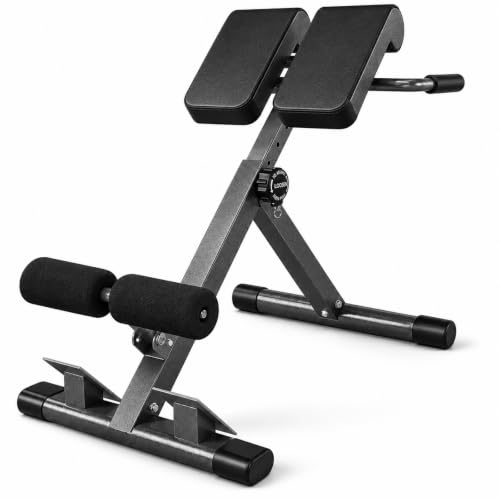
A hyperextension bench, widely sold as a roman chair, holds your legs still while your trunk folds forward over a padded support and then rises again under the power of your glutes, hamstrings and spinal erectors. It looks almost too plain to deserve a long guide, yet small differences in frame angle, pad placement and foot retention decide whether the movement feels smooth and targeted or awkward and vaguely worrying. Homes add another layer of difficulty, because the bench must share floor space with furniture, survive being moved for guests, and suit whoever else in the household eventually tries it.
Shoppers usually meet two broad families. The familiar design tilts the body at roughly forty-five degrees, feet planted low on a plate, hips resting against a pad partway up the frame. The other family keeps the body horizontal, knees or thighs supported on a longer deck, in the style associated with glute-ham developer stations. Both train the posterior chain, but they load it through different ranges, demand different amounts of starting strength, and occupy the floor in noticeably different ways.
How the two geometries actually differ
On a forty-five-degree bench, gravity pulls hardest while your trunk hangs near the bottom of the rep and eases off as you approach the top, where your body lines up with the incline. That forgiving curve suits beginners, because the hardest portion arrives where leverage is kindest and balance feels natural. Most people can learn the hinge pattern on this angle within a session or two, using nothing beyond bodyweight, and still find useful work many months later by holding a plate against the chest.
A horizontal design removes that mercy. With the trunk parallel to the floor at the finish, the erectors and glutes keep working near their hardest right through the final inches, and lowering under control becomes a genuine strength task. Trainees coming from deadlifts or kettlebell swings often enjoy the challenge, while deconditioned beginners may find even a partial range humbling. Neither geometry is superior in the abstract; the honest question is which resistance curve matches the person who will actually use the bench each week.
Length follows geometry. Horizontal stations stretch out well beyond the inclined models, often needing a clear run of floor comparable to a weight bench plus walking room behind it. Inclined units stand taller but cover less ground, and many fold toward the wall. Ceiling height rarely troubles either type indoors, although a tall user rising upright on an inclined frame in a low basement deserves one careful measurement before ordering anything.
What the movement trains, and what it cannot do
Back extension primarily builds the muscles that resist spinal flexion and extend the hip: gluteus maximus, the hamstring group, and the long erector muscles running alongside the spine. Strength there supports everyday tasks like lifting a laundry basket, gardening from a crouch, or carrying luggage up stairs. It also complements hinge training by teaching the pelvis and ribcage to move as a coordinated unit rather than letting the lower back round under load.
A roman chair is not a treatment device, and no bench can promise relief from back pain, disc trouble or sciatica. People managing a diagnosed condition belong in conversation with their clinician or physiotherapist before adding loaded spinal movement, however gentle the marketing language sounds. Treat the equipment as strength training furniture, respect sharp or radiating pain as a stop signal, and let medical guidance outrank any exercise guide, including this one.
Hip pad fit decides comfort more than anything else
The pad should meet the front of your pelvis just below the hip crease, leaving the fold of the hip free to close as you bend. Set too high, the pad digs into the abdomen and blocks the hinge, turning each rep into an uncomfortable crunch against foam. Set too low, it presses into the upper thighs, the pelvis rolls early, and the lower back ends up doing work the glutes were meant to handle. Correct placement feels almost boring, which is exactly the point.
Adjustment range therefore matters more than pad thickness. Look for a sliding or pinned carriage offering several positions spaced closely enough that one hole does not jump from clearly wrong to nearly right. Households with two trainees of different heights benefit from a tool-free pin they will actually bother moving between sets. Published adjustment ranges only help when matched against your own torso: measure from your hip crease to the floor in training shoes and compare that figure with the pad heights the maker lists.
Pad construction varies quietly. A single wide pad spreads pressure evenly and suits most bodies, while split pads leave a central gap some men find considerably more comfortable. Dense foam keeps its shape under repeated hip pressure; very soft foam feels plush for the first minute and then bottoms out against the plywood or steel beneath. Vinyl coverings wipe clean after sweaty sessions, though textured finishes grip shorts better than glossy ones during longer sets.
Borrowing a trick from other core stations can help a household decide how much adjustability it truly needs, and guides such as best captain chairs for exercise show how often shared equipment fails when one fixed position is expected to suit every body in the home.
Frame steel, rated load and the wobble question
Manufacturer weight ratings for home hyperextension benches commonly land between two hundred fifty and three hundred pounds, and that figure should be read as user plus anything held, not bodyweight alone. A two-hundred-pound trainee hugging a forty-five-pound plate is already pressing toward the ceiling of a lightly built frame. Shoppers near the top of a rating will be better served by the next tier of construction than by optimism.
Steel gauge, joint design and foot span explain most stability differences. Wider rear feet resist the rocking that appears when a tall user rises quickly, while triangular gussets near the pad upright keep flex from developing over months of use. Welds should look continuous rather than tacked at intervals, and bolted joints deserve a re-tightening check after the first few weeks, since new hardware often settles into paint and tubing.
A faint sway during the first session usually traces back to uneven flooring rather than a defective frame. Garages slope toward their doors, spare-room carpets compress under one foot, and old floorboards dip between joists. Shimming a foot or rotating the bench ninety degrees often cures what looked like a product flaw. Persistent creaking under moderate load, by contrast, deserves attention: find the joint, tighten it, and only then decide whether the design itself is underbuilt.
Flooring protection belongs in the same conversation, because steel feet concentrate the whole moving load onto four small patches. The guidance collected under best basement workout rugs covers dense, low-pile options that keep frames from creeping while sparing boards and tile from scuffs.
Ankle rollers, footplates and getting on safely
Your lower legs anchor the entire movement, so the retention system deserves the same scrutiny as the pad. Foam rollers behind the ankles or calves should spin freely, sit close enough to prevent the heels lifting, and adjust for different shoe sizes without tools. Rollers that lock the leg rigidly can irritate the Achilles area; a small amount of float usually feels kinder across a full set.
Footplates earn their keep through size and texture. A broad plate lets you press through the whole sole, experiment with stance width, and keep balance when fatigue arrives. Smooth painted plates turn treacherous in socks, so raised tread, grip tape or a lip along the bottom edge all count as practical virtues. Anyone training in a garage through winter will also appreciate a plate that tolerates trainers caked with a little grit without shedding its coating in a month.
Entry and exit sound trivial until a tired trainee tries to dismount awkwardly. Sturdy handles beside the pad give you something to hold while stepping in, settling the hips and climbing out after a hard set. Check that handles sit clear of the pad carriage through its full travel, and that their welds feel as deliberate as the main frame joints, because people instinctively haul on them with much of their bodyweight.
Footprint, folding and the reality of storage
Manufacturers love quoting the folded profile, and for once the numbers deserve attention, because a bench that stores easily gets used while one blocking a hallway gets resented. Many inclined models fold the leg assembly inward until the whole unit leans flat against a wall or slides into a cupboard, ending perhaps eight to twelve inches deep. Confirm the folded shape still passes your narrowest doorway, and note whether folding requires removing the pad carriage entirely.
Unit weight cuts both ways. A heavier frame stays planted during training yet punishes whoever drags it across the room twice a day. Transport wheels on one end solve most of that tension, provided they roll on your flooring and lift clear while the bench is in use. If the plan involves carrying the unit upstairs weekly, weigh that chore honestly against your enthusiasm, because convenience quietly governs long-term consistency more than any programme printed on paper.
Before ordering, mark the working footprint on the floor with tape, including space behind the footplate for stepping in and room at the sides for a held plate. Live with the outline for a day. Walk past it carrying shopping, open nearby doors, and check the cat, the children and the vacuum cleaner can all complete their usual routes without negotiation.
Setting up your first sessions
Begin without added weight, whatever your history elsewhere in the gym. Stand on the plate, settle the rollers, lean forward until the pad meets your pelvis, and adjust until the hip crease sits just above the pad edge. Cross your arms over your chest, brace lightly as if expecting a nudge, and let the hips fold while the spine keeps its natural curves. Rise by squeezing the glutes rather than by throwing the head back.
Range deserves restraint early on. Lower until the trunk approaches a comfortable stretch through the hamstrings, then finish each rep when the body forms a straight line from head to heels. Going further, arching the lumbar spine to lift the chest toward the ceiling, is the true hyperextension the name warns about, and it compresses structures that gain nothing from the extra inches. A straight finish looks undramatic on video and feels exactly right in the body.
Tempo teaches what load cannot. Try three seconds down, a brief pause, and a firm but unhurried rise for your opening weeks. Rushing invites momentum to steal the bottom half of the rep and encourages a bounce out of the stretch, which the hamstrings rarely forgive. Breathing follows the effort: inhale while folding, exhale through the rise, and never hold a maximal breath brace for a movement this moderate.
- Pad check: hip crease clears the top edge, no abdominal digging.
- Line check: head, ribs and pelvis finish stacked in one line.
- Tempo check: no bounce at the bottom, no swing at the top.
- Symptom check: effort in glutes and hamstrings, never sharp spinal pain.
Progressions once bodyweight feels easy
Add load gradually and hold it close. A plate hugged against the sternum, arms crossed over it, keeps the centre of mass near the body and the shoulders relaxed. Holding weight behind the head multiplies difficulty dramatically through leverage, so that variation belongs to experienced trainees using modest loads, if it belongs in their programme at all. Jumping ten pounds at a time is plenty; the erectors respond well to patient accumulation.
Paused reps offer progression without any extra equipment. Hover for two seconds at the straight-line finish, lower slowly, and repeat for fewer total reps than a normal set. Single-side emphasis is also possible on many benches by shifting one foot slightly and rotating the trunk a few degrees, though the change should stay subtle enough that the pelvis remains level and the pad pressure feels even.
Volume guidelines from general strength practice translate sensibly here: two or three sessions weekly, two to four sets of eight to fifteen controlled reps, leaving a rep or two in reserve. The lower back recovers more slowly than its effort during a set suggests, partly because the same muscles work during hinges, carries and ordinary bending the following day. Soreness that lingers beyond forty-eight hours is information, and the sensible response is trimming a set rather than adding a supplement.
Variations beyond the standard extension
Oblique work fits naturally on an inclined bench. Turn sideways across the pad, brace the feet, and let the trunk dip toward the floor before lifting through the waist muscles on the upper side. Keep the range modest and the movement slow, since lateral spinal loading surprises people who only train in straight lines. Equal reps each side matter more than depth, and a hand resting lightly on the frame restores balance whenever the position feels precarious.
A gentle reverse raise is possible on some designs by facing the pad, resting the pelvis on it, gripping the frame and lifting the legs a short distance behind you. Treat this strictly as a light glute exercise with a small range, never a swinging pendulum, and skip it entirely if the bench lacks secure handholds at the right height. Flat stations with long decks handle this family of movements more gracefully, which is worth remembering if variety ranks high on your list.
Glute emphasis shifts with small technical changes. Turning the feet outward slightly and allowing the upper back to round a little while the pelvis stays tucked tends to move effort toward the glutes and away from the spinal erectors, a technique popular in physique training. The opposite cue, a proudly arched chest, biases the erectors. Both are legitimate tools; confusion only arises when a trainee chases one effect while performing the other technique.
Programming the bench inside a home week
Place back extension where it supports, rather than sabotages, your heavier work. After deadlifts it can serve as a gentle finisher at low load, while on a separate day it can carry more intent as the main posterior-chain accessory. Pairing it with carries, rows and direct hamstring work covers the back from several angles without any single session becoming a marathon.
Recovery furniture sounds like a joke until a household trains seriously in shared rooms. Having a supportive seat nearby for rest periods, older relatives watching, or a training partner waiting their turn keeps sessions civilised, and the options reviewed at best easy chairs for seniors illustrate the stability features that also suit anyone rising carefully after a hard set.
Rest between sets can stay uncomplicated: sit, breathe, let the heart rate settle, and only start again once the previous set’s technique can be repeated. People who share the bench with a partner often alternate, one training while the other observes pad position and spinal line from the side, which is genuinely the best angle for spotting early arching.
Sharing one bench between different bodies
Mark the pad setting for each user with a strip of tape or a paint pen beside the correct hole. That tiny habit removes the most common cause of bad reps in shared homes, which is training on yesterday’s setting because adjusting felt like a faff. Keep the pin tethered to the frame if the design allows, since loose pins migrate into sofa cushions and tool drawers with remarkable speed.
Older trainees and anyone returning after a long layoff should start with a partial range and a hand kept on the frame, building confidence across several short sessions. A spotter standing alongside costs nothing and changes the psychology of the first week completely. Chairs placed thoughtfully nearby also help people sit straight down after a set instead of perching on the bench itself; households already researching best folding chairs for bad backs will recognise the same priorities of seat height, lumbar shape and firm support.
Children will inevitably treat the bench as playground equipment. Store it folded if curiosity is likely, keep plates elsewhere, and never leave a small child unsupervised around a frame with pinch points at its hinges. The same folding mechanism that delights adults searching for storage deserves a slow, fingers-clear demonstration for every older child allowed to move the unit.
Assembly, maintenance and quiet ownership
Assembly on typical home models involves bolting the foot assembly and pad upright to a central frame, usually with two wrench sizes and a helper to hold parts level. Lay every fastener out first, finger-tighten all bolts before final torquing so the frame can square itself, and train on carpet or a rug for the first session to catch any rocking early. Retighten after a fortnight, then glance at the hardware monthly.
Vinyl pads ask for little: a wipe with a damp cloth after sweaty work, mild soap for stubborn marks, and no solvent cleaners that dry the surface into cracks. Foam rollers eventually split at their seams on heavily used benches, so photograph part numbers from the manual while it is still findable. End caps vanish into vacuum cleaners; a small bag of spares in the parts drawer prevents the slow scratch damage bare tube ends inflict on floors.
Noise tells a maintenance story. A new squeak usually means a dry pivot or a bolt a quarter-turn loose, while a clunk at the same point in every rep suggests play developing in the pad carriage. Address sounds early and they stay trivial; ignore them for a season and joints wear oval, after which no amount of tightening restores the original feel.
Choosing by home situation
Small flat, bench stored after every session
Prioritise the folded depth, transport wheels and a pad carriage that stays attached while folding. An inclined model with a modest footprint will serve better than a horizontal station that technically fits the room but colonises it. Measure the cupboard or wall recess honestly, including skirting boards, and confirm you can complete the fold alone without pinching fingers or scraping paint.
Garage gym with permanent floor space
Here the horizontal design becomes tempting, since its harder resistance curve and longer deck reward trainees who already hinge well. Check the concrete for slope, plan the rug or mat run, and leave clearance behind the unit for plate storage. Cold garages also argue for vinyl you can wipe down and steel finishes that shrug off damp winter air.
Taller or heavier trainee
Filter first by rated load with headroom, then by pad height range, then by footplate size. A frame can meet its paper capacity yet still fail a tall user whose hips cannot reach the correct position on the pad. If listings omit pad height, ask the seller directly; a missing dimension in this category usually signals a short adjustment range hiding behind photography.
Cautious beginner with a sensitive back history
Choose the forty-five-degree angle, generous handles and the easiest pad adjustment available, then begin with partial reps under professional guidance where history warrants it. Confidence grows from uneventful sessions, so the best bench here is the one that feels almost too manageable in week one and still offers plate progressions by month three.
Listing claims and training habits worth distrusting
Inflated capacity figures appear across budget fitness equipment, sometimes describing a static load the frame survived once rather than a working rating for repeated dynamic use. Compare the steel, foot span and hardware against the claim; when they disagree, believe the construction. Photographs can mislead too, especially wide-angle shots that stretch a compact bench into something resembling commercial equipment, which is why published dimensions outrank imagery every time.
In training, the habits to distrust are bouncing from the bottom, hunting for depth the hamstrings have not earned, and treating the finish like a backbend contest. Each shifts stress toward passive structures and away from the muscles the exercise exists to build. Film one set from the side every few weeks; the camera notices drift long before the lower back files its complaint.
How the bench compares with other back-training options
Floor back extensions, where you lie prone and lift the chest a few inches, cost nothing and teach the basic contraction, yet they offer no easy way to add load or increase range once the basic version feels simple. A stability ball draped over the hips adds range but wobbles in every direction, which some trainees enjoy and others find distracting when the goal is straightforward strength. The bench sits between those poles: stable, repeatable, and progressively loadable without demanding a barbell’s worth of equipment around it.
Barbell hinges such as deadlifts and good mornings build the same musculature with far heavier loads, and nobody should expect a roman chair to replace them in a serious strength programme. What the bench offers instead is isolation and mercy: the erectors and glutes can be trained hard on days when grip, technique or general fatigue rule out heavy barbell work. Many home lifters use it exactly that way, as the reliable accessory that survives busy weeks when the headline lifts get postponed.
Dedicated reverse hyper machines occupy the far end of the spectrum, with swinging pendulum arms and loading pins built for rehabilitation settings and powerlifting gyms. They are large, specialised and far beyond what most homes can house. Mentioning them matters only to calibrate expectations: a folding roman chair borrows a small, gentle corner of that movement family, and judging it against pendulum equipment misses the purpose it actually serves.
Warm-up, footwear and session preparation
Two or three minutes of general movement prepares the tissues better than dropping straight into a loaded hinge. Marching on the spot, easy bodyweight hinges with hands sliding down the thighs, and a few glute bridges wake up exactly the muscles the bench will ask to work. Cold hamstrings pulled into a deep stretch under load complain loudly, so save any long static stretching for after the session, when the muscles are warm and the training stress is behind you.
Footwear changes the feel of the footplate more than most people expect. Flat, firm-soled trainers transmit pressure evenly and keep the ankle steady, while thick cushioned running shoes compress unevenly as you press, adding a faint wobble to every rep. Barefoot training grips well on textured plates but leaves the sole exposed to cold steel in a winter garage. Pick one consistent option for the first month so that changes in performance reflect training rather than changing shoes.
Clothing deserves a sentence as well. Bulky hoodies bunch against the pad and shift its contact point mid-set, while very slick leggings can slide across glossy vinyl. A fitted top and shorts or leggings with some texture keep the pelvis where you placed it. Jewellery, belt buckles and phone-filled pockets all dig in at exactly the pad line, so empty the pockets before the first rep rather than discovering the fact at the bottom of the third.
Reading a product listing like an editor
Start with the dimension block, not the headline. Working length, width and height tell you whether the bench fits; pad height range tells you whether it fits your body; folded measurements tell you whether the storage plan survives contact with reality. When a listing gives only one set of numbers, assume they describe the assembled unit and ask about the rest. Sellers who publish complete measurements rarely fear scrutiny, and the habit correlates with better manuals and spare-parts support.
Photographs reward a sceptical eye. Look for the adjustment pin actually engaged in a hole, the rollers positioned behind a model’s ankles rather than floating near them, and feet sitting flat on the floor instead of cropped out of frame. Lifestyle images shot in vast loft spaces make compact benches look palatial; the tape-measure outline exercise on your own floor remains the antidote to every photographic trick.
Reviews need filtering by use case. A complaint about wobble from someone far above the rated load says little, while repeated reports of the same bolt loosening across many owners describe a genuine design habit worth knowing. Praise for comfort from a trainee your height carries more weight than a generic five-word endorsement. Read for specifics: pad behaviour, assembly snags, folded size in a real cupboard, and whether customer service answered when something arrived bent.
- Dimensions: assembled, folded and pad-height figures all published.
- Rating clarity: capacity stated as user weight plus held load.
- Hardware: bolt sizes listed, spare fasteners included or identified.
- Support: manual available to download before purchase.
A sample training week for a home trainee
Monday might pair the bench with a primary hinge: after deadlifts or kettlebell swings, two easy sets of ten bodyweight extensions groove the pattern without draining recovery. Wednesday can stand alone as an accessory day, with three sets of twelve holding a light plate, followed by carries and core work. Friday returns to bodyweight volume, perhaps four sets of eight with a pause at the top, leaving the weekend free of lingering soreness for everything else life contains.
That skeleton bends to fit real schedules. A trainee with only two available days can place one heavier and one lighter bench session across the week and still progress, provided loads rise gradually and technique stays identical between sessions. What matters is the rhythm of exposure: the erectors adapt to regular, moderate work far better than to a heroic monthly session followed by three weeks of avoidance and a stiff back.
Keep a simple log. Date, pad setting, load held, sets, reps and one line about how the final set felt will outperform any elaborate spreadsheet abandoned by February. Reviewing a month of entries shows whether progress is real, whether a particular pad position keeps recurring in good sessions, and whether soreness follows specific combinations, such as bench work the day after heavy rows.
Red flags that should end a set or a session
Sharp pain, pain that travels into a leg, numbness, or weakness that was not present before the set are all full stops, not obstacles to push through. Muscle burn in the glutes and a deep ache across the lower back muscles are normal training sensations; anything electric, shooting or joint-like belongs to a different category entirely. End the session, note what happened, and let a clinician interpret recurring symptoms rather than crowdsourcing the diagnosis.
Dizziness on rising from the folded position appears occasionally, especially in warm rooms or after breath-holding. Sit on the floor or a nearby chair until it passes, breathe normally, and consider whether food and fluid intake matched the day’s demands. Repeated episodes deserve medical attention in their own right. The bench will keep; there is no training benefit important enough to justify fainting beside a steel frame.
Technique collapse is the quiet red flag. When reps turn into swings, when the finish becomes an arch rather than a line, or when you start dreading the pad because it bruises the same spot every session, the setup or the load is wrong for that day. Reduce one variable, fix the pad, and rebuild. Experienced trainees treat regression as programming information, while beginners often mistake it for personal failure; only one of those readings helps.
Buying second-hand without inheriting problems
Used roman chairs circulate constantly, since they are durable, simple and frequently outgrown rather than worn out. Inspect welds at the pad upright and foot assembly for hairline cracks in the paint, which can signal flexing metal beneath. Rock the frame from several angles, sit your full weight against the pad, and work the adjustment pin through every hole, because a bent carriage often reveals itself only at the extremes of its travel.
Foam condition tells the truth about storage history. Pads kept in damp garages develop a musty smell that cleaning rarely removes completely, and vinyl cracked along its seams will keep splitting once your hips load it daily. Replacement pads exist for some brands and not others, so price any needed parts before agreeing a figure. Missing end caps and worn rollers are bargaining points rather than deal-breakers, provided the frame itself is straight and complete.
Ask why the seller is parting with it. Upgrading to a horizontal station, moving house and recovering from an injury all produce honest bargains. Vague answers combined with fresh paint over the joints justify walking away, since paint hides exactly the cracks a buyer most needs to see. Bring the tools to fold the unit yourself in the seller’s hallway; a folding mechanism demonstrated is worth more than one described.
Warranty, returns and the paperwork that matters
Frame warranties on home fitness equipment often run far longer than cover for pads, rollers and other wear items, so read which parts fall into which bucket before assuming a decade of protection. Keep the receipt, photograph the serial or batch label if one exists, and save the manual somewhere searchable. When a roller splits in year two, the household that can quote a part number finishes the phone call in minutes.
Return windows matter disproportionately for fit-sensitive equipment. A bench can be perfectly well made and still wrong for your torso, which is why buying from a seller whose returns process you have actually read beats saving a small sum with a no-returns listing. Keep the packaging until the second week of training has passed, since repacking a steel frame into a destroyed box tests ingenuity nobody needs.
Register the product if the maker offers it, not for marketing reasons but because recall and parts notices travel through those lists. Note the assembly date in the log alongside your first sessions. If a joint ever fails, a clear timeline of purchase, assembly and use turns a warranty conversation from an argument into an exchange of facts.
Small details that separate good benches from frustrating ones
Handle placement reveals how much thought went into daily use. Grips angled slightly outward let wrists stay neutral while mounting, and knurled or rubberised surfaces stay secure with sweaty palms. On some designs the handles double as push-up bars when the bench is flipped or repositioned, a bonus worth having only if the frame remains stable in that orientation rather than rocking on its pad.
The adjustment pin deserves admiration when done well: a chunky knob that can be pulled with cold fingers, a tether that keeps it attached, and holes drilled cleanly so the pin drops in without a wrestling match. Slotted carriages with a clamp knob offer finer positioning between holes, at the cost of a few extra seconds per change. Either system works; what fails households is any mechanism fiddly enough that people stop adjusting altogether.
Paint and finish quality show up over years rather than weeks. Powder coating resists the scuffs of plates and shoe heels better than thin sprayed paint, especially around the footplate where grit grinds under every set. Check the underside photos in listings if available, because feet finished as carefully as the visible frame suggest a maker who expects the product to be lived with, moved and inspected from every angle.
Technique refinements for months two and beyond
Once the basic hinge feels automatic, attention can move to subtler dials. Foot pressure is one: pressing through the whole sole keeps the ankle quiet, while deliberately favouring the heels tends to recruit the hamstrings earlier in the rise. Neither is correct in isolation, and alternating emphasis between sessions teaches you how your own posterior chain shares work. Notice, too, how a slightly wider stance lets the pelvis settle deeper between the heels at the bottom, which some lifters experience as a stronger glute stretch.
Head position quietly steers the whole spine. Gazing at a fixed point on the floor a little ahead of the footplate keeps the neck in line with the trunk, while staring at the wall ahead encourages the chest-up arch that the finish is supposed to avoid. Think of the head as the last car of a train: it follows the line the pelvis sets rather than choosing its own route. A training partner watching from the side can confirm the line in seconds.
Breathing can sharpen as loads grow. A modest inhale and gentle abdominal brace before lowering gives the trunk stiffness without turning a moderate accessory lift into a maximal effort. Exhale steadily through the sticking point on the way up, then reset at the top rather than rushing into the next descent. Over a long set, that rhythm prevents the shallow, panicky breathing that often precedes technique breakdown more reliably than fatigue itself does.
Troubleshooting the complaints owners actually report
Hip bruising after early sessions usually means the pad edge is meeting bone rather than muscle and fascia, or that the trainee is folding at the waist instead of the hips and sliding across the pad on every rep. Recheck the crease position, slow the descent, and consider a folded towel over the pad for the first fortnight while tissues adapt. Bruising that appears in exactly the same crescent each week is a fitting problem asking to be solved, not a rite of passage.
Hamstring cramp at the bottom position surprises strong people, particularly those who also run or cycle. It often reflects the muscle working at a long length while also helping stabilise the knee, a double duty it protests when fatigued. Shorten the range slightly, warm up with bridges, and keep some bend in the knees if your bench technique allows it safely. Persistent cramping across many exercises merits a broader look at training load, hydration habits and sleep rather than blame aimed at one machine.
A bench that walks across the floor during sets is telling you about force direction. Pushing hard backward into the rollers as you rise drives the frame toward the wall, especially on smooth laminate. A dense rug beneath, feet checked for level, and a conscious effort to press down through the plate rather than back into the pads usually calm the migration. Mark the feet positions with small tape corners once the bench sits correctly, so resetting after cleaning takes seconds.
How long a good bench should last, and what wears first
A welded steel frame treated decently indoors should outlast several training fashions, which is why the second-hand market stays lively. The consumables are predictable: vinyl splits at pad corners where hips pivot, roller foam compresses into an oval, and rubber feet harden until they skate instead of grip. None of these require replacing the bench, provided the maker sells spares or the fittings are standard enough for generic replacements to fit.
Rust begins where sweat and condensation meet scratches, typically around the footplate and the lowest crossmember. Wiping the frame down when you wipe the pad, touching up deep chips, and keeping a garage unit off bare concrete on its rug all slow the process to a crawl. A bench stored folded against a damp exterior wall ages faster than one living in a dry spare room, a small fact worth weighing when storage options compete.
Resale value follows condition and completeness. Keeping the manual, spare bolts and original packaging materials costs a drawer and returns real money when the bench eventually funds its own replacement. Photograph it assembled in good light before listing, include the pad height range in the description, and the next owner starts their first session with the same setup knowledge you wished for at the beginning.
Questions to ask before any money changes hands
Ask for the pad height range in plain numbers, the folded depth, the unit weight and the tested user rating, and notice which questions produce documents and which produce adjectives. Ask whether replacement rollers and pads are stocked, how the carriage locks, and whether the footplate carries any grip texture beyond paint. A seller who answers with measurements is selling equipment; a seller who answers only with enthusiasm is selling a photograph.
Ask yourself the matching set. Where exactly will it stand during a session, where exactly will it sleep afterwards, who else will use it, and what will you do on the days when motivation is thin and the session must shrink to ten minutes? A bench bought with honest answers to those questions becomes furniture in the best sense: present, unremarkable and used so regularly that its value stops being calculated at all.
Adapting the bench through different seasons of life
Training equipment earns its place across years, not product cycles, and a roman chair adapts quietly as its owner changes. In a first year it might carry ambitious plate progressions. Later it becomes maintenance equipment for a parent snatching twenty minutes while a baby naps, the pad setting marked, the load modest, the goal simply to leave the session feeling taller and looser than the desk left them. The same frame serves both chapters without complaint, which is more than can be said for most fashionable fitness purchases.
Periods of detraining happen to everyone through illness, travel or workload. Returning after a month away calls for halving the previous load and range for the first two sessions, however insulting that feels to the ego. The erectors regain their rhythm quickly when the re-entry is gentle, whereas an ambitious comeback session can produce three days of stiffness that poisons the following week. The bench rewards the patient returner with interest, because its progressions are measured in small plates and single reps rather than in leaps.
Households change around the equipment too. A partner who once only watched may start training; a teenager may graduate from curiosity to supervised sessions; an ageing parent visiting for a month may use the bench, with guidance, for gentle supported hinges that keep them confident on stairs. Each new user restarts the fitting process from the pad outward, and the household that treats that ritual as normal extracts far more value from the purchase than one that sets the bench once and guards the setting like a relic.
Eventually the honest review of any home bench is written by behaviour rather than by star charts: whether it is unfolded without resentment, whether its pad sits at the right height for whoever steps up, and whether backs around the house feel stronger in the ordinary business of lifting, bending and carrying. Choose the frame that fits your floor, your pelvis and your household, maintain it in minutes rather than weekends, and it will keep answering those questions well long after the listing that sold it has been forgotten by everyone except the person still training on it, three quiet mornings a week.
Check prices on Amazon
Live listings for the shortlist in this guide are pulled from Amazon below, so prices and availability are always current at the moment you look.


The bench in apartments, rentals and shared houses
Renters weigh factors owners can ignore. A folding inclined bench that leans inside a wardrobe leaves no mark on a deposit, while a horizontal station dominating a studio flat becomes a daily negotiation with the landlord of one’s own patience. Check lease rules about gym equipment where they exist, protect the floor as a matter of courtesy, and favour designs whose feet spread load widely enough to keep boards and tiles unmarked through a full tenancy.
Neighbours below hear training through the floor more than through the air. Plates clinked onto a bench frame, a unit dropped the final inch while folding, and heels thudding against a plate all travel through joists. Training on a dense rug, setting plates down rather than dropping them, and keeping sessions to sociable hours preserves goodwill in a building far more effectively than any apology delivered after a complaint.
Shared houses add diplomacy to logistics. Agree where the bench lives, who folds it after evening sessions, and whether guests may try it without a briefing. A small laminated card with the pad settings and the straight-line finish cue, tucked beside the frame, prevents well-meaning housemates from inventing their own technique. Equipment that arrives with house rules attached tends to be treated as shared infrastructure rather than as one person’s clutter awaiting a skip.
When a move comes, the folding bench justifies itself again. It rides in a car boot or along one wall of a van, needs no disassembly beyond perhaps the pad carriage, and sets up in the new room within minutes of the kettle being found. Owners who have carried one through two moves speak about it the way they speak about a good ladder: rarely, briefly and with complete absence of regret.
One last measurement habit separates satisfied owners from returners: re-measure after the first week. Floors settle under rugs, pad carriages find their true resting position, and the tape outline drawn in optimism sometimes creeps into a doorway swing once real life resumes. Adjusting the bench’s home by six inches in week one is trivial; resenting its position for five years is a choice made by default.
Keep expectations proportionate and the bench will exceed them. It will not transform a back in a fortnight, replace a physiotherapist, or make heavy lifting unnecessary. It will, used twice weekly with a correctly set pad and honest loads, build the kind of unglamorous strength that shows up when a suitcase leaves a carousel, a toddler demands carrying, or a garden needs digging before rain arrives on Saturday afternoon.
Storage position influences condition more than owners expect. A bench folded with its pad pressed against a rough wall returns with scuffed vinyl, while one leaned pad-outward against smooth paint keeps its surfaces clean for years. In humid climates, a breathable cover draped loosely beats a sealed plastic sheet, which traps condensation against the steel overnight. Small courtesies like these, repeated automatically, are the difference between equipment that ages gracefully in a home and equipment that quietly becomes an eyesore its owner stops seeing as training gear altogether, until one day it is listed for sale with the photographs taken in flattering light. Treat the frame kindly, and it will still be answering your training questions, quietly and without drama, when newer equipment fashions have come and gone twice over in the meantime.
Finally, remember that consistency with a mid-priced bench that fits your body and your room will outperform a theoretically perfect machine that never gets unfolded. Buy for the hinge you will practise twice a week, set the pad with care, rise only to a straight line, and let patient loading do the quiet work it has always done.