What's inside
- Where to buy a glass-jar blender
- Quick Picks
- How these picks were chosen
- The glass lineup, compared directly
- How should you choose a glass-jar blender?
- Glass versus plastic, settled practically
- Blending technique that flatters any of these machines
- Six blenders, six households
- Noise, vibration and the early-morning blend
- What to blend in your first week with a new machine
- Common mistakes
- Where the blender lives: counter, cupboard and the space between
- Soups, sauces and the savoury half of blending
- Replacement jars, spare parts and the long view
- Final recommendation
- FAQ
As an Amazon Associate I earn from qualifying purchases. This post may contain affiliate links at no extra cost to you.
As an Amazon Associate, cottageverdict.com earns from qualifying purchases.
Glass has a particular honesty as a blender material: it does not hold yesterday’s curry colour, it shrugs off hot soup, and it lets you watch the vortex do its work. The best blenders with glass jars gathered here span a wide field, from an 84-ounce, 2200-watt Oster Titan built like a small commercial unit down to an 800-watt Oster Vortex tuned for oatmilk and salsa, and the differences among them are practical rather than cosmetic. Capacity in this set runs from 54 ounces to 84, power from 800 to 2200 watts as the titles state it, and programmes from three auto cycles to fourteen presets, so the first job of this guide is to match those numbers to the household actually doing the blending.
Why insist on glass at all, when plastic jugs dominate the market? Three reasons recur in real kitchens. Glass tolerates heat, which matters for soups blended straight from the pot. Glass resists staining and odour retention, which matters when the same jug makes a garlic sauce on Tuesday and a strawberry smoothie on Wednesday. And glass carries a reassuring weight and clarity that makes judging texture by eye easier. Against those stand two honest costs, weight in the hand and breakability at the sink, and this guide keeps both in view while comparing the six.
Every title in this set states a glass jar or glass pitcher, which sounds obvious for the keyword and yet matters, because the wider blender market is full of models whose glass-sounding listings turn out to describe plastic. The reviews below take each title’s material claim at face value, report wattage and capacity exactly as printed, and distinguish the machines by the work they are shaped for: batch smoothies, hot soups, nut milk, frozen drinks, or the everyday trio of shakes, salsas and sauces.
Our Top Picks
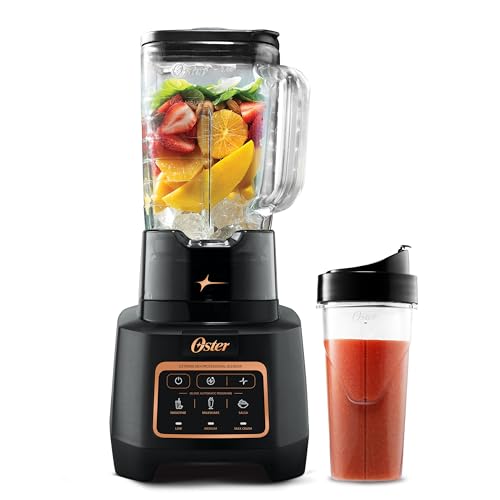 Oster Extreme Mix Blender1600 Watts Glass Jar w/ Cup8.5 x 7.8 x 17.44 inches11.8 poundsCheck on Amazon
Where to buy a glass-jar blender
All six blenders below are sold on Amazon, and each review includes its own purchase link.
Oster’s Titan leads on sheer scale, a professional-grade 2200-watt motor driving an 84-ounce Boroclass jar across five speeds and four iBlend presets, with reversible blades.
The Oster Extreme Mix follows with 1600 watts, an eight-cup glass jar, a ten-point stainless steel blade, iBlend technology and a Blend-N-Go option for taking a serving along.
Oster’s Vortex is the lightest touch of the trio, 800 watts with reversible steel blades, three iBlend auto programmes for milkshake, salsa and smoothie, and a 54-ounce shatter resistant glass jar that is dishwasher safe.
GDOR’s 1300-watt blender pairs a 67-ounce pitcher with a 22-ounce to-go cup, six preset programmes and a six-leaf blade aimed at ice crushing, frozen fruit and shakes, plus a self-clean function.
Universal’s Turbo Elite Max offers 1500 peak watts, a 71-ounce glass pitcher described as nine cups or 2.1 litres, three speed settings and six stainless steel blades.
ASTRALSHIP’s 1500-watt professional model closes the set with fourteen presets, nine speeds, a BPA-free glass jar and a heating function that extends it to nut milk, hot soups and slushies.
Quick Picks
| Pick | Best for | Điểm nổi bật theo title |
|---|---|---|
| Oster Titan Glass Jar Blender | Maximum power and batch size | 2200-watt, 84 oz Boroclass jar, 5 speeds, 4 iBlend presets |
| Oster Extreme Mix Glass Jar | Strong all-round blending with a to-go option | 1600W, 8-cup jar, 10-point blade, Blend-N-Go |
| Oster Vortex Glass Blender 800W | Everyday smoothies, salsa and oatmilk | 800 watt, 54 oz jar, 3 iBlend programmes, dishwasher safe |
| GDOR 1300W Glass Blender | Families blending frozen fruit daily | 67oz pitcher, 22oz to-go cup, 6 presets, self-clean |
| Universal Turbo Elite Max Glass | Large batches with simple controls | 1500 peak watt, 71oz pitcher, 3 speeds, 6 blades |
| ASTRALSHIP 1500W Glass Blender | Hot soups, nut milk and many presets | 14 presets, 9 speeds, heating function, BPA-free glass jar |
How these picks were chosen
The first requirement was a glass jar or pitcher stated in the title, full stop. Replacement jars and standalone pitchers, which flood blender searches, were excluded as accessories rather than appliances. That left complete countertop machines whose titles name glass as the vessel material, six of them here, and the reviews treat any further material detail, Boroclass branding on the Titan, shatter resistance on the Vortex, a BPA-free description on the ASTRALSHIP, exactly as each title phrases it.
Power was recorded as printed, with one distinction preserved. Most titles state watts plainly, 2200, 1600, 1300, 800, while the Universal states 1500 peak watts, and peak is a different measure from sustained rating, so this guide repeats the word peak wherever that machine’s power is mentioned rather than quietly promoting it into the same column as the others. Readers comparing raw numbers should hold that distinction in mind before ranking anything by wattage alone.
Capacity came third, converted carefully where titles mix units: 84 ounces on the Titan, eight cups on the Extreme Mix, 54 ounces on the Vortex, a 67-ounce pitcher plus a separate 22-ounce cup on the GDOR, 71 ounces described as nine cups or 2.1 litres on the Universal, and no capacity figure in the ASTRALSHIP title, a gap its review states openly. Batch size decides whether a blender serves a smoothie-for-one habit or a soup-for-six household, and it deserves the same honesty as power.
Programmes formed the fourth lens. Oster’s iBlend presets appear across its three models in counts of four, an unspecified technology mention, and three named auto programmes, while the GDOR offers six presets and the ASTRALSHIP fourteen with nine speeds. Programmes are a convenience philosophy, the machine deciding duration and ramp so the user does not, and the reviews weigh them against the simpler three-speed honesty of the Universal.
Finally, special functions were noted where titles claim them: Blend-N-Go portability, a self-clean cycle, reversible blades on two Osters, and a heating function for nut milk and soups on the ASTRALSHIP. Each such claim is reported as the maker’s, and each is tied to the household pattern it would actually change.

Oster Titan Glass Jar Blender
The Titan is the heavyweight of this set by every stated measure: a professional-grade 2200-watt motor, an 84-ounce Boroclass jar, five speeds, four iBlend presets and reversible blades. Eighty-four ounces is a serious vessel, enough smoothie for a family round or soup for a table, and 2200 watts as titled is the sort of power that treats frozen fruit and ice as ingredients rather than obstacles. Reversible blades add a subtle tool, running the blade assembly in the opposite direction to draw mixtures down or to work gentler folds, which experienced blenders use to manage thick blends without constant tamper work.
- Power: 2200 watts, described as professional-grade
- Jar: 84 oz, Boroclass glass
- Speeds: 5
- Programmes: 4 iBlend presets
- Blades: reversible
- To-go cup: none stated in the listing title
Strengths
- The largest jar and strongest stated motor here make it the batch blender of the group.
- Four presets cover common jobs without surrendering five manual speeds for everything else.
- Reversible blades give thick mixtures a second mechanical strategy beyond raw power.
Trade-offs
- An 84-ounce glass jar, full, is a heavy lift to the sink, and glass at this size asks for two-handed respect.
- Solo smoothie drinkers will chronically underuse its scale and washing footprint.
- Power at this level brings noise that early-morning households should anticipate honestly.
Who is this machine actually for? The household that blends in volume and in anger: big smoothie rounds for teenagers, frozen margarita batches for a garden full of adults, soups that begin as a pot of roasted vegetables. In that setting, power is not vanity but cycle time, the difference between a blend that finishes and a blend that stalls halfway into a warm, half-processed compromise. The presets keep that power house-trained for ordinary jobs, so the machine does not need a confident operator every time it runs.
Storage and handling deserve planning at this size. Measure the cabinet height the jar will live in, practise the pour with water before the first real batch, and accept that the Titan is a resident appliance rather than a cupboard visitor. Households with the counter and the appetite will find it the set’s most capable instrument; households without either should let its numbers impress them from a distance.
Best for: large households and entertainers wanting the strongest stated motor and the biggest glass jar in this group. Not suited for: one-person smoothie routines, where its scale turns every blend into a washing event. Check price on Amazon
Oster Extreme Mix Glass Jar
The Extreme Mix occupies the powerful middle: 1600 watts, an eight-cup glass jar, a ten-point stainless steel blade, iBlend technology and a Blend-N-Go option. The blade geometry is its distinguishing sentence. Ten points of stainless steel present more cutting edges to the mixture than a conventional four-point assembly, which in practical terms means the vortex has more chances to process what it circulates, useful for fibrous greens and frozen fruit that lesser blades orbit without engaging. Blend-N-Go then answers the weekday problem, letting a serving leave with the drinker instead of anchoring breakfast to the kitchen.
- Power: 1600 watts
- Jar: 8-cup glass
- Blade: 10-point stainless steel
- Technology: iBlend
- Portability: Blend-N-Go included in the title
- Speed count: not stated in the listing title
Strengths
- A ten-point blade is the most elaborate cutting geometry stated in this set.
- Sixteen hundred watts handles frozen ingredients confidently without the Titan’s scale.
- Blend-N-Go bridges batch blending and the commute, a combination few rivals here offer.
Trade-offs
- The title does not enumerate speeds or presets, so control detail must be checked on the full listing.
- An eight-cup jar still leans large for strictly solo blending.
- Hot-soup ambitions are not claimed in the title, unlike the ASTRALSHIP’s heating pitch.
Think of this model as the family all-rounder with a weekday escape hatch. Weekend batches run in the big jar; weekday singles run and go. That dual life is where many households actually live, and it is underserved by machines that force a choice between a batch blender and a personal one. The iBlend technology, whatever programme details the full listing holds, signals Oster’s programme-led approach to common jobs, which lowers the skill floor for younger or less confident users in the same house.
The blade claim also invites a maintenance note that applies across this set: multi-point stainless assemblies reward prompt rinsing, because fibrous material wedges where points meet the hub. A jug rinsed in the first minute is a jug washed in the second; a jug left until evening becomes a small archaeological project, and glass at least lets you see the problem clearly.
Best for: families wanting strong everyday blending plus a genuine to-go option in one glass-jar machine. Not suited for: buying without every speed and preset enumerated — this title leaves them uncounted. View the Extreme Mix on Amazon

Oster Vortex Glass Blender 800W
The Vortex is the modest-power, high-clarity entry: 800 watts, reversible steel blades, three iBlend auto programmes named for milkshake, salsa and smoothie, a 54-ounce shatter resistant glass jar, dishwasher-safe cleanup, and oatmilk mentioned in the title as a use it courts. Those three programmes tell you exactly who Oster imagines at the controls, a household blending the everyday trio rather than pulverising ice mountains. Fifty-four ounces is a sensible family-smoothie size, and shatter resistance plus dishwasher safety answer the two standard objections to glass in one phrase each.
- Power: 800 watts
- Jar: 54 oz, shatter resistant glass, dishwasher safe
- Programmes: 3 iBlend auto programmes, milkshake, salsa, smoothie
- Blades: reversible steel
- Named use: oatmilk
- Preset count beyond the three programmes: none stated in the listing
Strengths
- Named auto programmes remove guesswork from the three jobs most households blend weekly.
- Dishwasher-safe, shatter resistant glass directly answers the fragility and cleaning objections to the material.
- Reversible blades at this price class give thick salsas a gentler processing option.
Trade-offs
- Eight hundred watts is the lowest figure here and will work harder on dense frozen loads.
- Fifty-four ounces caps batch ambitions below the Titan and Universal.
- Heating or nut-milk specialisation is not part of this listing’s pitch.
There is a maturity in a product that names three jobs and promises to do them automatically. Most blender disappointment comes from machines bought for imaginary workloads, nut butters and commercial ice crushing, while the actual week contains smoothies, a salsa and a milkshake for a child. The Vortex is specified for the actual week. Oatmilk in the title is a small, telling detail too, signalling a maker who knows what home blenders currently spend their mornings making, and a programme-led machine at 800 watts can make it perfectly well because oats ask for thorough circulation rather than brute force.
Dishwasher safety changes ownership more than any programme. A jar that can go in the machine gets washed after every use without negotiation, and a blender that is always clean gets used daily. For busy households, that single line in the title may be worth several hundred watts.
Best for: everyday households blending smoothies, salsa and milkshakes who want glass without the fragility anxiety. Not suited for: heavy frozen-batch work, where the Titan’s stated power is the honest tool. See the Oster Vortex on Amazon
GDOR 1300W Glass Blender
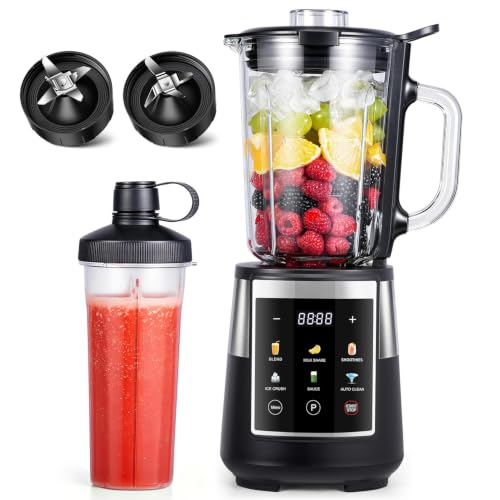
GDOR’s proposition is a household system rather than a single vessel: a 1300-watt glass blender with a 67-ounce pitcher for the batch, a 22-ounce to-go cup for the individual, six preset programmes, a six-leaf sharp blade described for ice crushing, frozen fruit and shakes, and a self-clean function. The two-vessel arrangement covers the same dual life as the Extreme Mix’s Blend-N-Go but with a full pitcher at the batch end. Six presets put it second only to the ASTRALSHIP for programme count, and self-clean addresses the category’s least loved chore by name.
- Power: 1300 watts
- Pitcher: 67 oz glass
- Extra vessel: 22 oz to-go cup
- Programmes: 6 presets
- Blade: 6-leaf, for ice crushing and frozen fruit per the title
- Cleaning: self-clean function included
Strengths
- Batch pitcher plus to-go cup covers family rounds and solo commutes without a second machine.
- Six presets give programme-led convenience across the common blending repertoire.
- A self-clean function lowers the friction that quietly reduces how often blenders get used.
Trade-offs
- Thirteen hundred watts sits mid-pack, below the two big Osters for the densest frozen work.
- Two vessels mean two items to store and wash across a full household day.
- No heating function is claimed, so hot soups rely on pre-cooked ingredients blended warm.
The self-clean point deserves expansion because it changes behaviour, not specifications. Blender owners consistently report that the anticipation of washing is what kills weekday use; a machine that can rinse its own jar with a programme lowers that anticipation to a button press, with a fuller wash still wise periodically. Combined with the to-go cup, which goes out the door rather than into the sink each morning, the GDOR is engineered around the real friction points of a blending household rather than around a showroom’s power chart.
Ice crushing named in the title also sets an expectation this machine should be judged by. Frozen drinks are the domestic blender’s public examination, and a six-leaf blade at 1300 watts, with presets presumably tuned for the task, is a credible entry. Households whose summers run on frozen fruit will find this listing speaking their language more directly than the soup-led or oatmilk-led rivals.
Best for: families blending frozen fruit and shakes daily who want presets, a to-go cup and self-cleaning in one system. Not suited for: minimalists set on a single vessel and three speeds, a brief the Universal answers more plainly. Explore the GDOR blender on Amazon

Universal Turbo Elite Max Glass
Universal’s Turbo Elite Max is the set’s plain-spoken big blender: 1500 peak watts, a 71-ounce glass pitcher that the title also expresses as nine cups or 2.1 litres, three speed settings, six stainless steel blades, and a stated purpose as a premium blender for smoothies in domestic use. Peak watts, as noted in the selection criteria, are a ceiling measure rather than a sustained rating, and this review keeps the word attached. What the machine offers in exchange for that caveat is simplicity at scale, a large glass vessel and three speeds a child could memorise, aimed squarely at home smoothie production.
- Power: 1500 peak watts
- Pitcher: 71 oz glass, also stated as 9-cup / 2.1 litre
- Speeds: 3 settings
- Blades: 6, stainless steel
- Use framing: smoothies, domestic use
- Preset programmes: none stated in the listing title
Strengths
- Seventy-one ounces is the second-largest vessel here, sized for family smoothie rounds.
- Three speeds keep operation legible for every member of the household.
- Six stainless blades give the large pitcher a substantial cutting assembly.
Trade-offs
- Peak wattage is not directly comparable with the sustained figures printed by rivals.
- No preset programmes means the user judges time and speed for every job personally.
- Special functions such as heating, to-go cups or self-cleaning are absent from this title.
Domestic framing is this listing’s quiet honesty. It does not claim a café, a bar or a professional kitchen; it claims smoothies at home, in a big glass pitcher, with simple controls. Households drowning in appliance features they never touch may find that restraint refreshing, because every omitted programme is a menu that cannot confuse a grandparent or a teenager. The skill the machine asks in return is judgement, knowing when a blend is done, and for experienced smoothie makers that judgement is already installed.
The dual capacity expression, ounces alongside cups and litres, is a small courtesy worth noticing in a category where shoppers think in whichever unit their recipes use. It signals a listing written for an international home audience rather than a single market’s habits.
Readers who prefer their blending in a more concentrated, in-the-pot form may enjoy our companion guide to Best All-Metal Hand Blenders, which covers immersion blenders with stainless shafts for soups and sauces.
Best for: families wanting a large glass pitcher and deliberately simple three-speed control for daily smoothies. Not suited for: programme-led users, since timing and ramping each job automatically is not this machine’s way. Check the Universal blender on Amazon

ASTRALSHIP 1500W Glass Blender
ASTRALSHIP builds the widest brief in the set: a 1500-watt professional glass blender for the kitchen, described as a countertop high-speed smoothie maker and heating nut milk machine, with fourteen presets, nine speeds, a BPA-free glass jar, and named territory covering hot soups and slushies. The heating function is the differentiator, turning the blender into a cooking appliance for nut milk and soups rather than merely a processor of ingredients cooked elsewhere. Fourteen presets is the deepest programme bench here by a wide margin, and nine speeds give manual control a range none of the others state.
- Power: 1500 watts
- Presets: 14
- Speeds: 9
- Jar: glass, described as BPA-free in the title
- Heating: included, for nut milk and hot soups per the title
- Jar capacity: not stated in the listing title
Strengths
- A heating function makes this the only listing here that cooks as well as blends.
- Fourteen presets and nine speeds form the broadest control offering in the group.
- Nut milk and hot soup specialisation serves households whose blending is culinary rather than merely recreational.
Trade-offs
- Jar capacity goes unstated in the title, a real gap for batch planners comparing vessels.
- Fourteen presets invite menu complexity that simple households may never explore.
- The professional framing may overshoot a kitchen that only wants morning smoothies.
Heating changes the appliance’s place in the kitchen’s week. A blender that can produce hot soup from its own cycle collapses two appliances’ work into one footprint, and nut milk made at home, on a heating cycle, answers a specific and growing household economy, plant milks bought weekly at café-adjacent prices. For those households the ASTRALSHIP is not an over-specified smoothie maker but a small production unit, and its preset bench reads as a recipe library rather than decoration.
The unstated capacity is the counterweight, and it should be checked on the full listing before any batch-dependent decision. A heating blender whose jar suits two bowls of soup is a different purchase from one that feeds five, and no quantity of presets compensates a household for a vessel of the wrong size.
Best for: culinary blenders wanting heating for soups and nut milk plus the deepest preset and speed range here. Not suited for: confirming jar capacity from the listing summary, or the simplest possible controls — the title supports neither. See the ASTRALSHIP blender on Amazon
The glass lineup, compared directly
| Blender | Power as titled | Vessel | Control style |
|---|---|---|---|
| Oster Titan Glass Jar Blender | 2200 watts | 84 oz Boroclass jar | 5 speeds, 4 iBlend presets |
| Oster Extreme Mix Glass Jar | 1600 watts | 8-cup glass jar | iBlend, Blend-N-Go |
| Oster Vortex Glass Blender 800W | 800 watts | 54 oz shatter resistant jar | 3 iBlend auto programmes |
| GDOR 1300W Glass Blender | 1300 watts | 67 oz pitcher + 22 oz cup | 6 presets, self-clean |
| Universal Turbo Elite Max Glass | 1500 peak watts | 71 oz glass pitcher | 3 speeds |
| ASTRALSHIP 1500W Glass Blender | 1500 watts | Glass jar, capacity unstated | 14 presets, 9 speeds, heating |
How should you choose a glass-jar blender?
Size the jar to the round you actually serve
Count the glasses in your largest regular round and buy for that, not for the party you host twice a year. Fifty-four ounces serves a small family’s smoothies; sixty-seven to seventy-one covers a generous round with headroom; eighty-four is catering territory that earns its washing only when the round is real. Undersized jars force double batches, oversized jars punish every ordinary morning, and both errors are visible in the first week.
Read wattage with its grammar intact
A sustained wattage and a peak wattage are different claims, and this set contains both. Use the numbers to place machines in broad bands, light everyday, strong all-round, heavy batch, rather than treating a few hundred watts as a precise ranking. Blade design, jar shape and programme tuning move real mixtures as surely as raw power does.
Let the hardest regular job set the power band
Every household has one blend that functions as its examination: the frozen smoothie with ice, the nut-heavy sauce, the fibrous green drink that lesser machines leave stringy. Name that job explicitly and require your finalist to be plausible for it, using the title evidence gathered in this guide, ice named by the GDOR, raw scale from the Titan, all-round strength from the Extreme Mix. Jobs you make twice a year should not set the specification, because they will be survived somehow on the day, while the weekly examination grades the machine fifty times a year and decides whether it is loved.
Decide whether programmes are help or homework
Fourteen presets liberate one household and bewilder another. If several people of different confidence will use the machine, named auto programmes for the common jobs are a genuine safety net. If one experienced cook does all the blending, three honest speeds may serve better and age more gracefully.
Check the pour before the power
A jar’s spout and handle decide whether a perfect blend arrives in glasses or on the worktop, and they are the features least visible in a specification list. Thick mixtures cling and then lurch; a well-shaped spout meters them, a poor one dumps them. Since titles rarely describe spouts, let the product photographs of a finalist carry this part of the judgement, and favour the design whose lip looks like it was drawn by someone who has poured soup in a hurry. It is a small, unglamorous criterion that will be exercised at every single use, unlike the fourteenth preset.
Plan for the sink as carefully as the counter
Glass rewards a washing plan: dishwasher safety where offered, self-clean where offered, and a sink routine you will actually perform for the designs that offer neither. The best blender in this set is the one whose jar is clean at 7 a.m. tomorrow, and that outcome is decided by cleaning friction more than by any specification printed in a title.
Think about who else will lift the jar
A full 84-ounce glass jar is a two-handed object, and in households where a grandparent, a child learning to cook, or anyone with a weaker grip will use the blender, that weight is a design fact, not a detail to wave past. Mid-size jars in the 54 to 67 ounce range keep the glass experience within one confident hand’s ability when partially filled, which is how most real blends are poured anyway. Match the vessel not only to the round you serve but to the hands that will carry it to the sink, because the most dangerous moment in a glass blender’s life is the wet, soapy journey after the blend, and it should be a journey every operator in the house can make safely.
Match special functions to weekly habits
Heating, to-go cups and reversible blades are each worth real money to the household that uses them weekly and nothing to the household that uses them never. Audit your last month of blending honestly before paying for a function, because the showroom imagination is a generous liar about nut milk.
Glass versus plastic, settled practically
The material debate resolves differently by household, and this guide’s glass brief should not be read as a universal verdict. Glass wins on heat tolerance, on freedom from staining and lingering odours, and on the clarity that lets a cook judge a soup’s texture mid-blend. Plastic wins on weight and on surviving the drops that happen in homes with small children, slippery floors or high cupboards. The listings here soften glass’s weaknesses where they can, shatter resistance on the Vortex, dishwasher safety alongside it, and a plastic-adjacent practicality in the big jars’ handles and bases, but no listing repeals gravity. Choose glass when your kitchen’s habits are careful and your blending is hot, colourful or odorous; that is the constituency these six machines were built to serve.
One further glass virtue rarely makes the marketing copy: longevity of appearance. A glass jar that is washed decently looks new for years, while plastic clouds and scratches into a permanent suggestion of dirt. For an appliance that lives on the counter in full view, that cosmetic honesty has real value, and it is part of why glass models hold their place in kitchens long after trendier vessels have been retired to the garage.
Blending technique that flatters any of these machines
Load order matters more than most owners learn. Liquids first, then soft ingredients, then frozen and hard items last, so the vortex forms early and pulls the heavy pieces down into the blades rather than leaving them bouncing on top. Give thick mixtures a pause and a stir rather than endless high speed, which heats the blend and strains the motor. Use the pulse or a low speed to settle a salsa’s texture instead of liquefying it at full power. None of this is machine-specific, which is precisely its value: technique transfers when appliances are replaced, and a household that blends well will get more from the Vortex’s 800 watts than a careless household gets from the Titan’s 2200.
Texture judgement is the skill that separates adequate blending from good blending, and glass quietly teaches it. Watch the surface of the mixture rather than the timer: a smoothie is done when the surface turns glossy and the vortex holds a steady dimple, a salsa is done the moment the pieces still read as pieces, and a soup is done when the swirl loses its last visible fleck. Programmes encode averages of these judgements, which is why they serve beginners well, but the eye learns faster than the menu, and a transparent jar is the classroom. Households that blend with the lid’s centre cap removed, where the design allows, can also judge by sound, since a finished blend settles into a lower, steadier note than a mixture still throwing chunks at the walls.
Frozen ingredients deserve a specific courtesy. Five minutes out of the freezer softens fruit enough to blend smoothly without thawing it into juice, reducing both noise and blade shock. Ice, by contrast, should go in as it is, with liquid present, and in households that crush ice daily the listings that name ice work in their titles, the GDOR explicitly, have made that task part of their stated design rather than an owner’s improvisation.
Readers furnishing the floors under all this kitchen industry may enjoy our companion notes on Best Non-Toxic Organic Area Rugs, which sort natural-fibre rugs by what their listings actually certify.
Six blenders, six households
The Titan belongs to the household that blends like it cooks, in volume and without apology: teenagers descending for smoothies, a freezer that always holds fruit, a soup pot that expects to become four bowls. Its owner has the counter, the cupboard height and the appetite, and would find smaller machines a daily negotiation.
The Extreme Mix belongs to the family generalist, the kitchen that makes a bit of everything and needs the blender to keep up without specialising. Its to-go option marks the household’s realism about weekday mornings, when breakfast leaves the house in a bag as often as it sits at a table.
The Vortex belongs to the household of habits, the same smoothies, the same Friday salsa, the same child’s milkshake, repeated with pleasure rather than boredom. Programmes named for exactly those jobs make the machine feel less like equipment and more like a routine with a power cord.
The GDOR belongs to the frozen-fruit family, whose freezer drawer is a smoothie inventory and whose summer runs on crushed ice. Presets and self-cleaning serve a machine that will be used twice a day in season, and the to-go cup serves the member of the family who is always leaving.
The Universal belongs to the smoothie traditionalists, a household that wants a big pitcher, three speeds and no further conversation with the appliance. Its owners have judgement and intend to use it, and they read a fourteen-preset menu the way a driver reads features on a car they will never take off-road.
The ASTRALSHIP belongs to the kitchen experimenter, the cook who makes nut milk on Sunday, soup on Tuesday and slushies when the weather turns, and who regards a blender as a small factory for things other households buy in cartons. Its heating function is wasted on almost everyone else in this set’s audience and indispensable to this one.
Household matching matters because blenders are unusually honest appliances: they are used exactly as much as they fit, and no more. A machine whose programmes, size and cleaning all match the household’s week will run daily for years, while a technically superior machine that mismatches will be used monthly and described as a disappointment, which is a verdict on the match rather than on the motor.
Noise, vibration and the early-morning blend
Powerful blenders announce themselves. A 2200-watt machine at full speed is a household event, audible through doors, and glass jars ring differently from plastic ones when a blend runs dry or a frozen chunk strikes the wall. None of this is a defect, but it belongs in the purchase plan for homes with sleeping babies, shift-working partners or thin walls. Practical mitigations are mundane and effective: blend the night before where the recipe allows, keep the jar’s contents liquid enough to cushion the blades, stand the machine on a solid surface rather than a hollow counter overhang, and reserve the frozen marathons for sociable hours.
Vibration tells a related story. Big jars at high speed can walk across a smooth counter if a blend unbalances, which is why experienced owners keep a hand near the lid during the first seconds of any heavy cycle, not from distrust of the machine but from respect for physics. Glass’s weight, so often listed as its drawback, partially answers this too, anchoring the vessel in a way a featherweight plastic jug cannot. The trade is real in both directions, and households should choose which side of it their mornings can live with.
What to blend in your first week with a new machine
A sensible first week teaches the machine’s character in ascending order of difficulty. Begin with a banana-based smoothie, forgiving and quick, to learn the vortex and the pour. Move to a frozen-fruit blend midweek to hear how the motor handles load and to practise the loading order described earlier. Make a salsa or a sauce next, where the skill is stopping in time, and let the week end with the job you actually bought the machine for, soup, nut milk, frozen drinks, at full commitment. By Sunday the household knows its blender’s voice at every speed, which jobs deserve programmes and which deserve a hand on the dial, and the appliance has become a colleague rather than a stranger with a warranty.
That week also reveals the cleaning truth of the specific design in your sink. Keep the first week’s blends colourful and honest, turmeric, berries, greens, and the jar will show you exactly how it ages and how it washes while the purchase is still young enough to judge fairly. Glass, to its credit, hides nothing in this examination, which is one more reason this category’s shoppers tend to stay loyal to the material once they have lived with it.
Common mistakes
Ranking the row by wattage alone. Peak versus sustained figures, blade geometry and jar design all bend the real result, and a shopper who sorts by one number will misread at least two machines in this set of six. Treat power as a band, then let capacity and programmes arbitrate.
Pouring boiling liquid straight from a rolling boil. Even heat-tolerant glass prefers a moment’s mercy; let a soup stand off the boil briefly before blending, keep the lid vented or held as the design intends, and start at low speed so pressure and liquid settle before power arrives. The habit costs thirty seconds and protects both the jar and the cook’s forearms.
Filling a glass jar to the brim with hot soup. Hot liquids expand their ambitions in a blender, and an overfilled jar will find the lid’s weak moment. Blend hot batches in stages with headroom, whatever the vessel’s maximum line suggests, and let the ASTRALSHIP’s heating cycle handle its own quantities where that function is the draw.
Storing the jar with the lid sealed tight for weeks. A closed, slightly damp jar grows stale smells that even glass cannot shrug off, and seals age faster under constant compression. Store the vessel clean, dry and loosely covered, and the next blend starts from neutral rather than from the memory of the last one.
Leaving fibrous blends sitting in the jar. Greens and ginger set like cement around blade hubs when left to dry, turning a ten-second rinse into a soaking project. Rinse immediately, use self-clean where your model offers it, and let glass’s transparency shame you into the habit.
Buying the biggest jar for a household of one. Scale is not a free upgrade; it is weight, washing and cupboard rent charged daily against a benefit collected rarely. The 54-ounce Vortex exists because most real rounds are smaller than showroom fantasies.
Running the jar dry to test the motor. Blades and mixtures need each other; a dry run at high speed heats components and tells you nothing except that the machine is loud. Every experiment in the first week should involve actual ingredients, which are cheaper than the parts a dry habit wears out.
Ignoring the lid and seal when judging a used-up jar. A blender’s working life often ends at its gasket rather than its motor. Keep seals clean and dry in storage, and when comparing long-term value, favour the design whose jar you can imagine still sealing tightly in year five.
Where the blender lives: counter, cupboard and the space between
Blenders divide households by storage as surely as by power. A machine that lives on the counter gets used for small jobs, a quick sauce, a single smoothie, because the cost of starting is zero. A machine that lives in a cupboard gets used for planned jobs only, and its owner’s blending repertoire quietly shrinks to match. Glass jars, being heavier and more fragile, push toward counter residence, which is an argument for choosing a size and silhouette the kitchen can host permanently. Measure the counter’s spare run and the cabinet height above it before ordering any of these six, and treat a model that cannot live in the open as a model that will live in retirement, whatever its wattage.
Cord and lid storage sound beneath discussion until the first month proves otherwise. A cord that wraps or tucks keeps the counter sane; a lid that sits securely on the jar between uses keeps the seal clean and the jar ready. These micro-details never appear in titles, and this guide does not invent them for any model here, but they are worth a glance at the photographs and full listings of a finalist, because the difference between a blender that is always ready and one that must be assembled from three cupboards is the difference between a habit and an occasion.
Soups, sauces and the savoury half of blending
Smoothies dominate blender marketing so thoroughly that the savoury half of the repertoire reads like a footnote, yet in many kitchens the glass jar earns its place on soup night. Roasted vegetables, stock and a minute of blending produce a soup with a texture no masher approaches, and glass handles the heat of that work without the warping anxiety or flavour memory that plastic brings to a curry-coloured liquid. Sauces follow the same logic: a romesco, a chimichurri, a gravy rescued from lumps at the last moment. Each of these jobs values the jar’s heat tolerance and odour neutrality, the two glass virtues that smoothie marketing rarely mentions because smoothies are cold and sweet.
The ASTRALSHIP’s heating function extends this savoury argument furthest, cooking within the jar rather than merely processing what a hob produced, but every machine in this set can blend a soup that was cooked conventionally, provided batches respect headroom and lids are held with respect for steam. Households deciding between the top Osters should weigh this savoury calendar honestly: a family that makes soup weekly gets more from its blender across a year than a family that blends only in smoothie season, and it should buy accordingly, favouring capacity and heat confidence over to-go accessories.
Frozen desserts close the savoury-to-sweet circle. Banana-based soft serve, frozen yoghurt mixtures and slushies all ask the same thing of a machine, sustained work against a cold, dense load, and they are the jobs where the stated power bands in this set separate most honestly. The GDOR names frozen fruit in its title, the Titan brings the largest motor to the task, and the Vortex, to its credit, never claimed this territory at all. Buy for the dessert you will actually make in August, not the one in the advertisement.
Replacement jars, spare parts and the long view
Glass ownership has a long-term arithmetic that plastic ownership mostly avoids: the jar can break, and when it does, the machine’s fate depends on whether a replacement vessel exists for that model. Established makers with long-running lines, Oster being the obvious example in this set with three models present, tend to support their jars as parts, which converts a breakage from a funeral into a repair. Before committing to any finalist, a shopper with a ten-year horizon should confirm that its jar is obtainable as a spare, and should store that knowledge with the warranty papers rather than discovering it beside a cracked vessel on a Sunday.
The same long view applies to seals and blade assemblies, the components that age even when the glass does not. A blender bought for a decade should be bought from a listing whose maker expects to be asked for parts, and the presence of three models from one brand in this set is itself a small market signal about which ecosystems are deepest. None of that guarantees a particular part at a particular date, and this guide claims no such thing; it simply notes that longevity is a property of systems, not of single purchases, and glass shoppers, who tend to keep appliances longest, benefit most from thinking in systems.
Final recommendation
For most families, the Oster Extreme Mix is the balanced buy: strong stated power, an elaborate blade, a full-size glass jar and a to-go route for weekdays. Step up to the Titan when batches are genuinely large and frequent, and down to the Vortex when the week’s blending is smoothies, salsa and shakes with dishwasher-easy cleanup. The GDOR suits frozen-fruit households that value presets and self-cleaning, the Universal suits smoothie families who want a big pitcher and no menus, and the ASTRALSHIP is the culinary outlier that cooks, heats and blends across the widest brief. Glass is the common thread; choose the machine whose size and programmes match the round you actually serve.
FAQ
Why choose a glass jar over a plastic one? Heat tolerance for soups, resistance to stains and odours, and clarity for judging texture are the practical reasons, with long-term appearance a quiet fourth. The costs are weight and breakability, which listings here mitigate with shatter resistance and dishwasher-safe designs but cannot eliminate.
How much power does a home blender really need? The everyday trio of smoothies, shakes and salsas is comfortably handled at the Vortex’s stated 800 watts, while dense frozen batches and large volumes justify the 1600 to 2200 watts of the bigger Osters. Match power to your hardest regular job, not your hardest imaginable one.
What does peak watts mean on the Universal? It describes a maximum the motor can reach rather than a sustained working rating, which is why this guide always prints the word peak beside that machine’s 1500 figure and advises comparing it as a broad band rather than a precise rank.
Can these blenders handle hot soup? Glass as a material tolerates heat well, and one listing, the ASTRALSHIP, goes further with a heating function for hot soups. For the others, blend cooked ingredients warm in sensible batches with headroom, and follow the same caution you would give any hot liquid in a sealed vessel.
How should a glass jar be washed to keep it clear? Rinse promptly, wash warm with ordinary detergent, and let the jar dry fully before storage so seals stay fresh. Dishwasher-safe designs, like the Vortex’s jar, can take the machine route; self-clean programmes, like the GDOR’s, handle the daily rinse, with a periodic hand wash for the blade hub area.
A good glass blender makes the kitchen’s hardest mixtures look easy and then washes up without holding a grudge about any of them. Pick the jar your household can lift, the power your hardest weekly job requires, and the programmes your least confident cook will thank you for, and the machine will stop being a purchase and start being a rhythm the whole household can set its mornings by, in every season of the year, without drama, fuss, regret or second thoughts.
Active households that blend recovery drinks after training may also appreciate our field guide to Best Towels for Diving, which covers quick-dry towels for swimmers and divers heading out before breakfast on training days.


