What's inside
- Where to buy
- Quick Picks
- How these picks were chosen
- Side-by-side comparison
- How do you choose between a dive towel, a chamois shammy and a changing poncho?
- A brief defence of the shammy, the diver’s sponge
- Building the two-cloth dive kit that covers everything
- Salt, chlorine and the afterlife of a working towel
- How dive boats, beaches and pools each rewrite the towel brief
- What a dive towel earns across a full season of diving
- Packing the towel layer of a dive bag, step by step
- Common mistakes
- Final recommendation
- Frequently asked questions
As an Amazon Associate I earn from qualifying purchases. This post may contain affiliate links at no extra cost to you.
As an Amazon Associate, cottageverdict.com earns from qualifying purchases.
A dive towel lives a harder life than a bathroom towel ever imagines. It gets wrung out on boat decks, draped over railings in salt wind, stuffed damp into kit bags and expected to dry a diver, a mask and cold hands between dives without turning into a heavy, sour rag. Choosing the best towels for diving therefore starts with format, because this small category contains three genuinely different tools wearing one name: full-size microfiber towels, compact chamois shammies that absorb like sponges, and a wearable changing poncho that happens to be made of towel material.
The six picks below map that whole territory honestly. Two are full towels, one printed with a dive logo and one built around the red-and-white dive flag at a generous 72.5 by 30 inches. Three are chamois products, the swimmer’s shammy in single, four-pack and six-pack form, each small enough to live in a mask box or a drysuit pocket. The sixth is the poncho, dive-adjacent by design, included because changing out of a wetsuit in a windy car park is a drying problem too, even if it is solved by wearing the towel.
Chamois deserves an explainer early. A shammy towel is not woven like a towel; it works like a sponge-cloth, absorbing many times its weight, then releasing the water when wrung, ready to absorb again immediately. Divers and competitive swimmers love the format because one small square handles a whole day of repeated drying, staying light even while working. The trade is coverage: a 13 by 17 inch shammy will never wrap a cold diver after a February shore dive, which is why formats must be matched to jobs rather than ranked on one scale.
Microfiber, the other material here, splits the difference: larger coverage, quick drying, sand resistance in one case, recycled content in another. Neither material wins outright. The right kit bag often holds one of each, and this roundup is organised to help a diver assemble exactly that pairing with open eyes about what each title does and does not claim.
Where to buy
Three formats share this page, so note the shape of each pick before its virtues, because a shammy and a poncho solve different problems.
- Innovative Scuba Concepts leads with the classic: a microfiber towel carrying a dive logo, model GP3096, no dimensions printed in its title.
- Nomadix brings the big coverage, 72.5 by 30 inches of dive-flag towel made with recycled materials, claiming super absorbency and sand resistance.
- Water Gear offers the traditional single chamois, fast absorbing, in aqua, framed for workouts and diving alike.
- Tisancy multiplies the shammy by four, 13 by 17 inch neutral microfiber squares for swimming, diving and triathlon decks.
- Bthomstfmly goes to six of the same small format, quick dry and lightweight, the deepest rotation in the group.
- Altum Vida closes with the wearable answer, a quick-dry unisex microfiber changing poncho in a Coral Garden design.
Quick Picks
| Pick | Best for | Deciding fact |
|---|---|---|
| Innovative Scuba Concepts GP3096 | divers who want a straightforward microfiber towel carrying a dive logo | Dive logo; dimensions absent from its title |
| Nomadix Original Towel Dive Flag | travelling divers who want one large towel for beach, boat and campsite | 72.5 x 30 in, recycled materials, sand resistant |
| Water Gear Chamois Towel | swimmers and divers who want a classic fast-absorbing chamois in aqua | Fast absorbing, aqua, no size in its title |
| Tisancy Swim Chamois Diving Shammy | deck-side divers who rotate several small shammies through a day’s dives | 13 x 17 in each, neutral, fast drying |
| Bthomstfmly 6 Pack Swim Chamois Towel | clubs and families who need six small quick-dry chamois towels in rotation | 13 x 17 in each, quick dry, lightweight |
| Altum Vida Scuba Changing Poncho | shore divers who change out of wetsuits in car parks and on beaches | Microfiber, quick-dry, unisex, Coral Garden |
How these picks were chosen
Eligibility demanded a real dive connection in the title itself: scuba, diving or a dive flag had to be named, not merely swimming-pool adjacency. That screen matters because plenty of generic gym towels would happily absorb dive-kit water while bringing nothing dive-specific to the purchase. Every pick here speaks the sport’s language on its own listing, from the GP3096’s dive logo to the poncho’s scuba changing purpose.
Format balance was curated deliberately. A page of six near-identical microfiber towels would have been easy to assemble and useless to read, since the live question for divers is which format earns bag space. Two full towels, three chamois options at different pack counts and one poncho let the comparisons happen across formats as well as within them, mirroring how a kit bag is actually packed.
Claims were kept on a short leash. Absorbency language is reported as the sellers phrase it — super absorbent, fast absorbing, quick dry — without inventing capacities, thicknesses or drying times no title states. Where a title omits dimensions, the spec boxes say so plainly, because a towel’s size is a basic fact a buyer deserves to know is missing rather than papered over.
Pack arithmetic received the same respect as material. One shammy, four shammies and six shammies are different purchases for different rotations, and the reviews treat count as a primary feature for the chamois trio, the way a dive club ordering for a season would.

Innovative Scuba Concepts GP3096
The GP3096 is the towel a dive shop would hand you without a speech: microfiber, a dive logo, a model number, and nothing else promised. That restraint defines both its appeal and its limits. A diver buying it knows the job — dry off between dives, wipe a mask, spread it on a bench to stage small gear — and knows the towel signals the sport on a boat rail. What the title withholds is size, and a review has to sit with that gap rather than fill it.
Listing facts
- Material: microfiber, per the listing
- Design: dive logo
- Model: GP3096
- Dimensions: not stated in the listing title
- Pack count: single towel
- Extra performance claims: none stated in the title
Strengths
- Dive logo makes it identifiable as yours on a crowded boat bench.
- Microfiber packs smaller and dries faster than a cotton bath towel.
- A single-purpose towel keeps dive kit separate from household linen.
Trade-offs
- No dimensions are printed, so coverage is unknown until it arrives.
- The title offers no absorbency or sand-resistance claims to compare.
- One towel means laundry decides its availability between dive days.
There is a quiet virtue in a dedicated dive towel that never migrates to bathroom duty. Kit hygiene stays simpler, the towel lives with the gear it serves, and packing becomes automatic: mask, computer, towel, go. The dive logo supports that dedication socially as well as practically, marking the towel’s territory on shared boats where a dozen similar cloths compete for railing space and ownership gets genuinely confusing by the third dive.
The missing dimensions are the honest sticking point. Towel coverage decides whether a product wraps a diver, merely pats one, or serves mainly as a gear cloth, and the GP3096’s title leaves that entirely open. Buyers who need guaranteed wrap-around coverage should choose the Nomadix below, whose inches are printed. Buyers content with a bench-and-boat cloth of unknown but presumably standard proportions may accept the gamble, eyes open.
Microfiber’s general behaviour fills in the rest fairly safely: it wrings out well, dries on a railing faster than cotton, and tolerates being packed slightly damp for the ride home better than natural fibres do. None of that is printed on this title, so treat it as category knowledge rather than product promise. The GP3096 sells identity and simplicity; divers who value those over specifications will find it sufficient, and spec-driven buyers have clearer options further down.
Best for: divers who want a dedicated, logo-marked microfiber towel living permanently in the kit bag.
Not suited for: a kit list that requires confirmed wrap-around coverage, because this title never prints the towel’s dimensions.
Check price on Amazon — view the logo-marked GP3096, for divers who like their kit labelled by the sport itself.
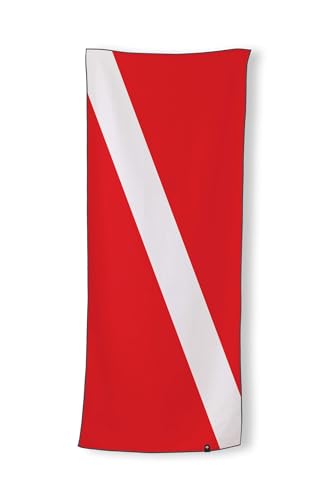
Nomadix Original Towel Dive Flag
Nomadix prints everything the first pick withheld: 72.5 by 30 inches of towel, a dive flag design, recycled materials in the construction, and claims of super absorbency and sand resistance, with beach, pool, travel, camping, yoga and scuba all named as territory. This is the group’s maximalist — the one towel meant to serve the whole waterside day, from the boat to the beach blanket role, and its size is the headline every other feature hangs from.
Listing facts
- Dimensions: 72.5 x 30 inches
- Design: dive flag
- Material note: made with recycled materials
- Claims in title: super absorbent, sand resistant
- Settings named: beach, pool, travel, camping, yoga, scuba
- Pack count: single towel
Strengths
- The largest coverage here by a wide margin, enough to wrap and lie on.
- Sand resistance suits shore diving where kit meets beach directly.
- Recycled materials give the purchase an environmental angle the others lack.
Trade-offs
- A towel this size occupies real bag space even in microfiber form.
- One multi-use towel must be washed between dive days and beach days alike.
- Its breadth of settings means it is a generalist, not a dive-only specialist.
Seventy-two and a half inches is longer than most divers are tall in their socks, which converts the towel from a drying cloth into infrastructure: a changing mat on gravel, a wrap after a cold exit, a groundsheet for staging a regulator and mask away from grit. Shore divers especially will recognise that second life, since half of dive-day towel work happens under the kit rather than on the diver. Size, honestly used, is a feature no shammy on this page can imitate.
Sand resistance pairs with that groundsheet role. A towel that shakes sand free instead of importing it into the car and the kit bag earns its keep at beach entries, and the claim is printed plainly in the title rather than implied. Combined with the recycled-materials note, the listing builds a coherent identity: the environmentally minded, beach-based traveller’s towel, dive flag flying to say which tribe it belongs to.
The generalist breadth cuts the other way for boat divers. On a crowded deck, a 72-inch towel is a sail looking for wind and a tripping layer under fins; the compact shammies below exist precisely because boat space punishes generosity. Nomadix suits the shore, the campsite and the travel bag where one towel must do everything. Dedicated boat kits should take its virtues as a warning about context, not as a universal recommendation.
Best for: shore divers and travelling divers who want one large, sand-resistant, recycled-materials towel for the whole waterside day.
Not suited for: crowded dive boats with minimal deck space, because 72.5 inches of towel needs room that a working deck rarely offers.
Check price on Amazon — view the dive-flag Nomadix at full 72.5 inch length, for shore days that need a towel with territory.

Water Gear Chamois Towel
Water Gear’s chamois is the traditionalist of the group: a single shammy in aqua, described as fast absorbing and great for drying, framed for workouts and diving, for men and women, multi-use. Chamois towels have served swimmers for decades with a simple bargain — a small, sponge-like cloth that drinks water, wrings nearly dry in one twist, and goes straight back to work. This listing asks for no new faith; it sells the classic format in a single unit.
Listing facts
- Format: chamois towel, single
- Colour: aqua
- Claim in title: fast absorbing
- Settings named: workout, diving
- Audience wording: for men and women, multi-use
- Dimensions: the listing title omits them
Strengths
- The shammy format absorbs, wrings out and is ready again within seconds.
- A single unit suits a diver trying chamois for the first time.
- Aqua colouring is easy to spot inside a dark kit bag.
Trade-offs
- One chamois offers no rotation when it needs a thorough wash.
- No dimensions are printed, leaving the cloth’s coverage unstated.
- A shammy’s small format can never wrap a diver after a cold exit.
Using a chamois is a technique worth describing, because newcomers sometimes judge it like a woven towel and find it strange. The cloth works best slightly damp, drawn across skin or a mask lens, soaking as it goes; a twist over the side of the boat resets it completely. Across a three-dive day that cycle repeats dozens of times with no loss of appetite, which is why deck crews and competitive swimmers treat the shammy as equipment rather than linen.
Water Gear’s multi-use framing, spanning workouts and diving, reflects the format’s real life. The same cloth that dries a diver at noon can wipe a car windscreen or a gym bench at six, and a single-unit purchase suits that casual versatility. Divers building a dedicated kit may prefer the multi-packs below for rotation, yet there is no waste in starting with one: a shammy that finds daily work around the house has justified itself even if a second joins it later.
The unstated size is the recurring chamois caveat. The Tisancy and Bthomstfmly listings print 13 by 17 inches for their squares; Water Gear prints nothing, so a buyer cannot confirm whether this aqua classic matches that deck-standard footprint. Judge it as the format’s ambassador rather than a specified instrument, and the purchase makes sense: cheap education in whether chamois suits your diving, before committing to a six-pack of the stuff.
Best for: divers and swimmers curious about chamois who want one fast-absorbing aqua shammy to learn the format with.
Not suited for: a full season of dive days without backup, because a single cloth leaves no rotation partner when washing day arrives.
Check price on Amazon — view the single aqua Water Gear shammy, the classic first step into chamois.

Tisancy Swim Chamois Diving Shammy
Tisancy sells the shammy as a system: four pieces, each 13 by 17 inches, in a neutral shade, soft microfiber in the description, fast drying, aimed at swimmers, diving, triathlons and other water sports. Four is a considered number. It is one in the kit bag, one in the car, one drying on a line and one spare, a rotation that matches how often a working shammy wants rinsing across a busy water week.
Listing facts
- Pack count: 4 pieces
- Dimensions: 13 x 17 inches each
- Colour: neutral
- Material: soft microfiber, per the listing
- Claim in title: fast drying
- Settings named: swimming, diving, triathlons, water sport
Strengths
- Four pieces give a genuine rotation across a week’s diving and training.
- Printed dimensions remove the guesswork that dogs rival chamois listings.
- Neutral colouring looks at home in any kit and shows less staining drama.
Trade-offs
- Each piece is small by design; none will serve as a wrap towel.
- Microfiber shammies feel different from traditional chamois and divide opinion.
- Four pieces still fall short for a whole club or a large family.
Rotation is the unglamorous secret of every cloth that works wet. A shammy rinsed after a salt day needs air and time; a diver diving again tomorrow morning reaches for the second piece while the first dries, and the week’s rhythm never snags on laundry. Tisancy’s four-pack is sized to that rhythm for an individual or a couple, which is why the count, not any exotic material claim, is the real specification of this listing.
The printed 13 by 17 inches deserve appreciation as information design. That footprint is the deck standard for a reason: large enough to dry a torso in a few passes, small enough to wring one-handed and to live inside a mask box or a wetsuit boot between uses. A buyer can picture it exactly, compare it with a hand’s span, and know the coverage bargain being struck — a courtesy the single chamois above does not extend.
Neutral colouring plays a long game. Bright aqua is findable; neutral is forgiving. Shammies live hard, picking up sunscreen, neoprene dye and boat grime, and a muted shade ages gracefully through that service while a vivid one advertises every mark. For divers who keep gear for years and dislike kit that looks tired before it is, Tisancy’s restraint is a practical feature wearing plain clothes.
Best for: regular divers and triathletes who want four printed-size shammies rotating through a week of water sessions.
Not suited for: post-dive warmth on cold shore days, because four 13 by 17 inch squares cannot wrap a shivering diver between them.
Check price on Amazon — view the Tisancy four-pack of neutral shammies, sized in print and ready to rotate.

Bthomstfmly 6 Pack Swim Chamois Towel
Bthomstfmly extends the same logic to six: six swim chamois towels at 13 by 17 inches each, described as quick dry, lightweight and absorbent microfiber for swimming, diving, triathlons and water sports generally. If four pieces serve a diver’s week, six serve a household, a pair of training partners, or a small club drawer where shammies are shared infrastructure and one is always, inevitably, missing.
Listing facts
- Pack count: 6 towels
- Dimensions: 13 x 17 inches each
- Material: microfiber, per the listing
- Claims in title: quick dry, lightweight, absorbent
- Settings named: swimming, diving, triathlons, water sports
- Colour: not stated in the listing title
Strengths
- Six pieces give the deepest rotation here, absorbing losses and laundry lags.
- Printed dimensions match the deck-standard footprint buyers can plan around.
- Lightweight framing suits kit bags already heavy with dive hardware.
Trade-offs
- Six identical squares offer no variety of size for different jobs.
- The title names no colour, a small but real unknown for the organised.
- Individual divers may find six more than a personal rotation ever needs.
Shared water sports eat small cloths. A shammy lent to a buddy, left on a railing, or claimed by a child’s swim bag simply leaves the ecosystem, and multi-packs price that entropy in from the start. Six pieces let a household stop guarding shammies like documents: one lives in each bag, one in the car, and the drawer still holds spares. For dive clubs running junior sessions or couples training together, that abundance is the product.
The lightweight claim matters in the specific arithmetic of dive luggage. Divers fly with weight allowances already besieged by regulators, wetsuits and torches; towels are where grams get clawed back. Six microfiber squares together likely weigh less than one cotton bath towel, and they distribute across bags and buddies in ways a single large towel cannot. Bthomstfmly’s title understands the travelling diver’s spreadsheet instinctively.
Set beside Tisancy’s four, the choice is arithmetic and temperament rather than quality: same printed footprint, same microfiber shammy concept, two extra pieces here. A solo diver with tidy habits will never miss the fifth and sixth squares; a family or club will bless them by August. Buy the count that matches your household’s talent for losing small wet cloths, and either pack will do its deck work without complaint.
Best for: families, training partners and small clubs that want six lightweight chamois towels spread across bags, cars and club drawers.
Not suited for: a solo minimalist diver with one bag, because six identical squares exceed any single person’s rotation and storage logic.
Check price on Amazon — view the Bthomstfmly six-pack, for households that treat shammies as shared infrastructure.

Altum Vida Scuba Changing Poncho
Altum Vida is not, strictly, a towel you hold; it is a towel you wear. This microfiber scuba changing poncho, quick-dry and unisex in a Coral Garden design, answers the most undignified moment in shore diving: peeling off a wetsuit in a public car park, one hand guarding a slipping bath towel, dignity and warmth leaking away together. A poncho with coverage solves the moment structurally, and its inclusion here is a deliberate stretch of the category toward the full drying problem.
Listing facts
- Format: changing poncho, wearable
- Material: microfiber, per the listing
- Claim in title: quick-dry
- Fit wording: unisex
- Design: Coral Garden
- Dimensions: none stated in the listing
Strengths
- Hands-free changing coverage that no flat towel can guarantee.
- Microfiber and quick-dry claims suit an item that gets wet inside and out.
- Unisex cut serves mixed dive groups and shared club kit.
Trade-offs
- It will not dry a boat deck, a mask or a second person.
- No dimensions are printed, so the coverage length is unverified.
- A poncho is bulkier to pack than any shammy in this group.
Every shore diver knows the choreography the poncho abolishes: towel gripped in teeth or clamped under a chin, wetsuit half off, car keys somewhere, an audience of dog walkers approaching. Wearing the drying layer converts that performance into a private changing room carried on the shoulders, with the microfiber absorbing as it covers. For divers who change at beaches, lakesides and lay-bys rather than in dive-centre facilities, this is not a novelty; it is the missing room.
The Coral Garden design and unisex framing widen its life beyond the car park. A changing poncho doubles as a beach cover, a windbreak layer while kit is packed away, and a modesty solution at campsite showers on dive trips. Those secondary roles justify its pack size in a vehicle-based kit, where volume is cheaper than on a boat. In a fly-away dive bag competing with a regulator for grams, the calculus tightens considerably.
Honesty about scope closes the case. The poncho dries and covers one changing diver; it does not wipe lenses, mop decks or dry a buddy. A complete kit still needs a shammy or flat towel alongside it, and Altum Vida should be bought as the changing layer of a system, not as a six-in-one replacement. Judged on its own stated job — scuba changing, quick-dry, unisex — it is the only pick here even attempting that job.
Best for: shore divers who change in car parks and on beaches and want hands-free, quick-dry coverage for the wetsuit shuffle.
Not suited for: drying gear, masks or decks, because a wearable poncho cannot be wrung over a bench or spread under equipment.
Check price on Amazon — view the Coral Garden changing poncho, for the wetsuit moment every shore diver recognises.
Side-by-side comparison
| Towel | Format on the label | Fact that decides its job |
|---|---|---|
| Innovative Scuba Concepts GP3096 | Microfiber towel | Dive logo; dimensions absent from its title |
| Nomadix Original Dive Flag | Microfiber towel | 72.5 x 30 in, recycled materials, sand resistant |
| Water Gear Chamois | Single chamois | Fast absorbing, aqua, no size in its title |
| Tisancy Diving Shammy | 4 chamois squares | 13 x 17 in each, neutral, fast drying |
| Bthomstfmly 6 Pack | 6 chamois towels | 13 x 17 in each, quick dry, lightweight |
| Altum Vida Poncho | Changing poncho | Microfiber, quick-dry, unisex, Coral Garden |
How do you choose between a dive towel, a chamois shammy and a changing poncho?
Name the job before the product
Drying skin, drying gear and changing clothes are three jobs sharing one shelf. A shammy excels at the first two in repeated small passes and fails at wrapping; a full towel wraps and spreads under kit; a poncho changes you. Divers who skip this naming step buy a shammy, curse its size on a cold beach, and conclude wrongly that chamois is useless. Write the job on the kit list, then let the format follow.
Count your dives per day and days per trip
Repetition favours chamois, because a wrung shammy is instantly ready again while a soaked towel stays soaked. Single-dive days forgive a flat towel; three-dive days with surface intervals punish one. Multi-day trips multiply everything by laundry access, which is where the four and six packs earn their existence. Match the rotation to the itinerary, not to the single afternoon you are picturing now.
Weigh the bag the towel must live in
Boat bags and fly-away luggage reward the shammy’s tiny footprint and punish the poncho’s bulk, while a car-based shore kit barely notices either. The big Nomadix sits between: large in coverage, modest in packed size for its area, happiest where a vehicle carries the load. Decide which transport reality is yours before envying another diver’s setup at the dive site.
Read dimensions and silences literally
Two listings here print exact inches, three print none, and that difference is information. A printed 13 by 17 or 72.5 by 30 can be measured against your body and bag tonight; an unstated size is a small lottery. Where coverage is the whole point of the purchase, prefer the listing that commits to numbers, and treat silence as a reason to demote a pick, not as a detail to imagine away.
A brief defence of the shammy, the diver’s sponge
New divers sometimes dismiss the chamois square as a swimmer’s affectation, then watch a divemaster dry a flooded mask, two hands and a computer screen with one small cloth, wring it once, and repeat the performance an hour later with no loss of enthusiasm from the cloth. The shammy’s trick is mechanical generosity: it holds a surprising volume, surrenders it completely under a twist, and never reaches the sodden saturation that ends a woven towel’s working day.
That reliability explains the pack counts in this category. Professionals and clubs do not buy shammies singly because the cloth’s whole value is availability — one always within reach, whatever state its siblings are in. The four and six packs in this roundup are not upsells; they are the format’s natural unit of purchase for anyone beyond a first experiment, mirroring how the same divers buy o-rings and mouthpieces: in working multiples.
Care is correspondingly plain. Rinse the salt out, wring, air-dry, and the square is ready for tomorrow. Stored bone-dry for months a shammy can stiffen, which alarms newcomers and means nothing; a soak restores it. Few items in a dive bag ask so little and report for duty so often.
Building the two-cloth dive kit that covers everything
Most experienced divers quietly converge on a pairing: one shammy for the repetitive work, one larger cloth for coverage and changing support. The shammy handles masks, hands and the diver’s face between dives; the big towel wraps, warms and stages gear. Add the poncho for car-park changing and the system completes itself, three formats each doing the job the others cannot, with total packed weight still below one cotton bath towel.
The pairing principle extends to packing. Keep the shammy in the wet zone of the bag, near the mask box, where its dampness harms nothing; keep the large towel in the dry zone with clothes, so the post-dive change stays comfortable. Poncho rides on top, first out at the car. Divers who organise this way stop thinking about towels entirely, which is the highest compliment kit organisation can earn.
Budget follows the same logic as the guides to Best Indoor Grills With Removable Plates in an unrelated corner of the home: buy the working core first, add the specialist second. Here the core is the shammy rotation; the specialists are coverage and changing. A diver who assembles in that order never owns a redundant cloth.
Salt, chlorine and the afterlife of a working towel
Every dive towel’s biography is written by what it touches. Salt water leaves crystals that stiffen fibres and chafe skin on the next outing; chlorinated pool water bleaches colour and weakens cloth across a season; sunscreen transfers into microfiber and resists ordinary rinsing, building a greasy memory in the fabric. A towel rotated and rinsed after each use ages slowly through all three assaults. A towel abandoned damp in a bag corner ages in fast-forward, and the sour smell that results is chemistry announcing that the cloth’s working life is being spent in storage rather than service.
Fresh water is the cheapest maintenance in diving. A shammy rinsed under a tap on the boat or at the dive centre’s hose arrives home nearly clean, needing only air. Divers who build that thirty-second rinse into their kit routine — mask, computer, shammy, in that order — find their cloths last for years. Those who rely on a weekly wash discover that salt and sunscreen set like concrete between outings, and no detergent fully reverses a week of neglect. The packs in this roundup, sized for rotation, quietly assume the rinsing habit; without it, even six squares will all be equally tired by midsummer.
Retirement deserves a thought too. A shammy that has lost its thirst, a microfiber towel gone thin and scratchy, should graduate to car duty or the rag bag rather than lingering in the dive kit out of thrift. Diving already asks enough of its participants — cold, early starts, heavy kit — without a failing towel taxing the surface interval. Replacing a cloth is among the cheapest upgrades in the sport, and the diver who treats towels as consumables with a service life, like o-rings and batteries, is simply being consistent about maintenance.
Travel adds one more chapter. A towel that crosses borders in a dive bag meets hotel balconies, liveaboard rails and rinse tanks of varying hospitality, and the ones that thrive are those that dry fast in poor conditions. That is the deep reason microfiber and chamois dominate this category while cotton stayed home: the travelling life selects for cloth that forgives a damp pack-up and a late arrival. Every pick in this roundup was chosen inside that reality, whether its title says so or not.
How dive boats, beaches and pools each rewrite the towel brief
On a boat, space is the governing law and wind is the enforcement officer. Anything large, light and loose will travel across the deck uninvited, which is why the shammy, dense and pocketable, is the boat’s native cloth and the big towel stays rolled in the dry bag until the journey home. Boat divers also dry different things: hands before handling cameras, lenses, the bench where a computer sits. Small, precise absorption wins those jobs, and the diver who packs for the boat packs small on purpose.
The beach reverses every priority. Sand is the enemy, ground coverage is gold, and the towel becomes furniture: changing mat, kit staging area, seat and wrap in one. Here the Nomadix dimensions stop looking generous and start looking correct, while a lone shammy, however thirsty, leaves its owner standing on hot sand juggling a wetsuit. Shore divers who judge boat kits by beach standards, or the reverse, end up with bags full of almost-right cloth, which is why this article insists on naming the venue before naming the product.
Pool training writes a third brief entirely. Deck space is ample, sessions are short and frequent, and the towel’s job concentrates between lengths and after the final one. Rotation is the pool’s real demand — a training week can mean five wet sessions — which is precisely the demand the four and six packs answer. The pool diver’s shammy also lives a chlorine life, fading and stiffening on a schedule sea divers never meet, so counts that look excessive to a boat diver look like simple foresight at the pool.
A diver whose year includes all three venues, as most do, should stop hunting for the single cloth that rules them and accept the fleet: shammies for boat and pool, the wide towel for shore, the poncho where changing is public. Fleets sound extravagant until their total weight is compared with the single cotton towel they replaced, at which point the fleet is lighter, drier and better organised. Specialisation, in cloth as in regulators, is how small problems stay small.
What a dive towel earns across a full season of diving
Judge a dive towel in April and it is a cloth; judge it across a season and it becomes a record. By August the working shammy has dried its owner after forty dives, wiped salt from a computer before every download, and absorbed the small emergencies of other people’s kits as well. The wide towel has staged regulators on three beaches, wrapped two cold divers and served as an emergency changing screen once, in a gale, behind a van. These accumulated services are the real specification of the category, invisible in any title, and they explain why divers speak of favourite towels with an affection outsiders find disproportionate.
Season economics follow the same accumulation. A cheap cloth replaced monthly costs more, in money and in mid-season shopping trips, than a rotation bought once in spring. The multi-packs in this roundup spread their cost across hundreds of uses until the price per dry approaches zero, while a single bargain towel that mildews in June delivers its whole value in a few weeks. Divers already think this way about masks and fins, amortising quality across years; towels deserve the same arithmetic rather than the disposable thinking borrowed from beach holidays.
Habits compound alongside the cloth. The diver who rinses, wrings and airs after every outing is training a system that protects everything else in the bag too, because the same discipline dries the wetsuit, vents the BCD and empties the mask box. Towel care is a gateway routine: small, quick, and diagnostic of how the whole kit will age. Dive buddies notice, instructors notice, and boats quietly allocate their dry space to the divers whose gear does not smell like a swamp by the third day of a trip.
By season’s end the right purchase has disappeared into competence. Nobody compliments the towel; nobody curses it either. The diver simply surfaces, dries, changes and drives home warm, trip after trip, while the cloth does its unrecorded work. That invisibility is the category’s definition of excellence, and it is why this article has spent its length on formats, counts and dimensions rather than on any single hero product: in towels, the system is the hero, and the season is the judge.
Packing the towel layer of a dive bag, step by step
Pack in the order the dive day will unpack. The poncho, if carried, rides on top of the vehicle kit because the changing moment often comes first at a shore site, before a fin is wet. The wide towel sits with the dry clothes, protected from the wet zone, so that the post-dive version of you is met by something genuinely dry. The shammy lives deepest in the working kit, beside the mask, because it will be wanted at the first surface interval and at every one after, and a cloth that must be excavated is a cloth that gets left behind in the bag while a borrowed one does its job.
Separation is the principle underneath the order. Wet and dry zones fail the moment a damp shammy is thrown onto the clothes towel in a hurry, so give each cloth a home it can be returned to half-asleep: a mesh pocket for the shammy, a dry sack or a distinct bag corner for the towel. Divers who dive from boats add one refinement, clipping or tucking the working cloth somewhere it cannot sail away, because a towel overboard is a donation the sea accepts without thanks and the day’s remaining intervals get colder for its absence.
At the day’s end the order reverses into maintenance. Shammies are rinsed and wrung at the site, the wide towel shaken free of sand before it enters the car, the poncho aired rather than sealed. Five unhurried minutes at the site replace an hour of remediation at home, and the bag that arrives back at the house needs only opening, not excavating. Packing systems earn their keep exactly there, in the tired hour, which is why this article ends its practical advice where the dive day itself ends.
A word, finally, about borrowing. Dive towels are borrowed constantly — a buddy’s shammy for a flooded mask, a stranger’s wide towel as an emergency changing screen — and the etiquette is simple: return it wrung, rinsed if water is near, and with thanks that acknowledge the cloth’s working value. Owners lend freely in this sport because everyone has been the diver whose towel blew off the boat or stayed in yesterday’s bag. Carrying a rotation, rather than a single precious cloth, makes that generosity painless, which is one more reason the multi-packs in this roundup punch above their modest station: they equip their owner to be useful to the whole boat.
That communal note is the right place for the practical summary to rest. A diver’s towel kit is small, cheap and constantly shared, yet it touches every dive of the season. Formats chosen for their venues, counts chosen for their calendars and care given in minutes rather than hours will keep that kit invisible in the best way, dive after dive, while lesser systems announce themselves in damp, cold and hurry. The water will supply enough drama on its own; the towels should supply none.
The same patience applies to assembling the kit itself, which rarely arrives complete in a single order. Most divers begin with one shammy, discover its limits on a cold shore day, add the wide towel before the next beach trip, and meet the poncho the first time a car park defeats them. Each addition answers a remembered discomfort, and a kit built that way fits its owner’s diving precisely, because every piece in it has a story that begins with a real need rather than a catalogue’s suggestion. There is no deadline on getting the layers right; the season is long, and the water will keep providing lessons at its own pace.
Common mistakes
Towel mistakes in diving are small, wet and entirely avoidable. Five recur on boats and beaches everywhere.
Packing a cotton bath towel out of habit
Cotton drinks water once, stays heavy all day, dries slowly in sea air and ferries sand into every bag it touches. It is the default in the linen cupboard and the wrong answer at the dive site. Every format in this roundup exists because cotton failed the job; leave the bath towel at home where its virtues still count.
Judging a shammy by towel standards
A first-time buyer spreads a 13 by 17 inch square, finds it cannot wrap a waist, and declares chamois a scam. The square was built for absorption cycles, not coverage, and judged on wring-and-repeat performance it outworks any towel on the boat. Mismatched expectations, not defective cloth, cause nearly every chamois disappointment ever recorded.
Buying coverage without checking dimensions
Three listings here print no size at all, and a diver who assumes standard proportions may receive a hand cloth wearing a big towel’s title. When wrapping matters, the printed-inches listings are the only safe ground. Guessing dimensions from a product photograph is how kit bags fill with almost-right purchases.
Forgetting the changing problem until the car park
Divers plan gas, exposure protection and navigation, then improvise the wetsuit change behind a car door with a slipping towel. The poncho exists because that improvisation fails publicly and regularly. If your diving involves outdoor changing, solve it in the kit list at home, not with choreography in a lay-by.
Storing a damp shammy sealed in a hot bag
Even the hardest-working cloth mildews when sealed wet in warm darkness for a week. Rinse, wring and air every piece after a dive day, and store the rotation dry or at least ventilated. The packs here are sized for rotation partly so no single cloth has to endure that sealed-bag sentence between trips.
Final recommendation
If a diver buys one thing from this page, it should be a chamois rotation: Tisancy’s four printed-size squares for the individual, Bthomstfmly’s six for households and clubs, with Water Gear’s single aqua shammy as the low-commitment introduction to the format. Chamois is the working heart of dive drying, and the pack counts here let a buyer match rotation to reality without paying for squares that will never leave the drawer.
Coverage and changing complete the kit in that order. Nomadix’s 72.5 inch dive-flag towel is the coverage champion for shore and travel, the GP3096 the dedicated boat-and-bench cloth for logo loyalists, and Altum Vida’s poncho the specialist that rescues the car-park change. Divers assembling a full system might finish the day’s planning with Best Sunrise Simulation Alarm Clocks for the early start, but the towel system itself needs nothing beyond these three layers.
Buy the format for the job, the count for the calendar and the size in print where print exists. A kit bag arranged on those rules dries its diver quietly for seasons, which is all anyone has ever asked of a towel.
Frequently asked questions
What is the difference between a chamois shammy and a microfiber towel?
A shammy is a sponge-like cloth that absorbs a large volume relative to its size, then releases it almost completely when wrung, ready to work again instantly. A microfiber towel is a woven cloth with far more coverage, better for wrapping, spreading under gear and general drying, but once soaked it stays wet until it dries in air. Divers use the shammy for repeated tasks and the towel for coverage, which is why this roundup treats them as partners rather than rivals.
How many shammies does one diver actually need?
One is enough to learn the format, and Water Gear sells exactly that introduction. A diver diving several days in a row benefits from the four-piece rotation Tisancy offers, so a rinsed square can dry while another works. Six, from Bthomstfmly, suits two divers sharing kit or a household where pieces wander. Beyond six, additional squares mostly insure against loss rather than adding function.
Can a dive towel double as a beach towel?
The Nomadix is explicitly built for that double life, at 72.5 by 30 inches with a sand resistant claim and beach named among its settings. The GP3096 can serve on a beach in a pinch, though its unstated size makes it a gamble as a lie-on towel. Shammies make poor beach towels by design, and the poncho, oddly, works well as a beach cover and changing layer while failing as a drying cloth for gear. The comparison in Best Instant Pot Multi Cookers between single-job and multi-job tools applies: versatility is real only where the title claims it.
Why do divers dry their masks and gear with a shammy?
Because the shammy leaves surfaces nearly dry in one pass and wrings out completely, it clears mask lenses, dive computers and camera housings without smearing or soaking a second cloth. Its small size keeps it handy in a mask box or BCD pocket, and its indifference to repeated wetting suits the rhythm of a dive day. A woven towel performs the same wipe more slowly and saturates across a long surface interval.
Is a changing poncho worth packing for a boat dive?
Usually not. Boats with cabins or heads give divers a private place to change, and deck space taxes bulky extras. The poncho earns its place at shore sites, lakes and car parks where changing is public and weather-exposed. Match it to your sites: shore divers will use it weekly, boat divers may use it twice a year, and luggage should follow that honest forecast.
How should dive towels and shammies be cared for?
Rinse salt and chlorine out after use, wring shammies thoroughly, and air-dry everything before storage. Microfiber prefers washing without fabric softener, which coats its fibres, though no title here prints care instructions, so treat that as category practice rather than a listing promise. Never seal a damp cloth in a closed bag for days; rotation packs exist partly to make proper drying effortless.
Pack a shammy for the work, a wide towel for the wrap and a poncho for the car park, and the wettest day of diving will still end with a dry diver driving home.


