What's inside
- Key Takeaways
- Quick Picks
- How Did We Choose Machines Around a Threading Feature?
- How Do the Six Compare on Threading and Control?
- What Does Automatic Threading Actually Do, Step by Step?
- Who Benefits Most From a Needle Threader?
- How Do You Use a Needle Threader Without Bending It?
- What About the Bobbin Half of Threading?
- Why Do Screens and Threading Belong Together?
- How Should You Troubleshoot When the Threader Misses?
- Which Stitches and Projects Reward Easy Threading Most?
- How Do You Teach a Beginner on a Threading Machine?
- What Should You Check on the Listing Before Ordering?
- When Is a Threader Not Enough — When Should You Look Elsewhere?
- How Does Threading Differ Between Mechanical and Computerized Machines?
- What Thread and Needle Pairings Thread Most Reliably?
- How Do You Build a Rethreading Routine for Colour-Heavy Projects?
- What Role Does Lighting Play in Threading Success?
- How Should Shared and Classroom Machines Be Chosen for Threading?
- What Does the Threader Mean for Sewing With Reduced Hand Strength?
- How Long Does a Needle Threader Last, and What Ages It?
- What Mistakes Do Buyers Make With Automatic Threading Machines?
- Final Recommendation
- Frequently Asked Questions
- Related Guides
As an Amazon Associate I earn from qualifying purchases. This post may contain affiliate links at no extra cost to you.
cottageverdict.com is reader-supported. When you buy through links on our site, we may earn an affiliate commission.
Where to buy: the six machines below are sold through Amazon, and their names in the Quick Picks table, the detailed sections and the comparison table link to their listings so you can check price on Amazon and confirm the threading features described before you order. Shoppers searching for the best automatic threading sewing machines usually arrive with sore eyes, a pair of reading glasses balanced mid-task, or a simple dislike of the fiddliest thirty seconds in sewing. This guide answers that search honestly, beginning with what the term actually covers on home machines.
Here is the scope, stated plainly so nobody buys under a misapprehension. On the computerized and mid-range machines in this group, automatic threading means a built-in needle threader: a small mechanism that swings a fine hook through the needle’s eye and pulls a loop of thread through it, replacing the squint, the wet-the-thread trick and the third failed attempt. It does not mean the machine routes the thread through its whole path by itself, winds its own bobbin or rethreads after a break without you. You still guide the thread through the marked path — these machines make that path quick and clearly numbered — and the threader finishes the last, hardest centimetre.
That final centimetre is, however, exactly where sewing sessions stall, especially with fine needles, dark thread on a dark needle, or hands that no longer enjoy precision work at close range. A good needle threader converts the most annoying step of setup into a two-second lever press, and it does so every single time you change colour, which on multicolour projects can be twenty times in an afternoon. Threading stops being a toll you pay per session and becomes a non-event.
The six picks are all computerized or computer-assisted models from Brother, plus one computerized SINGER heavy duty machine for buyers who want the threading help alongside thick-fabric strength. They span wide-table quilting models, a sewing-and-embroidery combination machine, and two lighter Brother models whose threading aids suit beginners. Each pick’s section explains its threading arrangement in its own terms, because the mechanisms and the screens that support them differ more than the shared label suggests.
One more expectation to set: a needle threader is a precision gadget with fine parts, and it rewards correct use — needle at its highest position, thread seated as the manual directs, hook kept clean. The how-to sections later in this guide walk through the routine and the troubleshooting, so the feature keeps working for years instead of bending in the first month.
Key Takeaways
- Automatic threading on home machines means a built-in needle threader that passes thread through the needle eye; the upper thread path is still guided by hand along a marked route.
- The feature pays off most for frequent colour changes, fine needles, low-vision sewers and anyone who sews in short sessions where setup time dominates.
- Brother’s computerized models pair their threaders with LCD guidance, so stitch selection and threading reminders live on the same screen-driven workflow.
- The SE700 adds a colour touchscreen and embroidery, where thread changes are constant and the threader earns its keep fastest.
- The SINGER HD6600C is the pick when threading help must coexist with genuine heavy duty power for denim and canvas.
- A bent threader hook is the commonest failure, and it is almost always caused by forcing the lever with the needle in the wrong position.
Quick Picks
| Pick | Badge | Why it earns its place |
|---|---|---|
| Brother CS7000X Sewing and Quilting Machine | Best Overall Threading Workflow | Seventy stitches, an LCD display and a wide table around a threading routine built for frequent colour changes. |
| Brother XR9550 Computerized Sewing Machine | Best for Large Stitch Libraries | One hundred sixty-five stitches with an LCD display and wide table — threading help for sewers who change stitches as often as threads. |
| Brother SE700 Sewing and Embroidery Machine | Best Threading for Embroidery Work | A 3.7-inch touchscreen, 135 built-in embroidery designs and wireless design transfer make thread changes — and threading help — central. |
| SINGER HD6600C Heavy Duty Computerized | Best Threading With Heavy Duty Power | Computerized control, an LCD screen and a 60% more power claim — threading assistance that survives denim days. |
| Brother CS5055 Computerized Sewing Machine | Best Compact Computerized Starter | A computerized Brother with an LCD display in a smaller, simpler package for sewers who want threading help without quilting bulk. |
| Brother GX37 Sewing Machine | Best Lightweight Threading Aid | Thirty-seven stitches printed right on the machine, six included feet and a threading aid in the lightest package here. |
How Did We Choose Machines Around a Threading Feature?
We started by verifying that each model genuinely belongs in a threading conversation — a built-in needle threader or an equivalent assisted-threading system in its design — rather than accepting search-result labelling. Machines whose only threading virtue was a printed diagram were excluded unless, like the GX37, their overall beginner-threading package of printed stitch guidance and simple layout made the setup experience demonstrably easier.
Next we judged the threading in context: how the machine guides the upper path, whether the bobbin system reduces the other half of setup pain, and whether the screen or panel helps a user recover when a step is missed. Threading is a workflow, not a single part, and a machine that only automates the final eye-pass while confusing everything upstream has solved the smallest part of the problem.
Finally we kept the sewing itself in view. A threader on a machine you would not otherwise recommend is a gimmick; every pick here also had to justify itself on stitches, handling and value, from the XR9550’s broad library to the HD6600C’s heavy duty motor. The sections below give each machine its own threading story and its own sewing story, in that order.
Where a listing gives limited threading detail, we say so and describe the experience at the level the evidence supports, rather than inventing mechanism names. Buyers deserve to know which claims are documented and which are informed generalities about a brand’s design habits.
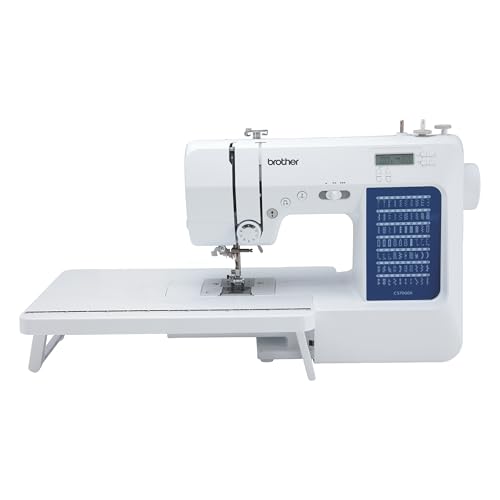
Brother CS7000X Sewing and Quilting Machine — Best Overall Threading Workflow
The CS7000X earns the lead because its threading sits inside the most complete everyday package in this group: 70 built-in stitches shown on an LCD display, a wide table for supporting quilts and garments, and ten included presser feet. Its automatic needle threader follows Brother’s established lever design — seat the thread, press, and the hook draws the loop through the eye — and the surrounding path is numbered so clearly that the hand-guided portion becomes a five-second formality rather than a memory test.
For quilters, who change thread colours per block and fabrics per session, that combination is the point: the wide table keeps the work still while both hands manage thread, and the screen confirms the stitch you actually selected after rethreading, preventing the classic error of sewing a new colour with the previous project’s settings. The machine threads quickly, but more importantly it threads calmly, inside a workflow designed to be repeated dozens of times a day.
Ownership is equally considered. The model sits in Brother’s well-populated accessory ecosystem, replacement needles and feet are everywhere, and the quilting table detaches for ordinary garment work. If one machine in this group will be threaded by several members of a household with different confidence levels, this is the one whose routine is easiest to teach and hardest to get wrong.
One scenario shows the whole package working: a quilt top finished at midnight, binding in a contrasting thread, light fading. The table holds the quilt flat, the screen confirms the stitch after the colour swap, and the threader does its two-second job under the machine’s own light. Nothing about that scene is luxurious, yet every element of it used to be a small friction, and removing small frictions is what this machine is for.
- 70 built-in stitches
- LCD display for stitch selection
- Automatic needle threader (needle-eye assistance)
- Wide table included
- 10 included presser feet
Strengths
- Threading routine is fast and easy to teach
- Wide table steadies work during colour changes
- Screen confirmation prevents wrong-stitch restarts
Trade-offs
- Quilting focus is more machine than a pure garment sewer needs
- Table requires storage space when detached
- Threader hook is delicate if forced against a lowered needle
Best for: quilters and frequent sewers who rethread many times per session.
Not suited for: buyers wanting embroidery functions in the same machine.

Brother XR9550 Computerized Sewing Machine — Best for Large Stitch Libraries
The XR9550 is the maximalist’s threading machine: 165 built-in stitches, an LCD display, a wide table and eight included presser feet. A library that large changes the threading equation, because decorative sewing means constant experimentation — a stitch tried, unpicked, rethreaded in a contrasting colour, tried again. Its automatic needle threader keeps that experimental loop cheap in time and temper, and the screen’s stitch display means the thread in the needle and the stitch on the panel are easy to keep in agreement.
Sewers graduating from a basic mechanical machine feel the difference most at the setup stage. Instead of a dial and a prayer, the XR9550 presents threading as a guided sequence that ends with the threader doing the eye-work, and the wide table gives samples and garments a stable stage while it happens. The eight feet cover the common techniques without an immediate accessory order.
The honest caution is abundance itself: one hundred sixty-five stitches will mostly go unused by any single owner, and the machine’s value case rests on the threading, the screen workflow and the table rather than on the library’s tail end. Buy it for the daily experience, and let the decorative depth be a bonus that occasionally delights rather than the justification.
The XR9550 also suits the household archivist: the sewer who keeps samples, logs settings and repeats successful decorative work months later. Screen-selected stitches are reproducible in a way dial positions never were, and reproducible settings plus fast threading make the second version of a project genuinely easier than the first — a quiet definition of a good tool.
- 165 built-in stitches
- LCD display
- Automatic needle threader (needle-eye assistance)
- Wide table included
- 8 included presser feet
Strengths
- Huge stitch library for decorative experimentation
- Threader keeps colour-and-stitch trials quick
- Wide table supports quilting and larger garments
Trade-offs
- Most owners will never use the majority of stitches
- Larger footprint than the compact Brother models
- Menu depth takes a weekend to learn confidently
Best for: decorative sewers and quilters who experiment constantly.
Not suited for: minimalists who want a short stitch list and simple panels.
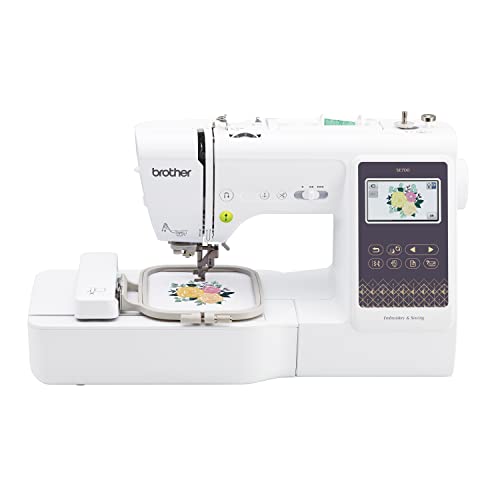
Brother SE700 Sewing and Embroidery Machine — Best Threading for Embroidery Work
Embroidery is the strongest argument for automatic threading ever devised, because a single design can demand a dozen thread colours in sequence, each one a full stop, unthread, rethread, resume cycle. The SE700 builds its whole interface around that rhythm: a 3.7-inch colour touchscreen that shows the design and its colour steps, 135 built-in embroidery designs, 103 sewing stitches for ordinary work, a 4 by 4 inch hoop, and wireless LAN so designs arrive from a computer or app without cables or cards.
Its needle threader therefore works harder than any other in this group, and the touchscreen earns its place by telling you which colour comes next and confirming where in the design you are — information that prevents the expensive mistake of threading the right colour at the wrong step. Between embroidery runs it remains a full sewing machine, so the threading convenience serves garment work too.
Calibrate expectations on the hoop: four inches square suits monograms, logos, baby items and patches beautifully, and frustrates anyone dreaming of jacket backs. Within that honest boundary, the SE700 is the most complete threading-centred machine here, because its whole design assumes threading is not a preliminary chore but the main recurring event of the craft.
Budget honesty belongs here too: embroidery consumes stabiliser, needles and thread at a rate sewing does not, and the SE700’s wireless convenience can accelerate the habit. None of that argues against the machine; it argues for buying it with eyes open, as a craft platform whose running costs are part of the hobby’s pleasure rather than a surprise discovered at the second spool order.
- 103 sewing stitches, 135 built-in embroidery designs
- 3.7-inch colour touchscreen
- Automatic needle threader (needle-eye assistance)
- 4 x 4 inch embroidery hoop
- Wireless LAN design transfer
- 8 included feet
Strengths
- Touchscreen sequences embroidery colour changes clearly
- Wireless transfer removes cable and card friction
- Full sewing capability when not embroidering
Trade-offs
- 4-inch hoop limits design size
- Embroidery supplies add ongoing cost beyond the machine
- Touchscreen workflow has a learning curve for dial loyalists
Best for: embroiderers and monogrammers facing constant thread changes.
Not suited for: buyers planning large-format embroidery pieces.

SINGER HD6600C Heavy Duty Computerized — Best Threading With Heavy Duty Power
Judged purely as a threading purchase, the HD6600C looks like an outlier; judged as a household compromise, it may be the smartest machine here. Its computerized specification — 100 built-in stitches, LCD screen, LED lighting, one-step buttonhole and a motor claiming 60% more power at up to 1,100 stitches per minute — serves thick-fabric work, while its built-in needle threader serves the same tired eyes that shop for threading help in the first place. The two needs coexist in real households more often than category pages admit.
The threading experience differs in flavour from the Brothers: the screen reports settings rather than guiding embroidery, and the machine’s personality is brisk and mechanical underneath the electronics. What the threader changes here is the rhythm of heavy work — swapping between denim thread and topstitching thread, changing needles for canvas, then rethreading — all the mid-project interruptions where a fiddly eye-pass used to break concentration.
Write its analysis honestly, though: buyers whose sewing is entirely light and decorative are paying for power they will not use, and the Brother models above thread within gentler, more guidance-rich interfaces. The HD6600C is for the household whose project list mixes quilt cottons with jeans hems and wants one machine, threaded easily, that refuses neither.
There is also a resale of attention worth naming: on a heavy machine, the moments of highest concentration should be spent on the fabric stack, not on setup. Every threading struggle before a difficult seam spends focus the seam itself deserved. The HD6600C returns that focus to the work, which is a safety feature in everything but name when needles and thick layers are involved.
- 100 built-in stitches
- Computerized selection with LCD screen
- Built-in needle threader
- Motor rated 60% more power
- Top speed 1,100 stitches per minute
- One-step buttonhole, LED light
Strengths
- Threading help combined with real thick-fabric power
- Digital settings return exactly after rethreading
- LED light aids threading dark thread at night
Trade-offs
- Heavier and more industrial in feel than the Brother picks
- Screen offers less hand-holding than Brother’s guidance
- Power is wasted on exclusively delicate sewing
Best for: mixed households sewing both garments and heavy repairs.
Not suited for: purely decorative sewers who never touch denim or canvas.

Brother CS5055 Computerized Sewing Machine — Best Compact Computerized Starter
The CS5055 is the threading group’s quiet, sensible middle: a computerized Brother with an LCD display, a stitch library sized for real wardrobes rather than exhibition, and the brand’s needle-threading assistance in a machine that does not demand a dedicated sewing table. For apartment sewers and kitchen-table crafters, that physical modesty matters as much as any feature, because a machine that lives in a cupboard must justify its setup time every single session — and easy threading is precisely a setup-time feature.
Its computerized manners soften the beginner experience in ways that compound with the threader: stitch selection is deliberate rather than dial-vague, and the display confirms choices, so a new sewer’s attention can stay on the fabric instead of on decoding the machine. The listing keeps its claims brief, and this guide mirrors that restraint; what is documented is a computerized Brother with an LCD, and what experience of the range supports is a calm, guided setup routine.
Choose it over the CS7000X when quilting is not on your horizon and the wide table would become clutter, and over the GX37 when you want computer confirmation of settings rather than dial simplicity. It is the least specialised machine here, which for many first-time buyers of a threading machine is exactly the right specialisation.
The CS5055’s restraint extends to its learning curve: an owner can plausibly explore everything it does within the first month, which cannot be said of the 165-stitch XR9550. Mastery is satisfying, and a machine fully mastered gets used with a confidence that shows in finished projects. For many households that completeness beats theoretical range they would never open.
- Computerized stitch selection
- LCD display
- Needle-threading assistance
- Compact footprint for small sewing spaces
- Brother accessory compatibility
Strengths
- Easy setup suits cupboard-stored, session-based sewing
- Computer confirmation helps beginners build habits
- Smaller size stores and carries easily
Trade-offs
- No wide table for large quilts
- Listing detail is thinner than its siblings’
- Fewer included feet than the CS7000X package
Best for: beginners and small-space sewers wanting guided, easy setup.
Not suited for: quilters needing a wide supporting table.
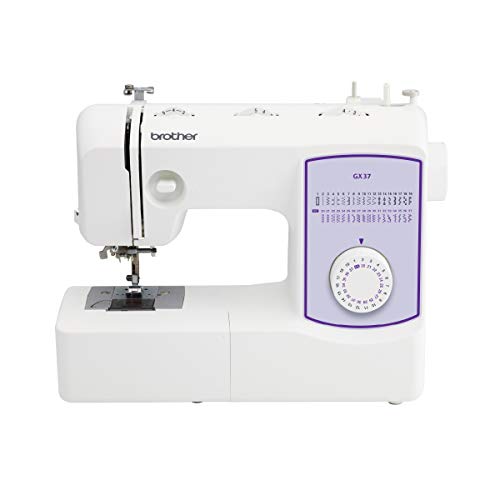
Brother GX37 Sewing Machine — Best Lightweight Threading Aid
The GX37 approaches threading from the opposite end of the price and complexity scale: 37 built-in stitches, six included sewing feet, decorative options for a machine of its class, and — the listing’s own highlighted convenience — the stitches printed directly on the machine’s body, so selecting one never requires fetching a manual. Its needle-threading aid trims the worst of the eye-pass struggle for beginners, and the machine’s light weight makes it the pick most likely to be carried to a class, a friend’s house or a holiday rental.
Honesty about scope matters most with this pick. Its threading help is an aid within a simple mechanical-style experience, not the polished lever routine of the computerized Brothers, and its stitch set and power are sized for garments, crafts and alterations rather than upholstery marathons. Judged as a first machine or a portable second machine, those are the right compromises, openly made.
Households buying for a teenager, a student flat or a grandparent who sews occasionally will find the GX37’s bargain is really about friction: light to lift, quick to set up, printed guidance always visible, threading assisted. Machines get used when using them is easy, and few machines in this group make starting easier for less commitment.
Its printed stitch chart deserves a final word, because it represents a design philosophy the expensive machines sometimes forget: information belongs where the decision happens. A beginner choosing a stitch while looking at the machine, not at a booklet across the room, makes better choices and fewer threading-adjacent errors, since selection and setup happen in one glance rather than two trips.
- 37 built-in stitches, printed on the machine
- 6 included sewing feet
- Needle-threading aid
- Decorative stitch selection
- Lightweight portable body
Strengths
- Stitch chart printed on the body ends manual-hunting
- Lightest and most portable pick in the group
- Friendly first machine for occasional sewing
Trade-offs
- Threading aid is simpler than the computerized models’ systems
- Not built for sustained heavy fabric work
- No LCD confirmation of settings
Best for: beginners, students and occasional sewers wanting easy setup.
Not suited for: heavy fabric projects or screen-guided workflows.
How Do the Six Compare on Threading and Control?
All six reduce the needle-eye struggle, but they surround that moment with very different machines. Compare the control style and the sewing mission first; the threading itself is the shared premise, not the separator.
| Pick | Badge | Specification snapshot | Threading and control notes |
|---|---|---|---|
| Brother CS7000X Sewing and Quilting Machine | Best Overall Threading Workflow | 70 stitches, LCD, wide table | Needle threader plus 10 included feet |
| Brother XR9550 Computerized Sewing Machine | Best for Large Stitch Libraries | 165 stitches, LCD, wide table | Needle threader plus 8 included feet |
| Brother SE700 Sewing and Embroidery Machine | Best Threading for Embroidery Work | 103 stitches plus 135 embroidery designs | Touchscreen, wireless LAN, 4×4 hoop |
| SINGER HD6600C Heavy Duty Computerized | Best Threading With Heavy Duty Power | 100 stitches, computerized, LCD | Needle threader, 60% more power claim |
| Brother CS5055 Computerized Sewing Machine | Best Compact Computerized Starter | Computerized, LCD display, compact | Needle-threading assistance, small footprint |
| Brother GX37 Sewing Machine | Best Lightweight Threading Aid | 37 stitches printed on machine | Threading aid, 6 feet, lightweight |
What Does Automatic Threading Actually Do, Step by Step?
With the needle raised to its highest point and the presser foot set as the manual directs, you lay the thread into the threader’s guide, draw it across the needle area, and press the lever. A hair-fine hook passes through the needle’s eye from behind, catches the thread, and draws a small loop back through as the lever releases. You pull the loop fully through, and the hardest part of threading is finished in about the time it takes to describe one second of it.
Everything before that moment remains your job on these machines: spool pin, tension discs, take-up lever, thread guides. Manufacturers number and arrow that path on the machine’s body, and on the computerized picks the screen reinforces settings once you are threaded. Fully self-threading machines that route the entire path exist in industrial and very high-end contexts; nothing in this group claims that, and this guide’s recommendations do not pretend otherwise.
The practical consequence is still large. The eye-pass is the step with the smallest target, the worst visibility and the most failures, and it is the step that multiplies with every colour change. Automating exactly that step is honest engineering aimed at the real bottleneck.
Who Benefits Most From a Needle Threader?
Sewers with reduced near vision benefit first and most obviously; the threader does not care about bifocals, lighting or a steady hand at two centimetres’ distance. Arthritis and reduced fingertip sensation come next — threading a needle by feel is a skill, but it is a skill nobody should need for a hobby. Then come the high-frequency threaders: embroiderers changing colours per design step, quilters matching thread per block, and teachers threading machines for a room of students.
Short-session sewers are the underestimated group. If your sewing happens in forty-minute fragments, a five-minute threading struggle is an eighth of your session and a genuine deterrent to starting at all. A two-second threader changes whether the machine comes out of the cupboard on a weeknight, which changes how much sewing a household actually does in a year.
Beginners benefit differently: early sessions set habits and confidence, and a beginner whose first evenings are spent sewing rather than squinting is a beginner who continues. The GX37 and CS5055 aim squarely at that effect.
How Do You Use a Needle Threader Without Bending It?
The hook is fine wire and the needle’s eye is a small, fixed target; the two meet correctly only when the needle sits at the very top of its stroke. Turn the handwheel toward you until the needle peaks — most machines have a mark or the take-up lever’s height as a cue — before touching the threader lever. Forcing the lever against a lowered needle is how hooks bend, and a bent hook misses the eye forever after.
Use the right needle sizes. Very fine needles have eyes smaller than some hooks prefer, and damaged or burred needles defeat the mechanism; if threading suddenly fails, change the needle before blaming the threader. Keep lint out of the needle area with a small brush, because a hook travelling through fluff arrives at the eye already deflected.
Thread choice plays a small role too: fuzzy, linty threads catch less cleanly than smooth ones, and extremely thick topstitching threads may simply be hand-threaded jobs. The threader is a precision convenience, not a challenge to be won against unsuitable materials.
What About the Bobbin Half of Threading?
A needle threader solves the top thread; the bobbin remains the other half of setup, and the machines here ease it with drop-in bobbin systems and clear covers that let you watch the thread supply while sewing. Drop-in bobbins remove the fiddliest older ritual — the removable bobbin case and its tension guesswork — and a visible bobbin ends the surprise of a seam sewn with no bottom thread, usually discovered at the worst possible moment.
Wind bobbins at a steady, moderate speed and fill them evenly; a badly wound bobbin sabotages tension no matter how perfectly the top is threaded. Use the bobbin class the manual specifies, because near-enough bobbins wobble, chatter and occasionally jam. Keep two or three bobbins wound in your common colours so a colour change is a swap rather than a winding session.
Together — assisted needle threading above, drop-in simplicity below — the full setup on these machines compresses into a minute or two. That compression, repeated across a year of sessions, is the real product being bought.
Why Do Screens and Threading Belong Together?
The computerized picks pair threading with displays because the two solve adjacent problems: getting the machine ready, and knowing it is ready. An LCD that names the stitch, length and width removes the doubt that used to follow any interruption — after rethreading, one glance confirms the machine is set for the seam you intend rather than the decorative experiment from yesterday. The SE700’s touchscreen extends the idea into embroidery, sequencing colours so the thread in your hand matches the step on the screen.
This is also why purely mechanical machines with threaders, while welcome, deliver a smaller total gain: the eye-pass is eased, but setting verification remains dial-reading. Households that value certainty — shared machines, returning beginners, anyone sewing tired at night — should weight the screen as part of the threading purchase, not as an unrelated luxury.
The HD6600C shows the balance from the other side: its screen is about settings discipline on a powerful machine, and paired with its threader it makes a heavy duty tool feel administratively calm.
How Should You Troubleshoot When the Threader Misses?
Work the checklist in order. Needle at its highest point? Needle fully inserted and not bent — replace it on suspicion, because needles are cheap and hooks are not. Thread seated in the threader’s guide rather than draped near it? Presser foot position as the manual specifies? Lint cleared from the needle clamp area? In practice, one of those five resolves nearly every failure, and the needle itself is the culprit often enough that swapping it should be step two, not step five.
If the hook visibly misses the eye sideways, it may have been bent by an earlier forced attempt; a dealer can often straighten or replace the threader unit, and it is a small repair rather than a machine-ending one. Do not attempt to bend it back with pliers by guesswork — the alignment tolerance is the entire mechanism.
Persistent failure on one thread type only usually means that thread is too thick or too fuzzy for the hook, and hand-threading that spool is the pragmatic answer rather than a defeat.
Which Stitches and Projects Reward Easy Threading Most?
Any project built from colour changes: appliqué with its rotating palette, embroidery with its sequenced steps, quilting with per-block matching, and decorative topstitching where contrast thread is the design. In each, threading frequency is the tax on creativity, and a threader cuts the tax to nearly nothing, which measurably changes behaviour — sewers experiment more, test more and unpick less reluctantly when restarting costs seconds.
Garment sewing benefits at the margins that matter: matching thread to each fabric of a mixed wardrobe-repair session, swapping to topstitching thread for a visible hem, then back again. Without a threader, sewers batch jobs by colour to avoid rethreading, which distorts the order of work; with one, jobs proceed in the order they are needed.
Even single-colour sewing gains quietly, because every broken thread, empty bobbin and needle change involves the eye-pass too. The feature is not really about colour at all; it is about removing the one step that interrupts flow, wherever flow gets interrupted.
How Do You Teach a Beginner on a Threading Machine?
Teach the full path by hand first, once, slowly, naming each guide — a beginner who understands the route can recover from any missed step, while one who only knows the lever is helpless when the hook misses. Then teach the threader as the finale of that route, with the needle-height rule stated as law: top position first, lever second, never force. Practise the sequence five times in a row on scrap thread; repetition builds the muscle memory that makes setup vanish.
Have the beginner sew a colour-change exercise early — a small appliqué or a sampler of decorative stitches in rotating threads — so the threader is experienced as a creative tool rather than a crutch. Confidence compounds: easy setup leads to more practice, more practice to straighter seams, and straighter seams to projects actually finished and worn.
Keep the printed manual open at the threading page for the first month regardless of age or pride. Every experienced sewer was once rescued by a diagram they nearly skipped.
What Should You Check on the Listing Before Ordering?
Confirm the threader explicitly in the listing’s feature list for the exact model, since model families share names across variants with different equipment. Check whether the machine’s stitch count, screen and included feet in the listing match the manufacturer’s specification for that model number, and note the hoop size on the SE700 so embroidery ambitions are calibrated before, not after, delivery.
Verify which feet are included — the CS7000X’s ten against the XR9550’s eight against the GX37’s six — because feet are the accessories you will actually miss. Check the machine’s weight if it will be lifted often, and confirm the plug and voltage suit your region, as these listings target the North American market.
Save the listing until the machine passes a first-week threading test: thread it ten times, sew, change colour, thread again. A threader that works ten times in your hands, under your lighting, is a verified feature; until then it is a claim.
When Is a Threader Not Enough — When Should You Look Elsewhere?
If the real barrier is the whole setup ritual — winding, path, tension, needle — a threader solves only its final step, and a sewer who dreads setup entirely may be better served by the most guided computerized workflow affordable, or by lessons that convert ritual into routine. If the barrier is heavy fabric, threading is secondary and the HD6600C’s power or a dedicated heavy duty machine should lead the decision.
If embroidery ambitions exceed a four-inch hoop, the SE700’s convenience will eventually chafe, and a larger-hoop machine deserves the budget instead. And if your sewing is a single colour, a single fabric and a monthly repair, the GX37’s modest aid may be all the threading help the household will ever need — spend the difference on fabric and notions.
The honest summary: buy the threader as part of a machine that suits your sewing, never as a rescue for a machine that does not.
How Does Threading Differ Between Mechanical and Computerized Machines?
On a mechanical machine, threading is a purely physical route: guides, discs, lever, eye. A needle threader bolted onto that route helps at the end, but nothing verifies your work — the machine sews whatever you set, rightly or wrongly. On the computerized picks here, the route is the same physical path, yet the screen closes the loop by displaying the selected stitch and settings, so the post-threading state of the machine is known rather than remembered.
That verification changes error patterns. Mechanical owners discover mistakes in the seam; computerized owners catch them on the display before the first stitch. Neither is morally superior — plenty of sewers love the mechanical directness — but for threading specifically, the screen is a genuine part of the feature’s value, and comparisons that count only the hook miss half the story.
Servicing differs as well: a mechanical threader is a simple lever-and-hook unit any technician can adjust, while computerized models occasionally tie threading behaviour to sensors and needle-position detection, which is one more reason to keep the needle area clean and the needle itself correctly seated.
What Thread and Needle Pairings Thread Most Reliably?
Smooth, standard-weight polyester or cotton all-purpose thread is the threader’s favourite diet: it presents a clean end, slides through guides predictably and forms a loop the hook can catch. Cut the thread end cleanly at an angle rather than tearing it, because a frayed, brush-like end defeats the hook’s precision and makes a good mechanism look faulty.
Metallic and slubby decorative threads are the troublemakers; their uneven surfaces catch, split or refuse the loop. The pragmatic routine is to thread those by hand and save the mechanism for the ninety percent of sewing that uses cooperative thread. Likewise, twin-needle work and wing needles fall outside the standard threader’s geometry and are hand-threading tasks on machines of this class.
Needle condition completes the pairing. A needle that has sewn a full project has a dulled point and possibly a burred eye; both degrade threading and stitch formation together. Since threading trouble so often announces a tired needle, treat the threader’s first miss as a maintenance reminder rather than a malfunction.
How Do You Build a Rethreading Routine for Colour-Heavy Projects?
Stage the project before touching the machine: spools in the order the design or quilt plan demands, each with its bobbin if the bottom colour matters, laid out left to right like a sentence. As each colour finishes, its spool moves to a separate tray, so progress is visible and no colour is threaded twice by mistake. This staging, trivial as it sounds, is what turns twelve thread changes from chaos into choreography.
Keep the tools of the transition at the machine: small scissors for clean thread ends, tweezers for the loop pull-through, and the brush for the needle area every few changes. Embroidery on the SE700 adds one more discipline — check the touchscreen’s next-colour prompt before threading, not after, because threading the right colour at the wrong step is the one error the threader cannot prevent.
Finally, unpick without shame. A colour sequence error caught early costs minutes; discovered after the next three colours, it costs the section. The threader’s speed makes restarting cheap, and cheap restarts are an invitation to correctness rather than an admission of failure.
What Role Does Lighting Play in Threading Success?
Threading is a visual task performed at the worst-lit point of many sewing rooms: the needle area, shadowed by the machine’s own arm. Built-in work lights help, and the HD6600C’s LED earns specific mention because heavy sewing often happens in the evening on dark fabrics with dark thread — the exact combination where an unaided eye-pass fails repeatedly. A threader plus good light is belt and braces; either alone leaves a failure mode open.
If your machine’s light is weak, a small adjustable lamp aimed at the needle plate transforms threading, stitch monitoring and unpicking alike, and costs less than a single accessory foot. Position it to avoid glare on the screen of computerized models, and prefer a colour temperature that distinguishes thread colours accurately, since colour-matching under yellow light is a quiet source of regret.
Vision aids deserve the same matter-of-fact treatment: many sewers keep a magnifier at the machine permanently, not as an admission of defeat but as standard equipment, like the seam ripper. The threader reduces how often magnification is needed; it does not argue against owning it.
How Should Shared and Classroom Machines Be Chosen for Threading?
Where several people thread the same machine — families, school classes, community groups — the winning features are robustness of routine and visibility of state. The CS7000X and XR9550 suit shared duty because their screens announce settings to whoever sits down next, ending the inherited-settings problem, and their threaders follow the same lever logic a whole group can be taught in one demonstration.
Teach the group one non-negotiable rule — needle fully up before the threader lever moves — and post it on the wall if necessary. In shared settings, threader damage almost always traces to a hurried user, not a weak part, and a visible rule protects both. Keep spare needles in the room, labelled by size, so the first response to a threading miss is a needle swap rather than a lever forced harder.
For a classroom fleet, uniformity beats excellence: identical models mean one lesson, one manual and interchangeable accessories. A row of GX37s or CS5055s, threaded identically, will teach more sewing per hour than a mixed row of superior machines each demanding its own ritual.
What Does the Threader Mean for Sewing With Reduced Hand Strength?
Threading by hand is a pinch-grip task performed at close range with a slippery filament; for hands with arthritis, tremor or reduced sensation it can be the single step that decides whether sewing happens at all. A lever threader converts that pinch into a press, which is a fundamentally more accessible motion, and the computerized models extend the accessibility further with screen text that can be read at arm’s length rather than dial markings read at inches.
Pair the machine choice with small environmental changes: a chair height that puts the needle area at a comfortable viewing distance, thread stands that keep spools from rolling away, and magnetic pin dishes that spare fingertips. Accessibility in sewing is a system, and the threader is its highest-value single component rather than its entirety.
If grip strength is the main barrier, also weight the machine itself: the GX37’s lightness helps hands that cannot lift a heavy unit onto a table, while a permanently stationed heavier machine, like the HD6600C, removes lifting from the routine entirely. Either strategy is valid; choose the one that matches how the sewing space is actually used.
How Long Does a Needle Threader Last, and What Ages It?
A threader has no consumable parts in normal use; its enemies are force, lint and misalignment, in that order. A machine threaded gently, with the needle raised and the area brushed clean, can keep its original hook accurate for the machine’s whole life. The mechanism’s precision is also why it should never be used as a lever for anything else — prising, poking or clearing jams with the threader bends the one part whose straightness is the feature.
If accuracy fades gradually rather than failing suddenly, suspect lint compaction around the needle clamp and hook path before suspecting wear. A thorough cleaning, a fresh needle and a careful test with smooth thread restore most tired-feeling threaders. What cleaning cannot restore is a hook bent by force; that is a small dealer repair, and arranging it promptly beats months of squinting at a machine bought specifically to end squinting.
What Mistakes Do Buyers Make With Automatic Threading Machines?
The feature is simple; the misunderstandings around it are not. These are the errors that disappoint owners of otherwise good machines.
- Expecting total self-threading — buying under the belief that the machine routes its entire thread path alone, then feeling misled when the numbered guides still need a hand. The threader automates the needle’s eye, and knowing that in advance is the difference between satisfaction and a return.
- Forcing the threader lever with the needle below its highest position, bending the fine hook on the first weekend and concluding the feature is fragile rather than misused.
- Blaming the threader for failures caused by a bent, burred or wrongly seated needle; swapping the needle fixes most threading failures and costs almost nothing.
- Choosing the machine for its threader alone while ignoring stitch range, table support and power — then discovering the sewing itself does not suit the household’s projects.
- Skipping the manual’s threading sequence because the lever looks self-explanatory, missing the one seating step that makes the hook catch reliably.
- Using very thick or fuzzy decorative thread through the threader repeatedly instead of hand-threading that spool, and wearing the mechanism for a job it was never sized to do.
Final Recommendation
Choose by the sewing first and the threading workflow second, and this group resolves cleanly. The Brother CS7000X Sewing and Quilting Machine is the balanced default, threading easily inside a complete quilting-ready package. Embroidery households should go straight to the Brother SE700 Sewing and Embroidery Machine, where the threader and touchscreen attack the same problem together, while mixed heavy-and-light homes are best served by the SINGER HD6600C Heavy Duty Computerized.
Learn the needle-height rule, keep spare needles closer than the manual, and the little hook becomes the hardest-working centimetre of your sewing room — threading stops being the toll at the gate of every project, and the gate simply stays open.
Frequently Asked Questions
Does automatic threading mean the machine threads itself completely?
No. On these home machines it means a built-in needle threader passes the thread through the needle’s eye. You still guide the thread along the numbered upper path and place the bobbin, both of which these models make quick and clearly marked.
Can a needle threader work with any needle?
It works with standard home-machine needles in ordinary sizes. Very fine needles, damaged needles or needles not fully inserted can cause misses. If threading fails, fitting a fresh standard needle is the first fix to try.
What if the threader stops catching the thread?
Check the needle is at its highest point, replace the needle, clear lint from the needle area and confirm the thread is seated in the guide. If the hook itself was bent by forcing, a dealer can usually service the threader unit.
Is the SE700’s threading different from the other Brother models?
The eye-threading task is the same, but the SE700’s touchscreen sequences embroidery colour steps, so you are told which thread to load next. In embroidery, that guidance is as valuable as the threader itself.
Do these machines help with bobbin winding too?
They simplify the lower half with drop-in bobbins and clear covers on the Brother models, so you can see remaining thread. Winding itself remains a normal spool-pin routine, eased by keeping pre-wound bobbins in your common colours.
Is a threading machine a good choice for a complete beginner?
Yes, provided the beginner learns the full thread path once by hand. The GX37 suits first steps and portability, the CS5055 adds computer confirmation, and the CS7000X gives room to grow into quilting.
Related Guides
Threading help pairs naturally with the neighbouring guides in this series: Best Automated Coffee Machines Best 4 Cubic Foot Washing Machines Best Sound Machines for Adults


