What's inside
- Where to buy
- Quick Picks
- How these picks were chosen
- Side by side: capacity, filtration and role
- How do you choose the right dust collection setup?
- Matching hose and port sizes without the usual frustration
- Filter care routines that keep suction honest
- Setting up extraction at the bench, step by step
- What a working week of dust actually looks like
- Noise, power draw and other household realities
- Reading dust collection titles like a sceptic
- Common mistakes
- Final recommendation
- FAQ
As an Amazon Associate I earn from qualifying purchases. This post may contain affiliate links at no extra cost to you.
As an Amazon Associate, cottageverdict.com earns from qualifying purchases.
Sawdust behaves differently from ordinary shop mess. A broom lifts the coarse shavings off a bench, yet the fine fraction — the pale powder that settles on shelves, coats a respirator strap and hangs in a shaft of light long after the saw stops — needs capture at the tool or disciplined suction close behind it. That is why the best shop vacuums for dust collection are not simply the loudest machines in the aisle. Capacity, filter behaviour, hose design and the way a unit starts and stops with a power tool matter more than a headline horsepower figure. This guide compares three true dust extractors that double as wet and dry vacuums, two stationary woodworking collectors built around large bags, and one cyclone separator that upgrades a vacuum you already own rather than replacing it.
Read the six entries as three families rather than one ladder. Extractors travel to the tool and switch with it. Bag collectors sit in a corner and swallow volume from a planer or jointer through wide ducting. A separator contributes no suction of its own; it spins debris out of the airstream so the vacuum behind it keeps its filter cleaner for longer. Mixing those families up is the most expensive mistake in this category, so each review below names plainly what the machine is, what its listing title actually states, and where its stated design stops being useful.
Where to buy
Six listings, three different jobs. The short orientation below places each one before the detailed reviews take them apart.
The ECOMAX opens the set as the extractor with the fullest woodworking vocabulary in its title: HEPA filtration, a semi-automatic filter clean, an anti-static hose and a dust-full indicator wrapped around an 8 gallon stainless tank.
Bosch’s VAC090AH answers with 9 gallons, automatic filter cleaning, power tool activation and a title that speaks the language of jobsites and grinder work rather than the home bench.
Fein’s Turbo I is the compact, quiet entry — 5.8 gallons, a stated 151 CFM and a 66 dB operating figure that suits shared walls and evening sessions.
The WEN DC1300 leaves the extractor format behind entirely: 1,300 CFM, a 14-amp motor and a 50-gallon collection bag on a mobile base, built to sit beside big chip producers.
Its smaller sibling, the WEN DC3401, scales that idea down to a 12-gallon bag and a 5.7-amp motor, with a wall mount offered as an alternative to floor space.
Closing the six, the Dustopper PRO is not a vacuum at all — it is a low-profile cyclone separator, rated by its listing for shop vacuums of 5HP and up, that intercepts debris before the host machine sees it.
Quick Picks
| Pick | Best for | Standout from the title |
|---|---|---|
| ECOMAX Dust Extractor Shop Vac 8 Gallon | Woodworking benches wanting HEPA plus filter cleaning | Semi-auto filter clean and dust-full indicator |
| Bosch VAC090AH 9 Gallon Dust Extractor | Jobsite crews using tool activation | Power tool activation with HEPA filter system |
| Fein Turbo I Wet/Dry Dust Extractor | Noise-sensitive workshops | 66 dB operation at a stated 151 CFM |
| WEN DC1300 Dust Collector 1300 CFM | Planers and jointers making heavy chips | 50-gallon bag and 1,300 CFM rating |
| WEN DC3401 Dust Collector 12-Gallon | Small shops short on floor space | Optional wall mount with mobile base |
| Dustopper PRO Dust Collector Separator | Owners of a 5HP+ shop vacuum | Cyclone separation ahead of the host filter |
How these picks were chosen
Selection started with a blunt question: does the listing title describe a machine, or a component, that genuinely collects dust? Hose kits, adapters and bare accessories were excluded, because a fitting collects nothing by itself. What remained had to state its capacity, its filtration approach or its airflow in the title, so a reader can verify the basis of inclusion without trusting adjectives. Three extractors qualified on those terms, each stating a tank size and a filter system. Two WEN units qualified as dedicated collectors, stating CFM or motor size alongside a collection bag. One separator qualified because its title states an efficiency figure and names the class of host vacuum it requires.
Filtration language was read literally. Where a title says HEPA, the review says HEPA and attributes the claim to the listing. Where a title states a micron figure instead — the DC1300 states 5-micron — the review reports that figure and does not upgrade it in prose. Airflow figures were likewise kept in their native units: CFM for the Fein and the large WEN, horsepower for the ECOMAX, amps for the smaller WEN. Those units are not interchangeable, and this guide does not convert or rank across them. Finally, each pick had to earn a distinct role; two machines that do the same job in the same way would have made one of them filler.

ECOMAX Dust Extractor Shop Vac 8 Gallon
The ECOMAX reads, on paper, like a checklist written by somebody who has emptied a clogged shop vacuum mid-project. Its title stacks a semi-automatic filter clean, a HEPA filter, an anti-static hose and a dust-full indicator around an 8 gallon stainless steel tank, then closes with the words “for Woodworking” — a positioning statement, not decoration. At 6.5 HP as the listing states it, this is a full-size extractor meant to live under or beside a bench and serve sanders, routers and track saws through a working day.
Listing-stated details — Tank: 8 gallon, stainless steel. Motor: 6.5 HP as titled. Filtration: HEPA filter, semi-auto filter clean. Hose: anti-static. Extras: dust-full indicator; wet and dry use. Intended setting per title: woodworking.
Strengths
- The semi-auto filter clean attacks the exact failure mode of fine dust work, where flour-like powder cakes a filter and suction fades halfway through a sanding session.
- A dust-full indicator removes the guesswork from an opaque stainless tank; you learn the tank is full from a signal, not from debris blowing back at a workpiece.
- Anti-static hose spec matters around fine dry dust, where static cling lines a hose wall with powder and static shocks annoy every time you grab the handle.
Trade-offs
- Eight gallons of stainless tank is substantial to carry up stairs or load into a vehicle; this extractor suits a settled bench more than constant site-hopping.
- The title gives no CFM figure, so airflow comparisons against the Fein or the WEN collectors cannot be made from listing data alone.
- Semi-automatic cleaning still involves the operator in the cycle; it is not the fully automatic filter cleaning the Bosch title describes.
Think about how the indicator and the filter clean change a working rhythm. Without either, the pattern in a small shop is familiar: sanding starts strong, suction quietly weakens as the filter loads, dust begins escaping at the sander’s pad, and the operator blames the tool before blaming the extractor. A dust-full signal interrupts that drift at the tank side, while a filter clean you can trigger without opening the machine interrupts it at the filter side. Neither feature makes the ECOMAX more powerful; both make its stated power more consistently available across a long session, which is what dust collection actually depends on.
The stainless tank deserves a practical note. Steel shrugs off the knocks a plastic tank absorbs with cracks over years of being dragged across concrete, and it wipes clean of resinous dust that stains polymer. Against that, steel shows every dent and adds heft, and the title states no wheel or handle details, so treat transport as an open question to confirm on the listing rather than an assumed convenience. Wet and dry capability broadens the machine beyond the bench: spilled finish, a leaking water line near the shop sink, or slurry from a tile job in the adjoining garage all fall within the titled role, provided the filter setup is configured for liquid as the manual directs.
Positioned against the Bosch below, the ECOMAX trades automatic filter cleaning and tool activation language for a woodworking-specific bundle at the same rough scale. Against the Fein, it offers more tank and the indicator, while conceding the published noise and airflow figures. A one-person woodworking shop that sands daily and hates opening a dusty tank to check its level is the natural home for this configuration.
Best for: a fixed woodworking bench running sanders and routers for long sessions, where the dust-full indicator and triggerable filter clean protect suction between breaks.
Not suited for: a 5.8-gallon-class footprint under a low bench, or a workflow built around published CFM figures, since the title states none.
Check price on Amazon — worth opening for the ECOMAX’s full hose and accessory list before you commit bench space to it.

Bosch VAC090AH 9 Gallon Dust Extractor
Bosch titles the VAC090AH like a jobsite document. The name pairs it with a grinder — “Auto Filter for Grinder 1773AK” — and the feature string runs through power tool activation, a dust control system, portable design, wet and dry collection and a HEPA filter system, all around a 9 gallon tank. Where the ECOMAX speaks to the woodworking bench, this extractor speaks to crews cutting, grinding and drilling mineral material where dust control is a compliance topic as much as a cleanliness one.
Details from the listing title — Capacity: 9 gallon. Filter care: auto filter cleaning. Starting: power tool activation. Filtration: HEPA filter system. Collection: wet and dry. Form: portable design, jobsite positioning.
Strengths
- Power tool activation starts and stops the extractor with the tool, so suction is present at the first cut and lingers only as needed — the single most-used convenience in this class.
- Automatic filter cleaning works without the operator triggering a cycle, suiting grinding dust that loads filters fast and steadily.
- Nine gallons is the largest extractor tank in this guide, stretching the interval between emptying stops on long runs.
Trade-offs
- The grinder pairing in the title signals its intended trade; a pure woodworking shop may pay for jobsite priorities it never uses.
- No noise figure appears in the title, unlike the Fein’s stated 66 dB, so sound-sensitive buyers get no listing-level reassurance here.
- At 9 gallons, a full tank of dense mineral dust is a heavy lift; capacity cuts both ways when debris is stone rather than shavings.
Tool activation changes behaviour in a way specifications cannot capture. When extraction requires a separate switch, operators skip it for short cuts — a quick trim, a single hole — and those short cuts, repeated forty times a day, generate much of a site’s airborne dust. Wire the extractor to start with the tool and the discipline problem disappears; the hose becomes part of the tool rather than an errand after it. That is the VAC090AH’s central argument, and its automatic filter cleaning extends the same logic to maintenance: the two chores most often postponed happen by themselves.
The wet and dry rating broadens its site role to slurry and wash-down water, and the portable design claim in the title suggests Bosch expects the unit to move between floors and buildings rather than retire to one corner. Confirm handle, wheel and cord details on the listing itself, because the title asserts portability without describing the hardware that delivers it. The HEPA filter system is stated as a system rather than a lone filter, language consistent with a sealed path from hose to exhaust; as with every filtration claim in this guide, that wording is the listing’s own and is reported here as such.
Compared with the ECOMAX, the Bosch adds a gallon, automates the filter cycle fully and centres tool activation, while dropping the anti-static hose and dust-full indicator from its title. Compared with the Fein, it is the bigger, trade-oriented machine that leaves noise unquantified. A contractor who grinds, cuts and drills across sites — or a serious renovator doing the same at home — matches its stated design most closely.
Best for: jobsite grinding, cutting and drilling where power tool activation and automatic filter cleaning keep extraction running without separate switches or manual filter cycles.
Not suited for: a noise-capped shared building where a published decibel figure is a purchase requirement, since the title gives none.
Check price on Amazon for the Bosch, and confirm which hose diameter the grinder pairing assumes.
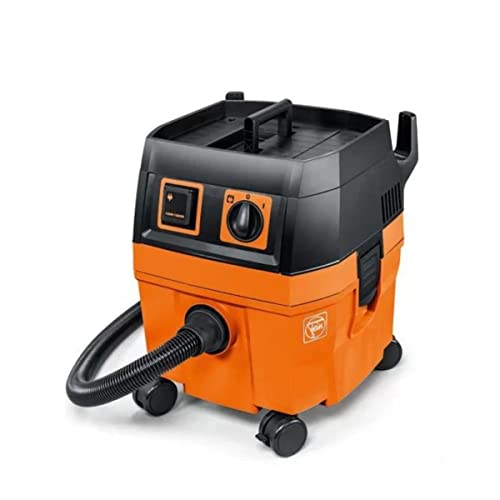
Fein Turbo I Wet/Dry Dust Extractor
Fein’s Turbo I makes the opposite opening move from the Bosch: it publishes numbers. The title states 5.8-gallon capacity, 151 CFM suction and quiet 66 dB operation, then adds an anti-static system and notes that a filter and accessories are included in the set. For a buyer comparing extractors on measurable behaviour rather than feature lists, this is the most legible listing in the guide — and its compact tank marks it as the extractor for smaller shops, apartments with a work corner, and anyone whose storage is a closet rather than a bay.
Stated in the title — Tank: 5.8-gallon. Airflow: 151 CFM. Sound: 66 dB operation. Static control: anti-static system. Included: filter and accessories, set configuration. Use: wet and dry extraction.
Strengths
- A published 66 dB figure lets a buyer in a shared house or thin-walled studio judge evening use before ordering, instead of discovering the noise at first switch-on.
- 151 CFM is stated outright, giving sander and saw pairing a concrete airflow basis that the ECOMAX and Bosch titles withhold.
- The set includes filter and accessories per the title, so the box arrives ready to connect rather than needing an immediate second order.
Trade-offs
- At 5.8 gallons, the tank fills fastest among the three extractors; planer-adjacent work or big clean-ups will mean frequent emptying.
- The title names no HEPA filtration, so buyers whose work demands that stated rating should look to the ECOMAX or Bosch entries instead.
- No filter-cleaning mechanism is mentioned in the title, leaving filter care a manual routine on this model as far as listing data shows.
Noise deserves more respect in buying decisions than it usually gets. A workshop extractor runs for the full duration of sanding, routing and clean-up, often in a room that shares a wall with a living space. A stated 66 dB operating figure — roughly conversational loudness as such figures are commonly presented — signals that Fein engineered this unit for occupied buildings, and the compact tank follows the same logic: the whole machine assumes modest space and neighbours within earshot. That coherence is the Turbo I’s identity. It is not a cut-down jobsite extractor; it is a small-shop extractor designed from the constraint outward.
The anti-static system addresses the same cling and shock problem as the ECOMAX hose, framed at system level in the title. Static matters most with fine, dry material — exactly what sanders produce — so its presence here fits the small-shop sanding role. Wet and dry capability keeps the machine useful for the spills and damp clean-ups of a multi-purpose room, and the included accessories in the set reduce the friction of getting started: confirm the exact accessory list on the listing, since the title confirms inclusion without itemising.
Set against the two larger extractors, the Fein concedes tank volume and HEPA language while winning on published airflow, published noise and footprint. For a maker whose bench folds away at night, or a woodworker in a condo whose sessions happen after dinner, those published numbers are not trivia — they are the purchase.
Best for: compact workshops in shared or residential buildings, where the stated 66 dB operation and 5.8-gallon footprint fit both the room and the neighbours.
Not suited for: high-volume chip work feeding a planer all afternoon, where a 5.8-gallon tank becomes an emptying schedule rather than a container.
Check price on Amazon — the Fein listing is the place to verify which accessories the set actually bundles.

WEN DC1300 Dust Collector 1300 CFM
The DC1300 is where this guide stops talking about vacuums. WEN titles it a woodworking dust collector, and the numbers change dialect accordingly: 1,300 CFM of airflow, a 14-amp motor, a 5-micron filtration figure and a 50-gallon collection bag on a mobile base. This is a stationary machine for a shop with a planer, a jointer or a table saw producing chips by the bucket — equipment whose waste stream overwhelms any extractor tank in this guide within the hour.
Title-stated specification — Airflow: 1,300 CFM. Motor: 14-amp. Filtration figure: 5-micron. Collection: 50-gallon bag. Base: mobile. Colour as titled: black.
Strengths
- Fifty gallons of bag capacity matches the output of thickness planers and jointers, the two machines that make extractor tanks look like thimbles.
- The 1,300 CFM rating is an airflow class extractors do not claim; moving that volume is what wide ducting to big machines requires.
- A mobile base lets one collector serve several stationary tools in a small shop, rolling to the machine in use instead of demanding permanent duct runs.
Trade-offs
- The 5-micron figure in the title is a coarser filtration statement than the HEPA language on the extractors; the finest airborne fraction is not this machine’s stated specialty.
- Nothing in the title offers wet capability — this is a dry woodworking collector, and liquids are outside its role entirely.
- A 50-gallon bag full of shavings is bulky to wrestle out and dispose of, even if it is light for its size.
Understanding this machine means understanding the difference between suction pressure and airflow volume. Extractors pull hard through a narrow hose, which suits a sander’s small port. A planer ejects a river of chips through a wide hood; capturing that river takes volume, not pressure, and volume is what a 1,300 CFM collector on a mobile base delivers. Shops often discover the distinction backwards, choking a big machine’s hood down to a vacuum hose and wondering why chips pack the cutter head. The DC1300 exists so that connection is never made.
The filtration trade-off should be read honestly rather than as a defect. A collector’s first job is bulk capture at the tool; pairing it with one of the HEPA extractors above for sanding — the operation that generates the finest dust — is a common two-machine division of labour in serious home shops. The title’s 5-micron statement tells you exactly where the DC1300’s responsibility ends. Bag changes, meanwhile, are the maintenance rhythm here: no filter-cleaning cycle, no indicator, just a large bag that fills in proportion to how much lumber you mill.
Floor space is the final consideration. A mobile base softens it, since the unit can park against a wall and roll out, but a 50-gallon collector is furniture-scale in a way no extractor in this guide is. Measure the corner you intend for it, and plan the hose or duct path to your biggest chip producer before ordering.
Best for: a stationary shop milling lumber with a planer or jointer, where a 50-gallon bag and 1,300 CFM airflow absorb a full session of chips between bag changes.
Not suited for: wet pick-up of any kind, or sanding dust as the sole filtration defence, given the title’s 5-micron figure and dry woodworking framing.
Check price on Amazon and check the DC1300’s bag size against your disposal routine.
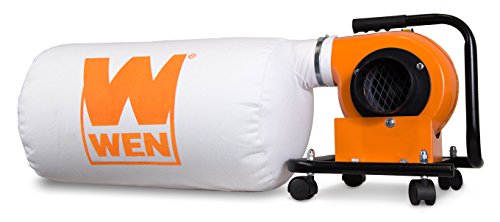
WEN DC3401 Dust Collector 12-Gallon
WEN’s DC3401 shrinks the collector idea to apartment-shop scale. The title states a 5.7-amp motor, a 12-gallon bag, a mobile base and — the detail that defines this model — an optional wall mount. Twelve gallons will not feed on a production planer all day, but for a bench-top planer, a mitre saw station or a lathe in a one-car shop, a collector that can hang on a wall instead of occupying the last square metre of floor is a genuinely different proposition from its bigger sibling.
From the listing title — Motor: 5.7-amp. Collection: 12-gallon bag. Placement: mobile base, optional wall mount. Model: DC3401. Filtration rating: none stated in the title.
Strengths
- The optional wall mount returns floor space entirely, a benefit no extractor or floor collector in this guide can match.
- A 12-gallon bag still out-swallows every extractor tank here except the Bosch, while keeping the machine’s footprint modest.
- The mobile base remains available for shops that prefer rolling the unit between two benches over fixing it to a wall.
Trade-offs
- The title states no filtration rating at all for this model — neither micron figure nor HEPA language — so fine-dust performance is unverified by listing data.
- At 5.7 amps, this is a light-duty motor; pairing it with the largest chip producers stretches the design past its stated scale.
- Wall mounting fixes the machine’s location, surrendering the roll-to-the-tool flexibility unless you unmount it.
The wall mount deserves a moment of thought about how small shops actually evolve. Floor space is claimed permanently by benches, saws and storage; wall space above shoulder height is often the only unclaimed territory left. A collector that hangs there, with its bag accessible and its hose dropping to a bench tool, fits the geometry of garages that also hold a car, a freezer and bicycles. The DC3401’s title is the only one in this guide to offer that geometry, and for the space-starved it may outweigh every specification the other five listings publish.
Temper expectations on filtration, because the title offers nothing to temper them with. No micron figure appears, so a buyer whose primary concern is the finest airborne fraction should treat this unit as a chip and coarse-dust collector and lean on respiratory protection and, ideally, a HEPA extractor for sanding. That is not a dismissal — bulk capture at a mitre saw or lathe is valuable work — but it is the honest boundary of what the listing supports. The 12-gallon bag, emptied regularly, keeps the unit in its effective range; a collector run with an overfilled bag loses airflow exactly when the work is messiest.
Against the DC1300, the DC3401 trades airflow class and bag volume for placement freedom and a lighter motor. Shops choosing between them should measure their chip output honestly: a weekend hobbyist’s bench planer and a production-minded jointer are different animals, and WEN clearly built one machine for each.
Best for: a one-car garage or basement corner where the optional wall mount keeps a 12-gallon collector off the floor entirely.
Not suited for: a buyer requiring a stated filtration rating in the listing before purchase, since the DC3401 title publishes none.
Check price on Amazon — and measure your wall run before choosing the mount over the base.

Dustopper PRO Dust Collector Separator
Read this entry carefully, because the Dustopper PRO is not a vacuum and does not pretend to be one once you read its title closely. It is a cyclone dust separator: a low-profile collection system with 90 degree elbows and hose attachments that sits between your tool and a wet/dry shop vacuum of 5HP or more, spinning debris out of the airstream into its own chamber so the host vacuum’s filter stays cleaner. The listing states a 99.9% efficiency figure for that separation — a claim of the listing, reported here as such — and notes it is made in the USA.
Stated by the title — Type: cyclone separator, not a powered vacuum. Separation figure: 99.9% efficiency as the listing claims. Host requirement: wet/dry shop vacuums 5HP and up. Fittings: 90 degree elbows and hose attachments included. Profile: low-profile design.
Strengths
- Separation ahead of the filter stretches the host vacuum’s filter life and steadies its suction, because the bulk of debris never reaches the filter at all.
- The low-profile form tucks onto a bucket-height setup under a bench where a tall cyclone would not fit.
- Included elbows and hose attachments mean the kit arrives ready to plumb between tool and vacuum, per the title.
Trade-offs
- It contributes zero suction: without a qualifying 5HP+ shop vacuum behind it, this product collects nothing at all.
- The host vacuum still provides the filtration, so the separator does not upgrade a non-HEPA vacuum into a HEPA system.
- Two chambers now need emptying and checking — the separator’s catch and the host tank — instead of one.
The economics of a separator only make sense when you already own the vacuum. Shops burn through filters and lose suction mid-job because fine dust blinds a filter long before a tank fills; a cyclone stage intercepts the overwhelming share of that material upstream. The Dustopper’s stated efficiency figure is the listing’s own claim for that interception, and even treated cautiously, the mechanism is well understood: spin the stream, drop the heavy fraction, pass the rest onward. Your existing vacuum keeps doing the sucking; it simply stops doing the choking.
Compatibility is the purchase question. The title specifies wet/dry shop vacuums of 5HP and above, so a small 2HP wet vac is outside the stated pairing, and hose diameters should be confirmed against the included attachments on the listing. Low profile matters in practice because separators usually live on top of a bucket or drum; a tall unit under a bench shelf becomes a head-knocking, tip-prone tower, while a squat one disappears into the setup. The 90 degree elbows support that tidy plumbing, routing hoses around bench legs instead of across walkways.
Do not buy this as a shortcut to a dust collection system. Buy it as an upgrade to a vacuum you already like — one whose suction is strong, whose noise you tolerate, and whose filters you are tired of replacing. In that specific situation, it is the cheapest capability jump in this entire guide.
Best for: an existing wet/dry shop vacuum rated 5HP or higher whose filter clogs with fine dust long before its tank fills.
Not suited for: a shop with no vacuum yet, or a host vacuum under 5HP, since the separator provides no suction of its own and the title sets that floor.
Check price on Amazon after confirming your current vacuum meets the stated 5HP threshold.
Side by side: capacity, filtration and role
| Model | Class | Capacity | Filtration as titled | Power/airflow as titled |
|---|---|---|---|---|
| ECOMAX Dust Extractor Shop Vac 8 Gallon | Extractor, wet/dry | 8 gallon stainless tank | HEPA, semi-auto clean | 6.5 HP |
| Bosch VAC090AH 9 Gallon Dust Extractor | Extractor, wet/dry | 9 gallon | HEPA system, auto clean | Tool activation; HP not stated |
| Fein Turbo I Wet/Dry Dust Extractor | Extractor, wet/dry | 5.8-gallon | Filter included; HEPA not stated | 151 CFM, 66 dB |
| WEN DC1300 Dust Collector 1300 CFM | Stationary collector | 50-gallon bag | 5-micron | 1,300 CFM, 14-amp |
| WEN DC3401 Dust Collector 12-Gallon | Stationary collector | 12-gallon bag | Not stated in the title | 5.7-amp |
| Dustopper PRO Dust Collector Separator | Cyclone separator | Chamber size not stated | Host vacuum filters; 99.9% separation claimed | None — needs 5HP+ host |
Read the class column first and the numbers second. An extractor and a collector solve different waste streams, and the separator solves a filter problem rather than a suction problem. Cross-class number comparisons — CFM against horsepower, bag gallons against tank gallons — mislead more than they inform.
How do you choose the right dust collection setup?
Which tool makes your worst dust?
Start at the tool, not the machine aisle. Sanders and routers make fine airborne powder and pair with extractors through small ports. Planers and jointers make volume and pair with collectors through wide hoods. A mitre saw makes a burst of both and often ends up served by whichever machine is closest. Name your worst offender honestly; the right purchase is the one that captures that tool’s output at the moment it is produced.
Does the machine need to move?
A settled bench can host a stainless tank or a wall-mounted collector. A renovator crossing rooms daily needs the Bosch’s portable design claim or the Fein’s compact tank. Mobility is a specification even when titles describe it loosely, so confirm wheels, handles and weight on the listing of any machine you expect to carry between floors.
What happens to the finest fraction?
Bulk capture and fine filtration are separate jobs. The extractors with HEPA stated in their titles address the fine end directly. The DC1300 states 5-micron; the DC3401 states nothing; the Dustopper leaves filtration to its host. If sanding dominates your work, weight the fine end heavily. If milling dominates, weight volume — and consider respiratory protection as a parallel layer regardless of machine.
How will you know when it is full or clogged?
The ECOMAX answers with an indicator, the Bosch and ECOMAX with filter cleaning systems, the WEN units with bags you inspect, and the separator with a chamber you check. Every system has a full state that quietly destroys performance; choose the one whose full state you will actually notice and service.
Guides on neighbouring dust topics can sharpen the picture further: our roundup of Best Air Purifiers With Reusable Filters covers the room-air side of fine particles once collection at the tool has done its part.
Matching hose and port sizes without the usual frustration
More dust collection disappointment traces to connections than to motors. Extractor hoses and tool ports come in several diameters, and a sander’s small port stepped down from a collector’s wide hose loses the airflow the big machine exists to provide. Before ordering any unit here, measure the outlet on your dustiest tool and the inlet on the machine you favour, then confirm the hose and any included adapters on the listing bridge that gap. The Dustopper’s included elbows and attachments ease this for vacuum owners; the Fein’s bundled accessories do similar work for its set. A ten-minute measurement prevents the classic outcome — a powerful machine connected by a whistling, leaking adapter stack that halves its real performance.
Filter care routines that keep suction honest
Every machine in this guide loses performance on a schedule set by its filter or bag, and the titles quietly encode the intended routine. Trigger the ECOMAX’s semi-auto clean at breaks rather than waiting for visible dust escape. Trust the Bosch’s automatic cycle but still inspect the filter at bag changes, because automatic systems extend intervals rather than abolishing them. Shake or replace the Fein’s filter on a calendar rhythm if your sanding is weekly. Change WEN bags before they are drum-tight, since an overfilled bag strangles airflow. Empty the Dustopper’s chamber while it is half full and the host vacuum behind it will reward you with the steady suction the separator exists to protect.
Setting up extraction at the bench, step by step
Begin with the tool that produces the finest dust you own — usually a random-orbit sander — and connect it to your extractor before any other tool gets a hose. Run a full sanding sequence on scrap, from coarse grit to fine, and watch two things: whether dust escapes at the pad’s edge during direction changes, and whether suction at the end of the sequence feels like suction at the start. Escape at direction changes points to a port or hose mismatch; fading suction points to filter loading, which is where the ECOMAX’s triggerable clean or the Bosch’s automatic cycle earns its place in a session rather than in a brochure.
Next, walk the hose path with the tool in hand. Hoses that cross walkways get stepped on, kinked at bench legs and yanked out of ports at the exact moment a cut begins. Route overhead where you can, or along the bench’s rear edge, and leave enough slack for the tool’s full travel without a coil dragging across the workpiece. The Fein’s compact tank helps here, since a smaller extractor can live on a low shelf directly behind the bench, shortening the run. Long hose runs cost airflow on every machine in this guide; the shortest tidy route beats the longest convenient one.
Then give the stationary collector its own test. Connect the DC1300 or the wall-mounted DC3401 to your largest chip producer and mill a board’s worth of material. Chips should stream without packing at the hood, and the bag should be filling evenly rather than ballooning at the inlet. If chips stall in the duct, the run is too long, too bent or too narrow — collectors reward straight, short, wide paths and punish improvised ones. Note where the bag sits when full and how you will carry it out; a 50-gallon bag that must be dragged through a finished room will not be changed as often as it should be, and an unchanged bag silently converts a collector into furniture.
Finally, if a separator joins the setup, plumb it in and repeat the sander test. The Dustopper should catch the visible bulk in its own chamber; open the host vacuum afterwards and compare what reached it against a session without separation. That before-and-after check, done once with your own tools and your own dust, tells you more about the pairing than any efficiency figure printed by any listing — including the 99.9% this one’s title claims.
What a working week of dust actually looks like
Monday’s milling leaves chips that a broom mostly handles, and this is where collectors prove themselves quietly: the DC1300 swallows the planer’s output at the hood, so the floor sweep afterwards is a minute rather than a quarter hour. Tuesday’s sanding is the opposite problem — almost nothing visible on the floor, and a great deal suspended in the air and settled on every horizontal surface by Wednesday. Extractors with stated HEPA systems address that invisible fraction at the sander’s port, which is why the two machine classes complement rather than compete.
Midweek joinery adds router work, the dust source most often left unextracted because fences and jigs complicate hose routing. An anti-static hose, as titled on the ECOMAX, or the Fein’s anti-static system reduces the cling that makes a router’s fine output coat the hose interior and the operator’s sleeves. End-of-week clean-up is where wet capability earns its keep: the three extractors here can take up the damp spill, the tracked-in grit slurry by the door and the rinse water from finishing rags’ bucket, while the WEN collectors and the separator stay strictly in their dry lanes.
Across that week, the maintenance rhythm separates ownership experiences more than any specification. Shops with an indicator or an automatic filter cycle notice problems as signals. Shops without them notice problems as symptoms — dust in the air, a whine from a straining motor, a workpiece surface gritty under the palm. Neither rhythm is wrong, but they suit different temperaments, and choosing the machine whose rhythm matches yours is a legitimate, practical basis for the decision.
Noise, power draw and other household realities
Extractors and collectors share circuits with the tools they serve, and a 14-amp collector starting beside a running saw can test a marginal breaker. The titles here state the DC1300 at 14 amps and the DC3401 at 5.7 amps; plan circuit assignments accordingly, ideally with the collector on its own run. The Fein’s published 66 dB remains the only noise figure in the set, which makes it the default shortlist entry for workshops under bedrooms. For the other five, assume workshop-loud until the listing or manual tells you otherwise, and schedule accordingly if your building has quiet hours.
Storage temperature and dust disposal close the practical list. Bags of fine dust should leave the shop sealed, not carried open through living space. Stainless tanks wipe down fastest after resinous material. A separator chamber emptied into the same bag as the host’s contents keeps one waste stream instead of two. None of these details appear in any title in this guide, yet all of them decide whether a well-chosen machine is still being used properly a year after delivery.
Reading dust collection titles like a sceptic
Product titles in this category compress hard, and learning to decompress them protects your money. Horsepower on a vacuum, as the ECOMAX’s 6.5 HP illustrates, is a motor rating convention rather than a promise about airflow at the tool; that is why this guide never converts it into CFM or ranks it against the Fein’s stated 151 CFM. Amp figures, like the WEN pair’s 14 and 5.7, tell you about electrical appetite and rough motor scale, not suction. Gallon figures describe the container, not the capture. When a title leads with the container and buries the filter, read the priorities in that order.
Filtration wording rewards the same scepticism. A title that says HEPA, as two here do, makes a specific claim you can hold the listing to. A title that says a micron number, as the DC1300 does, makes a different, narrower claim. A title that says nothing about filtration, as the DC3401’s does, makes no claim at all — and silence in a title is information, because manufacturers rarely omit a rating they are proud of. The separator’s efficiency percentage, finally, describes separation of debris from an airstream, which is a claim about where dust ends up, not about what the exhaust air contains; the host vacuum’s filter still decides that.
Accessories language closes the lesson. “Includes filter and accessories” on the Fein confirms a working set without itemising it; “hose attachments” on the Dustopper confirms plumbing without promising a hose of a particular length. In every case, the listing page — not the title, and not this guide — is where the confirmed inventory lives, which is why each review above ends by sending you to check the specific detail that model leaves open.
One further pairing deserves spelling out, because readers write in about it: an extractor and a separator are not rivals. The Dustopper stage can sit in front of the ECOMAX, the Bosch or the Fein just as it sits in front of a plain shop vacuum, provided the host meets the stated 5HP threshold where that threshold applies and the hose diameters reconcile. In front of a HEPA extractor, separation does not change what the exhaust contains — the extractor’s filter already decides that — but it changes how often that filter needs attention, because the bulk of each session’s debris settles in the separator’s chamber instead of against the filter media. In a shop that sands daily, that interval difference compounds across a season into real money and steadier suction.
Conversely, a collector and an extractor divide a shop by particle size and waste volume rather than by brand loyalty. Let the WEN machines take the planer’s river and the jointer’s output; let the extractor ride the sander, the router table’s fence port and the mitre saw’s hood. Shops that force one machine to do both jobs end up with a compromise that serves neither waste stream well — a collector choked down to a sander port, or an extractor drowning in planer chips by noon. The six listings in this guide were chosen so that a two-machine shop can be assembled from them without overlap, and so that a one-machine shop can pick the class that matches its worst tool first and add the other class later.
Respiratory protection deserves one honest paragraph in any dust guide, because machinery marketing quietly implies the machine makes it unnecessary. It does not. Even the best-matched extractor misses the dust from hand sanding between coats, the puff when a bag is emptied, and the cloud raised by sweeping a floor that collection never touched. Treat the machines in this guide as the layer that keeps the shop’s air and surfaces dramatically cleaner across a session — and keep a well-fitted respirator for the tasks and moments the hoses cannot reach. The two layers together, not either one alone, are what a careful shop actually runs on.
Emptying technique matters for the same reason. Carry a full tank or bag outside before opening it where the building allows, turn your back to any breeze, and let the initial puff settle before tipping the contents into a sealed bag. The dust you captured so carefully at the tool deserves a careful exit; a sloppy emptying re-aerosolises a week’s fine fraction in ten seconds beside the bin.
Budget the consumables before the machine, whichever of the six you choose: bags for the WEN pair, filters for the extractors, and the occasional hose or cuff that years of bench work eventually split. A collector whose bag you resent buying will be run overfilled; an extractor whose filter you resent replacing will be run blind. The honest running cost of each option here is part of its design, and the cheapest purchase is the one whose upkeep you will actually perform.
Common mistakes
Buying a separator as a first machine. The Dustopper PRO has no motor. A shop that orders it expecting suction has bought half a system, and the disappointment is entirely avoidable by reading its title’s host requirement.
Choking a collector down to a sander. Stepping a 1,300 CFM collector’s wide intake down to a small sander port wastes its volume advantage and can pack the hose; extractors exist for small ports.
Ignoring the full state. Tanks, bags and separator chambers all fail silently when full — suction fades, dust escapes at the tool, and the operator blames the wrong component. Pick the machine whose full signal you will notice.
Treating a micron figure as a HEPA claim. The DC1300’s stated 5-micron figure and the extractors’ stated HEPA systems are different filtration statements. Conflating them leads to sanding without the fine capture the work needs.
Skipping extraction for quick cuts. A thirty-second trim without the hose running still launches dust that settles for an hour. Tool activation, as on the Bosch, exists precisely to remove this temptation.
Forgetting the room. Collection at the tool is the first layer, not the only one; fine dust that escapes capture becomes a room-air problem, which is why desk-scale cleaning gets its own coverage in Best Desk Air Purifiers for the bench-adjacent office corner.
Final recommendation
For a woodworking bench that sands daily, start with the ECOMAX: its indicator, filter clean and anti-static hose form the most woodworking-specific bundle in the set. Crews grinding and cutting across sites should take the Bosch VAC090AH, whose tool activation and automatic filter cleaning remove the two steps operators skip. Small, shared or evening workshops belong to the Fein Turbo I, the only entry here publishing both its airflow and its noise.
Shops milling serious lumber need a collector, not a bigger vacuum: the DC1300 for volume and bag capacity, the DC3401 when the wall is the only free surface left. And the Dustopper PRO is the smart spend only in one situation — a strong vacuum already in the shop, choking on its own filter. Round out the wider cleaning picture with Best Mapping Robot Vacuums if the floors beyond the workshop door need their own automated routine.
FAQ
Can a dust collector replace a shop vacuum entirely? Not for wet work or small-port tools. The WEN collectors here are dry, stationary and built for volume; extractors handle liquids, portability and sander ports. Many shops run one of each.
Is the Dustopper PRO a vacuum? No. It is a cyclone separator that needs a wet/dry shop vacuum of 5HP or more behind it, per its title. It provides separation, not suction.
Which of these states HEPA filtration? The ECOMAX and the Bosch state HEPA in their titles. The Fein title does not use the term, the DC1300 states 5-micron, and the DC3401 states no filtration rating.
Does filter cleaning really matter? Fine dust blinds filters gradually, so suction decays before any failure is obvious. The ECOMAX’s semi-auto clean and the Bosch’s automatic clean exist to reset that decay without opening the machine mid-session.
What size extractor suits a one-person shop? Match tank to session length: the Fein’s 5.8 gallons suits short, quiet sessions; 8–9 gallons suit full days. Bigger tanks empty less often but travel worse.
Capture dust where the tool makes it, keep the filter path honest, and the shop stays a place you can breathe in while the work gets done.


