What's inside
- Key Takeaways
- Quick Picks
- How Did We Choose Sound Machines for Grown-Up Bedrooms?
- How Do the Six Compare for Adult Bedrooms?
- What Does Masking Actually Do, and What Can It Not Do?
- Why Do Loops Matter So Much to Adult Listeners?
- White, Pink, Brown or Green: Choosing a Noise Colour as an Adult?
- How Loud Should a Bedroom Sound Machine Be?
- Where Should an Adult Sound Machine Sit in the Room?
- Sound Machines for Shift Workers and Day Sleepers
- Can a Sound Machine Help in an Open-Plan or Shared Flat?
- How Do You Build a Wind-Down Routine Around Sound?
- How Do Sound Machines Interact With Earplugs, Headphones and Sleep Apps?
- What Should You Listen for in the First Fifteen Minutes?
- How Do You Share a Sound Machine With a Partner Who Hates It?
- When Is a Sound Machine the Wrong Purchase Entirely?
- How Long Do These Machines Last, and What Fails First?
- Can a Sound Machine Improve Focus During the Day?
- What Changes When the Bedroom Is Also a Home Office?
- How Should You Clean and Care for a Bedroom Sound Machine?
- Why Do Hotels, Hospitals and Barracks All Sound the Same at Night?
- A Word About Volume Creep in Adult Bedrooms
- What Mistakes Do Adult Buyers Make With Sound Machines?
- Final Recommendation
- Frequently Asked Questions
- Related Guides
As an Amazon Associate I earn from qualifying purchases. This post may contain affiliate links at no extra cost to you.
cottageverdict.com is reader-supported. When you buy through links on our site, we may earn an affiliate commission.
Where to buy: all six machines below are sold through Amazon, and the pick names in the Quick Picks table, the detailed sections and the comparison table link to their listings so you can check price on Amazon before ordering — a useful habit with the best sound machines for adults, because this category is crowded with near-identical boxes whose differences only appear in the details of looping, memory and volume control.
An adult buys a sound machine for different reasons than a nursery does. The enemies are a partner’s snoring, a street that never quite sleeps, a neighbour’s early alarm through a thin wall, a hotel corridor, or the simple fact that a bedroom gone suddenly silent makes your own thoughts very loud. The machine’s job is masking: laying down a steady, featureless sound that raises the floor of the room, so intruding noises stop standing out against silence and stop yanking you awake each time they occur.
Two qualities separate the serious adult machines from the nursery hand-me-downs. The first is the sound itself — specifically, whether it loops. A short recording repeated all night develops a pattern your brain learns, and a seam, a click or a recognisable swell every forty seconds can become more irritating than the snoring was. Non-looping generation and genuinely long, seamless tracks are therefore headline features here, not marketing garnish. The second is memory: the machine must return each night to your exact sound and volume without negotiation.
Nothing in this guide claims a machine will cure insomnia or treat any condition; if your sleep is persistently broken, that conversation belongs with a doctor. What these six can honestly do is control the acoustic environment of a bedroom — and for a great many adults, whose problem is the room rather than themselves, that control is the difference between a night endured and a night slept.
Key Takeaways
- The Yogasleep Dohm makes its sound with a real fan inside an acoustic housing — no recording, no loop, two speeds and a twist-to-tune tone.
- Magicteam’s headline is honesty about looping: 20 non-looping sounds and a memory function across 32 volume levels, powered by AC or USB.
- Housbay brings the loudest stereo output here — a 5W speaker for big rooms, thin walls and serious snoring standoffs.
- Hotmoon’s Cocoon 2 offers 40 sounds through dual speakers, with green and pink noise alongside brown and white for adults who find white noise too bright.
- Dreamegg’s battery portable is the adult travel machine: hotels, work trips and a spare room, with the same sound in every bed.
- Easysleep pairs 25 sounds with a night light, memory and 32 volume levels for readers and wind-down routines.
Quick Picks
| Pick | Badge | Why it earns its place |
|---|---|---|
| Yogasleep Dohm Classic White Noise Machine | Best Real-Fan Sound | The original fan-based machine: real moving air, two speeds, and a tone you tune by twisting the housing rather than browsing menus. |
| Magicteam Sound White Noise Machine 20 Sounds | Best Non-Looping Library | Twenty non-looping natural sounds with memory and 32 volume steps — the set-and-forget choice for purists about loops. |
| Housbay White Noise Machine 31 Sounds | Best for Loud Problems | A 31-sound machine with a loud 5W stereo speaker and wood-grain finish, built for large bedrooms and loud problems. |
| Hotmoon Sound Machine Cocoon 2 40 Sounds | Best Sound Library and Privacy Pick | Forty sounds through dual speakers, four timers and eight night-light settings — the maximalist’s plug-in for sleep and office privacy. |
| Dreamegg Portable Noise Machine | Best Adult Travel Machine | A battery portable with 21 sounds that travels between home, hotels and the spare room, keeping one sleeper’s environment constant. |
| Easysleep White Noise Machine 25 Sounds | Best Bedside Light Combination | Twenty-five sounds, a night light with memory, AC or USB power and five timer settings — the bedside reader’s compromise. |
How Did We Choose Sound Machines for Grown-Up Bedrooms?
We started with the loop question, because adults listen to these machines for thousands of hours and a repeated seam becomes a metronome for irritation. Machines that generate their sound mechanically, or state plainly that their sounds do not loop, were credited; machines with large libraries were checked for whether that library is a handful of honest long tracks or a pile of short clips wearing a bigger number. Library size alone earned nothing.
Volume behaviour came next, in both directions. A machine for adults must go quiet enough for a partner who barely tolerates sound, and — for the snoring wars and street-facing rooms — loud enough, cleanly enough, to mask real noise without distorting into harshness. Fine volume steps and a memory function to hold the chosen level were treated as core features, because re-negotiating volume nightly is how sound machines end up in drawers.
Finally we weighted bedroom citizenship: displays that dim or vanish, controls that work by touch in the dark, timers for those who want silence by morning, and designs that look like bedroom objects rather than hospital equipment. A sound machine is bought for years of nights; it should behave like furniture that happens to hum, not like a gadget demanding attention.

Yogasleep Dohm Classic White Noise Machine — Best Real-Fan Sound
The Dohm is the ancestor of this entire category and still its most distinctive machine: inside the dome is an actual fan, and the sound you hear is moving air shaped by the housing, not a recording of anything. That single fact dissolves the loop problem completely — there is no track, no seam, no pattern for your brain to learn across ten thousand hours — and it gives the Dohm a texture that digital machines imitate but rarely quite reproduce.
Tuning is mechanical and oddly satisfying. Two fan speeds set the broad volume, and twisting the housing’s collar and cap opens or closes vents that shift the tone from a lower hush to a brighter hiss. You tune it the way you would tune an instrument, by ear, in the room, at the bed. Once set, there is nothing to remember and nothing to update; the machine your grandparents could have operated is the machine a bleary adult operates perfectly at 3 a.m.
The compromises are the honest ones of a mechanical device. The sound palette is one sound, however well tuned — no rain, no brown rumble, no library — and a real fan consumes more power and gathers more dust than a speaker does. For sleepers who have tried digital machines and always heard the loop, or who simply want the original tool for the job, the Dohm remains the benchmark everything else is compared against.
Longevity is this machine’s silent argument. A fan, a switch and a housing have no firmware to abandon and no app to sunset, so the Dohm bought tonight can plausibly be the Dohm still humming in a decade, dusted twice a year and otherwise ignored. In a category where digital rivals are replaced for novelty, that mechanical stubbornness reads as value of the deepest kind.
- Sound source: real fan inside an acoustic housing
- Speeds: 2, with tone adjusted by rotating the housing
- Recording: none — sound is generated mechanically
- Positioning in listing: adults and baby; office privacy and meditation
- Colour: white
Strengths
- No loop exists to learn, click or anticipate.
- Tone tuned physically, by ear, without menus or screens.
- Decades-proven design with almost nothing to go wrong.
Trade-offs
- One sound only — no library, no nature tracks.
- Fan draws more power and collects dust over time.
- Volume steps are coarse compared with 32-level digital rivals.
Best for: loop-sensitive sleepers and purists who want a mechanical sound with zero screens, apps or settings.
Not suited for: variety seekers who rotate sounds nightly and want a library.
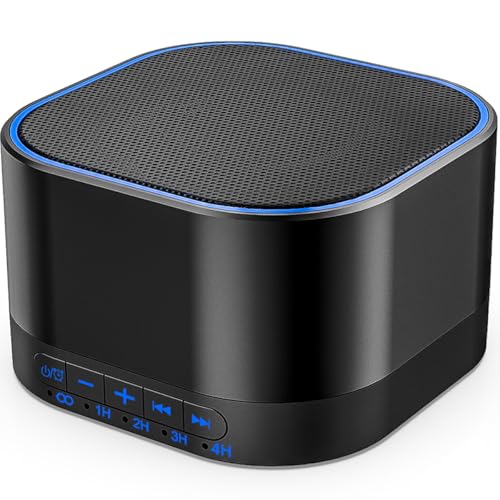
Magicteam Sound White Noise Machine 20 Sounds — Best Non-Looping Library
Magicteam puts its promise in the first line of its own listing: 20 non-looping natural soothing sounds. That phrase is the whole review in miniature. Where rivals compete on library size, this machine competes on library integrity — sounds that do not repeat on a short cycle, paired with a memory function and 32 levels of volume, powered by AC or USB with a sleep timer. It is a machine designed by someone who has clearly lain awake listening to a loop and sworn to fix it.
The memory function deserves its billing alongside the sounds. An adult’s sound machine setting is personal — this track, this volume, discovered across a week of experiments — and a machine that forgets it after every power cut or cleaning day slowly trains its owner to stop bothering. Magicteam remembers, so the bedside ritual becomes a single press, and the machine fades into the furniture exactly as a sleep tool should.
USB power is a quiet practical win: the machine runs from a bedside charger, a laptop in a hotel, or a power bank in a blackout, which makes it a credible travel understudy as well as a home machine. Its limits are scale and light — output suits bedrooms rather than halls, and there is no night light theatre here. For the adult who wants honest sound, remembered faithfully, those are the right things to leave out.
The 32-step volume deserves a second mention because couples feel it nightly. One partner’s perfect level is rarely a round number, and coarse machines force a nightly choice between slightly too loud and slightly too faint. Magicteam’s granularity, held by memory, ends that negotiation permanently — and ending small nightly negotiations is, in the end, most of what bedroom technology is for.
- Listed sounds: 20 non-looping natural soothing sounds
- Volume: 32 levels
- Memory: memory function included
- Power: AC or USB
- Extras: sleep sound timer; pitched at baby, kids and adults
Strengths
- Non-looping sounds remove the category’s biggest irritation.
- Memory restores a personal setting without nightly setup.
- USB power suits travel, desks and power-bank backup.
Trade-offs
- Output sized for bedrooms, not large open spaces.
- No night light for readers who want one built in.
- Twenty sounds is a modest library beside 40-sound rivals.
Best for: adults burned by looping tracks who want a remembered, honest sound at home or on the road.
Not suited for: households needing maximum volume to mask severe noise.

Housbay White Noise Machine 31 Sounds — Best for Loud Problems
Some bedrooms have polite problems — a distant road, a humming fridge — and some have a partner whose snoring could be heard through a closed door and a pillow. The Housbay is built for the second kind. Its listing leads with a 5W loud stereo sound, 31 soothing sounds, an auto-off timer and adjustable volume, all in a wood-grain finish that sits on a nightstand without announcing itself as medical equipment. Output is its argument: masking is a contest of levels, and this machine brings more clean level than its rivals.
Stereo matters more than the word suggests. A single small speaker produces a point of sound your ears can locate, and a located sound is a sound your brain keeps monitoring. A broader stereo image fills the room’s acoustic space more evenly, so the mask feels like the room itself humming rather than a device performing in the corner. In a large bedroom or an open-plan flat, that evenness is the difference between masking and merely adding a second noise.
The wood-grain finish and auto-off timer round out a machine aimed at adults who share rooms and compromise for a living: loud enough for the snore nights, timered for the quiet ones, handsome enough to leave out. Its size and appetite make it a poor traveller, and at low volumes its advantages fade — but bedrooms with real noise to defeat are exactly where this guide’s readers with the worst sleep live, and the Housbay speaks to them directly.
There is a fairness point in the Housbay’s favour for couples: the machine lets the snorer’s partner solve the problem unilaterally, without waking anyone, requesting surgery or retreating to a spare room. Many relationships have been quietly improved by less romantic purchases than a loud little speaker that lets two people keep sharing a bed in peace.
- Listed sounds: 31 soothing sounds
- Speaker: 5W loud stereo sound
- Timer: auto-off timer
- Volume: adjustable
- Finish: wood grain; pitched at baby, kid and adult
Strengths
- Strongest clean output here for snoring and street noise.
- Stereo image masks evenly instead of pointing at a corner.
- Wood-grain finish blends into adult bedrooms.
Trade-offs
- Too bulky and hungry to be a travel machine.
- Its power is wasted in already-quiet rooms.
- No battery option for blackouts or camping.
Best for: adults masking loud snoring, traffic or thin-wall neighbours in a proper-sized bedroom.
Not suited for: travellers, minimalists and the already-quiet-roomed.

Hotmoon Sound Machine Cocoon 2 40 Sounds — Best Sound Library and Privacy Pick
The Cocoon 2 is the maximalist entry: 40 sounds through dual speakers, plug-in power, four timers and eight night-light settings, with a listing that names white, green, pink and brown noise in one breath. Green noise — a lesser-known colour that emphasises the middle frequencies, rather like a steady stream or wind in leaves — is genuinely rare in this category, and adults who find white noise too hissy and brown noise too rumbling often land on pink or green as the texture they can live inside all night.
Dual speakers give that library room to breathe, and the listing’s own ambitions stretch beyond the bedroom: office privacy is named outright, and the logic transfers. A machine that keeps a sleeper’s room acoustically private also keeps a therapy office, a study or a home-working corner from broadcasting speech through a door. Forty sounds is more than any sleeper needs, but for a machine splitting duties between nights and working days, the breadth becomes a feature rather than a vanity metric.
Restraint is the owner’s job here. Eight night-light settings and forty sounds invite nightly browsing, and browsing is the opposite of the set-and-forget discipline that makes sound machines work. Choose in the first week, lean on the timers, and let the Cocoon become a fixture. Configured once and left alone, it is the most versatile plug-in in this group; fiddled with nightly, it becomes a hobby that happens to glow.
Treat the Cocoon’s first week as a tasting menu with a deadline. One sound per night, notes by morning, and a winner declared by Sunday — after which the browsing ends and the routine begins. Maximalist machines fail their owners only when the choosing never stops; chosen firmly, this one’s breadth becomes depth, because the sound it settles on was selected from real alternatives.
- Listed sounds: 40, including white, green, pink and brown noise
- Speakers: dual-speaker, plug-in
- Timers: 4 timer options
- Light: 8 night-light settings
- Audiences in listing: sleeping adults, office privacy, baby, dogs
Strengths
- Rare green noise alongside pink, brown and white.
- Dual speakers fill bedrooms and work as speech privacy.
- Four timers suit sleep and office schedules alike.
Trade-offs
- Feature abundance tempts nightly fiddling over routine.
- Plug-in only; no battery travel role.
- Light settings need taming for a truly dark bedroom.
Best for: adults who want one machine for night masking and daytime office privacy, and who enjoy tuning their sound.
Not suited for: set-and-forget minimalists who will never use the breadth.

Dreamegg Portable Noise Machine — Best Adult Travel Machine
For the adult who sleeps in forty beds a year, the best sound machine is the one that is always in the bag. The Dreamegg’s 21 soothing sounds and strong rechargeable battery make it the travelling constant in an inconstant life: the same sound, at the same volume, in a client-site hotel, a partner’s flat, a sleeper train or the spare room at Christmas. Sleep is a creature of cues, and carrying one cue with you is the closest thing to carrying your own bedroom.
Battery power shapes its adult uses differently from the nursery version of this pitch. There is no hunting for a socket behind hotel furniture, no cord across a strange room, and no surrender when a red-eye lands you in a bright, thin-walled airport hotel at dawn — the machine comes out of the wash bag and the room becomes acoustically yours within a minute. Its listing mentions office and sleeping use, and a pocketable mask for a desk nap or a loud open-plan afternoon is a legitimate second career.
At home it plays understudy rather than lead: smaller output than the Housbay, fewer sounds than the Hotmoon, and a battery that must be fed. Frequent travellers will not care. Occasional travellers should ask whether a plug-in with USB power, like the Magicteam, covers their two hotel nights a year while serving better at home. Road warriors already know their answer.
Hotels deserve a word of their own. Corridor doors, ice machines, lifts and the 5 a.m. departure of strangers are the enemies, and they all enter through one door — so place the Dreamegg near the room’s door rather than the bed, and it will mask at the border while staying gentle at the pillow. It is the single most useful sentence in this guide for a frequent traveller.
- Listed sounds: 21 soothing sounds
- Power: built-in rechargeable battery for cordless use
- Audiences in listing: baby and adult
- Use cases in listing: office, sleeping, home, travel
- Colour: classic white
Strengths
- Battery freedom in hotels, trains and spare rooms.
- Same sound everywhere — a portable sleep cue.
- Pocketable size lives permanently in a travel bag.
Trade-offs
- Output cannot match the big plug-in machines.
- Charging discipline required or it fails on the road.
- Home users may outgrow its modest library.
Best for: frequent travellers, shift workers and anyone who sleeps in many beds but wants one familiar sound.
Not suited for: homebodies needing maximum masking power nightly.

Easysleep White Noise Machine 25 Sounds — Best Bedside Light Combination
Easysleep builds the machine for the adult whose bedtime still includes a chapter of a book. Twenty-five soothing sounds arrive with night lights, a memory function, 32 levels of volume, five sleep-timer settings and power by AC or USB. The combination sounds unremarkable until you live with it: read under the machine’s own glow, tap the timer as you close the book, and the sound you chose last month resumes at your volume while the light bows out on schedule.
The memory function is again the quiet hero. Couples sharing a machine negotiate their compromise once — this sound, this level, light low — and the Easysleep simply holds the treaty. Thirty-two volume steps make that treaty precise enough to survive, because the difference between a partner’s ‘inaudible’ and ‘irritating’ is often a single coarse click on lesser machines, and this one can land between clicks.
Its ceiling is output and ambition. This is a bedside machine for ordinary bedrooms, not a weapon for the snoring wars, and its library is mid-sized by design. Within those honest limits it may be the most liveable machine here for the largest number of adults: sound, light, memory and timer in one small white box that asks almost nothing of its owners.
The Easysleep’s USB power gives it a second life its listing barely mentions: it runs happily from a laptop at a desk for afternoon focus, or from a power bank through a blackout, still holding its remembered settings. Machines that sip power from anything become household infrastructure, borrowed by teenagers for revision and by partners for the spare room, and earn their shelf many times over.
- Listed sounds: 25 soothing sounds
- Light: night lights included
- Volume: 32 levels, memory function included
- Timers: 5 sleep timer settings
- Power: AC or USB; for sleeping and relaxation
Strengths
- Sound, light, memory and timer in one bedside unit.
- Fine volume steps suit couples negotiating a compromise.
- USB power adds travel and desk flexibility.
Trade-offs
- Output is bedside scale, not a snoring-war weapon.
- Library mid-sized beside 31- and 40-sound rivals.
- Light and sound share one unit — a failure darkens both.
Best for: couples and readers wanting one remembered bedside setup with a gentle light and a timer.
Not suited for: light sleepers facing severe noise who need the Housbay’s muscle.
How Do the Six Compare for Adult Bedrooms?
| Pick | Badge | Key specification | Watch out for |
|---|---|---|---|
| Yogasleep Dohm Classic | Best Real-Fan Sound | Real fan, 2 speeds, mechanical tone | One sound only; fan gathers dust. |
| Magicteam 20 Sounds | Best Non-Looping Library | 20 non-looping sounds, 32 volume levels | Bedroom-scale output; no night light. |
| Housbay 31 Sounds | Best for Loud Problems | 31 sounds, 5W stereo speaker | Bulky; stays home. |
| Hotmoon Cocoon 2 | Best Sound Library and Privacy Pick | 40 sounds, dual speakers, green noise | Tempts fiddling; plug-in only. |
| Dreamegg Portable | Best Adult Travel Machine | 21 sounds, rechargeable battery | Modest output; needs charging. |
| Easysleep 25 Sounds | Best Bedside Light Combination | 25 sounds, night light, memory, USB | Mid-sized library and output. |
What Does Masking Actually Do, and What Can It Not Do?
Masking works on contrast. A dripping tap wakes you not because it is loud but because it is loud against silence; raise the room’s background with a steady sound and the same drip falls below the threshold of notice. That is the entire mechanism, and it explains both the power and the limits of every machine here. Sounds that are steady themselves — a partner’s rhythmic breathing, traffic wash — mask beautifully. Sounds that are sudden and far above the background, like a slamming door, will still break through any responsible volume.
It also explains the honest boundary of this guide. A machine can stop a room’s noises from disturbing sleep; it cannot create sleep where pain, anxiety, a disorder or a brutal schedule is the real problem, and no listing language should persuade you otherwise. Buy a sound machine as acoustic engineering for your bedroom. If the bedroom was the problem, it will feel like a cure. If it was not, you have bought a pleasant fan with a clear conscience and a doctor’s appointment still to make.
Why Do Loops Matter So Much to Adult Listeners?
A sleeping brain is not an off brain. It monitors, and it is superb at learning patterns — which is why a looped recording’s seam, inaudible on first listen, becomes the loudest thing in the room by the fiftieth night. The click where the rain track restarts, the gull that cries every forty seconds, the swell that always comes back: each becomes an event, and events are what wake us. Adults, who keep these machines for years, are far more exposed to this failure than any nursery user.
That is why this guide weighted non-looping design so heavily: a real fan cannot loop, Magicteam states its sounds do not loop, and the larger libraries earn trust when their tracks are long and seamless. When you test a new machine, test for this specifically — listen to your chosen sound for five full minutes in daylight and hunt for the repeat. Finding it at noon is a disappointment; finding it at 4 a.m. in month three is a betrayal.
White, Pink, Brown or Green: Choosing a Noise Colour as an Adult?
Adults choose noise colours the way they choose mattresses — by lying on them. White noise is the brightest and most even, excellent against high, sharp intrusions like voices through a wall, but some listeners find its hiss tiring across a whole night. Pink noise tilts energy downward and sounds like heavy rain; many adults find it the easiest all-night texture. Brown noise goes further into rumble — aircraft cabin, distant thunder — and is the snorer-masker’s favourite because snoring lives in those low frequencies too.
Green noise, offered by the Hotmoon, sits in the middle frequencies and resembles a stream or wind through leaves; it suits listeners who find white too sharp and brown too boomy. There is no hierarchy here, only fit. Use the first week with any machine as a tasting menu, one colour per night at the same volume, and let your own mornings mark the scores.
How Loud Should a Bedroom Sound Machine Be?
Loud enough to do the job and not a notch louder is the whole law. In practice: set the machine where it will live, lie in bed, and raise the volume until the intruding sound — the street, the snore — blurs into the background, then stop. If you must raise your voice to speak to a partner, you have gone past masking into a second noise problem, and the answer is placement, not volume: a machine nearer the door or the offending wall masks at its source and can run quieter doing it.
Remember that louder is not deeper sleep. Beyond the masking point, extra volume adds nothing but strain — a room that roars all night is its own disturbance, and morning headaches blamed on many things are sometimes just a sound machine set by enthusiasm rather than by ear. The fine-step machines here, with 32 levels, exist to find the exact notch where the room disappears. Find it once, let memory hold it, and stop adjusting.
Where Should an Adult Sound Machine Sit in the Room?
Between you and the noise is the first rule. Street noise enters at the window, snoring at the partner’s side, plumbing in the wall — the machine masks best when it stands near the intrusion’s entry point, raising the background exactly where the unwanted sound arrives. A machine on the far side of the bed from a snoring partner must fill the whole room to do what a nearer, quieter one could do locally.
The second rule is distance from your own ears. A machine on the nightstand, half a metre from your pillow, produces a localised hiss your brain keeps tracking; the same machine across the room becomes weather. Give it a shelf, a dresser, a corner of its own, keep it off the bed and out of the pillow fort, and let the room itself become the speaker.
Sound Machines for Shift Workers and Day Sleepers
Day sleep is the hardest sleep: the world is at full volume, daylight leaks around every curtain, and the household reasonably refuses to tiptoe for eight hours. A sound machine is close to essential equipment here, and the requirements sharpen. Output matters — daytime noise is louder and more varied — so the Housbay’s muscle or a Dohm at full chat earns its place, and timers matter less than the discipline of a consistent pre-sleep routine performed against the clock’s opinion.
Portability matters too, because shift workers often sleep in more than one place across a week. The Dreamegg in the work bag means the on-call room, the spare bed at a parent’s house and your own room all sound the same, and that sameness is a cue your body can learn even when the hours are upside down. Pair the machine with blackout and a door sign, and day sleep becomes a system rather than a daily act of will.
Can a Sound Machine Help in an Open-Plan or Shared Flat?
Yes, with expectations set by physics. In a studio or a shared flat, a sound machine cannot create privacy where walls do not exist, but it can draw an acoustic curtain: a steady sound at your bed or desk raises the effort required for a flatmate’s television, call or kitchen noises to reach you as distinct events. The Hotmoon’s office-privacy positioning works at home too — a machine near a door blurs speech in both directions, which flatmates on video calls will appreciate as much as sleepers do.
Diplomacy is part of the setup. Agree the machine’s hours and rough volume with the people who share your air, keep it at the lowest effective level, and remember it masks for everyone in earshot, willing or not. Most flatmates, offered the choice between your machine’s soft hush and your complaints about their evenings, choose the hush within a week.
How Do You Build a Wind-Down Routine Around Sound?
Adults mock routines and then sleep badly for decades. A wind-down is simply a sequence that tells a busy brain the day is closing: lights lowered, phone exiled, book or shower, then the machine’s sound arriving as the final full stop. The sound works as a cue because it is identical every night — the same texture at the same moment — and cues are how habits, including the habit of falling asleep, are actually built.
Timers let the routine end gracefully for those who prefer true silence by morning; memory functions let it start without thought. What matters is not the sophistication of the sequence but its sameness. Keep it under half an hour, keep it portable in spirit — the traveller’s version is the same sound from a battery machine in a dark hotel room — and within a fortnight the first notes of your chosen noise will start to feel like the edge of sleep itself.
How Do Sound Machines Interact With Earplugs, Headphones and Sleep Apps?
Each tool owns a different layer. Earplugs subtract sound at the ear and pair well with a machine for extreme cases — the machine blurs the room, the plugs take the edge off what remains — though many sleepers dislike the pressure and the isolation from alarms and children. Sleep headphones and headbands put the sound inside the ear, which suits a partner who wants silence, but they tether your head and trouble side-sleepers.
Apps on a phone are the gateway most adults try first, and their weakness is the phone itself: notifications, a bright screen at 3 a.m., a battery that dies at five. A dedicated machine is the same idea with every distraction engineered out — one purpose, one button, no feed. Most long-term sound-machine owners arrived here by retiring an app, and few go back.
What Should You Listen for in the First Fifteen Minutes?
Loop seams, first of all: sit with your chosen sound and hunt for any repeating event — a click, a swell, a pattern your ear can predict. Second, harshness at your intended volume: a mask that sounds pleasant quietly can turn gritty when raised, especially on small speakers, and bedroom volumes are where distortion hides. Third, the machine’s own mechanical voice — button clicks, fan rattle, a standby hum — because in a silent room at midnight, the machine’s noises compete with the noises it was bought to hide.
Finally, walk the room. A good mask sounds even from the pillow, the door and the partner’s side; a poor one beams at one spot and leaves the rest of the bed uncovered. Fifteen honest minutes in daylight will tell you more than a month of hopeful nights, and it tells you while returning the machine is still a trivial decision.
How Do You Share a Sound Machine With a Partner Who Hates It?
Negotiate the variables in order of flexibility. Sound colour first — many objectors hate white hiss specifically and accept brown rumble without a murmur. Placement second — moving the machine to your side, or nearer the noise, lowers what reaches the unwilling ear. Volume third, using the finest steps available, because the acceptable notch usually exists between two coarse ones. Timer last — a partner may accept sound until 2 a.m. if silence is guaranteed by morning.
If the veto survives all four, the peace treaty is personal audio: one sleeper wears a soft headband speaker, the room stays silent, and the machine retires to travel duty. Households are democracies at bedtime, and a sound machine imposed is a sound machine resented — which is itself a noise no speaker can mask.
When Is a Sound Machine the Wrong Purchase Entirely?
When the disturbance is vibration rather than sound — a boiler’s thump through a floor, a neighbour’s bass through a shared wall’s structure — masking helps little, because you feel those intrusions as much as hear them, and the honest fixes are rugs, isolation pads and landlord conversations. Likewise when the waking culprit is light, heat or a mattress, a speaker is an elegant answer to a question nobody asked.
It is also the wrong purchase as a delaying tactic. Sleep that has been broken for months by snoring with pauses and gasping, by pain, or by an anxiety that follows you from room to room, deserves a professional’s attention, and a machine that makes the nights merely quieter can postpone that attention past the point of kindness. Buy the machine for acoustics. Take everything else to a doctor, promptly and without embarrassment.
How Long Do These Machines Last, and What Fails First?
Digital sound machines are simple electronics and usually outlast their novelty by years; what fails first is rarely the speaker. Power supplies tire, buttons wear on the most-pressed spots, and batteries in portables lose their enthusiasm across a few hundred charges. The Dohm’s failure mode is older-fashioned — a fan that eventually gathers dust and bearing wear — and it can often be revived by cleaning where a sealed digital box cannot be opened at all.
Buying with that horizon in mind favours standard power connections, physical buttons over touch-only controls, and brands likely to exist when you need a cable. It also favours simplicity generally: every feature is a future failure point, and the machine with the fewest parts between the socket and the sound is, year after year, the one still working on the shelf.
Can a Sound Machine Improve Focus During the Day?
The same masking that protects sleep protects concentration, because both are broken by the same thing: intelligible, intermittent noise. Speech is the worst offender — a half-heard conversation colonises attention — and a steady sound near a desk or a door blurs speech into unintelligibility at surprisingly modest volumes. That is why several listings here name office privacy, and why home workers in shared flats keep a machine at the study door.
Choose a different texture for work than for sleep if your brain links the sleep sound with drowsiness; pink or green noise at a lower level reads as weather rather than as bedtime. And mind your colleagues-by-proximity: in a shared space, your focus machine is also their background, so keep it local, low and agreed — masking is a courtesy only when everyone consents to the weather.
What Changes When the Bedroom Is Also a Home Office?
Dual-use rooms ask the machine to work two shifts: privacy and focus by day, masking by night, often at different volumes and sometimes with different sounds. Memory functions and multiple timers stop being luxuries here, because a machine reset twice daily by hand will eventually be reset wrong at midnight. The Hotmoon, designed with office privacy in its listing, is the natural citizen of this room, but any remembered machine can hold both settings if its controls are honest.
Placement compromises too. The desk wants the machine near the door; the bed wants it near the street wall. If those are the same corner, fortune smiles. If not, put it where the night need wins — sleep outranks focus in any honest accounting — and let daytime speech privacy be handled by a closed door and a slightly raised voice of your own.
How Should You Clean and Care for a Bedroom Sound Machine?
Dust, again, is the whole battle. Speaker grilles inhale bedroom fluff for years, and a monthly dry wipe — plus a soft brush across the grille when you change the bedding — keeps the sound open and the electronics cool. The fan-based Dohm deserves an occasional deeper clean according to its maker’s guidance, since its sound is quite literally shaped air passing through that housing.
Keep drinks off the nightstand’s machine corner, route cables where they cannot be yanked by a duvet, and give battery portables a charge cycle even in months they are not travelling, so the battery wakes up alive when a trip appears. None of this is burdensome; it is the same light housekeeping as a lamp receives, and it buys the machine a decade.
Why Do Hotels, Hospitals and Barracks All Sound the Same at Night?
Because unfamiliar buildings share an acoustic signature: hard corridors, doors that slam on closers, lifts, ice machines, plumbing in the walls and strangers keeping strangers’ hours. The traveller’s defence is not volume but familiarity — one known sound, carried personally, laid over the unknown building’s noises until they blur into it. That is why the portable pick in this guide matters out of proportion to its size, and why experienced travellers pack a sound machine beside the charger, not as an afterthought in the toiletries.
At home the same principle works in reverse. Your own house has its own signature — the fridge’s cycle, the boiler’s tick, a particular stair — and long-term residents stop hearing it. A new partner, a guest or a returning student hears all of it, which is why the spare-room machine is such a thoughtful piece of hosting: it gives a visitor the same acoustic mercy you long ago stopped needing.
A Word About Volume Creep in Adult Bedrooms
Machines drift louder across a season for innocent reasons: a noisier month on the street, a partner’s cold that deepens the snoring, a guest who set it by their own ear. Each nudge is reasonable; the sum is a bedroom that roars. Once a quarter, perform the thirty-second reset — lie down, start from silence, and raise the volume only until the intrusion blurs. You will almost always land below where the dial had crept to.
The reset matters because masking is a threshold effect, not a dose. Everything above the threshold is waste: extra strain on the speaker, extra presence in the room, extra reason for a partner to object. The machines with fine steps and memory make the reset stick; the discipline of occasionally performing it makes the whole purchase work as intended, year after year.
What Mistakes Do Adult Buyers Make With Sound Machines?
Buying the biggest library is the classic first error. Forty sounds impress in a listing and bore in a bedroom, where one sleeper uses one sound for five years. The features that survive contact with real nights are memory, fine volume steps, honest non-looping sound and a display that knows how to be dark. Shop for those and let the library be whatever size it happens to be.
Volume heroics come second. A machine cranked to drown a partner’s snoring from across the room becomes a second occupant of the bed — loud, present and resented. Move the machine nearer the noise, choose a lower-frequency sound that masks where snoring lives, and accept that the goal is blurring the intrusion, not winning a loudness war against it.
Third, placing the machine on the nightstand by the pillow. Proximity makes the sound local and trackable, the exact opposite of masking’s intent. Across the room, near the noise’s entry point, is where these machines do their quiet work; the nightstand is for the lamp and the book.
Finally, expecting therapy from a speaker. A sound machine fixes rooms, not disorders, and the buyer who expects it to cure chronic insomnia will discard a good tool in disappointment — or worse, delay a conversation with a doctor that actually could help. Let the machine do its honest job superbly, and take anything beyond acoustics to a professional.
Final Recommendation
Choose by the noise you actually live with. Snoring and street-facing rooms point to the Housbay’s muscle or the Dohm’s endless fan; loop-sensitive listeners to Magicteam’s honesty or that same Dohm; travellers to the Dreamegg; tuners and office-privacy seekers to the Hotmoon; and couples who read in bed to the Easysleep’s remembered compromise. Every machine here can be the right one — for the room it was matched to.
Set it up once, properly: across the room, near the noise, at the lowest volume that blurs the intrusion, and then leave it alone for a month before judging. Sound machines reward patience and punish fiddling, and the best of them disappear so completely that you only notice them on the nights you sleep somewhere without one.
Our own bedside would take the Magicteam 20-sound machine for its non-looping honesty, keep the Dreamegg portable packed for every trip away, and call on the Housbay 31-sound machine if a partner’s snoring ever escalated the war.
Buy the machine that makes your room forgettable, and your nights will take care of themselves in the dark.
Frequently Asked Questions
Will a sound machine stop me hearing my alarm or my children?
At sensible masking volumes, important sounds still get through — alarms and a child’s cry are sharp, patterned and loud compared with the steady background, and your brain is good at prioritising them. Keep the volume at the lowest level that masks your problem noise, and test your alarm from the pillow on the first night for peace of mind.
Is it better to run the machine all night or use a timer?
If the noises that disturb you occur all night — traffic, snoring — continuous play keeps the mask in place when you need it. If your room quietens after midnight, a timer saves power and gives you true silence by morning. Most adults settle on continuous play at a modest volume after a week of experimenting.
Can I become dependent on a sound machine?
You can become accustomed to one, in the same way you become accustomed to a good mattress: sleeping without it is possible, merely less pleasant at first. If you travel often, a portable machine keeps the cue consistent; if you want to stop, fading the volume down across a fortnight usually ends the habit without drama.
Which noise colour is best for masking snoring?
Lower-frequency sounds — brown first, then pink — mask snoring best because snoring itself lives in the low frequencies, so the mask and the intrusion occupy the same acoustic territory. Placement matters as much as colour: put the machine on the snorer’s side of the room, nearer their bed than yours.
Do sound machines use much electricity?
Very little. The digital machines here sip power comparable to a phone charger, and USB models can run from almost anything. The fan-based Dohm uses more, as any real fan does, but still a fraction of what heating or lighting a bedroom costs. Running one nightly is not a decision your electricity bill will ever notice.
Should I buy a machine with a night light as an adult?
Only if your evenings want one — readers and couples with different bedtimes often value a gentle built-in glow that dies on a timer. If you sleep best in total darkness, choose a machine without one or with a light that switches fully off, and check that its display dims too; a bright standby LED has ruined more nights than any snore.
Related Guides
With the bedroom acoustics settled, the rest of the house has its own sound and comfort questions, and these guides carry the same thinking into the living room and beyond: Best Ambient Noise Machines for a Room Best Brother Quilting Machines Best Automatic Cappuccino Machines


