What's inside
- Key Takeaways
- Quick Picks
- How Did We Choose These Picks?
- Comparison Table
- How Do Sand-Free Beach Blankets Actually Work?
- How Many People Really Fit on Each Size?
- How Do You Keep a Lightweight Mat on a Windy Beach?
- Which Mistakes Do Beach-Mat Buyers Make Most Often?
- How Should You Clean and Store a Sand-Free Mat?
- Where Should You Pitch the Mat on a Real Beach?
- How Does a Mat Behave on Wet Sand and Pebble Shores?
- What Should You Do About Sunscreen, Food and Other Mat Enemies?
- How Do Sand-Free Mats Compare With Beach Towels and Pop-Up Tents?
- What Makes a Mat Last More Than One Summer?
- How Should Solo Beachgoers and Couples Choose Differently?
- How Do You Fold and Carry a Big Mat Without a Struggle?
- What Happens to the Mat in Rain and Sudden Weather?
- How Does the Mat Earn Its Place Beyond Summer?
- Why Does the Shake Test Tell You More Than Any Label?
- Final Recommendation
- Frequently Asked Questions
- Related Guides
As an Amazon Associate I earn from qualifying purchases. This post may contain affiliate links at no extra cost to you.
cottageverdict.com is reader-supported. When you buy through links on our site, we may earn an affiliate commission.
Where to buy: each mat below links to its Amazon listing, where you can check price on Amazon and verify the open dimensions, the staking system and the packed size against your own headcount. The sixth entry is a deliberate contrast — the traditional woven beach blanket, discussed without a link — because understanding what sand-free mats replaced explains what they still cannot do.
Every beach day wages the same small war against sand, and the best sand-free beach blankets win it by refusing to play on sand’s terms. A woven towel gives grains a thousand tiny pockets to lodge in; a smooth synthetic mat gives them nothing to grip, so a shake at the end of the day sends the beach back to the beach instead of home in the car boot. That is the whole technology, and this guide will describe it honestly: sand slides off these fabrics, brushes off with a hand and shakes off in seconds, but no mat levitates your belongings above a windy shoreline, and any product promising a literally sand-proof day is describing weather that does not exist.
Sizing is the second honest conversation. A mat’s open dimensions decide how many adults can actually recline rather than merely sit in shifts, and the listings in this category count people optimistically. This guide translates each size into realistic occupancy — sprawled adults, seated picnickers, a family with a cool bag and a toddler’s expanding empire of toys — because a blanket that fits the group on paper and fails them on the sand teaches an expensive lesson in square footage.
Wind is the third character in the story. A lightweight mat’s virtue at carrying time becomes its vice at gust time, which is why stakes, sand pockets and corner weights recur through the picks below. The reviews weigh those anchoring systems as heavily as the fabrics, and the later sections cover placement strategy, wet-sand behaviour, cleaning, and the etiquette of spreading a very large mat on a crowded shoreline without annexing your neighbours’ afternoon.
Key Takeaways
- Sand-free means sand slides and shakes off a smooth fabric, not that sand is magically repelled all day.
- Count realistic sprawled adults, not the listing’s seated maximum, when choosing a size.
- Stakes and fillable corner pockets matter as much as fabric on any breezy coast.
- The WEKAPO, at ten by nine feet, is the group headquarters option in this line-up.
- Compact solo and couple mats earn their keep on long walks from the car park.
- A traditional woven blanket still wins for drying off; the mat wins for sitting clean.
Quick Picks
| Pick | Badge | Why it earns its place |
|---|---|---|
| WEKAPO Beach Blanket Sandproof 10 x 9 | Best for Big Groups | A ten-by-nine-foot headquarters mat with six stakes and four corner pockets for up to seven adults. |
| EASYFUN Beach Blanket Sandproof Oversized | Best Family All-Rounder | Oversized at 79 by 83 inches, portable, water resistant and sized for a family without going enormous. |
| WIWIGO Beach Blanket Mat Sandproof | Best Size Range | A quick-drying, windproof mat family spanning two to eight adults across its sizes. |
| Wolfwise Beach Blanket Sandproof XXL | Best for Four People | An XXL mat for four with sand pockets, stakes and an integrated storage bag at 78 by 81 inches. |
| Utopia Home Beach Blanket Sand Proof 108 x 120 | Best Maximum Coverage | The largest sheet here, 108 by 120 inches, with stakes and a carry bag for gatherings and events. |
| Woven Cotton Beach Blankets, Discussed Generically | Knowledge Pick | The traditional absorbent blanket, examined for the jobs a smooth mat still does badly. |
How Did We Choose These Picks?
Fabric behaviour came first. Candidates had to be built from the smooth, tightly woven synthetics that shed sand by design — the parachute-style nylons and dense polyesters whose surfaces give grains nowhere to lodge. Loose weaves, terry surfaces and anything resembling a giant towel were excluded from the linked picks no matter how cheerful their prints, because a beach mat that traps sand has failed its single defining test before the day begins.
Anchoring decided the next cut. Every linked mat here ships with a system for staying put: stakes, fillable corner pockets, or both. A mat without anchoring is a kite awaiting a gust, and the weight saved by omitting stakes is repaid in an afternoon of chasing corners. The reviews note how many stakes each model includes and whether pockets exist, since a six-stake system on a ten-foot mat and a four-pocket system on a smaller one solve the wind problem at different scales of ambition.
Realistic occupancy shaped the ordering. Rather than repeating each listing’s headcount, the picks were mapped against how groups actually use sand space: an adult reclining needs a body’s length plus elbow room, children expand, and cool bags, dry bags and discarded sandals all consume territory. The guide therefore spans a deliberate range — one true headquarters mat, a maximum-coverage event sheet, and family and four-person options — so the right answer depends on your group rather than on which listing shouted largest.
Carry reality closed the selection. A mat’s packed size and weight decide whether it makes the walk from a distant car park or gets left behind by July. Models that fold into their own pocket or a compact carry bag scored over those needing a separate sack, and quick-drying behaviour mattered because a mat packed damp at dusk is a mat that smells by the next weekend.
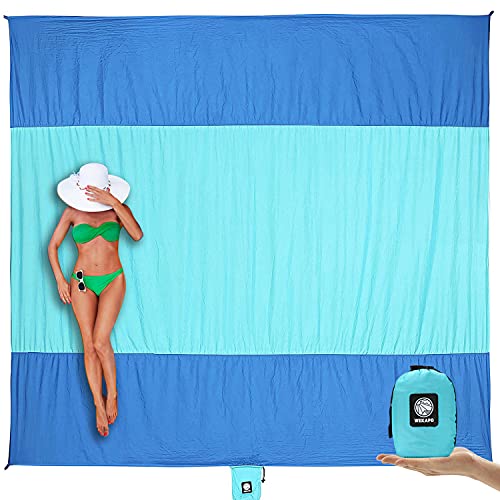
WEKAPO Beach Blanket Sandproof 10 x 9 — Best for Big Groups
Ninety square feet changes what a beach day feels like. The WEKAPO spreads to ten by nine feet, a territory on which seven adults can sit in the listing’s arithmetic and, more honestly, four or five adults can recline with bags, a cool box and a spreading game of cards all inside the border. Two families sharing one pitch stop performing the towel-archipelago shuffle, where everyone’s belongings migrate across gaps of hot sand. The mat becomes the room, and the room is big enough that nobody’s feet need to negotiate with anybody’s lunch.
The anchoring matches the ambition: six stakes plus four corner pockets that fill with sand and hold the perimeter like ballast. On a breezy coast that combination is the difference between a headquarters and a hazard, because a loose ten-foot sheet of fabric in a gust is a sail with opinions. The fabric itself is the light, quick-drying synthetic this category is built on, compact when folded in a way that seems implausible at first opening. Groups who camp at the beach from morning to sunset — the umbrella up, the day organised around one base — will find this the pick that reorganises the whole outing.
- Open size: 10 x 9 ft
- Listing capacity: up to 7 adults seated
- Anchoring: 6 stakes plus 4 fillable corner pockets
- Fabric: lightweight, quick-drying synthetic
- Packed character: folds compact despite the spread
- Best habitat: group base camps and all-day pitches
Strengths
- Genuine headquarters scale for two families or a big group
- Stakes and pockets together tame a genuinely large sail area
- Packs down far smaller than its open size suggests
Trade-offs
- Overkill, in size and setup, for a solo swimmer’s hour
- Needs a wide pitch; crowded beaches may not offer one
- More fabric to shake, fold and dry at day’s end
Best for: groups and families who build a base camp and stay all day. Not suited for: a lone reader with a paperback and forty minutes.

EASYFUN Beach Blanket Sandproof Oversized — Best Family All-Rounder
The EASYFUN occupies the sensible middle that most families actually inhabit: oversized at seventy-nine by eighty-three inches, large enough for two adults to stretch out with children orbiting between, small enough to carry without a planning meeting. Its verified listing leans on portability and water resistance, and the mat’s second career as a picnic blanket for travel, camping and hiking is genuine rather than decorative — the same smooth, sand-shedding surface that ignores a beach also ignores a damp meadow, and crumbs brush off it the way sand does.
For the household that owns one outdoor blanket and uses it everywhere, this balance is the argument. It will not host a volleyball team’s lunch, and it does not try to. What it offers is a clean, dry rectangle that appears from a compact bundle, hosts the family’s day without territorial stress and returns home in the evening needing a shake rather than a laundry cycle. Families graduating from the four-towel patchwork will feel the upgrade most at the seams — there are none, and nobody’s towel ends up three feet from where it started.
- Open size: 79 x 83 inches
- Character: oversized but portable
- Surface: water resistant, sand-shedding
- Second careers: picnic, camping and hiking mat
- Group fit: a family with young children
- Carry style: compact bundle for car boot or tote
Strengths
- The size most families will actually use weekly
- Doubles convincingly as a general picnic mat
- Water-resistant surface handles damp grass as happily as sand
Trade-offs
- Two reclining adults plus teenagers will outgrow it
- Less anchoring hardware than the largest picks here
- Mid-size means it wins no single category outright
Best for: a family of three or four wanting one mat for beach and park alike. Not suited for: gatherings that need a true headquarters footprint.

WIWIGO Beach Blanket Mat Sandproof — Best Size Range
WIWIGO’s interesting decision is range: the same quick-drying, waterproof, windproof mat design offered across sizes spanning two to eight adults, so the purchase becomes a sizing exercise rather than a model hunt. A couple can buy the modest version for two, a reunion can buy the banner version, and the fabric behaviour, care routine and folding habit stay identical. Consistency like that is underrated in households where the person packing the beach bag rotates.
The mat’s positioning reaches beyond the beach into travel, camping, hiking, picnics and festivals, and for once the breadth is plausible: a smooth waterproof sheet is a genuinely general outdoor tool, groundsheet one day and sand-free territory the next. Windproofing language in the listing points at the fabric’s dense weave, which also explains the sand behaviour — a surface tight enough to blunt wind gives grains very little purchase. Buyers should choose their size by the reclining test described in this guide’s introduction, not by the largest headcount printed anywhere on the page.
- Sizes: a range covering 2 to 8 adults
- Surface: waterproof, sand-shedding, quick drying
- Weave character: dense and windproof in feel
- Uses: beach, travel, camping, hiking, festivals
- Buying task: choose size by realistic occupancy
- Family trait: identical handling across the sizes
Strengths
- One design scaled from couples to reunions
- dense weave serves wind, water and sand resistance together
- Quick drying suits back-to-back holiday use
Trade-offs
- The buyer carries the burden of choosing the right size
- Largest sizes need the same wind discipline as any big sheet
- Generalist design lacks a single standout special feature
Best for: buyers who know their headcount and want the design to scale to it. Not suited for: shoppers who want the decision made for them by a single flagship size.

Wolfwise Beach Blanket Sandproof XXL — Best for Four People
Four adults is the classic beach unit — two couples, a family with older children, a double date with a cool bag — and the Wolfwise XXL is dimensioned precisely for it at seventy-eight by eighty-one inches. Four sand pockets and stakes anchor the corners, and the mat folds into an integrated storage bag rather than depending on a separate sack that will be lost by the second summer. That integrated bag sounds like a footnote and behaves like a headline: the mat that stores itself is the mat that is findable in the garage in June.
The waterproof, sand-shedding fabric follows the category pattern, and the foldable, windproof construction suits the picnic-and-festival second life its listing describes. In a line-up containing a ten-foot headquarters mat, the Wolfwise’s restraint is its intelligence. It covers the most common group completely, carries like an afterthought and asks for a pitch the size of two large towels rather than a small campsite. Most households shopping this category are, whether they admit it or not, shopping for exactly this.
- Open size: 78 x 81 inches
- Listing capacity: 4 people
- Anchoring: 4 sand pockets plus stakes
- Storage: integrated bag, nothing separate to lose
- Surface: waterproof and sand-shedding
- Second careers: picnics and outdoor events
Strengths
- Sized exactly for the most common beach group
- Self-storing design survives garage entropy
- Corner pockets plus stakes cover the wind bases
Trade-offs
- A fifth adult turns comfort into choreography
- Less sprawling luxury than the two biggest picks
- Integrated bag limits how tightly it can be compressed
Best for: two couples or a family of four with a standard beach routine. Not suited for: multi-family gatherings that need a shared headquarters.

Utopia Home Beach Blanket Sand Proof 108 x 120 — Best Maximum Coverage
At one hundred and eight by one hundred and twenty inches, the Utopia Home sheet is less a blanket than a venue. Ninety square feet was the WEKAPO’s claim; this one exceeds it, and the use cases shift accordingly — beach weddings’ informal edges, sports-day sidelines, outdoor cinema nights, the sprawling multi-family pitch where three households merge into one encampment. It ships with stakes and a carry bag, both necessities rather than accessories at this scale, because an unstaked sheet of this size in a sea breeze is a public announcement.
The lightweight, quick-dry travel positioning in its verified listing keeps it honest about portability: this is the mat a group organiser carries on behalf of everyone, not the one a solo swimmer tucks into a tote. On the sand it repays the effort by abolishing border disputes entirely; there is room for the bags, the games, the sleeping baby in shade and the adult who reads lying diagonally. Buyers should simply be certain their beach permits the footprint — on a narrow, crowded urban shoreline at noon in August, a ten-foot sheet can be more territory than etiquette allows.
- Open size: 108 x 120 inches
- Role: maximum-coverage group and event mat
- Included: stakes and carry bag
- Surface: waterproof, sand-shedding, quick dry
- Carry reality: an organiser’s load, not a tote item
- Best habitat: wide beaches, events, merged family pitches
Strengths
- The largest clean territory in this guide
- Event versatility far beyond ordinary beach days
- Included stakes and bag acknowledge its scale honestly
Trade-offs
- Needs a wide pitch and a group’s worth of occupants
- The most fabric to shake out, fold and dry here
- Wind management at this size is a genuine task
Best for: organisers of gatherings, events and multi-family beach days. Not suited for: crowded narrow beaches or anyone travelling light.
Woven Cotton Beach Blankets, Discussed Generically — Knowledge Pick
Before smooth synthetics, the beach blanket was a woven thing — cotton or a cotton blend, often striped, heavy when wet and permanently married to a quantity of sand it carried home in its weave. This entry exists because that older design still does two jobs the modern mat cannot. It absorbs water, so it can dry a swimmer; and it feels like a textile rather than equipment, warm to lie on in a way that a parachute-smooth sheet, for all its virtues, does not attempt. Generations of beachgoers were not wrong to love it.
They were, however, shaking sand out of it forever, and washing more sand out of the car. The woven blanket’s honest modern role is as a companion rather than a base: spread over a sand-free mat as the soft, absorbent top layer, carried for drying duty, or kept for the garden and the picnic lawn where its sand-trapping weave is irrelevant. Positioned on price, woven blankets occupy the budget-to-mid tiers depending on fibre quality, and a good one outlasts several synthetic mats — it simply serves a different brief.
Understanding the trade clarifies the whole category. The mat optimises the sitting surface; the woven blanket optimises the person. Households that swim seriously often end up owning both, deploying the mat as territory and the woven blanket as towel, wrap and siesta cover, and that two-layer system — old textile on new sheet — is arguably the most comfortable arrangement this guide can recommend.
- Format: traditional woven cotton beach blankets, as a class
- Signature strength: absorbency for drying swimmers
- Signature weakness: traps sand in the weave permanently
- Best modern role: top layer over a smooth mat
- Longevity: excellent; heavy cotton weaves endure for years
- Price positioning: budget to mid tier by fibre quality
Strengths
- Dries people, which no smooth mat attempts
- Soft, warm, familiar textile feel against skin
- Doubles as wrap, shade and picnic blanket anywhere
Trade-offs
- Carries sand home in its weave as a design feature
- Heavy when wet and slow to dry after a swim-heavy day
- Needs laundering where a mat needs only a shake
Best for: swimmers who want a real drying textile layered over a mat. Not suited for: anyone whose priority is leaving the beach’s sand at the beach.
Comparison Table
| Pick | Open size | Anchoring | Standout trait |
|---|---|---|---|
| WEKAPO Beach Blanket Sandproof 10 x 9 | 10 x 9 ft | 6 stakes, 4 pockets | Group headquarters scale |
| EASYFUN Beach Blanket Sandproof Oversized | 79 x 83 in | Portable design | Family all-rounder, picnic-ready |
| WIWIGO Beach Blanket Mat Sandproof | Sizes for 2–8 adults | Windproof weave | One design, many sizes |
| Wolfwise Beach Blanket Sandproof XXL | 78 x 81 in | 4 pockets, stakes | Integrated storage bag |
| Utopia Home Beach Blanket Sand Proof 108 x 120 | 108 x 120 in | Stakes included | Maximum coverage for events |
| Woven Cotton Beach Blankets, Discussed Generically | Various | Weight alone | Absorbency a mat cannot offer |
How Do Sand-Free Beach Blankets Actually Work?
The mechanism is friction, or rather its absence. Dry sand grains are small, hard and angular; against a woven surface full of interlaced yarns, each grain finds ledges and pockets, works deeper with every movement and resists eviction. Against a smooth, tightly woven synthetic sheet, a grain rests on a surface it cannot grip, so gravity and a shake are enough to evict it. That is the entire trick, and it is a good one — but it operates on contact, not at a distance. Sand blown across the mat by wind will land, sit and need brushing; sand tracked on by wet feet arrives with moisture as glue and must dry before it releases.
Wet sand deserves its own honesty. Fresh from the waterline, damp grains clump and adhere to almost anything, smooth synthetics included. The mat’s advantage reasserts itself as the patch dries — a few minutes of sun and the same area brushes clean, where a towel would hold its damp sand hostage all day. Experienced users therefore site the mat a little above the waterline’s busiest traffic, let wet arrivals pause at the corner to dry their feet, and treat the occasional damp footprint as a temporary exhibit rather than a failure of the concept.
One more behaviour separates good days from gritty ones: the mat rewards a brief settling routine. Spread it, anchor it, then give the surface one deliberate brush-down before anything is placed on it, clearing whatever the journey deposited. That ten-second reset establishes the clean baseline the rest of the day defends, and groups who skip it spend the afternoon unable to tell new sand from old, brushing at everything and enjoying it less.
Two-layer designs in the wider market push the principle further, letting sand fall through a mesh top layer so it cannot return. None of the picks here depends on that mechanism; they rely on the smooth-surface approach, which is simpler, lighter and doubles as a waterproof groundsheet. Understanding which mechanism a mat uses matters less than understanding the shared limit: all of them manage sand that lands. None of them can repeal a windy day.
How Many People Really Fit on Each Size?
Translate dimensions into bodies with a reclining adult as the unit: roughly six feet of length and two feet of width per person, plus shared margin for bags and movement. By that measure the WEKAPO’s ten by nine feet hosts four sprawled adults in luxury or five with discipline, whatever the seated headcount claims. The Utopia Home sheet adds a genuine fifth and sixth recliner. The family-sized mats around eighty inches square host two adults reclining and children in the remaining geometry, which is precisely the family shape they were designed around.
Seated occupancy is the listing number, and it is not a lie so much as a different activity. A picnic of eight seated adults with a shared centre of food fits a mat that would host three sunbathers. Decide which activity defines your beach day before choosing: groups that swim, walk and gather to eat need less territory than groups that arrive, recline and read for five hours. The second group should buy a size up from their first instinct, every time.
Shade structures, cool bags and the day’s accumulated equipment all draw from the same square footage, and honest planning subtracts them before counting people. An umbrella base planted on the mat consumes a body’s worth of territory; a large cool bag consumes a seated child’s. Groups that sketch the pitch — umbrella here, bags along that edge, sleepers in the long dimension — discover their true capacity in the car park rather than in an argument on the sand, and the sketch takes less time than the argument.
Children obey no unit. A toddler’s occupation of a mat expands to fill available space plus one toy’s width beyond it, and the sand toys themselves migrate. Families consistently report that the mat size they needed was the size that let the adults sit outside the toddler’s blast radius while remaining on clean fabric — an argument for the larger family options that no dimension table captures.
How Do You Keep a Lightweight Mat on a Windy Beach?
Anchor in sequence: pockets first, stakes second, belongings third. Fill the corner pockets with sand before the mat has a chance to lift, because a corner already weighted stays put while you work on the next. Drive stakes at an angle away from the mat’s centre, so tension pulls against the buried length rather than levering them out, and place heavy items — the cool bag, the water bottles, the bag of books — along the windward edge as a final breakwater. A mat anchored in that order survives gusts that scatter unanchored neighbours.
Timing is a wind tool too. Spreading a large mat is easiest in the lull that often comes mid-morning, before the sea breeze builds to its afternoon strength, and groups arriving early enjoy a calm setup that latecomers must perform in a gale. Where the day must start late, spread the mat folded in half, anchor the half that is open, then unfold the remainder into the wind’s direction so the breeze presses the new fabric down instead of getting beneath it. The sequence sounds fussy and takes ninety seconds; the alternative — a full sheet airborne with the cool bag chasing it — takes longer and entertains the whole beach at your expense.
Orientation helps more than hardware. A mat’s long edge presented to the wind acts as a sail’s leading edge; rotating the pitch so a short side faces the breeze reduces the lifting area and the flapping that works stakes loose. Siting behind a windbreak — a dune, a rock, the car’s own bulk in a beach car park — is the oldest solution and still the best one. When the wind defeats every measure, the honest answer is to fold the mat to half size and weight the remainder, conceding gracefully rather than spending the afternoon in combat.
Which Mistakes Do Beach-Mat Buyers Make Most Often?
Believing the headcount is the classic error, followed closely by believing the word sandproof describes a force field. Third comes choosing by open size while ignoring packed size, so the magnificent mat requires its own luggage allowance. Fourth, buyers overlook anchoring entirely and discover the omission in the first gust, improvising with flip-flops that were never going to hold a nine-foot sail.
Fifth, people pack the mat away damp and salted, then blame the fabric for the smell at the next outing; a rinse and a full dry are part of the product’s price. Sixth, they spread a headquarters-scale mat on a crowded shoreline’s last free patch, annexing the neighbours’ margin and spending the day in low-grade territorial diplomacy. And seventh, they expect the mat to dry swimmers, a job its water-shedding surface is specifically designed not to do. Every one of these mistakes is a mismatch of expectation rather than a defect of manufacture.
How Should You Clean and Store a Sand-Free Mat?
The daily routine is satisfyingly small: shake the mat downwind, away from your own pitch and everyone else’s, brush any damp patches once they dry, and fold it only when it is dry enough not to ferment in the car. At home, an occasional rinse with plain water clears salt and sunscreen residue; detergent is rarely necessary and a machine wash, where the maker permits it, should be gentle and infrequent. Sunscreen is the fabric’s real enemy over a season, dissolving into synthetic weaves and attracting the very grime the surface was designed to shed, so a rinse after oily days pays disproportionate dividends.
Storage asks for dry, dark and loose. A mat folded along different lines each time avoids permanent creases that can crack coatings; a breathable bag beats an airtight one in a humid garage. Check the stakes into the same bag every time, because a mat separated from its anchoring is half a product, and count them back in at the beach with the same discipline — shorelines accumulate a surprising archaeology of other people’s lost stakes.
Where Should You Pitch the Mat on a Real Beach?
Placement is a negotiation among sun, tide and traffic. Above the high-tide line is non-negotiable unless you enjoy relocating a full encampment under time pressure, and a glance at the debris line of seaweed and shells shows exactly where the water last reached. Within the dry zone, the busiest sand highways run in straight lines between the car park entrance and the water; a pitch set a few yards to either side of that corridor loses ninety percent of the passing foot traffic and the sand it kicks up, at the cost of no extra walking at all.
Shade planning separates veterans from beginners. An umbrella’s shadow migrates across the mat all day, and a pitch chosen with the afternoon position in mind saves the hourly shuffle. Families with a sleeping baby should map the shade’s journey at arrival, place the baby’s corner where shadow will be at nap time rather than where it is at ten in the morning, and let the adults rotate around that fixed point. The mat’s size earns its keep precisely here: a generous pitch absorbs the day’s geometry changes without anyone ending up exiled onto hot sand.
Neighbours are the final variable. A large mat spread with a margin of clear sand around it reads as a household minding its own business; the same mat spread flush against another group’s towels reads as annexation, whatever the intention. Leave a walkway. The goodwill costs two feet of sand and purchases an afternoon free of territorial friction, which is the best exchange rate available on a crowded beach.
How Does a Mat Behave on Wet Sand and Pebble Shores?
Wet sand near the waterline is firm, cool and tempting, and a mat laid there gains a stability dry sand never offers — the surface grips, stakes bite, and wind finds less loose material to throw at you. The price is damp: moisture wicks through any fabric eventually, the tide’s timetable governs your lease, and belongings sit closer to the splashing jurisdiction of children. As a short-stay pitch for swimmers who want a clean base between dips, it is excellent; as an all-day headquarters, the dry zone remains the professional choice.
Pebble and shingle shores invert the problem. Sand-shedding matters less because there is little sand; comfort matters more, because a thin synthetic sheet over stones is a diagram of every stone. On shingle, layer the woven blanket or towels over the mat, choose the flattest patch the shore offers, and appreciate the mat as a clean, dry barrier rather than a cushion. Campers who frequent mixed shores learn to carry the mat for its barrier value alone and to stop expecting one product to be both floor and mattress.
Rocky coves with pockets of sand reward the smaller mats in this guide. A four-person sheet fits the flat pocket a ten-foot headquarters mat cannot use, and the ability to fit the terrain you actually find, rather than the terrain the listing photographed, is a genuine feature. Households splitting their summers between wide sandy bays and small rocky inlets sometimes solve it with two mats of different sizes, an extravagance that pays for itself in pitches that always fit.
What Should You Do About Sunscreen, Food and Other Mat Enemies?
Sunscreen is the slow enemy. Oils soak into synthetic fibres, hold grit against the surface and gradually turn a sand-shedding sheet into a sand-collecting one, which is why the rinse-after-oily-days advice in the care section matters more than any other maintenance in this guide. Apply sunscreen before settling onto the mat where possible, keep the bottle in a sealed bag off the fabric, and treat the inevitable handprint as a prompt for the evening rinse rather than a catastrophe.
Food creates the day’s other traffic. A designated eating corner — ideally the downwind corner, near the edge — concentrates crumbs, drips and the sand that arrives on the feet of children summoned to lunch. The mat’s smooth surface is a genuine ally here: spills wipe, crumbs brush, and nothing soaks into a weave to reappear as a smell next weekend. After eating, a deliberate sweep of the whole surface resets the pitch; groups that build that two-minute ritual into the rhythm of the day report that the mat still looks civilised at six in the evening.
Dogs, where beaches permit them, combine every challenge at once: wet fur, sandy paws, enthusiastic shaking. A mat survives a dog better than any towel system ever built, provided the dog’s settling spot is the corner nearest the water and the humans accept that corner as a permanently renewable resource. The fabric will not be damaged; the fantasy of a pristine pitch simply needs adjusting to include a very happy animal.
How Do Sand-Free Mats Compare With Beach Towels and Pop-Up Tents?
The towel comparison is really about territory. A towel defines one person’s space and dries that person; a mat defines a group’s space and dries nobody. Households need both functions, and the modern settlement — mat as floor, towels as personal equipment kept mostly off the sand — uses each tool for its strength. The family that abandons towels entirely discovers the gap at the first swim; the family that relies on towels alone spends the day performing border maintenance between five shrinking islands.
Pop-up shade tents answer a different question, providing shelter rather than floor, and the two combine naturally: tent at the mat’s shaded end, open sand-space in front. Where wind rules out erected shade, the mat alone survives, which is why windy-coast regulars often invest in the mat first. Weight tells the same story — a mat’s negligible carry makes it the piece of beach infrastructure most likely to be present on an unplanned evening visit, and presence is the first feature every other feature depends on.
Beach chairs deserve a cautionary note in this company. Chair legs concentrate weight onto small points and can puncture or stress a thin mat’s fabric, particularly on soft sand where the legs sink and lever. Set chairs at the mat’s edge with legs off the fabric, or choose the mat as a chair-free zone and let its clean surface be the luxury it was bought to be.
What Makes a Mat Last More Than One Summer?
Ultraviolet light is the long-term tax on every synthetic left in the sun, and beach mats pay it at the highest rate of any household textile. Fading is the visible symptom; fibre weakening is the real one. A mat rinsed, dried and stored in the dark between outings ages at a fraction of the pace of one living permanently in a hot car boot, and the difference shows by the third summer as suppleness versus brittleness. Storage discipline, boring as it sounds, is the single largest variable in a mat’s lifespan.
Seams and stake points fail before fields of fabric do. Inspect the corners after windy days, when the anchoring has done real work, and retire or repair a mat whose stake loops are tearing rather than discovering the failure mid-gust on a crowded beach. Folding on fresh lines, as the care section advises, spreads crease stress across the sheet instead of concentrating it into cracks along a single fold. None of this is skilled work; it is two minutes of attention applied at the moments when attention is cheapest.
Salt is the final quiet agent. Left in the weave, it holds moisture against the fabric and stiffens the hand of the material across a winter’s storage. The end-of-season rinse is therefore the most important wash of the year — a full rinse, a complete dry in moving air, and only then the cupboard. A mat stored clean in September is a mat that opens in June smelling of nothing, ready to be believed in again.
How Should Solo Beachgoers and Couples Choose Differently?
A solo reader’s needs invert the group’s. Territory matters less than portability and speed: the mat that leaves the car in one hand, spreads in a minute and anchors with two pockets suits the swim-and-read rhythm better than any headquarters sheet. Small sizes in ranges like WIWIGO’s exist precisely for this user, and their discipline should be to resist buying up “just in case” — the case rarely arrives, and the bulk is paid on every single trip.
Couples occupy the interesting middle. Two people reclining need more than the smallest mats honestly offer, particularly with books, bags and a shared lunch in the geometry, which is why the four-person class — the Wolfwise’s territory — is secretly the couples’ class as well. The surplus space is not waste; it is the margin that keeps a shared afternoon feeling generous rather than allocated, and it absorbs the friend who joins for an hour without a pitch renegotiation.
Both audiences should weigh the walk honestly. A mat’s packed bulk interacts with everything else being carried — umbrella, chairs, cool bag — and the correct size is the one that survives the whole load’s logistics, not the one that wins a dimension contest in isolation. The beach rewards the party that arrives unburdened and slightly under-equipped far more reliably than the one that arrives exhausted behind a wagon of perfect gear.
How Do You Fold and Carry a Big Mat Without a Struggle?
Technique beats strength. Shake the mat downwind with two people holding corners where possible, since a ten-foot sheet shaken solo mostly relocates sand onto its owner. Fold in halves toward the centre rather than rolling from one edge, trapping less air and keeping the bundle flat enough for its bag. The fold lines should vary trip by trip — a detail the care section raised for the fabric’s sake that also, happily, makes the bundle pack differently enough to fit awkward car boots.
Assign the carry before the day begins. In group logistics the mat is light but bulky, the cool bag heavy but compact, and the person with the free shoulder should take the sheet while the person with the free hand takes the handle. Groups that improvise this at the car park perform the familiar ballet of swaps and drops across the sand. A mat in its own carry bag with a shoulder strap — as the largest picks here provide — largely dissolves the problem, which is why the bag is treated in this guide as part of the product.
What Happens to the Mat in Rain and Sudden Weather?
A waterproof-surfaced mat in a shower becomes a shallow tray, and the correct response is choreography: lift one edge, let the water run off, and move belongings to the centre’s high ground. The same surface that refuses sand refuses rain with equal indifference, so a passing shower that ruins a towel-based pitch merely interrupts a mat-based one. Groups who shelter under the umbrella for ten minutes return to a pitch that needs one tilt and a wipe rather than a full relocation.
Lightning and genuinely dangerous weather are a different matter, and no blanket advice outranks leaving the beach. The mat’s virtue in an evacuation is speed: stakes pulled, corners gathered, the whole pitch bundled in under a minute. Practising that bundle on a calm day is the sort of small rehearsal that turns a scramble into a routine, and families with children benefit most from making it a game before it is ever a necessity.
How Does the Mat Earn Its Place Beyond Summer?
Autumn and spring reassign the mat to ground duty everywhere a clean, dry layer is wanted: the touchline at children’s sports, the garden during a bonfire party, the floor of a tent porch where boots are shed, the base under a paddling pool. Its waterproof indifference to damp grass, the property that made it a picnic mat in July, makes it a mud-season tool in October. Households that store it accessibly rather than entombing it with the summer boxes discover these second seasons on their own.
There is also the indoor emergency career: the mat under a leaking washing machine’s temporary exile, beneath a painting project, as the clean surface for sorting a garage sale’s offerings on the lawn. None of this was in the listing, and all of it follows from owning a large, tough, washable sheet. The mats in this guide are bought for sand and kept for everything, which is the most durable argument for choosing a good one rather than the cheapest available sheet of fabric.
Why Does the Shake Test Tell You More Than Any Label?
When a mat arrives, take it to the garden with a bucket of dry sand and perform the experiment the whole category is built on. Spread it, scatter sand, walk across it in bare feet, sit, stand, then lift one corner and shake. A good mat returns to visibly clean in seconds, with grains cascading off rather than clinging in patches. Dampen a corner and repeat: the damp patch will hold its sand until it dries, confirming the honest limit this guide has described rather than any failure of your particular purchase.
That five-minute ritual calibrates expectations better than any review, including this one. You will know exactly what your mat does with dry sand, damp sand and a breeze, and the knowledge converts the first beach day from an experiment into a performance. Products in this category are unusually testable — a rare mercy in consumer goods — and the buyers who test are the buyers who write the calm, accurate reviews everyone else relies on.
Final Recommendation
Choose by group and by wind, in that order. Two families or one determined base camp should take the WEKAPO and its stakes-and-pockets anchoring; event organisers and merged households should go further, to the Utopia Home sheet. The ordinary family day is served best by the EASYFUN’s balanced footprint, the classic four-person unit by the Wolfwise and its self-storing bag, and anyone whose headcount swings between two and eight by picking their honest number from the WIWIGO range. Add a woven blanket over the top if swimming and drying are central to the day. Buy the size your group reclines on rather than the size it can technically sit on, anchor the windward edge before the first gust teaches you why, and the mat will repay you in the only currency this category truly deals in: a clean place to land, hour after hour, while the sand stays where it belongs — everywhere except on your blanket, your sandwiches and your drive home.
Frequently Asked Questions
Does sandproof mean no sand will ever stay on the mat?
No, and this guide has avoided claiming otherwise. Smooth fabric means sand does not lodge or cling: dry grains shake and brush off in seconds. Damp sand and wind-blown sand will land and linger until they dry or are swept away. The honest promise is a mat that returns to clean with a shake, not a mat sand cannot touch.
Can I use a beach mat as a picnic blanket on grass?
Yes — the same smooth, water-resistant surface that sheds sand also sheds crumbs and resists damp grass soaking through from beneath. Several picks here are explicitly positioned for both duties. Just remember the surface is not absorbent or padded; a woven layer over the top restores softness for long, lazy picnics.
What size should a family of five choose?
Work from reclining space rather than headcount. Two adults plus three children typically need the headquarters end of the range — the WEKAPO’s ten by nine feet — if everyone is to sprawl at once, or a family-size mat if the children spend the day in motion and only the adults truly recline.
How do I stop the corners curling up?
Curling is an anchoring and storage issue. Fill corner pockets fully, stake at an outward angle, and store the mat rolled or folded on fresh lines rather than crushed, since a mat stored in a tight ball learns a curl it then performs on the sand. A few minutes weighted flat in the sun usually retrains a stubborn corner.
Is a bigger mat always better?
Only until the walk, the pitch and the wind vote otherwise. Big mats need wide pitches, organised anchoring and a carrier committed to the load. A mat one size smaller that actually gets brought, spread and enjoyed beats a headquarters sheet left in the garage for being a production to deploy.
Related Guides
From the shoreline, the neighbouring guides below move to a sofa buried in plush, a kitchen floor patrolled by a rabbit and a mountain trail where a blanket’s weight is audited in grams.
Continue with Best Faux Mink Blankets for the opposite philosophy of blanket comfort, detour through Best Alpaca Blankets for natural-fibre luxury, or read Best Baby Blankets for Summer for the lightest blankets in the whole collection. The reading to pair with this one is Best Battery-Operated Pool Vacuums.


