What's inside
- Key Takeaways
- Quick Picks
- How Did We Choose the Best Blankets for Foster Kittens?
- At a Glance: How Do the Six Bedding Options Compare?
- How Should Foster Kitten Bedding Be Washed?
- How Do You Keep Foster Kittens Warm, Safely?
- Which Blanket Size Suits Which Stage of a Kitten’s Growth?
- Why Does a Kitten’s Blanket Matter on Adoption Day?
- How Do You Set Up a Foster Kitten Space Around the Bedding?
- How Can You Tell When a Foster Blanket Is Finished?
- What Does Blanket Rotation Really Cost a Foster Home?
- How Do Blankets Help With Handling and Socialisation?
- What Should You Look for When the Kittens Are Bottle Babies?
- What Are the Most Common Mistakes When Bedding Foster Kittens?
- Final Recommendation
- Frequently Asked Questions
- Related Guides
As an Amazon Associate I earn from qualifying purchases. This post may contain affiliate links at no extra cost to you.
cottageverdict.com is reader-supported. When you buy through links on our site, we may earn an affiliate commission.
Where to buy: each kitten blanket set below links to its Amazon listing, where you can check price on Amazon and confirm the blanket dimensions, the pack count and the fabric before ordering. Buy for the laundry rotation, not for the single photograph — fostering runs on clean bedding, in quantity, at all hours.
The best blankets for foster kittens live a harder life than any other blanket in this batch of guides. A foster kitten’s bedding is changed not when it looks tired but constantly — after every accident, every feeding spill, every bout of the digestive adventures that come with very young animals — and it is washed hot, dried fast and put straight back into service, sometimes for litter after litter across a fostering season. Underneath that laundry reality sits a simpler one: a kitten who has lost its mother sleeps against whatever softness it is given, kneads it, suckles it, and learns the world partly through it. The blanket is both a hygiene system and a substitute mother, and it has to be good at both jobs at once.
This guide is written for foster carers — the rescue volunteers and kind households with a crate in the spare room and a washing machine that never rests. Every linked pick is a small fleece blanket sold in a multi-pack, because fostering arithmetic is rotation arithmetic: you need enough blankets that a clean one is always ready while a load is in the wash and another is in use. Sizes here run from about 23 by 16 inches to 24 by 28 — crate, carrier and incubator-tub scale, not bed scale. One prose option, plain fleece yardage cut to size, closes the list for carers who go through bedding by the metre.
A note on warmth before the picks, because it is the one place this guide will be firm: very young kittens cannot regulate their own body temperature and rely on an external heat source managed according to your rescue organisation’s or vet’s guidance. A blanket’s job in that setup is insulation and comfort — layering over and around, never a substitute for the heat source itself. Follow your rescue’s neonatal protocol over anything printed here; our subject is the bedding, chosen well.
Key Takeaways
- Rotation is everything: buy enough small blankets that a clean one is always ready while others are in the wash.
- Fleece is the foster standard because it washes hot, dries fast, has no loose weave for tiny claws to snag, and stays soft without fabric softener.
- Crate-scale sizes around 24 by 16 inches suit carriers, tubs and small pens; larger litters want the 24-by-28 size.
- Unscented laundry habits matter — kittens navigate by smell, and strong detergent fragrance is noise in their world.
- Blankets that a kitten has suckled and kneaded can travel with it to the adoptive home as a familiar-smelling comfort.
- Retire blankets that pill heavily, thin out or develop holes; tiny limbs and worn fabric are a poor combination.
Quick Picks
| Pick | Badge | Why it earns its place |
|---|---|---|
| Kitten Blankets Fleece 4 Pack 24 x 16 | Best Purpose-Made Kitten Set | Four small fleece blankets in kitten colours, made and sized expressly for kittens and their crates. |
| Luciphia Cat Blankets 3 Pack 23 x 16 | Best Plush Comfort Pick | A thicker 280 GSM fuzzy blanket for kittens who knead, suckle and sleep hard against their bedding. |
| Comsmart Fleece Pet Blankets 6 Pack | Best Rotation Value | Six larger 24-by-28 blankets that keep a foster room supplied through constant changes. |
| Chumia Fleece Puppy Blankets 18 Pcs | Best Bulk for Rescues | Eighteen small printed blankets for high-volume fostering, shelters and kitten-season surges. |
| MIWOPET Fleece Pet Blankets 3 Pack | Best Non-Shedding Flannel | A non-shedding flannel set that comes out of the wash clean, for fast turnarounds and tidy crates. |
| Plain Fleece Yardage, Cut to Size | Best Custom Method | The prose-only route: unprinted fleece bought by length and cut to fit any crate or tub exactly. |
How Did We Choose the Best Blankets for Foster Kittens?
We judged these blankets the way a foster carer at 2 a.m. judges them: by how they survive the wash, how they fit the crate, and how they feel to a creature that weighs less than a bag of sugar. Wash survival came first, because it is the category’s whole story. Foster bedding is laundered more in a month than a household blanket is in a year, often hot, always unsentimentally. Fleece earns its monopoly here honestly — it tolerates that regime, dries in a fraction of cotton’s time, and does not fray into strings that tiny claws and mouths can work on.
Construction came second. We favoured smooth fleece and flannel surfaces over looped or loosely woven textures, because kitten claws are needles and a looped pile is a snare that frightens a baby animal and damages the blanket at the same time. Edges matter at this scale too: a small blanket is all edge, proportionally, and a finish that stays intact through fifty washes is worth more than a pattern.
We also thought about the carer’s hands, because fostering is physical work done by tired people. Small blankets are light to carry in armfuls, quick to fold, and kind to a household machine that will run daily for months; a foster room stocked with full-size household blankets would drown in its own laundry by the second week. Scale, in other words, is not a compromise forced on this category — it is the design. Everything in this guide is small because the animals are small, the changes are constant, and the people doing them deserve equipment sized to the rhythm of the work.
Finally, the pack arithmetic. A single litter of four kittens, changed twice a day, consumes clean blankets at a rate that shocks new fosters; a household running two litters needs a small linen economy. The picks here scale from a gentle three-pack for one kitten to an eighteen-piece supply for a rescue in kitten season, and the reviews are plain about which scale each serves — because the most common fostering purchase error is not buying the wrong blanket, it is buying the right blanket in a quantity that collapses by Thursday.

Kitten Blankets Fleece 4 Pack 24 x 16 — Best Purpose-Made Kitten Set
Most small pet blankets are dog blankets that shrank in the marketing; this set is the exception, made and described for kittens from the start. Four fleece blankets at 24 by 16 inches — the dimensions of a carrier floor, a small crate, a plastic tub nursery — in white, brown, pink and grey. The maker’s own description speaks of nursing and suckling, which tells you the blanket was designed with orphan kittens in mind: a soft, smooth surface that a kitten can knead and mouth without loose pile or loops to catch on.
Four is the minimum viable rotation for a single small litter, and the set knows it: one in the crate, one in the wash, one drying, one ready. The colours do quiet organisational work in a foster home — assign a colour per litter or per kitten and the laundry stops being archaeology. In a house running quarantines between litters, as good fostering practice demands, colour-coding is not tidiness for its own sake; it is hygiene you can see.
The fleece is the standard smooth kind, which is the right call at this age. It washes hot without complaint, comes out of the dryer nearly dry, and presents no texture a claw can hook. Kittens graduate to plusher surfaces as they grow, but for the first weeks — eyes opening, first wobbly expeditions across the crate — a smooth, warm, frequently changed fleece is precisely the environment experienced fosters build.
Buy two sets if your fostering is continuous. The price of the second set is small; the 2 a.m. moment when the last clean blanket is in a machine full of water and a kitten has just been sick on the fourth is not. This set is where we would start a new foster home’s linen cupboard, and the doubling is the first upgrade we would make to it.
- Pack count: 4 blankets
- Size: 24 x 16 inches each
- Material: fleece
- Colours: white, brown, pink, grey
- Care: machine washable and dryable
Strengths
- Purpose-designed for kittens, including the nursing and suckling stage
- Four colours enable per-litter colour-coding in multi-litter homes
- Smooth fleece surface is safe for tiny claws and easy to wash hot
Trade-offs
- Four blankets is a minimum rotation, not a comfortable one
- Small size is outgrown as kittens reach the playpen stage
- Lightweight fleece is insulation and comfort, not a heat source
Best for: new foster homes and single litters in crates and carriers. Not suited for: high-volume fostering without buying multiples.
Luciphia Cat Blankets 3 Pack 23 x 16 — Best Plush Comfort Pick
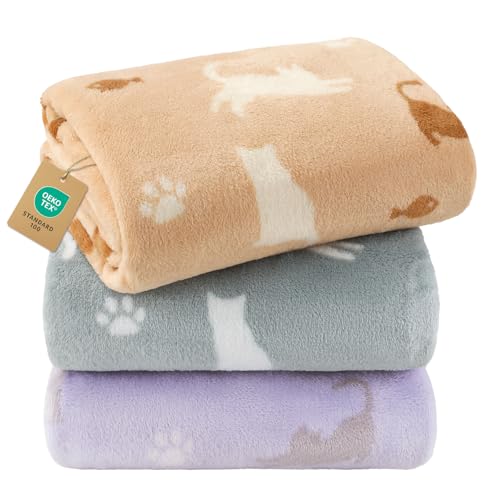
Some blankets in a foster home are infrastructure, and some are comfort, and the Luciphia set is unabashedly the second kind. Three blankets at 23 by 16 inches in a fuzzy 280 GSM fleece — noticeably plusher than the standard utility fleece elsewhere in this guide — made for the kitten who kneads before sleeping, suckles the bedding, and presses its whole small weight against softness as if reuniting with it. Orphaned kittens do this with heartbreaking dedication, and a blanket with real pile gives that behaviour somewhere satisfying to go.
The extra GSM is warmth and cushion as well as feel: layered over a properly managed heat source per your rescue’s protocol, a plush blanket makes the warm zone of the crate genuinely nest-like, holding a pocket of warmth around a sleeping litter. For singletons — the single rescued kitten with no littermates to pile against — that nest quality matters most of all, and fosters often pair a plush blanket with a small stuffed companion for the kitten to curl against.
The trade for plushness is laundry physics. A thicker blanket holds more water, dries slower, and shows the wash’s effects sooner than a flat fleece; rotate it as the comfort layer rather than the base layer, changed on the normal rhythm but not asked to be the only blanket in the system. Three in a pack is a comfort rotation, and most homes will run these alongside a plainer, larger set rather than instead of one.
As the kittens grow, these become the blankets that go home with adoptees — the familiar-smelling, much-kneaded favourite that eases the move to a new house. More than one foster keeps the Luciphia-style plush specifically for that farewell purpose, and it is as good a use as a blanket can be put to.
- Pack count: 3 blankets
- Size: 23 x 16 inches each
- Material: fuzzy fleece, 280 GSM
- Colours: assorted cute designs
- Care: machine washable; allow fuller drying time
Strengths
- Plush pile satisfies kneading and suckling behaviour
- Thicker fabric makes a warmer, more nest-like sleeping surface
- Ideal as the familiar blanket that travels with an adopted kitten
Trade-offs
- Slower to dry and quicker to show wash wear than flat fleece
- Three blankets is a comfort rotation, not a full bedding system
- Pile needs a check for matting as kittens begin to groom and play
Best for: comfort layering, singletons and adoption-day blankets. Not suited for: sole bedding in a high-turnover foster room.
Comsmart Fleece Pet Blankets 6 Pack — Best Rotation Value
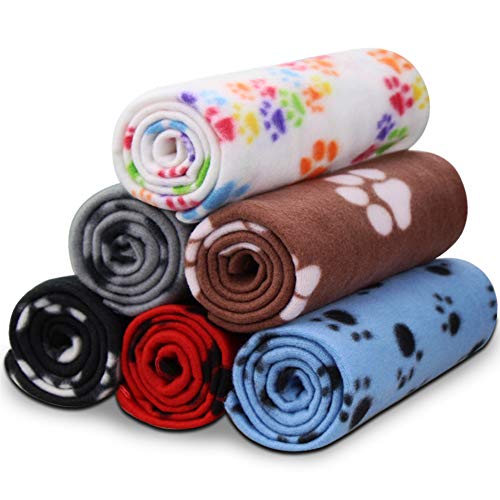
The Comsmart six-pack is the working foster room’s friend: six fleece blankets at 24 by 28 inches — a size up from the crate sets — with paw-print designs, at the kind of value that lets a carer treat blankets as the consumable they honestly are. The larger dimension covers a small pen floor, folds double for a thicker nest, drapes a carrier completely, and still serves when the kittens graduate from the tub to a playpen and need bedding with more ambition.
Six is the rotation number where a single-litter household starts to breathe: changes stop being synchronised with the washing machine’s moods. Fosters consistently report that the emotional texture of kitten season changes when the clean blanket is simply always there, and this pack is the cheapest way in the guide to buy that calm. The paw prints, meanwhile, do the same colour-coding work as the kitten set’s colours — pattern per litter, in a house that needs the system.
The fleece is a general pet fleece rather than a kitten-specific one, and the difference is mostly marketing; the surface is smooth, the edges are finished for the wash, and nothing about it will trouble a kitten. What you give up against the purpose-made set is the slightly finer hand feel and the nursing-specific design; what you gain is size, count and price discipline, which in a working foster room are the virtues that compound.
Retirement planning is part of this pack’s value. Blankets that have served a season of litters, washed to a tired softness, graduate to lining carriers for vet trips, covering traps in TNR work, or padding the beds of the foster’s own resident cats. A six-pack bought for kittens rarely stops working when the kittens leave.
- Pack count: 6 blankets
- Size: 24 x 28 inches each
- Material: fleece with paw-print designs
- Colours: assorted prints
- Care: machine washable
Strengths
- Larger size serves pens and playpens as kittens grow
- Six-blanket rotation ends the wait-for-the-wash problem
- Strong value that suits blankets’ real consumable status
Trade-offs
- General pet fleece rather than kitten-specific design
- Too large to fold neatly into the smallest carriers without bulk
- Prints vary; strict colour-coding per litter is approximate
Best for: working foster rooms running one or two litters. Not suited for: the tiniest neonatal tubs where smaller blankets handle better.

Chumia Fleece Puppy Blankets 18 Pcs — Best Bulk for Rescues
Kitten season, for rescues, is not a metaphor — it is a flood, arriving in spring and cresting for months, of litters in boxes, singletons in jacket pockets, and more small mouths than any facility planned for. The Chumia eighteen-piece set is the supply answer to that flood: eighteen fleece blankets at 23 by 16 inches, printed with paw, bone and star designs, at a bulk value that lets a rescue or a high-volume foster treat a clean blanket per kitten per change as a standard rather than an aspiration.
At this volume the blankets become a system. They line the intake tubs, they go into quarantine with each new arrival, they are the layer that can be changed without a negotiation with the laundry schedule, and — a use experienced rescues swear by — one can be sent with each adopted kitten as the familiar-smelling bridge to its new home, without the foster feeling the loss from a small personal stock. Bulk turns that kindness from a sacrifice into a routine.
The prints are puppy-marketed, and kittens, it turns out, cannot read. What matters is the fleece: smooth, light, quick in the wash, and consistent across the set so that any blanket fits any crate in the building. Consistency is an underrated virtue in a rescue, where bedding is handled by many volunteers; a standard blanket means every setup looks the same and every new helper already knows it.
The honest limit is the same as every bulk buy: storage, and the discipline to retire worn pieces from a large stock where a tired blanket can hide. Rescues should date or mark sets by season and cull without sentimentality at season’s end — the next flood deserves fresh fleece, and the budget that bulk buying creates is exactly what makes that cull affordable.
- Pack count: 18 blankets
- Size: 23 x 16 inches each
- Material: fleece with paw, bone and star prints
- Colours: assorted sweet prints
- Care: machine washable and quick to dry
Strengths
- Eighteen-blanket supply built for kitten-season volume
- Enables a send-home blanket with every adoption
- Uniform size standardises setups across a whole rescue
Trade-offs
- Bulk stock needs storage and a culling discipline
- Light fleece is a working layer, not the plushest comfort option
- Overbuy for a household fostering one litter a year
Best for: rescues, shelters and high-volume foster homes. Not suited for: occasional single-litter fostering.

MIWOPET Fleece Pet Blankets 3 Pack — Best Non-Shedding Flannel
The MIWOPET set’s claim is a negative virtue, and in a foster room negative virtues are gold: this flannel fleece does not shed. Three blankets at 23 by 15 inches in brown, pink and white with paw prints, made of a soft flannel that comes out of the wash as clean as it went in — no drift of fibres across the crate, no fuzz in the water bowl, no lint worked into a kitten’s eyes and nose during the weeks when both are barely open and entirely defenceless against irritation.
That cleanliness suits the youngest end of fostering. Neonatal and very young kittens live with their faces in their bedding; what the bedding releases, they breathe and swallow. A non-shedding surface is therefore not a tidiness preference but a small, real welfare feature, and it pairs with the smooth flannel hand feel that makes these blankets easy to check at a glance — a soiled blanket announces itself honestly against flannel, which speeds the change rhythm that hygiene depends on.
Three blankets is the smallest rotation in this guide, and we place it deliberately: this is the specialist set, bought for the neonatal crate or the isolation pen, while a plainer bulk supply handles the general population. Used that way, its count is not a weakness. Used as a whole fostering system’s bedding, it would be — the reviews in this guide keep returning to rotation arithmetic because kittens keep returning to it, usually at night.
The colours repay a mention: brown, pink and white read clearly against each other even to a tired carer under a dim bulb, which makes the which-litter-is-this check instant. Small mercies, in kitten season, are the whole infrastructure of sanity.
- Pack count: 3 blankets
- Size: 23 x 15 inches each
- Material: flannel fleece, non-shedding
- Colours: brown, pink, white with paw prints
- Care: machine washable
Strengths
- Non-shedding surface suits neonatal kittens’ faces-in-bedding stage
- Flannel shows soiling clearly, speeding hygiene checks
- Distinct colours support instant litter identification
Trade-offs
- Three blankets is a specialist rotation, not a full system
- Smallest dimensions here — best for crates, not pens
- Flannel is smooth rather than plush; comfort seekers may layer it
Best for: neonatal crates and isolation pens within a larger system. Not suited for: a foster home’s only blanket purchase.
Plain Fleece Yardage, Cut to Size — Best Custom Method
The final option sells nothing and serves the carers the packs cannot: the foster whose crates are an odd size, whose incubator tub is a repurposed storage box, whose rescue goes through bedding at a rate that makes retail packs feel like buying water by the bottle. Plain fleece bought by length from a fabric shop, cut with scissors into rectangles, needs no hemming — fleece does not fray — and produces blankets at exactly the dimensions of the housing they will line, in quantities limited only by the bolt.
The virtues compound quietly. Cost per blanket falls below every pack in this guide at volume. Sizes can vary within one purchase — large pieces for pens, small for carriers, a few cut long for wrapping a frightened arrival. And the carer chooses the fabric’s weight and surface in person, by hand, which no listing photograph can do for them. For a rescue equipping a whole room, an afternoon with a bolt of fleece and a pair of dressmaking scissors is the most economical setup session there is.
The costs are the familiar ones of all making: time, and the discipline to cut straight and consistently so the stock stacks and rotates uniformly. Unprinted fleece also surrenders the colour-coding system unless the carer buys two bolts in different colours — which, at yardage prices, many do, restoring the system at the level of the whole batch. As an everyday expense it sits in the budget tier; as a commitment of an afternoon it sits in the premium tier of effort, and high-volume carers consistently judge it worth both. Choose the packs above for convenience and the bolt for scale, and do not let anyone tell you one of those choices is the only serious one.
- Material: plain fleece bought by length
- Size: cut to your crates and tubs exactly
- Edging: none required — fleece does not fray
- Cost: lowest per blanket at volume
- Typical users: rescues and high-volume foster homes
Strengths
- Exact sizing for non-standard crates, tubs and pens
- Cheapest route to a genuinely large blanket stock
- Fabric weight and surface chosen in person, by hand
Trade-offs
- Costs an afternoon of measuring and cutting
- No prints or colours for coding unless you buy multiple bolts
- Cut edges look homemade — because they are
Best for: rescues and prolific fosters with non-standard housing. Not suited for: carers who need bedding tonight with no making involved.
At a Glance: How Do the Six Bedding Options Compare?
| Option | Count | Size | Fabric | Best role |
|---|---|---|---|---|
| Kitten Blankets Fleece 4 Pack 24 x 16 | 4 | 24 x 16 in | Fleece | Purpose-made kitten crates |
| Luciphia Cat Blankets 3 Pack 23 x 16 | 3 | 23 x 16 in | Fuzzy fleece 280 GSM | Plush comfort layer |
| Comsmart Fleece Pet Blankets 6 Pack | 6 | 24 x 28 in | Fleece | Everyday rotation value |
| Chumia Fleece Puppy Blankets 18 Pcs | 18 | 23 x 16 in | Fleece | Rescue-scale bulk |
| MIWOPET Fleece Pet Blankets 3 Pack | 3 | 23 x 15 in | Flannel fleece | Non-shedding neonatal use |
| Plain Fleece Yardage, Cut to Size | Cut to need | Any | Fleece by length | Custom sizes at volume |
How Should Foster Kitten Bedding Be Washed?
The laundry protocol matters as much as the blanket, so here it is as experienced fosters run it. Wash hot enough to do genuine hygiene work, with an unscented detergent, and skip the fabric softener entirely — softener coats fleece fibres, reducing the absorbency and warmth the blanket is there to provide, and leaves a fragrance in the fabric that overwhelms a small animal whose map of the world is drawn in scent. A second rinse, if your machine offers it, is worth the water for the youngest kittens. Dry thoroughly and completely; a blanket returned to a crate even slightly damp will chill the very animals it is meant to warm and will smell sour within a day.
Separation is the second rule. Litters in quarantine — and every new intake should be treated as unknown until your rescue’s protocol clears it — get their own laundry loads and their own blanket stock, which is where the colour and print coding in these packs stops being a nicety. Bedding from a litter being treated for anything contagious follows your vet’s or rescue’s specific instructions, up to and including disposal; fleece is cheap, and the packs in this guide are priced so that discarding a compromised blanket is a decision you can afford to make without hesitation. That affordability is, in a real sense, a biosecurity feature.
Build the rhythm before kitten season, not during it. A load a day is the foster household’s heartbeat in season: morning change, wash, dry, fold, restock the crate-side pile. The carers who thrive are the ones whose system makes the clean blanket the path of least resistance at 3 a.m., because a system that depends on willpower will fail exactly when the kittens need it most.
How Do You Keep Foster Kittens Warm, Safely?
Warmth for young kittens is a system with three parts, and the blanket is only one of them. The first part is the heat source itself — a rescue-approved warming pad or disc — which must always be set up under your organisation’s or vet’s guidance, and which this guide deliberately does not specify, because neonatal care is a protocol, not a shopping list. The second part is choice: kittens must always be able to move off the warm zone onto a cooler one, since overheating is as real a danger as chilling, so the heated area should cover only part of the crate floor. The blanket’s role spans both — layered over the warm zone to hold its heat gently, and present in the cool zone as plain comfort.
The third part is the nest structure. A blanket arranged with a fold or a soft roll at its edge gives kittens something to burrow against that mimics the press of littermates and mother — a boundary that makes a small animal feel held. Singletons benefit most visibly, but whole litters arrange themselves against a blanket’s folds with an instinct that predates their eyes opening. Change the arrangement at every bedding change so the nest is rebuilt fresh; a flattened, soiled nest is neither warm nor comforting, whatever it was at dawn.
Watch behaviour, finally, as your thermostat. Kittens piled tightly and crying are telling you something about cold; kittens spread far apart, away from the warm zone, are telling you the opposite. The blankets in this guide give you the material to respond to both messages in seconds — another layer on, a layer off — and that responsiveness, more than any single product, is what good fostering actually consists of.
Which Blanket Size Suits Which Stage of a Kitten’s Growth?
In the first two weeks of life, a kitten’s world is a few square inches, and the small sizes in this guide — the 23-by-16 class — are correctly scaled to it: large enough to line the tub and fold once for a nest, small enough to change completely and often without wrestling fabric. The blanket at this stage is essentially the kitten’s entire landscape, and its cleanliness is the landscape’s weather.
From roughly three to five weeks, mobility arrives all at once — first wobbles, then expeditions, then the discovery that siblings can be climbed. Bedding now needs to cover a pen floor and survive being dug at, dragged and rearranged by its occupants as a form of interior design. This is the Comsmart size’s moment: 24 by 28 covers the ground, folds for a sleeping corner, and tolerates the excavation phase without tearing. Expect to change it more often, not less; exploration is messy work.
Beyond five weeks, the blanket’s job changes character again — less nest, more territory. Kittens play on it, carry toys to it, and begin the serious business of grooming themselves and each other on it. Almost any clean fleece serves, and fosters often demote the older, softer stock to this stage while reserving the freshest blankets for the neonatal crate, where the standard matters most. That cascade — new blankets to the youngest, proven blankets to the robust — is the quiet economics of every well-run foster room, and the pack sizes in this guide were chosen to feed it at every level.
Why Does a Kitten’s Blanket Matter on Adoption Day?
Because smell is memory for a cat. A kitten rehomed at eight or ten weeks leaves the only environment it has ever known, and the single most effective comfort an adopter can be handed is an object that smells of the foster home — which in practice means the blanket the kitten has slept on, kneaded and claimed. Rescues that send a bedding blanket with each adoption report smoother first nights, and adopters consistently describe the kitten settling on its own blanket in the new house as the moment the move became real and manageable.
This is why the bulk and comfort picks in this guide matter beyond their laundry virtues. The eighteen-piece set makes the send-home blanket affordable at scale; the plush Luciphia makes it luxurious at the individual level. Fosters planning adoptions should set one blanket per kitten aside in the final week, keep it in the kitten’s own crate so it gathers the right scent honestly, and resist washing it before the handover — its whole value is that it is not clean in the laundry sense but familiar in the kitten’s.
For the foster, letting the blanket go is part of the discipline of the work: the object leaves with the animal it served, and the cupboard restocks for the next arrival. More than one carer has said that packing the adoption bag — blanket, a little food, the paperwork — is the moment fostering explains itself. You were the bridge. The blanket is the piece of the bridge the kitten gets to keep.
How Do You Set Up a Foster Kitten Space Around the Bedding?
A foster setup is a small machine for keeping kittens warm, clean and observable, and the bedding is its moving part. Start with the housing your rescue prescribes — crate, tub or pen, sized to the litter’s age — and place it somewhere warm, draft-free and quiet, away from the household’s traffic and its resident animals. Line the floor completely with the day’s blanket, arranged with the nest fold described earlier, and keep the spares within arm’s reach in a clean pile or bin: the distance between the crate and the clean blankets is measured, at 3 a.m., in units of resolve.
Beside the crate, the working kit assembles itself around the laundry cycle: a lidded container for soiled bedding awaiting the wash — lidded, because a foster room should smell of as little as possible — the heat source’s controls where you can check them without disturbing the litter, feeding supplies for the ages that need them, and a notebook. The notebook sounds old-fashioned and is indispensable: weights, changes, appetite, the small daily facts that a vet will ask about and a tired carer will not remember unaided. Bedding changes belong in it too, because a sudden change in how fast blankets soil is information about the litter’s health, visible first in the laundry.
Scale the setup by the same honesty as the blanket count. A room arranged for one litter, with its rotation stocked and its systems placed, will outperform a room ambitiously arranged for four litters with everything shared and nothing quite clean. Fostering rewards depth over breadth at every level, and the bedding — humble, washable, multiplied — is where that philosophy becomes physical.
How Can You Tell When a Foster Blanket Is Finished?
Retirement is a skill, and blankets announce their own ending if you know the signs. Pilling that has roughened the surface is the first: what began as smooth fleece becomes a texture that can catch a claw and irritate skin that has almost no defences. Thinning is the second — hold the blanket to the light at its centre, where bodies have pressed it for weeks, and a tired fleece will show its wear as a glow. Holes, loose edging and any fraying are the third and non-negotiable sign: a hole in a kitten blanket is a trap for a leg, and it retires the blanket on the day it appears, no matter what the stock count says.
There is also a hygiene retirement that has nothing to do with visible wear. Bedding that has served a litter through a contagious illness follows your rescue’s or vet’s direction — laundered to a specified standard, or discarded. This is where the economics of this guide quietly protect the animals: because the packs are affordable, the safe decision is never the expensive one, and no carer has to weigh a blanket’s remaining life against a kitten’s health.
Retired blankets need not be wasted blankets. Sound but tired fleece lines carriers for adult cats, pads the trap covers in neutering work, protects car seats on vet runs, and eventually stuffs beds for the foster’s own pets. A blanket’s career can be long and honourable; it simply should not spend its frail old age underneath the most fragile animals in the building.
What Does Blanket Rotation Really Cost a Foster Home?
It is worth doing the honest arithmetic once, because new fosters consistently budget for kittens and forget the laundry. A litter changed twice daily across an eight-week fostering uses a clean blanket at a rate of roughly two a day; a stock of eight blankets therefore cycles each blanket through the wash about twice a week, and across the season each blanket accumulates washes in the dozens. That is the duty cycle these fleeces are bought for, and it explains both why cheap packs are rational — the blanket is a consumable with a season’s lifespan — and why the slightly better fleece earns its place, since it reaches the season’s end still soft while the worst fabrics are cardboard by week five.
Water, energy and detergent are the running costs nobody lists, and they argue for the same conclusion from another direction: small blankets, washed in full loads, dried fast. The 23-by-16 size is not only crate-shaped; it is machine-shaped, packing a wash load densely where a household blanket would waste the drum. Carers fostering at volume sometimes keep a dedicated laundry rhythm for bedding alone, and the small sizes are what make that rhythm efficient.
Set against the costs of fostering that nobody questions — food, litter, fuel for vet runs — the blanket budget is among the smallest lines, and it buys the thing the whole enterprise is judged by at adoption day: kittens who arrive at their new homes healthy, socialised and smelling faintly of clean fleece. There are worse returns on a modest outlay anywhere in animal rescue.
How Do Blankets Help With Handling and Socialisation?
Fostering’s second product, after survival, is a kitten who likes people — and the blanket is one of the main tools for making one. A kitten wrapped loosely in a familiar blanket can be held securely through its first human interactions without the panic of slipping or the indignity of being grabbed, and the wrap carries the crate’s safe smell into the new experience of being handled. Carers call it the burrito, and beneath the joke is sound practice: warmth, gentle pressure and a known scent lower the stakes of every early encounter, from the first weigh-in to the first meeting with a prospective adopter.
The blanket also mediates the kitten’s introduction to the wider house. A supervised expedition onto the sofa happens on the foster blanket, which marks a portable home base the kitten can retreat across; sounds, dogs at a distance, the vacuum’s far-off menace are all experienced from a square of fleece that means safety. Adopters can be taught the same trick in one sentence at handover, and many report the blanket functioning as the kitten’s passport between worlds for the first fortnight.
None of this requires a special product — it requires a blanket that is soft, familiar and exclusively the kitten’s, which is precisely what the rotation systems in this guide produce as a by-product. The socialisation argument simply adds one more reason to keep the clean stock deep: a kitten whose blanket is always its own is a kitten whose confidence has a physical address.
What Should You Look for When the Kittens Are Bottle Babies?
Hand-reared kittens — bottle babies — place two extra demands on bedding that fostered-with-mother litters do not. The first is feeding mess at an industrial scale: milk replacer finds its way onto everything within a surprising radius, dries stiff, and smells, so the change rhythm after every feed is not fastidiousness but necessity. This is the strongest case in the guide for the deepest rotation a household can manage, and for the non-shedding flannel near the youngest faces, since a bottle baby’s face is wiped, washed and buried in bedding a dozen times a day.
The second demand is stimulation hygiene. Young kittens are helped to urinate and defecate by their carer after feeds, over or on bedding that is then changed — another cycle in the laundry economy, and another argument for the small sizes that wash densely. Carers new to bottle babies should take their full protocol from their rescue or vet, as this guide keeps insisting; but the bedding translation of that protocol is simple enough to state here: more blankets than you think, changed more often than you expect, washed hotter and dried more completely than household laundry ever is.
The emotional footnote is real, so we will include it: bottle babies imprint on the textures of their first weeks with unusual intensity, and the blanket a hand-reared kitten sleeps on is, in a meaningful sense, part of its mother. Choose it soft, keep it consistent, and send it with the kitten when the time comes. The packs in this guide are inexpensive; that particular continuity is not purchasable later at any price.
What Are the Most Common Mistakes When Bedding Foster Kittens?
Under-buying stands first, as it does in every rotation system: the carer who owns four blankets and needs six discovers the deficit at the worst hour of the worst night. Second is scented laundry — detergent fragrance and softener that overwhelm a kitten’s sense of smell and coat the fleece against its purpose. Third is the looped or textured blanket chosen for its looks, whose weave traps a claw and turns a sleepy kitten’s stretch into a fright; smooth fleece exists in this guide’s every pick for a reason.
Fourth: treating the blanket as the heat source — piling bedding over an unheated crate and expecting insulation to create warmth that is not there. Insulation conserves heat; it does not generate it, and young kittens generate very little. Fifth is sentimentality at the wrong end of the system: keeping a worn, holed or thinning blanket in service because it has history. History is for the adoption blanket, chosen deliberately. Working bedding should be retired the moment its surface could catch a claw or its thinness stops insulating, and the affordable packs here exist so that retiring it costs no one a second thought.
Final Recommendation
Start a foster home with two of the purpose-made four-packs, or one Comsmart six-pack if the litters will be larger, and add the Luciphia plush as the comfort layer and adoption blanket from the first litter onward. Rescues should standardise on the eighteen-piece bulk, keep the MIWOPET flannel for the neonatal crate, and consider the fleece bolt when the housing defies standard sizes. Wash unscented, change without negotiation, and always keep one clean blanket within arm’s reach of the crate — because somewhere tonight a two-week-old kitten is going to fall asleep mid-knead on the soft square you chose, and in that small, warm moment the whole laundry economy justifies itself.
Frequently Asked Questions
How many blankets does one litter actually need?
Plan on at least six to eight small blankets per litter in active rotation — two in use across the day, two in the wash, two drying or ready, plus a margin for the nights when everything happens at once. Multi-litter homes should multiply honestly rather than share stock between litters in quarantine.
Can foster kittens share blankets with resident cats?
Not during quarantine, and generally not at all for the youngest kittens. Your resident cats have their own bedding; foster bedding stays within the foster system, colour-coded if necessary, both for the kittens’ protection and your own cats’. When a foster graduates to full integration with the household weeks later, sharing can be reconsidered on your vet’s advice — but by then the kitten is usually days from adoption, and its own send-home blanket matters more than access to anyone else’s.
Is fleece really better than cotton for kittens?
For fostering, yes. Fleece dries far faster, does not fray into strings, holds warmth without weight, and survives the hot, frequent washing fostering demands. It is also, not incidentally, the fabric whose smell after a wash is closest to nothing at all, and in a world navigated by noses a few centimetres long, that neutrality is a kindness the kittens register even if the carer never once stops, mid-laundry, to think of it at all. Cotton’s virtues are real in other contexts; the foster laundry is not one of them.
What should I do with blankets after a litter is adopted?
Wash them hard, inspect them honestly, and return the sound ones to stock. One blanket per kitten ideally leaves with the adopter. Anything holed, heavily pilled or thinned should be retired or demoted to non-kitten duties like lining carriers for adult cats.
My kitten suckles its blanket constantly. Is that a problem?
It is common in kittens separated early from their mother, and a smooth fleece blanket is the safe object for it — far better than wool or loose-weave fabrics whose fibres can be ingested. Many carers keep one designated comfort blanket per litter for exactly this behaviour, washing it on the gentlest rhythm that hygiene allows so its familiar scent survives between the deeper cleans, and it is usually that blanket, above all others, that the kitten should keep for the journey to its permanent home. Mention persistent, intense suckling to your rescue or vet, who can advise on the individual kitten.
Should each kitten have its own blanket?
Littermates raised together normally share bedding happily — the pile is the point — but each kitten should have its own blanket set aside in the final week before adoption, kept in its sleeping spot so it gathers that kitten’s scent. In quarantine or illness, separate bedding per kitten or per litter stops being a nicety and becomes part of the hygiene system itself.
What do I do on the first night with a new litter?
Warmth, quiet and a clean, pre-warmed blanket arranged as a nest, with the heat source set up exactly as your rescue’s protocol directs and the spares stacked within reach. Then observe more than you intervene: how the kittens arrange themselves on the bedding tells you more about their temperature and comfort than any single check, and the first night’s notes in the foster notebook anchor every comparison that follows.
How warm should the crate be?
That is a neonatal-care question with answers that vary by the kitten’s age in days, and it belongs to your rescue organisation’s protocol or your vet — not to a bedding guide. What this guide can say is that blankets should layer over part of the crate only, so kittens can always move to a cooler spot.
How can I wash out unfamiliar smells so a new litter will settle on the bedding?
Rinse the load once before washing if milk, litter dust, or cleaning spray has soaked deeply into the fleece. Then wash with an unscented detergent, skip softener and dryer sheets, and add a plain extra rinse so residue does not linger near tiny noses. Dry everything completely, hold one piece up in daylight, and sniff it yourself once cool; if perfume, disinfectant, or sour damp remains noticeable to you, rewash rather than hoping kittens will ignore it. Finally, rest freshly laundered bedding inside the quiet foster room for several hours before use, so it loses the sharp just-washed air and feels like part of that calm space when the litter first climbs aboard.
Related Guides
The same logic of warmth, rotation and washing governs the adult end of the animal world in Best Blankets for Rabbits and Bunnies, while Best Blankets for High-Withered Horses covers the largest blanket-wearers of all. For the humans in the foster household, Best Chairs for Big Guys and Best Captain’s Chairs for Vans round out the seating that kitten-season nights are spent in.


