What's inside
- Key Takeaways
- Quick Picks
- How Did We Choose These Black Leather Chairs for a TV Room?
- PU, Faux, Bonded, Genuine: What Do the Words on a Listing Actually Mean?
- Manual or Power: Which Recline Mechanism Suits a TV Room?
- Our Six Picks in Detail: What Each Chair Is Really Made Of
- How Do the Six Compare Side by Side?
- How Should You Measure a Room for a Recliner?
- How Do You Care for Black Synthetic and Real Leather Differently?
- One Chair, a Pair, or a Row: How Should a TV Room Be Seated?
- Does a TV Room Chair Work for Gaming?
- How Do Pets, Children and Real Life Treat These Chairs?
- How Should You Read a Recliner Listing’s Dimensions Like an Engineer?
- What Should You Test in the First Fortnight of Ownership?
- How Do Throws, Cushions and Lighting Complete a Black Chair?
- What Mistakes Do Buyers Make with TV Room Chairs?
- Final Recommendation
- Frequently Asked Questions
- Related Guides
As an Amazon Associate I earn from qualifying purchases. This post may contain affiliate links at no extra cost to you.
cottageverdict.com is reader-supported. When you buy through links on our site, we may earn an affiliate commission.
Where to buy: the best black leather chairs for a TV room below mostly link to their Amazon listings, where you can check the current price and confirm dimensions against your floor plan. One entry — the genuine full-grain leather recliner — is discussed without a link, for a reason this guide will explain honestly rather than apologise for.
Start with the truth, because this category rarely does. When most shoppers type the words leather chair into a search box, the chairs that come back wearing that description are not upholstered in animal hide. They are covered in PU leather or faux leather — engineered materials that look like leather, wipe like leather and cost a fraction of leather — and for a TV room, that is frequently the right material anyway. But a guide that lets the word pass unexamined is not guiding; it is laundering. So this page says plainly, at every pick, what the covering actually is, and reserves one honest slot for the genuine article and what it really demands of a buyer.
Why does black dominate the TV room in the first place? Because the room is a cave by design. Screens want darkness around them; black upholstery absorbs stray light instead of reflecting it back at the picture, hides the evidence of a decade of film nights, and lets a large recliner read as a silhouette rather than a piece of furniture shouting for attention. A black chair in a media room is doing optical work as well as seating work, and the picks below were judged partly on how well they disappear when the lights go down.
The other axis of this guide is recline. A TV room chair is not a dining chair with ambitions; it is a machine for holding a person at the correct angle to a screen for two or three hours without fidgeting. Manual versus power mechanisms, the number of resting positions, lumbar behaviour at full stretch, footrest support for the calves — these decide whether a chair is loved nightly or merely owned. Read the six entries below with your own film habits in mind: the solo viewer, the couple with a chair each, the gamer, and the household where the TV room doubles as the guest-overflow lounge all need slightly different machines.
Key Takeaways
- Most chairs sold as leather in this category are PU or faux leather; the listings below say which, and so do we.
- For a TV room, synthetic coverings are often the practical choice: wipeable, consistent in colour, and easy on the budget.
- Genuine leather appears here as a prose-only entry because verified listings at honest descriptions are rare in this pool.
- Recline mechanism — manual or power — shapes the nightly experience more than upholstery does.
- Measure the fully reclined footprint, not the upright one; recliners grow backwards and forwards at once.
- Black upholstery earns its place in a media room by absorbing light and hiding wear.
- Single chairs compose better than joined recliners in rooms that change their minds.
- The first fortnight is an audition: test the full mechanism daily while returns are still simple.
- A washable throw over one armrest protects the highest-wear surface and warms the viewer who runs cold.
Quick Picks
| Pick | Badge | Why it made the list |
|---|---|---|
| Homall Recliner Chair PU Leather Black | Best All-Rounder | The category’s benchmark single recliner, honestly labelled PU leather, with lumbar support aimed squarely at long viewing sessions. |
| ANJ Power Recliner Chair with USB | Best Home Theater | Power recline, a USB port, cup holders, hidden arm storage and ambient lighting — the full cinema-chair brief in one frame. |
| Yaheetech Recliner Chair Black Faux Leather | Best Compact | A smaller-footprint faux leather recliner with three adjustable angles and pocket springs, sized for bedrooms and snug rooms. |
| MCombo Swivel Recliner with Ottoman | Best Swivel | A 360-degree swivel base and a separate ottoman give the most flexible lounging geometry in the group. |
| Massage Recliner Chair Home Theater Black | Best Cushioned | Overstuffed high-density sponge and a high backrest for viewers who like their seating soft, plus a massage function. |
| Genuine Full-Grain Leather Recliner (generic class) | The Real Hide | Discussed without a link as the authentic material benchmark, with its real costs and real rewards laid out. |
How Did We Choose These Black Leather Chairs for a TV Room?
Material honesty was the first filter, applied in an unusual direction: we favoured listings that name their covering accurately. A chair described openly as PU leather or faux leather starts with an advantage over one hiding behind the bare word leather, because the buyer deserves to know what will age, what can be wiped, and what they are paying for. Every linked pick below carries its material in its own name or listing, and this guide repeats that material in the review rather than letting the article’s title do quiet misdirection.
Verification followed the usual discipline. Each chair was confirmed against its live listing through the site’s product-checking tools, and the features quoted — power mechanisms, USB ports, swivel bases, ottomans, stated capacities — come from those listings. Where a listing’s own language is mixed, as one below is, we flag the mixture instead of tidying it away. Dimensions and colours can change between production runs, so confirm the numbers on the listing at purchase time, especially the width, which decides whether a chair passes through your door.
The final spread covers the TV room’s real population. One benchmark manual recliner, one powered cinema chair, one compact model for small rooms, one swivel-and-ottoman arrangement for restless loungers, one deep-cushioned massage chair, and the genuine-leather benchmark as the prose-only conscience of the page. Between them they answer the questions households actually ask: How much room? How much mechanism? How much maintenance? And — the question this category avoids — how much actual leather?
PU, Faux, Bonded, Genuine: What Do the Words on a Listing Actually Mean?
PU leather is a fabric or split base coated with polyurethane and embossed with a leather grain. Faux leather is the umbrella term for the same family of synthetics. Both look convincingly like hide from across a room, feel smooth and slightly uniform to the hand, and share the practical virtues that suit a TV room: spills wipe off with a damp cloth, colour is consistent from chair to chair when you buy a matching pair, and the material does not demand feeding, conditioning or protection from sunlight the way hide does. Two of the picks below wear PU in their names and a third declares faux outright; that candour is a feature.
The honest limitations deserve equal space. Synthetics do not develop patina; they wear toward peeling or cracking at high-flex points after years of use, particularly where body heat, sunlight and friction combine on armrests and headrests. They breathe less than hide, which some viewers notice as warmth during a long film in summer. And their lifespan, while respectable, is generally shorter than a well-kept genuine leather chair’s. None of this disqualifies them — for most households the trade is sensible — but it should be a trade made knowingly.
Genuine leather, meaning full-grain or top-grain hide, sits at the opposite pole: it breathes, it softens, it records its life as patina rather than damage, and it asks a premium-tier price and a modest care routine in return. Bonded leather, the fourth term you will meet in the wild, is a slurry of leather fibres in a binder; it wears the word leather with the least justification and ages the worst of the family, and no pick in this guide relies on it. When a listing says only leather with no qualifier at all, the careful reader assumes the least generous interpretation until the maker proves otherwise.
Manual or Power: Which Recline Mechanism Suits a TV Room?
A manual recliner moves because you move it: a handle, a lever, or the pressure of your back against the frame drives the footrest up and the back down. The virtues are simplicity, silence, independence from power sockets, and a price tier that leaves money for the second chair. The costs are effort and granularity — a manual chair offers the positions its mechanism offers, and a viewer with limited strength or a bad shoulder may find the daily operation genuinely annoying by the third film of the week.
A power recliner, represented here by the ANJ, replaces effort with a button and granularity with a near-continuous range of angles. You stop the back exactly where your neck wants it, which matters more over three hours than it sounds. The costs are a cable to route, a motor to trust, and a chair that becomes a heavy armchair when the power fails. For a dedicated home theater, where the chair is the room’s whole purpose and a socket can be planned into the layout, power is the natural choice; for a flexible room where furniture migrates, manual keeps its freedom.
Between the poles sit the partial solutions. The Yaheetech below offers three set angles rather than a full recline mechanism — a reading chair’s answer that suits shorter viewing and upright gaming. The MCombo abandons the integrated footrest entirely for a separate ottoman, gaining swivel and arrangement freedom. Neither is a failed recliner; both are different theories of how a person sits still, and the right theory is the one matching how your household actually watches.
Our Six Picks in Detail: What Each Chair Is Really Made Of
Each review names the covering first, because that is the information this category most often buries. Mechanisms, dimensions and comfort judgements follow, in the order a buyer sitting in the chair would discover them.
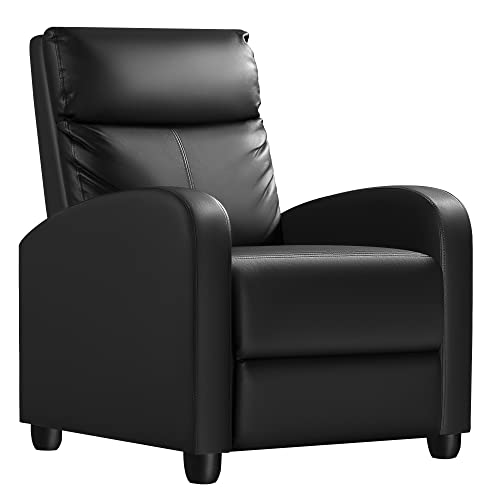
Homall Recliner Chair PU Leather Black — Best All-Rounder
The Homall is the chair this category is measured against, and its listing begins with the honesty this guide keeps asking for: PU leather, named in the title, no costume. As a material for a TV room it makes its case quickly — a smooth black surface that wipes clean after popcorn incidents, does not glare under screen light, and presents the uniform finish that lets a big recliner sit quietly in a darkened room. Nobody will mistake it for hide at touching distance, and nobody watching a film will care.
As a recliner it is a manual, single-seat design with lumbar support built into its brief, aimed at the living-room-to-media-room middle ground where most households actually live. Its proportions are those of a full adult recliner rather than a compact reading chair, so measure the room’s depth with the chair’s reclined length in mind — the classic mistake in this category is furnishing for the upright footprint and discovering the geometry later. For the solo viewer or the first chair of a growing theater row, this remains the sensible default: known design, honest material, no mechanisms you did not ask for.
Longevity expectations should be set in the same honest currency as its material. Treat the Homall as a chair for years of nightly service rather than decades, keep it out of the sunbeam that crosses the room each afternoon, and its PU surface will hold its side of the bargain. Owners who rotate two chairs — or who simply resist always taking the same seat’s exact centre — spread the wear across the cushion and double the time before any single spot shows its age. Small habits, again, are the whole maintenance department.
- Covering: PU leather, stated in the listing title
- Mechanism: manual recline
- Support note: lumbar support per listing
- Format: single recliner chair
- Setting: living room and TV room use
Strengths
- Material named honestly, so expectations are set correctly
- Balanced size and recline for general viewing
- Wipe-clean surface suits snack-heavy film nights
Trade-offs
- PU will not develop the patina of real hide
- Manual mechanism needs physical effort to operate
- Full-size footprint demands honest measuring
Best for: the first recliner in a TV room and general family viewing. Not suited for: a buyer specifically seeking genuine leather — see the final pick.

ANJ Power Recliner Chair with USB — Best Home Theater
If the Homall is the category’s benchmark, the ANJ is its showpiece: an electric recliner in PU leather — again, the listing says so — built around the full home-theater checklist. Power recline for exact angles. A USB port so the phone survives a double feature. Cup holders in the arms, hidden storage inside those arms for remotes and controllers, and blue ambient lighting underneath, which sounds like garnish until you have watched a film in a dark room and realised the soft floor glow is doing the work of a cinema aisle light, guiding feet without waking the picture.
Consider also what the power mechanism does to the viewing posture over a whole evening. Small adjustments — two degrees more upright for the dialogue-heavy act, a touch flatter for the finale — happen without thought when they cost a thumb-press, and are skipped when they cost heaving against a manual lever. Comfort across three hours is mostly the sum of those skipped or taken micro-adjustments, which is the ANJ’s real argument beneath its lighting and storage theatre.
All that equipment writes its own conditions. The chair needs a socket within cable reach, which should be planned rather than discovered, and its black PU surfaces will show dust against the ambient glow if the room is neglected. It is also unapologetically a theater chair: in a formal living room it would look like a cockpit that wandered in from the cinema. In its intended room, though, nothing else in this guide is as complete. Buyers building a dedicated media room, especially in pairs or rows, should start their shortlist here and make the other picks argue their way in.
- Covering: PU leather per listing
- Mechanism: electric power recline
- Power feature: USB charging port
- Extras: cup holders, hidden arm storage, blue ambient lighting
- Format: single home theater seat
Strengths
- Most complete theater feature set in this guide
- Power recline finds exact viewing angles
- Storage and charging solve real mid-film annoyances
Trade-offs
- Needs a planned power supply at the chair
- Theatrical styling suits dedicated rooms only
- Most complex mechanism here, with the most to maintain
Best for: dedicated home theaters and viewers who want the full cinema ritual. Not suited for: rooms where furniture moves often or sockets are scarce.

Yaheetech Recliner Chair Black Faux Leather — Best Compact
Not every TV room is a theater. In a bedroom with a screen on the dresser, a small flat, a reading corner that moonlights for evening viewing, the full-size recliners above are simply too much furniture. The Yaheetech answers with a compact faux leather chair — material declared in its name — offering three adjustable back angles rather than a full reclining mechanism, with pocket springs in the seat and lumbar support in the design brief. Think of it as a chair that leans with intent rather than a bed in disguise.
That restraint buys real advantages. The footprint fits rooms the others cannot enter, the chair reads as ordinary furniture when upright, and the listing pitches it at bedrooms, reading rooms and even RVs, which tells you something about its scale. The honest limit is session length and posture: three angles serve an evening’s viewing or a gaming session well, but the viewer who wants to lie nearly flat for a three-hour epic should take the Homall or the ANJ. For the small-room majority, though, this is the pick that respects the floor plan.
Students and first-flat furnishers should note this pick in particular, because it solves the arithmetic of small rooms without looking like a compromise borrowed from a caravan. It reads as a proper armchair in daylight, hosts a film night without rearranging the room, and leaves floor for the desk, the shelf and the life that shares the space. Compact chairs are usually where categories hide their worst materials; a declared faux leather over pocket springs is, by the standards of small furniture, an honest little machine.
- Covering: faux leather, stated in the listing
- Mechanism: three adjustable back angles
- Seat: pocket springs per listing
- Support note: lumbar support and footrest in design
- Settings named: bedroom, reading room, RV, living room
Strengths
- Compact footprint for small rooms
- Declared faux leather, priced and described accordingly
- Versatile across reading, gaming and viewing
Trade-offs
- Three angles are not a full recline
- Smaller seat will not suit every adult frame
- Less suited to very long, fully stretched sessions
Best for: bedrooms, small flats and mixed-use rooms. Not suited for: viewers who recline flat for entire films.

MCombo Swivel Recliner with Ottoman — Best Swivel
The MCombo rejects the integrated footrest altogether. In its place: a chair on a wooden swivel base that turns a full 360 degrees, an adjustable backrest, and a separate ottoman that goes wherever your feet prefer. The covering is faux leather, model line 9019 in the listing, and the stated capacity is 330 pounds. The arrangement suits restless viewers — the ones who rotate toward the conversation during the adverts, angle away from a window’s glare at matinee time, and park their feet at a different height every hour.
Freedom has a floor-space price. An ottoman is a second object that needs a home, migrates around the room, and will be sat on by guests who mistake it for a stool. In a tidy theater row it would be chaos; in a lived-in TV room it is often the most-used furniture geometry of all, because the chair serves the screen, the bookshelf and the conversation without being dragged. The wooden base also gives this pick a slightly more furniture-like silhouette than the full recliners, which matters in rooms that host non-viewing life during the day.
One more household will claim this chair: the reader who watches nothing at all. A swivel chair with an ottoman beside a lamp is the classic reading station, and in homes where the TV room doubles as the evening room, the MCombo may spend as many hours hosting novels as films. Versatility of that kind rarely appears in a feature list, but it decides which chair is still in the house in ten years, long after the screen has been replaced twice.
- Covering: faux leather per listing
- Base: 360-degree swivel on wooden base
- Foot support: separate ottoman included
- Stated capacity: 330 lbs per listing
- Backrest: adjustable
Strengths
- Swivel and ottoman give the most adaptable posture
- Furniture-like look suits dual-purpose rooms
- Ottoman doubles as casual extra seating
Trade-offs
- Two pieces need more floor discipline
- No powered or full-length recline mechanism
- Ottoman will wander in busy households
Best for: dual-purpose living and TV rooms, restless loungers. Not suited for: fixed theater rows or minimalists.
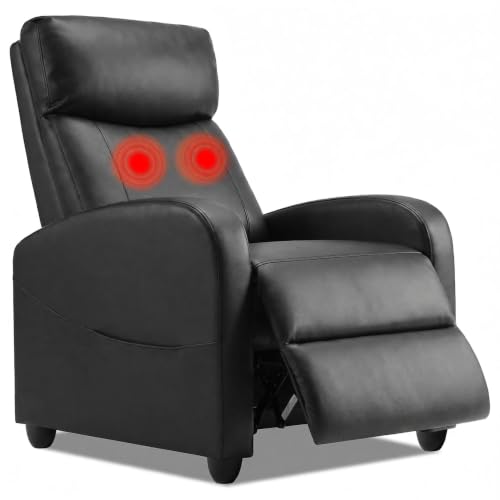
Massage Recliner Chair Home Theater Black — Best Cushioned
This pick requires the guide’s honesty policy in its purest form, because its own listing speaks in two voices: the title says leather, while the description mentions soft linen upholstery alongside overstuffed high-density sponge and a high backrest. We cannot resolve that contradiction from here, and we will not pretend to. What is consistent across the listing is the design intent — a deeply cushioned, high-backed home theater recliner with a massage function — so read the current listing’s material specification carefully before buying, and treat the upholstery question as open until the maker answers it on the page.
Material caveat recorded, the chair’s appeal is real. Some viewers do not want the firm, tailored sit of the Homall or the cockpit precision of the ANJ; they want to sink. Overstuffed cushioning and a tall back serve exactly that preference, and a massage function — a comfort feature, making no medical claims in this guide or, properly read, in any honest listing — adds the gentle vibration that some people find completes an evening. If deep softness is your brief and you verify the covering on the listing, this is the group’s plush option.
- Covering: listing language is mixed — verify on the page before buying
- Cushioning: overstuffed high-density sponge per listing
- Backrest: high back design
- Feature: massage function (comfort feature only)
- Format: single home theater recliner
Strengths
- Deepest cushioning in this guide
- High backrest suits taller viewers
- Massage function for those who enjoy it
Trade-offs
- Upholstery description needs buyer verification
- Very soft sit will not suit firm-seat preferences
- Massage hardware adds mechanism to maintain
Best for: viewers who prioritise plush cushioning above all. Not suited for: buyers who need material certainty without checking the listing.
Genuine Full-Grain Leather Recliner (generic class) — The Real Hide
Here is the chair the search box promised you. A genuine full-grain leather recliner is upholstered in actual hide — breathable, faintly scented, cool in summer and room-warm in winter, ageing toward a patina that records every film night as richness rather than wear. It is discussed without a link because our verified pool for this batch contains no listing that honestly offers it, and inventing one would betray the standard this guide has applied to every other pick. The class exists across the wider market at a firmly premium tier; what follows is how to think about it.
The case for hide is longevity and feel. A cared-for leather recliner can serve for decades, be reconditioned rather than replaced, and hold its looks in a way synthetics do not attempt. The case against is equally concrete: the price of admission is several multiples of the PU picks above, the hide asks for occasional conditioning and protection from direct sun and radiators, and a recliner mechanism in genuine leather concentrates all that value into a machine whose moving parts may age faster than its covering. Households that buy furniture once a decade should consider it seriously; households furnishing a first flat should admire it and buy the Homall.
Shopping for the class, when you do, reverses the habits this guide taught for synthetics. With hide, the maker’s name and warranty carry the information, because the material cannot be judged from a photograph and barely from a swatch. Ask which part of the hide, whether the reclining mechanism is rated for the chair’s weight class, and what the maker recommends for conditioning. A seller who answers those three questions precisely is selling leather; a seller who answers with adjectives is selling a photograph of it.
- Covering: genuine full-grain hide
- Tier: premium across the wider market
- Care: periodic conditioning, keep from direct heat
- Ageing: develops patina rather than peeling
- Availability in this guide: prose-only, no verified listing in pool
Strengths
- Unmatched feel, breathability and lifespan
- Ages gracefully instead of wearing out visibly
- Holds value and can be professionally reconditioned
Trade-offs
- Premium cost, several times the synthetic picks
- Needs a real, if modest, care routine
- Mechanism may need service before the hide does
Best for: buy-it-for-decades households furnishing a permanent media room. Not suited for: first flats, tight budgets, or anyone who will not condition leather.
How Do the Six Compare Side by Side?
| Pick | Covering | Mechanism | Standout feature | Room it suits |
|---|---|---|---|---|
| Homall Recliner | PU leather | Manual recline | Benchmark balance | General TV rooms |
| ANJ Power Recliner | PU leather | Electric recline | USB, storage, ambient light | Dedicated home theater |
| Yaheetech Recliner | Faux leather | Three set angles | Compact footprint | Bedrooms, small flats |
| MCombo Swivel | Faux leather | Swivel + ottoman | 360-degree base | Dual-purpose rooms |
| Massage Recliner | Verify on listing | Recline + massage | Overstuffed cushioning | Plush-comfort seekers |
| Genuine leather (class) | Full-grain hide | Varies | Patina and lifespan | Permanent media rooms |
How Should You Measure a Room for a Recliner?
Measure the chair in its working state, not its showroom state. A recliner’s upright footprint is a polite fiction; the real geometry includes the back travelling rearward and the footrest travelling forward, and both need clearance — behind the chair for the mechanism, in front for your legs, and at the sides for the arms and, on the ANJ, for access to its storage. Listings give upright dimensions, so add a generous allowance in both directions and then test the total against the room with a tape and, if needed, a outline of painter’s tape on the floor.
Distance to the screen is the second measurement, and it is personal rather than absolute. Reclined viewing tilts your head back, which is why theater chairs pair with screens mounted or sized for that posture; a screen placed for upright dining-chair viewing will strain necks in a deep recline. Before the chair arrives, sit where it will live, lean back as it will lean you, and look at where your eyes land. If they land below the screen’s centre, plan a mount adjustment or a different chair position as part of the same purchase.
Doorways and stairs form the third measurement, the one that generates the most sorrow in this category. A recliner that fits the room beautifully but cannot pass the hall door fits the hallway instead. Check the listing’s package and assembled dimensions against your narrowest passage, and favour designs that arrive in sections — backs commonly detach on recliners — when the route is tight. Five minutes with a tape measure in the hall is the cheapest insurance in furniture buying.
How Do You Care for Black Synthetic and Real Leather Differently?
PU and faux leather ask for a light, regular hand. Dust with a dry cloth before it becomes grime, wipe spills promptly with a damp one, and keep harsh solvents and abrasive pads away from the coating, whose surface is the whole product. Position synthetic chairs out of relentless direct sun where you can, because ultraviolet and heat are the combination that ages the coating fastest, and avoid parking a radiator against the back. That is the entire liturgy; the material’s convenience is genuine, and over-cleaning with strong products does more harm than popcorn ever will.
Real hide asks for slightly more and forgives slightly less. It wants dusting, prompt attention to spills before they soak, and a conditioner at intervals the maker suggests, worked in gently to keep the surface supple. It dislikes the same sun and radiator enemies as synthetics but for the opposite reason — drying rather than coating failure — and it rewards the routine with decades of deepening character. The massage chair’s mixed listing language matters here too: you cannot choose the right care until you know which material you own, which is one more reason to verify it on the page.
Both families share one enemy that has nothing to do with chemistry: the mechanism’s neglect. Work the recline through its full travel occasionally, keep the underside free of the dust and lost remotes that accumulate in dark rooms, and check power cables on electric models for pinching where the chair rocks or swivels. A chair is a machine that pretends to be furniture, and the pretense holds longest when somebody remembers the machine.
One Chair, a Pair, or a Row: How Should a TV Room Be Seated?
The single chair is the honest unit of this category, and it composes better than buyers expect. A pair of identical recliners with a small table between them serves couples more flexibly than a joined loveseat recliner, because each viewer owns their angle, their footrest and their exit route, and because a single chair can later migrate to a bedroom or study when the room evolves. Rows of three or more belong to dedicated theaters, where the ANJ’s storage arms and lighting stop being features and become infrastructure.
Joined seating has one real argument: shared warmth and the social geometry of watching together rather than adjacent. Households that genuinely curl up together should honour that over this guide’s modular logic. But count the cost honestly — a joined unit is the hardest furniture in the category to deliver, to rearrange and to partially replace when one mechanism tires before the other. Most rooms, most of the time, are better served by singles that can pretend to be a row when guests arrive.
Whatever the count, leave the room a spare ordinary seat. Guests who do not recline, children who prefer the floor’s front row, and the person who gets up to make tea all need somewhere that is not a mechanism. A TV room furnished exclusively with recliners feels like a vehicle; one ordinary chair and a floor cushion restore it to a room. The black recliners anchor the space; the humble extras keep it human.
Does a TV Room Chair Work for Gaming?
Increasingly the TV room is the games room, and the two activities sit differently. Film viewing rewards the deep recline; gaming rewards a posture a few degrees more upright, with feet grounded for the sessions that involve leaning into a final lap or a boss fight. That is why the Yaheetech’s set angles and the MCombo’s swivel find second careers here, and why the ANJ’s USB port — designed, presumably, for phones — spends its life keeping a controller alive through a long campaign.
The material argument tilts further toward synthetics in a gaming household. Sessions run longer, snacks run closer, and the chair hosts headsets, controllers and the occasional celebratory spill. A wipeable PU surface that shrugs at all of it is not the budget option in this context; it is the correct specification. Save the contemplation of hide for the room where the screen shows films and the chairs host adults at adult paces.
One ergonomic note crosses both activities: the headrest’s behaviour at your chosen angle decides your neck’s evening. In a deep recline the head needs support that meets it rather than a gap it must bridge, which is why the high backrest on the massage pick and the lumbar emphasis in the Homall’s design brief matter beyond their bullet points. Judge a chair, when you can, by sitting in its cousins at a showroom and holding the pose for five honest minutes; the first thirty seconds of any chair are a liar.
How Do Pets, Children and Real Life Treat These Chairs?
A TV room chair will be claimed by the household in ways the listing never photographed. Cats will test the armrests with the only tools they own, dogs will regard the reclined footrest as a personal ramp, and children will discover the mechanism’s entertainment value within the hour. Synthetic coverings meet this reality pragmatically: claws can mark them, but crumbs, spills and muddy paws all surrender to a damp cloth, and the chair returns to duty without a specialist cleaner. It is not invulnerable; it is recoverable, which is the quality family life actually consumes.
Genuine hide meets the same reality with a different bargain. It resists odours beautifully and shrugs off a great deal, but claw punctures and deep scratches are permanent entries in its patina, and some households will experience them as damage rather than character. The deciding question is temperamental: if you can watch a scratch become part of the chair’s story, hide rewards you; if every mark will itch, the synthetics above will keep your evenings calmer at a fraction of the stake.
Mechanisms need one safety habit regardless of covering. Recliners have moving parts with gaps that attract small fingers, pet paws and dropped objects, so teach the household to check under the footrest before closing it and to keep the power cable of an electric model routed where nothing chews or trips. None of the picks here is a toy, and the massage and power models least of all. A chair treated as a machine by its owners stays a comfort to everyone else.
How Should You Read a Recliner Listing’s Dimensions Like an Engineer?
Three numbers matter and listings do not always volunteer all of them. Seat width, measured between the arms, decides whether you sit in the chair or on it; compare it with your own hip width plus a hand’s breadth of dignity. Seat height decides the relationship between your feet and the floor in the upright position, which older knees read very carefully. And the fully reclined length — the number most often missing — decides the room, as the measuring section above explained; when a listing omits it, the maker’s question-and-answer section or a direct query is worth the delay.
Weight and assembly deserve the same unsentimental reading. Recliners are dense objects, and a power model with a steel mechanism is a two-person carry up any staircase; plan the labour before the delivery van plans it for you. Assembly is usually a matter of slotting the back onto the base, which is genuinely simple, but on the swivel model the base itself wants a level floor and a few minutes of honest bolt-tightening. None of this should deter a purchase; all of it should be scheduled, because a chair installed in a rush is a chair installed slightly wrong.
Finally, read the returns language with the same care as the features, especially on the pick whose material description you are verifying. Furniture is the category where a changed mind is most expensive, and a chair you cannot send back deserves one more evening of thought before the order. The picks in this guide were chosen to minimise that risk by favouring clear listings, but clarity at purchase time is a shared responsibility between maker and buyer.
What Should You Test in the First Fortnight of Ownership?
The first two weeks with a recliner are its audition, and they should be conducted deliberately. Sit through one full-length film at your preferred angle and note where your body files its reports: a lumbar that felt supportive for ten minutes may argue by minute ninety, and a headrest that seemed tall enough in the shop may reveal its gap only in a genuine recline. These are not necessarily verdicts against the chair — cushions settle, bodies adapt — but they are information to gather while adjustment and return windows are still open.
Run the mechanism through its whole travel daily during the audition, listening for the sounds a healthy mechanism makes: smooth, unhurried, identical each time. A new noise in week one is a question for the maker, not a quirk to adopt. On power models, test the chair’s behaviour when the room’s other demands are running — the point is not electrical drama but discovering whether the socket arrangement you planned actually serves the household’s real evenings, chargers and lamps included.
Then perform the room test. Watch how the chair collects the household: who claims it, who avoids it, whether the ottoman has emigrated, whether the black upholstery is performing its light-absorbing duty or merely collecting visible dust in a sunlit room. A chair that passes the film test but fails the household test will be resented quietly for years. The fortnight is your chance to exchange a near-miss for the right pick, and using it is not fussiness; it is the entire advantage of buying from listings with clear terms.
How Do Throws, Cushions and Lighting Complete a Black Chair?
A black recliner is a background actor that occasionally needs a supporting cast. A throw across one arm does three jobs at once: it warms the viewer who runs cold while their partner runs warm, it protects the armrest — the highest-wear surface on any chair — from the friction and body oils that age coverings fastest, and it gives a dark room one deliberate note of colour or texture. Choose washable throws without ceremony, because their whole purpose is to take the damage the chair should not.
Cushions require more restraint. A recliner’s back and lumbar shaping are engineered as a system, and a fat decorative cushion behind the back rewrites that engineering at random, usually pushing the sitter forward into exactly the slump the chair was designed to prevent. If a cushion is wanted, let it be thin, let it live at the side for the head during a sideways lounge, and let the chair’s own support do its job unassisted the rest of the time. The massage pick’s overstuffed design makes the point from the other direction: when cushioning is the design, nothing needs adding.
Lighting is the last layer, and the ANJ’s ambient glow points at the principle: a TV room needs light that serves movement without murdering the picture. Low, warm, indirect light — a lamp behind the seating, a lit path to the door — keeps the black chairs in their intended silhouette while sparing everyone the shin-versus-coffee-table incidents that fully dark rooms specialise in. The chairs absorb light; the room should offer just enough of it, in the right places, to be safe and sociable between films.
What Mistakes Do Buyers Make with TV Room Chairs?
- Believing the word leather without a qualifier. PU, faux, bonded and genuine are different materials with different lives; the listing should say which.
- Furnishing for the upright footprint. Recliners expand in both directions; measure the working geometry or rearrange the room in anger later.
- Buying theater styling for a living room. Ambient-lit cockpit chairs belong in dedicated rooms; dual-purpose spaces need furniture that can change the subject.
- Ignoring the doorway. The finest chair in the world is a hallway ornament if it cannot reach its room.
- Skipping the socket plan for power models. A cable across a dark floor is a trip hazard with a plug.
- Over-cleaning synthetics. Strong solvents damage PU coatings; a damp cloth is the whole requirement.
Final Recommendation
Start with the Homall if your TV room is a normal room living a double life: it is honestly covered, sensibly mechanised and priced in the tier where most households should be shopping. Build a dedicated theater and the ANJ’s power recline, storage and glow become the correct extravagance. Small rooms take the Yaheetech, restless rooms the MCombo, and cushion-first viewers the massage chair after verifying its covering on the listing. The genuine hide recliner remains the horizon — worth it for the permanent room, honestly out of reach for the temporary one.
Whichever chair carries you through the coming winters of films, buy it with its material’s true name in your ears and its full reclined shadow measured on your floor, and the black shape waiting in the dark of the room will feel less like furniture and more like the opening frame of every good evening. That is the whole test, really: a chair you stop noticing by the second scene has done everything a TV room ever asked of leather, real or otherwise.
Frequently Asked Questions
Is PU leather good enough for a TV room chair?
For most households, yes, and this guide’s top picks say so by example. PU offers the look, the wipe-clean practicality and the colour consistency the room wants, at a tier that lets you buy two chairs instead of one. Its honest costs are a shorter ultimate lifespan than hide and no patina as it ages. If those costs are acceptable — and in a dark room used nightly, they usually are — PU is not a compromise but a sensible specification.
How can I tell what a chair is really covered in?
Read the listing’s materials language rather than its headline. PU leather, faux leather and synthetic are declared terms; full-grain or top-grain with a hide thickness is the genuine claim; the bare word leather with no qualifier deserves a question to the seller. Price is a rough witness too: a recliner at a budget tier is not upholstered in premium hide, whatever its title implies. When the language is mixed, as with one pick in this guide, treat the material as unconfirmed until the maker clarifies.
Do I need a power recliner, or is manual fine?
Manual is fine for most viewers and most rooms: it is simpler, cheaper and free of cables. Power earns its premium when the chair is used for long daily sessions, when the viewer has limited strength or mobility, or when exact back angles matter to comfort across a three-hour film. The deciding question is who operates the chair every day, not which mechanism sounds more impressive in a listing.
How far should a recliner sit from the screen?
Far enough that your reclined eye line meets the screen near its centre without tilting your chin up or down. As a rough household test, if you finish a long film aware of your neck, the geometry is wrong somewhere; if you finish it aware only of the film, the chair and the screen have been introduced correctly and should be left to get on with their arrangement. That distance depends on screen size and mounting height, so test it in your own room: sit in the intended spot, recline as the chair will hold you, and check where your gaze rests. If it rests low, raise the screen or move the chair; neck strain is a layout problem, not a chair defect.
Can two different models share one TV room?
They can, and mixed pairs are common — a power chair for one viewer, a manual for another. Keep the coverings in the same black family and the heights roughly matched so the row looks intentional, and accept that mechanisms will differ in feel. What does not mix well is scale: a compact chair beside a theater chair looks like a child seated with adults, so keep sizes within a hand’s breadth of each other.
Is black the only sensible colour for a TV room?
It is the most forgiving, not the only, choice. Black absorbs stray light, hides the wear of nightly use and matches every screen ever made, which is why this category defaults to it. Deep charcoal and very dark brown achieve most of the same optical calm with a slightly softer presence in daylight. Pale colours in a media room reflect the picture back at itself and display every snack incident in high contrast; they belong to rooms where the television is a guest rather than the host.
How long should a synthetic leather chair last?
With the light care described above and ordinary nightly use, a decent PU or faux leather chair should serve for years before its high-flex points show their age; direct sun, heat and harsh cleaning shorten that span considerably. Genuine hide, maintained, is the multi-decade option. Neither figure is a promise — usage patterns differ too much — but the ranking between the materials is consistent across the industry.
Related Guides
When the credits roll and the household disperses, the other seats in the house deserve the same honest audit: Best Hunting Blind Chairs takes seating outdoors into very different weather, Best Cane Hanging Chairs covers the room’s relaxed opposite, Best Casters for Office Chairs on Carpet keeps the working chair rolling as it should, and Best Faux Mink Blankets supplies the throws that finish a film night properly.



[…] handled, the rest of the household’s seating deserves the same scrutiny: our Best Black Leather Chairs for a TV Room covers the indoor end of the comfort spectrum, Best Camp Chairs for 500 Pounds takes heavy-duty […]