What's inside
- Key Takeaways
- Quick Picks
- How Did We Judge Sewing and Quilting Machines Together?
- How Do You Budget for the Whole Quilting Setup?
- What Separates a Good Piecing Machine From a Good Quilting Machine?
- How Do the Six Machines Divide the Quilting Household?
- Comparison Table
- How Do You Learn Free-Motion Quilting Without Ruining a Top?
- Specialist or All-Rounder: Which Quilting Machine Fits Your Home?
- What Does Pressing Have to Do With Machine Choice?
- How Do You Quilt a Large Top on a Basic Machine?
- How Do You Piece a Quilt Top That Lies Flat?
- What Does a Year of Quilting Do to a Machine?
- Which Mistakes Shorten a Quilting Machine’s Happy Life?
- How Do You Choose Between Two Finalists on Your Table?
- Final Recommendation
- Which Batting and Thread Choices Change Your Results?
- How Should You Plan a Quilt Your Machine Can Actually Finish?
- Frequently Asked Questions
- Related Guides
As an Amazon Associate I earn from qualifying purchases. This post may contain affiliate links at no extra cost to you.
cottageverdict.com is reader-supported. When you buy through links on our site, we may earn an affiliate commission.
Where to buy: the six machines below are sold through Amazon, and each name links to its listing so you can check price on Amazon and verify the included feet and tables before ordering. The best basic sewing and quilting machines share a philosophy that fancier categories sometimes forget: a quilt is mostly straight seams sewn accurately for hours, followed by the wrestling match of pushing the finished sandwich under the needle. Machines that serve both halves of that job — feeding evenly at the piecing stage and offering room and control at the quilting stage — are the ones owners keep. This guide deliberately mixes two tribes: straight-stitch specialists that do one thing superbly, and versatile all-rounders that also hem jeans and sew buttonholes between quilts.
Key Takeaways
- Straight-stitch specialists like the PQ1600S and TL-2000Qi piece faster and feed straighter than general-purpose machines.
- Throat space decides quilting comfort more than any electronic feature; measure it before comparing stitch counts.
- A knee lifter keeps both hands on the quilt, and quilters who try one rarely go back.
- All-rounders such as the HC1850 and C7290Q cover garments and décor between quilts, suiting one-machine households.
- Drop feed or a dedicated straight-stitch setup matters for free-motion work; check before assuming.
- Buy for the quilt sizes you truly finish — a twin on a small machine is pleasant, a king is an endurance event.
Quick Picks
| Pick | Badge | Why it earns its place |
|---|---|---|
| Brother PQ1600S High-Speed Straight Stitch Machine | Best Straight-Stitch Specialist | Seam after seam at speed, with a pin feed system that keeps layers registered. |
| JUKI TL-2000Qi Sewing and Quilting Machine | Best for Serious Quilters | Die-cast body, knee lifter, and feeding that shrugs at thick quilt sandwiches. |
| Janome MC6650 Sewing and Quilting Machine | Best Big-Throat All-Rounder | A wide, flat work area with full garment features for one-machine homes. |
| Brother XR3774 Sewing and Quilting Machine | Best Budget All-Rounder | Thirty-seven stitches and a wide table at the friendliest price in this guide. |
| Brother HC1850 Sewing and Quilting Machine | Best Computerized Value | One hundred eighty-five stitches, LCD ease, and quilting feet in the box. |
| SINGER C7290Q Computerized Sewing and Quilting Machine | Best Modern Feature Set | Hundreds of stitch applications, lettering, and twelve feet for embellished quilts. |
How Did We Judge Sewing and Quilting Machines Together?
A combined guide has to judge two jobs honestly. For piecing, we cared about seam accuracy over distance: does the machine hold a scant quarter-inch allowance for a metre of stitching without the fabric drifting, and does it start and stop without nesting thread underneath? Feed systems earned their reputations here — pin feed, box feed, and simple well-timed feed dogs all have partisans, and each design in this guide has proven itself in long production runs rather than a single season.
For quilting, the criteria shift to space and control. The horizontal room from needle to machine body — the throat — decides how much rolled quilt you manage at once, while a flat, wide bed keeps the work supported so gravity stops pulling seams crooked. Free-motion capability was checked in principle: feed dogs that drop or disengage, a foot suited to hopping or gliding, and speed control that lets a nervous beginner stipple slowly. Straight-stitch machines were not penalized for lacking zigzag; they were judged on whether their single job is done superbly and whether the listing is honest about that focus.
Versatility was the third axis, weighted by household reality. A dedicated quilting studio can justify a specialist; a dining-table sewist usually cannot store two machines. That is why half this guide sews garments happily and half refuses to — both answers are correct for somebody, and the reviews below say plainly which reader each machine serves.

Brother PQ1600S High-Speed Straight Stitch Machine — Best Straight-Stitch Specialist
The PQ1600S is Brother’s semi-industrial answer to a simple observation: most quilting is straight stitching, so a machine that only straight-stitches can be built faster, stronger, and more precise than one dividing its budget among hundreds of patterns. It sews at genuinely high speed, yet its party trick is the pin feed system — a thin pin that rises to move fabric in step with the feed dogs, keeping quilt layers and slippery fabrics registered instead of creeping apart. Long piecing sessions feel different on this machine: seams come off the bed flat, matched, and boring in the best possible way.
Supporting details suit production work. The knee lifter raises the presser foot while both hands hold the work, the needle threader and thread cutter keep rhythm, and the included extension table gives quilt tops a proper landing zone. What it will not do is zigzag, buttonhole, or forgive a buyer who did not read the badge: this is a one-stitch machine by design. Garment sewists who need stretch stitches must pair it with a second machine or choose an all-rounder below. For piecing-focused quilters, though, the focus is the feature.
- Stitch: straight stitch only, high-speed semi-industrial design
- Feed: pin feed system plus feed dogs for layer control
- Controls: knee lifter, automatic thread cutter, needle threader
- Table: extension table included
- Needle position: adjustable for scant seam allowances
Chain piecing reveals the PQ1600S’s character fastest. Feeding unit after unit under the needle without lifting the foot or snipping between pieces, the quilter watches a basket of cut squares become a string of finished seams in minutes, each allowance holding true because the pin feed refuses to let the top layer wander. That rhythm — sew, feed, sew — is production quilting’s heartbeat, and no general-purpose machine in this guide sustains it with the same ease.
Strengths
- Pin feed keeps quilt layers and silky fabrics from shifting mid-seam.
- High sewing speed turns chain piecing into a short session.
- Knee lifter and cutter keep hands on the work and rhythm unbroken.
Trade-offs
- Straight stitch only — no zigzag, buttonholes, or stretch stitches.
- Speed can startle beginners until the control becomes familiar.
- Needs a second machine in households that also sew garments.
Best for: piecing-focused quilters who value speed and seam accuracy. Not suited for: one-machine households that sew clothing regularly.
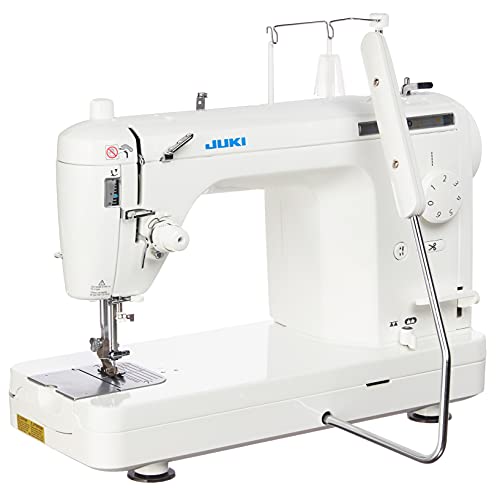
JUKI TL-2000Qi — Best for Serious Quilters
JUKI’s TL series carries an industrial maker’s DNA into the home studio, and the TL-2000Qi feels it the moment you lift the presser foot: the body is aluminum die-cast, the action is mechanical and certain, and the machine sews through a folded quilt binding without the hesitation that smaller motors show at thick intersections. Like the Brother specialist above, it is a straight-stitch-only machine — but where the PQ1600S emphasizes speed and pin feed, the JUKI emphasizes mass, torque, and an almost stubborn steadiness at any pace you choose.
Quilters love its supporting cast. The knee lifter is standard equipment, the extension table is wide and genuinely flat, needle up/down can be worked from the foot pedal with a heel tap, and the sub-tension and thread guide arrangement produces the kind of even stitch that shows beautifully in dense quilting lines. It also handles heavier home projects — canvas bags, denim repairs — with an ease that makes it the second machine in many garment studios too. The learning curve is real but short, and the reward is a machine that feels unchanged after years of quilts.
- Stitch: straight stitch only, industrial-heritage design
- Body: aluminum die-cast frame for stability
- Controls: knee lifter, heel-tap needle position, thread cutter
- Table: wide extension table included
- Character: high torque for thick sandwiches and canvas
Time spent quilting an actual sandwich, rather than piecing, is where the TL-2000Qi converts skeptics. The machine does not slow at seam intersections, does not whine at binding thickness, and holds its stitch length through the layers as though the sandwich were a single sheet. Owners describe a feeling of inevitability about its feeding, and that feeling is worth money to anyone who has wrestled a lesser machine across a queen-size top and sworn quietly at the halfway point.
Strengths
- Punches through thick quilt intersections without stalling or skipping.
- Die-cast body stays planted and calm at working speed.
- Stitch evenness flatters dense quilting and topstitching alike.
Trade-offs
- Straight stitch only, so garment features live on another machine.
- Heavier than the Brother specialist; not a class-travel machine.
- Mechanical character offers fewer electronic conveniences.
Best for: committed quilters wanting an industrial feel at home. Not suited for: sewists needing zigzag and buttonholes in the same machine.

Janome MC6650 — Best Big-Throat All-Rounder
The MC6650 exists for the sewist who refuses to choose between quilting room and garment features. Its work area is the widest in this guide — a long, flat expanse from needle to body that swallows a rolled quilt with far less shoving than standard machines demand — yet it still offers a full stitch menu for clothing, including buttonholes and stretch stitches. The top-loading bobbin, memorized needle position, and thread cutter keep the computerized conveniences that production quilting quietly depends on during a long afternoon.
Janome’s feed system deserves its reputation here: pieced seams track straight, and the machine transitions from two layers of cotton to a quilt sandwich without tension tantrums. The flat bed design means the machine sits flush and stable, and the workspace lighting is bright across the whole sewing field rather than pooled at the needle. It is a substantial machine that wants a permanent table, and its price sits at the top of this guide — but as a single machine for a household that quilts seriously and sews everything else too, it makes the strongest case here.
- Workspace: extra-wide throat and flat bed for large quilts
- Stitches: full utility, decorative, and quilting range
- Controls: memorized needle up/down, thread cutter, speed control
- Bobbin: top-loading with clear cover
- Character: stationary, substantial, built for a dedicated table
The MC6650’s flat bed changes quilting ergonomics in a way specifications understate. With no raised lip around the needle area, fabric slides rather than climbs, and the operator’s hands rest naturally instead of hovering. Across a long quilting session that posture difference accumulates into shoulders that forgive you. Combined with the workspace width, it makes this the machine in the guide most likely to be chosen by someone who has already quilted on a standard machine and knows exactly which frustrations they are paying to retire.
Strengths
- Throat space transforms whole-quilt handling compared with standard machines.
- Full garment capability means it can be the household’s only machine.
- Even feeding keeps both piecing and quilting lines honest.
Trade-offs
- Largest and heaviest option here; it wants a permanent home.
- Price leads this guide, reflecting the workspace it provides.
- No knee lifter standard, which some production quilters miss.
Best for: one-machine households quilting large projects regularly. Not suited for: sewists who must store the machine away after each use.

Brother XR3774 — Best Budget All-Rounder
The XR3774 proves that a quilting-capable machine does not need electronics to be useful. It is a dial-selected model with thirty-seven built-in stitches — the utility core, a handful of decorative patterns, and an automatic one-step buttonhole — paired with a wide table that gives it quilting manners beyond its price. Eight included feet cover quilting, appliqué, zippers, and button sewing, so the machine that arrives can piece a top, quilt it with straight lines, and bind it without an accessory order in between.
Its appeal is mechanical honesty. There are no menus to freeze and no screens to fade; you turn a dial, the machine changes stitch, and a printed chart on the body reminds you of the settings. Beginners find that directness reassuring, and experienced sewists keep these as forgiving second machines. The limits are equally honest: no needle up/down memory, no thread cutter, and a motor that prefers cotton-weight work to canvas. Judged as the entry point to both sewing and quilting, though, it delivers the essentials with the fewest barriers in this guide.
- Stitches: 37 built-in, dial selected
- Buttonhole: automatic one-step style
- Table: wide table included for quilting support
- Feet: 8 included sewing feet
- Threading: automatic needle threader, drop-in bobbin
There is a teaching virtue to the XR3774 that computerized models cannot replicate: every function is visible. A student can see the stitch selection change the mechanism, understand what a dial does by watching it, and build a mental model of sewing itself rather than of a menu system. Instructors and parents teaching a first machine prize that transparency, and it partly explains the model’s long life in classrooms and family sewing rooms where the next beginner is always arriving.
Strengths
- Wide table included at the lowest price point in this guide.
- Dial controls are instantly understandable for new sewists.
- Covers piecing, straight-line quilting, and basic garments in one box.
Trade-offs
- No needle position memory or automatic thread cutting.
- Motor is happiest with light to medium fabrics.
- Throat space is standard, so big quilts need patience.
Best for: beginners wanting one affordable machine for sewing and quilting. Not suited for: production quilters or heavy-fabric projects.

Brother HC1850 — Best Computerized Value
The HC1850 has been a quiet recommendation among quilt guilds for years, because it bundles the computerized conveniences that matter — a clear LCD, one hundred eighty-five stitches including a monogramming font, and eight feet with a quilting focus — at a price that leaves budget for fabric. It sews garments all week and pieces quilts all weekend without asking its owner to learn two machines. The included spring action quilting foot opens free-motion experiments, and the stitch chart printed for reference keeps the library usable rather than theoretical.
Daily behavior is pure Brother: gentle starts, a drop-in bobbin you can watch, and an automatic needle threader that works when your eyes are tired. It shares the family limits — standard throat, light-to-medium fabric appetite — and its decorative stitches will not all see daylight. But as a value equation for a household that wants computerized ease with genuine quilting intent, it remains difficult to beat, and its long production run means tutorials and spare parts are everywhere.
- Stitches: 185 built-in including monogramming font
- Display: LCD with stitch reference chart
- Feet: 8 included, with quilting foot for free-motion trials
- Table: detachable accessory table surface
- Threading: automatic needle threader, drop-in bobbin
The HC1850’s longevity in the market has created an ecosystem advantage no specification captures: every technique question has a video, every accessory exists in three price tiers, and every repair bench knows its habits. For a buyer who sews far from a dealer, that ambient knowledge is a form of insurance. The machine itself remains a pleasure — light enough to move, capable enough to keep — and the ecosystem ensures it stays one for years.
Strengths
- Computerized ease and quilting feet at a genuinely modest price.
- Monogramming font adds labels and personalization to quilts.
- Long production history means abundant guides and accessories.
Trade-offs
- Standard throat space; large quilts still require management.
- Many decorative stitches duplicate each other in practice.
- Not intended for heavy canvas or upholstery layers.
Best for: value hunters wanting computerized quilting and garment range. Not suited for: sewists focused on very large quilts or heavy fabrics.

SINGER C7290Q — Best Modern Feature Set
SINGER’s C7290Q is the newest design language in this guide: a computerized quilting machine quoting four hundred seventeen stitch applications — the combinations its two hundred core stitches produce with mirroring and elongation — along with lettering, an LCD screen, a built-in needle threader, and a one-step buttonhole. Twelve presser feet is the richest foot bundle here, and the metal frame underneath gives the machine a steadiness that suits the quilting in its name. For sewists who finish quilt tops with decorative stitching rather than plain lines, this library is a playground.
The modernity cuts both ways. Stitch applications take a session with the manual to understand, and new owners should sew a sampler strip of favorites before committing to a quilt border. Once learned, though, the machine rewards the effort: edges gain heirloom detail, labels get lettered directly, and the same machine returns to plain piecing without fuss. It is the choice for the embellisher — the quilter whose tops are canvases — rather than the minimalist piecer, and it wears that identity proudly.
- Stitches: 417 stitch applications with lettering
- Feet: 12 presser feet included
- Frame: metal internal frame
- Display: LCD screen with stitch selection
- Threading: built-in needle threader, one-step buttonhole
Sampling is the C7290Q’s rite of passage, and owners who embrace it unlock the machine. A stitched reference strip of favorite applications, labeled with settings, turns the library from a brochure number into a personal palette. Quilters then deploy those stitches with intent: a feathered pattern echoing the fabric’s print along a border, lettering that signs the work inside the binding. The machine rewards the methodical, and its best results look unmistakably deliberate.
Strengths
- Decorative range and lettering exceed everything else in this guide.
- Twelve included feet cover quilting and garment techniques broadly.
- Metal frame keeps the machine composed during longer runs.
Trade-offs
- Stitch application system needs manual time to unlock fully.
- Throat space is standard rather than quilting-generous.
- Embellishment focus may exceed what plain piecers ever use.
Best for: quilters who decorate tops with stitching and lettering. Not suited for: minimalists who sew straight seams almost exclusively.
How Do You Budget for the Whole Quilting Setup?
The machine is the largest single purchase but rarely the majority of a working quilting budget. A cutting mat that lies flat, a rotary cutter with fresh blades, rulers that match your block sizes, quality thread, and the batting and backing for the year’s quilts together rival a basic machine’s price — and each affects the finished work as surely as the needle does. The wise allocation buys the machine whose feeding and space suit the quilts planned, then funds the cutting and pressing station properly, because most quilting disappointment is born at the cutting table and merely revealed at the machine.
Feet deserve their own line in the budget. A walking foot, a quarter-inch piecing foot, and a free-motion foot between them cover the craft’s core techniques, and several machines here include some or all of them — a genuine saving worth checking in the box contents before comparing prices. Buy the rest of the accessory shelf strictly against projects. A drawer of unused specialty feet is the quilting equivalent of a gym membership in February: purchased with sincerity, redeemed by almost nobody.
What Separates a Good Piecing Machine From a Good Quilting Machine?
Piecing is a game of millimeters played hundreds of times. The machine must start a seam without eating the fabric corner, hold a consistent allowance without the operator steering, and stop exactly where the next piece joins. Feed timing, a slim and accurate foot, and smooth low-speed control decide that game, which is why the two straight-stitch specialists feel so different from general machines at the piecing stage: their entire mechanism is tuned for one repeated act, performed flawlessly. A piecing specialist also tends to offer needle positions that nudge the seam allowance by hair’s breadths, letting you dial in the scant quarter inch that makes blocks finish at their intended size.
Quilting the finished top is a game of space and stamina. The sandwich is bulky, the sessions are long, and the operator’s shoulders file the review. Throat room, a flat and supportive bed, and a machine that maintains stitch quality through three layers for hours matter more than any stitch menu. Speed control becomes a comfort feature: the ability to cap the machine’s pace while learning free-motion patterns prevents the runaway spirals that discourage beginners in their first session.
The all-rounders in this guide compromise on both games in exchange for covering a third — garments and home décor — and the compromise is honest. Their piecing is accurate, their quilting is capable, and their buttonholes keep a household clothed between quilts. Studios with room and budget for dedication choose specialists; households with one table choose versatility. The mistake is only in mismatching, not in either direction of the choice itself.
How Do the Six Machines Divide the Quilting Household?
The production piecer recognizes the PQ1600S immediately: chain piecing strips at speed, pressing, and repeating, with the pin feed keeping long seams true. That owner’s quilts accumulate tops the way other households accumulate laundry. The TL-2000Qi belongs to the finisher — the quilter who takes those tops, whether their own or a guildmate’s, and quilts them with dense, even lines on a machine that never feels strained by the sandwich. Many serious studios eventually house both personalities under one roof, in either order.
The MC6650 serves the quilter who does everything at one table and resents swapping machines mid-project: piecing in the morning, a grandchild’s costume after lunch, quilting in the evening, all without moving anything heavier than fabric. The XR3774 is the household’s first chapter — the machine on which someone discovers whether quilting is a passing curiosity or a life’s hobby, at a price that forgives either answer. Its wide table makes the discovery pleasant rather than cramped.
The HC1850 fits the value-minded computerized household: quilting on weekends, garments in between, labels lettered onto finished work. The C7290Q belongs to the decorator, whose quilt tops carry stitched vines, lettered dedications, and borders that took an afternoon of sampling to choose. Read the six as six households and the ranking dissolves into matching — which is what a basic machine purchase should be, since the basics done well are what every one of these quilts is actually made of.
Comparison Table
| Machine | Type | Stitches | Best suited to |
|---|---|---|---|
| Brother PQ1600S | Straight-stitch specialist | 1 | Fast, accurate piecing |
| JUKI TL-2000Qi | Straight-stitch specialist | 1 | Thick sandwiches, durability |
| Janome MC6650 | Computerized all-rounder | Full range | Large quilts, one machine |
| Brother XR3774 | Mechanical all-rounder | 37 | Budget start with wide table |
| Brother HC1850 | Computerized all-rounder | 185 | Value with quilting feet |
| SINGER C7290Q | Computerized all-rounder | 417 applications | Decorative quilting detail |
How Do You Learn Free-Motion Quilting Without Ruining a Top?
Nobody’s first free-motion session belongs on a real quilt. Build a stack of practice sandwiches from scraps and batting, set the machine for a moderate pace, and draw the same simple motif — loops, then leaves, then a meander — until your hands stop negotiating with each other. The skill is a duet: one hand’s movement sets the stitch length while the machine’s speed sets the tempo, and the duet only harmonizes after an hour or two of deliberately unimportant sewing. Every machine in this guide with drop feed can host that learning; the specialists’ steadiness makes it calmer, the all-rounders’ speed controls make it safer.
Gloves with grippy palms, an unglamorous purchase, transform the practice by letting the sandwich move without hauling. Lower the stitch length setting to zero where the design expects the operator to set the pace, keep the quilting area small — one block’s worth of ambition per session — and stop while it is still enjoyable. The quilters who finish free-motion projects are the ones who protected the learning phase from frustration, and the sandwich stack is how they did it.
Specialist or All-Rounder: Which Quilting Machine Fits Your Home?
The deciding question is what else the machine must do. If a second machine already handles garments, a specialist like the JUKI TL-2000Qi converts your quilting hours into pure production: faster piecing, calmer feeding, and no compromises made for buttonholes you will never sew on it. If this purchase is the household’s only machine, an all-rounder earns its compromises honestly, because curtains, costumes, and repairs will outnumber quilts in most months of the year.
Space argues as loudly as features. Specialists and the MC6650 assume a table they can live on; their weight and extension tables make cupboard storage a fiction. Apartment sewists who pack away nightly should favor the lighter all-rounders and accept standard throat space, managing large quilts with careful rolling and a supportive table arrangement instead. Neither answer is a compromise in quality — they are different optimizations, and choosing the wrong one is how good machines end up resold.
Budget allocation matters too. Money not spent on stitch libraries buys fabric, a cutting mat that is not warped, and the walking foot that will improve your quilting more than any decorative pattern. Several veterans in every guild sew masterpieces on machines like the XR3774 because their accessory kit and technique are complete; the machine is rarely the binding constraint after the basics are sound.
What Does Pressing Have to Do With Machine Choice?
More than the industry admits. A seam sewn accurately and pressed flat behaves in the next seam; a seam sewn accurately and left rumpled drags its error forward, and by the twelfth block the quilt top has opinions of its own. Machines with strong, even feeding reduce the pressing burden because their seams emerge flatter, while a machine that creeps layers forces the iron to negotiate peace after every join. When owners praise a machine’s accuracy, they are often praising how little rescue work its seams require downstream.
Build the pressing habit into the machine’s station: an iron within reach, a pressing surface at a height that does not ask your back for tribute, and the discipline to press each unit before it joins the next. Quilters who adopt piece-press-piece rhythms finish tops that lie flat enough to quilt on any machine in this guide, while quilters who defer all pressing to the end meet a topography no throat space can flatten. The machine matters; the sequence matters just as much, and the two together are the craft.
How Do You Quilt a Large Top on a Basic Machine?
Preparation does most of the work. Baste generously — pins, spray, or hand stitches — because a domestic machine cannot muscle a shifting sandwich into line. Roll the quilt from the right side toward the needle so the bulk sits in the throat rather than dragging off the table’s left edge, and support the rest on the table surface or an ironing board lowered beside you. Work from the center outward in sections, quilting one manageable region before unrolling the next.
Choose designs that forgive. Straight lines with a walking foot, gentle waves, and large stippling suit basic machines and standard throats; dense micro-quilting belongs to longarm territory. On the Brother PQ1600S, straight-line quilting at speed with the pin feed engaged is a genuine pleasure. Lower your pace for free-motion work, drop the feed dogs where the machine allows, and practice each motif on a scrap sandwich until your hands learn the rhythm before the real quilt goes under the needle.
Thread and needle choices finish the job. A slightly heavier quilting thread shows texture beautifully but demands a larger needle eye; match them as a pair. Change the needle when you change the bobbin for the third time, roughly, and stop to clean lint from the feed area whenever the sandwich has shed a visible halo — quilting generates more lint in an hour than garment sewing does in a week.
How Do You Piece a Quilt Top That Lies Flat?
Flatness is decided long before the quilting begins, in the unglamorous sequence of cutting, sewing, and pressing performed consistently. Cut with a sharp blade against a ruler that does not flex, because a wandering cut becomes a wandering seam no machine can correct. Sew with the allowance the pattern assumes — and verify yours with a test seam measured after pressing, since the fold of pressed fabric consumes a thread’s width that patterns quietly expect you to donate. The specialists in this guide make that consistency easier with their feeding, but the measuring habit belongs to the quilter, not the machine.
Press each unit as it is completed, seams to the side the pattern directs or open where bulk demands, and check blocks against their intended dimensions before assembly rather than after. A block that finishes a quarter inch proud will not argue its way into a row of correct blocks; it will simply move the argument into the finished top’s borders. Trim and square with the same ruler throughout a project, because mixing rulers mixes realities. None of this is advanced technique — it is the basic discipline the word basic in this guide actually refers to, and it is what separates quilts that drape from quilts that ripple.
Assembly rewards the same patience. Pin or clip intersections where seams must nest, sew rows with the seam allowances alternating so junctions lie flatter, and give the finished top a final, complete pressing before it meets its batting. The top that enters the sandwich flat gives the machine — any machine here — a fair chance to quilt it beautifully.
What Does a Year of Quilting Do to a Machine?
A year of regular quilting writes its diary in lint. Cotton batting and flannel shed fibers into every crevice the feed dogs pass, and a machine brushed out monthly sews in December exactly as it did in January, while its neglected twin develops the vague tension complaints owners describe as personality. The year’s second lesson is needle economics: quilters who treat needles as consumables, replaced with each large project, enjoy unbroken threads and clean stitches, while the needle that shipped in the machine becomes a small legend of false economy by its fiftieth hour.
Belts, feed timing, and motor brushes wear on longer horizons, and this is where the guide’s established models repay their selection. The JUKI and Brother specialists and the Janome all-rounders carry parts ecosystems measured in decades; a service visit in year six is a tune-up, not an archaeological dig. Owners help by keeping the machine covered against dust, oiled only where and when the manual directs, and never — despite a thousand forum suggestions — improvised upon with household lubricants.
The year’s pleasant surprise is how little else changes. A basic machine bought well does not become obsolete; the stitches that pieced your first quilt piece your fifteenth with the same fidelity. Quilters upgrade for space, speed, or a new technique’s demands, rarely because the old machine stopped deserving its table. Buy with that horizon in mind and the purchase price divides itself across a decade of finished work.
Which Mistakes Shorten a Quilting Machine’s Happy Life?
Forcing fabric is the first. Hands should guide, never haul; hauling bends needles, shifts timing, and teaches the machine habits a service visit must unteach. The second is neglecting the seam allowance discipline that quilting assumes — a drifting quarter inch compounds across a hundred blocks into a top that will not lie flat, and no presser foot can rescue geometry. Use the machine’s guides, mark your allowance, and check the first seam of every session with a ruler.
Skipping test sandwiches is the third classic error. Tension that behaved on two layers misbehaves on three, and the middle of a quilt is a poor place to discover it. Finally, many owners store machines with the presser foot down on a folded project for weeks, flattening feed components and inviting rust in humid rooms; park the machine empty, covered, with the foot raised on a scrap of felt instead.
How Do You Choose Between Two Finalists on Your Table?
Sew the same test on both, because paper comparisons end where fabric begins. Piece a four-patch from your own cotton, checking whether the seam allowance holds without steering and whether the starts stay clean. Quilt a practice sandwich with three long lines and one free-motion curve, and watch your shoulders as much as the stitches — the machine that leaves you relaxed at line three is the machine you will still be quilting with at hour three. Test the buttonhole if garments matter, on the fabric you actually wear, not the shop’s demo cotton.
Then audit the unglamorous: bobbin class and its price, the feet included against the feet your next project needs, the weight your arms will carry to the table, and the manual’s clarity at midnight. Read a few owner discussions for each finalist with a skeptic’s eye for patterns — one complaint is an anecdote, while the same complaint across seasons is data. The machine that wins the fabric test and the audit rarely disappoints, and it is frequently not the one with the longer feature list.
A closing thought on lessons, because quilting machines teach in proportion to their honesty. The specialists teach precision by refusing to disguise a wandering seam as anything else; the all-rounders teach range by letting one pair of hands clothe a family and cover its beds in the same season. Neither curriculum is preliminary to the other. Quilters who understand what their machine is teaching them stop shopping for permission to begin and start finishing work, which is the only credential the craft has ever issued.
Guilds understand this instinctively, which is why their show-and-tell tables display masterpieces attributed, on questioning, to machines every bit as basic as these. The limiting factor walked into the room holding the quilt, and it was never the equipment. Choose the machine whose company you will enjoy for the thousands of seams ahead, keep its needles fresh and its feed dogs clean, and let the work accumulate.
Traveling with a quilting machine, for retreats and guild weekends, rewards a small discipline of its own. Photograph your threading path before unplugging anything, transport bobbins in a closed tin rather than loose in the accessory box, and pack the foot pedal where it cannot be pressed by luggage for six hours. The lighter all-rounders here travel happily; the specialists travel deliberately, in a padded case, by owners who have decided the retreat’s sewing is worth the ceremony. Arrive, set up, sew a test seam on scrap before touching the project — travel shifts nothing in a healthy machine, and the test proves it in thirty seconds, buying an entire weekend of confidence.
Seasons change a quilting room’s work in ways worth planning around. Winter invites the large quilts and the long free-motion sessions, when a substantial machine earns its table space daily; summer shifts the same households toward piecing, small projects, and the portable end of this guide traveling to porches and retreats. Owners who sew year-round learn to schedule machine servicing in the quiet season, so the workhorse returns tuned before the autumn’s first quilt top is cut. It is a small calendar wisdom, borrowed from farmers and their equipment, and it fits this craft exactly.
The year’s rhythm also argues for owning the machine that suits your heaviest season rather than your lightest. A quilter’s December exposes every compromise made in June, and the reviews above are written with December in mind.
There is one more test worth running before the decision hardens: imagine the machine on your table during your least glamorous sewing — the repair, the hem, the Tuesday-evening alteration — rather than during the dream project. The machine that feels welcome in that ordinary light is the one that will be used, and use, repeated across years, is what turns a basic machine into a beloved one. Dream projects arrive on their own schedule; Tuesdays arrive every week.
Choose with that Tuesday in mind and the dream projects will find a machine already warmed up, threaded, and trusted waiting for them when they finally arrive on the calendar.
It really is that simple, and it has been that simple for every quilter who ever finished a quilt worth keeping through a winter.
Final Recommendation
Choose the Brother PQ1600S for piecing speed, the TL-2000Qi for industrial steadiness, the MC6650 for the biggest workspace with full features, the XR3774 for the friendliest budget start, the HC1850 for computerized value, and the C7290Q for decorative ambition. A quilt asks for accuracy repeated a thousand times and room to breathe at the end; pick the machine whose strengths match the half of that bargain you feel most, and it will still be earning its table space when the quilts it made are keeping grandchildren warm.
Which Batting and Thread Choices Change Your Results?
Batting decides how a quilt drapes, how warm it sleeps, and how it behaves under a domestic machine. Cotton batting lies flat, quilts easily, and gives the traditional, slightly crinkled finish after washing that most cottage quilts wear. Polyester batting is loftier and lighter, springs back in the wash, and pushes back a little more under the presser foot. Blends split the difference and are the forgiving choice for a first large quilt. Match the batting to the quilt’s job: a wall hanging wants flat stability, a winter bed quilt wants loft and warmth, and a baby quilt wants softness that survives a hundred washes.
Thread weight writes the quilting’s visibility. A standard quilting thread disappears politely into the fabric, letting the piecing speak; a heavier topstitch thread draws visible lines that become part of the design. Color choice follows the same logic — match the fabric for texture without pattern, contrast it for drawing. Whatever you choose, buy enough of the same dye lot for the whole quilt, because a border finished in a slightly different shade announces itself forever.
Needles translate those choices into stitches. A quilting needle’s reinforced shaft and sharp point handle the sandwich’s layers without deflecting, while a topstitch needle’s larger eye accommodates heavier thread without shredding it. When a machine that has sewn happily for weeks suddenly skips or frays thread mid-quilt, the needle is the first suspect and the cheapest fix in the entire craft.
How Should You Plan a Quilt Your Machine Can Actually Finish?
Start with the finish line: the quilt’s dimensions, its batting, and your machine’s throat, considered together rather than sequentially. A design with generous negative space quilts faster and shows a domestic machine’s straight lines to advantage. Dense all-over quilting on a king-size top is a longarm’s natural work; the same design at lap size is a satisfying month of evenings on any machine in this guide. Scaling ambition to equipment is not surrender — it is how quilts get finished, bound, and used instead of aging in a project bag.
Break the quilting into a map before the first stitch. Decide the order of regions, where the bulk will rest at each stage, and which motifs repeat, then mark or rehearse the first region on a practice sandwich made from the same fabrics and batting. The rehearsal settles tension, thread, and pace with zero risk to the real top, and it converts the first quilting session from an experiment into an execution of a known plan.
Schedule like a finisher: shorter regular sessions beat heroic weekends, because fatigue writes itself into stitch length by the third hour. Keep the binding ready before the quilting ends, so momentum carries the quilt across the true finish line — a bound edge — rather than into the traditional limbo of the almost-done.
Frequently Asked Questions
Can a straight-stitch-only machine really be a quilting machine?
Yes — piecing and most quilting are straight stitching, so specialists devote their entire build to feeding, speed, and stitch quality for that single task. What they cannot do is zigzag appliqué edges, sew buttonholes, or handle knit garments. Households that need those jobs should choose an all-rounder or plan on a second machine eventually.
What is a walking foot, and do I need one?
A walking foot feeds the top layer of fabric in step with the feed dogs below, keeping quilt layers from shifting during straight-line quilting. For sandwich work it is close to essential, and it also tames knits and plaid matching. Some machines here include quilting feet; a walking foot is the first accessory purchase for those that do not.
How much throat space do I actually need?
For quilts up to twin size, a standard throat with good table support works with patient rolling. Regular queen and king projects justify the wider workspace of a machine like the MC6650, because the struggle against bulk is what makes owners abandon quilts halfway. Match the space to the largest quilt you finish yearly, not the largest you imagine once.
Is free-motion quilting possible on basic machines?
On models with drop feed and a suitable foot, yes — including the HC1850 with its quilting foot and the specialists with their feed arrangements. Success depends more on practice sandwiches and speed control than on machine price. Start with loops and leaves on scraps; the muscle memory arrives faster than confidence does.
What size needle and thread suit quilting cotton?
A sharp quilting or topstitch needle in a medium size handles piecing and most quilting through cotton and batting. Pair it with quality all-purpose or quilting thread, and step up the needle size when moving to heavier decorative threads. When stitches skip, change the needle before touching any tension dial — dull points cause most quilting complaints.
Do I need a special table for a quilting machine?
You need a stable, level surface at a height that lets your forearms rest comfortably, and enough of it to support the quilt’s weight — the machine’s extension table covers part of that duty, and the rest can be any sturdy table. Wobbly folding tables transmit vibration into stitch quality, so brace or replace them. Quilters working at dining tables do fine with a non-slip mat under the machine and a chair adjusted so the needle area sits at elbow height.
How do I store quilts my machine has finished?
Clean, fully dry, and folded with acid-free tissue at the folds if they will rest for months; better still, refold them a few times a year so creases do not set into the fibers. Cotton quilts prefer breathing cotton storage over sealed plastic. The machine’s contribution ends at the binding, but a quilt stored carelessly ages faster than a quilt used gently on a bed — most makers would rather see their work worn out by grandchildren than preserved into fragility.
Related Guides
Laundry for a quilting household means washing finished quilts gently and often, so our roundup of Best Basic Top Loading Washing Machines covers the agitator and capacity questions that matter for bulky bedding. For the kitchen side of a sewing weekend, Best 16 Quart Electric Roaster Ovens handles feeding a crowd hands-off, and Best Air Fryer Ovens rounds up countertop ovens that crisp snacks while the machine hums.



[…] the neighbouring purchases a range project usually drags with it. Best 30 Inch Electric Ranges Best Basic Sewing and Quilting Machines Best Black Friday Washing […]
[…] your interest leans further toward quilting-specific machines, continue with Best Basic Sewing and Quilting Machines, where straight-stitch specialists join the computerized models. When sale season approaches, our […]