What's inside
- Key Takeaways
- Quick Picks
- How Did We Choose These Drafting Stools and Chairs?
- Why Does Drafting Height Change Everything About a Chair?
- The Five Linked Picks and One Prose-Only Reality Check
- What Working Heights Do These Chairs Actually Serve?
- How Do the Picks Compare on Capacity and Format?
- What Is the Difference Between a Drafting Chair, a Counter Stool and a Bar Stool?
- How Should You Set a Drafting Chair’s Height and Foot Ring?
- How Should a Big and Tall Worker Test a Drafting Chair in the First Week?
- What Mistakes Do Big and Tall Buyers Make in This Category?
- Which Workplaces Buy These Chairs Again and Again?
- How Do You Care for a Tall Chair So Its Column and Ring Stay Honest?
- Final Recommendation
- Frequently Asked Questions
- Related Guides
As an Amazon Associate I earn from qualifying purchases. This post may contain affiliate links at no extra cost to you.
cottageverdict.com is reader-supported. When you buy through links on our site, we may earn an affiliate commission.
Where to buy: the five linked chairs below lead to their Amazon listings, where you can check price on Amazon and confirm the stated capacity, seat height range and foot ring dimensions against your counter or standing desk. The sixth entry discusses plain workshop stools in prose only, because the honest version of that product is a category, not a listing, and it deserves words rather than a substitute link.
The best big and tall drafting stools exist because two measurements collided. The first is the height of modern work: standing desks, raised counters, draughting tables, lab benches and kitchen islands all put the work surface well above standard chair territory, so the seat must climb to meet it. The second measurement is the worker: taller, broader, heavier than the statistical person office furniture is usually drawn around. A standard drafting chair fails that worker twice — once at the seat, which sits too low and pinches too narrow, and once at the specification sheet, where its capacity quietly assumes somebody smaller. This guide is for the worker who is done being an afterthought in both directions at once.
Three features decide almost everything in the pages that follow. The foot ring comes first, because at drafting height your feet cannot reach the floor, and a ring at the right height is the difference between a perch and a posture. Stated capacity comes second — the listings here run from 400 to 500 lb class figures, numbers that are not decoration but the core of the category — and seat height range comes third, because a tall chair that does not rise tall enough for your counter is just an expensive ordinary chair. The five linked picks were chosen to cover the realistic ways big and tall workers sit high: full drafting chairs with backs and flip-up arms, a thick-seated comfort model, a lab stool built like workshop equipment, and a leather-seated all-rounder.
A word about how this guide handles the capacity figures, because they are the article’s backbone: every number quoted is the figure the product’s own listing states, reported as a ceiling to live inside rather than a promise to test. Makers revise listings, so the figure deserves a fresh check on the live page before you order — a thirty-second habit that this category, more than any other in the batch, genuinely rewards. Where a listing does not headline a figure, the guide says so and treats the checking as part of the purchase, which is the honest position for equipment bought by the people who most need the numbers to be true.
Key Takeaways
- Stated capacities in this guide run from 400 lb to a 500 lb class figure — capacity is the category’s headline, not a footnote.
- Every linked pick includes a foot ring or footrest ring, the essential furniture of sitting at counter height.
- Four picks are full drafting chairs with backs and flip-up arms; the TAKE UR SEAT is a backless lab stool on glides.
- The HYLONE’s five-inch thickened seat is the comfort-led option for long raised shifts.
- Glides instead of casters, on the lab stool, suit benches where a rolling chair would wander.
- Measure your counter height first: the chair’s seat range must place you with elbows at the work, not below it.
Quick Picks
| Pick | Badge | Why it earned its place |
|---|---|---|
| Heavy Duty Drafting Chair 500 lbs | Highest Stated Capacity | A 500 lb class drafting chair with flip-up arms, contoured leather seat and adjustable foot ring for standing desks. |
| HYLONE Big and Tall Drafting Chair 400 lbs | Best Cushioned Seat | A five-inch thickened seat with lumbar support, flip-up armrests and footrest ring, built for long raised shifts. |
| TAKE UR SEAT Deluxe Drafting Lab Stool 450 lbs | Best Lab Stool | A 450 lb capacity stool with wide footring, generous height travel and non-rolling glides for bench work. |
| Bondesin Drafting Chair 400 lbs | Best Leather All-Rounder | A 400 lb PU leather drafting chair with lumbar support, footrest ring and flip-up arms for counters and standing desks. |
| Primy Drafting Chair with Flip-Up Armrests | Best Streamlined Chair | An executive-style drafting chair with lumbar support and adjustable footrest ring in a tidy, office-friendly form. |
| Plain Round Workshop Stools, Discussed Generically | Budget Reality Check, Prose-Only | Simple shop stools serve short tasks at a basic tier, but lack the capacity ratings and foot rings this category exists for. |
How Did We Choose These Drafting Stools and Chairs?
Capacity came first, and it was treated as a gate rather than a ranking. Every linked pick here states its figure in its own listing — 500 lb class, 450 lb, 400 lb — because a big and tall worker cannot shop this category on vibes. A chair whose maker will not state a number is asking the largest buyers to take the largest risk, and those chairs were set aside regardless of their other charms. Within the gate, we favoured figures with headroom: a worker should sit comfortably inside a chair’s rating the way a driver stays inside a speed limit, with margin in hand for the long term.
The foot ring was the second gate. At counter height, unsupported feet dangle, and dangling feet pull the whole sitting posture apart within the hour — so every pick here provides a ring or footrest, and we looked for adjustability, because a ring fixed at the wrong height is only slightly better than none. The TAKE UR SEAT stool’s wide footring and the chairs’ adjustable rings represent the two honest approaches: a generous fixed platform, or a ring that travels to meet your legs.
We also thought about the buyer’s tape measure, because this category punishes approximation more than any other in the batch. A chair can be magnificent and still be wrong for a specific counter, so the guide keeps returning to three measurements — surface height, the sitter’s leg length, and the chair’s stated range — and favours listings that publish enough numbers for the comparison to be made before money moves. Vague listings were treated the way big and tall buyers have learned to treat them: as a decision already made by the maker not to serve this market seriously.
Third came the working context. Drafting-height sitting happens in studios, workshops, labs, retail counters and home offices converted to standing desks, and those places punish delicate furniture. We favoured builds described in the language of duty — heavy-duty frames, thick seats, glide options for benches — and we included one backless lab stool deliberately, because at a bench, a back is sometimes furniture in the way of the work.
Why Does Drafting Height Change Everything About a Chair?
Raise a seat by ten inches and three things happen at once. Your feet leave the floor, which removes the base your posture quietly relies on and hands that job to the foot ring. Your relationship to the desk changes: at a standing desk or counter, you are perching as much as sitting, shifting weight, half-standing to reach, settling again — a rhythm closer to a bar stool’s life than an office chair’s. And the chair’s own mechanics are stressed differently, with a longer column, more leverage on the base, and a greater distance to fall short over, which is why drafting chairs for big and tall users must be over-built as a matter of design rather than pride.
The foot ring deserves its reputation as the category’s defining part. Set at the right height, it lets your feet rest flat, your thighs stay level, and your weight distribute between seat and feet the way it does in an ordinary chair. Set wrong — too high, too low, too small to find without looking — and you will hook a heel on the base or dangle, and by midday your body will file its complaint. When you test a drafting chair, test the ring with the same seriousness as the seat; in this category the ring is half the product.
There is a fourth, quieter change: visibility. A tall worker in a tall chair occupies a room differently, and in open workplaces the drafting perch has become a small social signal — the seat of the person supervising a bench, staffing a counter, or working standing-desk style among seated colleagues. None of that should drive a purchase, but buyers furnishing shared spaces should know the chair will be noticed, which is one more reason the guide includes an executive-styled option beside the workshop stools.
Finally, height changes how a chair should move. Casters at drafting height let a seated worker glide along a counter — wonderful in a studio, hazardous where the floor slopes or the work involves leaning with tools. That is why this guide includes a glide-based lab stool beside the rolling chairs: the correct answer to “should it roll?” is a property of your floor and your work, not of the chair’s quality.
The Five Linked Picks and One Prose-Only Reality Check

Heavy Duty Drafting Chair 500 lbs — Highest Stated Capacity
This chair leads the guide because its listing leads with the number the whole category turns on: a 500 lb heavy-duty rating, the highest figure among our picks. Around that foundation it builds the complete drafting-chair pattern — a tall executive format for standing desks, flip-up arms, a contoured leather seat, and an adjustable foot ring with height adjustment to place the sitter at counter level. For the largest workers, that combination answers the two historic failures at once: the chair is high enough for the work and rated honestly for the worker.
The flip-up arms matter more at drafting height than in an ordinary office chair. Raised, they support forearms during close work at a counter; flipped away, they let the chair pull in tight to a standing desk and let the sitter mount and dismount sideways without threading past fixed armrests — a small choreography that happens a dozen times a day at a perch-style workstation. The contoured seat, meanwhile, is shaped to keep a sitter centred at height, where sliding forward is both easier and more consequential than at desk level.
Buyers should understand what the top capacity figure is for. It is not a challenge to be approached; it is headroom to live inside, and a worker well under it gains a chair whose column, base and seat are all specified with margin, which shows up as quietness — no creaks, no slow sink, no sense of machinery at its limit — across years of daily perching. If your first requirement is that the chair never make you think about whether it can hold you, this is the pick that retires the question.
Retail and reception work deserve a mention in this chair’s story, because a high counter staffed all day is where capacity, height and durability stop being separate virtues. The person staffing a trade counter or a workshop reception perch sits, stands, perches and leans in rotation, often in view of customers, and the chair must look composed while being used hard. A heavy-duty executive format suits that stage better than visibly industrial equipment, and the stated rating means the same chair serves every member of a varied team without a manager ever having to think about which employee may use which seat — a small administrative mercy that businesses quietly value.
- Stated capacity: 500 lbs per the listing
- Seat: contoured leather
- Arms: flip-up
- Foot support: adjustable foot ring
- Setting: standing desks and counter-height work
Strengths
- Highest stated capacity in the guide.
- Complete drafting pattern: ring, arms, tall format.
- Contoured seat keeps a perched sitter centred.
Trade-offs
- Executive leather styling may exceed a workshop’s needs.
- Most substantial chair here — check your floor space.
- Top-tier capacity is wasted on smaller sitters.
Best for: the largest workers at standing desks and high counters. Not suited for: small studios or sitters who need a compact stool.
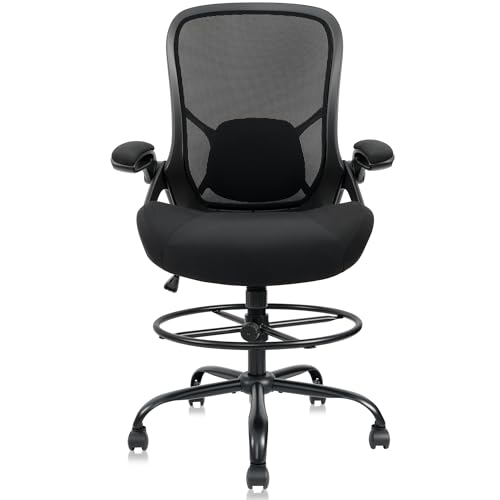
HYLONE Big and Tall Drafting Chair 400 lbs — Best Cushioned Seat
The HYLONE’s argument is five inches thick. Its listing specifies a five-inch thickened seat — a serious slab of cushioning by drafting-chair standards — on a 400 lb big and tall frame with lumbar support, flip-up armrests and an adjustable footrest ring. Perching concentrates pressure differently from ordinary sitting: the sitter’s weight rides more on the seat’s front half, and a thin cushion that would pass at desk height becomes a hard opinion by the second hour at a counter. This chair was clearly designed by someone who understood that arithmetic, and it is the comfort-led pick of the guide for workers whose raised shifts run long.
The supporting cast is complete: lumbar support in the back, because a tall chair with a flat back abandons the sitter’s spine at exactly the height where leaning is most tempting; flip-up armrests for the mount, dismount and pull-in choreography of counter work; and the footrest ring to carry the feet. HYLONE states the big and tall intent plainly in the listing, and the chair reads as a coherent whole rather than a standard chair stretched upward — a distinction experienced buyers learn to look for, since stretched chairs keep standard-width seats and standard-duty columns under their tall costumes.
Its trade-off is the cushion’s own physics. A very thick seat raises the effective sitting height and softens the perch’s precision; workers who like a firm, exact seat for draughting or bench detail may find five inches of cushion more hospitality than they want. But for the long counter shift — retail, reception, studio days, standing-desk work measured in hours — the HYLONE is the chair in this guide most plainly designed around the sitter’s afternoon.
Cushion care is the honest footnote to a thick seat. Five inches of foam earns its keep daily and asks, in return, to be treated like the working component it is: vary your perch position across the week so the foam wears evenly, keep sharp tools and belt hardware off it in workshop settings, and expect it to soften gradually into a personal shape rather than staying showroom-firm forever. Workers who understand that a cushion is a consumable with a long life, rather than a permanent structure, get the best years out of chairs built like this one.
- Stated capacity: 400 lbs per the listing
- Seat: five-inch thickened cushion
- Back: lumbar support included
- Arms: flip-up armrests
- Foot support: adjustable footrest ring
Strengths
- Thickest seat cushion in the guide.
- Full ergonomic set: lumbar, arms, ring.
- Big and tall intent stated plainly.
Trade-offs
- Deep cushion softens perch precision for detail work.
- Thick seat raises minimum sitting height.
- Comfort-led design is more chair than a lab needs.
Best for: long raised shifts at counters and standing desks. Not suited for: workers wanting a firm, minimal bench stool.

TAKE UR SEAT Deluxe Drafting Lab Stool 450 lbs — Best Lab Stool
The TAKE UR SEAT entry breaks the guide’s pattern deliberately: no back, no arms, no casters. It is a drafting lab stool with a 450 lb stated capacity, an 18 inch adjustable footring, a generous ten inches of height adjustment per its listing, and glides instead of wheels — a specification written for benches, labs and workshops where the worker sits high, works with both hands, and needs the seat to stay exactly where it was put. In those rooms, a rolling chair is not a convenience; it is a slow drift away from the work at the worst moments.
The footring is this stool’s centre of gravity as a design. At 18 inches and adjustable, it gives big and tall sitters a real platform rather than a token hoop — feet flat, weight shared, posture settled — and the wide height range lets the same stool serve a standard counter and a tall bench across a working week. The glide base completes the bench logic: the stool can be dragged or lifted into place and then trusts friction to keep it there, which is also why it suits uneven workshop floors that would send a caster chair wandering.
What you give up is everything a back and arms provide, so this stool should be bought by workers whose tasks are active — reaching, turning, standing often — rather than by anyone planning to sit in it like an armchair for eight hours. As a second seat in a studio, a bench stool in a lab, or the workshop’s high perch, it is the most honestly engineered object in the guide. As a sole chair for a desk worker, it would be a category error, and the guide says so in the stool’s own section rather than in a footnote.
There is also a teaching-lab argument for a stool like this. In workshops and classrooms where several people share stations across a day, a backless glide stool is the seat nobody has to adjust a backrest on, nobody catches a sleeve on, and nobody rolls into a neighbour’s bench. Its adjustments — height and ring — are the two that matter at a bench, and both can be reset in seconds by the next user. Shared equipment succeeds by being obvious, and this stool’s entire design is obvious in the best sense: sit, set the ring, work.
- Stated capacity: 450 lbs per the listing
- Footring: 18 inch, adjustable
- Height travel: ten inches of adjustment per the listing
- Base: glides, non-rolling
- Form: backless drafting lab stool
Strengths
- Serious capacity in a true stool format.
- Wide adjustable footring suits tall sitters.
- Glides keep the seat planted at a bench.
Trade-offs
- No back or arms — active tasks only.
- Must be lifted or dragged to reposition.
- Not a sole chair for long desk-style sitting.
Best for: labs, workshops and benches needing a planted high seat. Not suited for: workers wanting back support for long seated stretches.

Bondesin Drafting Chair 400 lbs — Best Leather All-Rounder
The Bondesin occupies the guide’s sensible middle: a 400 lb stated capacity, a PU leather seat, lumbar support, an adjustable footrest ring and flip-up armrests, arranged in the tall format for standing desks and counters. Nothing in its specification chases a superlative, and that is its appeal — it is the drafting chair for the buyer who read the whole category, understood the gates that matter, and wants them all passed without paying for the extremes at either end. Home studios, reception counters and shared workstations are its natural habitats.
PU leather is a considered choice for raised work. It wipes clean in the environments — studios with paint and ink, workshops with dust, counters with coffee — where fabric upholstery collects the day’s evidence, and it gives the chair a finished, office-respectable look when the standing desk lives in a room that also receives guests. The lumbar support and ring do the ergonomic work, and the flip-up arms keep the chair’s footprint flexible in the tight spaces where counters usually live.
Against the HYLONE it trades cushion drama for a firmer, more conventional sit; against the 500 lb chair it trades ultimate headroom for a lighter presence and a gentler tier. Those are respectable trades, and for the large middle of big and tall buyers — workers who need the 400 lb class, the ring and the height, in a chair that looks at home anywhere — the Bondesin may be the easiest recommendation in this guide to actually live with.
Shared workstations are the Bondesin’s home turf. A chair whose adjustments are quick and whose styling offends nobody can serve a studio’s whole team across a rota, and the 400 lb class rating means the rota rarely has to think about it. Managers of small workshops and co-working corners learn to prize exactly this profile — capable, cleanable, unremarkable — because every unusual chair in a shared space generates questions, instructions and exceptions, while a balanced all-rounder simply gets used.
- Stated capacity: 400 lbs per the listing
- Seat: PU leather
- Back: lumbar support included
- Arms: flip-up armrests
- Foot support: adjustable footrest ring
Strengths
- Balanced specification with no weak gate.
- Wipe-clean leather suits messy work environments.
- Respectable looks for guest-facing spaces.
Trade-offs
- No single headline feature to champion.
- Firmer sit than the HYLONE’s deep cushion.
- Less capacity headroom than the guide’s leader.
Best for: mixed studios, counters and standing desks wanting balance. Not suited for: buyers needing the maximum capacity figure available.

Primy Drafting Chair with Flip-Up Armrests — Best Streamlined Chair
The Primy is the drafting chair for the office that still wants to look like an office. Its listing describes an executive-style tall chair with flip-up armrests, lumbar support and an adjustable footrest ring — the full drafting pattern, drawn in the visual language of a boardroom rather than a workshop. That matters in a specific and common setting: the home office or professional studio where the standing desk is also the room clients see on video calls, and where industrial furniture would strike the wrong note several times a day.
Functionally it covers the guide’s gates in their standard forms: height for counters and standing desks, a ring for the feet, lumbar support for the long sit, arms that flip away for mounting and for tucking the chair in. Buyers should do one piece of diligence the other picks make easier — the Primy’s listing foregrounds design and ergonomics rather than a headline capacity figure, so check the stated capacity on the live listing and confirm it gives you the headroom your body requires before ordering. That check is the price of the chair’s streamlined presentation, and it takes a minute.
Choose the Primy when the room’s appearance is a genuine working requirement and its verified figures suit you; choose the Bondesin or HYLONE when you want the capacity stated in the headline and the styling to fend for itself. In a guide built on gates and margins, the Primy is the reminder that a chair can pass them with polish — provided the buyer reads the listing as carefully as this category always demands.
Video has changed what an office chair is for, and the Primy is this guide’s answer to that change. A chair that appears in the background of a professional’s calls all day is part of their presentation, whether anyone admits it or not, and a tall chair with executive lines keeps a standing-desk user looking established rather than perched on workshop equipment. That is a superficial virtue with un-superficial consequences for freelancers and consultants whose rooms are their reputations — and it costs nothing in function, provided the listing’s figures pass the same checks as every other pick here.
- Form: executive-style tall drafting chair
- Arms: flip-up armrests
- Back: lumbar support included
- Foot support: adjustable footrest ring
- Setting: standing desks in presentable offices
Strengths
- Most office-appropriate styling in the guide.
- Complete drafting pattern in a streamlined form.
- Flip-up arms suit tight, tidy workstations.
Trade-offs
- Verify the stated capacity on the listing before ordering.
- Polish prioritised over workshop ruggedness.
- Less cushion emphasis than the HYLONE.
Best for: presentable offices and studios with standing desks. Not suited for: buyers who shop by headline capacity figures alone.
Plain Round Workshop Stools, Discussed Generically — Budget Reality Check, Prose-Only
Every category has an honest bottom rung, and in this one it is the plain round workshop stool: a padded disc on a column, sold everywhere, costing little, and fine for what it is. This guide discusses it in prose only, because the generic version is the point — no single listing defines it, and attaching one would pretend a precision the product does not offer. What can be said generically is where its limits sit for the readers of this guide: basic stools rarely state serious capacity figures, their foot rings — when present at all — are fixed and narrow, and their columns are built for occasional perching rather than a big and tall worker’s full working week.
That is not contempt; it is calibration. For ten-minute tasks at a workbench, for a spare seat in a garage, for a teenager’s art desk, the plain stool is the correct purchase at its basic tier, and overspending there would be its own error. But a big and tall worker choosing daily equipment should understand the trade plainly: the money saved against the chairs above is saved out of the capacity rating, the ring and the seat — the three things this entire category exists to provide. Buy the plain stool for occasional perching with a clear conscience; do not ask it to be a working chair.
Best for: short, occasional tasks at a bench. Not suited for: daily drafting-height work by big and tall sitters.
What Working Heights Do These Chairs Actually Serve?
It helps to name the surfaces, because “drafting height” covers a family rather than a point. Kitchen islands and breakfast bars sit at counter height and ask for a modest climb. Standing desks in their raised position, draughting tables, jewellers’ and technicians’ benches, and retail counters sit higher and ask for the full range. Lab benches can sit higher still. The practical method is unglamorous: measure your surface, subtract roughly the distance from your seat to your working elbow, and check the result against each listing’s seat range — remembering that the foot ring must reach your feet at whatever height the arithmetic chooses, which is why the ring’s adjustability keeps appearing in this guide’s judgements.
Workers between two surfaces — a standing desk by day and an island perch by evening — should favour the chairs with the widest height travel and the most mobile rings, and should expect to reset the chair as part of moving rooms. That reset is not a flaw in the furniture; it is the furniture working as designed, and it takes less time than making the coffee that usually accompanies the move.
How Do the Picks Compare on Capacity and Format?
| Pick | Format | Stated capacity | Standout trait |
|---|---|---|---|
| Heavy Duty Drafting Chair 500 lbs | Chair, flip-up arms | 500 lbs | Maximum headroom, contoured leather seat |
| HYLONE Big and Tall Drafting Chair 400 lbs | Chair, flip-up arms | 400 lbs | Five-inch thickened seat |
| TAKE UR SEAT Deluxe Drafting Lab Stool 450 lbs | Backless stool, glides | 450 lbs | Wide footring, planted base |
| Bondesin Drafting Chair 400 lbs | Chair, flip-up arms | 400 lbs | Balanced leather all-rounder |
| Primy Drafting Chair with Flip-Up Armrests | Chair, flip-up arms | See listing | Executive styling |
| Plain Round Workshop Stools, Discussed Generically | Basic stool | Rarely stated | Lowest tier, occasional use |
Two decisions organise the table: whether your work wants a back, and how much capacity headroom your body honestly requires. Everything else in the comparison — leather against fabric, glides against casters, polish against ruggedness — is taste and setting, and taste is the one part of the decision this guide is very happy to leave entirely to you and your room. A third decision hides beneath both and is worth surfacing before you order: how many hours a day will actually be spent in the chair? A perch used for ninety minutes of counter tasks tolerates a firmer seat and a simpler ring than a chair carrying a full shift, and the guide’s comfort-led options — the HYLONE above all — exist for the long-shift end of that honest answer. Buy for your real hours and the rest of the specification tends to fall into place around them. Answer those and the table stops being six options and becomes one or two, with the foot ring — present in every linked pick — quietly doing the category’s essential work underneath whichever you choose.
What Is the Difference Between a Drafting Chair, a Counter Stool and a Bar Stool?
The three terms describe cousins, and big and tall buyers get hurt in the gaps between them, so the distinctions are worth stating plainly. A bar stool is hospitality furniture: a fixed or simply adjustable high seat built for an hour of social sitting, usually without a serious capacity statement, a back designed for work, or a ring placed for posture. A counter stool is its domestic relative, sized for kitchen counters and breakfast bars, prettier and lighter in duty. A drafting chair is work equipment: height-adjustable across a real range, built around a foot ring, with a back and arms designed for hours of task sitting, and — in the company kept in this guide — a stated capacity a large worker can plan around.
The confusion costs money because the cousins look alike in thumbnail photographs. A tall worker who orders a handsome bar stool for a standing desk discovers the difference across one working week: no ring at the right height, no back support worth the name, and a column never intended for daily perching loads. Read listings for the working vocabulary — capacity, ring adjustability, height range, lumbar support — and treat its absence as information. Furniture that will hold your working life should be willing to describe itself in working terms.
How Should You Set a Drafting Chair’s Height and Foot Ring?
Work from the counter down. Stand at your work surface and note where your elbows naturally work; the chair’s job is to put your seat at a height where, seated, your forearms arrive at that same working level with shoulders relaxed. Set the seat first, sit, and only then place the foot ring: your feet should rest flat on it with thighs roughly level, neither knees jacked high nor legs dangling past it. The ring set correctly disappears from attention, which is the test — a ring you keep hunting for with your feet is a ring at the wrong height.
Then live with the settings for a full working day before judging them. Perching also changes how often you should move: the half-standing rhythm of counter work is a gift to the body if you take it — stand fully for some tasks, perch for others, sit deep for the concentrated ones — and a drafting chair supports that rotation better than any fixed stool. Workers new to raised sitting often discover their favourite working position is one they cycle through rather than one they hold, and the chair’s job is to make every point in the cycle properly supported. Perching posture is a habit the body learns across hours, not minutes, and small adjustments on day two — ring up a notch, seat down a fraction — are the normal path to a setup you will keep for years. Workers sharing a chair across shifts should agree a quick reset ritual, because a drafting chair’s adjustments are its whole point, and a chair left at a colleague’s settings serves neither of you.
How Should a Big and Tall Worker Test a Drafting Chair in the First Week?
Test the mount first, because it happens most often. Sit and rise a dozen times across the first day, using the arms and ring as you naturally would, and notice whether the chair stays composed or begins to feel like equipment you negotiate with. Then test the long sit: a full work session at your real counter, with your real tasks, because perching comfort is a property of hours and no showroom minute predicts it. Finally, test the extremes — the chair at its highest, the ring at its lowest useful point — since a chair bought for range should be verified across that range while returns are still easy.
Keep notes, briefly. Which setting suited which surface, where the ring felt right, whether the cushion’s character changed between morning and afternoon. A drafting setup has more variables than an ordinary chair, and the worker who records the answers owns a workstation that can be recreated after any move, clean or house change — while the worker who relies on memory re-derives the whole setup every time the chair is shifted.
What Mistakes Do Big and Tall Buyers Make in This Category?
The first is buying a standard chair and a prayer: ordinary drafting chairs are drawn around ordinary dimensions, and their seats, columns and capacities all quietly assume them. The second is reading capacity as a target instead of a ceiling — a worker near a chair’s stated figure will feel the machinery working at its edge daily, in sink, creak and flex, and the chair will age in dog years. Buy headroom. The third mistake is forgetting the counter: a chair whose maximum seat height leaves your elbows below the work surface cannot be fixed by posture, cushions or optimism, so the tape measure comes before the order, every time.
Buyers also misjudge the room a tall chair needs. A drafting chair at full height, with its ring extended and its sitter’s legs upon it, occupies a deeper footprint than its base suggests, and a chair wedged between a counter and a wall leaves its owner climbing in from the side like a saddle. Leave the chair a working apron of floor — space to approach, mount, turn and dismount — and measure that apron before the chair arrives, not after it has been assembled in the only corner it fits. At drafting height, getting into the chair is a small athletic event, and fixed armrests turn it into a squeeze for broad sitters — which is why four of the five linked picks flip their arms away. And the quietest mistake is treating the foot ring as an accessory. In this category the ring is load-bearing furniture for your legs; a chair with a token ring is a chair half designed, whatever its capacity figure claims.
Which Workplaces Buy These Chairs Again and Again?
Certain rooms reveal the category’s logic by reordering the same chairs for years. Dental and medical-adjacent workstations keep tall stools at benches because the work is high, active and shared. Print shops, framing studios and sign workshops keep drafting chairs at cutting and assembly counters for the same reason with dust added. University and school labs keep glide stools because students are hard on casters and harder on backs they can lean and swing on. In every case the reorders follow the same pattern: the chairs that survive are the ones bought with capacity headroom and honest rings, and the ones replaced early are the bargains whose listings never stated a number.
Home workers have joined that list since standing desks became ordinary furniture. The home standing-desk user is, mechanically, a counter worker with a longer shift and no facilities department, and the chairs that serve them best are borrowed directly from the commercial world this guide surveys. If your home office has quietly become your workplace in full, it deserves workplace furniture — rated, ringed and built for the hours it actually hosts.
How Do You Care for a Tall Chair So Its Column and Ring Stay Honest?
A drafting chair’s column works harder than an ordinary chair’s, simply because there is more of it exposed and more leverage upon it. Keep it clean — dust and workshop grit on the column become an abrasive paste in the mechanism — and resist the habit of dropping into the chair from standing height, a landing that multiplies the load far beyond the sitter’s weight and teaches lifts to sink early. The foot ring’s clamp deserves a periodic check for the same reason a bicycle’s quick-release does: it holds position by friction, and a ring that has begun to slip underfoot should be tightened the day it is noticed, not the month it becomes a habit to hook your feet elsewhere.
Upholstery care follows the material. Leather and PU leather wipe down and appreciate an occasional suitable conditioner in dry rooms; fabric seats in workshops collect the environment and want regular vacuuming. Casters, where fitted, collect hair and thread exactly as office casters do, and glide bases want their pads inspected for the grit that turns a glide into a floor-scratcher. None of this is a service schedule — it is the same five-minute attention any hard-working furniture earns, applied to a chair whose height makes neglect more consequential than usual.
One last distinction for readers hesitating between the two 400 lb chairs, since they are the guide’s closest pair. The HYLONE spends its design budget on the seat — five inches of cushion for the worker who sits long and feels every minute of it. The Bondesin spends its on balance and surface — leather that wipes clean, proportions that suit anywhere, nothing exaggerated. Neither is the other’s poor relation; they are answers to different days. Choose by the day you actually work, and the chair will feel chosen rather than merely bought.
Final Recommendation
Start with the number and let it be honest: workers who want the question of capacity retired entirely should take the 500 lb class chair and its complete drafting pattern. Long raised shifts point to the HYLONE and its five-inch seat; benches and labs point to the TAKE UR SEAT stool and its planted glides; the Bondesin serves the broad middle with balance and wipe-clean leather; and the Primy dresses the whole pattern for presentable offices, once its listing figures are verified. Measure your counter, respect the ring, buy your headroom — a big and tall worker equipped by those three rules stops adapting to furniture and starts being served by it.
Frequently Asked Questions
What seat height do I need for a standing desk or counter?
Enough that, seated, your forearms meet the work surface with relaxed shoulders. A useful cross-check is the mirror test used by bench workers for generations: sit at the surface, close your eyes, and reach for where your tools or keyboard live. If your hands land naturally and your shoulders have not climbed, the height is honest. If you are reaching down into the work or hunching up out of the chair, no cushion will rescue the geometry, and the chair’s range — not your posture — is what needs to change. For most counters that means a chair whose range extends well above standard desk chairs. Measure from the floor to your work surface, then compare with the listing’s seat height range, remembering that a thick cushion compresses and a foot ring must still reach your feet at the chosen height. The counter’s measurement, not a universal number, is the answer.
Why do drafting chairs have a foot ring?
Because at drafting height your feet cannot rest on the floor, and unsupported feet leave your legs dangling, your thighs bearing pressure at the seat edge and your posture slowly collapsing. The ring restores the floor at the right altitude: feet flat, weight shared, thighs level. It is not an accessory or a styling cue, and in this category its size and adjustability deserve the same scrutiny as the seat itself. Workers who have only ever sat at ordinary desks tend to underestimate the ring until their first full day at a counter, after which they describe it the way cyclists describe gears — as the part that makes the whole machine usable. If a listing photographs the chair without showing the ring clearly, treat that omission the way you would treat a bicycle advertised without its drivetrain.
Are casters or glides better for a drafting stool?
Casters suit smooth floors and work that travels along a counter — studio desks, long benches with tasks spread along them. Glides suit work that stays in one place, floors that slope or snag, and any setting where a chair drifting mid-task would be a nuisance or worse; the TAKE UR SEAT stool’s glide base is built on exactly that logic. Choose by your floor and your workflow rather than by habit. One hybrid habit is worth copying from workshops: casters on the chair, and a mat defining its territory on the floor. The mat protects the surface, quietens the roll, and gives the chair a home position to return to, which in a shared studio quietly prevents the slow migration of good chairs toward whoever arrived first.
How much capacity headroom should I buy?
Comfortably more than the sitter weighs — the stated figure is a ceiling for the mechanism’s smooth, durable operation, not a description of the ideal user. Workers who sit well inside the rating get quiet machinery and long service; workers at the edge get neither. In a category whose listings honestly span 400 to 500 lb class figures, the headroom is there to be bought, and it is the wisest money in the purchase. Think of the margin as buying the chair’s middle age in advance: every mechanism in this category is happiest in the centre of its range, and a chair that spends its life there will still be lifting smoothly on the day a harder-worked bargain is being carried out to the kerb.
How long should a heavy-duty drafting chair last?
Years of daily use is the honest expectation for chairs built and rated like these, with the moving parts ageing first: the lift, the ring’s locking hardware and the cushion will show wear before the frame does. Buying capacity headroom extends that life directly, because machinery worked inside its rating ages slowly, and the maintenance asked of the owner is modest — keep the ring’s clamp clean, check fixings occasionally, and do not let the chair live at its maximum height under load for months at a time if a lower setting serves. When wear does arrive, it usually announces itself politely — a ring that slips a fraction, a lift that sighs — and attending to the first announcement is what separates a maintained chair from a replaced one.
Can a drafting chair replace my regular office chair?
For standing-desk and counter work, it is the correct tool and a standard chair is the substitute. For a conventional low desk, a drafting chair’s minimum height may sit you too high, with the ring solving a problem you do not have. Many workers keep the drafting chair at the raised station and a standard chair at the low desk; if one chair must serve both, check its full height range against both surfaces before deciding. Sit-stand desks blur the line helpfully here: a drafting chair pairs with the desk’s raised hours and perches neatly aside for the standing ones, which is why so many sit-stand owners end up drafting-chair owners without ever having used the word drafting.
Related Guides
Tall workstations connect to the rest of the house in surprising ways. Readers may also enjoy Best Gaming Chairs for Computer Gamers for another high-backed category, Best Chairs for Home Movies for sitting at the opposite extreme of effort, and Best Chairs for a Marble Dining Table for chairs chosen to match a surface. For the broader question of seating sized generously, see Best Chairs for Big Guys.


