What's inside
- Key Takeaways
- Quick Picks
- How Did We Choose These Best All Metal Sewing Machines?
- How Do the Six Machines Compare Side by Side?
- What Does a Metal Frame Actually Do While You Sew?
- Which Needles and Thread Do These Machines Really Need?
- How Should You Test a Machine on Thick Fabric?
- What Can These Machines Not Do, Honestly?
- How Do You Keep a Metal-Frame Machine Sewing for Decades?
- How Do You Choose Between Mechanical and Electronic in This Class?
- Which Fabrics Tell You the Truth About a Heavy-Duty Machine?
- What Does the Sewing Space Around the Machine Need?
- How Should a Beginner Grow Into a Heavy-Duty Machine?
- When Does an Extension Table Change the Result?
- What Should You Budget Beyond the Machine Itself?
- How Do You Read a Heavy-Duty Listing Without Being Fooled?
- What Is the Sensible Upgrade Path From an Entry-Level Machine?
- How Should You Store a Machine Between Projects?
- What Mistakes Do Buyers of Heavy-Duty Machines Make Most Often?
- Final Recommendation
- Frequently Asked Questions
- Related Guides
As an Amazon Associate I earn from qualifying purchases. This post may contain affiliate links at no extra cost to you.
cottageverdict.com is reader-supported. When you buy through links on our site, we may earn an affiliate commission.
Where to buy: each machine below is sold through Amazon, and the names in the Quick Picks table, the detailed reviews and the comparison table all link to the live listings, so you can check price on Amazon and confirm the current bundle contents before ordering. The best all metal sewing machines need an honest definition before any ranking makes sense, because the phrase means something narrower than most shoppers expect. On a modern domestic machine, “all-metal” describes the internal frame and chassis — the skeleton that holds the needle bar, hook and feed system in alignment — while the outer shell, knobs, spool pins and covers are still plastic on nearly every model sold today. A genuinely metal-bodied machine belongs to the vintage and industrial worlds, not to the current home market.
That distinction is not a disappointment; it is actually where the value lives. A rigid metal frame resists the flex and vibration that make lightweight machines wander off a seam line, skip stitches in denim, and sound as though they are shaking themselves apart on thick work. Plastic outer panels, meanwhile, keep weight and cost sane and protect the mechanism from knocks. What you are really shopping for in this category is frame stiffness, motor strength and a metal hook assembly, and the six machines gathered here all answer that brief in different ways and at different levels of commitment.
Two brands dominate the field, and both appear here in pairs. Janome’s HD3000 shows up twice — once as the standard machine and once as a Black Edition bundle — because the underlying machine is the benchmark for this class and the bundle question is a real one for buyers. SINGER’s Heavy Duty line contributes three models spanning the budget end, a holiday bundle and a newer evolution of the design. Brother’s ST150HDH rounds the group out as the stitch-rich alternative for sewers who want heavy-duty bones without giving up decorative range.
None of these machines is a true industrial unit, and none should be bought expecting to sew sailcloth or upholstery leather eight hours a day. What they do offer is a decisive step up from entry-level machines: stronger piercing power, steadier feeding, and frames that stay aligned after years of curtains, jeans hems, quilt sandwiches and tote bags. The sections after the individual reviews explain how to judge frame claims, which needles and thread these machines actually need, and where the honest limits of the whole category sit.
Key Takeaways
- “All-metal” on a current home machine means a metal internal frame, not a metal body — every pick here pairs that frame with plastic outer panels.
- The Janome HD3000 remains the reference point for this class, and the Black Edition is the same machine dressed in black with a bonus bundle added.
- SINGER’s Heavy Duty models trade stitch variety for speed and piercing power, suiting garment repairs, denim and home décor workloads.
- Brother’s ST150HDH carries the widest stitch library of the six while keeping a heavy-duty frame and metal needle plate.
- Needle choice matters as much as frame material: denim and leather points, matched to fabric, prevent most “weak machine” complaints.
- Buy the frame for the thickest work you sew regularly, not for a fantasy project you may attempt once.
Quick Picks
| Pick | Badge | Why it earns its place |
|---|---|---|
| Janome HD3000 Heavy-Duty Sewing Machine | Best Overall Heavy-Duty Classic | Eighteen stitches, a hard case and a metal frame in the machine that has defined this category for years. |
| Janome HD3000 Black Edition Sewing Machine Bundle | Best Bundle for New Sewers | The HD3000 in black with an exclusive bonus bundle, for buyers who would purchase the extras anyway. |
| SINGER Heavy Duty 4552 Next Evolution | Best Modern Heavy Duty | Thirty-two stitches, a metal frame and bonus presser feet in SINGER’s updated take on its heavy-duty formula. |
| SINGER 4423 Heavy Duty Sewing Machine | Best Budget Heavy Duty | Twenty-three stitches delivering ninety-seven applications, in the Meltwater Blue finish, at the group’s friendliest entry point. |
| SINGER 4452 Heavy Duty Sewing Machine Bundle | Best Accessory Bundle | The 4452 with an extension table and two extra presser feet packed into a holiday accessory kit. |
| Brother ST150HDH Strong and Tough Sewing Machine | Best Stitch Variety | Fifty stitches on a strong-and-tough platform built to handle layered and heavier fabrics. |
How Did We Choose These Best All Metal Sewing Machines?
Frame construction came first, because it is the entire premise of the search. Each candidate needed a metal internal frame stated by its maker, and preference went to machines whose hook and needle-plate areas also use metal where cheaper models substitute plastic. Marketing language was discounted heavily: words like “heavy duty” appear on machines with modest motors, so the shortlist favours models with a track record on denim, canvas and layered quilting cotton rather than those with aggressive naming alone.
Stitch selection was judged by usefulness rather than raw count. A sewer hemming jeans, making curtains and piecing quilts needs a reliable straight stitch, a zigzag that holds its width under load, a proper buttonhole and a stretch stitch — decorative counts beyond that are welcome but secondary. That is why an eighteen-stitch Janome can headline this guide while a fifty-stitch Brother earns its place for a different kind of buyer, and why both arguments are made openly in their sections.
Practical ownership details completed the picture: whether a hard case or extension table is included, how the accessory bundle changes the value calculation, whether the machine uses standard needles and bobbins that any shop stocks, and how much mechanical simplicity remains for home servicing. Machines that demand proprietary consumables for ordinary sewing were marked down, because a heavy-duty machine should reduce friction in a sewing room, never add errands to it.
Finally, each model was matched against a recognisable sewing life. One pick serves the garment repairer, another the quilter working through thick sandwiches, another the household that sews twice a year but always on something stubborn. The verdicts under each review name those matches plainly, including who should walk past a given machine and choose its neighbour instead.

Janome HD3000 Heavy-Duty Sewing Machine — Best Overall Heavy-Duty Classic
The HD3000 is the machine other heavy-duty models get measured against, and sitting down at one explains why within a single seam. The metal frame gives it a planted, unhurried feel: press the pedal on four layers of denim and the needle goes through with a firm, even stroke instead of the anxious clatter lighter machines produce. Eighteen built-in stitches cover the genuine working set — straights, zigzags, a stretch stitch, buttonhole — without burying the controls in menus, because this is a mechanical machine adjusted with dials you can read at a glance.
The included hard case sounds like a minor accessory until you store the machine in a cupboard shared with other household gear, or carry it to a class. It also signals how Janome positions the HD3000: as a long-term tool rather than a seasonal purchase. Owners keep these machines for decades, and the mechanical design means a competent service technician can clean, oil and time it without proprietary electronics standing in the way. That serviceability is a real part of the heavy-duty promise, and it is one the electronic-heavy alternatives cannot fully match.
Where does it fall short? Decorative range is modest, the lighting and creature comforts are a generation behind newer designs, and the price sits above the SINGER models below for buyers counting carefully. If your sewing is mostly repairs, garments, curtains and quilts, none of that matters much. If you dream in embroidered monograms, look at the Brother instead. For the core brief — a metal-framed machine that sews thick fabric calmly — this remains the surest answer in the group.
- 18 built-in stitches
- Metal internal frame
- Hard case included
- Mechanical dial controls
- Drop-in bobbin system
Strengths
- Calm, flex-free sewing on denim and canvas layers
- Simple mechanical design that any technician can service
- Hard case protects the machine in storage and transit
Trade-offs
- Decorative stitch range is deliberately small
- Costs more than the SINGER heavy-duty models
- No electronic speed control or needle positioning extras
Best for: garment sewers and quilters who want one durable mechanical machine for decades of work.
Not suited for: crafters who prioritise decorative stitches and electronic convenience features.

Janome HD3000 Black Edition Sewing Machine Bundle — Best Bundle for New Sewers
Start with the essential fact: underneath the black finish and the bundle box sits the same HD3000 mechanical machine reviewed above, with the same eighteen stitches and the same metal frame. Nothing about the sewing changes. What changes is everything around the sewing — an exclusive bonus bundle of accessories bundled in, and a finish that many buyers simply prefer on a worktable that stays set up in a living space rather than hidden in a cupboard.
The bundle logic deserves a fair hearing. A new sewer, or someone returning after years away, needs feet, needles, bobbins and the small tools that experienced sewers already own in drawers. Buying those pieces separately, one frustrated project at a time, usually costs more and always costs momentum. A bundle that anticipates the first year of projects removes that friction, and it arrives in one box on one day, which matters more to a beginner’s confidence than seasoned sewers tend to remember.
The counter-argument is equally clear: if your sewing drawer is already stocked, the bundle duplicates what you own, and the standard HD3000 in white is the smarter purchase. Choose between these two Janomes by inventorying what you already have, not by the colour — though if the machine will live permanently on display, preferring the black finish is a perfectly respectable reason on its own. Either way, the frame, stitches and sewing behaviour underneath are identical, and both inherit the classic’s long service life.
- 18 built-in stitches
- Metal internal frame
- Black Edition finish
- Exclusive bonus accessory bundle
- Hard case included
Strengths
- Same proven HD3000 mechanism as the classic pick
- Bundle equips a new sewer from the first day
- Black finish suits machines left permanently set up
Trade-offs
- Extras duplicate accessories experienced sewers already own
- No mechanical advantage over the standard HD3000
- Bundle contents vary by listing, so check before ordering
Best for: new or returning sewers who want the HD3000 plus a stocked accessory kit in one purchase.
Not suited for: well-equipped sewers who would pay for accessories they already own twice over.

SINGER Heavy Duty 4552 Next Evolution — Best Modern Heavy Duty
SINGER’s Heavy Duty formula — metal frame, strong motor, high sewing speed, modest stitch set — gets a refresh in the 4552 Next Evolution, and the refresh is aimed squarely at sewers who found the older models a little stark. Thirty-two built-in stitches widen the working range beyond the bare essentials, and bonus presser feet arrive in the box, which quietly answers the most common complaint about budget heavy-duty machines: that the second foot you need costs extra and arrives next week.
On fabric, the character is classic SINGER heavy duty. The machine prefers momentum; it sews fast and punches through folded hems and strap webbing with authority, and the metal frame keeps that energy from turning into vibration at the needle. Beginners should practise on scraps first, because a fast machine rewards a steady hand and punishes hesitation at thick seams — easing over a jeans hem intersection slowly, or hand-cranking those few stitches, is technique rather than a flaw in the machine.
Consider this model the moderniser’s choice within the group. It keeps the mechanical honesty of the heavy-duty class — no touchscreen, no embroidery dreams — while sanding down the rough edges of the older design. Buyers cross-shopping the 4423 below should weigh the extra stitches and included feet against the price gap; buyers cross-shopping the Janomes are trading some long-term refinement for speed, stitch count and a lower entry cost. Both trades are defensible, and the right one depends on whether your sewing leans toward volume or toward heirloom patience.
- 32 built-in stitches
- Metal frame construction
- Bonus presser feet included
- Heavy-duty motor for thick layers
- Top drop-in bobbin
Strengths
- Widest stitch set in the SINGER trio here
- Bonus feet remove the usual first-month extra purchases
- Fast, confident sewing through folded hems and webbing
Trade-offs
- Speed can overwhelm absolute beginners at first
- Refinement and quietness trail the Janome models
- Still a plastic outer shell over the metal frame
Best for: confident home sewers who want heavy-duty power with a more current feature set.
Not suited for: beginners who want the slowest, gentlest learning curve available.

SINGER 4423 Heavy Duty Sewing Machine — Best Budget Heavy Duty
The 4423 is where most households should start reading this guide, because it delivers the heavy-duty essentials — metal frame, strong motor, stainless steel bedplate — at the group’s most approachable entry point, here in the Meltwater Blue finish with accessories included. Twenty-three stitches sounds modest next to the Brother’s fifty until you translate it the way SINGER does: ninety-seven stitch applications, because length, width and technique multiply each pattern into real-world uses. For repairs, garments and home décor, that working set rarely leaves a genuine gap.
Its personality is eager. The 4423 sews quickly, and on long curtain seams that pace feels like a gift; on a short, fiddly repair it asks you to feather the pedal and guide firmly. The metal frame earns its keep precisely here, holding alignment while the motor works hard, and the machine’s relative simplicity means the manual is short and the learning curve is measured in evenings rather than weekends. This is the pick that gets borrowed by neighbours, and it survives the lending.
Honesty about limits matters with a budget recommendation. The 4423 will sew denim hems and canvas totes happily, but it is not the machine for daily upholstery work, and its finish and refinement sit a step below the Janomes. Buy it as the household workhorse for repairs and projects, and it will repay you for years. Buy it expecting industrial behaviour at a domestic price, and the disappointment will be in the expectation rather than the machine, which does exactly what its class promises.
- 23 stitches, 97 applications
- Metal frame construction
- Stainless steel bedplate
- Accessories included
- Meltwater Blue finish
Strengths
- Lowest entry cost into genuine metal-frame sewing
- Fast motor makes long seams and big projects painless
- Simple controls suit occasional and returning sewers
Trade-offs
- Less refined feel than the Janome pair
- Not built for daily upholstery-weight workloads
- Quick pace needs a practised foot on short repairs
Best for: households wanting one affordable, sturdy machine for repairs, garments and décor projects.
Not suited for: heavy daily sewing businesses or upholstery specialists needing industrial capacity.
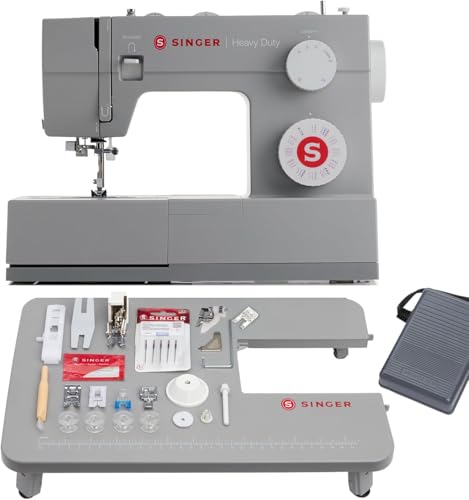
SINGER 4452 Heavy Duty Sewing Machine Bundle — Best Accessory Bundle
Two words in this listing change the sewing experience more than any stitch count: extension table. The 4452 holiday bundle pairs SINGER’s heavy-duty machine with an accessory kit that includes the table and two extra presser feet, and the table alone transforms how larger work handles. Curtains stop dragging off the edge and pulling seams sideways; quilt tops rest level instead of folding into your lap; the machine’s feeding suddenly feels twice as accurate because the fabric, not gravity, is finally in charge of direction.
The 4452 itself sits in the heart of the Heavy Duty range: metal frame, strong motor, a stitch set oriented toward utility with a little more range than the 4423 offers. As a bundle, the value calculation hinges on whether you would buy the table and feet separately — quilters and curtain-makers almost certainly would, garment-only sewers perhaps not. Price the pieces individually before deciding, because bundle value is arithmetic, not atmosphere, and this one adds up best for people whose projects are physically large.
One caution applies to every bundle in this guide: contents are set by the listing, and holiday packaging can differ from the standard kit, so read the current listing’s accessory list carefully before ordering. With that checked, the 4452 bundle is the easiest recommendation here for a new quilting enthusiast — the machine has the frame for layered work, the table supports the work properly, and the extra feet cover the techniques beginners reach for in their first year, from even feeding to cleaner edges.
- Metal frame construction
- Extension table included
- Two additional presser feet in kit
- Heavy-duty motor
- Accessory kit packaging
Strengths
- Extension table dramatically improves large-project handling
- Bundle covers the feet new quilters need first
- Frame and motor suit layered quilt sandwiches
Trade-offs
- Value fades if you would never buy the table separately
- Bundle contents should be confirmed on the live listing
- Takes more storage room than a bare machine
Best for: quilters and curtain-makers who want machine, table and feet settled in a single order.
Not suited for: garment-only sewers with limited storage who rarely handle large flat work.

Brother ST150HDH Strong and Tough Sewing Machine — Best Stitch Variety
Brother looked at the heavy-duty formula and asked why toughness should mean austerity. The ST150HDH answers with fifty stitches — the widest library in this guide by a distance — on a Strong and Tough platform with a metal needle plate and the feeding confidence to handle layered fabrics. If your sewing mixes mending with making, denim with dress fabrics, and utility with the occasional decorative flourish on a child’s costume or a table runner, this is the machine that refuses to make you choose a personality.
The electronic side of the Brother shows in small mercies: stitch selection is quicker than dial-hunting when you switch tasks often, and the machine behaves politely at low speeds, which nervous beginners and careful repair work both appreciate. Where the SINGERs want momentum, the Brother is content to creep through a tricky corner and then open up on the straight. That breadth of temperament is its real distinction, more than any single stitch in the fifty.
Balance the praise with the usual truths. Fifty stitches include many you may touch twice a year, electronics add a service dimension the mechanical Janomes avoid, and determined upholstery-weight work still belongs to a class above this one. But as the single machine for a varied sewing life — school uniforms on Monday, a quilted gift on Saturday — the ST150HDH covers more ground than anything else here, and it does so without giving up the sturdy frame that brought you to this guide in the first place.
- 50 built-in stitches
- Strong and Tough platform
- Metal needle plate
- Electronic stitch selection
- Handles layered fabrics
Strengths
- Far more stitch variety than any rival in this group
- Composed at slow speeds for careful work
- Tough platform still manages layered, heavier fabrics
Trade-offs
- Many decorative stitches will see rare use
- Electronics complicate servicing versus mechanical rivals
- Not a substitute for a true industrial machine
Best for: varied sewers mixing repairs, garments and decorative projects on one sturdy machine.
Not suited for: purists who want a purely mechanical machine with no electronics at all.
How Do the Six Machines Compare Side by Side?
| Pick | Stitches | Frame | Standout extra |
|---|---|---|---|
| Janome HD3000 Heavy-Duty Sewing Machine | 18 | Metal internal frame | Hard case included |
| Janome HD3000 Black Edition Sewing Machine Bundle | 18 | Metal internal frame | Bonus accessory bundle |
| SINGER Heavy Duty 4552 Next Evolution | 32 | Metal frame | Bonus presser feet |
| SINGER 4423 Heavy Duty Sewing Machine | 23 | Metal frame | Lowest entry cost |
| SINGER 4452 Heavy Duty Sewing Machine Bundle | Utility range | Metal frame | Extension table in kit |
| Brother ST150HDH Strong and Tough Sewing Machine | 50 | Heavy-duty platform | Widest stitch library |
What Does a Metal Frame Actually Do While You Sew?
Picture the forces inside a sewing machine at a thick seam: the needle drives down through folded denim, the feed dogs push resistant fabric forward, and the whole mechanism tries to twist slightly with every stroke. A flexible frame absorbs those forces by moving, and movement is the enemy — timing drifts, stitches skip, seams wander. A metal frame refuses most of that movement, so the needle lands where the last stitch landed, thousands of times in a row, and the machine sounds composed instead of distressed.
The benefit compounds over years. Alignment that survives a decade of projects is worth more than any single feature, because a misaligned machine frustrates every single seam while a stiff one quietly disappears beneath the work. When you read “metal frame” on these listings, that long, boring reliability is what you are actually buying — not a shinier box, and certainly not a fully metal machine of the kind factories used generations ago.
Which Needles and Thread Do These Machines Really Need?
More “weak machine” complaints trace back to needles than to motors. Fit a denim or jeans needle for heavy woven fabrics, a leather point only for genuine leather, and a fresh universal needle for everyday cotton — and change needles far more often than feels reasonable, because a dulled point deflects, shreds thread and mimics a failing machine. Every pick in this guide uses standard needle systems, so the right point is always a small, cheap purchase away.
Thread deserves the same realism. Quality all-purpose polyester thread handles the vast majority of heavy-duty home sewing, including denim repairs and canvas work. Save heavy topstitching thread for machines and needles set up for it, and never blame a frame for breakage caused by a bargain spool — linty, uneven thread defeats good engineering. Match needle, thread and fabric as a trio and these six machines all perform a class above their price conversations.
How Should You Test a Machine on Thick Fabric?
Reproduce your hardest real task in miniature before judging any machine. Fold a denim offcut to four layers, add a crossed seam to mimic a jeans hem intersection, and sew slowly across it. A capable heavy-duty machine walks over the ridge with hand-crank assistance at the very peak and keeps stitch length honest on both sides. Canvas tote straps, folded webbing and a three-layer quilt sandwich make equally honest tests for the work you actually plan.
Listen during the test as much as you watch. Strain announces itself as laboured rhythm, rising pitch and vibration through the table; composure sounds boring, which is exactly right. Then check the underside: balanced tension on thick work means the machine’s frame and hook are holding their geometry under load. Any of the six picks should pass a household version of this test, and the ones that suit you best will pass it on the fabrics your own projects use most.
What Can These Machines Not Do, Honestly?
They cannot replace an industrial walking-foot machine, and pretending otherwise wastes money in both directions. Thick upholstery leather, multi-layer sailcloth, and all-day production sewing exceed what domestic motors, feed systems and warranties are built for. A household machine asked to do factory work will do it briefly and then fail expensively, which is the most costly outcome of all.
The honest ceiling still sits high. Curtains, slipcovers in midweight fabrics, jeans alterations, canvas bags, quilts, outdoor cushion covers in woven fabrics — the whole landscape of ambitious home sewing fits comfortably under it. Buy within that landscape and these machines feel overbuilt; buy beyond it and no badge on a domestic box will rescue the project. Matching ambition to class is the single most valuable skill this guide can hand you.
How Do You Keep a Metal-Frame Machine Sewing for Decades?
Brush lint from the bobbin area after every dusty project, because packed fibres are the leading cause of mysterious tension trouble. Oil only where the manual directs, with proper sewing machine oil, and never improvise with household lubricants that gum into varnish. Cover the machine or case it between sessions; dust is patient, and a sewing room near a laundry area generates more of it than most owners realise.
Schedule professional servicing by workload rather than by calendar guilt — heavy users benefit from a technician’s visit every couple of years, occasional sewers less often — and store the machine somewhere dry, since the metal frame that gives these models their strength also deserves protection from damp. Treated this way, the Janomes in particular are famous for outliving their owners’ interest in replacing them, and the SINGERs and Brother reward the same modest care with long, uneventful service.
How Do You Choose Between Mechanical and Electronic in This Class?
The six picks divide quietly into two philosophies. The Janomes and SINGERs are mechanical machines: dials set stitch, length and width, and what you select is physically what the machine does, forever, with no software between intention and needle. The Brother adds electronic selection to the same heavy-duty brief. Neither philosophy is superior in the abstract; they serve different temperaments, and choosing honestly between them prevents the commonest form of buyer’s remorse in this category — owning a fine machine whose interface irritates you daily.
Mechanical ownership ages gracefully. A dial machine can be cleaned, oiled and timed by any competent technician twenty years from now, using knowledge that has not changed in fifty years, and it asks nothing of its owner between projects — no updates, no boot sequence, no screen to fade. Sewers who sew in bursts, months apart, often prefer this: the machine they return to is exactly the machine they left. The cost is convenience at the margins: no automatic needle-down positioning, no programmable patterns, and buttonholes that reward practice rather than automation.
Electronic selection earns its keep when variety is the workload. A sewer switching among garment construction, repairs and decorative work several times in one session feels the Brother’s quicker selection as a genuine saving, multiplied across a year of evenings. The machine also tends to behave more gently at crawl speeds, which matters for learners and for the fiddly corners of real projects. Weigh the two philosophies by your own rhythm: depth of one craft favours mechanical simplicity, breadth of many crafts favours electronic range, and either answer is respectable in a metal frame.
Which Fabrics Tell You the Truth About a Heavy-Duty Machine?
Denim is the category’s public examination, and it examines two different things. A single layer of jeans fabric is easy work that almost any machine manages; the truth arrives at the hem intersection, where folded seams stack four to six layers and the needle must penetrate without deflecting. Machines with stiff frames and strong motors cross that ridge with a slowed, confident stroke — sometimes with a turn of the hand wheel for the thickest two stitches — while lesser machines skip, bend needles or wander off line. Every pick in this guide was chosen with that ridge in mind.
Canvas and duck cloth test feeding rather than penetration. These fabrics resist the feed dogs, and a machine that cannot grip and advance them evenly produces seams that pucker and lengths that shrink mysteriously. Quilt sandwiches test the opposite virtue: three soft layers that must move together without the top layer creeping, which is where presser-foot pressure and walking-foot options earn their mention in the bundle discussions above. A machine honest on denim, canvas and quilting cotton has passed the whole home curriculum; the rest is decoration.
Stretch fabrics complete the picture, because heavy-duty marketing rarely mentions them and real wardrobes are full of them. A stretch or lightning stitch that holds its elasticity after twenty washes matters more to a garment sewer than a dozen decorative patterns. Test any new machine on a jersey offcut before trusting it with a favourite top: the stitch should flex with the fabric and recover, and the seam should lie flat without waviness. The picks here all carry the necessary stitches; the technique — gentle tension, no pulling the fabric through — belongs to the sewer.
What Does the Sewing Space Around the Machine Need?
A heavy-duty machine deserves a table that behaves like one. Wobble is the enemy the frame cannot fight from inside: a machine screwed tight against vibration still transmits its energy somewhere, and a flimsy folding table returns that energy as bounce at the needle. A solid worktop, a machine sitting flat with all its feet in contact, and enough depth for fabric to rest behind the needle rather than waterfall off the edge — these unglamorous arrangements do more for seam quality than another ten stitches would.
Light deserves equal seriousness. Sewing thick, dark fabrics — which is this category’s home territory — under a single ceiling bulb is how eye strain and missed lines happen. A daylight-balanced lamp aimed at the needle area, from the side opposite your guiding hand, transforms accuracy on navy denim and black canvas alike. Several machines here carry modest built-in lighting designed for ordinary work; supplementing it is not an admission of failure but the normal practice of every professional sewing room you have ever seen in a photograph.
Finally, give the work somewhere to go. Fabric entering and leaving a heavy-duty machine on a real project is heavy itself — a quilt, a pair of curtains, a canvas cover — and supporting its weight on the table rather than letting it drag against the needle is the difference between straight seams and mysterious curves. This is the extension table argument from the 4452’s review generalised to the whole category: buy the table with the bundle, add one later, or arrange furniture to do the same job, but never ask the feed dogs to haul a curtain’s weight uphill and then blame the frame for the result.
How Should a Beginner Grow Into a Heavy-Duty Machine?
Begin with forgiveness: choose projects whose failure costs nothing. A tote bag in midweight canvas teaches feeding, corners and strap attachment in an afternoon, and its mistakes become design features with a straight face. A cushion cover adds a zip and the discipline of matching edges. Only then approach the jeans hem — the category’s emblematic task — with a denim needle fitted, the machine slowed, and an offcut sacrificed first to confirm stitch length and tension on the real fabric’s thickness.
Speed is the beginner’s specific temptation with these machines, because several of them sew very fast and fast feels like skill. It is not; control is skill, and control at walking pace on a thick seam is what the frame was bought for. Practise stopping exactly on a marked line, pivoting with the needle down, and easing over ridges by hand wheel. Those three habits, learned on scraps in the first month, are worth more than any accessory bundle — though the bundles in this guide will happily supply the feet your growing technique starts requesting.
Expect the second month to reveal your true category. Some beginners discover they are repairers, keeping household textiles alive; some become garment makers; some fall for quilting’s geometry. The machine does not care — a metal frame serves all three for decades — but your accessory spending should follow the discovery rather than precede it. Buy the frame for the long term, as this guide advises, and let the feet, tables and notions accumulate behind evidence about who you actually are as a sewer.
When Does an Extension Table Change the Result?
Whenever the project is wider than the machine’s own bed and heavier than a shirt — which, in heavy-duty sewing, is most of the interesting work. A curtain panel sliding off a small bed pulls sideways against the needle with every stitch, and the seam records that argument as a gentle, infuriating curve. The same panel resting level on an extension table feeds as if it weighed nothing, because the feed dogs are finally moving fabric rather than fighting gravity. The difference is visible from across the room, and it is why the 4452’s bundle leads with the table rather than treating it as packing material.
Quilting makes the case twice over. A quilt sandwich is bulky in every direction, bunching behind the needle and pooling in the sewer’s lap, and each bunch is a small tug that shortens stitches and shifts layers. A table flattens that landscape. Even garment sewers feel it on long seams — a dress’s skirt panels, a coat’s lining — anywhere the seam’s length exceeds the comfortable span of two hands. The table is not an accessory in the decorative sense; it is the machine’s missing worktop, supplied in the box.
The honest limits are space and habit. A table needs a home when the machine is stored, and sewers whose work is small — repairs, children’s clothes, bags — may genuinely never miss one. That is why this guide treats the table as bundle arithmetic rather than universal law: price it, picture your three largest recurring projects, and decide with evidence. For curtain-makers and quilters the arithmetic is not close, and they should read the 4452’s section again with a pencil.
What Should You Budget Beyond the Machine Itself?
The machine is the headline cost, not the whole cost, and planning the difference prevents the small resentments that sour a good purchase. Needles are consumables with a work ethic: heavy sewing dulls them, and a household doing regular denim work should expect to refresh them often enough that buying in multipacks is simply sense. Thread follows the same logic — quality thread in the colours your projects actually use, bought a little ahead, rather than emergency spools of whatever the nearest shop stocks on a Sunday evening.
Feet and furniture form the second tier. Most households will eventually want an even-feed option for quilting or slippery layers, and curtain-makers will discover the extension table argument from direct experience if their bundle did not settle it. Neither purchase is urgent on day one; both become obvious by month three, which is the correct order — accessories bought behind evidence fit the sewer, while accessories bought in advance fit the marketing. The bundles in this guide were judged partly on how much of that second tier they settle honestly at the start.
Servicing is the third tier, and the cheapest insurance in the category. A professional clean and timing check every year or two for a working machine costs a fraction of a replacement and catches the small drifts that become skipped stitches and frayed tempers. Mechanical models reward this especially, since their longevity is their selling point. Budget the machine, the needles, one considered accessory wave and periodic servicing, and the true cost of a decade of heavy-duty sewing will still undercut most households’ expectations pleasantly.
How Do You Read a Heavy-Duty Listing Without Being Fooled?
Start by translating adjectives into evidence. “Heavy duty” is a phrase any maker may print; the evidence is a stated metal frame, a motor described in terms of power or speed, and a stitch set that includes the working stitches your projects need. Listings that linger on stitch counts in the hundreds while whispering about construction are telling you where their money went. The picks in this guide were required to state their frames plainly, which is why two brands with long heavy-duty histories dominate the page.
Photographs deserve the same scepticism as text. A machine photographed sewing leather proves a photographer visited, not that the model thrives on leather; a size comparison against hands or fabric bolts tells you more about the machine’s true scale than any dimension line. Read the accessory list literally — “included” items are a contract, while items shown in lifestyle photographs and absent from the list are set dressing. The 4452’s review makes this point about its own bundle, and it applies to every listing in the category without exception.
Finally, read for what is missing. A heavy-duty claim with no mention of the frame’s material, no needle system information and no stated stitch applications is asking to be believed rather than checked. Prefer the listing that specifies, even when its numbers look humbler — an honest eighteen stitches on a metal frame will out-sew a vague hundred on an unstated one, on every fabric that brought you to this guide in the first place.
What Is the Sensible Upgrade Path From an Entry-Level Machine?
Recognise the symptoms first, because they announce themselves in projects rather than in specifications. Seams that wander on thick fabric despite careful guiding, a machine that walks across the table at speed, hems that defeat the needle at every intersection, a growing reluctance to start the projects you actually want to make — each is a frame and motor asking to be upgraded. When two or more appear together, the entry-level machine has not failed; it has been outgrown, which is a success story with a purchase at the end of it.
Keep the old machine if space allows. A lightweight model remains the better tool for taking to classes, for teaching a child, and for the quick single seam when the heavy machine is threaded for a project. Many sewing rooms run exactly this pair — the veteran for convenience, the metal frame for work — and the arrangement costs nothing beyond a shelf. If it must go, entry-level machines pass beautifully to beginners, for whom its limitations are next year’s curriculum rather than this year’s frustration.
Time the upgrade to a project, not a sale. A machine bought for the curtains, the quilt or the workwear repairs already queued will be learned on real work and judged by real results, and its first month will teach you more than any specification comparison. That is, in the end, the philosophy of this entire guide: frames are bought for sewing, sewing is learned by sewing, and the best all-metal machine is the one whose first project is already cut out and waiting when the box arrives.
How Should You Store a Machine Between Projects?
Covered, clean and somewhere dry is the whole doctrine, and each word earns its place. Covered, because dust settles into bobbin areas and thread paths with geological patience, and the hard case supplied with the Janome picks exists precisely to make covering effortless. Clean, because lint packed around the hook during a heavy project hardens into the cause of next month’s mysterious tension trouble; a two-minute brush-out at the end of a project is the cheapest maintenance in sewing. Dry, because the metal frame that gives these machines their virtue deserves better than a damp garage’s slow attention.
Position matters in storage more than sewers expect. A machine stored on its side in a crowded cupboard arrives at its next project with its accessories scattered and its owner mildly annoyed before the first seam; a machine stored upright, case closed, feet and manual in the case’s own compartments, starts the next project in the first minute. Thread the machine before storing it only if the next session is soon — old thread left under tension for months helps nothing — and lower the presser foot onto a scrap of fabric to protect both foot and plate during transport.
Households that sew seasonally — curtains in spring, costumes in autumn, repairs as they arise — should treat the first session after storage as a recommissioning: fresh needle, a test seam on scraps, a glance at the bobbin area, a drop of oil where the manual directs. Ten minutes of this ceremony returns the machine to its best self and reminds the sewer of its habits. Machines stored with this much respect are the ones still sewing, decades on, in the houses of the grandchildren who inherit them.
What Mistakes Do Buyers of Heavy-Duty Machines Make Most Often?
- Believing “all-metal” means a metal body, then feeling misled by a plastic shell that was never hidden in the specifications.
- Judging machines by stitch count alone, when frame stiffness and feeding decide real heavy work.
- Sewing denim with an old universal needle and blaming the motor for skipped stitches.
- Expecting domestic machines to handle industrial upholstery leather or production volumes.
- Skipping the extension table for large work, then fighting fabric drag on every long seam.
- Choosing a bundle without reading the live listing’s accessory list carefully first.
Final Recommendation
Start with the Janome HD3000 Heavy-Duty Sewing Machine if you want the surest long-term answer: a mechanical, metal-framed machine with a hard case and a reputation earned across decades of sewing rooms. Its Black Edition twin suits anyone who would buy the bundled accessories anyway. Choose the SINGER Heavy Duty 4552 Next Evolution for a modernised take with more stitches and bonus feet, or the 4423 when budget leads and the workload is household repairs. The 4452 bundle earns its place wherever an extension table will genuinely be used, and the Brother ST150HDH Strong and Tough Sewing Machine closes the guide as the variety-lover’s heavy-duty machine.
Whichever frame you bring home, buy it for the sewing you already do, feed it the right needles, and let its stiffness turn thick seams from a wrestling match into a routine — the first jeans hem you finish without a single skipped stitch will explain this entire category better than any specification sheet.
Frequently Asked Questions
Is any modern home sewing machine really all metal?
No current domestic model in this class has a fully metal body. The term describes the internal metal frame and chassis; outer panels, knobs and covers are plastic, and genuinely metal-bodied machines are vintage or industrial models with very different prices, weights and maintenance needs.
Can these machines sew leather?
They can sew thin, soft leather and leather-look fabrics with a proper leather needle and a test on scraps first. Thick upholstery leather, multiple stiff layers and production leatherwork exceed the domestic class and belong on industrial walking-foot machines instead.
Which pick is best for quilting?
The SINGER 4452 bundle, because its extension table supports quilt tops properly, with the Janome HD3000 close behind for its calm feeding through layered sandwiches. Serious quilters should also confirm presser-foot options for even feeding on the listing.
Do heavy-duty machines sew delicate fabrics badly?
Not inherently, though fast models like the SINGERs need a gentle foot and a suitable needle on sheers. The Brother ST150HDH is the most forgiving here thanks to its composed low-speed behaviour, and tissue or stabiliser under delicate fabric helps every model.
Are the two Janome HD3000 models mechanically identical?
Yes — the Black Edition shares the standard HD3000’s frame, eighteen stitches and mechanical design. The difference is the finish and the bundled accessories, so the choice should be made by checking what your sewing drawer already holds.
How long should a metal-frame machine last?
With lint removal, correct oiling and occasional professional servicing, decades of home use is a realistic expectation for the mechanical models here. Longevity is the core argument for the metal frame, and it is why this category rewards buying once and buying well.
Related Guides
Sewing sits inside a wider workshop of home machines, and these neighbouring guides continue the comparison: Best Affordable Karaoke Machines Best Juice Maker Machines Best American Made Dishwashers



[…] Gas Ranges. The craft machines that fill a renovated home’s quieter corners are rounded up in Best All Metal Sewing Machines, and the papercraft companions to a new kitchen’s first celebrations appear in Best Card […]
[…] sizing everywhere it turns. Readers furnishing the rest of the compact plan might continue with Best All Metal Sewing Machines for the craft corner, compare notes with Best Card Making Machines for the studio shelf, and […]