What's inside
- Key Takeaways
- Quick Picks
- How We Chose These Picks
- Which All-Natural Rugs Should You Look at First?
- How Do These All-Natural Rugs Compare Side by Side?
- How Should You Pair Natural Rugs With Pads, Layering and Furniture?
- What Should You Know About Wool, Jute and Sisal Before Buying?
- How Do Natural Rugs Change a Room’s Sound and Warmth?
- How Do You Care for a Natural Fibre Rug?
- Tufted or Flatweave: Which Natural Construction Ages Better in Your Room?
- How Do You Style Natural Fibre Rugs in Cottage Interiors?
- How Do Natural Rugs Feel Across the Seasons?
- What Mistakes Do Buyers Make With All-Natural Rugs?
- Undyed or Dyed: How Should You Think About Colour in Natural Rugs?
- What Questions Should You Ask Before Ordering an 8×10 Natural Rug?
- Final Recommendation
- Frequently Asked Questions
- Related Guides
As an Amazon Associate I earn from qualifying purchases. This post may contain affiliate links at no extra cost to you.
cottageverdict.com is reader-supported. When you buy through links on our site, we may earn an affiliate commission.
Where to buy: linked names open their Amazon listings, where you can check price on Amazon and confirm the fibre blend, pile height and backing before ordering. The search for the best all-natural rugs begins with a vocabulary problem, because natural is the most abused adjective in the rug aisle. A rug can wear the word while carrying a synthetic face on a natural backing, or natural fibres in a blend whose majority is anything but. The six rugs below were chosen because their natural story survives a reading of the fine print: wool in serious proportions, jute woven where you can see it, cotton serving as backing and partner fibre rather than as a marketing garnish.
Two families live inside this guide, and understanding them matters more than any single pick. The first family is tufted wool — the ANSSO and the Shilucheng — where wool yarn is punched into a backing to create a soft, cushioned pile, the kind of surface a bedroom foot hopes for. The second family is handwoven flatweave — the LIANLAM and the FRELISH DECOR — where wool and jute are interlaced on a loom into a flat, firm, richly textured ground. Between them stand two hybrids: a handwoven jute-and-wool check with real pile height, and a power-loomed SAFAVIEH that marries wool to sisal for a hard-wearing low profile. Same natural banner, four different floors.
Natural fibres also bring natural behaviours, and this guide will not launder them away. New wool carries a lanolin-rich smell that fades with airing. Wool sheds in its first season as loose fibres work free. Jute is gloriously tough and gloriously uninterested in absorbing spills gracefully. None of these traits is a defect; each is the signature of a material that grew rather than being extruded. Choosing an all-natural rug means choosing those signatures knowingly, in exchange for warmth, texture, longevity and a floor that never smells of a factory.
Every pick here is sized at 8×10, the workhorse dimension of living rooms and dining rooms, which makes this guide unusually easy to compare: with size held constant, the differences you are weighing are pure fibre, construction and character. Read the tufted pair if your room wants softness, the flatweaves if it wants texture and structure, and the hybrids if it wants a negotiated peace between the two. Few rug decisions reward patience like this one, because the differences between natural constructions only fully reveal themselves across seasons of living — the guide’s job is to make those seasons predictable before the rug ever reaches your floor.
Key Takeaways
- All six picks lead with natural fibres in meaningful proportions — wool above all, partnered with jute, sisal or cotton.
- Tufted wool picks, the ANSSO and Shilucheng, deliver cushioned pile softness for bedrooms and quiet living rooms.
- Handwoven flatweaves, the LIANLAM and FRELISH DECOR, trade cushion for firm texture, structure and easy chair movement.
- The jute-and-wool check hybrid carries the deepest pile here at 0.6 inches, with a wide border framing its pattern.
- The SAFAVIEH wool-and-sisal rug is the low-pile durability specialist for entries and dining rooms.
- Expect honest natural behaviours: a new-wool smell that airs away with ventilation, an early shedding season on tufted piles, and jute’s firm dislike of soaking.
Quick Picks
| Pick | Badge | Why it earns its place |
|---|---|---|
| ANSSO Wool Rug 8×10 Merino Tufted | Best Tufted Comfort | Merino-rich tufted pile on a cotton backing gives bedrooms the softest natural landing in this guide. |
| Natural Jute and Wool Rug 8×10 Mini Check | Best Texture Blend | Three parts jute to one part wool, handwoven into a mini check with deep pile and a farmhouse soul. |
| Shilucheng Wool Rug 8×10 Non-Slip | Best Non-Slip Wool | An 80 percent wool blend with a cotton backing that grips, softening living rooms without wandering across them. |
| SAFAVIEH Natural Fiber Wool Rug 8×10 NF475C | Best Low-Pile Durability | Wool and sisal power-loomed to a hard-wearing 3/8 inch, in light grey that brightens busy thresholds. |
| LIANLAM Handwoven Wool Rug 8×10 Beige | Best Handwoven Flatweave | Merino and cotton interlaced by hand into a flat, calm beige ground with certified natural materials. |
| FRELISH DECOR Wool and Jute Rug 8×10 | Best Chunky Stripe | A bold handwoven stripe in wool and jute that gives hallways and dining rooms a crafted, graphic backbone. |
How We Chose These Picks
Our first pass was a fibre audit, conducted listing by listing, with each candidate’s claims checked against its own specifications rather than its headline. We recorded the natural proportion of each candidate and the role each fibre played — face, blend partner or backing — and set aside rugs whose natural content was decorative rather than structural. What survived was a wool-led field, which reflects the market truthfully: at 8×10, wool is the natural fibre with the depth of quality options, while jute and sisal appear most honestly as its partners. Cotton appears in this guide as it most often appears in serious rugs, as the backing and blending fibre that gives wool its stability.
Our second pass sorted by construction, because construction decides how a natural rug feels and ages more than fibre alone ever will. Tufted wool gives pile, warmth and a measure of shedding in its youth. Handwoven flatweave gives firmness, reversibility of character, and a surface that dining chairs cross without negotiation. Power-loomed wool-sisal gives density and abrasion resistance at the cost of softness. We kept the strongest representative of each approach rather than six variations of the most popular one.
Finally we weighed ownership: the airing-out period, the shedding season, the spot-cleaning discipline, the weight of an 8×10 natural rug when it must be moved for a proper clean. Every pick below states its burdens in its own review. A natural rug is a long relationship, and this guide treats the introduction accordingly. We also favoured rugs whose natural claims could be stated in one honest sentence — fibre, proportion, construction — because a rug that needs a paragraph of qualifications to call itself natural is usually telling you something.
Which All-Natural Rugs Should You Look at First?
One preliminary deserves stating before the voting begins: every rug in this guide is a full 8×10, so none of them is a tentative purchase. Natural rugs at this size are furniture-grade decisions, with furniture-grade presence, weight and lifespan. That is precisely why the detailed reviews below dwell on construction and care as much as on looks — a rug you will live on for a decade should be chosen the way you would choose a sofa, by how it is built and how it will age, with the photograph considered last.
Let your feet vote first. If the room is a bedroom or a quiet sitting room where bare feet land hopefully each morning, begin with the tufted pair — ANSSO for the deepest softness, Shilucheng where grip matters. If the room works for a living — dining chairs in motion, hallway traffic, a table that hosts projects — begin with the flatweaves and the SAFAVIEH. And if your heart is set on visible, rustic texture, the jute-wool check and the FRELISH stripe are where natural fibre shows its hand most openly.

ANSSO Wool Rug 8×10 Merino Tufted — Best Tufted Comfort
The ANSSO is the softness candidate, and it makes its case with fibre before anything else: a tufted pile of 80 percent Merino wool with 20 percent cotton, in a beige-cream tone that suits the rooms it is built for. Merino’s fine fibres are why this rug feels the way it does underfoot — a dense, yielding warmth rather than the springy bounce of coarser wools. Tufting sets those fibres upright into the backing, so the surface reads as a calm, even field of pile across the full 8×10, equally at home under a bed’s lower half or gathering a living room’s seating into one soft territory.
The cotton backing deserves its sentence, because it carries the listing’s non-slip promise and gives the rug a finished, stable underside against hard floors. A rug pad is still a wise companion on polished boards, but the ANSSO arrives better prepared than loose-backed tufted rugs that skate at a touch. In daily life this is the rug that changes a bedroom’s first minute: cold floor replaced by warm pile, the day beginning on a softer note than the alarm suggested.
Ownership follows the tufted wool pattern honestly. Expect an early shedding season as loose fibres release — vacuum gently and often rather than aggressively and rarely — and expect the new-wool smell to need airing before the rug settles into neutrality. Spills should be blotted promptly, since wool’s absorbency is real even though its natural oils buy you a little time. Accept those terms and the ANSSO repays them with the most comforting surface in this guide, the one children will choose for floor reading and adults will cross the room to stand on.
- Size: 8 x 10 feet
- Fibre: 80% Merino wool, 20% cotton
- Construction: tufted pile
- Backing: cotton, non-slip
- Colour: beige cream
Strengths
- Fine Merino fibres create the softest, warmest barefoot landing among these six rugs.
- Cotton backing adds stability and grip that many tufted wool rugs leave to chance.
- Calm beige-cream tone layers easily under both pale and mid-tone furniture.
Trade-offs
- Tufted wool sheds during its early season and asks for patient, gentle vacuuming.
- New-wool smell needs airing before the rug smells like nothing at all.
- Plush pile slows dining chairs, making it a bedroom and sitting-room specialist.
Best for: bedrooms and quiet living rooms wanting maximum natural softness underfoot.
Not suited for: dining rooms with daily chair traffic or owners unwilling to weather a shedding season.

Natural Jute and Wool Rug 8×10 Mini Check — Best Texture Blend
This handwoven rug inverts the usual natural recipe: 75 percent jute to 25 percent wool, interlaced into a mini check pattern and finished with a four-inch border, at a pile depth of 0.6 inches that makes it, counterintuitively, the deepest surface in the guide. The jute brings its dry, golden, architectural toughness; the wool threads soften the hand and warm the tone; the check pattern gives the whole field a farmhouse order that plain jute never achieves. From across a room it reads as texture. From the doorway it reads as intention.
The border matters more than borders usually do. At four inches wide, it frames the check like a picture’s mount, which lets this rug sit under a dining table or in an entry-adjacent living room and look finished rather than merely placed. The 0.6-inch pile, built from woven fibre rather than tufted yarn, feels firm and nubby underfoot — a massage more than a cushion — and it hides tracked dirt within its texture with a jute rug’s traditional indifference to appearances between cleanings.
Care follows jute’s rules. Keep soaking water away from it: blot spills instantly, clean with minimal moisture, and never steam it into a swamp. In a dry, busy room — a farmhouse living room, a dining room over boards, a wide hallway — those rules are easy to keep, and the rug will out-tough softer competition by years. In a damp-prone basement or a toddler’s splash zone, choose one of the wool-led picks instead and let this characterful hybrid serve the rooms it understands.
- Size: 8 x 10 feet
- Fibre: 75% jute, 25% wool
- Construction: handwoven mini check, 4-inch border
- Pile: 0.6 inch
- Style: boho farmhouse, neutral
Strengths
- Jute-led weave delivers exceptional toughness and dirt-hiding texture for busy rooms.
- Mini check pattern and wide border give rustic floors a composed, deliberate finish.
- Deep woven pile feels substantial underfoot without a tufted rug’s shedding season.
Trade-offs
- Jute dislikes soaking, so spills must be blotted fast and cleaning kept low-moisture.
- Firm, nubby surface is a texture experience, not a soft landing for floor-sitting children.
- Rustic character commits the room to a farmhouse or boho direction.
Best for: farmhouse living and dining rooms wanting durable, visible natural texture.
Not suited for: damp rooms, splash zones, or anyone seeking plush softness.

Shilucheng Wool Rug 8×10 Non-Slip — Best Non-Slip Wool
The Shilucheng starts where the ANSSO starts — an 80 percent wool, 20 percent cotton recipe in soft beige and white — and then answers a different anxiety: will it stay where I put it? Its cotton backing is specified as durable and non-slip, and the rug’s whole presentation is aimed at living rooms and dining rooms where a wandering rug is not a quirk but a hazard. On hard floors, in homes with running children or older relatives, that grip is not a footnote; it is the feature the purchase turns on.
The surface is a modern, soft wool blend face in a pale, versatile palette. Beige and white in a natural fibre read warmer than the same colours in synthetics, because wool’s matte texture keeps its own counsel about light. The rug softens a room’s acoustics and temperature the way wool reliably does, and its 8×10 footprint covers the standard living-room grouping with the calm neutrality that lets furniture and art hold the eye.
Set against the ANSSO, the honest comparison is temperament rather than quality: the ANSSO leans into Merino softness as its headline, the Shilucheng into stability and everyday living-room duty. Both will shed a little in youth, both want prompt blotting and gentle vacuuming, and both carry the new-wool smell through a brief airing. If your household’s rug history includes corners kicked up and edges migrated across the floorboards, the Shilucheng is the natural-fibre answer written for you.
- Size: 8 x 10 feet
- Fibre: 80% wool, 20% cotton blend
- Backing: cotton, non-slip
- Colour: beige and white
- Suits: living rooms, bedrooms, dining rooms
Strengths
- Non-slip cotton backing keeps a full-size wool rug planted on hard floors.
- Soft wool face warms and quiets living rooms with a calm, modern neutrality.
- Balanced blend suits family rooms where grip and softness both matter daily.
Trade-offs
- Pale beige-white palette shows marks sooner than the guide’s deeper textures.
- Early shedding and a new-wool airing period come with the natural territory.
- Grip backing still benefits from a pad on very polished or uneven boards.
Best for: family living rooms on hard floors where a wool rug must stay exactly where it was laid.
Not suited for: high-spill dining duty in pale colours or damp-prone rooms.

SAFAVIEH Natural Fiber Wool Rug 8×10 NF475C — Best Low-Pile Durability
The SAFAVIEH NF475C is the guide’s workhorse, built by power loom from wool and sisal to a dense three-eighths-inch pile in light grey. Sisal is the natural world’s abrasion specialist — the fibre of ropes and scratching posts — and woven with wool it produces a rug that treats foot traffic as a rumour. Entries that open into living rooms, dining rooms in daily use, kitchens’ calmer corners: these are its posts, the places where softer natural rugs would show their years early.
Light grey in natural fibres behaves differently from light grey in synthetics. The wool-sisal surface has a dry, heathered texture that scatters light and disguises the faint shading of traffic paths, so the rug brightens a room without advertising every footstep across it. The power-loomed construction keeps the field even and the edges disciplined, giving the rug a tidy, almost tailored finish that suits transitional rooms straddling traditional and modern.
What it does not offer is softness as an experience. This is a rug to walk on, work on and dine over, not to lounge upon; children will choose any other surface in the house for floor play. It also shares sisal’s moisture caution — blot, never soak — though its dining-room brief makes that a manageable discipline. For households whose first question is how a natural rug survives real traffic, the NF475C is the answer with the fewest asterisks.
- Size: 8 x 10 feet
- Fibre: wool and sisal
- Construction: power-loomed
- Pile: 3/8 inch, low
- Colour: light grey
Strengths
- Sisal partnership delivers natural abrasion resistance for entries and dining rooms.
- Dense low pile lets chairs glide and doors swing while hiding traffic shading.
- Heathered light grey brightens rooms without the glare of synthetic pale rugs.
Trade-offs
- Firm surface offers little comfort for floor sitting, play or lounging.
- Sisal content means low-moisture cleaning only; soaking is off the table.
- Tailored, even finish lacks the hand-made irregularity some natural buyers seek.
Best for: busy living rooms, dining rooms and entry-adjacent spaces needing durable natural fibre.
Not suited for: bedrooms and nurseries where softness is the whole point.
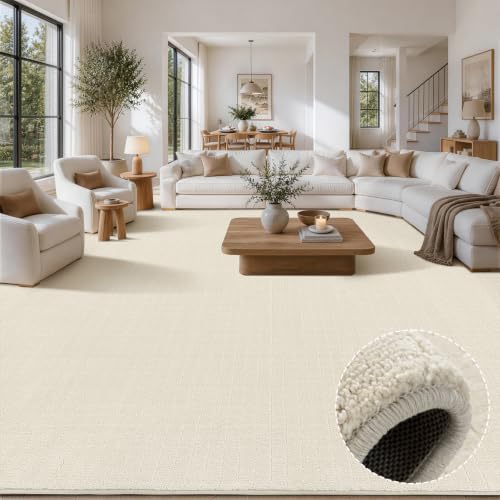
LIANLAM Handwoven Wool Rug 8×10 Beige — Best Handwoven Flatweave
Where the tufted picks build wool upward into pile, the LIANLAM interlaces it flat: 80 percent Merino wool with 20 percent cotton, handwoven into a calm beige flatweave whose virtues are structure, honesty and touch. A flatweave lies like a textile rather than a cushion, defining a room’s ground plane with a woven field whose slight variations announce the loom in every row. In Scandinavian and calm contemporary rooms, this is often exactly the register wanted — warmth without plushness, craft without rusticity.
The listing adds two practical notes worth weighing. Its materials carry OEKO-TEX recognition for safety, a reassurance households with floor-level children will appreciate in a natural product. And it is described as washable and stain-resistant with a non-slip character — claims that, for a handwoven wool rug, should be read as careful spot and gentle care rather than a licence to machine-soak an 8×10, but which signal a rug designed for real rooms rather than museum duty. Dining chairs cross it without a whisper of resistance, and its flat profile slips under doors that pile would block.
Flatweave ownership is the gentlest in this guide: little shedding, easy shaking and vacuuming, and a surface that forgives the daily evidence of life by simply being a woven field rather than a pile that traps it. What you surrender is cushion and insulation; on a cold floor in January, a flatweave is a textile, not a blanket. Pair it with a good pad — which also answers any residual slipping — and the LIANLAM becomes the natural rug for households that want wool’s material honesty in its most architectural form.
- Size: 8 x 10 feet
- Fibre: 80% Merino wool, 20% cotton
- Construction: handwoven flatweave
- Materials: OEKO-TEX recognised natural materials
- Colour: beige
Strengths
- Handwoven flat construction gives rooms a calm, architectural natural ground.
- Minimal shedding and easy surface care make it the lowest-fuss wool here.
- Certified natural materials reassure households with children at floor level.
Trade-offs
- Flat profile provides little cushion or insulation on cold hard floors.
- Washable description still means gentle care at 8×10, not casual machine soaking.
- Quiet beige field will not supply pattern or colour drama to a plain room.
Best for: dining rooms and calm contemporary spaces wanting wool in a flat, crafted weave.
Not suited for: anyone seeking plush pile comfort or a bold patterned centrepiece.

FRELISH DECOR Wool and Jute Rug 8×10 — Best Chunky Stripe
The FRELISH DECOR closes the guide with the boldest hand in it: a handwoven blend of wool and jute in natural ivory, organised into a chunky stripe that runs the rug’s length like a backbone. Where the mini check rug whispers its pattern, this one declares it. The stripe gives long rooms direction, gives hallways and dining rooms a graphic structure to arrange furniture against, and gives the natural palette — ivory, undyed, unhurried — a design confidence that plain natural rugs often lack.
Chunky is the accurate word for the weave. The yarns are substantial, the texture pronounced, the surface a landscape your feet can read. Wool warms and softens the jute’s dryness, while the jute returns the favour with body and grit resistance; the partnership is the same one the mini check exploits, tuned here toward pattern and presence rather than depth of pile. It is a rug for rooms that entertain — entry-adjacent living rooms, dining rooms with opinions, hallways wide enough to deserve furniture-grade flooring.
Its cautions are the jute family’s: keep soaking water away, blot with discipline, and accept that the chunky texture will hold crumbs in its valleys until a thorough vacuuming evicts them. The stripe also commits the room’s geometry, since a strong directional pattern wants aligning with the room’s long axis and its furniture. Households happy to make those small treaties gain the most characterful flat natural rug in this guide — proof that all-natural need not mean visually quiet.
- Size: 8 x 10 feet
- Fibre: wool and jute blend
- Construction: handwoven, chunky stripe design
- Colour: natural ivory
- Suits: hallways, entryways, bedrooms, dining areas
Strengths
- Chunky stripe gives natural rooms graphic structure and direction.
- Wool-jute partnership balances warmth and softness with toughness.
- Pronounced handwoven texture delivers craft character at room scale.
Trade-offs
- Directional stripe wants careful alignment with the room and its furniture.
- Deep texture valleys hold crumbs until a deliberate, thorough vacuuming.
- Jute content rules out soaking and steamy, high-moisture cleaning methods.
Best for: hallways, dining rooms and living rooms wanting natural fibre with visible design intent.
Not suited for: damp rooms or buyers seeking a plain, pattern-free natural ground.
How Do These All-Natural Rugs Compare Side by Side?
| Pick | Fibre lead | Construction | Defining strength |
|---|---|---|---|
| ANSSO Wool Rug 8×10 Merino Tufted | Merino wool | Tufted pile | Softest natural landing |
| Natural Jute and Wool Rug 8×10 Mini Check | Jute | Handwoven check, 0.6 in | Tough patterned texture |
| Shilucheng Wool Rug 8×10 Non-Slip | Wool | Blend with grip backing | Stays planted on hard floors |
| SAFAVIEH Natural Fiber Wool Rug 8×10 NF475C | Wool and sisal | Power-loomed, 3/8 in | Traffic-ready durability |
| LIANLAM Handwoven Wool Rug 8×10 Beige | Merino wool | Handwoven flatweave | Calm architectural weave |
| FRELISH DECOR Wool and Jute Rug 8×10 | Wool and jute | Handwoven chunky stripe | Graphic natural pattern |
The comparison reduces to a single question asked six ways: how should natural fibre meet your floor — as cushion, as grip, as armour, as weave or as pattern? Softness seekers have two tufted answers of different temperaments. Texture seekers have the check and the stripe. Structure seekers have the flatweave and the power-loomed workhorse. Because every rug here shares the 8×10 footprint, your room’s dimensions cannot make the decision for you; your room’s life must. Read the table once for fibre, once for construction, and a third time for the room each row is quietly imagining — the pick whose imagined room most resembles yours is usually the right one, and the resemblance is easier to feel than to calculate.
How Should You Pair Natural Rugs With Pads, Layering and Furniture?
The pad question returns in every section of this guide because it genuinely decides outcomes. Under a flatweave, a firm pad supplies the cushion the weave omits and the grip that keeps a light rug from travelling; under a tufted wool rug, a thinner pad protects the backing and stops creep without turning the pile into a trampoline. Felt and natural rubber pads are the usual companions for natural rugs, chosen because they grip mechanically, breathe with the fibres above them, and avoid the adhesive residues that can mark both backing and floor. Trim the pad inside the rug’s outline and the system disappears, which is the highest praise a pad can earn.
Furniture placement on natural rugs follows the old geometry — all legs on, front legs on, or a dining arrangement with chair-pull clearance — with one natural-fibre footnote: heavy furniture standing for years on tufted wool will compress the pile beneath its feet. Furniture coasters spread that load, and the twice-yearly rotation gives compressed areas a season to recover, which wool’s elasticity is genuinely good at when given the chance. Flatweaves forgive furniture entirely, one more entry in their ledger of practical virtues.
Layering, finally, is where natural rugs socialise. A natural flatweave under a smaller patterned rug, a jute-textured field beneath a coffee table grouping, a wool rug warming the centre of a room whose perimeter stays bare board — these arrangements let one purchase do the work of two, and they suit the collected, evolving way cottage rooms actually grow. When in doubt, let the natural rug be the large, quiet layer and bring personality in smaller, changeable pieces above it.
What Should You Know About Wool, Jute and Sisal Before Buying?
Wool first, since it leads four of these six rugs and defines the category’s centre of gravity. Wool fibre is crimped, elastic and coated in lanolin, which together explain its personality: it springs back underfoot, it resists absorbing a spill for the first crucial moments, it insulates against cold floors and dampens a room’s echo. It also sheds loose fibres in its youth, carries a farmyard-adjacent smell when new that airing disperses, and wants protection from moths in long storage. None of this is hidden behaviour; it is the fibre being itself, and households that know it in advance almost always come to love it.
Jute is a bast fibre, spun from plant stems, and its personality is architectural: dry, strong, golden, and happiest in texture-forward weaves like the mini check and the FRELISH stripe. It hides dirt superbly and shrugs off abrasion, but water is its enemy in quantity — repeated soaking weakens and stains it — so jute rugs belong in dry rooms with disciplined blotting. Sisal, the SAFAVIEH’s partner, is jute’s even tougher relative, the fibre of ropes, with a firmer hand and outstanding wear resistance at the price of softness.
Cotton’s role in this guide is the supporting one it plays across the serious rug world: backings that stabilise and grip, blend proportions that soften wool’s cost and add washability of character, flatweaves where it partners Merino. When a listing trumpets a natural fibre, check which chair that fibre sits in — face, partner or backing — and you will understand the rug’s real nature faster than any photograph can tell you.
How Do Natural Rugs Change a Room’s Sound and Warmth?
Stand in a hard-floored room and clap once; then imagine the same room with an 8×10 wool rug at its centre. The difference is not subtle. Natural pile absorbs the mid and high frequencies that make rooms feel echoey and exposed, which is why bedrooms with wool rugs feel hushed at night and why living rooms with them hold conversation at a lower, kinder volume. Flatweaves contribute less absorption but eliminate the sharp percussion of heels and chair legs, replacing clatter with something closer to a tap. For open-plan homes and upstairs rooms above quiet bedrooms, this acoustic work is often the rug’s most appreciated daily service — the one nobody lists in the specifications.
Warmth follows a similar pattern. A rug does not heat a room, but it changes where the room’s cold lives: instead of pooling at ankle height across bare boards, cold is kept at the floor’s surface and out of the occupants’ territory. Wool’s crimped fibres trap still air, which is the actual mechanism of insulation in everything from sweaters to sheep, and the tufted picks put that mechanism under every step. Children playing on a wool rug in winter are, in a small but real sense, playing on stored warmth; the flatweaves offer less of this, which is why the guide steers them toward dining and transit rooms where nobody lingers barefoot.
There is a subtler comfort too, difficult to specify and easy to feel: natural fibres moderate the static and dryness of heated indoor air at the surface where people actually touch the room. Hands, feet and knees meet fibre that behaves like the textiles humans have lived on for millennia, because it is those textiles. Households rarely buy a natural rug for acoustics or microclimate, yet when asked years later why the room feels right, they describe exactly those things. The fibre was doing quiet work the whole time.
How Do You Care for a Natural Fibre Rug?
Begin with airing, the simplest and most skipped step in natural rug ownership. Unroll a new wool rug in a ventilated room and give its smell a day or two to disperse before judging it; what remains afterwards is the faint, clean scent of fibre. Vacuum weekly with suction-led settings, working gently over tufted piles during the shedding season and more briskly over flatweaves, which release their dirt willingly. Rotate the rug a half-turn twice a year so sunlight and traffic distribute their effects instead of engraving one path and one faded window-shaped patch.
Spills follow one protocol across all natural fibres, with jute and sisal adding urgency: blot immediately with a clean white cloth, work from the stain’s edge inward, use minimal cool water and only cleaners meant for natural fibres, and dry the spot thoroughly with airflow. Never soak a jute or sisal rug, never steam any of these six into a swamp, and lift — do not drag — a wet natural rug, since waterlogged wool weighs a startling amount and dragging stresses its backing.
Once a year or so, a room-size natural rug earns a professional clean from someone who works with natural fibres, or a careful outdoor shake and air for the flatweaves. Store any natural rug rolled, dry, clean and with moth protection for wool. Follow that unglamorous rhythm and these rugs will not merely last; they will improve, settling into the softened, lived-in character that synthetic rugs imitate with distressing and never quite achieve.
Tufted or Flatweave: Which Natural Construction Ages Better in Your Room?
The two great natural constructions age along different curves, and knowing the curves helps you choose the rug whose tenth year you will like best. A tufted wool rug begins at its softest-looking and gradually settles: the pile relaxes, traffic lanes take a faint polish, and the surface develops the mellow, inhabited quality of a favourite sweater. Its beauty at year five is a beauty of use. A handwoven flatweave begins at its crispest and changes least; the weave’s geometry holds its lines, colours soften by degrees in the sun, and the rug at year five looks remarkably like the rug at year one, only more at home. Its beauty is a beauty of endurance.
Room acoustics follow construction too. Tufted pile absorbs sound across a wider range, which is why a tufted wool rug transforms a echoing bedroom into a hushed one. Flatweaves dampen the sharpest reflections — footsteps, chair scrapes — while leaving a room’s liveliness intact, which suits dining rooms and hallways where some sparkle of sound is welcome. If your open-plan space rings like a stairwell, pile is the prescription; if it merely clatters at the edges, a flatweave plus furniture will civilise it.
Movement is the third axis. Flatweaves travel: they fold, roll light, and migrate between rooms as households rearrange, which makes them the natural choice for renters and chronic redecorators. Tufted 8×10 wool rugs are citizens of one room, heavy enough that moving them is a planned, two-person event. Neither trait is a flaw, but a household that rearranges quarterly should hear the flatweaves calling, while a household furnishing a forever bedroom can invest in tufted weight without regret.
How Do You Style Natural Fibre Rugs in Cottage Interiors?
Cottage interiors run on a palette of undyed and gently dyed things — linen, wood, wool, clay — and natural rugs are the floor’s membership in that family. The beige and ivory fields in this guide were practically designed as the ground layer of such rooms: they receive patterned cushions, floral curtains and inherited furniture without competing, and their matte texture keeps the whole arrangement feeling gathered rather than decorated. Start with the rug as the room’s quiet majority, then let smaller objects carry the colour and pattern.
Layering is the cottage stylist’s favourite move, and flat natural rugs make it possible. A LIANLAM or FRELISH spread wall-to-wall in spirit can host a smaller, richer rug at its centre — a faded vintage piece, a braided oval — creating the collected, generations-deep look that cottages aspire to. The flatweave’s firmness keeps the layered rug honest, without the rocking and curling that pile-on-pile layering produces. Even the mini check hybrid can serve as a base layer in a large room, its pattern reading as texture from standing height.
Contrast deserves a mention, because all-natural rooms can drift toward beige unanimity if every choice is timid. The FRELISH stripe exists to prevent exactly that drift, giving an ivory room a spine. The orange warmth missing from this guide’s palette can arrive through cushions, throws and wood tones, letting the rug stay neutral and permanent while accents rotate seasonally above it. That division of labour — rug as landscape, textiles as weather — is the most durable styling strategy natural fibres offer.
How Do Natural Rugs Feel Across the Seasons?
A natural rug is one of the few furnishings whose character genuinely changes with the calendar, and many owners count that among its pleasures. Wool in winter is insulation you can feel through socks, a floor that stops stealing warmth from the room’s occupants; the tufted picks turn January bedrooms into noticeably kinder places. In summer the same wool breathes rather than sweating, staying neutral where synthetic pile can feel clammy in humid weather, and the flatweaves come into their own — cool, dry and crisp under bare feet on August mornings.
Jute and sisal are summer fibres by temperament, their dry textures most welcome when the air is warm, though in heated winter homes they perform perfectly well as the tough ground layer they are. Cotton-backed constructions stay stable across the humidity swings that can make lesser backings curl at the corners, a small seasonal mercy that only announces itself by the problems that never happen.
The seasonal ritual that ties it together is the twice-yearly rotation already recommended for even wear, timed to spring and autumn cleaning. Turn the rug, air it, inspect its underside, and the object re-enters the season refreshed — a small ceremony of household care that synthetic rugs, indifferent to seasons, never inspire. Natural fibres reward households that enjoy such ceremonies, and quietly convert households that did not know they would.
What Mistakes Do Buyers Make With All-Natural Rugs?
The first mistake is reading natural as a synonym for indestructible or, conversely, for delicate. Natural fibres are neither; they are specific. Wool forgives traffic and punishes moths and soaking. Jute forgives dirt and punishes water. Buyers who learn their fibre’s one vulnerability live happily with it for years; buyers who assume natural means carefree meet the vulnerability unprepared and blame the rug.
The second mistake is panic during the shedding season. A new tufted wool rug releasing fibres is not disintegrating; it is finishing its manufacture in your living room, shedding the loose ends every tufted pile carries. Gentle, frequent vacuuming shortens the season. Aggressive beater bars and despair both lengthen the owner’s suffering without helping the rug. The third mistake is placing jute or sisal where water lives — the bathroom door, the plant-watering corner, the dog’s bowl station — and then reviewing the fibre for failing a job it never applied for.
Fourth comes skipping the pad, particularly under flatweaves, then complaining that natural rugs slide — when a pad was always part of the system, adding grip, cushion and years of backing life. And fifth is buying natural for the label while secretly wanting synthetic behaviour: stain-proof, hose-able, indifferent. The honest natural buyer wants a floor that ages like wood and leather, with care as part of the pleasure. If that sentence sounds like you, every pick in this guide will feel like it was woven for your house.
Undyed or Dyed: How Should You Think About Colour in Natural Rugs?
Many of this guide’s rugs live in the undyed-to-gently-dyed spectrum — beige, cream, ivory, light grey — and that is not a failure of imagination but a property of the materials. Undyed wool carries the sheep’s own palette, which varies by fleece and gives natural rugs their heathered, unrepeatable depth: stand close to the ANSSO or the LIANLAM and the apparently solid field resolves into hundreds of fibre tones. Undyed rugs also sidestep dye-lot surprises and age without the particular sadness of a faded strong colour, mellowing instead toward an even softer version of themselves.
Dyed natural rugs earn their place where a room needs direction. The light grey of the SAFAVIEH is a dyed neutrality, cooler and more deliberate than undyed beige, chosen to sit with contemporary furniture. The lesson is to read natural colour as a spectrum of intent: undyed for rooms built on texture and calm, gentle dye for rooms that want their neutrality tuned warm or cool, and pattern — the check, the stripe — where the floor should participate in the room’s design rather than merely host it.
Practical colour wisdom follows. Mid-tones and heathered fields hide the daily evidence of life better than either stark white or deep solid shades; texture hides more than colour does, which is why the mini check can serve a busy farmhouse room in pale tones that would doom a flat pale rug. And because natural colours are quiet, they forgive the boldest furniture and art you will ever bring home — the natural rug is the one purchase in the room that almost never needs replacing when tastes change around it.
What Questions Should You Ask Before Ordering an 8×10 Natural Rug?
Ask first about the delivery reality: an 8×10 natural rug is a heavy, rolled object, and its journey from door to room deserves a plan — a clear path, a second pair of hands, and a decision about which way the roll unrolls before it is halfway across the floor. Ask about the first week: the rug may arrive with roll memory, its edges curling until weight and time persuade them flat, a process corner weights and patience complete. Neither fact diminishes the purchase; both punish the unprepared.
Ask about your own floor. Natural rugs and delicate floor finishes are good neighbours when a pad stands between them, and some natural backings can mark very soft finishes if left damp — another reason the pad is part of the system rather than an accessory. Ask about the room’s light, and plan rotation if one window floods the rug’s corner daily. Ask, finally, about the household’s five-year intentions: natural rugs are keepers, and the right question is not whether the rug suits the room today but whether its fibre, construction and colour will suit the room you are slowly becoming. The six picks above were chosen to answer that longer question well.
Final Recommendation
Match the construction to the room’s life and the fibre argument resolves itself. Bedrooms and bare feet: the ANSSO’s Merino tufting, or the Shilucheng where the floor is slick and the household is lively. Dining rooms and working floors: the LIANLAM flatweave for calm rooms, the SAFAVIEH wool-sisal where traffic is heaviest. Texture and farmhouse character: the mini check for depth, the FRELISH stripe for direction. All six keep the same promise — a floor made of things that grew, woven or tufted by processes you can understand, aging in the open rather than pretending to be new forever.
There is a particular satisfaction in a natural rug that no synthetic purchase replicates: the room smells faintly of fibre instead of factory, the floor feels different in each season, and the object under your furniture has a material biography that began in a field rather than a refinery. Choose the weave your rooms will love, keep its one vulnerability in mind, and let the years do the rest of the decorating. A decade from now, the rug that began as a purchase will read as part of the house’s own history — which is, in the end, what buying natural was always for.
Frequently Asked Questions
Do all-natural rugs shed?
Tufted wool rugs shed loose fibres during their first weeks or months, which is normal and finite. Flatweaves shed very little, and jute or sisal constructions shed least of all. Gentle, frequent vacuuming carries a wool rug through its season; the shedding is a beginning, not a condition.
Why does my new wool rug smell, and will it fade?
New wool carries the natural scent of its fibres and lanolin, noticeable at unrolling and dispersing with airing over a few days. Keep the rug ventilated at first and the smell resolves into neutrality. A persistent chemical smell, by contrast, is not a natural-fibre trait and is worth raising with the seller.
Can I put a jute rug in a bathroom or kitchen?
Jute tolerates a dry kitchen corner with disciplined blotting, but bathrooms and other soaking environments are poor assignments for it, since repeated water weakens and marks the fibre. For wet rooms, choose washable synthetics or cotton constructions made for moisture, and keep jute for the dry rooms it serves beautifully.
Are natural rugs a good choice with pets?
Mostly yes, with fibre-aware placement. Wool’s resilience and dirt-hiding texture suit settled dogs, flatweaves vacuum clean of hair easily, and sisal’s toughness is legendary — it is, after all, a scratching-post material. Keep any natural rug out of a house-training puppy’s primary territory until the season passes.
How long do all-natural rugs last?
With the care rhythm this guide describes, a quality wool rug commonly serves a decade or more, and flatweaves in dry rooms can serve longer still, since their construction has no pile to wear thin. Jute and sisal rugs in heavy traffic give years of service before their texture tires. Natural rugs rarely fail suddenly; they soften, settle and eventually retire gracefully, which is part of their appeal.
Are natural rugs suitable for underfloor heating?
Generally yes, and wool is a traditional companion to heated floors because it tolerates warmth without melting or off-gassing concerns associated with some synthetics. Keep total tog low — a flatweave or low-pile rug over a thin pad insulates least — and check your heating system’s guidance, since any rug slows heat transfer somewhat by design.
Do I need a rug pad under a natural rug?
Yes, in nearly every case. A pad prevents creep, protects the backing from abrasion, adds cushion under flatweaves and extends the rug’s life. Choose a pad that grips mechanically rather than with adhesive, and size it slightly smaller than the rug so it stays hidden.
Related Guides
For the domestically made branch of the natural family, our guide to the Best American-Made Area Rugs explores the long-running American rug mills in depth. Large-format natural fibres get their own treatment in the Best 9×12 Natural Fiber Rugs, while readers furnishing a whole room around these textures will enjoy the Best Farmhouse Area Rugs. Households where natural rugs must coexist with whiskers should also read the Best Area Rugs for Cats before finalising a choice.


