What's inside
- Key Takeaways
- Quick Picks
- How Did We Choose These Rugs for Carpet?
- How Do All Six Rugs for Carpet Compare Side by Side?
- Which Carpet Piles Accept a Layered Rug, and Which Refuse?
- How Do You Stop a Rug Creeping on Carpet Without Damaging the Pile?
- Where Does a Layered Rug Earn Its Keep, Room by Room?
- How Should You Wash and Rotate Layered Rugs So the Carpet Beneath Stays Fresh?
- How Can Layering Give a Rented Carpet a Personality Transplant?
- How Does a Layered Rug Change the Feel of a Carpeted Room’s Sound and Warmth?
- Can You Layer a Rug Over Carpet in a Child’s Room or Play Space?
- How Should You Coordinate Several Small Layers So a Home Looks Designed, Not Scattered?
- What Should You Check in the First Week With a New Layered Rug?
- When Should You Skip Layering and Solve the Room Differently?
- How Do Seasons Change Which Layer Belongs Where?
- How Can a Layered Rug Help an Older Carpet Look Intentional Again?
- How Much Should You Expect to Spend, and Where Does Money Actually Help?
- What Mistakes Do People Make When Putting Rugs on Carpet?
- How Do Guests and Gatherings Test a Layered Carpet?
- Final Recommendation
- Frequently Asked Questions
- Related Guides
As an Amazon Associate I earn from qualifying purchases. This post may contain affiliate links at no extra cost to you.
cottageverdict.com is reader-supported. When you buy through links on our site, we may earn an affiliate commission.
Where to buy: every rug below links to its Amazon listing, where you can check price on Amazon and confirm the backing type and exact dimensions before ordering. Small layering rugs like these are easy to trial in one spot and move to another, which is half their charm.
Shopping for the best area rugs for carpet means accepting what the market honestly offers for the job: not giant statement rugs, but small, thin, flat pieces — woven doormats, jute layering rugs, washable 2×3 throws, and one low-profile runner — designed to sit on top of wall-to-wall carpet without rippling, creeping, or chewing up the pile beneath. A thick rug laid over carpet is a trip hazard with good intentions; a thin one, chosen well, is a tool for defining zones, protecting the carpet’s wear lanes, and giving a rented or builder-plain room a personality it did not arrive with.
Why layer anything over carpet at all? Because carpet fails unevenly. The patch in front of the sofa, the lane from door to kitchen, the square under the desk chair — these age years faster than the corners, and a sacrificial layer over each takes the wear instead. Layering also solves the rental problem in reverse: you cannot change the beige carpet your landlord chose, but you can cover the parts of it you actually look at with colour, pattern, and texture of your own choosing, then roll your choices up and take them with you when you leave.
Every pick here is small on purpose. The largest is a 3×5 jute layering rug; the rest are 2×3 throws, a 2.6×4 scalloped door mat, and a 2×5 runner. At these sizes a rug can lie flat on low- and medium-pile carpet without the edge curl and travelling wrinkles that plague big rugs on soft foundations. The sections after the reviews cover the mechanics — which carpet piles accept a layer, how to stop creeping without adhesives that damage the base carpet, and where a layered rug earns its keep room by room.
Key Takeaways
- Rugs that work on carpet are thin, flat, and small — the picks here run from 2×3 throws to a 3×5 layering rug and one 2×5 runner.
- The job is zoning and sacrifice: define a reading corner, protect the sofa-front wear patch, and let the layer take traffic the base carpet would otherwise absorb.
- Low- and medium-pile base carpets accept layers best; deep plush carpet makes almost any top rug ripple and wander.
- Avoid adhesive tapes and sticky pads on carpet you care about — weight, furniture anchoring, and textured backings hold a layer without damaging the pile beneath.
- The Antep runner’s rubber backing grips hardest, so reserve it for low-pile carpet and check its edges weekly.
- Washable throws are the easiest layer to live with: shake, wash, relay, and the base carpet stays fresher underneath.
Quick Picks
| Pick | Badge | Why it earns its place |
|---|---|---|
| EARTHALL Woven Doormat 2×3 Braided Cotton | Best woven texture | A braided cotton 2×3 with non-slip backing that adds hand-made texture at doors and bedsides without any bulk. |
| Easy Jute Layering Rug 3×5 | Best true layering rug | Sold explicitly for layering, with a black-and-white diamond check over jute that anchors a whole seating corner. |
| LORWER Easy Jute Door Mat 2.6×4 | Best farmhouse accent | A scalloped-edge jute mat that softens a doorway or bathroom threshold with genuine farmhouse charm. |
| 2×3 Washable Thin Boho Throw Rug Terracotta | Best warm colour | A thin washable boho throw in terracotta and beige that warms up grey or beige carpet instantly. |
| Washable 2×3 Thin Entryway Rug Vintage | Best vintage grey | A water-resistant vintage-print throw that hides wear and washes clean — the hardest-working small layer here. |
| Antep Rugs Modern Bordered 2×5 Low Profile | Best runner on carpet | A low-profile bordered runner with a rubber backing for hallways over low-pile carpet — with an edge-check caveat. |
All six are linked picks; check price on Amazon at each listing, since the small sizes rotate through colourways quickly.
How Did We Choose These Rugs for Carpet?
The first filter was thickness, ruthlessly applied. A rug destined to live on carpet must be thin enough that its edges present almost no step, because every millimetre of height on a soft foundation becomes a curl, a ripple, or a caught toe. That single rule eliminated the entire world of plush and medium-pile area rugs and left the flatweaves, the woven cotton mats, the jute layers, and the printed thin throws — which is why this guide’s picks look like a doormat family reunion. On carpet, that family is the aristocracy.
The second filter was footprint. Small rugs behave on carpet in ways large ones cannot: their own weight relative to their area keeps them registered, furniture can anchor their corners, and when one does migrate, repositioning it is a two-second job rather than a furniture-moving expedition. We capped the guide at 3×5 and favoured 2x3s, the size that can serve at a door, a bedside, a sink, and a desk in the same week.
Backing came third, with a carpet-specific twist. On hard floors, aggressive grip is a virtue; on carpet, the backing’s job is subtler — enough texture to resist creeping, nothing adhesive or abrasive that will pull, mat, or tear the base pile when the layer is lifted. The Antep runner’s rubber backing is the strongest gripper here and therefore carries the guide’s one explicit caution: low-pile bases only, edges checked weekly, because a backing that grips carpet pile too well can distort it over months.
Finally we chose for washability and honesty of role. Layers over carpet collect the household’s traffic evidence first, so most of these picks wash at home. And none pretends to be a room-sized rug; each is reviewed for the zoning and protection work it can actually do on top of carpet, which is considerable when the expectations are set correctly.

EARTHALL Woven Doormat 2×3 Braided Cotton — Best woven texture
The EARTHALL is a braided cotton mat in warm beige and ivory, and its braided construction is precisely what makes it behave on carpet. Braiding gives the mat body without thickness — it lies like a heavy cloth rather than a board, flexing with the carpet pile beneath instead of bridging over it and rocking. Placed at a bedroom door or beside a bed on wall-to-wall carpet, it adds a hand-made texture the flat base carpet cannot provide, and its woven face traps the dust of the doorway before that dust distributes itself across the room.
Cotton is the second virtue. A cotton mat on carpet feels like a deliberate textile choice rather than a plastic intervention, it washes without drama, and its natural fibres sit kindly on synthetic carpet pile without the static arguments some all-synthetic pairings produce. The non-slip backing gives it registration on hard floors too, which makes this the most itinerant pick in the guide: door mat on carpet this month, kitchen accent on tile next month, wherever a 2×3 of warm neutral texture is needed.
Manage one expectation: braided cotton is soft, not armoured. In a doorway with heavy outdoor traffic it will show wear sooner than the printed synthetic throws below, and its pale beige-ivory colourway reports dirt honestly. Use it where texture and warmth matter more than abuse — bedrooms, calm entries, beside a reading chair — and it will repay the placement for years.
- Size: 2×3 feet
- Material: braided cotton weave
- Colours: beige and ivory
- Backing: non-slip
- Care: washable
Strengths
- Braided body lies flat and flexes with carpet pile instead of bridging and rippling over it.
- Natural cotton texture upgrades a plain carpet’s feel more than any printed synthetic can.
- Equally at home on hard floors, so it can migrate rooms as needs change.
Trade-offs
- Pale colourway shows doorway dirt quickly and asks for regular washing.
- Cotton braid wears faster than synthetic flatweave under heavy grit traffic.
- At 2×3 it defines a moment, not a zone — seating corners will want the larger jute layer.
Best for: bedroom doors, bedsides, and calm entries on carpet where texture is the goal. Not suited for: mud-heavy main entrances or covering a whole seating area.

Easy Jute Layering Rug 3×5 — Best true layering rug
Most rugs tolerate being layered; this one is sold for it, and the difference shows in the proportions. At 3×5 it is the largest pick here — big enough to sit under a coffee table and define a seating corner on wall-to-wall carpet — while its low-pile jute build keeps the profile thin enough to lie calmly on a soft foundation. The black-and-white diamond check over a beige-white ground does the visual work: a crisp geometric field that organises whatever furniture stands on it into a deliberate arrangement.
Layering rugs earn their name by creating a room within a room, and this is the pick to buy when that is the actual project — a rental living room whose beige carpet swallows every piece of furniture into one undifferentiated expanse. Drop the checkered jute under the sofa’s front legs and the coffee table, and the seating group suddenly has borders, a pattern, and a centre. The rest of the carpet becomes the margin, and margins make centres look intentional.
Jute asks for two honest notes. Its natural fibres are textured rather than soft, so this is a layer to look at and walk on in socks, not to lounge on at floor level. And while it is washable per its listing, a 3×5 jute rug is a heavier wash than the little throws — most owners will shake and spot-clean it in place and save full washes for genuine need. On carpet, where it is protected from floor grit beneath, that lighter care rhythm is entirely workable.
One placement refinement separates good layering from great layering with this rug: leave its border visible on all four sides. A jute layer pushed against a wall or slid halfway under a sofa loses the framed quality that makes it read as a designed field, while the same rug floating with a margin of base carpet around it looks like a deliberate island. In an open-plan room, that island can also hold the room’s one bold pattern safely — the check is energetic, but contained at 3×5 and surrounded by calm carpet, it energises the seating group without colonising the entire floor.
- Size: 3×5 feet
- Material: jute-look low pile
- Pattern: black-and-white diamond check, beige-white ground
- Backing: non-slip
- Best placement: under a coffee table, anchoring a seating corner
Strengths
- The only pick sized and designed specifically to anchor a furniture group on carpet.
- Bold check pattern creates a defined zone in a plain carpeted room more effectively than any solid could.
- Low-pile build stays flat on low- and medium-pile base carpets without edge drama.
Trade-offs
- Jute texture is firm underfoot — a visual layer, not a comfort layer.
- Heavier to wash than the 2×3 throws; plan on shake-and-spot care most of the year.
- The strong black-and-white pattern commits the corner’s palette around it.
Best for: renters and anyone zoning a plain carpeted living room into defined areas. Not suited for: floor lounging, nurseries, or anyone wanting an invisible layer.
LORWER Easy Jute Door Mat 2.6×4 — Best farmhouse accent
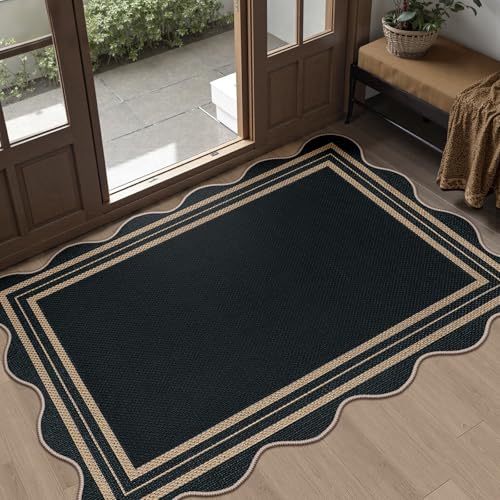
The LORWER’s scalloped edge is doing more than decoration. On carpet, a straight-edged small rug reads as a placed object; a scalloped one reads as a chosen accent, and that shift in perception is the whole value of this 2.6×4 jute mat in black. Lay it at a doorway, a bathroom threshold, or the foot of a kitchen run where carpet meets hard floor, and it softens the transition with a farmhouse gesture that costs almost no floor height at all.
Its elongated proportions suit the in-between places rectangles fumble: the strip in front of a dresser, the landing inside a bedroom door, the carpeted hallway’s first stretch where shoes come off. The low-pile jute build lies flat, the non-slip backing steadies it, and the black colourway is the most forgiving in this guide — a mat at a threshold can be dark and hardworking or pale and frequently washed, and the LORWER sensibly chooses the former.
Scallops come with one care note: edges with a shaped outline catch vacuum heads and broom strokes less smoothly than straight edges, so shake this one rather than aggressively vacuuming its border. In exchange you get the pick with the most personality per square foot here — the layer guests actually notice, placed exactly where every guest passes.
- Size: 2.6×4 feet
- Material: jute-style low pile
- Edge: scalloped outline
- Colour: black
- Best placement: thresholds, dresser fronts, entry landings on carpet
Strengths
- Scalloped silhouette turns a functional layer into a deliberate farmhouse accent.
- Dark colourway hides threshold traffic better than any other pick here.
- Elongated shape fits the transitional strips where square rugs look lost.
Trade-offs
- Shaped edges prefer shaking to hard vacuuming along the border.
- Black jute shows pale lint and pet hair more than mid-tone rugs do.
- Its charm is style-specific; strictly modern rooms may find scallops too sweet.
Best for: farmhouse-leaning homes wanting a noticed accent at carpeted thresholds. Not suited for: minimalist schemes or heavy wet-boot entrances.

2×3 Washable Thin Boho Throw Rug Terracotta — Best warm colour
Grey carpet and beige carpet share a secret: they are not colours so much as absences, and a room built on them can feel like a waiting room no matter how good the furniture is. This thin boho throw in terracotta and beige is the smallest possible intervention with the largest possible effect — two by three feet of warm, sun-baked colour that a grey carpet makes look twice as rich by contrast. Beside a bed, at a desk, or in front of a reading chair, it gives the eye one warm place to land.
The construction suits the layering job precisely: low pile, genuinely thin, soft enough for bare feet at a bedside, and washable, because a small rug placed where feet land on carpet is a rug that will be washed often. Its non-slip backing is listed for hard floors, but on carpet the throw’s own lightness is the point — it can be picked up, shaken out over the base carpet’s most trafficked patch, and relaid in under a minute, a maintenance loop so easy it actually happens.
Boho patterning also hides the evidence of life better than the solids in this guide. The terracotta field with its woven-look design forgives the crumbs, pet hair, and faint traffic shading that a plain throw would announce, which makes this the pick for the spots where a layer works hardest: the kitchen-adjacent carpet edge, the kids’ room door, the desk chair’s landing zone.
- Size: 2×3 feet
- Style: boho, terracotta and beige
- Pile: low, thin throw weight
- Care: machine washable
- Best placement: bedside, desk, reading chair on grey or beige carpet
Strengths
- Warm terracotta transforms cool, plain carpet more dramatically than any other pick here.
- Patterned surface hides daily evidence between washes — ideal for high-duty small spots.
- Thin and light enough that the shake-wash-relay routine takes minutes, not a morning.
Trade-offs
- Warm boho is a definite palette; cool-toned rooms should take the vintage grey pick instead.
- Lightweight throws can drift on plush carpet and need a furniture anchor or occasional relaying.
- Small size means small effect — one throw warms a corner, not a whole room.
Best for: warming up grey or beige carpet at bedsides, desks, and reading corners. Not suited for: cool minimalist palettes or whole-room coverage.

Washable 2×3 Thin Entryway Rug Vintage — Best vintage grey
If the terracotta throw is the warm intervention, this vintage grey 2×3 is the cool, hardworking one. Its distressed traditional print in grey does two jobs at once on carpet: it looks like a fragment of a much more expensive rug, and its mottled pattern is functionally invisible to dirt. Entryways over carpet are where layers earn their sacrificial title — every shoe crosses them — and a rug that hides the evidence between washes while washing completely clean is the correct tool for the post.
The water-resistant surface adds a second line of defence that matters specifically on carpet. A wet boot on a bare carpet wicks moisture down into pile and padding; the same boot on this throw mostly stays on the throw, which then goes into the wash while the carpet beneath remains dry and unmarked. In homes where the front door opens directly onto carpeted living space — a layout more common than architects admit — that interception is worth more than the rug’s modest size suggests.
It is also the most versatile traveller in the six: kitchen sink line, bathroom door, laundry room threshold, bedroom entry. Thin, soft, non-slip backed, and unbothered by frequent washing, it is the layer to buy in multiples — one at the door, one at the sink, one in reserve — and let them rotate through the wash as a team while the carpet underneath all of them ages at the pace of the corners instead of the lanes.
- Size: 2×3 feet
- Style: vintage distressed print, grey
- Surface: water resistant
- Backing: non-slip
- Care: machine washable, easy clean
Strengths
- Distressed grey pattern conceals entry traffic better than any solid or pale pick.
- Water resistance intercepts wet footwear before moisture reaches the carpet’s pile and pad.
- Built for the multi-buy rotation strategy — cheap to duplicate, effortless to wash.
Trade-offs
- Printed vintage is a look some households find busy at close quarters in tiny entries.
- Grey on grey carpet can disappear entirely; check your carpet’s tone before ordering.
- Thin construction offers no cushion at a sink where someone stands for long stretches.
Best for: carpeted entryways, sink lines, and any high-traffic patch needing a washable shield. Not suited for: adding warmth of colour or cushioning underfoot.
Antep Rugs Modern Bordered 2×5 Low Profile — Best runner on carpet
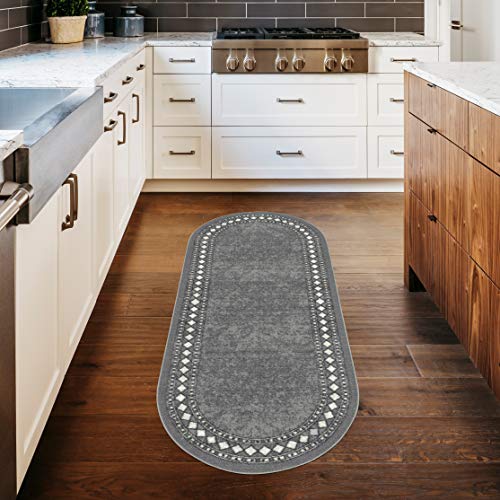
The Antep is the one pick here shaped for a lane rather than a landing: a 2×5 oval runner with a modern bordered design and a genuinely low profile, built to lie along a hallway or beside a kitchen run. On hard floors its rubber backing is unremarkable; on carpet, that backing is both its distinction and its caveat, so this review gives it to you plainly. The rubber grips carpet pile firmly — the runner stays registered in a hallway better than any throw in this guide — but that grip belongs on low-pile carpet only, and its edges deserve a weekly check.
Why the caution? A backing that holds pile under tension can, over months, leave the base carpet’s fibres beneath it pressed and patterned, and on medium or plush pile the runner’s firm grip fights the pile’s movement until the runner ripples at its ends. On low-pile carpet — the flat commercial-style carpet common in hallways, rentals, and basements — none of that applies: the Antep lies flat, stays flat, and gives a bordered, finished look that loose throws cannot match in a traffic lane.
Used in its proper conditions, it solves the hallway problem elegantly. Hall carpet wears in a centre stripe; a runner takes that stripe’s traffic, its border design makes the lane look deliberate, and when the runner eventually tires, the carpet beneath emerges unworn. Lift it monthly to vacuum beneath and inspect the pile, keep it off plush carpet entirely, and this is the most architectural layer in the guide.
Hallway light deserves a mention in the Antep’s favour, because halls are where bordered runners look most like architecture. A bordered design creates a visual track that lengthens a short hall and organises a long one, and over the flat, often dull carpet that hallways are given, that track is frequently the only designed element in the entire passage. Guests may never consciously register it, but they walk a bordered lane differently — straighter, calmer — and a hallway that guides its traffic also concentrates its wear exactly where the runner is standing guard.
- Size: 2×5 feet, oval runner
- Design: modern bordered, grey
- Profile: low, flat-lying
- Backing: rubber non-skid — low-pile carpet only
- Care: vacuum regularly, lift monthly to inspect beneath
Strengths
- The firmest registration on carpet here — a hallway runner that genuinely stays where it was laid.
- Bordered design gives traffic lanes a finished, intentional look throws cannot achieve.
- Low profile presents almost no edge step, even at its oval ends.
Trade-offs
- Rubber backing is for low-pile carpet only; on plush pile it can ripple and press the fibres beneath.
- Edges need a weekly glance to confirm they are lying flat and not curling under traffic.
- Not machine washable like the throws — hallway care is vacuuming and spot cleaning.
Best for: hallways and lanes over low-pile or commercial-style carpet. Not suited for: plush or deep-pile carpet, or anyone unwilling to check edges occasionally.
How Do All Six Rugs for Carpet Compare Side by Side?
| Pick | Size | Material and style | Washable | Primary job on carpet |
|---|---|---|---|---|
| EARTHALL Woven Doormat 2×3 Braided Cotton | 2×3 | Braided cotton, beige-ivory | Yes | Textured door and bedside layer |
| Easy Jute Layering Rug 3×5 | 3×5 | Jute check, black and white | Gentle care | Anchoring a seating zone |
| LORWER Easy Jute Door Mat 2.6×4 | 2.6×4 | Jute, scalloped, black | Shake and spot | Threshold accent |
| 2×3 Washable Thin Boho Throw Rug Terracotta | 2×3 | Thin boho throw, terracotta | Yes | Warm colour at bedsides and desks |
| Washable 2×3 Thin Entryway Rug Vintage | 2×3 | Vintage print, grey, water resistant | Yes | Sacrificial entry shield |
| Antep Rugs Modern Bordered 2×5 Low Profile | 2×5 oval | Bordered runner, rubber backing | No | Hallway lane on low-pile carpet |
Choose by post, not by pattern alone: texture at the bedside, a zone anchor under the coffee table, an accent at the threshold, colour at the desk, a shield at the door, and a runner down the lane.
Which Carpet Piles Accept a Layered Rug, and Which Refuse?
Low-pile carpet — the flat, tight weave of many rentals, basements, and commercial-style installations — is the ideal foundation: a thin rug on it behaves almost as it would on a hard floor, lying flat, staying registered, and presenting clean edges. Medium-pile carpet accepts most of the picks here too, provided the layer is light and its corners are anchored by furniture or regular relaying. The foundation and the layer negotiate a truce, and the truce holds.
Deep plush and shag carpet refuse the arrangement. A top rug on a deep pile floats on fibre tips, ripples under every footstep, and migrates like a raft; its edges become genuine trip lips. If your carpet is plush, the honest options are to skip layering in traffic paths, confine a small throw to a furniture-anchored corner where nobody crosses it, or address the room’s look with other textiles entirely. No product in this guide — or any guide — repeals that physics, and pretending otherwise is how layered rugs get their bad reputation.
How Do You Stop a Rug Creeping on Carpet Without Damaging the Pile?
Creep happens because carpet pile is a field of tiny springs that walk a light rug forward under traffic. The damage-free countermeasures are weight and anchoring, not adhesives. Place a furniture leg or a heavy plant on the layer’s trailing corners, choose the heaviest pick the post allows — the braided cotton and the jute layers creep less than the printed throws — and orient patterns so the traffic crosses the rug’s short dimension, giving creep less runway to build.
What to avoid matters as much. Double-sided carpet tape and sticky grip pads bond to pile fibres and, when eventually peeled up, can pull fibres out, leave residue that attracts dirt in a visible rectangle, and void more than one carpet warranty. Hook-and-loop systems sewn or stuck to the base carpet have the same problem at removal time. If a layer simply will not stay put by weight, the correct answer is a different post or a heavier rug — not glue. A layer you cannot lift freely for washing has also lost half its purpose, which is another reason adhesives defeat the concept.
Where Does a Layered Rug Earn Its Keep, Room by Room?
Living rooms first: the sofa-front patch is the fastest-ageing carpet in most homes, and either the jute zone anchor or a washable throw rotated through that patch doubles the base carpet’s presentable life there. Entries over carpet need the sacrificial shield — the vintage grey throw — because that is where outdoor evidence lands. Bedrooms take the texture and colour picks at the bedside, where bare feet appreciate cotton braid or warm terracotta at the exact moment of waking.
Home offices are the sleeper case. A desk chair’s casters chew carpet pile in a neat circle of destruction, and a flat layer under the chair zone intercepts that wear; choose the firmest, flattest pick and check that casters roll over its edges without catching. Hallways belong to the runner on low-pile bases. Kitchens with carpeted eating areas — more common in rentals than anyone admits — benefit from a washable throw under the table’s foot zone, catching the crumb-and-spill radius before the base carpet has to.
How Should You Wash and Rotate Layered Rugs So the Carpet Beneath Stays Fresh?
The layer’s dirtiest secret is that it protects the carpet from traffic while trapping ordinary dust against it, so the routine has two halves. The layer itself washes or shakes out on the household’s normal rhythm — the washable throws here can go through a gentle cycle and come back the same day. The carpet beneath gets vacuumed every time the layer lifts, without exception, because that thirty-second habit is what stops the protected patch from becoming a dust archive that reveals itself, darker or lighter than its surroundings, on the day the layer moves.
Rotation prevents the other reveal: a permanently placed layer can leave a visible outline, not from damage but from differential fading and pile compression around it. Shift the layer a few inches at each wash, or rotate it end to end, and the patch ages with the room instead of in a frame. Twice a year, leave the carpet bare for a day after a deep vacuum so the pile under the layer can stand back up — crushed pile recovers slowly, and a day of freedom plus a brush helps it rejoin the rest of the floor.
How Can Layering Give a Rented Carpet a Personality Transplant?
Renters inherit carpet as a fixed fact — usually beige, occasionally grey, never chosen. Layering is the one fully reversible counterattack. The jute check under a seating group redraws the living room’s map. A terracotta throw at the bed and a braided cotton mat at the door establish a warm material story that repeats, and repetition is what makes a scheme look designed rather than accumulated. Even the hallway runner contributes: a bordered lane over rental carpet reads as an intention, and intentions are what separate a home from a tenancy.
The discipline is restraint. Two or three coordinated layers across a flat will transform it; seven unrelated small rugs will make it look like a rug shop’s storage problem. Choose one accent colour family — terracotta and natural jute, or grey vintage and black scallop — and let every layer speak it. When the lease ends, the entire personality rolls up into one box, and the beige carpet remains for the next tenant, exactly as the deposit requires.
How Does a Layered Rug Change the Feel of a Carpeted Room’s Sound and Warmth?
Carpet already absorbs sound, so a layer’s acoustic contribution is subtle — but its thermal and tactile contribution is not. A cotton braid or jute layer underfoot feels different from synthetic wall-to-wall pile: cooler in summer, more textured always, and that textural change is what registers as the room feeling more considered. In a bedroom, stepping from carpet onto a braided mat at the bedside is a small daily signal that the floor has been thought about, and rooms are largely judged by the accumulation of such signals.
There is also a zoning effect on behaviour. People sit, stand, and place things differently on a defined layer: children play on the jute square rather than across the whole floor, bags land on the entry throw instead of the carpet, and the reading chair’s layer collects the books and blankets into a camp. A thin rug cannot change a room’s architecture, but it reliably changes the room’s habits, and habits are what wear carpets out — redirected habits are therefore a genuine form of protection, not just a decorating story.
Can You Layer a Rug Over Carpet in a Child’s Room or Play Space?
Yes, and it is one of the best uses of the category, with two conditions. First, the layer must be anchored or heavy enough that a running child cannot surf it: place its edges under the toy storage, the reading chair, or the bed frame, and test it with an adult’s deliberate scuff before trusting it to smaller, faster feet. Second, choose the washable picks, because a play layer over carpet intercepts paint water, snack residue, and the occasional stomach bug, and its whole value is that it can be carried to the machine while the carpet below stays out of the incident entirely.
Play layers also define the blast radius. A jute square or a pair of throws marking the play zone teaches a tidiness geography — toys live on the layer, and clearing the floor means clearing one visible field. When the play years end, the layer lifts away and the carpet beneath, having been shielded through the heaviest years of its life, is the best-preserved floor in the house. Parents who layer a child’s room rarely regret it; parents who let bare carpet take the play years directly often do.
How Should You Coordinate Several Small Layers So a Home Looks Designed, Not Scattered?
The trick is a shared material or colour thread. Natural jute appears in two picks here, cotton braid in a third, and a home that runs those three across its entry, living corner, and bedroom door reads as one idea in three places. Alternatively, run the colour thread: terracotta at the bedside, echoed by nothing more than a cushion and a throw blanket, makes the small rug look like the anchor of a scheme rather than a stray purchase. What breaks the effect is six unrelated small rugs in six unrelated voices, each too small to argue its case.
Scale rhythm matters too. Vary the sizes by post — the 3×5 where furniture anchors, 2x3s at the moments of transition — but keep the visual weight similar, so no layer shouts over the others. Leave deliberate bare carpet between layers; the base carpet is the background of the composition, and backgrounds need area to work. A carpeted home layered this way photographs like a designed interior and, more importantly, lives like one, because every layer is where a habit actually happens.
What Should You Check in the First Week With a New Layered Rug?
Watch the corners. A layer that will misbehave announces itself early — one corner that lifts, one edge that creeps toward the traffic, a faint ripple that appears after the first vacuum. Catching these in week one is the difference between repositioning a rug and replacing it: shift the layer off the pile’s walk line, rotate it so traffic crosses it differently, or move a furniture foot onto the wandering corner while the arrangement is still new and adjustable.
Also lift it once at the week’s end and look at the carpet beneath with fresh eyes. You are establishing the baseline photograph in memory — this is what protected carpet looks like — and confirming that the backing and your pile are on good terms. If the pile beneath stands as it did before, the pairing is sound and the routine can settle into its monthly rhythm. If anything looks pressed or pulled, change the pairing now, while the evidence is a week deep rather than a year.
When Should You Skip Layering and Solve the Room Differently?
Honesty requires the exits. If the carpet is deep plush, if the room’s traffic is a wheelchair or a walking frame whose wheels will catch any edge, or if the household includes a determined toddler whose sport is peeling up floor coverings, a layered rug may be the wrong tool no matter how thin. In those rooms, spend the effort elsewhere: a washable throw over the sofa, art at eye level, lighting that warms the carpet’s colour — the personality transplant can happen on other surfaces while the floor stays safely single-layered.
Likewise, if the base carpet itself is near the end of its life, layering is decoration on a deadline. A sacrificial throw over a dying carpet protects nothing worth protecting, and the money is better saved toward the floor’s eventual replacement. Layering shines on carpet with years left in it — carpet whose lanes and patches are worth defending — and this guide’s picks are priced and built for exactly that long game.
How Do Seasons Change Which Layer Belongs Where?
Mud season promotes the sacrificial throws: the vintage grey moves to the front door if it was not there already, and a second one joins it, because spring traffic carries grit that no doormat fully retires. Summer lightens everything — the jute layers come into their own, since natural fibres read cool and dry in hot months, and the cotton braid by the bed is at its most pleasant under bare feet. Households that rotate layers seasonally also rotate their wear, which quietly doubles the service life of every piece in the rotation.
Winter reverses the logic toward warmth and darkness. The terracotta throw migrates to wherever the household lands most — the desk, the reading chair — because its colour does psychological heating in grey months, and darker, patterned layers everywhere earn their keep against the season’s tracked-in evidence. A layer stored for a season should be washed before it is put away and aired before it returns, so the rotation never becomes a way of shelving a problem. Treated as a small wardrobe for the floor, four to six layers cover a carpeted home in every month of the year.
How Can a Layered Rug Help an Older Carpet Look Intentional Again?
An ageing carpet’s problem is rarely uniform wear; it is the map of its life — the pale lane to the kitchen, the dark crescent at the sofa, the mysterious spot by the door that no cleaning has ever fully explained. A layer placed with that map in mind does not hide the carpet so much as edit it: the jute square redefines the seating area so the eye reads a composition, the runner covers the lane’s worst stretch, and the entry throw retires the spot by the door from public view. What remains visible is carpet that reads as background, which is all an older floor needs to look respectable again.
This is also the cheapest staging trick in a home being prepared for sale or for guests. Two coordinated layers, freshly washed and deliberately placed, signal care more loudly than a professional carpet clean that leaves the traffic map intact. The layers leave with you afterward, which makes the investment reusable in the next home — a rare property in the world of cosmetic fixes, and one more reason this modest category keeps earning its place in carpeted houses.
How Much Should You Expect to Spend, and Where Does Money Actually Help?
Layering is one of the cheapest interventions in home furnishing, and its economics are part of the appeal: the picks in this guide are small rugs, priced like small rugs, and two or three of them transform a carpeted flat for less than a single medium area rug would cost. Money helps most when it buys the right construction for the post — braided cotton where texture matters, a genuinely washable synthetic where the wash cycle is the point — rather than when it buys size, which on carpet is usually a liability dressed as generosity.
The one place to spend deliberately is duplication. A second vintage grey throw for the entry rotation, a spare bedside layer for laundry day — duplicates convert a good layer into a system that never has a gap, and gaps are when the base carpet takes the damage the layer existed to prevent. Buy the single statement layer once, buy the sacrificial layers twice, and the arithmetic of the whole arrangement stays firmly on the renter-friendly side of the ledger.
What Mistakes Do People Make When Putting Rugs on Carpet?
The headline mistake is ambition: buying a large, plush area rug to cover carpet, then fighting its ripples, curls, and migration for a year before admitting physics won. The second is adhesive enthusiasm — taping a layer down and damaging the very carpet the layer was meant to protect when removal day arrives. The third is forgetting the underneath: a layer never lifted becomes a dust trap with a tidiness illusion on top, and the reveal, when it finally happens, is always worse than the weekly vacuum would have been.
Placement errors finish the list. A small throw in the middle of a traffic lane, unanchored, will travel and bunch exactly where feet land in the dark. A rubber-backed runner on plush carpet marries the Antep’s one caveat to the pile least able to forgive it. And a pale cotton mat at a mud-season front door is a washing schedule disguised as a rug. Match thin layers to the right piles, anchor them with furniture, lift them often — the category rewards exactly that much care and asks no more.
How Do Guests and Gatherings Test a Layered Carpet?
A party is a layered carpet’s examination night: more feet, unfamiliar shoes, drinks in motion, and furniture dragged into new arrangements. The layers that pass are the anchored ones — the jute square under the coffee table will not move because the table is its anchor, and the entry throw will simply do its sacrificial job at higher volume and go into the wash the next morning. The layers that fail are the unanchored throws in crossing paths, which is why a quick pre-gathering pass — lift the stray throw from the hallway lane, leave the anchored ones — is worth the two minutes it takes.
Afterward, the layered home recovers faster than the bare-carpet home, and this is the hidden dividend hosts notice. The evidence of the evening is concentrated on washable, liftable surfaces; the base carpet underneath emerges having attended the party only as a spectator. Shake, wash, vacuum beneath, relay — by the next evening the room has forgotten the event, which is more than can be said for the host, and considerably more than an unprotected carpet would manage.
Final Recommendation
Start with the job, and the pick names itself. Zoning a plain living room: the Easy Jute layering rug, anchored under the coffee table. Shielding a carpeted entry: the vintage grey washable throw, ideally bought in a rotating pair. Warming a grey bedroom: the terracotta boho throw at the bedside, with the braided cotton EARTHALL where texture matters more than colour. A hallway over low-pile carpet: the Antep runner, edges checked, pile respected. Keep every layer thin, lift it often, never glue it down — and your base carpet will age at the pace of its quiet corners rather than its busy lanes, which is the whole modest, useful promise of putting a rug on a carpet in the first place. Thin layers, lifted often and never glued, are how a carpet you did not choose becomes a floor you actually like living on.
Frequently Asked Questions
Will a rug on carpet damage the carpet underneath?
Not if it is thin, clean, and lifted regularly. Damage comes from adhesives that pull fibres, abrasive backings left grinding under traffic, and dust trapped for months beneath a never-lifted layer. The picks here are light and non-adhesive; vacuum beneath whenever you lift one, and check the rubber-backed runner’s patch monthly.
Why does my rug ripple and bunch on carpet?
Because carpet pile flexes underfoot and walks a top layer forward, especially if the top rug is thick, stiff, or placed on deep pile. Thin, flexible, small rugs ripple least; anchoring corners under furniture helps most; and on plush carpet, some rippling is physics rather than a product fault.
What size rug works best over carpet?
Smaller than instinct suggests. The 2×3 to 3×5 range in this guide covers doors, bedsides, desks, and seating zones while staying flat and manageable. Room-sized rugs over carpet are the category’s classic failure — reserve large coverage for hard floors.
Can I use a rug pad between a rug and carpet?
Most pads are designed for hard floors and add bulk that worsens rippling on carpet. A very thin, non-adhesive grip mesh made specifically for rug-on-carpet use can help a stubborn throw, but weight and furniture anchoring solve most cases without adding a layer that itself can bunch.
How often should I lift a layered rug?
Shake or lift small throws weekly in busy posts, wash the washable ones whenever they look tired, and vacuum the carpet beneath at every lift. Runners and the larger jute layer can go monthly. The rule is simple: a layer should never stay down long enough for you to forget what the carpet under it looks like.
Is a rubber-backed runner safe on carpet?
On low-pile carpet, yes, with monthly checks — that is the Antep’s intended post. On medium or plush pile, the firm grip can press and pattern the fibres and the runner may ripple at its ends, so choose a non-rubber throw for those foundations instead.
Can I layer a rug over carpet on stairs or in a doorway swing?
Keep loose layers off stairs entirely — a stair is a traffic lane with consequences, and no unanchored textile belongs on it. In a doorway, place the layer clear of the door’s swing arc, or choose a throw thin enough that the door passes over it without contact; a door that drags a rug will bunch it within the day, and the bunch will always be exactly where feet land.
Related Guides
For the other floors and the rooms they connect, browse our guides to Best Area Rugs for Cats, Best Area Rugs for a Neutral Living Room, Best American-Made Area Rugs, and Best Acoustic Rugs to give every surface in the house the layer it actually needs.



[…] from Best Coastal Area Rugs for washable rugs that survive rented floors and small rooms, while Best Area Rugs for Carpet covers the different art of layering a rug over carpet; renters defining a seating zone should also […]
[…] the standouts. If your cotton rug will live over wall-to-wall carpet, the layering advice in the Best Area Rugs for Carpet will help it lie flat and stay put. And for rooms that want a shoreline mood with their natural […]