What's inside
- Key Takeaways
- Quick Picks
- How We Chose These Picks
- Which of the Best Cordless Handheld Vacuums for Pet Hair and Cars Matches Your Mess?
- How Do the Six Handhelds Compare at a Glance?
- Why Does Pet Hair Cling to Fabric So Stubbornly?
- How Should You Detail a Car Interior With a Handheld?
- What Runtime Do You Actually Need From a Handheld?
- How Do You Empty a Hair-Filled Cup Without the Mess?
- Where Should a Handheld Live in Your Home?
- How Should You Clean Up After a Dog Journey Without a Full Valet?
- What About Children, Snacks and the Archaeology of the Back Seat?
- How Do You Choose Between a Dock and a Cable?
- What Should You Know About Filters in Small Machines?
- How Can Renters and Students Use a Handheld as Their Main Vacuum?
- What Is the Right Way to Store a Handheld in a Car?
- How Do You Tackle Stairs With a Handheld Instead of an Upright?
- When Is a Handheld the Wrong Purchase Entirely?
- What Mistakes Do Handheld Buyers Make Most Often?
- How Should You Test a New Handheld During Its First Week?
- What Does a Sensible Handheld Cleaning Kit Look Like?
- How Do Handhelds Handle Litter Trays, Bird Seed and Other Scatters?
- What Should Drivers With Dogs Know About Boot Carpets?
- How Should You Choose Between the Two Featherweights?
- Final Recommendation
- Frequently Asked Questions
- Related Guides
As an Amazon Associate I earn from qualifying purchases. This post may contain affiliate links at no extra cost to you.
cottageverdict.com is reader-supported. When you buy through links on our site, we may earn an affiliate commission.
Where to buy: the six handhelds below are sold on Amazon, and their names in the Quick Picks table, the review sections and the comparison table link to each model’s listing, where you can check price on Amazon and confirm battery details, included nozzles and charging style. The best cordless handheld vacuums for pet hair and cars exist because two messes refuse to wait for a full-size machine: the sofa where the cat has just finished a long, deliberate shed, and the car footwell where a week’s worth of crumbs, gravel and dog hair have compacted into upholstery archaeology. Both jobs are small in area and large in annoyance, and both happen far from the cupboard where the big vacuum lives.
A good handheld is therefore judged on grab-ability before anything else. It should live charged, fit one hand, point like a tool rather than balance like a jug, and carry the one attachment that matters for its owner’s life — a motorised pet brush for fabric, a crevice nozzle for the valley between car seat and console, or a scrubbing brush for mats that have absorbed a winter. Suction figures appear in a couple of these listings and we record them as listing data; in practice, nozzle seal against the surface and brush agitation decide whether hair leaves the fabric or merely relocates.
The six picks divide into two temperaments. Bissell, BLACK+DECKER and Shark bring purpose-built pet tools and established charging bases. The XenonLab and Antaha bring featherweight bodies — barely over a pound each — and modern Type-C charging for cars, desks and travel. Between them sits a classic dustbuster shape that has been cleaning cars since before cordless was fashionable. Which temperament suits you depends on whether your handheld’s home is the hallway or the glovebox.
Key Takeaways
- Motorised pet brushes on the Bissell, the furbuster and the Shark do the real work on upholstery hair; bare nozzles mostly skate over it.
- Two picks weigh about a pound, the XenonLab at 1.1 pounds and the Antaha at 1.2 pounds per their listings, and suit cars and desks best.
- Charging style splits the group: bases and stations for hallway living, Type-C for charging anywhere a cable already lives.
- Crevice tools matter as much as suction in cars, where the worst dirt hides in seams no wide nozzle can enter.
- Small cups fill quickly with hair, so easy, one-motion emptying is a genuine feature and not a detail.
- Keep the handheld where the mess happens; a brilliant machine stored two rooms away loses to a modest one within reach.
Quick Picks
| Pick | Badge | Why it earns its place |
|---|---|---|
| Bissell Pet Hair Eraser Cordless Hand Vacuum | Best All-Round Pet Handheld | A pet-specialist design with lithium-ion consistency, aimed equally at home, auto and upholstery work. |
| BLACK+DECKER dustbuster furbuster Pet Vacuum | Best Motorised Pet Brush | Its powered pet hair brush agitates fabric properly, the single most useful trick in this category. |
| Shark UltraCyclone Pet Pro Plus Hand Vacuum | Best Tool Selection | Pet power brush, crevice tool and scrubbing brush plus an XL cup cover home and car in one kit. |
| BLACK+DECKER dustbuster AdvancedClean Hand Vacuum | Best Classic All-Purpose | A rotating nozzle, crevice tool and charging station in the proven dustbuster form, with a large dust bowl. |
| XenonLab Handheld Vacuum Cordless 1.1 Pounds | Best Ultralight for Cars | At 1.1 pounds with a HEPA filter and 4-in-1 brief, it lives happily in a car or desk drawer. |
| Antaha Handheld Vacuum Cordless Car Vacuum | Best Type-C Travel Pick | A 1.2-pound body, Type-C charging and multiple accessories tailored to car and pet messes. |
How We Chose These Picks
We started with the hair problem, because it is the harder one. Pet hair on fabric is not loose debris; it is a fibre hooked into other fibres, and removing it takes agitation plus airflow together. That is why motorised brushes headline three picks and why we treated them as a class above bare-nozzle designs for upholstery. For cars we asked a different question: can the nozzle reach the seams? Seat rails, the gap beside the handbrake, the fold where seat back meets cushion — a crevice tool and a slim body answer those, while headline suction cannot.
Then came daily-life criteria. Weight, because a handheld is used in bursts at arm’s length and every extra half pound is felt by the wrist. Charging, because a machine that is flat when needed becomes furniture. Cup emptying, because hair compacts into a felt plug that must come out without a excavation project. And storage, because the entire premise of the category is proximity: docked by the door, kept in the car, or drawer-ready. Picks earned their places by answering at least one of these questions better than the rest, and the badges say which.
Which of the Best Cordless Handheld Vacuums for Pet Hair and Cars Matches Your Mess?

Bissell Pet Hair Eraser Cordless Hand Vacuum — Best All-Round Pet Handheld
Bissell thinks about pet hair the way other brands think about their flagship feature, and the Pet Hair Eraser is the handheld expression of that obsession. The listing’s own framing — home, auto and pet — is unusually honest about the machine’s intended triangle of work, and the design follows it: a body sized for one hand, a nozzle shaped for fabric, and lithium-ion power chosen, as the listing notes, for consistent output rather than the fading sigh of older battery chemistries. Consistency matters with hair, because the last cushion should clean like the first instead of being abandoned halfway by a tired motor.
On upholstery the technique is slow passes with pressure, letting the nozzle work the weave. Hair that has been sat on for a month resists any handheld at first and then releases in sheets once the bond breaks, which is deeply satisfying and entirely normal. In the car, the same machine handles seat fabric and boot carpet well, though the dedicated crevice work between seats belongs more naturally to a slim tool. As the household’s single handheld — kept near the sofa, borrowed by the car on weekends — this Bissell is the most balanced answer in the group, and the one we would hand to a pet owner who asked for one machine without a follow-up question.
Its compromises are the category’s compromises, fairly distributed. The cup is sized for bursts, not for a whole-car deep clean after a beach trip with a wet dog; expect to empty mid-job on heroic sessions. Runtime is a burst budget too. Plan the work in zones — sofa today, car seats tomorrow — and the machine never feels limited. Ask it to behave like a full-size vacuum and it will file its objection in minutes.
- Format: cordless hand vacuum, pet-focused
- Battery: lithium-ion, chosen for consistent power
- Stated territory: home, auto and upholstery pet hair
- Model reference: 2390A, per the listing
- Use pattern: short, frequent bursts
Strengths
- Pet-first design shows in nozzle behaviour on fabric.
- Steady battery output keeps later cushions cleaning evenly.
- Balanced across home and car without specialising badly.
Trade-offs
- Cup size interrupts genuinely large cleaning sessions.
- Burst runtime rewards planning rather than marathons.
- Deep car seams still want a dedicated crevice pass.
Best for: pet owners wanting one handheld for sofa, stairs and car seats.
Not suited for: marathon whole-car detailing in a single charge.
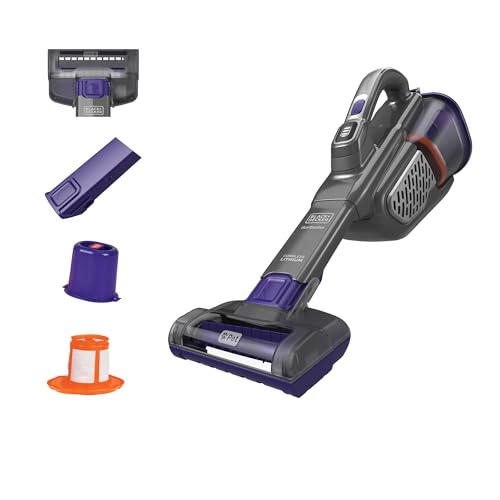
BLACK+DECKER dustbuster furbuster Pet Vacuum — Best Motorised Pet Brush
The furbuster’s name is a pun and its premise is serious: a motorised pet hair brush at the front, spinning against the fabric to lift hair that suction alone leaves behind. This is the correct engineering answer to the category’s central problem. A bare nozzle held over woven upholstery creates airflow parallel to the surface, and hooked hairs simply lie flatter. A powered brush digs, flicks and presents the hair to the airflow. On a sofa arm where a dog rests its chin, or the car seat that serves as a travelling bed, the difference is not marginal; it is the difference between the job being possible and not.
BLACK+DECKER builds the brush into the dustbuster lineage, so the rest of the machine is the familiar, grabbable shape with a bowl that empties without ceremony. The listing frames it for home and car, rechargeable and portable, and that dual citizenship is real: the brush earns its place on household fabric, while the body remains small enough for footwells and boot corners. Keep the brush head clean — its own rollers collect a hair wrap over time, as every powered brush does — and its performance stays at the level that justifies the name.
Where the design asks for compromise is focus. The motorised head is wider and more purposeful than a crevice nozzle, so the narrow seams of a car interior need the standard nozzle and a slower hand. Battery and cup follow the burst pattern of the class. None of that dims the central point: if pet hair on fabric is your defining mess, the tool that agitates wins, and this is the pick that agitates best.
- Format: cordless handheld with motorised pet brush
- Headline tool: powered pet hair brush for fabric
- Stated territory: home and car pet hair
- Lineage: dustbuster AdvancedClean family
- Use pattern: upholstery-first, car-second
Strengths
- Powered brush lifts hooked hair bare nozzles miss.
- Familiar dustbuster handling and simple emptying.
- Genuinely dual-purpose across sofa and car seat.
Trade-offs
- Brush head is not the tool for narrow car seams.
- Powered head needs its own periodic de-hairing.
- Burst format limits very long sessions.
Best for: fabric-heavy pet homes where upholstery hair is the main enemy.
Not suited for: seam-and-crevice car detailing as the primary job.

Shark UltraCyclone Pet Pro Plus Hand Vacuum — Best Tool Selection
Shark’s answer to the handheld brief is to ship the whole toolkit: a pet power brush for fabric, a crevice tool for seams, a scrubbing brush for the ground-in stuff, and an XL dust cup to hold the proceeds. That inventory reads like a detailing kit because it is one, and it makes the UltraCyclone the natural pick for owners whose handheld work splits evenly between the house and a car that leads an interesting life. The scrubbing brush in particular is the tool nobody knew they needed until they met dried mud on a car mat or a mystery patch on a boot liner; agitation with stiff bristles, followed by suction, shifts what wiping only smears.
The UltraCyclone name refers to the separation system, and its practical gift is steadiness as the cup fills — useful here because hair and grit together fill cups fast, and a handheld that fades halfway through a car clean teaches its owner to stop starting. The XL cup stretches sessions further than most rivals manage. In the hand the machine feels like the serious end of the category: purposeful, a little denser than the featherweights, built for owners who will use the attachments rather than lose them in a drawer.
That seriousness is also the caveat. If your handheld life is a ten-second crumb patrol after breakfast, this kit is more apparatus than the job requires, and the lightest picks below will be used more simply because they ask less. But for the weekend pattern — sofa, stairs, then the car, properly — the Shark’s completeness means one machine, one charge, no improvising with the wrong nozzle held at a hopeful angle.
- Format: cordless hand vacuum, detailing-leaning kit
- Tools: pet power brush, crevice tool, scrubbing brush
- Cup: XL dust cup, per the listing
- Separation: UltraCyclone system
- Model reference: CH951, per the listing
Strengths
- Attachment set covers fabric, seams and ground-in dirt.
- Larger cup sustains longer car and home sessions.
- Separation system resists mid-job performance fade.
Trade-offs
- More kit than a crumb-patrol household will use.
- Denser in the hand than the ultralight picks.
- Attachments need a home or they will wander off.
Best for: owners splitting handheld duty between upholstery and car detailing.
Not suited for: minimalists wanting the lightest possible grab-and-go tool.

BLACK+DECKER dustbuster AdvancedClean Hand Vacuum — Best Classic All-Purpose
Some product shapes become generic nouns, and the dustbuster is the handheld vacuum’s. This AdvancedClean version keeps the classic silhouette and adds the details that made the line durable: a rotating nozzle that angles into awkward spaces without rotating your wrist, a crevice tool for the seams, a charging station that gives the machine a permanent address, and a large dust bowl by handheld standards. The listing describes it plainly as a compact home and car vacuum, and that plainness is the appeal. It is the handheld for people who do not want a relationship with their handheld.
The rotating nozzle deserves more credit than it gets. Car interiors and stair corners are full of surfaces that meet at unfriendly angles, and a nozzle that pivots to meet them keeps the seal — and therefore the suction — where a rigid neck breaks it. The charging station matters in the same unglamorous way: a machine that is always returned to the same dock is a machine that is always charged, and the category’s saddest failure mode, the flat battery at the moment of need, is designed out by furniture rather than by willpower.
Note what it is not: this is the standard AdvancedClean model, not a pet-specific variant, and while it handles everyday hair competently, it lacks a motorised brush for the deep upholstery work the furbuster and its peers specialise in. Choose it for general duty — crumbs, grit, litter spills, car mats, the hallway after muddy boots — and it will serve for years without a single interesting incident, which for many households is the highest praise a small appliance can earn.
- Format: cordless handheld, classic dustbuster shape
- Nozzle: rotating design with crevice tool
- Charging: station included, per the listing
- Cup: large dust bowl for the class
- Model reference: CHV1410L, per the listing
Strengths
- Pivoting nozzle keeps its seal on angled surfaces.
- Charging station guarantees a ready machine.
- Generous bowl stretches time between emptying.
Trade-offs
- No motorised brush for deep upholstery hair.
- Classic shape is bulkier than the new featherweights.
- Generalist tuning shows on stubborn fabric hair.
Best for: general household and car duty with zero fuss.
Not suited for: dedicated pet-hair upholstery work as the main job.

XenonLab Handheld Vacuum Cordless 1.1 Pounds — Best Ultralight for Cars
At 1.1 pounds, the XenonLab changes the question from how powerful a handheld is to where a handheld can live. The answer is places no conventional model fits: the glovebox of a small car, a desk drawer, the narrow shelf beside the driver’s seat, a caravan cupboard. Its listing claims 10,000Pa and a 4-in-1 brief spanning car, office, home and pet hair, with a HEPA filter and a large capacity dust cup for its size. We record the suction figure as listing data and focus on the lived reality: a featherweight tool that is present for the small mess at the moment it happens, which is when small messes are cheap to remove.
In a car it is genuinely handy. Crumbs in the seat fold, ash-like grit in the footwell, the dust film on the dash’s lower reaches — all are thirty-second jobs at this weight, done one-handed while the other hand holds the door. Rechargeable design means it returns to a cable rather than a dock, suiting vehicles and desks where a charging station has no home. The HEPA filter is a thoughtful inclusion for a machine that will often be used in the enclosed air of a car cabin.
The physics of smallness still apply. The cup is small in absolute terms whatever the listing calls it, the runtime suits bursts, and deep-pet-hair upholstery is beyond its ambition — it will tidy surface hair, not excavate a sofa. Buy it as a proximity tool and it delights. Buy it as your only vacuum for a hairy household and it will be overwhelmed by Tuesday.
- Format: cordless handheld, ultralight class
- Weight: 1.1 pounds, per the listing
- Stated suction: 10000PA, as printed on the listing
- Filter: HEPA, with large capacity cup for its size
- Brief: 4-in-1 across car, office, home and pets
Strengths
- Featherweight body lives in cars and drawers.
- One-handed use suits quick cabin tidy-ups.
- HEPA filtration suits enclosed car interiors.
Trade-offs
- Absolute cup size remains small for big spills.
- Deep upholstery hair is outside its brief.
- Burst runtime, not session runtime.
Best for: car cabins, desks and small daily messes within arm’s reach.
Not suited for: serving as a pet household’s only vacuum.

Antaha Handheld Vacuum Cordless Car Vacuum — Best Type-C Travel Pick
The Antaha follows the same featherweight philosophy as the XenonLab — 1.2 pounds by its listing — and adds the detail that defines its niche: Type-C charging. That single port decision means the vacuum charges from the same cable ecosystem as a phone, in the car, from a laptop, from a power bank in a tent. For drivers who keep a car perpetually tidy, for rideshare drivers whose cabin is a workplace, and for travellers in campervans, charging universality is worth more than any suction increment. The listing claims 11,000Pa, which we again file as catalogue data, and promises multiple accessories for home, pet and car work.
Accessory variety at this weight is best understood as reach variety: nozzles that let a small machine address seat seams, vents and the grit that collects around pedals. Used in that spirit — little and often, everything within one charge’s worth of bursts — the Antaha keeps a car at the standard where a weekly five minutes replaces the quarterly valet. Its lightness also suits drivers with limited grip strength, for whom the classic dustbuster shape can be a genuine strain during a full cabin session.
Boundaries mirror its sibling’s. Hair excavation on household upholstery belongs to the motorised brushes above; this is a surface and seam tool. Runtime and cup are burst-scale. But as the vacuum that actually lives in the car, charged by the cable already there, it closes the category’s oldest gap: the distance between the mess and the machine.
- Format: cordless handheld, car-first design
- Weight: 1.2lbs, per the listing
- Stated suction: 11000Pa, as printed on the listing
- Charging: Type-C, per the listing
- Kit: multiple accessories for car, home and pet use
Strengths
- Type-C charging works anywhere a phone charges.
- Light enough for drivers with limited grip strength.
- Accessory set targets seams, vents and pedals.
Trade-offs
- Surface tool, not an upholstery excavator.
- Small cup fills fast after beach or dog trips.
- Runtime suits maintenance, not rescue missions.
Best for: cars kept tidy little and often, and travel use.
Not suited for: deep pet-hair recovery on household furniture.
How Do the Six Handhelds Compare at a Glance?
| Model | Defining tool | Charging style | Happiest territory |
|---|---|---|---|
| Bissell Pet Hair Eraser Cordless Hand Vacuum | Pet-focused nozzle | Battery, lithium-ion | Sofa and car seats |
| BLACK+DECKER dustbuster furbuster Pet Vacuum | Motorised pet brush | Rechargeable | Upholstery hair |
| Shark UltraCyclone Pet Pro Plus Hand Vacuum | Three-tool kit, XL cup | Rechargeable | Home plus car detailing |
| BLACK+DECKER dustbuster AdvancedClean Hand Vacuum | Rotating nozzle | Charging station | General duty everywhere |
| XenonLab Handheld Vacuum Cordless 1.1 Pounds | Ultralight body, HEPA | Rechargeable | Glovebox and desk |
| Antaha Handheld Vacuum Cordless Car Vacuum | Accessory set, Type-C | Type-C cable | Car kept tidy daily |
The pattern to notice is that no column crowns a single winner. Brush agitation, tool reach, weight and charging each matter to a different household, and the right handheld is the one whose column matches the mess you actually make.
Why Does Pet Hair Cling to Fabric So Stubbornly?
Look at a pet hair under magnification and the mystery dissolves: its surface is scaled, and woven upholstery is a field of loops and fibres waiting to catch those scales. Add the static that synthetic fabrics generate, the pressure of a sleeping animal compressing hair into the weave for hours, and the slight oiliness of a coat, and you have a bond that moving air alone was never going to break. This is why the motorised brush is not a luxury in this category but the mechanistic answer — it physically lifts each hair’s caught end free, and only then can airflow carry the hair away.
It also explains technique. Slow passes give the brush time to work each patch; pressing lightly keeps bristles in the weave rather than skating on it; working in two directions, along the weave and across it, releases hairs hooked at different angles. A rubber pet brush or a dampened hand makes a fine pre-pass on the worst patches, loosening the mat so the vacuum can finish. Owners who learn this stop blaming suction figures and start getting clean sofas, which is the correct order of understanding.
How Should You Detail a Car Interior With a Handheld?
Work top-down and dry-first. Begin with the seats, because everything you dislodge falls to the footwells you will clean last. Use the crevice tool along every seam, the fold where back meets base, and the rails beneath, where grit collects in a line that fingers cannot reach. Move to door pockets and the console’s edges, then mats: lift them out if they unclip, since the worst of a car’s dirt lives underneath, compacted into the carpet by months of heels. Footwells finish the route, with the scrubbing brush, where fitted, working the heel pad’s ground-in crescent.
Two habits separate a tidy cabin from a detailed one. The first is emptying before the cup compacts, because a handheld’s airflow falls quickly once hair felts across the filter. The second is a final pass with the car doors open in daylight; raking light across fabric reveals the hair shadow that interior bulbs hide, and it always concentrates where the dog sits and where children’s shoes swing. Five extra minutes in good light is the entire difference.
What Runtime Do You Actually Need From a Handheld?
Less than you fear, provided the work is zoned. A sofa takes minutes. A car’s front seats take minutes. The failure stories in this category almost always involve a machine asked to do a whole house’s overflow work on one charge — a job its format never promised. Think in bursts: the handheld’s natural unit is the single mess, the single room, the single car zone. Charged between bursts on its dock or cable, even a modest runtime becomes effectively unlimited for the work the category exists to do.
Battery chemistry and charging habits decide whether that pattern survives the years. Lithium-ion packs prefer being kept topped up rather than run to exhaustion, and a docked machine lives in that happy state by default. Cable-charged featherweights should be plugged in after use as a reflex, the way a phone is. A handheld that is charged is a tool; a handheld that is flat is a rumour, and the difference is entirely in the owner’s last ten seconds after each job.
How Do You Empty a Hair-Filled Cup Without the Mess?
Hair leaves a handheld cup as a felted plug, and technique keeps that plug’s dust where it belongs. Empty outdoors or directly over a bin, with the cup pointed downward and opened at its base where the design allows, so gravity does the work instead of your fingers. A light tap dislodges the plug whole. Resist shaking the filter over the bin like a rug; that gesture aerosolises exactly the fine dust the filter caught. Instead, tap the filter gently against the bin’s rim, or brush it with the old toothbrush that should live with your cleaning kit.
Washable filters reward a rota: rinse, dry fully, refit. Keep a reminder tied to something monthly and unmissable. And wipe the cup’s interior occasionally with a dry cloth, because the static film that builds on plastic is what makes the next plug cling and tear rather than drop. None of this takes a minute. All of it is the difference between a handheld that stays pleasant and one that gets quietly exiled to a high shelf.
Where Should a Handheld Live in Your Home?
The honest answer is: within sight of its work. Pet households should dock the machine near the animals’ favourite furniture, even if that means a hallway socket and a small aesthetic surrender. Car-focused models should live in the car or the garage’s first shelf, not in a kitchen drawer three doors from the driveway. Desk-scale featherweights belong in the desk. Every metre between the machine and its mess is a tax paid in postponed jobs, and postponed crumbs become ground-in evidence.
Households with both problems — hairy sofa, hairy car — should consider whether one machine can commute or whether the budget honestly stretches to the classic pairing: a brush-equipped model indoors and a featherweight in the vehicle. That pairing sounds indulgent until priced against a single valet or a replaced sofa throw, at which point it becomes the economical reading of the situation. The six picks here were chosen so that either strategy can be assembled from the list.
How Should You Clean Up After a Dog Journey Without a Full Valet?
Accept the two-stage method and a car recovers gracefully. Stage one happens at the destination or the moment you get home, while the evidence is loose: shake the mats outside the car, run the handheld over seats and footwells, and empty the cup before the hair felts. Ten minutes now is worth an hour next month, because loose hair lifts and compacted hair negotiates. Stage two, within the week, is the seam pass with the crevice tool and a damp cloth on the hard surfaces, which together restore the cabin to a standard passengers will not comment on — the true goal of all car cleaning.
Keep a small kit in the boot so stage one never requires a trip indoors: the handheld itself, charged, and a lint roller for clothing emergencies. Drivers who adopt the ritual find the car stops accumulating a background layer of dog, and the quarterly deep clean shrinks from an expedition into a formality. The machine’s job in this system is not heroism. It is punctuality.
What About Children, Snacks and the Archaeology of the Back Seat?
The back seat of a family car is a sedimentary record: crisp strata, a fossilised chip layer, something once organic near the seat-belt buckle. Handhelds are the correct excavation tool because the area is small, the access is awkward and the job recurs weekly. Work with the doors wide and the seats folded where they fold. Crumbs hide in the hinge line of folding seats and in the buckle recesses, both crevice-tool territory. A scrubbing brush earns its keep on the fabric where drinks have dried into the weave, loosening the deposit so suction can take it.
Prevention deserves one line: a washable seat protector under child seats converts most of this archaeology into a shake-outside task. The handheld then maintains rather than excavates, which is the division of labour every cleaning tool dreams of. And involve the archaeologists themselves — a child trusted with the featherweight pick for their own footwell learns both the tool and the standard, and the back seat’s condition often improves out of all proportion to the physics involved.
How Do You Choose Between a Dock and a Cable?
The dock is a behavioural device disguised as an accessory. It fixes the machine’s address, guarantees charge, and turns putting the vacuum away into the same motion every time. Homes with a hallway socket and a resident pet should strongly prefer it; the classic dustbuster’s station and the hallway-docked pet models build their reliability on exactly this. The cable is a flexibility device: it charges in cars, caravans, offices and rental flats where drilling or dedicating a socket is impossible, and Type-C extends that flexibility to every charger a modern household already owns.
Choose by predicting your own laziness honestly. If the machine must be fetched from a cupboard and plugged in after use, will it be? If the answer wavers, the dock wins, because a charged modest machine outperforms a flat excellent one every single time. If your life is mobile — the vacuum genuinely travels — the cable wins and the dock becomes the constraint. The picks divide cleanly along this line, which is why the comparison table lists charging as a primary column rather than a footnote.
What Should You Know About Filters in Small Machines?
A handheld’s filter is small, which means it loads quickly and its condition dominates performance sooner than in a full-size machine. The symptoms of a loaded filter are a higher motor note, weaker pickup and a cup that seems to fill with dust cake instead of loose debris. The remedies are the tapping, rinsing and full drying described earlier, performed more often than pride suggests. HEPA-grade filtration, as on the XenonLab, is a genuine benefit in enclosed spaces like car cabins, where everything the machine exhausts stays in the air you are breathing for the rest of the drive.
Two cautions keep filters alive. Never run the machine with a damp filter refitted early; the moisture binds dust into a crust that rinsing struggles to reverse. And never run without a filter to save time on a quick job, because the motor then eats the debris directly. A spare filter, rotated while the other dries, is a small purchase that removes both temptations and keeps the machine at full voice year-round.
How Can Renters and Students Use a Handheld as Their Main Vacuum?
In a genuinely small home — one room, a bathroom, a kitchenette — a good handheld plus discipline can carry the whole cleaning load, and students have proved it for decades. The method is frequency: hard floors swept daily in two minutes, rugs worked slowly twice a week with the brush head if the model has one, upholstery on rotation. The machine’s smallness stops mattering because the territory is small, and its storage advantage in a room where every cupboard is contested is decisive.
Know the ceiling of the strategy. A full carpeted flat with a shedding dog will defeat it, and the honest upgrade path from this list is the compact upright in our related guides, not a second handheld. But as a first machine in a first room, a brush-equipped pick like the Bissell or the furbuster is a rational, complete answer — and it remains useful as the household’s second machine for the rest of its life.
What Is the Right Way to Store a Handheld in a Car?
Heat and cold are the enemies, and both live in parked cars. A lithium battery left through a summer of cabin heat ages in fast-forward, so the machine should ride in the boot’s shaded side or, better, come indoors during heatwaves and hard frosts. Secure it against sliding; a handheld that travels the boot on every corner becomes a battered handheld, and its nozzle seals suffer first. A small crate or the car’s own underfloor compartment makes an ideal garage-within-the-car.
Charging in the car deserves a routine rather than an intention. Plug in during a weekly longer drive, or top up from the house cable on bin night — any fixed rhythm beats the plan of remembering. The Type-C picks make this easiest, sipping from the same port as a phone. A car vacuum that is charged, shaded and secured is a detailing department; one that is flat, baked and loose is litter.
How Do You Tackle Stairs With a Handheld Instead of an Upright?
Stairs are where handhelds quietly outclass their bigger relatives. No cord geometry, no body balanced on a tread, no hauling. Work from the top down so dislodged grit falls to steps not yet cleaned, using the crevice tool at the tread-riser junction and a slow fabric pass across each tread’s centre, where the traffic lane compresses dirt into the pile. A motorised brush model transforms the job on carpeted stairs, because that centre lane is exactly the hooked-debris problem the brush exists to solve.
The landing and the hall runner join the same session, and the whole staircase takes perhaps ten minutes — which is why stairs cleaned by handheld get cleaned monthly while stairs awaiting an upright get cleaned seasonally. Frequency wins again. Keep the machine at whichever end of the staircase has a socket or a shelf, and the job slots into ordinary life instead of requiring an occasion.
When Is a Handheld the Wrong Purchase Entirely?
When the home’s real problem is area. A handheld asked to maintain three carpeted bedrooms is a category error, and no badge in this guide should be read as permission. When the problem is a severe dust allergy under medical management, the answer is a sealed-system full-size machine, not a burst tool with a small filter. And when the car’s dirt is professional-grade — a work vehicle carrying plaster, soil or animal feed daily — a workshop vacuum with a hose is the honest tool, with the handheld demoted to cab duty.
Recognising these boundaries is part of choosing well, and it protects the category’s reputation: handhelds fail publicly when they are bought for the wrong war. Bought for hair on fabric, seams in cars and the daily small mess, the six here are not compromises. They are the correct instruments, sized to the hand and the moment.
What Mistakes Do Handheld Buyers Make Most Often?
The first is buying by suction number for a job governed by brushes and seals. The second is expecting a handheld to substitute for a full-size vacuum during a genuine crisis — the post-renovation clean, the whole-car rescue after a muddy dog — and then rating it unfairly for failing a job outside its design. The third is losing the attachments: a crevice tool in a junk drawer might as well not exist, so give the kit a single home from day one. The fourth is storage far from the mess, covered above but worth repeating because it silently defeats more purchases than any specification.
The fifth mistake is neglecting the powered brush, on models that have one. A motorised head wound in its own hair collection stops agitating while still spinning, and the owner concludes the machine has weakened. Thirty seconds with scissors, monthly, restores the entire premise of the purchase. Small machines ask small maintenance; the tragedy is only ever that nobody told the owner.
How Should You Test a New Handheld During Its First Week?
Set it three honest examinations. First, the sofa test: choose the cushion your pet loves most, photograph it in daylight, clean one half with your best slow technique and compare. A brush-equipped machine should produce a visible border between the halves; a bare-nozzle model should at least clear the surface layer completely. Second, the seam test: run the crevice tool along one car seat rail and inspect with a fingertip, which detects grit your eyes miss. Third, the readiness test: leave the machine off its charger for two days of normal small jobs and note whether it is still willing — that is the runtime pattern your life will actually experience, as opposed to a continuous laboratory run.
Also weigh the machine in your own hand at arm’s length for thirty seconds, because that is the posture of upholstery work and wrists vote honestly. Empty the cup once and judge the mess of doing so. A handheld passes its first week by being reached for voluntarily on day six, and that small behavioural fact predicts years of service better than any specification in this guide.
What Does a Sensible Handheld Cleaning Kit Look Like?
Around the machine itself, four cheap companions multiply its value: a rubber pet brush for pre-loosening, a soft brush for dashboards and vents, a spare filter drying in rotation, and a small caddy that keeps the attachments in one place. In cars, add a microfibre cloth for the hard surfaces vacuums cannot help. The whole kit fits a shoebox, and its existence converts the handheld from an appliance into a system — one that handles fabric, seams, dust and spills of the dry kind without improvisation.
Resist expanding the kit beyond the box. The category’s charm is immediacy, and a system that requires assembly loses it. Everything within reach, everything charged, everything with a home: that discipline, applied to whichever of the six picks you choose, is the real product being recommended here.
How Do Handhelds Handle Litter Trays, Bird Seed and Other Scatters?
Granular scatters are a handheld’s easiest work and its most frequent call-out in pet homes. Cat litter kicked beyond the mat, seed husks beneath a cage, kibble sprayed from a bowl by an enthusiastic eater — all are dry, loose and localised, which is the exact profile these machines exist for. A wide nozzle at a slow pace ingests without scattering; charging at the pile merely relocates it, a physics lesson every owner learns once. Empty before the cup’s contents reach the filter, because fine litter dust loads a small filter faster than hair does.
Position is the long-term fix. A handheld docked in the room with the litter tray gets used daily, and the scatter never graduates into the grit that migrates through a home on socks and paws. That migration is the real cost of litter, not the visible pile, and it is why pet owners rate proximity over power in this category with such consistency.
What Should Drivers With Dogs Know About Boot Carpets?
Boot carpet is the hardest-working fabric in a dog owner’s life: wet paws, shaken coats, mud transferred from every field in the county. A handheld maintains it well if the routine is shake, dry, then vacuum — in that order. Vacuuming a wet boot mat smears; letting it dry first, ideally with the mat lifted out at home, returns the mud to a loose state the machine can lift. The scrubbing-brush models earn their place here, working the dried crescent where the dog sits and turns.
A liner changes the economics entirely, converting most boot dirt into a shake-outside task and leaving the handheld a finishing role. Owners who combine a liner, a docked-in-the-garage handheld and the dry-first rule find the car stops smelling like the hobby it serves, which passengers experience as a small miracle of civilisation.
How Should You Choose Between the Two Featherweights?
The XenonLab and the Antaha share a philosophy and differ in emphasis, so the choice is a portrait of your routine. If the machine will live in a drawer or glovebox and be charged wherever a cable happens to be, the XenonLab’s HEPA filtration and 4-in-1 brief make it the enclosed-space specialist. If the machine will live in the car and charge from the car’s own ports, the Antaha’s Type-C connection removes the last excuse for a flat battery, and its accessory set leans harder into seams and vents. Both will tidy a cabin beautifully; neither will excavate a sofa, and choosing between them on that shared understanding is choosing well.
Weight separates them by a tenth of a pound, which no wrist will ever detect. Charging and filtration are the real ballot, and your answer to where this machine sleeps at night decides it more honestly than any specification either listing prints.
Final Recommendation
Choose by the tool, not the number. Fabric hair as the main battle points to the BLACK+DECKER dustbuster furbuster Pet Vacuum and its powered brush, with the Bissell Pet Hair Eraser Cordless Hand Vacuum as the balanced single-machine alternative. A home-and-car detailing split belongs to the Shark UltraCyclone Pet Pro Plus Hand Vacuum, general duty to the classic dustbuster, and the car-kept-tidy life to the two featherweights, split by whether Type-C charging matters to you.
Whichever you bring home, dock it beside its battlefield and use it the day the mess is made, because a handheld’s whole philosophy is that small dirt, met early, never gets the chance to become a weekend.
Frequently Asked Questions
Can a handheld vacuum really remove pet hair from a sofa?
Yes, with the right head and technique. A motorised brush lifts hairs hooked into the weave so the airflow can carry them off; a bare nozzle will mostly remove surface hair and leave the woven-in layer. Work slowly, in two directions, and empty the cup before it compacts. The worst patches may want a rubber brush pre-pass, after which the vacuum finishes quickly.
How do I stop grit hiding between my car seats?
That valley is crevice-tool territory. Slide the tool slowly along the seat rails and the fold where the seat back meets the base, working from front to back so debris travels toward the opening. Move the seat fully forward and fully back during the session, because each position exposes a different strip of rail. A slim handheld body helps; a wide nozzle simply cannot enter the gap.
Are the suction figures on lightweight models meaningful?
Treat them as listing information rather than a ranking system. Small handhelds are tested under differing conditions, and in real use the nozzle’s seal against the surface, the brush’s agitation and a clean filter influence results more than the headline figure. Use the numbers as a rough class indicator and choose on tools, weight and charging, which predict daily success far better.
How long should a handheld run on one charge for car use?
Long enough to zone the car rather than marathon it: seats one day, footwells and boot the next, or a full cabin in two bursts with a top-up between. Burst-pattern machines are designed around that rhythm and their batteries age better for it. If your use genuinely demands one long continuous session, favour the larger-bodied picks with bigger cups and plan the route before you start.
Can I use a car handheld for household jobs too?
Certainly for small ones: crumbs, litter spills, desk dust, a single chair’s worth of hair. The featherweight car models are proximity tools, and around the home they shine in the same small radius. Whole-room or deep upholstery work belongs to the brush-equipped models or a full-size machine. Matching the tool’s scale to the job’s scale is the whole skill this category teaches.
Related Guides
A handheld handles the sudden and the small; the weekly whole-floor story belongs to the uprights and compacts in our companion guides, and the final link below leaves vacuums entirely for the range hood your cooking deserves. Read Best Compact Upright Vacuums when the handheld starts being asked to do a whole flat’s work, consider Best Ductless Under Cabinet Range Hoods for the kitchen air above the stove, and wander over to Best Freestanding Comfortable Bathtubs when the bathroom’s turn for an upgrade arrives.


