What's inside
- Key Takeaways
- Quick Picks
- How We Chose These Picks
- How Do the Six Thermometers Compare at a Glance?
- Which Family Suits the Way You Actually Roast?
- How Should a Probe Be Placed to Read the Truth?
- How Do You Verify a Thermometer Without Laboratory Gear?
- What Care Keeps a Wired Probe Alive for Years?
- How Does Resting Change the Temperature You Aim For?
- What Changes When the Meat Is Stuffed, Brined or Frozen at the Core?
- How Do You Read a Dial Through Oven Glass Without Losing Heat?
- Can These Thermometers Handle Frying Oil and Sugar Work?
- Why Do Two Thermometers Sometimes Disagree in the Same Roast?
- How Do Convection Fans and Covered Pots Change the Reading Story?
- How Should You Store Probes and Dials Between Cooks?
- What Mistakes Do Oven Thermometer Buyers Make Most Often?
- Final Recommendation
- Frequently Asked Questions
- Related Guides
As an Amazon Associate I earn from qualifying purchases. This post may contain affiliate links at no extra cost to you.
cottageverdict.com is reader-supported. When you buy through links on our site, we may earn an affiliate commission.
Where to buy: all six picks below are sold on Amazon, and each name in the Quick Picks table, each review heading and each comparison row links to its own listing, where current availability and the full specification can be confirmed before you order. Choosing among the best meat thermometers for oven cooking starts with a fork in the road that has nothing to do with brands. Down one path sit analog dial thermometers that live inside the oven for the entire roast, need no battery, and ask you to open the door and peer through glass or steam to read them. Down the other path sit digital probe thermometers whose thin metal probe stays in the meat while a heat-resistant cable snakes out through the door seal to a display sitting safely on the counter, calling out the temperature without a single door opening. Both paths end at the same place — meat pulled at the right moment — but they suit very different cooks, kitchens and tempers.
A Sunday rib roast in a heavy Dutch oven rewards the set-and-forget simplicity of a dial that rides along inside. A brisket on a smoker at midnight rewards a wired probe with an alarm, because nobody wants to stand in a cold garden reading a fogged dial at two in the morning. This guide keeps the two families honestly separated. Three picks here are analog leave-in dials, three are digital wired designs, and the reviews will never blur that line, because a thermometer that survives inside a hot oven and a display unit that must never enter one are different tools obeying different rules. Confusing them is how good equipment gets ruined and good roasts get misread.
One more honesty note before the picks. Accuracy claims belong to listings, not to reviewers’ imaginations. Where a listing publishes a tolerance figure, judge the thermometer by it. Where it does not, this guide says so plainly rather than inventing laboratory numbers, and the buying advice explains how to sanity-check any thermometer at home with ice water and boiling water. A cook who verifies a new thermometer once, on the day it arrives, cooks with it confidently for years.
Key Takeaways
- Analog leave-in dials stay inside the oven for the whole cook and need no battery, but you read them through the door or by opening it.
- Digital wired probes keep the display outside the heat, so alarms and backlit screens do the watching for you.
- Only the probe and its rated cable may cross the oven door seal; the digital display unit itself never goes inside.
- Dual-probe models let you track two roasts, or a roast and the oven air, at the same time.
- None of the analog picks needs charging, while the rechargeable digital pick trades that simplicity for a brighter, faster display.
- Test any new thermometer in ice water on arrival, whatever family it belongs to.
Quick Picks
| Pick | Badge | Why it earns its place |
|---|---|---|
| Escali AH1 Oven Safe Meat Thermometer | Best Analog Leave-In Classic | A big, calm dial with meat temperatures printed on its face and an NSF certification behind it. |
| OXO Good Grips Chef’s Precision Leave-In Meat Thermometer | Best Analog With Doneness Guide | OXO’s leave-in dial carries its doneness guidance on the face, in both Fahrenheit and Celsius. |
| TempPro TempTrack Digital Meat Thermometer | Best Wired Digital Starter | A single wired probe, a large display and a built-in timer cover the everyday roast with no fuss. |
| TempPro TempTrack Dual Probe Meat Thermometer | Best Dual Probe Digital | Two probes, a backlit screen and high and low alarms suit smokers and double-roast Sundays. |
| AWLKIM Analog Meat Thermometer Oven Safe 2 Pack | Best Analog Value Pair | Two battery-free dials with a pot clip in the box, so one can live in each oven or pan. |
| AWLKIM Dual Probe Meat Thermometer Digital | Best Rechargeable Dual Probe | A handheld instant probe plus a long wired leave-in probe, recharged over USB-C. |
How We Chose These Picks
Every candidate had to answer one question first: how does the temperature reach the cook’s eye? Models that answer “the dial lives in the oven” were judged on dial size, legibility at a glance, whether doneness guidance is printed where it is needed, and whether the listing confirms the whole unit is oven safe rather than merely heat tolerant for a few minutes. Models that answer “a probe on a cable” were judged on cable length and construction, display size, whether alarms can be set for a target temperature, and whether a second probe earns its keep or merely pads a feature list.
Construction mattered next. Stainless steel housings and probes dominate this group because they shrug off oven heat, pan splashes and drawer knocks. Glass dial faces were weighed against the reality of reading through a hot oven window; a large dial is not a luxury on an analog model, it is the entire interface. For the digital picks, we looked at how the probe meets the cable, since that joint is where wired thermometers usually die, and at whether the display can stand on a counter at a readable angle rather than lying flat like a dropped phone.
We also separated features that help from features that decorate. A timer on a single-probe digital unit genuinely helps, because roasting is half clock and half temperature. A pot clip on an analog dial genuinely helps, because the same dial can monitor frying oil or a poaching bath. By contrast, a doneness chart printed only in a leaflet helps nobody at the moment of decision, which is why the two analog picks with guidance printed on the dial itself rank so comfortably here. Battery strategy closed the assessment: analog picks need nothing, two digital picks run on replaceable cells, and one recharges, and each arrangement suits a different household rhythm.
Finally, we read each listing for what it does not say. None of these six listings leads with a published accuracy tolerance in its title, so no pick below is credited with laboratory precision it never claimed. That restraint is deliberate. Thermometers earn trust through the ice-water test in your own kitchen, and the how-to section further down walks through that two-minute ritual step by step.

Escali AH1 Oven Safe Meat Thermometer — Best Analog Leave-In Classic
The Escali AH1 is the thermometer equivalent of a cast-iron skillet: one job, done plainly, built to be handed down. Its dial measures two and a half inches across, which on an analog instrument is the difference between reading the temperature from a step away and squinting through oven glass with your nose nearly on the door. Printed around that dial are the target temperatures for beef, poultry, pork and veal, so the knowledge you need at the decisive moment is physically attached to the needle that delivers the verdict. There is no menu, no pairing ritual, no firmware. You push the probe into the thickest part of the roast, set the roasting tin in the oven, and the needle climbs as the meat cooks.
Escali builds the AH1 from stainless steel and the listing carries NSF certification, a detail worth pausing on. Certification does not make a roast juicier, but it signals that the instrument was built for food environments and honest measurement rather than novelty-gadget tolerances. In daily use the AH1’s virtues compound quietly. It cannot run out of battery during a holiday turkey. It does not care about splashes. It rinses clean and goes back in the drawer, or better, stays clipped near the oven where analog tools belong. Cooks who roast twice a week often end up trusting a dial like this more than any screen, because its failure modes are visible: a needle that sticks or a fogged face announces itself, unlike a dying battery mid-cook.
Its limits are the family’s limits, stated openly. Reading it means opening the door or peering through glass, and every door opening sheds heat and stretches the cooking time a little. The needle also moves at the pace of a bimetal coil, so it will not give you the near-instant reading of a digital probe when you are checking a thin steak. Treat the Escali AH1 Oven Safe Meat Thermometer as a roast instrument, inserted before cooking and consulted along the way, and it is superb. Ask it to behave like a pocket instant-read and you are using the wrong branch of this guide.
- Format: analog dial, designed to remain in the meat inside the oven
- Dial: extra large, two and a half inches across
- Guidance printed on the face for beef, poultry, pork and veal
- Body material: stainless steel, NSF certified per the listing
- Power: none required, ever
Strengths
- Huge dial stays readable at a glance, even through a oven door window.
- Doneness temperatures printed on the face remove all mid-cook guesswork.
- Nothing to charge, pair, update or replace before a big cook.
Trade-offs
- Checking progress means opening the door or reading through glass.
- The needle responds more slowly than a digital sensor does.
- One probe watches one roast; there is no second channel.
Best for: traditional roasters who want a permanent, battery-free oven companion. Not suited for: cooks who need alarms or who check thin cuts in seconds.

OXO Good Grips Chef’s Precision Leave-In Meat Thermometer — Best Analog With Doneness Guide
OXO approaches the same analog problem from the guidance side. The Chef’s Precision leave-in thermometer is built to monitor roasts in the oven, and its face carries a doneness guide alongside markings in both Fahrenheit and Celsius. That dual scale sounds like a small thing until a recipe from a British cookbook lands in an American kitchen, or the other way round, and the cook starts doing arithmetic with raw chicken in hand. OXO removes the arithmetic. The guide on the dial does similar work, placing the target beside the needle so a less experienced cook can roast a leg of lamb beside a confident one and both read the same truth off the same face.
The probe enters the meat before the oven door closes and stays there, which shapes how you cook with it. Placement becomes a deliberate act: find the thickest part, avoid bone, avoid fat pockets, and commit. That deliberateness is quietly educational. Cooks who learned on instant-read thermometers sometimes poke a roast six times in six places and average the confusion. A leave-in dial teaches single, careful placement, and rewards it with a continuous story of the cook — the early climb, the plateau that tests patience, the final approach to target. Watching that story through the door builds intuition that transfers to every other cut you will ever roast.
OXO’s design language shows in the details rather than in decoration. The dial is angled and proportioned to be read from above, the markings are high-contrast, and the whole unit wipes clean without seams that trap roast juices. Like the Escali, it asks for no power and forgives rough drawers. Unlike the Escali, it speaks Celsius as fluently as Fahrenheit, which settles its ranking for internationally-reading households. Where it shares the family weakness, we will not pretend otherwise: the door still opens for a close read, and the response still trails a digital sensor. Within the analog brief, though, the OXO Good Grips Chef’s Precision Leave-In Meat Thermometer is the most instructive dial in this guide.
- Format: analog leave-in probe and dial, oven resident during cooking
- Scales: Fahrenheit and Celsius markings on one face
- Doneness guide printed on the dial for meat and poultry
- Intended work: monitoring roasts without repeated probing
- Power: none; the mechanism is entirely mechanical
Strengths
- Dual scales end conversion sums when recipes cross the Atlantic.
- Printed doneness guidance helps newer roasters cook with confidence.
- Continuous in-oven monitoring teaches placement and patience together.
Trade-offs
- Still read through glass or an opened door, like every analog rival.
- Slower to settle than a wired digital probe on the counter.
- Guidance on a dial cannot cover every cut and preference.
Best for: households cooking from both American and European recipes. Not suited for: smoker cooks who want an alarm to wake them at target.
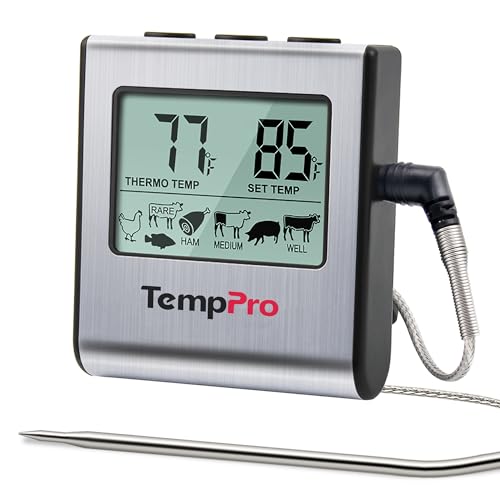
TempPro TempTrack Digital Meat Thermometer — Best Wired Digital Starter
Crossing to the digital side of the guide changes the geography of roasting. With the TempPro TempTrack, the probe stays in the meat, a stainless steel probe on a cable that leaves the oven through the door seal, and the large LCD display lives on the counter where displays belong. The practical effect is larger than it sounds. The door stays shut. The oven keeps its heat. The cook glances at a bright number while chopping herbs instead of fogging the oven window. For households graduating from the poke-and-pray method, this single wired probe is the gentlest possible upgrade, because it changes the reading experience without asking anyone to learn an app or manage a fleet of probes.
TempPro adds a clock and timer to the same unit, and the pairing is smarter than it first appears. Roasting runs on two clocks at once — the temperature clock inside the meat and the wall clock governing side dishes, resting time and guests. Having the timer on the same display as the temperature keeps both stories in one glance. The listing points the TempTrack at cooking and smoking alike, plus the wider kitchen work a probe does well, and that breadth suits a first digital thermometer: it will check a roast on Sunday, a smoker brisket in summer, and a pan of candy at the holidays, all with the same uncomplicated screen.
Care is the price of the cable, and it is worth stating the rules plainly. The display unit never enters the oven. The cable should cross the door seal without being pinched hard or draped across a burner, and it should not be dunked when washing; the probe washes, the cable wipes. Observe those three habits and a wired thermometer serves for years. Break them and the joint between probe and cable is where the damage will show. For a first step into probe cooking, the TempPro TempTrack Digital Meat Thermometer keeps the learning curve nearly flat while removing the door-opening ritual entirely.
- Format: digital display outside the oven, wired stainless probe inside
- Display: large LCD, sized for reading across the kitchen
- Extras on the unit: clock and countdown timer functions
- Listed work: cooking, smoking, grilling and candy temperatures
- Rule of use: probe and cable cross the seal; display stays out
Strengths
- Counter display ends the open-door, lose-heat reading ritual.
- Timer and temperature share one screen during a roast.
- Single probe keeps setup to under a minute for weeknight cooking.
Trade-offs
- The cable needs gentle routing and wipe-only cleaning care.
- One channel means one dish is monitored, not two.
- No wireless freedom to wander far from the oven.
Best for: first-time probe buyers upgrading from guesswork or dials. Not suited for: cooks running two roasts or a roast plus ambient monitoring.

TempPro TempTrack Dual Probe Meat Thermometer — Best Dual Probe Digital
The dual-probe TempTrack exists for the cooks the single-probe model leaves behind: the ones with a turkey and a ham sharing a holiday oven, or a brisket in the smoker whose pit temperature matters as much as the meat. Two probes feed one backlit display, and each channel carries its own high and low temperature alarm. Set the meat channel to sing at target and the second channel to warn if the smoker drifts cold overnight, and the thermometer becomes a night watchman rather than a mere gauge. The backlight, easy to dismiss as a comfort feature, earns its place at dawn barbecues and in dim winter kitchens where a roast finishes after dark.
High and low alarms deserve emphasis because they change behaviour. A target-only alarm tells you when food is done. A low alarm tells you when the fire is dying, the oven element is struggling, or a door was left ajar — early enough to rescue the cook rather than merely record its failure. In an oven, the second probe can ride in a second roast cut differently from the first, ending the tyranny of timing a chicken and a beef joint by the same clock. The timer mode remains on board, so the unit still covers the ordinary Tuesday roast without feeling like overkill brought home from the smoker.
Two cables double the housekeeping, and honest advice must say so. Label which probe is which before the cook starts, route both cables through the same stretch of door seal so the door closes evenly, and coil rather than kink them in storage. The silver display unit is a countertop citizen, never an oven one, and its backlight will spoil you for unlit screens. For households whose roasting has outgrown one channel, this is the natural summit of the wired digital path: the TempPro TempTrack Dual Probe Meat Thermometer watches two stories at once and speaks up about both.
- Format: digital unit with two wired meat probes
- Display: large LCD with backlight for low-light reading
- Alarms: high and low temperature alarms per the listing
- Timer mode included for ordinary roasting duty
- Typical pairing: two roasts, or meat plus oven air temperature
Strengths
- Two channels end the one-roast-at-a-time limitation completely.
- Low alarms warn about dying heat before dinner is ruined.
- Backlit numbers stay legible during overnight smoker sessions.
Trade-offs
- Two cables demand tidier routing and storage habits.
- More settings to learn than the single-probe sibling.
- Display still tethers you to within cable reach of the oven.
Best for: smoker cooks and holiday hosts running two dishes at once. Not suited for: minimalists who roast one small joint at a time.

AWLKIM Analog Meat Thermometer Oven Safe 2 Pack — Best Analog Value Pair
AWLKIM’s analog entry doubles the idea: two oven-safe dial thermometers in one box, each with a two-and-a-half-inch dial printed with doneness temperatures, and a pot clip included in the package. The two-pack format sounds like a bulk-buy gimmick until you map it onto a real kitchen. One dial can live permanently with the roasting tin while the second rides in a stockpot clipped to the rim, watching a poaching bath. Or one stays in the main oven and the other in the countertop oven that handles weeknight chicken thighs. Or — the use nobody admits until it happens — the second is simply there on the day the first is hiding in a drawer of utensil chaos five minutes before guests arrive.
The pot clip is the quiet star of this listing. Clipped to a pan edge, the probe hangs in liquid at a consistent depth, which turns a meat dial into a general-purpose analog monitor for frying oil, sugar syrups and gentle poaches. That versatility suits smaller kitchens where every tool must hold two jobs. The dials are dishwasher safe per the listing, a claim worth respecting precisely: it makes cleanup genuinely easy after a greasy roast, though cooks who baby their instruments will still hand-wash and dry the face to keep the print crisp for the long term.
No batteries, no charging, no displays to protect from steam — the pair asks only for drawer space and sensible placement in the meat. What it cannot do is call out to you. Analog silence is the family’s defining trait, and if your cooking style involves leaving the kitchen for long stretches, a dial of any brand will under-serve you. But as a household foundation — the thermometers that are always ready, always in the oven from the first minute, and cheap to station in pairs — the AWLKIM Analog Meat Thermometer Oven Safe 2 Pack makes a persuasive, unfussy case.
- Format: two analog dial thermometers, both fully oven safe
- Dial: two and a half inches, doneness temperatures printed on it
- Included extra: pot clip for pan-rim liquid monitoring
- Cleaning: dishwasher safe according to the listing
- Power: none; no battery to die before a feast
Strengths
- Two dials cover two ovens, two pans, or one spare.
- Pot clip stretches the tool into frying and poaching work.
- Dishwasher-safe build keeps post-roast cleanup painless.
Trade-offs
- No alarm will ever call you back to the kitchen.
- Reading still happens at the oven, not from the sofa.
- Dial pace lags behind digital sensors on thin cuts.
Best for: households wanting an always-ready analog dial in two places. Not suited for: cooks who monitor long smokes from another room.
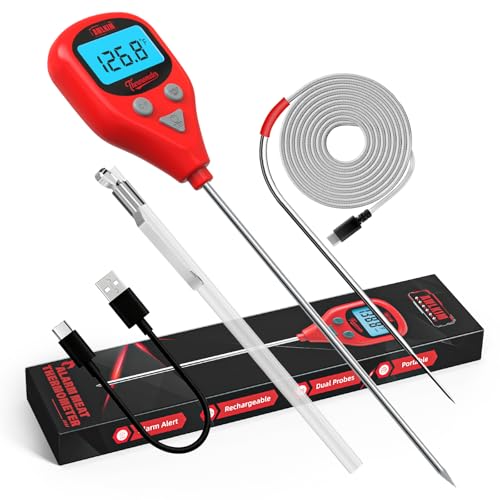
AWLKIM Dual Probe Meat Thermometer Digital — Best Rechargeable Dual Probe
AWLKIM’s digital model refuses to choose between the two ways cooks actually take temperatures, so it ships both. In the hand sits a five-point-three-inch probe for the quick check — the steak on the grill, the chicken breast you are unsure about, the reheated casserole centre. On a forty-inch cable sits the leave-in probe, the one that goes into the roast before the door closes and reports continuously to the unit outside. Most kitchens use both motions every week, the patrol and the stakeout, and owning one instrument that does each well is tidier than owning two that each do one.
The unit recharges over USB-C, which settles the battery question in the modern direction: no drawer of button cells, no proprietary cable, just the same connector that charges half the household. A target temperature alarm watches the wired probe’s progress, a hold function freezes a reading long enough to read it in awkward light, and the backlit display keeps the numbers available in a dim kitchen. The forty-inch cable deserves a practical note — it is long enough to let the display sit well away from oven heat on a crowded counter, and long enough to tangle if you toss it loose into a drawer, so coil it around your hand before storing.
Rechargeability cuts both ways, and this guide will say so. A battery-free analog dial is ready after a year in a drawer; a rechargeable unit that sat forgotten since spring may greet a holiday roast with an empty cell. The habit that fixes this is trivial — charge it when you charge the kitchen tablet, or top it up the night before a planned big cook — but it is a habit. Cooks who accept it gain the most versatile instrument in this guide: the AWLKIM Dual Probe Meat Thermometer Digital checks a chop in seconds and babysits a brisket for hours, with one screen for both jobs.
- Format: handheld instant probe plus wired leave-in probe
- Handheld probe length: five point three inches
- Wired probe cable: forty inches, oven-door rated routing
- Functions: target temperature alarm, reading hold, backlit screen
- Charging: rechargeable battery over USB-C
Strengths
- Instant checks and leave-in monitoring live in one instrument.
- USB-C charging uses the cable already on most counters.
- Generous cable length keeps the display clear of oven heat.
Trade-offs
- A forgotten charge can bench it before a big cook.
- Two probes mean two items to wash and store.
- More electronics to protect from steam and splashes.
Best for: versatile cooks who both spot-check and roast long. Not suited for: set-and-forget households that ignore charging routines.
How Do the Six Thermometers Compare at a Glance?
| Pick | Badge | Distinguishing detail |
|---|---|---|
| Escali AH1 Oven Safe Meat Thermometer | Best Analog Leave-In Classic | Analog dial, 2.5 inch face, NSF certified |
| OXO Good Grips Chef’s Precision Leave-In Meat Thermometer | Best Analog With Doneness Guide | Analog dial with Fahrenheit and Celsius |
| TempPro TempTrack Digital Meat Thermometer | Best Wired Digital Starter | Single wired probe, large LCD, timer |
| TempPro TempTrack Dual Probe Meat Thermometer | Best Dual Probe Digital | Dual probes, backlight, high/low alarms |
| AWLKIM Analog Meat Thermometer Oven Safe 2 Pack | Best Analog Value Pair | Two analog dials plus pot clip included |
| AWLKIM Dual Probe Meat Thermometer Digital | Best Rechargeable Dual Probe | Handheld probe plus 40 inch wired probe, USB-C |
Which Family Suits the Way You Actually Roast?
Strip the branding away and the decision is about attention. Analog dials ask for yours, in small visits to the oven across the cook. In exchange they offer total independence from power and a simplicity that borders on indestructible. Wired digitals return that attention to you, watching continuously and, in the alarm models, speaking up at the moment that matters. Neither answer is more serious or more skilled; professional kitchens run both side by side. The honest test is your own pattern. If your roasts are ninety-minute affairs while you prepare sides nearby, a dial’s visits fit naturally into the rhythm. If your cooking involves a garden, children, a dog and a phone call, the alarm earns its cable.
Households often solve this the way they solve knives, by owning one of each family. An analog dial lives with the roasting tin for weeknight chickens, while the wired digital comes out for the holiday turkey and the summer brisket. The six picks here were chosen to make that pairing easy, because the analog and digital choices do not cannibalise each other. They cover different hours of the cooking week.
How Should a Probe Be Placed to Read the Truth?
Every thermometer in this guide reports the temperature where its tip sits, and nowhere else, so placement is the whole craft. Aim for the centre of the thickest part of the cut. Slide past the surface inch, where heat arriving from the oven flatters the reading, and stop before you approach bone, because bone conducts heat differently from muscle and will lie to you in the optimistic direction. Fat pockets mislead the other way, heating oddly and reading strangely. On a whole bird, the deep thigh joint is the honest neighbourhood; on a beef joint, the geometric centre is. For leave-in probes, commit to that placement before the door closes and resist mid-cook rearrangement, since every repositioning opens the door and restarts the meat’s surface story.
Thin cuts deserve a sideways approach. A probe entering a chicken breast or a pork chop from the side, travelling along the plane of the cut, puts more sensor length inside the meat and reads far more truthfully than a probe stabbed down through a one-inch thickness. Wired leave-in probes are at their weakest here, which is precisely the gap the handheld probe on the AWLKIM digital fills. Match the instrument to the geometry and the numbers start deserving your trust.
How Do You Verify a Thermometer Without Laboratory Gear?
Two kitchen rituals expose a lying thermometer in minutes. Fill a glass with crushed ice, add just enough cold water to fill the gaps, stir, and wait a moment; a probe resting in that slurry, touching neither ice chunk nor glass, should read at the freezing point of water. Then boil a kettle or a pan of water and, once it rolls, hold the probe in the water without touching the pan; at sea level it should read at boiling point, a little lower if you live at altitude. An analog dial that misses both marks by the same amount can be mentally corrected or replaced. A digital unit that wanders between tests is telling you its sensor or cable is failing.
Run these checks when a thermometer arrives, after any drop onto a hard floor, and at the start of the heavy roasting season. Listings for these six picks do not headline a published tolerance figure, so your own two-point check is the accuracy evidence that counts in your kitchen. Write the result on a slip of tape on the drawer if a dial reads a degree or two off in a consistent direction; honest correction beats false confidence every time.
What Care Keeps a Wired Probe Alive for Years?
The cable joint is the memoir of every wired thermometer’s life. Water wicked into that joint during washing, heat soaking into it when the cable drapes across a hob, a sharp kink where the drawer closes — each writes a chapter, and the final chapter is a display showing nonsense. Prevention is mundane: wash the probe itself, wipe the cable with a damp cloth, route the cable away from burners and out of the door seal’s hardest pinch, and store it in a loose coil. Never submerge the display unit, never bake it, and never use the cable to lift or drag the probe from a roast.
Analog dials ask for less but not nothing. Roast juices baked onto a dial face eventually cloud the view, so wipe the face after each cook rather than monthly. Store dials where heavier utensils will not land on the glass. And if a dial ever fogs inside the face and stays fogged after cooling, moisture has breached the seal; the readings may drift, and retirement is the honest outcome. Instruments that measure the difference between rare and ruined deserve that level of respect.
How Does Resting Change the Temperature You Aim For?
A roast does not stop cooking when the oven door opens. Heat stored in the outer layers keeps travelling inward during the rest, and the centre of a large joint can climb several degrees while it sits under foil on the counter. That climb is the reason experienced roasters pull big cuts slightly before the target rather than exactly at it, and it is the reason a leave-in thermometer keeps earning its place after the oven is off. Leave the probe where it was, watch the number crest during the rest, and you learn your own oven’s carryover behaviour within two or three roasts. A small chicken barely climbs; a thick beef joint climbs with real conviction.
Alarms should be set with the rest in mind. On the dual-probe models, set the alert a few degrees early for large cuts and let carryover finish the journey, rather than setting the textbook target and then watching the meat overshoot while it rests. For thin cuts there is effectively no carryover worth planning around, so the reading at the pan is the reading that matters. This is also where analog dials quietly shine: the needle’s slow honesty during the rest teaches the rhythm of your favourite cuts better than any chart taped inside a cupboard door.
What Changes When the Meat Is Stuffed, Brined or Frozen at the Core?
Stuffing rewrites the safety map of a bird or a rolled joint. The stuffing itself must reach a safe temperature, and it sits in the slowest-heating neighbourhood of the whole dish, insulated by the meat around it. Probe the centre of the stuffing as its own destination, not as an afterthought to the thigh reading, and expect the cook to run longer than an unstuffed equivalent. Brined meat behaves differently again: it holds moisture generously and can look rosy even when properly cooked, which is exactly the situation where colour lies and only a thermometer tells the truth. Pink near the bone of a brined bird has ended more dinners early than any other illusion in roasting.
A roast that went into the oven still cold at its heart — not frozen solid, which no guide endorses for even cooking, but refrigerator-cold from a short thaw — will show a long, slow early climb on a leave-in dial. Do not panic at the plateau and do not turn the oven up in revenge. The probe is reporting physics, not failure. Wired digitals help here because the continuous display shows the climb resuming, while a cook checking a dial every twenty minutes may convince themselves nothing is happening. Patience, verified by a number, is the whole skill.
How Do You Read a Dial Through Oven Glass Without Losing Heat?
Most oven doors have a window, and most windows are filmed with the evidence of previous roasts. Before a long cook with an analog dial, give the inside of the glass a proper clean; two minutes with a degreaser buys you a clear view for hours. Position the roasting tin so the dial faces the window squarely rather than at an angle that turns numbers into guesses, and turn the oven light on for readings instead of opening the door. A dial read by lamplight through clean glass loses the oven nothing at all.
When a close look is unavoidable, make it a raid rather than a visit. Open the door only as far as needed, read, close. Have the carving board, foil and resting plan ready before that moment so the open door is not also the moment you start improvising the next ten minutes. Analog veterans develop a rhythm — glance through glass for the trend, one brief opening near the end for certainty — that keeps both the heat and the information flowing. The two-and-a-half-inch dials in this guide exist precisely to make that rhythm possible.
Can These Thermometers Handle Frying Oil and Sugar Work?
Probes do not care what medium surrounds them, and the listings here gesture at that wider life: the single TempPro names candy among its work, and AWLKIM’s analog pair includes a pot clip designed to hold a probe in liquid at the pan’s rim. Hot oil and syrup punish carelessness more than roasts do, because both climb beyond meat temperatures and both punish splashes. Clip the probe so its tip floats in the liquid without touching the pan base, since the base runs hotter than the bath and will inflate the reading. Keep cables and dial housings clear of the hob’s heat plume.
Sugar stages are where slow analog response matters least and steady monitoring matters most, because syrup moves through its stages over minutes, not seconds. A dial clipped to the pan gives a continuous, battery-free watch while both hands stay free for the tray, the brush and the water pot. Just respect each listing’s stated limits, wash the clip and probe promptly before sugar sets like cement, and never leave any thermometer — analog or digital — balanced where a knock could send it into the pan.
Why Do Two Thermometers Sometimes Disagree in the Same Roast?
Because the roast itself disagrees. A large joint is a landscape of temperatures, warmer near the surface and the bone’s surroundings, cooler at its dense heart, and two probes in two neighbourhoods will faithfully report two different truths. Disagreement of a few degrees between spots is information about the meat, not evidence against the instruments. This is why placement doctrine in this guide is so insistent: the reading that governs safety and doneness is the one from the slowest, thickest point, and other readings are supporting evidence.
True instrument disagreement is tested in the same medium, not the same roast. Put both probes in one ice bath or one pan of boiling water and compare like with like. If they agree there, they are both honest and your roast was simply uneven — a prompt to rotate the tin next time or rest the meat longer so the landscape settles. If they disagree in the bath, the ice-water verdict decides which one keeps its job. Cooks who run this two-minute tribunal never again stand over a carved joint wondering which number to believe.
How Do Convection Fans and Covered Pots Change the Reading Story?
A convection fan moves hot air across the meat’s surface, and the surface is where a shallow probe lives. Under fan heat, a probe placed too near the outside of a joint will report a flattering temperature long before the centre has caught up, which is why the placement guidance in this guide insists on depth. The fan also shortens cooks overall, so the window between nearly ready and overdone narrows; a leave-in dial or a wired display earns extra value in a convection oven simply because checking by opening the door interrupts the fan’s work and dumps the very air movement you paid for. Set the probe deep, trust the centre, and let the fan do its job undisturbed.
Covered cooking writes a different story. Inside a Dutch oven or under a tight lid, steam joins the heat, surfaces stay moist, and temperatures climb in a gentler, more even curve. A dial inside a covered pot is nearly impossible to consult without lifting the lid, which is the wired probe’s finest hour: its cable escapes under the lid’s edge or through the door, and the counter display narrates a cook you cannot see. Analog owners cooking covered dishes learn to schedule their peeks — one at the expected halfway point, one near the end — and to accept the steam bath that greets each peek as the cost of the method.
Grill-roasting and smoker work stretch the same principles over longer hours and harsher weather. Cables must dodge direct flame and the hottest metal, displays must sit somewhere shaded and dry, and analog dials must be read through smoke-filmed glass that rewards a pre-cook clean. None of this is exotic. It is the same doctrine — deep placement, protected electronics, minimal door openings — wearing outdoor clothes. A cook who internalises the doctrine in a calm kitchen will apply it instinctively beside a smoker at dawn, which is exactly when instinct has to carry the work.
How Should You Store Probes and Dials Between Cooks?
Storage is where thermometers quietly accumulate the damage that later gets blamed on quality. A dial tossed into the general utensil drawer spends its life being landed on by ladles and graters, and its glass face and needle mechanism absorb every impact. Hang it from a hook near the oven, or give it a narrow slot of its own, and it will read as honestly in year five as in week one. Wired probes prefer a loose coil secured with a twist tie, never a tight wrap around the display unit, which stresses the cable joint every time it is wound and unwound. Keep the probe tip capped or sheathed if your model provides a cover; a bare tip in a drawer dulls and, worse, pricks the hand that goes fishing for a spoon. Rechargeable models add one more rule: store them with some charge rather than empty, and top them up when you notice the battery icon rather than the night before a feast. Small courtesies, all of them, but instruments repay courtesy with accuracy.
What Mistakes Do Oven Thermometer Buyers Make Most Often?
The costliest mistake is category confusion: buying a handsome digital unit and baking its display inside the oven because the probe was rated for the heat. Only probes and their rated cables cross into the heat; screens, batteries and housings stay outside, always. The second mistake is trusting any thermometer, new or old, without the ice-water check described above. The third is probe placement by convenience — wherever the meat was easiest to stab — rather than by the geometry rules, followed by blaming the instrument for the resulting surprise.
Door discipline fails many analog owners. A dial is read in a glance, not a study session; opening the door wide for a long look dumps the heat the dial was helping you protect. Digital owners make the mirror-image error, routing the cable across a hob ring or trapping it so hard in the seal that the door sits ajar and the oven bleeds heat all afternoon. Finally, many cooks buy a second probe before they need one and a first probe that is wrong for their style. Buy for the roasts you actually cook this month, not the banquet you imagine next year.
Final Recommendation
Start by choosing your family, because that decision organises all the others. If your roasting is attentive, frequent and close to the oven, the Escali AH1’s big certified dial or OXO’s dual-scale guide will serve you for years without asking for a single battery, and AWLKIM’s two-pack stations that same reliability in two places at once. If your cooking runs long, wanders away from the kitchen, or doubles up at holidays, the wired digitals repay their cables: TempPro’s single probe for the straightforward upgrade, its dual-probe sibling for smokers and double roasts, and AWLKIM’s rechargeable hybrid when you also want an instant probe in the same hand. Whichever you choose, verify it in ice water on day one and place its probe like you mean it. A roast pulled at the right temperature, rested properly and carved without apology is the entire point — and somewhere between the dial’s quiet needle and the alarm’s small song, your next Sunday joint is already cooking better than the last.
Frequently Asked Questions
Can the digital display unit itself go inside the oven?
No, under no circumstances. Heat that a stainless probe shrugs off will destroy a screen, a battery and the plastic housing in short order. The probe and its rated cable are the only parts that cross the door seal; the display lives on the counter for every wired model in this guide.
Why does my analog dial seem slower than my friend’s digital probe?
A dial moves by a coiled metal element expanding as it warms, and that mechanism settles gradually by design. Digital sensors report electronically and settle in seconds. The dial is not broken; it is built for monitoring a long roast, not for rapid spot checks on thin food.
Where exactly should the probe tip sit in a whole chicken?
Push into the deepest part of the thigh, close to where it joins the body, without touching bone. That neighbourhood is the last place in the bird to finish cooking, so a safe reading there means the rest of the chicken has arrived as well.
Does an oven thermometer measure oven air as well as meat?
A probe in meat reports meat. A second probe, on dual models, can be positioned to follow the oven or smoker air instead, which is how pit cooks watch both stories at once. None of the analog dials here are intended as oven-air gauges.
How often should I repeat the ice-water check?
On arrival, after any hard knock or drop, and whenever a reading surprises you. Many cooks simply repeat it each autumn before the heavy roasting months, the way they sharpen knives before the holidays.
Can a wired probe stay in meat on a grill or smoker too?
Yes, the listings for the wired picks name smoking and grilling among their work. Route the cable away from direct flame and hot metal edges, and keep the display shaded and dry, since weather is harder on electronics than oven duty is.
Related Guides
Thermometers settle the doneness question, but the rest of the roast-day toolkit matters too. For the small tools that open the tins and jars around a big cook, see Best Hand Can Openers. If a chest freezer holds the joints you plan menus around, Best Chest Freezers for Garage covers that storage decision, and for the cleaning half of a household that cooks this seriously, Best Home Upright Vacuums rounds out the picture.


