What's inside
- Key Takeaways
- Quick Picks
- How We Chose These Picks
- How Do the Six Single Serve Machines Compare at a Glance?
- Pods or Grounds: What Does Each Cup Really Cost You?
- Reservoir or Fill-Per-Cup: Which Morning Do You Want?
- How Do Brew Sizes and Mug Clearance Decide Your Shortlist?
- How Do You Make Pod Coffee Taste Better?
- Why Does Descaling Decide How Long Your Machine Lives?
- How Does a Single Serve Machine Fit an Office, a Dorm or a Guest Room?
- Can a Single Serve Machine Make a Good Iced Coffee?
- What About Reusable Pods and the Grounds Basket Routine?
- How Do You Troubleshoot a Weak, Slow or Bitter Cup?
- How Do You Set Up a Counter Corner That Makes Mornings Faster?
- What Else Can These Machines Brew Besides Coffee?
- How Should You Store Pods and Grounds So They Stay Fresh?
- When Is It Time to Replace a Single Serve Machine?
- What Mistakes Do Single Serve Coffee Machine Buyers Make Most Often?
- Final Recommendation
- How Do You Brew for Two People on a One-Cup Machine?
- How Do Roast Level and Pod Choice Change the Cup?
- Frequently Asked Questions
- How Do You Clean the Outside and the Drip Tray Without Drama?
- How Does a Single Serve Machine Suit an Older Drinker or a Busy Carer?
- Related Guides
As an Amazon Associate I earn from qualifying purchases. This post may contain affiliate links at no extra cost to you.
cottageverdict.com is reader-supported. When you buy through links on our site, we may earn an affiliate commission.
Where to buy: each machine below is sold on Amazon, and every pick links to its own listing so you can check the reservoir size, the colour and what arrives in the box. Two of these picks are the same Keurig model in different colours, which this guide treats as one idea wearing two finishes rather than two separate recommendations.
The best single serve coffee machines exist for a simple reason: most mornings involve one person, one cup and very little patience. A full pot brewed for a single drinker mostly goes stale, gets microwaved into sadness or gets poured away, while a pod or one-cup brewer makes exactly the cup that will actually be drunk, at the moment it is wanted. The trade is cost per cup and a little plastic guilt, and this guide will not pretend otherwise.
Within the category, the real choices are narrower than the marketing suggests. Do you want a reservoir that frees you from refilling every morning, or a mini machine that earns its tiny counter footprint? Do you live happily inside one pod ecosystem, or do you want the freedom to brew ground coffee when the pods run out? The six picks below answer those questions in order: two Keurig reservoir machines, one of them in evergreen, a Keurig mini, and three compact brewers that split their loyalty between pods and grounds.
Key Takeaways
- Reservoir machines like the K-Express suit daily drinkers; mini machines suit small counters and occasional cups.
- The black and evergreen K-Express picks are the same brewer in two colours — choose the finish, not the features.
- Tastyle, Karosie and the small unbranded pick brew both pods and ground coffee, which softens pod cost and waste.
- Brew size range decides your mornings: travel mugs need the taller settings and clearance under the spout.
- Descaling on schedule is the difference between a five-year machine and a two-year one.
- Pod machines trade a higher cost per cup for speed, consistency and zero measuring at dawn.
Quick Picks
| Pick | Badge | Why it earns its place |
|---|---|---|
| Keurig K-Express Single Serve Coffee Maker | Best All-Round Pod Brewer | Three brew sizes, a 42 ounce removable reservoir and a strong brew option in a compact body. |
| Keurig K-Mini Single Serve Coffee Maker | Best for Tiny Counters | A one-cup-at-a-time mini with cord storage, sized for dorms, desks and small kitchens. |
| Keurig K-Express Single Serve Coffee Maker Evergreen | Best Colour Choice | The K-Express formula — reservoir, three sizes, strong button — in an evergreen finish. |
| Tastyle Mini Single Serve Coffee Maker | Best Pod and Grounds Hybrid | Brews K-Cups or ground coffee from 6 to 14 ounces, hot or iced, with a recipe book included. |
| Karosie Small Single Serve Coffee Maker | Best One-Button Simplicity | Fast brewing for pods or grounds across 6 to 12 ounces with a single control. |
| Small Single Serve Coffee Maker K Cup and Grounds | Best Portable Spare | A portable one-button brewer for pods and grounds, suited to offices, guests and travel corners. |
How We Chose These Picks
We organised the shortlist around the two decisions that actually divide this category. The first is water handling: reservoir machines remove the morning refill ritual, while fill-per-cup minis remove the stale-water problem and shrink the footprint. The second is loyalty: pure pod machines promise consistency inside one ecosystem, while the hybrid brewers from Tastyle, Karosie and the unbranded pick accept grounds as well, which changes both the running cost and the waste story.
Brew range and cup clearance were checked against each listing, because a single serve machine that cannot fill a travel mug or fit one under its spout fails at the exact moment it is needed most. Colour duplicates were kept but labelled as such, since the evergreen K-Express is a legitimate choice for buyers decorating a kitchen, provided nobody mistakes it for a different machine. Every pick was confirmed against the live catalogue entry held for this site before a link was attached.

Keurig K-Express Single Serve Coffee Maker — Best All-Round Pod Brewer
The black K-Express is the machine most households picture when they decide to join the pod world, and the spec explains why. A 42 ounce removable reservoir covers several mornings without a refill trip, three brew sizes span the range from a small strong cup to a travel mug, and the strong brew button answers the oldest complaint about pod coffee by slowing the water’s work for a bolder cup. The body stays compact enough for an ordinary counter, and the removable tank makes both filling and cleaning a sink-side job rather than a juggling act.
Daily life with a K-Express is mostly about rhythm. Pods lined up, water kept fresh, the drip tray rinsed before it becomes a science project. The machine rewards that light routine with the thing it was bought for: a consistent cup in about the time it takes to find your keys. Buyers who drink one cup a day may find the reservoir more than they need, and buyers who resent pod prices should read the hybrid reviews below before committing — but as the default pod brewer, this is the benchmark of the page.
- Format: K-Cup pod brewer
- Reservoir: 42 oz removable
- Brew sizes: 3 sizes, with strong brew option
- Colour: black
Strengths
- Reservoir removes the daily refill ritual
- Strong option answers the weak pod coffee complaint
- Removable tank makes cleaning straightforward
Trade-offs
- Pods only, so grounds drinkers need another machine
- Reservoir water should be refreshed rather than left for days
- Cost per cup stays above drip brewing
Best for: daily pod drinkers who want the standard, proven machine. Not suited for: households determined to brew ground coffee.

Keurig K-Mini Single Serve Coffee Maker — Best for Tiny Counters
The K-Mini reduces the pod idea to its smallest honest form. There is no reservoir to manage: you pour in one cup of water, between 6 and 12 ounces, drop in a pod and brew exactly that amount. Cord storage tucks the cable away, and the whole machine occupies the counter territory of a kettle rather than an appliance. For dorm rooms, office desks, caravans and kitchens where every inch is contested, that restraint is the feature.
The per-cup ritual cuts both ways. Fresh water every time means no stale tank taste, and the machine can be drained and stored between uses, which suits occasional drinkers and guest rooms. The price is a small ceremony each morning — measure, pour, wait — and no possibility of a second cup queuing behind the first without repeating it. Households with two pod drinkers on a deadline will outgrow the Mini quickly; the single drinker in a small space will wonder why anyone buys bigger.
- Format: K-Cup pod brewer, fill per cup
- Brew size: 6 to 12 oz, measured by your pour
- Design: cord storage, compact body
- Reservoir: none — fresh water each brew
Strengths
- Smallest footprint of the Keurig picks here
- Fresh water every cup, nothing stale in a tank
- Stores away easily between uses
Trade-offs
- Every cup requires its own fill and wait
- No reservoir for households brewing back to back
- Pod-only format, like its bigger sibling
Best for: small spaces, single drinkers and occasional use. Not suited for: busy households brewing several cups in a row.

Keurig K-Express Single Serve Coffee Maker Evergreen — Best Colour Choice
Everything said about the black K-Express applies here, because this is the same machine: three brew sizes, the 42 ounce removable reservoir and the strong brew option, presented in evergreen instead of black. We list it separately for one honest reason — colour is a real buying criterion for an appliance that lives permanently on a counter, and a deep green machine can be the difference between a kitchen corner that looks assembled and one that looks accidental.
Choose between the two K-Express picks by finish and by which listing suits you at the time of ordering, not by imagining a performance gap that does not exist. The evergreen will show pale limescale dust around the base a little more readily than a lighter colour would, so a weekly wipe joins the routine. Beyond that small housekeeping note, your mornings will be identical whichever twin you bring home, which is precisely the point of flagging the duplication rather than dressing it up.
- Format: K-Cup pod brewer
- Reservoir: 42 oz removable
- Brew sizes: 3 sizes, with strong brew option
- Colour: evergreen — same machine as the black pick
Strengths
- Full K-Express performance in a distinctive finish
- Reservoir convenience for daily drinkers
- Lets a considered kitchen keep its colour story
Trade-offs
- No feature advantage over the black version
- Dark finish shows limescale dust between wipes
- Still a pod-only machine with pod running costs
Best for: buyers who want the standard Keurig in a considered colour. Not suited for: anyone expecting different features from the black model.
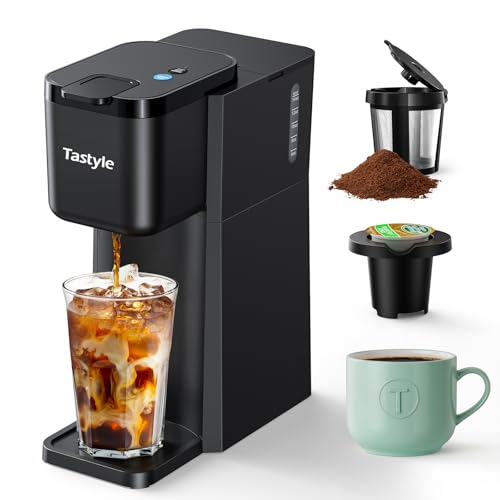
Tastyle Mini Single Serve Coffee Maker — Best Pod and Grounds Hybrid
Tastyle’s mini is where this guide changes philosophy. It brews K-Cup pods when convenience rules and ground coffee when it does not, across a 6 to 14 ounce range that is the widest in this line-up, and it handles both hot coffee and an iced preparation. The included recipe book signals the intended audience: a drinker who treats a small machine as a café toy box rather than a caffeine utility, and who will genuinely enjoy experimenting with what a single serve brewer can be persuaded to do.
The hybrid format changes the household economics. Pods cover the rushed mornings; a bag of grounds covers the slow ones at a fraction of the per-cup cost and with no pod to bin. The compromises are the usual hybrid ones — a grounds basket to rinse, a little more counter ceremony than a pure pod machine, and a brand name with less history than Keurig’s. For the drinker who has been pod-curious but grounds-loyal, this is the machine designed to end the argument.
- Format: K-Cup pods and ground coffee
- Brew sizes: 6 to 14 oz
- Modes: hot and iced coffee
- Extras: recipe book included
Strengths
- Pods or grounds, chosen cup by cup
- Widest brew range here, up to 14 ounces
- Iced coffee mode widens the machine’s year
Trade-offs
- Grounds basket adds a rinsing step
- Smaller brand track record than Keurig
- Mini format means filling per session
Best for: experimenters and households splitting pods with grounds. Not suited for: buyers who want a large reservoir and nothing to rinse.

Karosie Small Single Serve Coffee Maker — Best One-Button Simplicity
Karosie’s small brewer makes its pitch in the listing’s own words: fast brewing, pods or ground coffee, 6 to 12 ounce sizes and one button. That last detail deserves more respect than it gets. A single control means a guest can use the machine without a tutorial, an elderly relative never faces a menu, and your own first morning with it requires no manual. In a category that sometimes mistakes a touchscreen for progress, a machine that simply brews is a position worth taking.
Like the Tastyle, the Karosie splits its loyalty between pods and grounds, so the running-cost and waste advantages of grounds stay available. The brew range tops out at 12 ounces, which covers most mugs but not the largest travel cups, and fast brewing at this size means the machine suits one drinker at a time rather than a queue. Treat it as a personal appliance — on a desk, in a small flat, beside a reading chair with ambitions — and its simplicity becomes the luxury.
- Format: coffee pods and ground coffee
- Brew sizes: 6 to 12 oz
- Control: one-button operation
- Design focus: fast brew, small footprint
Strengths
- One button makes it guest-proof and fuss-free
- Pods or grounds keep running costs flexible
- Fast brewing suits a single daily drinker
Trade-offs
- Brew range stops at 12 ounces
- No reservoir for back-to-back cups
- Newer brand, so check support details on the listing
Best for: solo drinkers who value simplicity above features. Not suited for: households brewing for several people each morning.

Small Single Serve Coffee Maker K Cup and Grounds — Best Portable Spare
The final pick is the page’s utility player: a small, portable single serve brewer for K-Cups and grounds, run by one button and described by its listing in deliberately plain terms. Machines like this earn their keep in the second locations of life — the office that deserves better than the shared pot, the guest room that wants to offer morning coffee, the caravan, the workshop, the spare brewer that saves the day when the main machine is descaling or dead.
Portability asks for modest expectations, and this review will keep them. You are buying compact convenience and format flexibility, not café theatre; the listing leads with easy operation rather than exotic modes, which is the right priority for a spare. Because the title carries no brand name, read the listing’s warranty and support lines with care before ordering, and treat the machine as the household’s capable understudy rather than its star. Understudies, on the mornings they are needed, are priceless.
- Format: K-Cup pods and ground coffee
- Control: one-button operation
- Design focus: portable single cup brewing
- Role: spare, office or travel machine
Strengths
- Portable size suits offices, guests and travel
- Pods and grounds in one small machine
- One-button ease for occasional users
Trade-offs
- Unbranded listing — verify warranty details first
- Basic feature set beside the hybrids above
- Single cup pace, no reservoir convenience
Best for: a second machine for office, guests or travel. Not suited for: buyers wanting a flagship daily brewer.
How Do the Six Single Serve Machines Compare at a Glance?
| Model | Brews | Water | Standout trait |
|---|---|---|---|
| Keurig K-Express Single Serve Coffee Maker | Pods | 42 oz reservoir | Strong brew option |
| Keurig K-Mini Single Serve Coffee Maker | Pods | Fill per cup | Tiniest footprint, cord storage |
| Keurig K-Express Single Serve Coffee Maker Evergreen | Pods | 42 oz reservoir | Evergreen finish, same machine |
| Tastyle Mini Single Serve Coffee Maker | Pods and grounds | Fill per session | 6 to 14 oz, hot and iced |
| Karosie Small Single Serve Coffee Maker | Pods and grounds | Fill per session | One-button fast brewing |
| Small Single Serve Coffee Maker K Cup and Grounds | Pods and grounds | Fill per session | Portable spare machine |
Pods or Grounds: What Does Each Cup Really Cost You?
The honest arithmetic of single serve brewing has two columns. Pods cost more per cup than ground coffee bought in a bag — often several times more — and they generate a small piece of packaging waste with every drink. Ground coffee costs less and wastes less, but asks for measuring, a basket to fill and rinse, and a tolerance for the slight mess that loose grounds bring to a morning counter. Neither column is a moral verdict; they are simply the prices of convenience and of economy, and different households will pay each happily.
Hybrid machines like the Tastyle and Karosie in this guide exist to let a household pay each price on the days it makes sense. Pods for the 6 a.m. departure, grounds for the slow Sunday, a refillable routine for the drinker who counts cost per cup carefully. Pure pod machines like the Keurigs answer with consistency: every cup measured by someone else, identical on a groggy Tuesday to the cup you enjoyed on Saturday. Many owners settle into a pattern within a month and rarely switch, which is useful self-knowledge to borrow in advance — buy the machine that matches the pattern you will actually keep.
Waste deserves a practical note rather than a lecture. Pod recycling schemes exist in many areas, grounds can be composted, and a hybrid machine halves the dilemma by halving the pods. The least wasteful cup remains the one you actually drink, which is the quiet environmental argument for single serve brewing itself: no half pot poured away, ever.
Reservoir or Fill-Per-Cup: Which Morning Do You Want?
A reservoir machine removes a step from every morning and adds a chore to every week. The K-Express pair in this guide hold 42 ounces, enough for several cups, so the daily ritual is pod in, button pressed, cup filled. The chore is freshness: water standing in a tank for days tastes like it, and the tank itself needs washing on a rhythm, or the convenience curdles into a faintly stale cup you cannot quite explain.
Fill-per-cup machines invert the bargain. The K-Mini and the three hybrids ask you to pour fresh water for every brew, which guarantees the water is fresh and lets the machine be drained, dried and stored — a real advantage in guest rooms, offices and caravans. The chore is the ritual itself, repeated daily, plus the impossibility of a second cup without starting over. Households brewing for two people on a schedule should count that repetition honestly.
There is no universal winner, only a match between machine and household tempo. One daily drinker in a small flat: the mini format sings. A couple plus a teenager converging on the counter at 7 a.m.: the reservoir earns its footprint before the first school run. Choose for the morning you actually live.
How Do Brew Sizes and Mug Clearance Decide Your Shortlist?
Single serve machines advertise brew sizes because cups are not standard. The drinker who takes a small strong cup lives happily at 6 to 8 ounces; the travel mug commuter needs 12 to 14 ounces and, just as importantly, the vertical clearance to fit that mug under the spout without removing the drip tray and improvising. The Tastyle’s range up to 14 ounces is the widest here for a reason, while the K-Mini’s pour-what-you-brew approach quietly adapts to any vessel you own, since the water you add is the coffee you get.
Check the tray before you buy. Many compact machines let the drip tray lift out to buy an extra inch for a tall mug, and that small design decision decides whether your favourite cup is compatible or exiled. Measure your tallest regular mug against the listing’s stated clearance where given, and remember that a machine which fits your mug will be loved daily, while a technically superior machine that does not will be resented daily.
Brew size also steers strength. The same pod stretched across 14 ounces tastes thinner than across 8, which is why strong-brew options and smaller settings exist. Commuters filling a large mug may prefer brewing a stronger smaller cup and topping with hot water, or choosing a hybrid and dosing grounds generously — both are legitimate crafts, and both beat drinking a watery litre of disappointment.
How Do You Make Pod Coffee Taste Better?
Start with the water, because coffee mostly is water. Fresh, filtered water in the tank, refreshed rather than topped up for a week, lifts every pod you own. Next, warm the cup: a splash of hot water through the machine with no pod, tipped away, both rinses the brew path and stops your coffee donating its heat to cold ceramic. Then use the strong setting if your machine offers one, and choose the smallest brew size your thirst honestly requires, since pod coffee stretched thin is the category’s most common self-inflicted wound.
Storage matters more than pod snobbery admits. Pods kept beside a steamy kettle or in sunlight stale quietly; a cool, dry cupboard keeps them closer to the roaster’s intent. Rotate stock so the oldest pods brew first, and be suspicious of bargain pods stored badly by someone else. Finally, descale on schedule — mineral build-up slows the water and drops its temperature, and a scaled machine makes weak coffee out of good pods with complete impartiality.
Grounds drinkers using the hybrids have one more lever: dose. A heaped basket and a finer grind will strengthen a cup far more than any button. Experiment on a lazy morning, write down what worked, and your small machine becomes a café of exactly one regular.
Why Does Descaling Decide How Long Your Machine Lives?
Every heated cup of water leaves a trace of mineral behind, and in hard water areas those traces accumulate into scale that narrows pipes, insulates heating elements and slows the brew. The symptoms arrive gradually — coffee a little cooler, a little weaker, the machine a little louder — which is why owners often blame the pods for what the water did. Descaling dissolves that build-up, and machines treated on schedule commonly outlive neglected ones by years.
Follow the maker’s method for your model, using either the recommended descaler or a plain citric or vinegar solution where the manual allows it, and rinse thoroughly afterwards so the next cup tastes of coffee rather than chemistry. How often depends on your water: hard water households may descale every couple of months, soft water households a few times a year. Many machines now prompt with an indicator; where yours does not, a calendar note tied to the seasons does the same job.
Reservoir machines need the companion habit of washing the tank itself, with warm soapy water and a full dry, because a clean brew path fed by a slimy tank is a job half done. Ten minutes, a few times a year, is the entire maintenance budget of this category — and it is the cheapest longevity any appliance offers.
How Does a Single Serve Machine Fit an Office, a Dorm or a Guest Room?
Shared spaces reward machines that need no instructions. A one-button hybrid or a K-Mini can be explained in a sentence — water here, pod or grounds there, press that — and cleaned in a minute by whoever used it last. In an office, the single serve format also ends the politics of the shared pot: no stale communal coffee, no argument about who makes the next batch, and each person drinking the strength and flavour they actually chose.
Dorm rooms add constraints of space, power and rules. A mini machine with cord storage, like the K-Mini, fits a desk corner and stores in a drawer during inspections or holidays, and its fill-per-cup design means it never sits full of water between uses. Check the building’s appliance rules before buying, since some residences restrict anything with a heating element, and no coffee is worth a disciplinary meeting.
Guest rooms are where the portable unbranded pick in this guide makes its case. A small machine, a few pods, two mugs and a note saying help yourself converts a spare room into something closer to a boutique stay, and the machine stores away when the room returns to ordinary life. Hosts consistently report that this small theatre of hospitality is remembered out of all proportion to its cost.
Can a Single Serve Machine Make a Good Iced Coffee?
Yes, with one principle respected: brew strong and small, over ice, rather than brewing a full hot cup and chilling it. The Tastyle in this guide formalises the method with a dedicated iced preparation among its modes, but the craft works on any machine here. Fill the glass with ice, brew the smallest strong setting directly over it, and let the melt bring the drink to its final strength. Coffee brewed hot and left to cool tastes tired; coffee brewed concentrated over ice tastes deliberate.
Grounds drinkers have an extra option: a slow cold brew made in a jug overnight, portioned into the fridge, needs no machine at all — but it needs yesterday’s planning, which is precisely what single serve machines exist to forgive. Keep both crafts if you like; the machine covers the spontaneous iced coffee on the first hot afternoon, and the jug covers the planned one.
Sweeten while the coffee is warm if you sweeten at all, since sugar dissolves reluctantly in a cold glass, and add milk after the brew has met the ice to keep the drink from separating into layers of regret. A small machine that can anchor a summer afternoon as well as a winter dawn has earned its counter space twice over.
What About Reusable Pods and the Grounds Basket Routine?
Refillable pods promise the economy of grounds inside a pod machine, and for many owners they deliver it: fill with your own coffee, brew, rinse, repeat. The honest frictions are consistency and ritual. A refillable pod packed too tightly brews slowly and bitterly; packed too loosely it brews pale. The ritual — fill, tamp lightly, close, brew, empty while warm — takes under a minute once learned, but it is a minute the disposable pod was invented to delete, so households should adopt refillables because they enjoy the craft or the saving, not from guilt.
The hybrid machines in this guide sidestep the compromise with a proper grounds basket, which holds more coffee, rinses cleanly and asks no pod-shaped compromises. If grounds are likely to be your majority format, a hybrid is the straighter path; if pods rule and grounds visit occasionally, a refillable pod for the pod machine may be all the flexibility you need.
Either way, empty grounds promptly. A basket or refillable left full in a warm machine becomes tomorrow’s stale first note, and the rinse that takes twenty seconds today prevents the scrub that takes ten minutes next month.
How Do You Troubleshoot a Weak, Slow or Bitter Cup?
Weak coffee in this category usually has a short list of causes. The brew size may be too large for the pod, the water may be stale or the machine may be scaled enough to underheat. Work through them in that order: smaller size or strong setting, fresh water, then a descale. Bitter coffee points the other way — water too hot for too long on too little coffee, an over-packed refillable, or a grounds basket dosed with a very fine grind that over-extracts. Loosen the pack, coarsen the grind, or step the size up.
A slow brew is the machine asking for maintenance. Scale narrows the water path, and a needle clogged with coffee oils and fragments — the little piercer that opens the pod — restricts flow at the source. Most makers describe a simple cleaning for that needle with a straightened paper clip and the power off; do it gently, rinse, and run a water-only cycle. A machine that still sulks after descaling and needle care may be reaching the end of its economic life, at which point the portable pick in this guide can hold the fort while you choose its successor.
Spluttering and grounds in the cup suggest a sealing problem: a pod seated crookedly, a basket overfilled, or a gasket tired with age. Reseat, dose less, wipe the seal, and the cup usually clears. These are small machines with small faults, and nearly all of them confess quickly when approached in order.
How Do You Set Up a Counter Corner That Makes Mornings Faster?
A single serve machine is only as fast as the corner it stands in. Place the brewer where water is easy to reach — filling a reservoir or a mini at a distant sink adds a small daily tax that compounds into irritation. Keep the pods or grounds in a closed container within arm’s reach, the mugs on a shelf directly above or beside, and a small bin or caddy for spent pods close enough that disposal is part of the same motion as brewing. When everything lives within one step, the machine’s promise of a one-minute cup becomes literally true.
Light and heat deserve a thought. A corner under a window ages pods faster and can leave a reservoir sun-warmed, while a spot beside the hob collects grease on every surface. The ideal corner is boring: dry, shaded, ventilated, on a surface that wipes clean. Add a small tray under the machine if your counter is wood, because every brewer eventually drips, and a tray turns a potential stain into a rinse.
Households with two drinkers benefit from a tiny queue system: cups staged the night before, pods chosen and set out, water checked before bed. It sounds like theatre until the first school morning runs on rails, after which it becomes simply how the kitchen works.
What Else Can These Machines Brew Besides Coffee?
Every machine in this guide will run plain hot water, which quietly makes it a kettle substitute for tea, instant soups, oatmeal and the occasional hot water bottle emergency. Tea drinkers should run a water-only cycle between coffee brews to clear the path, since coffee oils linger and will haunt a delicate green tea brewed immediately after a dark roast pod. Households that drink both seriously sometimes dedicate the portable spare pick to tea duty, which is a respectable second career for a small machine.
Pod ecosystems extend beyond coffee into teas, hot chocolate and cider-style drinks, and the hybrid machines add whatever a grounds basket can be persuaded to hold, including loose herbal blends in a suitable filter. Experimentation is part of the format’s charm, with one discipline: sweet drinks leave residue, so a water-only rinse cycle after a hot chocolate keeps the next morning’s coffee tasting like itself.
Iced drinks, hot drinks, plain hot water on demand — the single serve machine’s real product is not coffee but immediacy. Households that understand that tend to use their machines more, maintain them better and replace them more happily than households that bought one as a compromise.
How Should You Store Pods and Grounds So They Stay Fresh?
Coffee’s enemies are air, light, heat and moisture, and a kitchen counter can supply all four. Keep pods in their box or a closed container in a cool cupboard rather than in a decorative open bowl beside a steamy kettle, however photogenic the bowl may be. Rotate the stock so older pods brew first, and be wary of very large bargain purchases: a pod is sealed, but it is not immortal, and a year’s supply bought cheaply can spend its last months tasting like the cupboard it lived in.
Ground coffee is more fragile still. Buy in quantities your household finishes within a few weeks, store the bag sealed in a cool dark place — not the fridge, where it collects moisture and odours — and grind only if your routine honestly allows it; the hybrid machines in this guide accept pre-ground coffee happily, which suits most mornings. Beans keep best of all, but a single serve routine built on speed usually trades the grinder away, and that is a fair trade when made knowingly.
The water deserves the same respect as the coffee. A reservoir refreshed daily and washed weekly, or a mini filled from the tap each time, keeps the largest ingredient in the cup tasting of nothing at all, which is exactly right.
When Is It Time to Replace a Single Serve Machine?
These are simple appliances, and their decline is usually legible. A machine that brews noticeably cooler despite descaling, leaks from somewhere other than the tray, needs two cycles to fill a cup, or pierces pods so unevenly that grounds flood the drink is telling you its pump, seals or heater are tired. Parts and repair rarely make economic sense at this end of the appliance world, which is an argument for buying the machine whose maker and support you trust in the first place.
Replacement is also a chance to correct the original mismatch. Owners of minis who now brew for two should step up to a reservoir; owners of reservoir machines in shrinking households can step down and reclaim the counter. The second purchase in this category is usually the right one, because it is made with a year of real mornings as evidence. Keep the old machine, if it still works at all, as the office or guest-room spare — the role the portable pick in this guide was born to play.
What Mistakes Do Single Serve Coffee Machine Buyers Make Most Often?
Buying the reservoir when the household drinks one cup a day, or the mini when four people queue at dawn, is the classic mismatch — both machines are good, and both are wrong in the other’s home. The second mistake is ignoring the mug: discovering on day one that the beloved travel cup fits nowhere under the spout. The third is treating the two K-Express listings in guides like this one as different machines and agonising over a choice that is, in truth, only a colour.
Owners then add their own errors. Tanks left unwashed for months, descaling postponed until the machine slows to a plea, pods stored in steam and sunlight, refillable baskets left full overnight. Every one is a small neglect with a small fix, and the machines in this guide forgive them all more readily than most appliances — provided the fix eventually happens. Buy for your real mornings, keep the water fresh and the scale at bay, and a single serve machine will repay you in the currency it trades in: good-enough coffee, instantly, every day.
Final Recommendation
Choose the Keurig K-Express Single Serve Coffee Maker as the default pod machine, or the Keurig K-Express Single Serve Coffee Maker Evergreen if the green finish belongs in your kitchen — remembering they are twins. Take the Tastyle Mini Single Serve Coffee Maker if you want pods and grounds with the widest brew range, the K-Mini if counter space rules your life, and the Karosie or the portable pick for one-button duty in small or second locations.
Whichever machine you bring home, the ritual that makes it sing is unglamorous: fresh water, a warm cup, the right size for the pod and a descale on the calendar. Do those four things and the first cup of the day stops being a negotiation. It becomes the quietest minute of the morning — the kettle-less, measure-less pause while the kitchen wakes around you — and a household that protects that minute tends to keep its machine, and its mornings, in good order for years.
How Do You Brew for Two People on a One-Cup Machine?
Gracefully, with a small amount of stage management. Brew the first cup into the mug of whoever leaves earliest, rinse nothing, and brew the second immediately while the machine is hot and the first drinker is finding their shoes. On a fill-per-cup mini, stage both measures of water in the two mugs themselves, so each pour is ready when its turn comes. The whole performance takes only a few minutes, and couples who share a mini by choice often describe the rhythm as part of the morning rather than a flaw in it.
Where the queue grows beyond two, or the schedule tightens to the minute, the honest answer changes: that household has outgrown the format’s smallest machines and should let a reservoir model carry the rush. Recognising which household you are, this year rather than last, is the recurring skill this entire category rewards.
How Do Roast Level and Pod Choice Change the Cup?
A pod fixes the dose, the grind and the coffee itself, so the drinker’s remaining freedom is selection. Darker roasts survive the pod format’s brisk extraction with their character intact, which is why so many pod ranges lean bold; lighter roasts can taste bright and interesting but punish any weakness in water temperature or freshness. If your machine’s cups taste thin across several brands, the variable is rarely the roast — check size, strength setting and scale first, as the troubleshooting section of this guide sets out.
Flavoured pods divide households cleanly. For drinkers who enjoy them, a single serve machine is the only sane way to keep vanilla, hazelnut and plain coffee in one kitchen without three open bags staling. For purists, the hybrid machines offer the better path: a small bag of a single-origin ground coffee, brewed fresh in the basket, will out-cup a flavoured pod on any morning it is given the chance.
Decaf deserves a mention, because single serve quietly solved its oldest problem. A household with one decaf drinker no longer brews a separate pot or accepts instant; a pod or a small basket of decaf grounds produces one real cup on demand. Many mixed households cite exactly this peace treaty as the reason the machine earned its counter space.
Frequently Asked Questions
Are the black and evergreen K-Express machines different?
No. They are the same K-Express brewer — three brew sizes, a 42 ounce removable reservoir and a strong brew option — in two colours, and any difference you taste between them will have come from the water, the pod or the day, never from the machine wearing a different coat to the counter. Choose by the finish that suits your kitchen and by the listing that suits you on the day, not by any imagined difference in the cup.
Can I use my own ground coffee in a Keurig?
The Keurig picks in this guide are pod machines, so grounds need a refillable pod accessory rather than the standard holder, filled loosely enough for water to pass and emptied while it is still warm and easy to rinse. If brewing grounds matters daily, the Tastyle, Karosie and portable picks accept grounds directly in a basket, which is the simpler route to the same cup.
How often should I descale a single serve machine?
Every two to three months is a sensible rhythm for average water, more often in hard water areas and less in soft. Follow your model’s indicator or manual, and treat a slower, cooler, weaker brew as the machine asking early. Regular descaling is the main reason these machines reach old age. If your household brews several cups daily, count cups rather than months and descale a little sooner; a machine that works hard deserves its maintenance on the same schedule as its labour, not on a calendar written for a weekend-only drinker in a soft water town.
What size machine suits a travel mug?
Look for a brew range reaching 12 to 14 ounces and the clearance to fit the mug, with a removable drip tray as a useful bonus that buys the extra inch a tall insulated mug so often needs on a cold platform at dawn. The Tastyle reaches 14 ounces, the K-Express covers the common mug sizes across its three settings, and the K-Mini brews exactly the amount of water you pour in, up to 12 ounces.
Can I take a mini coffee maker travelling?
The mini and portable picks in this guide are built for exactly that impulse, provided the destination has a suitable outlet and a stable surface, and provided you pack the machine dry and padded rather than rattling loose in a bag beside the shoes. Drain the machine fully, let it dry overnight rather than merely wiping it, and pack pods or grounds in a sealed bag. In a caravan, a holiday rental or a long-stay work flat, a familiar machine and your own coffee can anchor a morning routine in an unfamiliar kitchen, which many travellers value far beyond the cup itself, because the first hour of a day sets the tone for everything that follows it.
Why does my coffee taste different from the café version?
A café controls dose, grind, water and pressure with a precision a pod standardises differently and a small basket brewer only approaches on its very best and most carefully tended mornings. The gap narrows with fresh water, the right brew size, a warm cup and a descaled machine — the four habits this guide repeats — and for most drinkers the remaining difference is a fair price for a cup that takes one minute at home. Chasing the last of the gap is a hobby in its own right; enjoy it as one if it takes you, and let the machine handle the ordinary mornings without apology.
Is single serve coffee wasteful?
Pods add packaging per cup, which is the honest cost of the format, and any guide that waves that away is selling rather than advising. Hybrid machines cut it by brewing grounds whenever time allows, many pods can be recycled through local schemes, and grounds compost readily. Against that, single serve brewing wastes almost no coffee itself, since every cup made is a cup someone drinks.
How Do You Clean the Outside and the Drip Tray Without Drama?
The exterior routine is weekly and brief: power off, a damp cloth over the body, particular attention to the splash zone behind the cup and the ledge where pods are loaded, where coffee oils and dust combine into a film that hardens if ignored. The drip tray wants emptying before it becomes a pond — a sour tray will perfume a fresh cup from below, which is a sentence nobody wants to read about their own kitchen — and most trays lift out for a proper wash in the sink.
Descale drips and hard water spots on dark finishes, the evergreen K-Express included, wipe away more easily while fresh. A soft cloth, never an abrasive pad, protects the finish of every machine in this guide. End the routine with the needle check from the troubleshooting section if your model calls for it, and the machine returns to service looking like the appliance you chose rather than the one you have merely kept.
How Does a Single Serve Machine Suit an Older Drinker or a Busy Carer?
One-button and reservoir machines quietly serve households where measuring, lifting a full pot or managing a hot carafe has become genuinely difficult. A pod removes the measuring; a reservoir removes the daily jug of water; a single large button removes the menu. For an older drinker living alone, that combination can be the difference between making coffee at home and skipping it, and for a carer it removes one small task from a day full of larger ones.
Set the machine up for success: a stable low counter position rather than a high shelf, mugs with handles that suit the hands using them, pods stored where they can be reached without a step, and the water routine assigned to whoever visits or helps regularly if lifting the tank is hard. The K-Mini’s pour-per-cup design suits some hands better than a tank; the K-Express’s tank suits others. Choose with the actual drinker in the room, and the machine becomes an independence aid disguised as a coffee maker.
Related Guides
For the rest of the morning-and-storage picture, see our guides to Best Garage Ready Refrigerators, Best Cordless Stick Vacuums for Pet Hair and Best Kitchen Island Range Hoods, each written with the same insistence on honest labels, real capacities and formats named plainly rather than dressed up for a headline.


