What's inside
- Where to buy the six half-moon options
- Quick Picks
- How these picks were chosen
- Comparing the six doorway semicircles
- Will a half circle mat fit your door?
- The two-mat system, explained for real houses
- The doorway through a year of weather
- Guests, deliveries and dogs: the doorway’s social life
- What the backing does while nobody watches
- Small foyers, rented foyers and other real constraints
- Colour and pattern decisions you will live with
- Cleaning rhythms that keep a semicircle honest
- Common mistakes at the front door
- How long each family lasts, and what kills it early
- Buying a semicircle without seeing it first
- Semicircles beyond the front door
- Steps, slopes and double doors: awkward thresholds
- The first week with a new foyer mat
- A note on thresholds in older and newer homes
- When the semicircle is the wrong answer
- Final recommendation
- Questions about half-moon foyer mats
As an Amazon Associate I earn from qualifying purchases. This post may contain affiliate links at no extra cost to you.
As an Amazon Associate, cottageverdict.com earns from qualifying purchases.
A front door swings in an arc, and the floor it sweeps is exactly where shoes arrive carrying rain, grit and leaf litter — which is why the best half circle rugs for a foyer doorway are shaped like the swing itself. A semicircle puts material where feet actually land and leaves the corners of a small entry free, so the door clears, the eye reads a deliberate curve instead of a chopped-off rectangle, and the dirtiest square metre of the house gets a washable, grippy, sacrificial layer. The six products below share that curved outline and almost nothing else, and understanding their split personality is the key to choosing well.
Honesty first: most of this category is really doormats wearing a rug’s name. Two of the six — the OLANLY and the RORA — are rubber-backed scraper mats built to strip dirt and water off soles at an outside or inside threshold. Three others are soft, washable half-moon rugs with printed or woven designs meant to be seen and felt: the Restydon, the Mandala Green and the Vintage Mosaic. The sixth, from Super Area Rugs, is a hand woven jute semicircle, a natural fibre piece with a different temperament entirely. Sizes stay modest throughout, from 16×33 inches down to small door-width mats, because a foyer semicircle serves a doorway, not a whole room.
Where to buy the six half-moon options
Restydon leads with a washable low-pile semicircle in beige, sized 2×3 and aimed squarely at indoor entry duty. RORA answers with a green 17×30 scraper mat whose rubber backing and dirt-trapping face belong at an outside entrance or garage door. OLANLY’s black 29.5×17 mat is the heavy-duty all-season scraper of the group, absorbent and low-profile. Mandala Green brings a soft washable surface printed with an ethnic mandala for people who want the doorway to feel decorated. Vintage Mosaic offers the widest soft option at 35.4×23.6 in light brown geometric patterning. Super Area Rugs closes with hand woven natural jute, reversible, for households that prefer fibre to synthetics.
Quick Picks
| Pick | Best for | Headline trait from the title |
|---|---|---|
| Restydon Half Circle Rug Washable Entryway 2×3 Beige | Indoor foyers wanting a soft landing | Washable, low pile, stain resistant wording |
| RORA Half Circle Door Mat 17×30 Green | Outside entrances and garage doors | Rubber backing, traps dirt and moisture |
| OLANLY Half Circle Front Door Mat 29.5×17 Black | Wet climates and heavy traffic | All-season rubber, absorbent, waterproof backing |
| Mandala Green Half Round Door Mat Semi Circle Rug | Decorative doorways and festivals of colour | Soft, washable, mandala print |
| Vintage Mosaic Half Round Door Mat 35.4×23.6 Light Brown | Wider doors needing a bigger curve | Geometric semicircle, non slip wording |
| Super Area Rugs Jute Half Circle Rug 16×33 Natural | Natural-fibre households | Hand woven jute, reversible |
How these picks were chosen
The shape came first: a listing had to describe a half circle, half round, half moon or semicircle format sized for a doorway. That single requirement swept in both scraper mats and soft rugs, and rather than pretend they are one product type, this guide keeps the two families visible in every section, because a rubber scraper and a washable printed rug solve different problems that happen to share an outline.
Door clearance shaped the second filter. A foyer mat lives under a swinging door, so low profiles matter; several titles say low-profile or low pile outright, and that wording was treated as a first-class feature rather than filler. Backing came next — non-slip and rubber backing claims appear across the group, because a semicircle that skates across tile each time the door opens is worse than no mat at all.
Care method formed the third consideration. Washable appears in the soft rugs’ titles, while the scrapers promise a shake, hose or wipe routine implied by their rubber construction; jute, by contrast, asks for gentler treatment, and its review says so. Colour and pattern were weighed last, not because they are trivial — a foyer sets the tone for the whole home — but because a beautiful mat that blocks the door or slides underfoot fails at its only job. Readers working on a hearth rather than a doorway will find the neighbouring problem addressed in Best Fireproof Fireplace Rugs, where half-round shapes reappear in a fire-resistant role.

Restydon Half Circle Rug Washable Entryway 2×3 Beige
Restydon is the entry that behaves most like a rug and least like equipment. Its 2×3 semicircle is low pile, washable, described as stain resistant and non slip, and finished in a neutral beige that disappears politely under a door while still softening the step. The title also floats the mat beyond the foyer — kitchen and bedroom both get a mention — and that wanderlust makes sense: a washable half-moon works anywhere a door swings or a sink needs a standing pad with a curved front edge.
- Size given: 2×3, half circle
- Surface: low pile semi circle carpet
- Care wording: washable, stain resistant
- Colour: beige, described as neutral
Strengths
- Machine-washable care suits muddy-season households
- Low pile lets interior doors swing without dragging
- Beige neutrality pairs with wood, tile and stone floors alike
Trade-offs
- Soft pile scrapes boots less aggressively than rubber mats
- Pale beige records dark mud until wash day
- Two feet of depth may crowd a very narrow hall
The lived experience of this mat is about bare feet and socks. A foyer used by a family that kicks shoes off at the door becomes a small dressing area, and a soft semicircle gives that ritual a defined, warm place to happen, unlike cold tile. In winter the difference between stepping onto pile and stepping onto stone at 7 a.m. is the difference between a doorway that feels finished and one that feels forgotten. Washing closes the loop: when the beige finally dulls under a month of traffic, the whole mat goes into the machine rather than being beaten against a fence.
Where it should not go is outside an unsheltered door. A soft washable rug can survive an interior threshold or a covered porch, but driving rain will saturate pile faster than it can dry, and the scraper mats further down this list exist precisely for that exposure. Use Restydon where the weather has already been stopped by a door, and it will reward you with the most rug-like comfort in the group.
Check price on Amazon if your foyer wants softness first and scraping power second.
Best for: interior foyers, kitchen doorways and shoe-off households. Not suited for: exposed outside entrances in wet climates.

RORA Half Circle Door Mat 17×30 Green
RORA speaks the language of the threshold guard: a 17×30 half circle whose face is built to trap dirt and moisture, whose backing is non-slip rubber, and whose profile stays low enough for the door to pass overhead. The green colouring sets it apart from the black-and-brown scraper crowd, giving a garden-facing door a mat that echoes the planting outside rather than the tarmac. The title names the garage as a welcome home for it too, which tells you the maker expects grease-adjacent, heavy-duty service.
- Size given: 17×30
- Backing: non-slip rubber
- Profile: low-profile per the title
- Suggested placements in the title: entrance, garage
Strengths
- Dirt and moisture trapping is the stated purpose, not a side effect
- Rubber backing grips hard floors and concrete firmly
- Green finish suits garden doors and porches
Trade-offs
- Utilitarian face offers little softness under bare feet
- Seventeen inches of depth is a single stride, no more
- Green can clash with formal interior colour schemes
Scraper mats live or die by the first step. A visitor’s wet shoe lands, the textured face flexes and holds the water and grit, and the rubber base keeps the whole mat from surfing across the step under that pressure. RORA’s dimensions suit a standard single door: wide enough to receive both feet in one standing moment, shallow enough to stay clear of the swing. Placed outside, it takes the weather’s first punch so the interior floor never has to; placed just inside a garage door, it catches the workshop dust and grass clippings that boots collect crossing a yard.
Maintenance is outdoor work — a shake, a hose, a spell drying over a railing — and rubber-backed mats tolerate that routine indefinitely. What they do not love is being folded or creased in storage, which can set a curl into the edge; store it flat or rolled, and it will lie flat for years.
Check price on Amazon when the doorway you are defending faces a garden or a garage.
Best for: outside entrances, garden doors and garage thresholds. Not suited for: formal foyers where the mat is part of the décor.
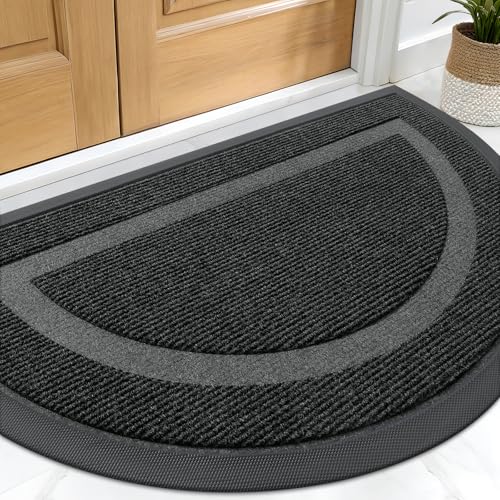
OLANLY Half Circle Front Door Mat 29.5×17 Black
OLANLY writes the most emphatic title in this group: all-season, heavy-duty, absorbent, stain and fade resistant, waterproof non-slip backing, low-profile. Strip the adjectives back and the object is a black rubber doormat, 29.5×17 inches, built to sit outside or inside a front door and take whatever the climate posts through it. Black is the honest colour for that job; a scraper mat’s face is supposed to accumulate the evidence of its work, and black keeps that evidence from becoming the first thing guests see.
- Size given: 29.5×17
- Material named: rubber doormat construction
- Backing described as: waterproof, non-slip
- Season wording: all-season
Strengths
- Absorbent face addresses wet shoes, not just dry grit
- Fade resistant wording suits sun-exposed porches
- Black hides a season of trapped dirt between cleanings
Trade-offs
- Rubber mats can carry a new-product smell at first
- The look is purely functional, offering no pattern at all
- Seventeen inches deep gives one step of protection only
The absorbency claim is the interesting one, because pure scraper mats shed water while absorbent faces hold it, and holding matters at a door where puddles form. A mat that traps meltwater from snow boots keeps that water from migrating across a hall floor in socked feet later. The waterproof backing completes the arrangement by stopping held moisture from reaching the floor beneath, which protects wood and laminate at exactly the spot where they are most vulnerable — the threshold where outdoor weather is invited in daily.
All-season wording should be read as the maker’s positioning rather than a test certificate, yet the underlying logic is sound: rubber does not rot, freeze-crack under normal household winters, or fade quickly, so a rubber mat genuinely can stay at its post all year while fabric mats rotate indoors for the wet months. If your doorway faces driving rain and you want one purchase to end the problem, this is the group’s most direct answer.
Check price on Amazon for the black workhorse if your porch sees serious weather.
Best for: exposed front doors, snowy or rainy climates, rental properties. Not suited for: anyone wanting the foyer mat to contribute decoration.

Mandala Green Half Round Door Mat Semi Circle Rug
Where OLANLY hides, Mandala Green displays. An ethnic mandala printed across a soft semicircle turns the doorway into a small piece of floor art, and the title’s long list of rooms — bedroom, bathroom, kitchen — plus a nod to festival decor suggests the maker imagines this mat living wherever a splash of pattern is welcome, not only at the front door. It is described as soft and washable, which places it firmly in the rug family rather than the scraper family.
- Shape: half round / semi circle
- Design: ethnic mandala, green
- Surface described as: soft
- Care wording: washable
- Exact dimensions: none given in the listing title
Strengths
- Mandala artwork gives an entry genuine character
- Soft surface suits barefoot rooms beyond the foyer
- Washable build keeps a printed design practical
Trade-offs
- No dimensions in the title means measuring homework for you
- Printed pattern will show wear in the centre over time
- Soft face scrapes mud less effectively than rubber
A mandala’s radial symmetry flatters a semicircle in a way few prints can: the design’s centre can sit at the flat edge, letting the pattern bloom outward with the curve, so the mat reads as a sunrise of pattern each time the door opens. Green, meanwhile, is a forgiving colour for a doorway that opens onto a garden, echoing leaves while disguising grass stains better than cream or white would.
The missing dimensions deserve emphasis rather than apology. Because the title omits them, a careful buyer should read the listing’s size details and measure the doorway before ordering — a half-moon that overhangs a step edge or blocks a door sweep is a nuisance no pattern can redeem. If the size lands right, this is the pick for households that treat the foyer as a room with feelings, not a checkpoint.
Check price on Amazon once you have confirmed the dimensions against your own doorway.
Best for: pattern lovers, boho entries, festival-season decorating. Not suited for: mud-heavy outside doors or buyers who dislike checking specs.

Vintage Mosaic Half Round Door Mat 35.4×23.6 Light Brown
Scale is this mat’s opening argument: at 35.4 by 23.6 inches it is the largest semicircle in the set, wide enough for a generous door and deep enough for a full standing turn while keys are found. The design reaches back rather than out — a vintage mosaic in geometric patterning and light brown — which suits older houses, tiled halls and anyone whose entry floor already carries pattern in stone or terracotta. The title calls it non slip and places it across porch, kitchen and general home decor duty.
- Size given: 35.4 x 23.6 inch
- Design: geometric vintage mosaic
- Colour: light brown
- Grip wording: non slip semicircle entryway rug
Strengths
- Largest curve here covers double-step landings comfortably
- Mosaic pattern camouflages dust between cleanings
- Light brown warms stone and tile entries
Trade-offs
- Its width can overwhelm a narrow apartment doorway
- Vintage styling may fight ultra-modern interiors
- Depth needs checking against the door’s swing radius
That extra depth changes behaviour at the door. On a shallow mat, a person steps on, steps off, and the second foot often lands beyond the edge; twenty-three inches of depth lets both feet, a shopping bag and a small dog occupy the mat at once, which is how real arrivals actually happen. The mosaic’s small-scale geometry helps too, because a busy, low-contrast pattern is the most forgiving surface a high-traffic threshold can wear.
Porch use is named in the title, and a covered porch is the right reading of that promise — a mat like this, with a decorative face, belongs where a roof blunts the rain. In a fully exposed position the scraper mats will outlast and outperform it. Inside the door, though, paired with an outside scraper, it forms the second half of the classic two-mat system described later in this guide.
Check price on Amazon if your doorway has the width to give this mosaic room.
Best for: wide doors, period homes, covered porches. Not suited for: cramped entries or fully weather-exposed steps.

Super Area Rugs Jute Half Circle Rug 16×33 Natural
Jute changes the conversation. Super Area Rugs hand weaves this 16×33 semicircle from natural fibre, makes it reversible, and describes it with an honesty the synthetics avoid: the title calls it a hearth carpet and a kitchen floor covering as readily as a doorway rug, because a flat woven jute piece is a general-purpose floor cloth in the old sense. Its natural colour is the colour of the plant itself, undyed-looking and calm, and it will feel dry and textured underfoot in a way no rubber or microfibre mat imitates.
- Size given: 16″ x 33″, half circle
- Material: natural jute fibre
- Construction: hand woven, reversible
- Positioning in the title: eco friendly floor covering
Strengths
- Natural fibre suits households reducing synthetics
- Hand woven texture scrapes dry dirt effectively
- Reversible build doubles the usable life of the faces
Trade-offs
- Jute dislikes soaking; it is not a rain mat
- No rubber backing is claimed, so grip on slick tile needs checking
- Natural fibres shed a little, especially when new
Care is where jute asks for a different owner. It wants shaking, spot cleaning and air, not saturation; a jute mat left wet can mildew and weaken, so its foyer must be an interior or well-sheltered one. In exchange, it offers a dry, scratchy, honest surface that suits farmhouse, coastal and Scandinavian entries beautifully, and it ages by softening rather than by peeling or cracking. The hearth mention in its title is a reminder that flat natural weaves have served beside firesides for generations, though anyone placing fibre near a hearth should read the fireplace guide linked earlier and keep generous distance from sparks.
On very smooth floors, test its footing during the first days; a thin rug pad underneath, cut to the semicircle, solves sliding without changing the look. That small addition still leaves this the most materially distinctive option in the six.
Check price on Amazon for the jute semicircle if natural texture tops your list.
Best for: natural-material homes, sheltered entries, hearthside accents away from sparks. Not suited for: wet porches, mudrooms or machine-wash devotees.
Comparing the six doorway semicircles
| Mat | Family | Size from title | Care style |
|---|---|---|---|
| Restydon | Soft washable rug | 2×3 | Machine washable per title |
| RORA | Rubber scraper | 17×30 | Shake and hose routine |
| OLANLY | Rubber scraper | 29.5×17 | Shake and hose routine |
| Mandala Green | Soft printed rug | Not given | Washable per title |
| Vintage Mosaic | Decorative mat | 35.4×23.6 | Not specified in title |
| Super Area Rugs | Hand woven jute | 16×33 | Shake, spot clean, keep dry |
The family column does the heavy lifting in that table. Pick the family that matches your weather exposure first — scraper for exposed doors, soft rug for interior thresholds, jute for sheltered natural interiors — and only then argue about colour. Households kitting out the rest of the entry zone may also want the towel guidance in Best Hot Tub Towels if a pool or spa door shares the same traffic path.
Will a half circle mat fit your door?
Swing the door and watch the floor
Open your door slowly and mark, with painter’s tape, the arc its bottom edge traces. A semicircle belongs inside that arc’s footprint on the floor — its flat edge parallel to the threshold, its curve reaching into the room roughly as far as the door’s swing. If the tape arc bulges past skirting boards or a radiator, a shallower mat like the 17-inch-deep scrapers will serve better than the deep Vintage Mosaic.
Check the gap under the door
Slide a coin stack under the closed door to gauge clearance, then compare it with the mat’s profile language: low-profile and low pile exist precisely for tight gaps. A mat that drags will bunch, wear at the drag point and eventually trip someone; a mat with clearance glides through a thousand openings unnoticed, which is the highest praise a foyer mat can earn.
Width is about the doorway, not the door
Measure the frame’s full width, including the sidelights or trim you step past. A mat slightly wider than the door leaf looks intentional and catches the step-aside foot that always lands beside the swing. The 35.4-inch Vintage Mosaic and the 33-inch jute both serve wider frames; standard single doors sit happily with the 29.5 to 30-inch options.
The two-mat system, explained for real houses
Professional buildings defend their floors in layers, and a house can borrow the trick cheaply. An aggressive scraper outside — RORA or OLANLY from this list — strips the coarse load: gravel, mud, snow. A softer, absorbent or washable semicircle inside — Restydon, Mandala or Vintage Mosaic — catches the fine remainder and dries the soles. Each mat then does half the work and lasts far longer, and the interior one stays presentable for guests because the filth never reaches it in quantity.
The system matters most where floors are precious. Hardwood halls, pale tiles and light carpets all stain from the slow drip of a single overworked mat that saturates and starts releasing dirt instead of holding it. Splitting the job keeps both layers below saturation. It also lets you express yourself indoors — the visible semicircle can be the pretty one — while the outside mat stays purely functional in black rubber anonymity.
The doorway through a year of weather
Autumn tests a foyer with leaves. Dry leaves crumble underfoot into a grit that behaves like sand, and a scraper’s textured face earns its keep by holding those fragments until shaking time. Wet leaves are slimier and arrive stuck to soles; an absorbent interior mat behind the scraper catches what the first layer misses, which is the two-mat logic working exactly as designed. Households under big street trees often keep a small brush by the door in October, and thirty seconds of sweeping the mat each few days prevents the crumble from migrating down the hall.
Winter adds meltwater, the foyer mat’s hardest assignment. Snow packed into boot treads melts indoors over twenty minutes, releasing a slow puddle that a merely decorative mat will surrender to the floorboards. This is the season the OLANLY’s waterproof backing justifies itself, and the season when rotating a washable interior mat — one in place, one drying — keeps the system honest. Salt and grit from treated pavements also arrive in winter; both scratch hard floors when tracked further in, so the mat’s job quietly includes protecting the hall’s finish, not only its cleanliness.
Spring brings pollen and mud in alternation. Pollen dust shows cruelly on black rubber, a cosmetic annoyance rather than a functional one, while mud argues for the washable soft rugs to be washed more often than pride suggests. Summer, finally, is the easy season: bare feet and sandals carry little, doors stand open, and the foyer mat can be lifted, aired and inspected. Summer is the right moment to check a rubber mat’s edges for curling, a washable rug’s backing for wear, and the jute for any winter damp damage, repairing your system while the weather forgives you.
Guests, deliveries and dogs: the doorway’s social life
A foyer mat works hardest when the household is busiest. Guests arrive in clusters, often in their least practical shoes, and the semicircle becomes a small stage where coats are taken and greetings happen standing on it. A mat with visual intention — the mandala’s bloom, the mosaic’s geometry — quietly tells visitors the home is cared for before they see a single room. Hosts who entertain often should weight that signal more heavily than laboratory notions of dirt capacity.
Deliveries write a different story. Parcels get set down on the mat, drivers step on it in work boots in all weathers, and in homes with a porch the outside scraper absorbs a working day of other people’s routes. That argues for the toughest, least precious surface outside — black rubber again — and against placing a beloved printed rug where courier boots will grind. If your household receives daily deliveries, treat the outside mat as a consumable with a replacement rhythm, not as a furnishing.
Dogs add joy and abrasion in equal measure. Paws skid on arrival, claws scrabble for grip on smooth floors, and a grippy semicircle at the door can prevent the splayed-leg scramble that hurts older dogs on tile. After walks, the mat is where paws get wiped; a washable interior option handles that duty best, since it will need washing precisely because it is doing it well. Cats, indifferent to all of this, will simply choose the jute to sharpen their claws on if allowed, so fibre households with cats should watch the edges during the first weeks.
What the backing does while nobody watches
Backings rarely get photographed, yet they decide whether a mat stays where it was placed. Solid rubber backings grip by weight and friction and suit both scrapers here; they also block moisture from passing downward, which protects floors but means a soaked mat must dry from the top, ideally lifted and draped. Non-slip treatments on the soft rugs are lighter — enough for interior traffic on wood or tile, less commanding on polished stone, where a separate pad may still help.
Backing condition is also the honest way to judge when a mat is finished. Faces can look presentable while the underside cracks, flakes or loses its grip, and a mat that has begun to wander is a fall risk dressed as a furnishing. Turn every foyer mat over twice a year, flex the backing gently, and retire any piece that sheds crumbs of rubber or slides under a firm hand push. The jute, having no applied backing, ages differently — its weave loosens slowly — and its retirement signal is thinning at the centre where feet pivot.
Small foyers, rented foyers and other real constraints
Apartment foyers are often a fiction — a patch of hall where the door opens directly into living space. There, a semicircle earns its shape twice over, because its missing corners leave room for the door-side furniture that a rectangle would collide with: the shoe rack, the umbrella stand, the narrow console. Shallow options like the 17-inch scrapers or the 16×33 jute laid at a side door keep the gesture of an entry without annexing the room. Colour discipline matters more at this scale; a mat that matches the floor’s tone enlarges the space visually, while a bold mandala in a tiny entry should be a deliberate, joyful choice rather than an accident.
Renters face a different calculus: no fixings, no damage, and a deposit watching every decision. All six options here are loose-lay, which suits renting perfectly, but rubber backings left for years on some vinyl floors can leave marks, so lifting and airing the mat monthly is a deposit-protecting habit, not fussiness. Renters also benefit from washable and hoseable care, since a mat that can be restored to freshness travels to the next home instead of being abandoned at each move.
Households with mobility aids should think about edges and profiles with extra care. A low, firmly anchored semicircle gives a cane or walker a predictable surface at the exact point where a person is also managing a door, keys and perhaps a bag — a small choreography that deserves a stable stage. Thick or curled edges are the enemy in that choreography, which again favours the low-profile scrapers and the flat jute over anything plush, and argues for checking edge lie during the first week rather than assuming it.
Colour and pattern decisions you will live with
The foyer is a home’s handshake, and its colours set expectations for every room beyond. Beige, as on the Restydon, promises calm and hides pale dust while confessing dark mud; it suits homes whose palette continues in creams and wood. Black rubber promises nothing decorative and delivers pure function, the right message for a working farmhouse door or a rental’s exposed porch. Green, whether RORA’s flat tone or the mandala’s printed bloom, links the threshold to the garden and flatters houses surrounded by planting.
Light brown mosaic occupies the warm middle: enough pattern to forgive dust, enough warmth to greet, and a vintage flavour that sits comfortably in homes built before open-plan living. Natural jute is the quietest voice of all, a texture rather than a colour, and it pairs with almost anything while asking the room’s other elements to supply the personality. A useful test before choosing: photograph your doorway at the hour guests usually arrive, in that light, and imagine each candidate in the frame — the mat you stop noticing in the photo is often the one you will enjoy longest, unless you deliberately want the doorway to perform, in which case the mandala is waiting.
Cleaning rhythms that keep a semicircle honest
Scraper mats want violence, gently applied: shake them against a railing weekly, hose them monthly, and let them dry fully before returning them to duty, because a rubber mat put back damp will hold that damp against the step. Soft washable rugs want regularity rather than intensity — a vacuum pass every few days lifts grit before it saws at the pile’s base, and a machine wash when the pattern dulls restores them completely; washing too rarely lets soil set like dye.
Jute wants restraint. Vacuum without a beater bar, blot spills immediately with a dry cloth, and never soak it; a jute mat cleaned gently lasts for years, while one drowned in a well-meant wash may never lie flat again. Across all three families, the underside deserves the same attention as the face: grit trapped beneath a mat grinds floors, so lift, sweep beneath, and replace on a clean surface. Five minutes of that routine each week is the entire maintenance secret of a good foyer.
Common mistakes at the front door
Placing a soft washable rug outside an unsheltered door is the error this category sees most; the rug saturates, dries slowly, and begins to smell, after which owners blame the rug rather than the placement. Match the family to the exposure, as the comparison section urged. A second frequent slip is ignoring door clearance until the mat arrives, then living with a dragging door for years instead of exchanging for a lower profile.
Third, people buy the doorway mat in a colour that fights the floor: pale mats on pale tile vanish and look dirty instantly, while a considered contrast reads as design. Fourth, a lone interior mat with no outside partner is expected to perform miracles in mud season and disappoints predictably. Fifth, jute gets machine-washed by owners who assume every mat tolerates it, and comes out distorted; fibre mats want air and shaking, not immersion. Sixth, mats get placed curve-inward by shoppers who think the flat edge should face the room, which wastes the shape — flat edge to the threshold, curve into the room, always.
How long each family lasts, and what kills it early
Rubber scrapers are the marathon runners of the doorway world. Sun, frost and grinding boots barely trouble them, and their typical end comes not from the face wearing out but from backing fatigue or edge curl after years of service. Keeping them out of permanent standing water and storing them flat during any off-season extends that span considerably. Between the two here, placement decides longevity more than brand: a scraper on a sheltered porch will outlive an identical one on a fully exposed step, simply because ultraviolet and freeze-thaw cycles do slow, cumulative work.
Soft washable semicircles live a middle-length life governed by washing and pivot wear. The centre of the curve, where every entrant turns toward the hall, thins first; rotating the mat is impossible given its shape, so the defence is regular vacuuming to remove the grit that accelerates that thinning, plus washing before soil becomes abrasive paste. Printed designs like the mandala fade gradually with washing and sunlight, a graceful ageing that many owners accept as patina.
Jute’s lifespan is the most owner-dependent. Kept dry, swept and aired, a hand woven piece serves for many years and arguably improves, its fibres settling into a tighter, smoother mat. Kept damp, it can mildew within a single bad season. That spread of outcomes is not a defect; it is the nature of an untreated plant fibre, and buyers who choose jute are choosing a material relationship closer to caring for wood than to owning plastic. Households unwilling to grant that attention should pick a washable synthetic and enjoy its indifference instead.
Buying a semicircle without seeing it first
Online listings for doorway mats compress hard information into titles, and this guide’s spec notes show how uneven that information can be: one product here gives no dimensions in its title at all, another gives two different settings, and care instructions range from a single word — washable — to silence. The disciplined response is a short checklist applied before any purchase: confirm the exact width and depth on the listing page, confirm the backing type, confirm the care method, and measure your own door gap and frame with a tape rather than from memory.
Photographs deserve a sceptical minute as well. A semicircle photographed on a wide porch with a double door will look modest; the same mat in your narrow hall may dominate. Seek images that show the mat’s edge and backing, since those reveal thickness and grip construction that a top-down beauty shot hides. If a listing shows the mat rolled or folded, note how it behaves — a mat that ships flat or rolls softly will lie flat sooner than one fighting its packaging for a week.
Finally, think about the return path before you need it. Doorway mats are cheap to ship back compared with furniture, yet the real cost is a week with the wrong mat teaching you what the right one must do: deeper, grippier, softer, quieter. Even a returned mat leaves you better informed, and the second choice in this category is very often the keeper, because foyers are personal in ways specifications only partly capture.
Semicircles beyond the front door
Once a household owns one half-moon mat, the shape starts suggesting other posts. At a kitchen sink, a washable semicircle gives a standing cook a cushioned, washable station whose curved front edge looks deliberate against cabinet lines; the Restydon’s title itself proposes kitchen duty. In a bathroom, a soft half-round sits naturally against a pedestal basin or a curved shower enclosure, echoing the fixture’s geometry instead of fighting it, though bathroom service demands the washable members of this group and regular drying.
Beside a hearth, a flat semicircle has historical precedent — the jute title even uses the phrase hearth carpet — because the curve echoes the firebox opening and catches the ash and wood dust that drift from a stove door. Fibre near fire demands respect and distance, and the fireplace-specific guide linked near the top of this article covers mats actually built and described for heat; a foyer mat should only ever serve as a decorative dust-catcher well clear of sparks, never as fire protection.
Children’s rooms and reading nooks adopt the shape playfully: a mandala semicircle against a bookshelf makes a defined sitting island for one small reader, its curve marking territory without walls. At a desk, a half-moon under the chair’s front castors protects a patch of floor while leaving the room’s main rug uncommitted. Each of these posts rewards the same qualities the foyer does — a shape that fits an arc of movement, a surface matched to the mess involved, and a size that serves a person rather than a whole room.
Steps, slopes and double doors: awkward thresholds
Not every doorway is a flat rectangle of luck. A raised threshold bar can lift a mat’s flat edge and create a rocking edge that catches toes; the fix is a thinner mat, or placing the semicircle wholly on the room side of the bar so its entire body lies on one level. A step down immediately inside the door shortens the landing, favouring the shallow scrapers over the deep mosaic, because a mat that overhangs a step edge will fold and become a hazard within days.
Double doors and French doors widen the stage beyond any single semicircle here; two matching half-moons placed flat-edge to flat-edge form a full oval-ish field that looks intentional, or one wide Vintage Mosaic can serve the active leaf while the fixed leaf’s floor stays bare. Sloped porch floors, built to shed rain, will slowly walk a lightweight mat downhill; rubber backing resists that migration best, and checking the mat’s position weekly through the first month tells you whether your slope is one of the determined ones.
Historic houses add thresholds worn into gentle waves by a century of feet. A flexible woven or soft mat follows those waves kindly, while a stiff rubber mat may bridge a hollow and drum underfoot until a pad fills the gap. None of these quirks is a reason to abandon the semicircle idea; they are reasons to match the mat’s construction to the architecture, which is the same lesson every section of this guide keeps teaching from a different angle.
The first week with a new foyer mat
Day one teaches you about lie and grip. Unroll or unwrap the mat, place it flat-edge to the threshold, and give it time to relax; rubber and woven pieces that arrive rolled may hold a curl for a day or two, which books or a night under a low bookshelf edge can persuade away. Walk the door’s swing a dozen times, watching for drag, lift or slide, because every later problem announces itself quietly in that first week if you are paying attention.
By day three, traffic patterns emerge. Watch where the dirt collects: a crescent of grit at one side tells you visitors favour that foot, and a scraper doing its job will show a visible harvest by the weekend. That is also when households discover whether the mat is deep enough — if the second step of an arrival consistently lands beyond the curve, a deeper model belongs on the exchange list while returning is still painless.
By day seven you will know the mat’s sound, and sound is an underrated quality in a foyer. A mat that drums, squeaks or shifts audibly underfoot will irritate for years in a way no photograph warned you about, while a silent, planted semicircle disappears into the home’s background music. Judge that first week honestly, adjust placement or add a pad where needed, and the mat that survives this probation will usually serve until its backing, not your patience, gives out.
A note on thresholds in older and newer homes
New-build doorways tend to be flat, wide and forgiving, with generous door gaps that accept almost any low-profile mat without complaint. Older homes ask for more diplomacy: narrower frames, worn sills, doors planed and re-hung across decades until their swing sits a few millimetres from the boards. In those houses the tape-arc test from the sizing section is not optional homework but the difference between a mat that works and a mat that fights the door daily. Flexible, thinner constructions — the washable rugs and the jute — usually negotiate old floors most gracefully, while a stiff scraper may need to live outside the door rather than under its swing.
When the semicircle is the wrong answer
Candour requires a short section on doorways that should skip this shape entirely. A foyer where a wheelchair turns needs an unobstructed, flush floor more than it needs a decorative curve, and any mat there must be vanishingly thin, fully secured, or absent. A door that opens onto a steep interior stair leaves no landing for a semicircle to occupy, and forcing one creates a folded edge at the worst possible place. Homes in deep-mud rural settings may find even the best scraper semicircle too small an airlock, better served by a full boot-room arrangement with a long runner. And if your hall is blessed with beautiful original flooring that you love seeing, a rectangle runner set back from the door may show it off better than a semicircle hugging the threshold. The shape is a tool, not a rule, and recognising the few doorways it does not suit makes the many it transforms easier to choose for.
Final recommendation
For most interior foyers, the Restydon is the safest single purchase: washable, low pile, neutral and honestly sized. For an exposed door, skip the soft options entirely and take the OLANLY for wet climates or the RORA where a green, garage-friendly scraper fits better. Decorative hearts should follow the Mandala or the Vintage Mosaic — the latter when the doorway is wide — and natural-fibre households have exactly one candidate, the hand woven jute, provided their threshold stays dry. Layering a scraper outside with a soft semicircle inside beats any single-mat solution in this guide. And if the foyer project grows into a full warm-layer refresh, Best Polar Fleece Blankets King covers the king-size fleece end of that shopping trip.
Questions about half-moon foyer mats
Why choose a semicircle instead of a rectangle?
The curve mirrors the door’s swing and the natural arc of a turning step, covers the landing zone completely, and leaves hall corners free for furniture, plants or shoe storage that a rectangle would crowd.
Can these mats go outside?
The rubber scrapers, RORA and OLANLY, are built for outside or garage thresholds according to their titles. The soft rugs and the jute belong inside or under solid cover; their titles aim them at interior rooms.
Which option handles snow boots best?
OLANLY, because its title pairs absorbency with a waterproof backing, so meltwater is held in the face instead of reaching the floor. Shake it out and let it dry regularly through the season.
Should the mat sit inside or outside the door?
Ideally both, in the layered arrangement described earlier: a scraper outside where the weather hits, a softer semicircle inside where people linger. If budget or space allows only one, place it where your climate does its damage — outside for homes whose interior floors are hardy, inside for homes protecting delicate wood or pale tile from a sheltered porch’s milder load. A single mat asked to do both jobs in an exposed, wet doorway should be a rubber scraper, since soft rugs placed outside unsheltered doors age fastest of any option in this guide.
How do I stop a semicircle sliding on tile?
Start with the rubber-backed models, which grip by design. For the jute or any mat that wanders, a thin non-slip pad cut to the half-moon outline underneath solves the movement without showing.
What size suits a standard single door?
Widths around 29 to 33 inches with depths near 17 inches match most single doors; go wider and deeper, like the Vintage Mosaic, only when the frame and hall give you the room.
One last habit separates satisfied owners from disappointed ones: they re-evaluate the doorway after a season rather than assuming the first arrangement was final. Traffic changes when a baby arrives, a dog grows old, a home office moves the day’s comings and goings to a side door, or a new floor changes what needs protecting. The mat that was perfect for last year’s doorway may belong at the garden door now, with a different family member of this group promoted to the front. Because these six are inexpensive, movable and varied, treating the foyer as a system you tune — rather than a purchase you file away — is the surest way to end up with a threshold that works as well in year three as it did in week one.
Keep the receipt and the measurements together, too. If the mat delaminates, curls beyond persuading, or sheds its backing early, those details turn a complaint into a quick resolution; and when the mat eventually wears out honestly after long service, your recorded width and depth let you reorder the right semicircle in minutes instead of re-measuring a doorway you measured years ago.
Small courtesies live here as well: a mat kept clean invites guests to wipe their feet without being asked, and a mat allowed to stay filthy quietly licenses everyone to stop bothering.
A doorway asks little — catch the dirt, clear the swing, look like you meant it — and the right semicircle does all three every single day.


