What's inside
- Where to buy these six mats
- Quick Picks
- How these picks were chosen
- Side-by-side: the six mats compared
- How do you choose the right camping mat size?
- Ground rules: using a plastic mat without killing the grass
- Cleaning a woven plastic mat without wrecking it
- One mat, four kinds of ground
- Packing, storing and travelling with a big roll
- Mistakes people make with outdoor mats
- A season of weather, watched from one pitch
- What a mat cannot do, said plainly
- Matching the mat to the way you actually travel
- Children, dogs and grandparents on the same square of plastic
- Reading a camping mat listing like a sceptic
- One large sheet or two smaller ones?
- Final recommendation
- Questions campers ask about these mats
As an Amazon Associate I earn from qualifying purchases. This post may contain affiliate links at no extra cost to you.
As an Amazon Associate, cottageverdict.com earns from qualifying purchases.
Anyone who has pitched camp on gravel, damp grass or a sun-baked concrete pad knows the ground itself becomes the room you live in, and that is exactly why shoppers hunting for the best outdoor camping rugs are really shopping for a floor. A woven plastic mat turns an awning’s shade into a place where chairs sit level, crumbs brush away, and bare feet can cross from the RV door to the cooler without collecting grit. None of the six mats gathered here is a fibre rug in the indoor sense. Every one of them is a woven plastic straw or HDPE-style mat built to live outside, shake clean and roll up for the storage bay, and being honest about that single fact makes the rest of the comparison far easier.
Size is the second thing to settle before pattern seduces you. The group runs from a compact 5×8 mat that tucks under a small camper’s door to a sprawling 9×18 sheet that can swallow an entire picnic setup. Between those poles sit several 9×12 options, the classic awning footprint, differing in motif, in whether a carry bag or ground stakes are mentioned, and in small wording details that hint at how each maker expects the mat to travel. This guide walks through all six slowly, because a mat that delights a weekend tent camper can annoy a full-season RVer, and the reverse holds true as well.
Where to buy these six mats
The SAND MINE 5×8 suits a small pitch where a black and grey lattice will not fight with anything. FACOYANS brings a 9×12 camper mat whose printed slogan speaks directly to people who park their home wherever the road ends. HappyTrends offers a reversible straw mat in white and grey, although its title mixes two sizes and deserves a careful read. The unnamed 9×18 mat is the giant of the set, sold with a portable bag and four stakes. Stylish Camping leans on a swirl pattern in black and white at 9×12. Garvee closes the list with another 9×12 reversible mat in grey, pitched at patios and awnings alike.
Quick Picks
| Pick | Best for | Standout detail from the listing title |
|---|---|---|
| SAND MINE Waterproof Outdoor Rug 5×8 Black Grey Lattice | Small pitches and solo campers | Plastic reversible weave in a lattice pattern, 5×8 ft |
| FACOYANS RV Outdoor Camping Rug 9×12 Home Is Where We Park It | RV owners who like a slogan underfoot | Carry bag mentioned, plus UV resistant wording |
| HappyTrends Outdoor Camping Rug Plastic Straw 9×12 | Deck and balcony campers | Reversible straw build in white and grey |
| Outdoor Camping Rug 9×18 Waterproof Reversible | Big groups under wide awnings | Four stakes and a portable bag in the title |
| Stylish Camping RV Mat Swirl 9×12 | Pattern lovers wanting black and white | Swirl motif at 9 feet by 12 feet |
| Garvee Outdoor Rug 9×12 Waterproof Reversible | Grey-toned patios and awnings | Plastic straw mat listed for garden and beach too |
How these picks were chosen
Selection began with a blunt filter: the listing title had to describe a mat made for outdoor camping or RV use, not an indoor area rug photographed outside. That filter explains why every survivor is woven plastic rather than wool, cotton or jute. Plastic straw construction sheds water instead of drinking it, and a camper who has folded a sodden fabric rug into a storage compartment understands why that matters more than softness.
Dimensions came next. A useful comparison needs the realistic spread of awning life, so the set deliberately spans 5×8, 9×12 and 9×18, with one title that confusingly mentions both 9×12 in its name and 6×9 in its description text — that inconsistency is flagged in its review rather than smoothed over. Shoppers should always confirm the size variant selected on the listing page itself, because mat families often share one page across many footprints.
Reversibility counted as a genuine feature rather than a gimmick. A reversible mat gives you two looks for one packed roll and lets you flip a faded or dirty face down midway through a long stay. Most of these six claim that trait in their titles. Extras were noted only when the title states them: a carry bag, ground stakes, UV resistant wording, easy clean wording. Where a title stays silent about an extra, this guide stays silent too, and the spec boxes below mark those gaps plainly instead of guessing.
Finally, pattern variety mattered because these mats are enormous visual surfaces. Lattice, slogan lettering, plain reversible colour blocking, diamond, swirl and flat grey all appear, and a 9×12 sheet of the wrong motif will dominate your pitch photos for years. If you are also furnishing the doorway back home, our guide to Best Half Circle Rugs for a Foyer Doorway covers the small half-moon mats that greet guests at a house door, a very different job from covering ground at a campsite.

SAND MINE Waterproof Outdoor Rug 5×8 Black Grey Lattice
A 5×8 footprint sounds modest until you picture it beside a camper door, where it covers precisely the patch of ground that shoes cross dozens of times a day. SAND MINE weaves this mat from plastic, describes it as reversible, and prints a lattice pattern in black and grey across the surface. That lattice does quiet visual work: the repeating geometry hides scattered leaves and dust far better than a flat colour would, so the mat keeps looking tidy between sweeps.
- Footprint: 5×8 ft, as given in the title
- Build: plastic, reversible
- Pattern: modern lattice, black and grey
- Stakes or carry bag: none stated in the listing title
Strengths
- Small packed size suits car camping and cramped storage bays
- Lattice geometry disguises everyday campsite dirt
- Reversible face doubles the styling options in one roll
Trade-offs
- Five feet of width vanishes quickly under a table and four chairs
- No bag or stakes are mentioned, so transport kit is your problem
- Plastic weave feels firm under bare feet compared with fabric
Think about how this mat behaves at a real site. Rain runs off the plastic strands rather than soaking in, so a morning shower does not leave you dragging a heavy, dripping rectangle around while you pack. A broom or a shake clears sand. The firm surface lets camp chair legs rest without sinking, though thin plastic weave can still pucker on very uneven stones, and spreading it over the flattest patch you can find pays off. Because the mat is small, one person can unroll, position and re-roll it in minutes, which suits touring stops where you move every night or two and resent any chore that stretches departure.
Colour discipline is another quiet virtue. Black and grey lattice pairs with almost any awning, tent or folding furniture, and it will not clash with the parade of coloured coolers and camp blankets that accumulate over a season. If your pitch style leans cheerful and bright, the restraint might read as dull, yet many campers prefer the ground to stay visually calm while everything above it carries the personality.
Check price on Amazon if the small footprint matches your door-side patch; this is the mat for travellers who pack light and move often.
Best for: solo campers, couples in small vans, and anyone whose storage space is tight. Not suited for: large groups needing a communal floor under a big awning.

FACOYANS RV Outdoor Camping Rug 9×12 Home Is Where We Park It
FACOYANS prints its message right into the weave: “Home is Where We Park It” runs across this 9×12 camper mat, turning a practical groundsheet into a small declaration of how its owners live. Some RVers will grin every time they step onto that sentence. Others will find lettering underfoot too chatty, and both reactions are legitimate — at 9×12, this mat is a billboard you live on, so buy the words only if you enjoy reading them daily.
- Footprint: 9×12 FT per the title
- Build: waterproof plastic straw, reversible
- Included according to the title: carry bag
- Other title wording: UV resistant, easy clean
Strengths
- A carry bag is named outright, easing the wet-mat-in-the-bay problem
- Full awning size gives a proper outdoor room
- Slogan design gives the pitch an identity no plain mat can
Trade-offs
- Lettering locks you into one decorative mood for years
- Reversing the mat flips the message, so the second face reads differently
- A 9×12 roll is bulky in a small camper’s locker
The practical details hold up well. Plastic straw weave shrugs off spills, and the title’s easy clean phrasing matches how these mats generally behave: hose, shake, dry in the sun, roll. UV resistant wording appears in the title as the maker’s own claim, worth noting for sun-exposed pitches, though no specific rating or number accompanies it. The carry bag deserves emphasis because anyone who has wrestled a damp 9×12 sheet into a bay without one knows the bag is not a trivial bonus — it keeps the rest of your stored gear cleaner and gives the roll a handle.
Under an awning, 9×12 covers the classic rectangle where a table, chairs and a dog bed all compete for clean ground. Kids can sprawl on it with colouring books. A dropped marshmallow wipes off instead of grinding into grass. When evening dew settles, the plastic surface keeps book pages and board games dry in a way bare ground never would.
Check price on Amazon when the slogan feels like something your family would happily stand on all summer.
Best for: proud full-time and seasonal RVers who treat the awning space as a front porch. Not suited for: minimalists who want their ground covering to say nothing at all.
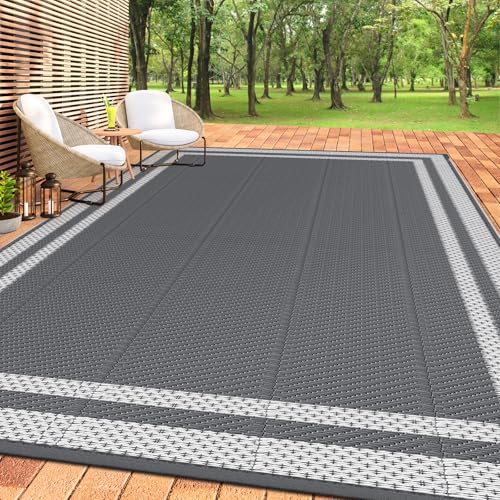
HappyTrends Outdoor Camping Rug Plastic Straw 9×12
HappyTrends needs a careful sentence before anything else, because its own title disagrees with itself: the product name says 9×12 while the descriptive text inside the same title gives 6’x 9′ in white and grey. Treat that as a prompt to check the size selector on the listing page with your own eyes before ordering. Makers often run several footprints through one listing, and titles assembled from variant data can carry both numbers. The mat underneath the confusion is a portable plastic straw rug, reversible and waterproof by its title’s account, aimed at RVs, patios, decks, porches and balconies.
- Sizes appearing in the title: 9×12 in the name, 6’x 9′ in the description
- Build: plastic straw, reversible
- Colours named: white and gray
- Carry bag: not given in the listing title
Strengths
- Light white and grey palette brightens shaded pitches
- Straw weave travels well between campsite, deck and balcony
- Reversible layout stretches the time between deep cleans
Trade-offs
- Conflicting size figures demand a double-check before purchase
- White shows mud faster than darker mats in this group
- No stakes are mentioned for windy, exposed sites
Assuming you confirm the footprint you actually want, the appeal here is brightness. Many camping mats lean dark to hide grime, and the trade is a pitch that can look gloomy under tree cover. White and grey weave bounces light around, makes dropped tent pegs easier to spot, and photographs beautifully against grass. The cost of that freshness is honesty about dirt: a pale mat records every muddy paw print, so owners who choose it should expect to hose it more often.
Portability is the other theme in the title. A straw mat rolls into a tube one person can carry under an arm, and that ease encourages uses beyond the campsite — under a balcony table at home, beneath a picnic spread, as a clean island on a sandy beach day trip. Multi-role gear earns its storage space, and this mat’s title clearly wants that multi-role life.
Check price on Amazon after you have verified which size the listing will actually ship to you.
Best for: campers who split the mat’s life between road trips and a home deck. Not suited for: buyers who hate pausing to confirm variant details before checkout.

Outdoor Camping Rug 9×18 Waterproof Reversible
Nine feet by eighteen feet is not a mat so much as a land claim. This unbranded entry covers 162 square feet, enough for a dining table at one end, loungers at the other, and a walking lane between them that never touches bare earth. The title calls the weave waterproof and reversible plastic straw, names a diamond pattern in black and grey, and — unusually helpful at this scale — includes a portable bag and four stakes in the package description.
- Footprint: 9x18FT, the largest in this guide
- Pattern: diamond, black and grey
- Package per the title: portable bag and 4 stakes
- Resistance wording in the title: stain and UV resistant
Strengths
- Enormous coverage turns a whole site into one clean room
- Stakes address the wind-lift problem big mats genuinely have
- Diamond pattern breaks up the vast surface visually
Trade-offs
- Needs a big, fairly level pitch to lie flat
- Rolling 18 feet of mat alone is awkward work
- Overkill, plainly, for a two-person weekend tent
Wind deserves a paragraph of its own. A small mat sits still because chairs and tables pin most of it; an 18-foot sheet has long free edges that gusts can catch and fold. Four stakes through the corners change that behaviour, anchoring the sheet so a breezy afternoon does not rearrange your floor. The stain and UV resistant phrasing is the seller’s claim in the title, offered without test figures, so read it as a positioning statement rather than a measured guarantee.
Groups will use the space best. Multi-family camps, rally neighbours sharing one awning line, scout troops, festival crews — anywhere people gather in chairs arranged in a rough circle, this mat gives the circle a floor. It also protects grass at long-stay sites by spreading foot traffic across a wide area instead of grinding one muddy doorway patch.
Check price on Amazon if your campsite furniture plan genuinely needs eighteen feet of covered ground.
Best for: big RV crews, rally camping and long stays on one pitch. Not suited for: backpackers, tiny sites, or anyone packing a small car.
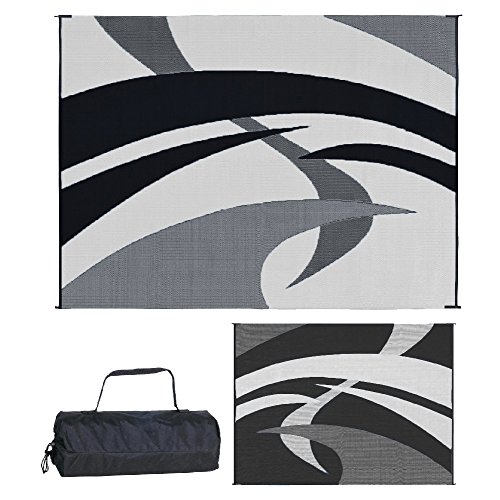
Stylish Camping RV Mat Swirl 9×12
Some campers want the ground to disappear beneath them; Stylish Camping wants it noticed. The swirl motif curling across this 9 by 12 foot mat in black and white gives an awning the energy of a patterned tile floor, and it has been a recognisable look at campgrounds for years. The title is terse compared with its rivals — no claims about bags, stakes or coatings — and that brevity cuts both ways: fewer promises to parse, but also fewer confirmed details to lean on.
- Footprint: 9-feet x 12-feet
- Pattern: swirl, black and white
- Material wording: none stated in the listing title beyond the mat format
- Extras: not stated in the title
Strengths
- Bold swirls hide crumbs and leaf litter remarkably well
- Classic awning size fits the standard RV rectangle
- Monochrome scheme matches nearly any rig colour
Trade-offs
- Title silence leaves construction details unconfirmed
- A busy pattern can overwhelm a small, cluttered pitch
- No carry solution is promised in the wording provided
Pattern psychology is real at a campsite. A swirling design breaks the surface into dozens of small visual pockets, so the eye slides past scattered sand instead of catching on it. Hosts who entertain at their pitch — potluck dinners, card games, neighbours drifting over with chairs — often prefer that forgiving quality to a pristine plain mat that shows every footprint by noon. The black and white palette also ages gracefully, since there is no colour to fade unevenly in strong sun.
What this guide cannot tell you from the title is how the mat is edged, whether it reverses, or what exactly it is woven from. Comparable mats in this family are plastic, and the product imagery suggests that world, but honesty requires marking the gap: if a specific construction detail decides your purchase, read the full listing description rather than assuming. That caution applies to every product here, yet it applies most to the one with the shortest title.
Check price on Amazon for the swirl if your pitch could use a floor with some theatre in it.
Best for: sociable campers and design-led awning setups. Not suited for: shoppers who want every specification spelled out in the title itself.

Garvee Outdoor Rug 9×12 Waterproof Reversible
Garvee takes the broadest brief in the group: patio, RV awning, garden, deck, balcony, camping and beach all appear in its title, with a grey plastic straw mat sized 9×12 ft as the single answer to every one of those settings. Generalists like this live or die on whether the core object is sound, and the core here is familiar — waterproof, reversible, woven plastic — in the most neutral colour a mat can wear.
- Footprint: 9×12 ft
- Build: plastic straw area mat, reversible
- Colour named: grey
- Settings listed: patio, RV awning, garden, deck, balcony, camping, beach
Strengths
- Grey hides dust and pairs with any furniture colour
- One mat can rotate between home patio and campsite
- Standard 9×12 sizing suits most awnings and decks
Trade-offs
- Plain grey offers little personality for themed setups
- No bag or stakes appear in the title
- Jack-of-all-settings wording gives no camping-specific detail
The home-and-away rotation deserves thought. A mat that spends spring on a deck, summer touring, and autumn under a garden table earns its cost across far more days than a dedicated camping mat used six weekends a year. Grey supports that rotation because it belongs nowhere in particular — it will not fight patio furniture in May or a tent in July. Plastic straw construction suits the rotation too, since the same hose-down cleaning works in a driveway and at a campsite spigot.
There is also a buying-psychology point: households new to outdoor mats often freeze over pattern choice, worrying a bold design will clash with gear they buy later. A grey reversible sheet removes that worry almost entirely. You give up charm, and in exchange you get a mat that will still look acceptable beside whatever chairs, tents and coolers arrive in future seasons.
Check price on Amazon if a single grey all-rounder sounds like the sensible addition to your kit.
Best for: households wanting one mat for home and road alike. Not suited for: campers building a strongly themed, colourful pitch.
Side-by-side: the six mats compared
| Mat | Footprint from title | Pattern | Named extras |
|---|---|---|---|
| SAND MINE | 5×8 ft | Black grey lattice | None mentioned |
| FACOYANS | 9×12 FT | Slogan lettering | Carry bag |
| HappyTrends | 9×12 name / 6×9 text | White and gray | None mentioned |
| 9×18 mat | 9x18FT | Diamond, black grey | Bag and 4 stakes |
| Stylish Camping | 9 x 12 feet | Swirl, black/white | None mentioned |
| Garvee | 9×12 ft | Grey | None mentioned |
Reading down the footprint column tells most of the story. One small mat, four variations on the 9×12 standard — counting the HappyTrends with its size caveat — and one giant. Extras cluster at the extremes of effort: the two makers who mention bags sell either the slogan mat or the giant, which suggests they understand that bigger rolls punish owners who lack a carrying solution. Handmade-look indoor rugs live in a different world entirely; readers curious about that contrast can browse Best Crochet Rugs, where small cotton bath mats show what fibre construction does instead.
How do you choose the right camping mat size?
Measure the awning, not the brochure
Unroll a tape under your awning at full extension and write down the shaded rectangle. Mats work best slightly inside that shade line, because edges left in direct sun get hot underfoot and edges left in rain channel water onto the surface. A 9×12 suits the common mid-size awning; a 5×8 fits a teardrop or a van door; the 9×18 needs a genuinely wide setup or an open group pitch with no awning constraint at all.
Count chairs before counting feet
Furniture decides usable space more than raw area does. Four camp chairs and a table consume roughly a 9×12 sheet once walking room is included. Two chairs and a cooler live happily on a 5×8. Sketch your layout on paper with rectangles for each item, then pick the smallest mat that holds the sketch — smaller mats pack smaller, dry faster and cost less effort at every stop.
Think about who rolls it up
Rolling a mat is the chore nobody photographs. A long mat rolled by one tired person at checkout time becomes a wrestling match, and wet weather makes it worse. If you camp solo, favour the compact end of this list or the bagged 9×12 options. Crews of three or more can handle the 9×18 with one person per end.
Ground rules: using a plastic mat without killing the grass
Campground etiquette and simple grass biology both argue for lifting your mat regularly. Woven plastic breathes better than a solid tarp, yet any covering left for a week in hot sun will yellow the grass beneath it. Many sites ask campers to roll mats up every few days or when leaving for day trips, and honouring that request keeps both the grass and your welcome intact. Shaking the mat out at lift time also dumps the grit that otherwise grinds into the weave.
Neighbours notice a tidy pitch, and a mat quietly signals one. Sites that look cared for attract considerate behaviour around them — people walk around rather than across, children ask before cutting through, and the whole row settles into an unspoken standard. It is a soft benefit, impossible to list in a specification table, yet regular campers mention it often: the mat draws a polite boundary that grass alone never manages, and evenings feel more private inside it even though nothing taller than an ankle surrounds you.
Placement matters too. Avoid spreading a mat where water pools after rain, because a plastic sheet over a puddle creates a squelching trampoline that sprays mud at ankle height. On slopes, put the mat’s long edge across the fall line so runoff passes under the downhill edge rather than sheeting across the top. On gravel, sweep the sharpest stones aside first; plastic straw tolerates gravel well, but a single pointed rock under a chair leg concentrates force enough to damage strands over a long stay.
Cleaning a woven plastic mat without wrecking it
Daily care takes thirty seconds: a stiff hand brush swept from the centre outward pushes crumbs, grit and dog hair off the edges, and doing it each evening stops dirt from being ground into the weave by chair legs the next day. Sand deserves special attention at beach-adjacent sites, because fine grains lodge between strands and act like abrasive paper underfoot. A thorough shake, holding the mat by one short edge and snapping it like a bedsheet, clears most of that hidden load.
Weekly washing, on longer stays, is a hose-and-broom affair. Lay the mat on the flattest clean surface available, wet it down, and scrub with a soft broom and plain water; greasy spots from a spilled burger respond to a small amount of ordinary dish soap worked in with the broom and rinsed generously. Avoid pressure washers held close to the surface, since a concentrated jet can fray cut strand ends along the edges, and avoid bleach, which can streak printed patterns such as the lattice and the swirl unevenly.
Drying decides whether the wash helped or harmed. Drape the mat over a fence, a picnic table or the awning’s own support arms until both faces feel dry to the palm, not merely the sunny side. Rolling a mat that is dry on top and damp beneath traps moisture in the middle layers of the roll, exactly where air cannot reach it in a storage bay. On departure mornings, experienced campers wash the mat the afternoon before, precisely so the overnight hours do the drying while they sleep.
Edge care extends a mat’s life quietly. The bound or folded edges take the scuffing from boots and the bending from every roll, so they wear first. Rolling the mat in the opposite direction on alternate trips evens out the curl memory that makes one end spring up annoyingly. If an edge begins to lift despite that habit, weighing it down with the cooler for the first hour after unrolling usually persuades it flat again without any heat or tools.
One mat, four kinds of ground
On short grass, every mat in this guide behaves well; the weave bridges the blades, chairs stand steadily, and the surface dries quickly after dew because air moves through the strands. Long wet grass is trickier, since flattened stems hold moisture against the underside, so lifting the mat at midday on damp sites is worth the small effort.
Gravel pitches reward the thicker-feeling weaves and punish impatience. Rake or sweep the pitch first, removing the largest pointed stones, and the mat becomes a genuinely comfortable floor; skip that preparation and every step reminds you of the stone you left beneath the dining area. The big 9×18 sheet spreads weight best here simply because furniture loads distribute across more strands.
Concrete and paved pads, common at newer RV resorts, are the easiest surfaces of all, though they introduce heat: dark patterns like the black lattice can grow hot in direct afternoon sun, a point in favour of the pale HappyTrends or the mid-grey Garvee for unshaded southern pitches. Sand is the fourth case, and there a mat earns its keep most visibly, giving coolers and bags a grit-free island; choose the largest size you can transport, because the clean island always feels smaller than its measurements once a family colonises it.
Packing, storing and travelling with a big roll
Roll along the long dimension so the finished tube matches your storage bay’s width, and roll tightly from the start rather than trying to compress a loose roll at the end. A bag, where one is included, solves the unravelling problem; where none is included, two ordinary luggage straps or a pair of bungee cords around the roll do the same job for pennies. Store the roll on its side rather than standing on one end, because months of standing can oval the tube and set a stubborn curl into the bottom edge.
Winter storage at home asks for a dry, ventilated spot — a garage shelf or loft corner rather than a sealed plastic bin in a damp basement. Before the long rest, wash the mat properly, dry it completely, and roll it with the cleaner face inward. Come spring, unroll it on the driveway for an hour; any storage odour airs out of plastic weave quickly, and you can inspect edges and corners for damage while repairs or replacement are still easy to arrange before the first trip.
Travelling days bring one more decision: mat on top of the load or beneath it? Placing the roll where you can reach it first at the site speeds setup, because the mat goes down before chairs, tables and boxes claim the ground. Many RVers keep it in an exterior bay for exactly that reason, and solo travellers with the little SAND MINE often slide it under a seat, where its small tube fits spaces no other gear wants.
Mistakes people make with outdoor mats
Buying by pattern photograph alone is the classic error. Listing photos show mats on perfect lawns at golden hour; your pitch may be sloped gravel in flat noon light, where a busy swirl looks chaotic and a pale mat shows every speck. Choose for your ground, not for the photograph.
Storing a mat wet is the second error, and it punishes quietly. Plastic itself will not rot, but trapped moisture grows mildew on the dirt film clinging to the weave, and the smell greets you at the next unroll. Dry the mat over a picnic table or fence before rolling, even if that delays departure by twenty minutes.
A third mistake is dragging furniture across the surface. Chair legs catch strands when slid; lifted and placed, they do no harm. Teach the whole crew the lift habit on day one. Fourth: leaving a mat staked through a storm and expecting the stakes to win against a gale — in violent wind, roll the mat up and stow it, because a flapping 9×12 sheet can bend poles and scatter everything resting on it. Finally, many buyers assume bigger always feels more luxurious, then discover the giant mat overhangs their pitch, curls at the fire ring, and never quite lies flat; a mat that fits is the luxury.
A season of weather, watched from one pitch
Spring camping tests a mat with mud. Meltwater and soft ground mean every trip from the door to the woodpile crosses a surface eager to coat boots, and the mat becomes a mudroom without walls. Dark patterns earn their keep in these weeks; the lattice and the diamond both swallow brown smears into their geometry, while the pale HappyTrends will demand a hose-down after a single wet weekend. Spring is also when a mat protects young grass most, spreading your weight so feet do not churn a recovering pitch into a bare patch the site manager remembers.
Summer brings the opposite trial: heat and ultraviolet light. Dark plastic in full sun can grow uncomfortably warm for bare feet by mid-afternoon, which is why awning shade is not merely a comfort but part of the mat system itself — the mat belongs inside the shade line, as the sizing section argued. Two titles in this guide mention UV resistance in their own wording, FACOYANS and the 9×18 mat; neither attaches a number to that claim, so the sensible reading is that the makers expect outdoor exposure, not that the mat is immune to fading forever. Every plastic mat will soften its colours over enough summers, and reversible models let you alternate faces to spread that change evenly.
Autumn camping is arguably where these mats shine brightest, because fallen leaves on grass turn slick and hide uneven ground, while leaves on a woven mat sweep away in seconds and the surface beneath stays visible and predictable. Cool mornings put dew on everything; plastic strands hold that dew as droplets you can shake off, whereas a fabric rug would drink it and stay cold and heavy until noon. Campers who extend their season into frosty weeks learn to put the mat down after the morning dew lifts, so they are not sealing moisture underneath for the whole day.
Winter storage and occasional winter trips complete the cycle. Plastic weave does not mind cold, though it stiffens, so unrolling a mat in freezing weather should be done gently rather than with the snap you would use in July. Snow campers — a hardy minority — use a mat as an insulating, visible platform for sorting gear, and the dark patterns show up against snow so clearly that dropped screws and tent pegs stop disappearing. Whatever the season, the habit that protects both mat and pitch stays the same: lift it, shake it, let air underneath, and never let it sit sealed against wet ground for weeks without a look.
What a mat cannot do, said plainly
Honest limits save returns. A woven plastic mat is not insulation in any serious sense; it breaks contact with cold or damp ground, which feels warmer, but it will not turn a thin tent floor into a heated room. It is not waterproofing for the ground beneath a tent either, since water passes through the weave by design — that drainage is a feature on a patio and a misunderstanding if you expected a sealed barrier. It will not level a lumpy pitch, silence gravel crunch underfoot, or survive being dragged across sharp stone by a loaded cooler.
Fire deserves a direct sentence: keep every mat in this guide well away from fire rings, grills and stove flames. Plastic melts and can burn; no title here claims any heat resistance, and sparks from a campfire will pit the surface permanently. Position the mat so the fire stays on bare ground or the site’s own pad, with a clear margin, and treat any ember that lands on the weave as a reason to check for a melted spot once it cools.
Finally, a mat is not a toy for vehicle levelling, a ramp, or a groundsheet for changing oil. Using it under tyres or jacks crushes strands and voids whatever life it had. Kept to its real job — a clean, defined, washable floor for outdoor living — any of these six should serve for seasons; asked to do other jobs, the best of them will fail quickly and look abused doing it.
Matching the mat to the way you actually travel
Weekend tent campers live by a different arithmetic from seasonal RVers. If your trips run Friday to Sunday and the car boot already bulges, the mat must justify itself in packed volume before anything else, and the 5×8 SAND MINE wins that argument easily. It covers the tent’s front porch — the strip where boots come off and the stove sits — without pretending to floor an entire encampment, and it rinses clean at home in a bathtub or over a garden fence. Two or three seasons of such trips will teach you whether you crave more covered ground; upgrading later costs little because the small mat retires gracefully to door duty.
Touring RVers who change sites every few nights should weigh setup minutes heavily. Every additional foot of mat is another minute of unrolling, aligning, weighting and, on departure, brushing and re-rolling, multiplied by a hundred stops a year. For that rhythm the bagged FACOYANS makes a strong case: the bag speeds the departure routine, the 9×12 still gives a full living area at each stop, and the slogan suits people whose identity is bound up with moving their home around the map.
Seasonal campers, parked for months on one pitch, should think in the opposite direction. Setup effort happens once, so size stops being a chore and becomes pure benefit; the staked 9×18 sheet, or two 9×12 mats laid side by side, can define separate dining and lounging zones for an entire summer. Long stays also reward the patterned faces — swirl, lattice, diamond — because a pattern you stare at for twelve weeks should be one you enjoy, and its dirt-hiding geometry matters more with every passing week between washes.
Festival and rally campers occupy a middle ground: big gatherings, short stays, heavy foot traffic from visitors. Here the mat becomes social infrastructure, the surface neighbours stand on with drinks in hand, so durability of appearance counts most. Dark, busy patterns win; the Stylish Camping swirl and the diamond 9×18 both shrug off the visual evidence of a crowd. A pale mat at a festival looks exhausted by Saturday morning.
Children, dogs and grandparents on the same square of plastic
A camping mat quietly becomes the family’s shared floor, and each generation uses it differently. Toddlers crawl on it, and for them the weave’s texture matters: plastic straw is smooth enough not to graze knees, firm enough for wobbly standing practice, and — the decisive advantage over a blanket — it does not bunch into trip ridges under small feet. Parents also gain a visible boundary; a child who learns that toys stay on the mat gives the whole pitch a tidiness rule that grass alone cannot teach.
Dogs vote for the mat with their behaviour, choosing it over bare ground for naps because it insulates them from cold earth in the morning and hot gravel at noon. Paw traffic brings grit, which argues for the darker patterns, and claws do no meaningful harm to woven plastic. After muddy walks, the mat gives you a staging area where paws can be wiped before the dog reaches the RV door, saving the interior carpet from the worst of every trail.
Older campers benefit from the mat in ways brochures never mention. A defined, level, trip-free surface reduces the shuffle-catching hazards of tufted grass and loose stones between chair and door, especially after dark. A pale or strongly patterned edge also helps ageing eyes judge where the floor ends, which is a small safety gift on unfamiliar ground. Anyone using a walker or cane will find the firm weave kinder than soft turf that swallows a cane tip, though on very uneven pitches no mat fully levels the ground and expectations should stay realistic.
Evenings pull all of this together. The mat holds the day’s warmth a little longer than bare earth, so bare feet linger outside later; board games stay clean; the dog settles; and the pitch feels like a room rather than a parking spot. That feeling, more than any specification, is what people are buying when they search for camping rugs, and it is why choosing the size and pattern that suit your own crew matters more than chasing the largest sheet or the boldest print in this list.
Reading a camping mat listing like a sceptic
Titles in this category compress a whole product into one breathless line, and learning to unpack them saves disappointment. Start with the material words: plastic straw, HDPE and polypropylene all describe woven synthetic strands, which is what you want outdoors; if a title instead celebrates wool, cotton or jute, you are looking at an indoor rug wearing outdoor keywords, and it will suffer outside. Next, find the size and then find it again — as the HappyTrends entry in this guide shows, a name and a description can carry different figures, and the variant selector at purchase time is the only version that counts.
Treat resistance language as advertising until a number appears. Waterproof, UV resistant and stain resistant in these titles are the sellers’ own characterisations, offered without test standards or measurements, so they tell you how a maker positions a mat rather than how it performed in a laboratory. That does not make the claims useless — a maker who prints easy clean on a plastic straw mat is describing behaviour the material genuinely tends to show — but it does mean you should not pay a large premium for an unquantified adjective.
Photographs need the same scepticism. Listing images stretch mats across lawns mown like golf greens, often with furniture arranged by a stylist and sunlight doing half the decorating. Look instead for close views of the weave and edges, which reveal strand thickness and how the border is finished, and for any photo showing the mat rolled, which tells you honestly what you will be storing. A mat whose listing hides its rolled form is asking you to discover the storage problem after delivery.
Accessories deserve a final check. A bag transforms the ownership of a big mat, stakes transform its behaviour in wind, and neither can be assumed from a photograph of them lying decoratively nearby; if the words are absent from the title, as they are for four of these six, budget for straps or a bag of your own. Reading listings this way — material, size twice, claims discounted, edges inspected, extras confirmed — takes two minutes and prevents nearly every unhappy surprise this product category produces.
One large sheet or two smaller ones?
A question worth settling before checkout is whether your covered ground should arrive as a single sheet or as a pair. Two 5×8 or 9×12 mats give you a seam, and seams collect grit and can curl where they meet, yet the pair offers freedoms a single giant cannot: you can split them between two doors, angle one toward the fire-viewing chairs while the other serves the kitchen setup, or leave one at home on the patio while its twin travels. When one mat of a pair is damaged, you replace half your floor rather than all of it.
A single large sheet, by contrast, gives an unbroken surface that chairs slide across without catching a seam, and it looks calmer in photographs. The 9×18 in this guide exists for campers who value that unbroken field and gather enough people to justify it. Weight and rolled bulk concentrate in one package, though, so a solo traveller wrestling it in wind may envy the pair owners. Neither answer is universally right; the deciding facts are how many doors your rig has, how many people help at setup, and whether the mat must ever work in two places during the same week. Answer those three honestly and the format chooses itself, after which the patterns and extras in the reviews above can settle the rest.
Final recommendation
For the typical RV awning, the FACOYANS 9×12 earns the lead recommendation here: full-size coverage, a carry bag named in the title, and a design that turns the pitch into a place with a point of view. Small-pitch travellers should take the SAND MINE 5×8 and enjoy the easy packing. Groups and long-stay campers with room to spread out are the natural owners of the 9×18 staked mat. HappyTrends suits deck-and-road double duty once its size variant is confirmed, Stylish Camping serves pattern-first buyers, and Garvee is the grey all-rounder for households wanting one mat everywhere. Pet owners outfitting the home base as carefully as the campsite may also enjoy Best Dog Blankets, which covers washable fleece blankets for crates and sofas.
Questions campers ask about these mats
Are these mats actually rugs?
Not in the indoor sense. All six are woven plastic mats — closer to a durable groundsheet with a decorative face than to a fibre rug — and that construction is why they survive weather, hosing and folding that would ruin a wool or cotton rug in a single trip.
Can a plastic mat sit on grass for a whole season?
It can physically endure it, but the grass underneath will suffer without regular lifting, and many campgrounds require periodic rolling for exactly that reason. Lift, shake and air the mat every few days on long stays.
Which size fits a standard RV awning?
Most mid-size awnings pair naturally with a 9×12 mat, the size carried by four entries in this guide. Measure your own shade line first, since awning widths vary by rig.
Do any of these include a way to carry them?
Two titles say so: the FACOYANS lists a carry bag, and the 9×18 mat lists a portable bag plus four stakes. The remaining titles are silent on bags, so plan your own strap or bag if that matters to you.
How long should a woven plastic mat last?
No title in this guide promises a lifespan, so any honest answer is about habits rather than years printed on a box. A mat that is dried before rolling, lifted off grass regularly, kept clear of fire and dragged nowhere should serve through many seasons of regular trips. The same mat stored wet, left sealed over sodden ground for a month, or pulled across gravel under load can look tired within a single summer. Longevity in this category is mostly owner behaviour wearing a product costume.
What does reversible actually change?
You get a second pattern or colour arrangement on the underside, which refreshes the pitch visually and lets you hide a stained face during a trip. Remember that printed lettering, like the FACOYANS slogan, will read reversed or altered on the flip side.
Choose the mat that fits your shade, your crew and your storage bay, and the ground at every stop becomes the easiest room you own.


