Our Top Picks
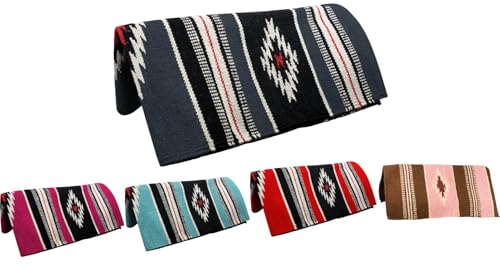
 Mayatex 1340-3 Double Weave 32x64 Acrylic Blend Saddle32 x 64-Inch17 x 17 x 2 inches5 poundsCheck on Amazon

What's inside
- Why the layer under the saddle matters
- Woven wool, felt and blends compared
- Thickness: more is not automatically better
- Shape, contour and spine relief
- Sizing for western and English saddles
- Moisture, heat and the working back
- How riders judge durability in practice
- Care and washing without ruining the blanket
- Matching a blanket to common riding jobs
- Common buying mistakes and how to avoid them
- What rider feedback reveals over time
- A note on older horses and changing backs
- Reading manufacturer specifications critically
- Putting together a small, sensible collection
- Seasonal adjustments worth making
- Signs it is time to replace a blanket
- Check prices on Amazon
- Final thoughts
As an Amazon Associate I earn from qualifying purchases. This post may contain affiliate links at no extra cost to you.
A good saddle blanket does quiet, unglamorous work. It sits between leather and horse, spreads pressure across a wider area, absorbs sweat before it soaks into a saddle, and helps a saddle stay put without constant adjustment. When that layer is wrong, the signs show up quickly: a dry patch in an otherwise sweaty back, white hairs appearing after a season, a saddle that creeps forward on downhill ground, or a horse that pins its ears during girthing. None of those problems is solved by colour or pattern alone, which is why this guide spends most of its time on fibre, thickness, construction and fit rather than looks.
Readers who ride in different disciplines often need different answers from the same product category. A western rider schooling in an arena for forty minutes, a trail rider out for four hours in summer heat, and an English rider using a shaped pad under a close-contact saddle are asking a thin layer of cloth or felt to do three rather different jobs. The blanket that suits one of them can be too bulky, too hot or too short for another. Matching the blanket to the saddle, the horse’s back shape and the length of a typical ride matters far more than chasing a single universal recommendation.
This guide compares saddle blankets and pads using published manufacturer specifications, stated fibre content, stated dimensions and thickness, care instructions from makers, and patterns that appear repeatedly in rider feedback. Where riders disagree, that disagreement is reported rather than smoothed over, because disagreement usually points to a fit issue: the same blanket praised by owners of high-withered horses is often criticised by owners of broad, flat-backed horses, and both groups can be describing their experience accurately.
Disclosure: Cottage Verdict may earn a commission when readers buy through links on this page, at no extra cost to the reader. That support helps keep these guides free to read. Product details below come from manufacturer listings and published specifications, checked against rider reports, and prices and availability can change without notice.
Why the layer under the saddle matters
Pressure is the first idea to get clear. A saddle tree distributes a rider’s weight, but it does so through panels or bars that contact the horse over a limited area, and any hard edge or uneven flocking concentrates force. A blanket cannot fix a badly fitting saddle, and no honest guide should suggest otherwise. What it can do is soften minor irregularities, reduce friction as the back moves, and provide a sacrificial layer that takes sweat and dirt instead of the saddle itself. Riders who expect a thick pad to cure bridging or rocking are usually disappointed, while riders who use a modest blanket to fine-tune an already decent fit tend to report the best results.
Sweat tells a useful story after a ride. An even sweat pattern, with dampness spread broadly and no large dry islands, suggests contact was fairly uniform. A completely dry rectangle under the panels while the surrounding back is wet can indicate pressure so concentrated that sweat glands were compressed, whereas a dry channel along the spine is desirable because the spine itself should carry no direct load. Reading that pattern takes practice, and a single ride in cold wind can mislead, but checking the blanket and the back together over several rides builds a picture that no product description can provide.
Woven wool, felt and blends compared
Traditional woven wool blankets, often associated with western riding, are made by interlacing warp and weft yarns into a dense cloth. Makers frequently cite New Zealand wool or wool blends, and a tightly woven blanket tends to breathe well, wick moisture away from the coat, and conform gradually to the shape of the back. The trade-off is maintenance: woven wool can shrink if washed hot, can stretch when hung wet, and usually costs more than synthetic alternatives of similar size. Riders who value natural fibre and a classic profile accept that care burden willingly.
Felt offers a different set of strengths. Produced by matting fibres together with heat, moisture and pressure rather than weaving them, felt resists fraying when cut, holds a contoured shape, and provides cushioning that feels firmer under the hand. Wool felt is prized for moisture handling and durability, while synthetic felt is cheaper and easier to wash but can trap more heat. Thickness in felt is usually stated in fractions of an inch, and small differences matter: a quarter inch changes saddle fit noticeably on a horse whose saddle already sits close.
Blended and synthetic options fill the middle ground. Wool blends mix natural fibre with polyester or nylon for strength and lower cost, and many everyday schooling blankets use that formula. Fully synthetic fleece and microfibre pads dry quickly, weigh little and tolerate frequent washing, which suits riding schools and owners whose horses work daily. Their weakness appears on long, hot rides, where heat build-up under less breathable material is a recurring complaint in rider feedback, particularly from endurance and trail riders covering long distances.
Fibre content percentages deserve a close look. A blanket described loosely as a wool blanket may contain anywhere from a modest share of wool to almost entirely wool, with the remainder made up of synthetic fibre that changes how it washes and wears. Manufacturer listings that state an exact blend give buyers something concrete to compare. When the percentage is missing, riders in feedback threads often fill the gap with guesswork, and expectations drift. Treat a clearly stated fibre breakdown as a sign of a maker willing to be specific.
Related reading: best 9×12 natural fiber rugs
Thickness: more is not automatically better
Thickness is the specification most often misunderstood. Adding a thick pad under a saddle that already fits well effectively makes the saddle narrower, in the same way that thick socks make a well-fitting boot tight. Horses with ample room under the tree can benefit from extra cushioning, especially older horses that have lost some muscle along the topline. Horses with a close fit, by contrast, may develop pressure points precisely because an owner added padding with the best intentions. Several veterinarians and saddle fitters quoted in trade publications make the same point: correct the fit first, then choose the thinnest blanket that protects the back.
As a rough framework drawn from maker guidance, thin blankets around one quarter inch suit close-fitting saddles and short schooling sessions. Medium options near one half inch are the common all-round choice for trail and general western work. Thick felt near three quarters of an inch or a full inch is generally reserved for saddles with room to spare, for high-impact work such as roping, or for temporary use while a horse rebuilds condition. Those are starting points rather than rules, and the sweat pattern after a ride remains the better judge.
Compressibility changes the story over time. Some foams and felts feel plush in the shop yet pack down within weeks, leaving far less cushioning than the stated thickness implies. Dense wool felt compresses more slowly and tends to hold its working thickness longer, which is one reason experienced riders accept its higher price. Rider feedback that mentions a pad feeling flat after a month is worth weighting heavily, because thickness on day one is a promise and thickness after fifty rides is the reality that a horse actually experiences.
Shape, contour and spine relief
A flat rectangular blanket is simple, versatile and easy to fold for different saddles, but a horse’s back is not flat. Contoured blankets are cut or moulded to rise over the withers and dip along the back, reducing the tenting that pulls a flat blanket tight across the spine. Owners of horses with prominent withers report fewer rubs at the wither when the profile follows that rise, while owners of mutton-withered horses sometimes find contoured designs shift more because there is less anatomy for the shape to key into.
Spine relief channels, cut-outs and raised wither sections all aim at the same goal: keeping material and pressure off the spinous processes. A blanket should be pulled up into the gullet of the saddle before girthing, a habit older horsemen call tenting or clearing the blanket, so that it does not press down on the withers as the rider’s weight settles. Even a well-shaped blanket can cause discomfort if it is laid flat and then dragged tight by the saddle. Technique, in other words, can undo or rescue design.
Wear leathers and reinforced wither sections appear on many western blankets. Those leather patches sit where saddle rigging and fenders rub, and they extend the life of the cloth beneath. Feedback from working riders on ranches suggests wear leathers matter most when a blanket is used daily and rotated less often. For a leisure rider using a blanket three times a week, the same feature is nice to have but rarely decides whether a blanket lasts five years or eight.
Sizing for western and English saddles
Western blankets are commonly sold in sizes around thirty by thirty inches, thirty-two by thirty-two, and larger thirty-four by thirty-six formats for bigger saddles and longer-backed horses. The blanket should extend a little beyond the saddle on all sides, roughly an inch or two, so the saddle never sits on an edge or overhangs onto bare back. Too much excess, however, adds bulk under the leg and can bunch behind the shoulder. Measuring an existing blanket that fits, rather than guessing from a photograph, remains the most reliable way to order a replacement.
English pads follow a different logic because the saddle itself is smaller and closer fitting. Shaped pads, square dressage pads and half pads each serve a distinct purpose, and their sizing is often given by spine length and drop rather than by a simple square measurement. A dressage pad needs enough drop to clear a long flap, while a jump pad that is too large can interfere with the rider’s leg. Riders crossing between disciplines should resist using a western blanket folded under an English saddle as a permanent solution; folded layers create ridges exactly where even pressure matters most.
Foals, ponies and compact horses are poorly served by simply folding an adult blanket in half. The doubled layer changes thickness unevenly and the fold itself becomes a pressure line. Makers who offer pony and cob sizes solve that problem properly. At the other end of the scale, draft crosses and broad warmbloods may need oversized blankets that many standard ranges stop short of, and owners of such horses feature prominently in feedback asking for longer drops and wider spines.
Moisture, heat and the working back
A horse in moderate work can produce a surprising amount of sweat under a saddle, and that moisture has to go somewhere. Wool has a natural capacity to absorb moisture within the fibre while still feeling relatively dry on the surface, which helps explain its enduring popularity despite cost and care demands. Synthetic fleece moves liquid quickly but may hold it against the coat if the outer layer cannot evaporate it. In humid climates, riders often prefer thinner, more open constructions and rotate two blankets so each can dry fully between rides.
Heat is the companion issue. Every additional layer insulates, and on a summer trail ride the difference between a breathable woven blanket and a dense closed-cell foam pad is visible in how much lather builds and how quickly a horse recovers at a rest stop. Ventilation features such as perforated foam, mesh spines and airflow channels are marketed heavily; rider reports suggest they help modestly, but none of them compensates for choosing a blanket far thicker than the work requires.
Salt and dried sweat stiffen fibres over time, and a stiff blanket loses its ability to conform. Rinsing sweat out promptly, brushing dried mud from the underside, and checking for burrs or thorns before the next ride are small habits with outsized effects. A single embedded burr can create a sore that takes weeks to heal, and more than one rider account describes tracing a mysterious rub back to debris lodged in a blanket that had been shaken but not inspected.
How riders judge durability in practice
Durability claims are hard to compare because makers rarely state abrasion data. Rider feedback therefore becomes the main evidence, and patterns emerge: tightly woven blankets fray first at the edges and wither, pressed felt cracks if stored folded in a hot tack room, and cheap fleece pills and thins under the saddle area. Stitching quality around bindings is another recurring theme. A blanket whose binding separates after a season of washing frustrates owners even when the main body remains sound.
Related reading: best all natural rugs
Rotation extends life more than any single construction feature. Two mid-priced blankets used on alternate days commonly outlast one premium blanket used daily, because fibres recover and dry fully between outings. Owners with several horses sometimes colour-code blankets by horse, which also limits the spread of skin conditions such as rain scald or ringworm between animals. Sharing blankets without washing them is one of the easier ways to share a fungal problem across a yard.
Storage sounds trivial until mould appears. Blankets stored damp in sealed plastic bins develop mildew quickly, and the smell is notoriously hard to remove from wool. Breathable storage, a dry tack room and occasional airing in sunlight keep fibres in better condition. Mice are an under-discussed hazard in barn storage; natural fibres are attractive nesting material, and a blanket pulled out in spring with a chewed corner is a familiar story in rural feedback groups.
Care and washing without ruining the blanket
Woven wool generally prefers cool water, gentle handling and flat drying away from direct heat. Hot water and aggressive agitation can felt the fibres further and shrink the blanket unevenly, leaving it smaller and stiffer than before. Many makers recommend hosing and brushing for routine cleaning, reserving full washing for heavy soiling. Felt pads often should not be machine washed at all; a stiff brush, air and spot cleaning preserve their moulded shape.
Synthetic pads are the forgiving category. Most tolerate machine washing on a gentle cycle, though hook-and-loop straps should be closed so they do not snag other items or fill with hair. Horsehair itself is the main laundry nuisance: a shake and brush outdoors before washing keeps machines and drains happier. Whatever the fibre, detergent residue left in a thick pad can irritate skin, so an extra rinse is worthwhile, and strongly scented products are best avoided under a saddle.
Drying deserves as much attention as washing. Hanging a heavy wet wool blanket by two corners stretches it out of shape, while laying it flat or draping it broadly over a rail preserves its dimensions. Direct sun fades colours and can dry leather wear patches until they crack, so shaded air is kinder. A blanket put away still damp in the centre will smell musty within days, and thick felt in particular can feel dry on the surface while holding moisture deep inside.
Matching a blanket to common riding jobs
For arena schooling, where sessions are moderate and the surface is even, a medium woven blanket or a quality shaped pad usually suffices. The priority is a stable fit that does not creep during transitions and lateral work. Riders schooling young horses often prefer a blanket with a little grip, because a saddle that shifts during a spook undermines a young horse’s confidence as well as the rider’s balance.
Trail riding adds duration, hills and weather. Here moisture handling and freedom at the shoulder matter more, and a blanket that is slightly longer can protect against brush and saddle bags rubbing. Riders covering rocky or steep ground report that a contoured profile stays centred better on climbs and descents. Carrying a lightweight spare on multi-day trips is common practice among pack riders, both for rotation and as insurance against a soaked blanket after a river crossing.
Ranch and roping work place the highest loads through a saddle. A dense felt pad with real thickness, paired with a woven show or work blanket over it, is a traditional combination: the felt cushions, the woven layer protects the felt and adds grip. That two-layer system works because each layer has a defined job. Simply stacking two random blankets, by contrast, often creates slipping between layers and should be avoided unless each layer is thin and stable.
Showing introduces rules and aesthetics. Many western show blankets are woven with elaborate patterns and are used over a plain work pad, so the decorative layer is not expected to provide all the cushioning. Colours are chosen to complement the horse’s coat and the rider’s outfit, and a slightly oversized show blanket presents a neater picture in the ring. Even here, fit underneath matters: judges may admire the pattern, but the horse feels only the layers beneath it.
Endurance and long-distance riders are the most demanding testers of moisture claims. Their feedback consistently favours materials that keep working when saturated over many hours, and many settle on wool or wool-rich constructions despite the weight penalty when wet. They also tend to replace blankets sooner, accepting that a pad compressed by thousands of miles no longer protects as it did. Leisure riders can borrow their scepticism about miracle materials while ignoring their replacement schedule.
Common buying mistakes and how to avoid them
Buying by photograph alone is the most frequent error. Colours render differently on screens, but the deeper problem is that a photograph reveals nothing about density, flexibility or how an edge is finished. Where possible, handling a blanket, folding it, and pressing a thumb hard into the felt tells more than a gallery of images. When buying unseen, stated weight can help: a substantial woven wool blanket in a standard western size weighs noticeably more than a thin decorative one, and makers who publish weight give buyers a useful clue.
Ignoring the saddle already owned is another common trap. A rider who plans to change saddles within the year may be wise to delay buying a precisely contoured pad, because the new saddle may need a different profile. Conversely, a rider whose saddle has been professionally fitted should tell the fitter before adding a much thicker pad, since that single change can alter the fit the fitter just achieved. Communication between fitter, rider and blanket choice saves money and backs.
Choosing the thickest option as insurance feels cautious but often backfires, as discussed earlier. A related mistake is using a corrective pad with shims without a diagnosis. Shims can help a skilled fitter address a temporary asymmetry, such as muscle loss after time off, but inserting them at random can create the very pressure pattern a rider hopes to prevent. Feedback from fitters suggests corrective products work best with a review date attached, not as a permanent fixture.
Neglecting the girth and rigging interaction also causes trouble. A blanket that is slightly too short can be pulled out of position by rigging, and a blanket with a very slick underside may migrate on a round-barrelled horse regardless of its other virtues. Testing a new blanket first on a short, familiar ride, rather than debuting it on a long planned outing, is simple risk management that experienced riders recommend repeatedly.
Related reading: best alpaca blankets
What rider feedback reveals over time
Patterns in long-term rider reports are more informative than first impressions. New blankets almost always feel good; the meaningful comments arrive after a season. Wool blankets earn praise for staying odour-resistant longer between washes, while synthetic pads earn praise from owners who wash weekly and need fast drying. Complaints cluster around shrinkage after washing, colours bleeding onto light coats, and contoured shapes that fit one horse beautifully and the stablemate not at all.
Value judgements in feedback depend heavily on workload. A blanket criticised by a professional who rides six horses a day may serve an amateur for years. Reading feedback with the reviewer’s workload in mind prevents both overbuying and underbuying. Similarly, a blanket praised for winter warmth may be exactly the wrong choice for a rider in a hot region, and geographic context in reviews is worth seeking out before deciding.
Horses vote as well, in their own way. A horse that stands quietly for saddling, moves forward freely in the first ten minutes and shows an even sweat pattern is giving positive evidence. A horse that develops new resistance, hollowing or tail-swishing after a blanket change is giving evidence too, and it should outweigh any amount of attractive marketing. Changing one variable at a time, and giving a new blanket several rides before judging it, makes that evidence readable.
A note on older horses and changing backs
Backs change across a horse’s life. Young horses muscle up, middle-aged horses hold condition with work, and older horses often lose topline even when otherwise healthy. A blanket that suited a horse at eight may be wrong at eighteen, not because the blanket changed but because the back beneath it did. Senior horses frequently benefit from a little more cushioning and from closer attention to spine clearance, and their owners feature in feedback describing a move from thin woven blankets to moderate felt as condition changed.
Weight change through the seasons has a similar effect on a shorter timescale. A horse coming out of winter carrying extra condition presents a different fit from the same horse fit in late summer. Riders who check saddle fit and blanket behaviour at those transition points catch problems early. Keeping notes, even brief ones, on which blanket was used and how the back looked after a ride turns guesswork into a record.
Reading manufacturer specifications critically
Specifications are most useful when they are complete: fibre percentages, dimensions in inches, thickness, weight, country of manufacture and care instructions together allow a fair comparison. A listing that offers only adjectives asks the buyer to take a great deal on trust. Comparing two blankets side by side on stated facts, then using rider feedback to judge the qualities that numbers cannot capture, such as grip and long-term compression, is the method this guide follows throughout.
Terminology varies between makers, which complicates comparison. One company’s heavyweight is another’s medium, and the word pad and the word blanket are used interchangeably in some catalogues and distinctly in others, with pad usually implying a thicker, more structured product. Relying on measured dimensions and thickness rather than category labels avoids most of that confusion. When a maker states both, so much the better.
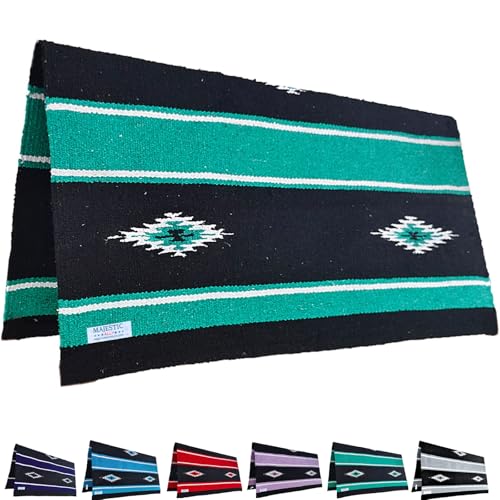
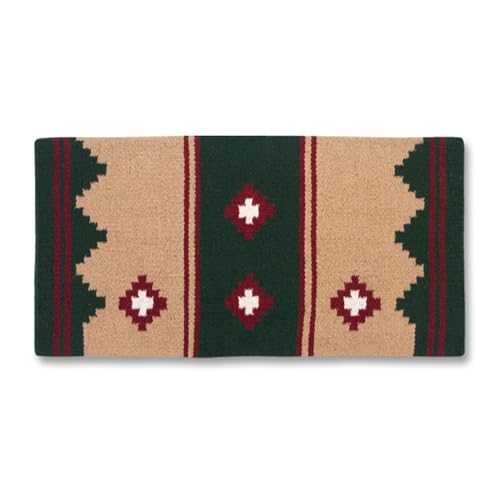
Country and tradition influence design in ways worth understanding. Southwestern woven blankets carry a long heritage and a distinctive look, and modern versions range from fully traditional wool to inexpensive imitations in synthetic yarn that share only the pattern. A buyer who wants the performance of wool should check fibre content rather than assume a traditional design guarantees a traditional material. Heritage is a fine reason to choose a style; it is not a substitute for a specification.
Putting together a small, sensible collection
Most owners do not need a wardrobe of blankets. A practical collection for one horse might be a dependable everyday blanket, a second blanket for rotation and washing days, and, where showing or heavy work is part of life, a specialised option for that job. That modest set covers nearly every situation a leisure rider meets, costs less than chasing novelty, and makes it easier to notice when one blanket begins to wear because its behaviour is familiar.
Budget is better spent on the layer that touches the horse than on decoration that does not. If funds force a choice between a beautiful top blanket over a poor pad and a plain, well-made blanket of the right thickness, the horse’s back argues for the second option every time. A plain blanket can later be dressed up with an inexpensive decorative over-blanket for special occasions, reversing the priority only in appearance.
Trying a borrowed blanket before buying, where a yard culture allows it, is an old and effective strategy. Horses at the same barn often work in similar conditions, and a fellow owner’s experience with washing, shrinkage and durability on the same water supply and the same arena surface is unusually relevant evidence. Borrowing also reveals fit on a particular back shape faster than any size chart.
Seasonal adjustments worth making
Winter coats change the interface between blanket and horse. A thick winter coat compresses under the saddle and can make a familiar blanket feel different, while a clipped horse loses that natural cushion and may need a touch more protection. Riders who clip often adjust by a small step in thickness rather than a large one, and they watch the first few rides after clipping for rubs along the edges of the clip lines.
Summer brings sweat, flies and sudden rain. A blanket that dries overnight is worth a great deal when rides are daily, and lighter colours reflect some heat when a horse stands saddled in the sun, though the effect is modest. Fly spray applied heavily to the back before saddling can make some materials slick and can irritate skin trapped under a pad, so experienced riders apply it after the ride or keep it away from the saddle area.
Mud season tests the underside of every blanket. Grit worked into fibres acts like sandpaper, and a quick brush before saddling on a muddy day protects both coat and blanket. Riders in wet climates also learn to check the blanket after a ride in rain, because a soaked blanket left on a rack in a cold barn can still be damp two days later and should not go back on a horse in that state.
Related reading: best 8×10 rugs
Signs it is time to replace a blanket
A blanket that has compressed unevenly, developed a permanent crease, or begun to crack across the felt is telling its owner that its working life is ending. Frayed edges that catch on rigging, a wither area worn thin, and a persistent odour that survives proper washing are other common signals. Replacing a blanket at that point is cheaper than managing a sore back, and the old blanket can often retire to lighter duties such as padding under a saddle on a rack.
Keeping a simple record of purchase dates helps, because blankets decline gradually and daily familiarity hides slow change. Comparing a two-year-old felt pad with a new one of the same model, side by side, often surprises owners with how much thickness has been lost. That comparison is a fair, evidence-based way to decide, far better than relying on how a blanket looks from a distance.
Blanket weight and what it signals
Weight is an underused specification. Two blankets with identical dimensions can differ greatly in mass, and that difference usually reflects how much fibre is actually present. A substantial woven blanket feels reassuring in the hand, drapes rather than flutters in wind, and stays in place on a breezy day while being carried to the horse. Very light blankets have their place for showing over a pad, but as a sole working layer they often disappoint. Makers who publish weight allow a buyer to spot a thin product dressed in thick language.
Carrying weight matters on the trail as well. A soaked wool blanket is considerably heavier than the same blanket dry, and pack riders factor that into loads after river crossings or rain. Synthetic options shed water faster and add less weight when wet, which is one reason some long-distance riders accept their heat drawbacks. The choice is rarely about a single property; it is about which drawback a particular rider would rather manage on the kind of ground they actually cover.
Edges, bindings and finishing details
The edge of a blanket works harder than its centre. Bindings take abrasion from boots, spurs, rigging and washing, and a binding stitched with a single row of loose thread will fail long before the body of the blanket wears out. Double stitching, a tightly woven binding tape and neatly finished corners are unglamorous details that predict service life. Riders who inspect second-hand blankets professionally look at edges first, because edges confess how a blanket was made and how it was treated.
Corner shape influences fit more than expected. Square corners on a contoured blanket can dig or fold under the saddle flap, while rounded corners lie flatter and are less likely to create a pressure ridge. On rectangular western blankets, a slightly reinforced corner resists the curling that makes an older blanket look tired and sit unevenly. None of these details appears in headline marketing, yet together they separate a blanket that remains pleasant to use from one that becomes an irritation.
Grip, slip and the underside surface
The underside of a blanket determines how it behaves on the coat. A slightly textured wool underside grips hair gently and resists migration, whereas a shiny synthetic underside can slide on a sleek summer coat, especially on a round horse with little wither to anchor the saddle. Some makers add a grippy panel or a canvas underside for exactly this reason. Riders who battle slipping should examine the underside before blaming the saddle, because a change of blanket sometimes solves a problem that looks like a fitting fault.
Grip can go too far. A very high-friction underside on a thin-skinned horse may pull at the coat during movement and contribute to rubs at the loins, particularly in winter when coats are long. Balance is the goal: enough hold to stay centred, enough freedom to move with the back. Feedback describing a blanket as staying put without soreness usually reflects that balance, and it is a more useful compliment than any claim about advanced technology.
Colour, pattern and practical visibility
Colour is usually treated as pure preference, but it has practical sides. Dark blankets hide sweat and dirt, which pleases the eye and can also hide the sweat pattern a rider should be reading after work. Light blankets reveal that pattern clearly and show contamination, burrs and staining that need attention. Show riders choose colours for the ring, working riders often choose them for the yard, and both are rational. A spare blanket in a contrasting colour also makes rotation easier to track at a glance.
Pattern can help with placement. A woven design with a clear centre stripe gives the rider a visual reference for centring the blanket on the spine, and an off-centre stripe after a ride is immediate evidence that something shifted. Plain blankets offer no such reference. Some riders mark the centre of a plain blanket with a small stitched line for the same purpose, a humble modification that improves daily accuracy more than many purchases do.
Blankets for specific breeds and back shapes
Arabians often present a shorter, sometimes flatter back with a naturally high head carriage, and owners report that standard western blankets can overwhelm them or extend too far behind the saddle. Shorter sizes and lighter constructions suit that shape. Thoroughbreds, by contrast, frequently bring prominent withers and a longer slope, rewarding a contoured profile with genuine wither clearance. Warmbloods may need width and drop more than length, while cobs and native ponies often need the opposite: modest length with enough width for a broad barrel.
Mules and donkeys deserve a mention because their backs and withers differ from horses in ways that make standard blankets sit oddly. Owners of mules in trail feedback groups describe favouring blankets that stay centred without relying on wither shape, and they are candid that many horse products assume anatomy their animals do not have. Gaited horses, whose movement involves a different pattern of back motion, generate their own preferences, with riders valuing flexibility through the loin over rigid structure.
The role of a liner
A thin liner under a main blanket is a strategy borrowed from working yards. The liner takes the sweat and dirt, washes easily and dries overnight, while the expensive main blanket stays cleaner for far longer. Cotton and light synthetic liners are common, and the added thickness is small enough not to disturb fit in most cases. Riders who adopt a liner often report that their main blanket lasts noticeably longer, and the liner itself is cheap to replace when it eventually thins.
Liners also help horses with sensitive skin, because the layer touching the coat can be chosen for softness and washed frequently enough to stay genuinely clean. A main blanket washed rarely can harbour dried sweat and bacteria against the skin, and some recurring girth-area or saddle-area skin irritation improves simply when a clean liner is interposed. As with stacking blankets generally, the rule is that each layer should be thin, stable and there for a defined reason.
What to check in the first month of use
The first month with a new blanket is a trial period whether a rider treats it as one or not. Checking the back after every ride, running a hand under the blanket before removing the saddle to feel for dry spots, and photographing the sweat pattern occasionally builds evidence while a return is still possible. A blanket that shifts in the first week rarely improves with age, and a blanket that rubs will not stop rubbing because its owner hopes otherwise.
Washing behaviour should also be tested early. A small, careful first wash according to the maker’s instructions reveals shrinkage or colour loss while the purchase is recent and the lesson is cheap. Riders who postpone the first wash for months sometimes discover a problem when nothing can be done about it. Recording the blanket’s dimensions before that wash turns an impression of shrinkage into a measurement.
Blankets and saddle fit checks
A professional saddle fitting should ideally be done with the blanket the horse normally wears, because the fitter is assessing a system rather than a saddle in isolation. Bringing a much thicker blanket to a fitting than the one used daily produces a misleading result. Riders who change blanket thickness substantially after a fitting would be wise to mention it at the next check, and many fitters ask about pads and blankets as a routine part of their assessment for exactly this reason.
Seasonal flocking changes, muscle development from a new training programme and recovery after injury all alter fit, and the blanket is the easiest variable to adjust in small steps while larger changes are arranged. That adjustability is valuable, provided it is used deliberately and reviewed. A temporary adjustment that quietly becomes permanent is a recurring theme in fitter accounts of backs that gradually became sore.
Environmental choices in materials
Wool is a renewable fibre that biodegrades, and for some buyers that settles the material question. Others note that wool production has its own land and animal welfare considerations, and that a long-lasting synthetic blanket replaced rarely may compare favourably with a natural blanket replaced often. The most defensible environmental position in this category is durability: whichever fibre is chosen, a blanket that serves for many years and is repaired rather than discarded carries the smaller footprint.
Repair is refreshingly possible with blankets. A torn binding can be restitched, a worn patch can be reinforced, and a woven blanket with a small hole can often be darned invisibly. Tack shops and saddlers frequently offer such repairs at modest cost. Riders accustomed to repairing rugs and tack tend to extend the same habit to blankets, and their cost per year of use is strikingly lower than that of riders who replace at the first sign of wear.
Travelling and competing with spare blankets
Competitors learn to carry a spare blanket for reasons that have nothing to do with fashion. A blanket soaked by a downpour, fouled in transit or borrowed by a stablemate in a crisis leaves a horse without its usual layer, and a spare in the lorry solves the problem instantly. Spares also allow a fresh, dry blanket for the journey home after work, which matters for comfort when a horse travels in cooling weather after exertion.
At multi-day events, rotation becomes hygiene as much as comfort. A blanket used for several consecutive days of competition accumulates sweat and arena dust, and alternating two blankets keeps each fresher. Riders who stable away from home also appreciate that a familiar blanket carries familiar smells for a horse in a strange place, a small comfort that thoughtful grooms mention more often than riders do.
How arena surface and work type change sweat patterns
Deep arena surfaces make a horse work harder and sweat more under the saddle than firm ground does, so a blanket judged on a quiet hack may behave differently in a schooling session on heavy going. Jumping adds concussion and a shifting rider weight, testing grip and stability. Dressage work, with its sustained collection, loads the back in a prolonged way that reveals any tendency of a blanket to creep backward. Judging a blanket across the horse’s actual mixture of work gives a fairer verdict than judging it on the easiest day.
Young horses in early training present a special case because their backs are developing and their tolerance is being built. A simple, well-fitting blanket, changed as they grow, serves them better than an elaborate corrective system. Their riders should expect to replace or resize sooner, and buying modestly for a growing horse is sound economics as well as sound horsemanship.
Understanding price differences without prices
Price differences in this category reflect fibre cost, weave density, finishing, size and brand, roughly in that order. A buyer paying more for genuine high wool content, tight weaving and careful finishing is buying measurable things. A buyer paying more purely for a fashionable pattern is buying appearance, which is legitimate for showing but should be recognised as such. Reading a specification sheet with those distinctions in mind makes the market far less confusing, and prevents both overspending on decoration and underspending on the layer that touches the horse.
Second-hand blankets are a thriving market and can be excellent value, because quality wool and felt outlast fashion. Buyers should inspect for thinning under the saddle area, cracked felt, shrunken dimensions from hot washing and any odour suggesting mildew deep in the fibres. A second-hand blanket should be washed thoroughly before use on a new horse, both for hygiene and to reveal its true size and shape once clean.
Questions to ask before ordering
A short checklist prevents most disappointments. What is the exact fibre content, what are the measured dimensions, what is the thickness and weight, how should it be washed, and what saddle and back shape was it designed around? A seller who can answer all five is selling a known product. A seller who can answer none of them is selling a picture. Riders who habitually ask those questions report far fewer failed purchases, and their feedback becomes more useful to everyone else as well.
Returns policies matter more for blankets than for many tack items because fit on a particular back cannot be fully predicted from measurements. Buying from a seller who accepts a clean, tried-on blanket back, or who offers a trial, reduces risk. Trying a blanket on a clean horse, without riding hard in it, is the courteous way to test fit while keeping a return possible.
A final word on patience
Backs respond slowly and blankets reveal themselves slowly, and the riders who get the best from this category are those willing to observe over weeks rather than judge over minutes. Small, documented changes, one at a time, with attention to the horse’s behaviour and sweat patterns, will teach an owner more than any single purchase. That patient method is available to every rider, costs nothing, and improves every future decision about saddles, blankets and the horse beneath them both.
Trying a blanket on a clean, dry back
Fit checks are cleanest on a clean, dry horse in good light, where the blanket can be placed, smoothed and viewed from both sides and from behind. The rider can see whether the front edge clears the shoulder, whether the back edge extends just beyond the saddle, and whether the centre line sits straight before any girth is tightened. Photographing that first placement from behind gives a reference for later rides, when sweat and movement may have shifted things and memory alone would be unreliable.
After girthing, a hand slipped under the front of the blanket should find room at the wither without a struggle, and the blanket should not be drum-tight across the spine. Walking the horse in hand for a few minutes before mounting lets the layers settle into their working positions, and a second glance at that point catches folds that were invisible in the stable. Many small rubs begin as a fold nobody noticed during a hurried tacking up.
Riders who keep a brief note after the first three rides, covering position, sweat pattern and any behaviour change, create the evidence that decides whether to keep, exchange or return a blanket. That habit sounds formal, but in practice it is two lines in a phone note, and it protects both the horse and the wallet far better than a vague feeling that things seemed mostly fine at the time.
How professional grooms handle blankets daily
Professional grooms treat blankets as consumable equipment with a routine: shake, brush, inspect, air, and rotate. Their speed comes from habit rather than haste, and the inspection step is never skipped, because a groom who finds a thorn or a torn binding before saddling has prevented an injury that would have cost far more time. Amateur riders with one horse can copy the routine exactly and gain the same protection in a few minutes a day.
Yards that manage blankets well also label them. A name or a coloured tag prevents mix-ups between horses, which matters for hygiene and for fit, since two blankets of the same model in different sizes look identical on a rack. When a blanket comes back from washing, the label returns it to the right horse without guesswork, and the quiet efficiency of that system explains why large yards insist on it.
A last practical habit is to stand back once a month and look at the whole picture: the blanket, the saddle, the horse’s coat and the horse’s expression at tacking up. Seen together, small changes announce themselves early, long before they become soreness, expense or a horse that dreads being saddled.
Check prices on Amazon
Live listings for the shortlist in this guide are pulled from Amazon below, so prices and availability are always current at the moment you look.


Final thoughts
Choose the blanket that fits the saddle you own, the back in front of you and the work you actually do, in the thinnest form that still protects, and let the sweat pattern over several honest rides have the last word.