What's inside
- Key Takeaways
- Quick Picks
- How Did We Choose These Bamboo and Seagrass Rugs?
- How Do the Six Bamboo and Seagrass Options Compare?
- Is Seagrass Really Stain Resistant, or Is That Marketing?
- Which Rooms Suit Bamboo Slat Mats Better Than Woven Rugs?
- Do Seagrass Rugs Need a Rug Pad, and Which Kind?
- How Do You Clean Seagrass Without Damaging the Fibre?
- Seagrass, Jute, Sisal or Bamboo: How Do the Natural Fibres Differ?
- What Should You Expect From Colour and Texture Variation in Natural Rugs?
- How Should You Arrange Furniture on a Large Seagrass Rug?
- Can Seagrass Work in a Rental or a First Home?
- What Happens to Seagrass Across the Seasons of a Year?
- What Mistakes Do People Make With Seagrass and Bamboo Rugs?
- Final Recommendation
- Frequently Asked Questions
- Related Guides
As an Amazon Associate I earn from qualifying purchases. This post may contain affiliate links at no extra cost to you.
cottageverdict.com is reader-supported. When you buy through links on our site, we may earn an affiliate commission.
Where to buy: follow a linked name in this guide to its Amazon listing, where you can check price on Amazon and verify weave, border and dimensions before committing. The best bamboo and seagrass rugs answer a craving that synthetic fibres imitate but never quite satisfy: a floor covering that smells faintly of the shore, cools a room visually in summer, and brings the irregular, hand-made texture of a plant fibre into spaces full of smooth manufactured surfaces. Seagrass, harvested from saltwater marshes and woven into tight, lustrous strands, is the workhorse of this category; bamboo, sold as slatted mats rather than woven rugs, is its harder, cooler cousin.
Honesty matters in this category more than most, because natural fibres reward the right room and punish the wrong one. Seagrass shrugs off dry dirt, resists stains better than almost any plant fibre thanks to its waxy natural coating, and wears a handsome sheen that deepens with age. It also dislikes standing water, resents dragging furniture, and cannot be machine washed or steam cleaned, which rules it out of mudrooms and pet-accident zones no matter how beautiful the listing photograph looks.
The five linked picks below are woven rugs: three sizes and constructions from SAFAVIEH’s long-running Natural Fiber seagrass line, a nuLOOM flatweave in the same spirit, and a CAMILSON jute rug whose herringbone weave belongs in this conversation even though its fibre is jute rather than seagrass. The sixth pick is deliberately different — a roll-up bamboo slat mat, prose-only here — because shoppers searching this category meet both product families side by side and deserve a clear account of how unlike each other they really are.
Style is the reason most people arrive, and two styles dominate. Coastal rooms use seagrass as their neutral ground: pale, sandy, light-catching, happy under white linen and weathered wood. Scandinavian rooms use it as warmth without colour, a woven texture that keeps minimal palettes from feeling clinical. Both styles ask the same practical questions about size, borders and pads, and the sections after the reviews take those questions in turn.
Key Takeaways
- Seagrass is naturally stain-resistant and hard-wearing in dry rooms, but standing water and steam cleaning are its enemies.
- True bamboo flooring pieces are slatted mats that roll up — hard, cool and wipeable, a different product from woven fibre rugs.
- A rug pad is close to mandatory under seagrass: it stops creep, cushions the weave and protects the floor beneath.
- Border colour quietly decides the look; natural cotton borders read coastal, while darker bindings read tailored and formal.
- Measure for furniture legs, not just floor area, because seagrass dislikes being dragged and prefers pieces placed, not slid.
- Expect gentle colour variation across a seagrass rug — the fibre is a crop, not a dye lot, and that variation is the point.
- A slat mat under a rolling office chair will outserve any woven rug in this guide, and choosing it knowingly is a success, not a compromise.
Quick Picks
| Pick | Badge | Why it earns its place |
|---|---|---|
| SAFAVIEH Seagrass Rug 8×10 NF111A | Best Large Coastal Anchor | The full-size seagrass anchor: 8×10 of tight power-loomed weave with a natural border for living rooms that run on linen and light. |
| SAFAVIEH Seagrass Rug 6×8 NF114A | Best Dining Room Size | A 6×8 seagrass rectangle that fits a dining table’s working footprint and shrugs off the crumbs and chair traffic of daily meals. |
| SAFAVIEH Seagrass Rug 5×8 NF117B | Best Bedroom and Entry Size | The 5×8 seagrass for bedrooms, entries and small sitting rooms — same honest weave, friendlier scale, easy to lift and air. |
| nuLOOM Rigo Flatweave Rug 6×9 | Best Flatweave Alternative | nuLOOM’s long-running natural flatweave in a versatile 6×9 — the relaxed, slightly rustic cousin among the tailored seagrass picks. |
| CAMILSON Easy Jute Rug 8×10 | Best Herringbone Texture | An 8×10 jute rug with a herringbone weave and an easy-clean pitch — the patterned texture option for rooms that find plain seagrass too quiet. |
| Roll-Up Bamboo Slat Mat | Prose-Only: The Hard Alternative | Not a woven rug at all: linked bamboo slats on a backing, rolled for storage, wiped like a tabletop — judged here on its own terms. |
How Did We Choose These Bamboo and Seagrass Rugs?
We began by separating the category into its two honest halves. Woven plant-fibre rugs — seagrass above all — form one family, with shared care rules and shared weaknesses. Bamboo slat mats form the other, sold under similar search terms but built like a flexible wooden blind for the floor. Any guide that ranked the two families as interchangeable would mislead, so we reviewed five woven rugs as the linked picks and treated the bamboo mat as a clearly labelled prose-only alternative with its own distinct brief.
Within the woven family, we checked listings for fibre content, weave tightness and pile height, favouring power-loomed seagrass with the low, dense profile that sweeps cleanly and sits flat under doors of furniture. SAFAVIEH’s Natural Fiber line appears three times because its three sizes genuinely serve three different rooms — the 8×10 anchors a living room, the 6×8 suits a dining space, the 5×8 fits bedrooms and entries — and pretending otherwise for the sake of brand variety would have made the guide worse.
We weighed borders more heavily than shoppers usually do, because on a plain natural rug the border is the design. Cotton canvas bindings in natural tones keep the look relaxed; they also protect the weave’s edge, which is where natural rugs fail first. Listings that hid their edging or left the fibre raw at the perimeter were set aside, however attractive their centres looked.
Care realism closed the selection. Every woven pick here can be vacuumed without a beater bar, spot-cleaned with a barely damp cloth, and lifted for a shake; none can be machine washed, and we say so in each review rather than letting buyers discover it. The bamboo mat, by contrast, wipes clean like a tabletop — a genuine advantage that earns it its place despite sharing almost nothing else with its five companions.
We also read the listings against the rooms they claimed to suit, and discounted any whose photography placed a woven rug in a bathroom or beside a pool. A guide earns trust by refusing the category’s own marketing when the marketing contradicts the material, and natural fibre marketing contradicts its material more often than most — the fibre is genuinely beautiful, genuinely durable in dry rooms, and genuinely ruined by the wet settings it is so often photographed in.

SAFAVIEH Seagrass Rug 8×10 NF111A — Best Large Coastal Anchor
An 8×10 seagrass rug changes a living room the way a lawn changes a garden — it becomes the ground everything else stands on. The NF111A’s power-loomed weave is tight and even, with the slight sheen that distinguishes seagrass from duller jute: light moves across it as the day turns, and the room feels cooler by association even at noon in August. At 3/8 inch pile it sits low and firm, more woven floor than cushion, which is precisely the character this fibre does best.
The natural border frames that ground without decorating it. In a coastal scheme — white slipcovers, pale oak, a bowl of shells doing no harm — the rug supplies texture so the palette can stay quiet. In a room with stronger furniture, a dark walnut sideboard or a leather chair, the pale weave lightens the whole arrangement and keeps heavy pieces from sinking the space visually.
Living with it asks two disciplines. Vacuum with suction only, since a rotating beater bar worries the weave’s surface over time, and deal with spills by blotting rather than soaking, because seagrass tolerates a wiped accident gracefully but sulks under standing water. A felt pad beneath is close to obligatory at this size: it stops the slow creep that big natural rugs develop on hard floors and adds the small amount of underfoot give the firm weave does not provide itself.
Colour variation deserves a sentence of welcome rather than warning. Across eight feet of harvested fibre, tones drift gently from straw to sage-tinted beige, and that drift is the difference between a rug that looks grown and one that looks printed. If your eye demands absolute uniformity, a synthetic sisal-look rug will serve you better; if you want the real material’s quiet irregularity, this is the size at which it shows to best advantage.
In open-plan spaces the big NF111A also does acoustic work its firmness might not suggest: eight by ten feet of woven fibre breaks the echo that hard floors and high ceilings conspire to produce, softening voices and footsteps without a single soft furnishing added. It will not hush a room like deep pile would, but the difference between bare boards and this ground is audible from the doorway.
- Footprint: 8 x 10 feet, living-room anchor size
- Stated pile: 3/8 inch, low and firm underfoot
- Construction: power-loomed seagrass, per the API title
- Border: natural tone binding, per the listing
- Colour in the listing checked: natural and beige
- Care route: suction vacuum, blot spills, no machine wash
Strengths
- Tight weave sheds dry dirt and sweeps clean easily
- Natural sheen lightens large rooms without pattern
- Low firm profile slides under sofas and door swings
Trade-offs
- Standing water and steam cleaning are off limits
- Firm surface offers little cushion for floor-sitting
- Large size needs a pad and two people to position well
Best for: coastal and Scandinavian living rooms wanting a pale, textured ground for substantial furniture.
Not suited for: homes needing a washable rug where drinks and pet accidents are weekly events.

SAFAVIEH Seagrass Rug 6×8 NF114A — Best Dining Room Size
Dining rooms are where seagrass quietly outperforms plusher fibres. Crumbs fall, chairs scrape, a glass of something red eventually tips — and a tight 1/4 inch weave releases dry debris to a hand brush instead of swallowing it, while the fibre’s natural coating buys precious seconds with a spill before it can stain. The 6×8 footprint suits a four-to-six-person table with room for chairs to pull back while staying on the rug, which is the geometry that keeps both floor and temper intact.
The NF114A keeps the same natural-and-beige colouring and power-loomed construction as its larger sibling, in a size one person can carry, position and lift for a seasonal shake. That manageability matters in a dining room, where the rug lives under furniture and gets moved for deep cleans more often than a living-room anchor does. Two people make it easy; one determined person manages without drama.
Chair legs are the one negotiation. Seagrass dislikes being dragged across, and dining chairs are dragged daily, so felt glides on every leg are a genuine requirement rather than a fussy extra. With glides fitted, chairs slide over the low weave acceptably; without them, the weave’s surface will fuzz along the chair lines within a season, a wear pattern no cleaning can reverse.
We would choose this size over the 8×10 for any room where the rug’s job is to define a working zone rather than carpet a whole floor: dining spaces, a large home office with a desk and reading chair, a sunroom where plants gather. It gives the fibre’s look and behaviour at a scale that stays easy to live with, and it is the pick most likely to be reordered for a second room once the first has settled in.
Breakfast rooms deserve a specific mention, because morning light raking across this weave is when its texture performs best, turning an ordinary weekday meal into something that feels briefly like a holiday house. It is a small aesthetic dividend, paid daily, and it costs nothing beyond choosing the dining size with the window in mind.
- Footprint: 6 x 8 feet, dining-table working size
- Stated pile: 1/4 inch, the lowest profile in this set
- Construction: power-loomed seagrass, per the API title
- Border: natural tone binding, per the listing
- Colour in the listing checked: natural and beige
- Care route: suction vacuum, brush crumbs, blot spills promptly
Strengths
- Releases crumbs and dry debris instead of trapping them
- One-person manageable for lifting and seasonal shaking
- Low weave works under dining chairs fitted with glides
Trade-offs
- Chair legs without felt glides will fuzz the surface
- Not enough coverage for large open-plan dining areas
- Spills must be blotted fast; the coating buys seconds, not immunity
Best for: dining rooms and sunrooms with four-to-six-seat tables and hard floors beneath.
Not suited for: homes where dining chairs are heavy, glide-less and dragged by children daily.

SAFAVIEH Seagrass Rug 5×8 NF117B — Best Bedroom and Entry Size
At 5×8, seagrass becomes a personal rug rather than a room’s ground, and the NF117B is sized for the places individuals actually occupy: beside and under the foot of a bed, inside an entry where two people and a dog negotiate coats, along a small sitting room’s reading corner. The 1/4 inch pile keeps it door-friendly and easy underfoot in the half-dark, and the natural beige tone warms pale floorboards without introducing pattern into rooms that already have bedding or curtains doing that work.
Bedrooms reveal one honest limitation of the fibre: seagrass is cool and firm, not soft. Bare feet at dawn meet a woven texture that many people love for its clean, almost outdoor freshness, and others experience as a missed opportunity for plushness. If your household’s religion is a deep-pile sink on waking, layer a small washable cotton rug on the getting-out side, or choose a different fibre entirely and let seagrass serve the rooms where its firmness is a virtue.
Entries are its happiest assignment outside the bedroom. Dry grit falls through the weave’s interstices to the floor beneath rather than grinding across the surface, a weekly lift-and-sweep keeps the arrangement honest, and the fibre’s stain resistance handles the everyday insults of a doorway far better than wool or cotton at this price of effort. Keep a coir scraper outside the door for mud, though; seagrass is a finishing layer, not a boot-cleaning station.
Because it is the lightest of the three SAFAVIEH sizes here, this is also the easiest seagrass to rotate seasonally — into the room for summer’s barefoot months, rolled and stored when winter asks for wool. Households experimenting with natural fibre for the first time could do worse than start at this scale, learn the care rhythm on a forgiving size, and graduate to the 8×10 with their eyes open.
Hallways deserve a mention of their own, because a 5×8 seagrass laid along a hall’s length gives bare feet a woven path between bedrooms and bathroom that changes the whole house’s mornings. The fibre’s coolness, which some bedroom shoppers hesitate over, becomes pure pleasure on a summer hall floor, and the weave’s tolerance of through-traffic suits the most walked-on strip in any home.
- Footprint: 5 x 8 feet, bedroom and entry scale
- Stated pile: 1/4 inch, slim and door-friendly
- Construction: power-loomed seagrass, per the API title
- Border: natural tone binding, per the listing
- Colour in the listing checked: natural and beige
- Care route: lift and sweep beneath weekly in entry use
Strengths
- Light enough to lift, shake and rotate seasonally alone
- Handles entry grit gracefully with a lift-and-sweep rhythm
- Cool woven texture suits summer bedrooms beautifully
Trade-offs
- Firm surface will disappoint seekers of morning plushness
- Too small to anchor a full living-room furniture group
- Needs a coir partner outside the door in muddy seasons
Best for: bedrooms, entries and reading corners wanting natural texture at an easy scale.
Not suited for: barefoot households that judge a bedroom rug purely by softness at dawn.
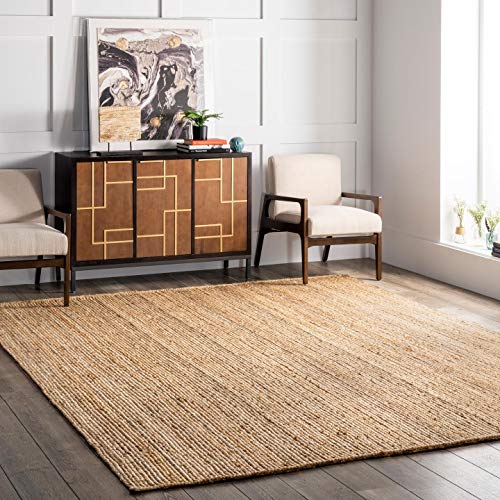
nuLOOM Rigo Flatweave Rug 6×9 — Best Flatweave Alternative
The Rigo has been a default answer in natural-fibre rugs for years, and its character differs from the SAFAVIEH seagrass picks in a way worth understanding. Where those are tight, lustrous and almost tailored, the Rigo’s flatweave reads looser and more rustic — a hand-finished irregularity that suits farmhouse and bohemian rooms better than crisp coastal ones. Choosing between them is choosing a temperament, not a quality tier.
At 6×9 it occupies the useful middle ground between dining rectangle and living-room anchor, and its flat profile is the thinnest-feeling in this set underfoot: doors clear it, chair castors tolerate it, and robot vacuums climb onto it without the negotiations thicker rugs demand. Flatweaves do need their pad, though — without one, a light flatweave on a smooth floor will travel, bunch at the corners and generally behave like a large placemat with ambitions.
The natural solid colouring is the point and the limitation in one. It will harmonise with almost any scheme that includes wood, linen or plants, and it will also show dark pet hair and pale dust with complete impartiality, since a flat mid-tone surface hides nothing that lands on it. A weekly suction vacuum keeps the peace; households with shedding black dogs should simply know what they are signing.
Durability expectations should be set by the weave’s relaxed nature. This is a rug that ages into a room, softening and settling, rather than holding a showroom edge for years. For renters and first natural-fibre buyers it is often the wisest purchase in the set: substantial enough to learn the fibre’s habits, forgiving enough that learning them is not expensive.
- Footprint: 6 x 9 feet, between dining and living scales
- Profile: flatweave, the slimmest feel in this set
- Construction: natural solid flatweave, per the API title
- Border treatment: simple finished edges, per the listing
- Colour in the listing checked: natural
- Care route: suction vacuum; a pad is strongly advised
Strengths
- Rustic flatweave suits farmhouse and boho rooms naturally
- Slim profile clears doors and tolerates chair castors
- Versatile 6×9 serves dining, office or living layouts
Trade-offs
- Travels and bunches on smooth floors without a pad
- Mid-tone surface shows both dark hair and pale dust
- Relaxed weave ages softly rather than holding a crisp edge
Best for: farmhouse and bohemian rooms wanting an easy natural ground at a flexible size.
Not suited for: crisp, tailored interiors that need the seagrass picks’ tighter, shinier weave.

CAMILSON Easy Jute Rug 8×10 — Best Herringbone Texture
Jute is seagrass’s softer, earthier relative, and the CAMILSON uses it in a herringbone weave that gives a large floor something plain weaves cannot: a pattern made of structure rather than print. From across the room the 8×10 reads as warm natural texture; up close, the zigzag of the weave catches light in alternating directions, which keeps a big expanse of beige from going flat. Rooms that found the SAFAVIEH picks too quiet usually find this one just talkative enough.
The listing leans on easy cleaning and indoor-outdoor versatility, and the honest translation is that jute tolerates diligent vacuuming, prompt blotting and outdoor airing well, while remaining a plant fibre that should not be soaked, saturated or left damp. Treat the easy-clean claim as encouragement to maintain it briskly rather than permission to hose it like a plastic mat, and the rug will reward the distinction with years of service.
Underfoot, jute is kinder than seagrass — a little more give, a little less of that cool woven firmness — which makes this 8×10 a plausible living-room anchor for households that sit on the floor for games and films. It still wants a pad, both for creep and for the furniture-dragging protection all natural fibres beg for, and it still sheds a small amount of fibre in its early weeks, a normal settling that vacuuming shortens.
Style-wise, the herringbone leans boho and Mediterranean: rattan, terracotta, olive branches in a tall vase, linen in stripes rather than plains. In a strict coastal scheme of whites and driftwood it can read a touch warm and busy, where the NF111A’s calm would serve better. Neither is superior; they are answers to different rooms, and this guide’s job is to keep those rooms distinct.
A final practical note: large jute rugs arrive with a fold memory from shipping that can take days to relax. Unroll the CAMILSON in the morning, weight its corners with books, and let the room’s warmth persuade it flat by the weekend rather than forcing the issue with steam, which jute should never meet. Patience here is the whole technique.
- Footprint: 8 x 10 feet, full living-room anchor
- Weave: herringbone pattern woven into the surface
- Fibre: jute, per the API title, in natural colouring
- Use pitch: indoor and outdoor, per the maker’s listing
- Colour in the listing checked: natural
- Care route: vacuum diligently, blot promptly, never soak
Strengths
- Herringbone structure gives large floors visual movement
- Slightly softer underfoot than the seagrass picks
- Warm tone suits boho and Mediterranean schemes
Trade-offs
- Jute must never be soaked despite the easy-clean pitch
- Early fibre shedding needs a few weeks of vacuuming
- Warm busy texture can crowd a strict white coastal room
Best for: boho and Mediterranean living rooms wanting pattern without print on a large natural rug.
Not suited for: any spot where the rug will be drenched, hosed or left damp outdoors.
Roll-Up Bamboo Slat Mat — Prose-Only: The Hard Alternative
Every search for bamboo rugs surfaces these mats, so let us describe one plainly. A bamboo slat mat is a series of narrow bamboo strips joined side by side on a fabric or foam backing, forming a flexible sheet that lies flat, rolls up for storage, and presents a hard, smooth, faintly clicking surface to the feet. It is closer in spirit to a wooden blind or a sushi mat enlarged to rug scale than to anything woven, and no amount of shared search vocabulary makes it a textile.
Judged as itself, it has real virtues. The surface wipes clean with a damp cloth because there is no pile to hold anything; spills sit on top awaiting a tissue rather than soaking toward a backing. It is cool in summer in a way no fibre matches, it fears no chair castors, and it rolls away when the room needs to change — under a bed, behind a door — which makes it a favourite in small flats, home offices under rolling chairs, and rented rooms where the floor beneath must be protected without commitment.
Its limits are the mirror of its virtues. It offers no softness, no warmth in winter, and no sound absorption; a room floored with slats stays acoustically bright. The slats can crack if a heavy point load lands badly, the edges can catch bare toes until you learn their geography, and water left standing in the joins will mark the backing over time, so the wipe-clean promise assumes you actually wipe.
We list it prose-only, without a link, because the pool for this guide verified woven rugs, and because this product family should be bought by deliberate choice rather than by search-term accident. If what your room wants is a hard, cool, wipeable ground that rolls away on demand, buy a bamboo slat mat with your eyes open and it will please you for years. If what you wanted was the woven shore-grass texture of the five picks above, a slat mat would have disappointed you daily, and now you know why.
- Format: joined bamboo slats on a backing sheet
- Storage: rolls up; sold in sizes from mat to room scale
- Surface feel: hard, smooth and cool, no pile at all
- Backing: fabric or foam, varies by maker
- Positioning: mid-tier among floor coverings, priced by size
- Care route: wipe with a damp cloth; keep joins dry
Strengths
- Wipes clean instantly; nothing soaks into a pile
- Rolls away for storage, ideal in small or rented rooms
- Indifferent to chair castors and office-chair traffic
Trade-offs
- No softness, warmth or sound absorption whatsoever
- Slats can crack under heavy point loads
- Standing water in the joins marks the backing over time
Best for: home offices, small flats and summer rooms wanting a cool, wipeable, storable floor layer.
Not suited for: anyone actually seeking the woven texture and softness of a fibre rug.
How Do the Six Bamboo and Seagrass Options Compare?
| Pick | Format | Surface or build | Care route |
|---|---|---|---|
| SAFAVIEH Seagrass Rug 8×10 NF111A | Woven rug, 8×10, 3/8 in pile | Power-loomed seagrass, natural border | Suction vacuum; blot only |
| SAFAVIEH Seagrass Rug 6×8 NF114A | Woven rug, 6×8, 1/4 in pile | Power-loomed seagrass, natural border | Suction vacuum; brush crumbs |
| SAFAVIEH Seagrass Rug 5×8 NF117B | Woven rug, 5×8, 1/4 in pile | Power-loomed seagrass, natural border | Lift and sweep beneath weekly |
| nuLOOM Rigo Flatweave Rug 6×9 | Flatweave rug, 6×9 | Natural solid flatweave | Suction vacuum; pad advised |
| CAMILSON Easy Jute Rug 8×10 | Woven rug, 8×10 | Jute herringbone weave | Vacuum diligently; never soak |
| Roll-Up Bamboo Slat Mat | Slatted mat, sizes vary | Joined bamboo slats on backing | Wipe with a damp cloth |
Is Seagrass Really Stain Resistant, or Is That Marketing?
Mostly, it is botany. Seagrass grows in salt marshes, and its fibres carry a natural waxy coating that water beads on rather than soaking into, which is why a spilled drink on seagrass gives you a calm half-minute to fetch a cloth while the same spill on cotton is already a stain. Tea, coffee and wine blotted promptly usually leave no trace at all, a performance no other common plant fibre matches without chemical treatment.
The limits are equally botanical. That coating resists brief contact, not immersion; a plant pot leaking overnight, a pet accident discovered in the morning, or a rug left rolled and damp will mark the fibre permanently, often as a dark tide line that no cleaning lifts. Seagrass also cannot be shampooed, steamed or machine washed, so a stain that does set is a stain you keep, softened at best by sunlight and time.
Plan the room accordingly. Seagrass thrives where spills are events — dining rooms with adults, living rooms with house rules, offices, sunrooms — and struggles where spills are a climate, such as under a toddler’s high chair or beside a large dog’s water station. In climate rooms, put the washable synthetics to work and save the seagrass for the spaces where its natural armour is enough.
Which Rooms Suit Bamboo Slat Mats Better Than Woven Rugs?
The home office is the slat mat’s kingdom. Rolling chairs destroy pile, creep rugs into ridges and demand a surface that behaves like flooring; bamboo slats give castors a hard, even road, protect the boards or carpet beneath, and add a cool, deliberate look that photographs well on video calls. A woven rug under a desk chair is a maintenance argument renewed weekly; a slat mat simply ends the argument.
Summer rooms run a close second. A sunroom, a screened porch’s inner edge, a bedroom in a hot climate — anywhere bare feet want coolness rather than cushion — the slatted surface feels like a shaded veranda floor, and its indifference to plant watering drips and tracked-in garden dust suits rooms that live half outdoors. Keep it out of direct weather, though; the backing is not made for rain.
Small rented flats make the third case, because the mat is furniture that stores like a poster tube. Rolled behind a wardrobe it waits out the months when the room needs bare floor, then returns for summer or for a work-from-home season. No woven rug in this guide offers that vanishing act, and for tenants whose landlords forbid anything permanent, a floor layer that leaves no trace is worth more than softness.
Do Seagrass Rugs Need a Rug Pad, and Which Kind?
Yes, and the reasons are threefold. A natural rug on a hard floor creeps — slowly, diagonally, always toward the traffic — and a pad’s grip holds the geometry you arranged. The pad also supplies the thin cushion that a 1/4 inch weave cannot, turning a firm surface into a comfortable one without changing its character. Most importantly, the pad is a sacrificial layer between fibre and floor finish, preventing the weave’s slight abrasiveness from dulling varnish along the walking lines over years.
Choose felt or felt-and-rubber pads, cut an inch smaller than the rug on every side so the pad hides completely. Avoid thick memory-foam pads, which make a low natural rug feel oddly nautical underfoot, and avoid cheap rubber pads of uncertain composition on newly finished wood, since some rubbers react with finishes over time. The pad makers behind well-known hardwood-safe lines exist precisely because this pairing matters.
Bamboo slat mats reverse the advice: most carry their own backing and need no pad, and adding one can make the sheet ripple rather than lie flat. If a slat mat slides on a polished floor, a few strips of rug tape at the corners solve it more honestly than a full pad. Different constructions, different physics — the guide keeps them separate for exactly such reasons.
How Do You Clean Seagrass Without Damaging the Fibre?
Weekly suction vacuuming is the whole foundation. Use the hard-floor head or retract the beater bar, because rotating brushes fray the weave’s crown over months and give the surface a premature fuzz. Work in the direction of the weave where the pattern shows one, and lift the rug monthly to sweep the grit that has filtered through — that under-rug grit, ground between fibre and floor, is the real enemy of both.
Spills get blotted, never rubbed, with a white cloth and plain water used sparingly; a drop of mild detergent on the cloth handles greasy marks, followed by a second blotting with a clean damp cloth to lift the soap. Dry the spot with air movement — a fan, an open window — rather than heat. Anything stronger, from steam cleaners to rented shampoo machines, risks driving moisture deep into a fibre that cannot release it, trading a small stain for a large watermark.
Once or twice a year, a sunny-day airing does what no product can: the rug draped over a railing, both sides breathing, sheds the stale indoor smell that natural fibres slowly collect. Bamboo slat mats ask even less — a damp cloth along the slats, a dry one after, and attention to keeping the joins dry. Neither family rewards heroic cleaning; both reward brief, regular, gentle attention.
Seagrass, Jute, Sisal or Bamboo: How Do the Natural Fibres Differ?
Seagrass is the sleek one: smooth, slightly shiny, naturally water-resistant, cool to the touch, and the hardest of the woven fibres to stain. Jute is the soft one: matte, golden, a little giving underfoot, kinder in bedrooms, but thirsty and easily marked by liquids. Sisal, from the agave plant, is the tough one: coarse, bristly, extremely durable in halls and on stairs, and the least forgiving to bare knees and crawling babies. Each is honestly natural; they simply grew up in different climates and carry those climates in their behaviour.
Bamboo stands apart from the woven three entirely, being a grass processed into lumber rather than a fibre twisted into yarn. It shares their palette and their eco-friendly reputation while behaving like wood: hard, wipeable, cool, noisy under heels. When a listing blurs these distinctions — a ‘bamboo fibre’ textile here, a ‘seagrass style’ print there — read the materials line until the actual construction is clear, because care, comfort and lifespan all follow from construction rather than from the name on the label.
For most living spaces the practical ranking writes itself. Choose seagrass where spills and dining happen, jute where softness and pattern matter more than stain armour, sisal where traffic is brutal and feet are shod, and bamboo slats where wheels roll or floors must be wiped rather than vacuumed. The five linked picks in this guide cover the first two of those territories, which are the ones this category’s shoppers overwhelmingly inhabit.
What Should You Expect From Colour and Texture Variation in Natural Rugs?
A seagrass rug is a harvested field made rectangular, and its colour carries the field’s biography: strands from sunnier edges dry paler, strands from wetter ground carry a green-grey cast, and the loom blends them into a surface that shifts gently across its width. Photographs flatten this into a single beige; the real object has weather in it. Most owners come to read that variation as the rug’s authenticity, the visible proof that no dye vat or printer was involved.
If your room’s scheme depends on an exact match — a specific cushion, a painted wall that must rhyme precisely — order with the expectation of a family resemblance rather than a twin. Natural rugs sit happiest in palettes built from ranges: whites that tolerate cream, woods of several tones, greens of several depths. The coastal and Scandinavian styles that made seagrass famous are both range palettes, which is no coincidence; the fibre taught the styles their tolerance.
Texture varies more politely: a tight power-loomed weave like the SAFAVIEH picks keeps its rows disciplined, while looser flatweaves such as the Rigo wander charmingly. Neither is a defect. What should prompt a return is damage — broken strands, a border pulling away, a corner that will not lie flat after a week of books upon it — not the gentle irregularity that distinguishes a grown material from an extruded one.
How Should You Arrange Furniture on a Large Seagrass Rug?
The front-legs rule serves natural rugs particularly well: sofa and chairs rest their front feet on the weave, back feet on the floor, which anchors the group without burying the rug’s texture under furniture. On seagrass the arrangement has a second benefit — the visible weave between pieces becomes the room’s pattern, so a plain rug can carry a whole seating group without cushions and throws having to work overtime to supply interest.
Leave a border of bare floor around the rug wherever the room allows it. Natural weaves read as crafted objects, closer to a mat laid with intent than to wall-to-wall carpeting, and a margin of wood or stone frames them the way a mount frames a print. Twelve to eighteen inches of floor suits most rooms; less than six starts to look like a measuring error rather than a decision.
Finally, plan the placement before the rug arrives and then commit. Every repositioning of a large natural rug means lifting furniture, and every lift is a chance to skip the felt glides you meant to fit. Fit the glides during the first placement, photograph the arrangement for future reference, and let the rug settle; seagrass rewards households that arrange once and then leave the room alone to be lived in.
Can Seagrass Work in a Rental or a First Home?
Renters may be natural fibre’s ideal owners. A seagrass rug transforms a landlord’s indifferent flooring without touching it, travels rolled to the next home, and suits the pared-back furniture of a first household precisely because its texture supplies the richness that sparse rooms lack. The 5×8 and 6×8 sizes in this guide move in a car; the 8×10 sizes move in a small van and a friendship.
Protect the deposit as diligently as the look: a pad beneath, glides on legs, and a phone photograph of the floor before placement create a paper trail of care. Because the rug cannot be deep-cleaned, keep it out of the spill-heavy zones of a rental — the sofa’s drink side can host a small washable mat as a bodyguard — and the seagrass will leave with you in the same condition it arrived.
First homes teach the same lesson at larger scale. Buy the fibre for the rooms it suits, in the size the furniture needs, and resist stretching one rug across two jobs. A household that learns material honesty on its first natural rug tends to furnish the rest of the home more wisely, which is a dividend no listing mentions.
What Happens to Seagrass Across the Seasons of a Year?
Spring suits it effortlessly. Windows open, shoes lighten, and the fibre’s cool surface matches the season’s mood; this is also the moment for the annual lift, shake and under-rug sweep that resets the arrangement after winter’s grit. Check the pad while the rug is up — felt compresses over a year — and rotate the rug half a turn so the doorway lane of wear moves to a quieter edge.
Summer is seagrass’s showcase season, when its temperature and texture feel designed for bare feet and long evenings. Sunlight is the one summer hazard: a rug half in a sunny window will fade unevenly, the lit half paling against the shaded half until the line across the room becomes permanent. Sheer curtains, or rotating the rug monthly through the brightest months, keep the colour honest.
Autumn asks for a coir ally at the door, since leaf litter and the first muds arrive together, and winter asks for lowered expectations of any natural fibre near entrances. Inside the room, though, seagrass under a lit fire’s glow holds its own against wool visually, especially layered with a sheepskin or a small wool rug at the sofa’s foot — a winter costume that comes off in March. Owners who dress the rug seasonally rather than replacing it tend to keep it longest of all.
What Mistakes Do People Make With Seagrass and Bamboo Rugs?
Putting seagrass where water stands. A leaking planter, a dog’s sloshing bowl, a bathroom’s edge — sustained moisture defeats the fibre’s coating and leaves permanent tide marks. Seagrass belongs in rooms where spills are accidents, not in rooms where wetness is the daily condition.
Steam cleaning or shampooing a natural weave. The machines promise deep cleaning and deliver deep wetting, which plant fibres cannot release; the usual result is a watermark larger than the original stain and a rug that smells of the marsh it came from. Blotting and air are the whole medicine cabinet here.
Skipping the pad to save money. A pad costs a fraction of the rug and prevents the creep, the floor dulling and the edge curl that make owners blame the fibre. On hard floors especially, the pad is not an accessory but half of the product you actually bought.
Dragging furniture across the weave. Natural fibres tolerate weight gladly and friction badly; a sofa dragged six inches can fuzz a permanent track. Lift pieces, or slide them on felt pads during the twice-yearly rearrangement, and the surface will stay even for years.
Expecting a slat mat to behave like a rug. Buyers who order bamboo slats imagining woven softness return them in disappointment that has nothing to do with quality. Read the construction, picture walking on a cool wooden blind, and buy the mat only if that picture pleases you.
Judging the colour from the listing photograph alone. Screens warm and cool at random, and natural fibre varies by harvest besides. Decide whether your room’s palette can embrace a range of straw-to-sage tones; if it cannot, a dyed synthetic in a fixed shade is the safer servant.
Final Recommendation
Decide first whether your room is a dry room with accidents or a wet room with dry spells, because that single judgement sorts this entire category more reliably than any brand comparison. Dry rooms with accidents deserve the woven picks and will be repaid with years of calm texture; wet rooms with dry spells should take their natural look from washable lookalikes and keep the real seagrass for the bedroom and the sitting room, where it can be itself.
For most rooms, the answer is the SAFAVIEH seagrass in the size that fits the furniture: the 8×10 NF111A where a living room needs a pale ground, the 6×8 NF114A under a dining table, the 5×8 NF117B where a bedroom or entry wants texture at a gentle scale. Choose the nuLOOM Rigo when your room’s mood is rustic rather than tailored, the CAMILSON herringbone when plain beige needs a pulse, and the bamboo slat mat only when you truly want a hard, rolling, wipeable floor layer rather than a rug.
Live with any of them for one full season before judging. Natural fibres settle — the sheen evens, the edges relax, the colour finds its place in the room’s light — and the rug you assess in month three is calmer and better integrated than the one that arrived in a roll. A seagrass rug chosen for the right room does not demand attention; it lowers the room’s temperature, quiets its palette, and lets everything you actually love in the space stand on solid, sandy ground.
Frequently Asked Questions
Does seagrass smell when it is new?
A fresh seagrass rug carries a hay-like, faintly sweet smell that most people find pleasant and all people find temporary. Airing the rug for a day before placement, or simply living with open windows during its first week, reduces it to a whisper. If the smell strengthens after the rug gets wet, that is moisture talking rather than newness, and thorough air drying is the answer.
Can seagrass rugs go in a kitchen?
In the eating part of a kitchen, yes, happily — crumbs brush off and spills blot up well. Under the sink and cooker line, where water and grease land daily, a washable mat serves better and the seagrass can stop at the boundary. Many households run exactly that border: natural rug for the table zone, practical mat for the working zone.
Are natural fibre rugs suitable for homes with cats or dogs?
For dry, well-mannered pets, seagrass is among the best choices: hair vacuums off its tight weave easily and the fibre resists casual stains. For puppies in training, elderly dogs or any animal whose accidents are frequent and soaking, the inability to wash the rug becomes decisive — choose a machine-washable rug for those rooms and keep the seagrass for the calm territories.
How long should a seagrass rug last?
In a dry room with a pad beneath and suction-only vacuuming, a well-made seagrass rug serves many years, its surface mellowing rather than failing. The edges and border are the usual first casualties, followed by wear lanes in doorways. Rotating the rug half a turn each season spreads that traffic and is the cheapest lifespan extension available.
Will a bamboo slat mat damage the floor beneath it?
The backing is designed to rest on floors safely, and the greater risk runs the other way: grit trapped under any floor covering can scratch as the covering shifts. Sweep beneath a slat mat monthly, keep its corners taped if your floor is polished, and both mat and floor will coexist without marking each other.
Can I use a seagrass rug over carpet?
It can be done in a pinch with a rug-on-carpet pad, but the pairing fights itself: the firm weave wants a hard, flat foundation, and carpet’s give makes it creep and ripple. Natural rugs earn their keep on hard floors, where their texture contrasts with wood, stone or tile; over carpet, a woven textile rug is the happier layer.
Related Guides
If the natural-fibre mood extends through the house, Best Basement Workout Rugs covers the one room where woven rugs should never go, Best Bath Rugs That Resist Mold and Mildew handles the wettest territory with the same honesty about materials, and Best Area Rugs for Wood Floors explores what belongs beneath and around hard floors generally. For the garden side of the same palette, Best Affordable Outdoor Rugs takes the coastal look outside.


