What's inside
- Key Takeaways
- Quick Picks
- How We Chose These Picks
- Which of the Best HEPA Bagged Canister Vacuums Fits Your Routine?
- How Do the Six Compare at a Glance?
- What Is the Difference Between True HEPA, HEPA Filtration and HEPA-Type?
- Why Do Bags Belong in a Filtration Conversation at All?
- How Much Do Replacement Bags Really Cost a Household Over Time?
- Turbobrush, Electrobrush or Pure Suction: Which Head Fits Your Floors?
- How Does Adjustable Power Earn Its Place on a Strong Canister?
- What Should You Check in the First Fortnight With a Bagged Canister?
- How Do Bagged Canisters Serve Allergy-Aware Households Without Medical Promises?
- When Is a Specialist Brand Worth Its Ordered Consumables?
- How Do You Compare Filtration Claims Across Brands Without a Laboratory?
- What Happens to Suction as a Bag Fills, and How Do You Read It?
- How Should a Bagged Canister Be Stored to Protect Its Seals?
- Why Do Two Identical-Looking Tritans Deserve Separate Reviews?
- How Do You Budget a Decade of Bagged Ownership Before Buying?
- What Should You Ask a Seller or Listing Before Committing?
- How Do Filters and Bags Share the Work Across a Machine’s Life?
- Why Does a Canister’s Exhaust Matter in a Closed Winter House?
- How Should You Move From a Bagless Past to a Bagged Future?
- How Do You Hear a Canister Asking for a Bag Change?
- What Is the Honest Place of Scented Bags and Fresheners?
- How Should a Bagged Canister Share a House With a Robot Vacuum?
- Why Does the Hose Deserve as Much Attention as the Motor?
- How Do You Introduce a Bagged Canister to a Household Member Who Hates Changing Anything?
- Why Does a Canister Belong at the Centre of a Whole-House Cleaning Day?
- How Should You Clean the Rooms of Someone Who Works Nights?
- Why Is a Spare Bag the Cheapest Insurance in Floor Care?
- What Is the Final Check Before a Bagged Canister Becomes Yours?
- What Mistakes Do Buyers Make Most Often?
- Final Recommendation
- Frequently Asked Questions
- Related Guides
As an Amazon Associate I earn from qualifying purchases. This post may contain affiliate links at no extra cost to you.
cottageverdict.com is reader-supported. When you buy through links on our site, we may earn an affiliate commission.
Where to buy: the six canisters below are sold on Amazon, linked from the Quick Picks table, the review headings and the comparison table, where you can check price on Amazon and confirm bag type, floor heads and filtration wording on each listing. The best HEPA bagged canister vacuums live or die by language, because HEPA can describe a sealed system, a filter grade or a resemblance, and this guide grades the wording of every listing before it grades anything else.
Two Prolux Tritans that differ by one word, sealed, anchor the lesson, while Kenmore, Akitas and two Miele C3 models show how bags, heads and brands interact with filtration claims. Bag replacement cost is treated throughout as a real trade-off with a budget method, never as a footnote.
Key Takeaways
- Sealed HEPA wording outranks plain HEPA filtration, which outranks HEPA-type.
- The bag is part of filtration: most dust never reaches the filter at all.
- One Tritan here claims sealed HEPA and five speeds; its sibling does not.
- Date your first bag and let your own household price the consumable year.
- Buy the floor head for your deepest pile; technique cannot upgrade a gentle head.
- No health promises are made: these machines control dust’s journey, nothing more.
Quick Picks
| Pick | Badge | Why it earns its place |
|---|---|---|
| Prolux Tritan Bagged Canister | Best Adjustable Home Care Kit | A blue bagged Tritan with HEPA filtration, adjustable power and a complete home care tool kit in its listing. |
| Prolux Tritan Sealed HEPA 5-Speed | Best Sealed Claim, Five Speeds | The second Tritan, distinguished by sealed HEPA wording and a five-speed motor in its listing. |
| Kenmore 600 Series Bagged Canister | Best for Pet Hair and Carpet | A 600 Series bagged canister with a Hair Eliminator brushroll, Pet PowerMate, two motors and HEPA filter wording. |
| Akitas C11 Bagged Canister | Best Lightweight, Long Radius | A lightweight bagged C11 with HEPA filtration wording, a 33ft cleaning radius and an extra floor brush. |
| Miele Complete C3 Calima | Best Turbobrush Versatility | A curry yellow C3 Calima with a turbobrush floorhead for low-medium pile carpet and hard floors. |
| Miele Complete C3 Marin | Best Electrobrush for Carpet | A marine blue C3 Marin with an electrobrush floorhead for carpets and hard floors alike. |
How We Chose These Picks
Bagged architecture was the entry condition, and filtration wording was then ranked on a three-tier hierarchy applied consistently: sealed or true system claims first, filter-grade HEPA claims second, and resemblance language, absent from these titles, last. Each review states its pick’s tier in plain terms so the comparison stays honest when a famous brand meets a specialist one.
Floor heads were mapped against pile with equal strictness: powered electrobrush and brushroll designs for carpet-led homes, an air-driven turbobrush for the low-medium middle, suction-led designs for hard floors. Ownership arithmetic, bag cost, consumable availability, radius and weight, was scored as part of the machine rather than as an afterthought, because a canister is a decade-long relationship with a supply chain attached.
Which of the Best HEPA Bagged Canister Vacuums Fits Your Routine?

Prolux Tritan Bagged Canister — Best Adjustable Home Care Kit
The first Tritan in this list is the kit-minded one: a blue bagged canister whose listing leads with HEPA filtration, adjustable power and a complete home care tool kit, pitched at households that want attachments for the whole map rather than a floor head and good wishes. Adjustable power is the Tritan signature worth understanding, because a bagged canister’s suction is strong enough to need governing, on rugs it might lift, curtains it might swallow and hard floors where full force mostly adds noise.
On filtration language, read this listing as claiming HEPA filtration within a bagged system, and credit the bag itself as part of that system, since a sealed bag is where most dust is actually detained. The honest hierarchy this guide applies throughout is simple: a listing that says sealed HEPA describes the strongest claim, a listing that says HEPA filtration describes a filter grade, and HEPA-type language, where it appears in the wider market, describes something that resembles the standard without meeting it. This Tritan sits in the middle tier on its wording, with the bagged architecture doing quiet, genuine work beside the filter.
- Format: bagged canister, blue
- Filtration claim: HEPA, per the listing
- Power: adjustable setting, per listing
- Kit: complete home care tools included
- Stated work: pet hair and home cleaning
- Dust handling: bags, sealed at disposal
Strengths
- Adjustable power governs strong suction politely
- Tool kit covers more than floors alone
- Bagged disposal keeps dust enclosed
Trade-offs
- Filtration wording stops short of sealed
- Bags are a lifetime running cost
- Kit storage needs a cupboard plan
Keep this Tritan’s tool kit in one labelled box near the machine, because a kit scattered across three cupboards is a kit that does not exist at the moment the stairs need doing. Its adjustable power rewards a household that learns its own surfaces’ favourite settings and writes them on the box lid.
Best for: households wanting one bagged machine with tools for the whole home
Not suited for: buyers who require the strongest sealed HEPA claim available

Prolux Tritan Sealed HEPA 5-Speed — Best Sealed Claim, Five Speeds
Two Tritans share this list, and the difference between them is written in this one’s title: sealed HEPA filtration and a five-speed motor. Sealed is the load-bearing word in filtration, because it describes a system designed so air must pass through the filter path instead of leaking around it, and on this guide’s hierarchy that places this Tritan a tier above its sibling’s plain HEPA filtration wording. Buyers comparing the two should let that word, and the finer speed control, carry real weight in the decision.
Five speeds turn suction into a dialled instrument: full voice for kitchen grout and entrance grit, a middle register for everyday floors, a gentle draw for rugs and curtains that a fixed-power canister bullies. The listing pitches the machine at pet hair and home cleaning, and a sealed bagged system is the configuration dust-sensitive pet households are routinely steered toward, since hair and dander leave inside a closed bag. Bags remain the standing cost, and the specialist brand means ordering consumables rather than grabbing them locally, the accepted tax on the sealed claim.
- Format: bagged canister
- Filtration claim: sealed HEPA, per listing
- Motor control: five-speed settings
- Stated work: pet hair and home cleaning
- Dust handling: bags, sealed at disposal
- Brand type: specialist floor care name
Strengths
- Sealed wording tops this list’s hierarchy
- Five speeds tailor suction surface by surface
- Bagged system suits dust-aware pet homes
Trade-offs
- Consumables ordered rather than bought locally
- Bags continue for the machine’s whole life
- Functional styling over showroom polish
Five speeds invite a small experiment in the first week: run the same rug at three settings and watch where hold-down ends and cleaning begins. That private calibration, ten minutes once, is what turns a control dial from a feature into a habit the machine was bought for.
Best for: dust-sensitive households wanting the strongest filtration claim here
Not suited for: buyers who want high-street consumable availability

Kenmore 600 Series Bagged Canister — Best for Pet Hair and Carpet
The Kenmore 600 is the carpet-capable heavyweight of this six: two motors, a powered head whose Hair Eliminator brushroll is designed to shed the wrap that pet hair builds, a Pet PowerMate mini tool for stairs and upholstery, and a Stair Grip design that lets the body sit securely on a tread. Its listing claims a HEPA filter, which on this guide’s hierarchy is a filter-grade claim rather than a sealed-system claim, and the bagged architecture again contributes the sealed disposal that matters most at emptying time.
Judge the Kenmore by its division of labour. On hard floors it runs as a suction canister with manners; on real carpet the powered head does work no suction-only rival here attempts. That breadth costs weight and complexity, and in an all-hard-floor home the second motor is a passenger. In a mixed-floor pet household it is the entire argument, because the alternative is two machines. Bag costs apply as they do to every pick in this guide, and the Kenmore’s bags join a consumable budget that should be counted before purchase, not discovered after.
- Format: bagged canister, powered head
- Motors: two-motor design, per listing
- Brushroll: Hair Eliminator anti-tangle
- Tools: Pet PowerMate for stairs, upholstery
- Filtration claim: HEPA filter, per listing
- Extras: retractable cord, Stair Grip design
Strengths
- Cleans deep carpet as well as hard floors
- Pet tools reach stairs and furniture properly
- Bagged disposal keeps pet dust enclosed
Trade-offs
- Heaviest, most complex machine here
- Powered head is surplus on all-hard floors
- HEPA wording is filter grade, not sealed
The Kenmore’s brushroll should be inspected monthly in a pet household, not because its anti-tangle design fails, but because even a shedding roll appreciates a cleared bearing and a checked belt path. Five minutes with scissors and a cloth keeps the powered head’s whole argument intact.
Best for: mixed-floor pet households split between carpet and hard floors
Not suited for: all-hard-floor homes paying for carpet machinery they will not use

Akitas C11 Bagged Canister — Best Lightweight, Long Radius
The Akitas C11 argues that a bagged HEPA-minded canister need not be heavy or short-reached. Its listing states a 33ft cleaning radius with a retractable cord, a figure worth picturing against your largest room, because a radius that covers the room from one socket changes a session from socket-hopping to a single continuous pass. Light weight compounds the advantage on stairs and in smaller homes where the body is carried as often as it is trailed.
Its filtration wording claims HEPA filtration, the middle tier of this guide’s hierarchy, and the bagged format supplies the sealed disposal that supports the claim in daily life. An extra floor brush in the listing suits the C11’s stated territory of hard floors and low-pile carpet, and that territory should be respected: deep carpet belongs to the Kenmore’s powered head, not to this lighter machine. What the C11 offers instead is the bagged, filtered formula at an effort level that encourages frequent use, and frequency, in floor care, quietly beats power left in a cupboard.
- Format: bagged canister, lightweight
- Cleaning radius: 33ft, per the listing
- Cord: retractable, per the listing
- Filtration claim: HEPA filtration wording
- Surfaces: hard floors, low-pile carpet
- Extras: extra floor brush included
Strengths
- 33ft radius covers rooms from one socket
- Light body encourages frequent use
- Bagged disposal suits dust-aware homes
Trade-offs
- Suction brief ends at low-pile carpet
- Filtration claim is not sealed wording
- Smaller brand means ordered consumables
A long radius changes where a machine lives. The C11 can serve a whole floor from a hall cupboard without a mid-clean relocation, so give it that cupboard, coiled and ready, and its lightness will be used weekly rather than admired occasionally.
Best for: smaller and multi-level homes wanting a light bagged canister
Not suited for: deep-carpet households needing a powered brushroll

Miele Complete C3 Calima — Best Turbobrush Versatility
Miele’s Calima is the diplomat of the C3 range: a bagged canister in curry yellow whose turbobrush floorhead, driven by air rather than a motor, agitates low to medium pile carpet respectably while remaining safe and effective on hard floors. That air-driven head is the distinction to grasp, because it places the Calima between pure suction and the Marin’s electric brush: more carpet ambition than a suction head, less weight, cost and aggression than a motorised one.
Miele’s bagged system is engineered as a sealed journey for dust in practice, with bags and filters designed as one system, and the brand’s filtration reputation rests on that system thinking rather than on a single word in a title. The Calima’s stated territory, low-medium pile and hard floors, describes most real homes more honestly than all-floor promises do. Bags are premium consumables and should be budgeted as such; what they buy is a machine whose parts, service knowledge and composure are measured in decades rather than product cycles.
- Format: bagged canister, curry yellow
- Floorhead: turbobrush, air-driven
- Surfaces: low-medium pile, hard floors
- System: Miele bag and filter system
- Build brief: Complete C3 range
- Dust handling: sealed bag disposal
Strengths
- Turbobrush bridges suction and powered heads
- System filtration engineered as one design
- Composed manners across mixed floors
Trade-offs
- Premium bags continue for its lifetime
- Air-driven head yields to deep pile
- Considered price across machine and parts
Register the Calima’s bag dates in a note on the cupboard door. Miele systems reward owners who treat consumables as a schedule rather than a surprise, and a four-line pencil record is the entire technology required to keep its filtration performing as designed for a decade.
Best for: mixed homes of hard floors and medium carpet wanting one refined machine
Not suited for: deep-pile households needing a motorised electrobrush
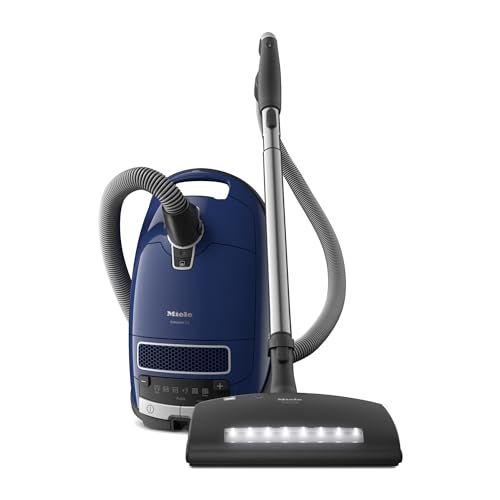
Miele Complete C3 Marin — Best Electrobrush for Carpet
The Marin is the C3 range’s carpet authority: an electrobrush floorhead, motor-driven for genuine agitation, on a bagged canister in marine blue, stated for carpets and hard floors without the pile qualifications its Calima sibling honestly carries. Where deep or dense carpet exists, that motorised brush is the difference between surface cleaning and extraction, and the Marin is the pick in this list that a carpet-led household should read first and measure the others against.
The rest is the Complete C3 formula: a bagged system engineered end to end, filtration treated as a system property, and a body built for a long service life with parts support to match. On hard floors the electrobrush can be swapped or its agitation managed according to the floor’s delicacy, so the Marin’s breadth is real rather than rhetorical. Its costs are equally real: the machine sits at the considered end of the market and its bags are premium consumables, a budget line to accept with open eyes in exchange for the deepest carpet clean available in a bagged canister here.
- Format: bagged canister, marine blue
- Floorhead: electrobrush, motor-driven
- Surfaces: carpets and hard floors
- System: Miele bag and filter system
- Build brief: Complete C3 range
- Dust handling: sealed bag disposal
Strengths
- Motorised brush extracts from deep carpet
- Full C3 system refinement throughout
- Hard floors handled within one machine
Trade-offs
- Premium machine and bag costs combined
- Heaviest filtration of wallet, not of hand
- Powered head needs care on delicate floors
The Marin’s electrobrush deserves a parking rule: store it on its wheels or hung, never resting on its bristles, because a brush parked under weight for months takes a set that its first carpet of the season will have to correct.
Best for: carpet-led households wanting bagged refinement with real agitation
Not suited for: hard-floor-only homes paying for carpet power they will never use
How Do the Six Compare at a Glance?
| Model | Form | Key trait | Signature strength |
|---|---|---|---|
| Prolux Tritan Bagged Canister | Bagged canister | Adjustable power, full kit | Versatile home care |
| Prolux Tritan Sealed HEPA 5-Speed | Bagged canister | Sealed HEPA, 5-speed | Filtration-first control |
| Kenmore 600 Series Bagged Canister | Bagged canister | Powered pet system | Mixed-floor breadth |
| Akitas C11 Bagged Canister | Bagged canister | Lightweight, 33ft radius | Effortless filtered cleaning |
| Miele Complete C3 Calima | Bagged canister | Turbobrush floorhead | Refined mixed-floor diplomacy |
| Miele Complete C3 Marin | Bagged canister | Electrobrush floorhead | Carpet authority, bagged |
What Is the Difference Between True HEPA, HEPA Filtration and HEPA-Type?
They are three different promises wearing similar coats. True or sealed HEPA language describes a system: a filter meeting the HEPA standard, housed so that air cannot bypass it, which is why the sealed wording on one Tritan in this list carries weight beyond the word HEPA alone. Plain HEPA filtration wording, used by several listings here, claims a filter of that grade inside the machine without describing the sealing of the path around it, a meaningful claim with a quieter scope.
HEPA-type, and its cousins HEPA-style and HEPA-like, describe filters that resemble the standard without meeting it, capturing less of the finest fraction. No pick in this list uses that weakest language in its title, and buyers comparing beyond this list should treat the suffix as a discount on the promise. In every tier, the bag matters: a sealed bag detains the bulk of dust before filtration is even asked its question, which is why bagged machines punch above their wording.
Why Do Bags Belong in a Filtration Conversation at All?
Because most dust never reaches the filter. A bag is the first and largest detention stage, holding hair, grit and the great mass of household dust inside a sealed container that is removed whole. By the time air reaches the filter, its burden is the fine fraction, and the filter’s job stays possible for far longer than in a bagless design where the same filter meets everything the floor offered.
Disposal completes the argument. A bag leaves the machine closed, goes to the bin closed, and at no point asks its owner to shake a cloud loose at arm’s length. For dust-sensitive households that closed journey is often worth more than a tier of filter wording, and it is the reason this guide scores bagged architecture as part of filtration rather than as a mere storage preference with a price attached.
How Much Do Replacement Bags Really Cost a Household Over Time?
Enough to budget, not enough to fear, provided the budget is written before the purchase. A bag fills with compacted dust rather than fluffy volume, so a single bag commonly serves for weeks of ordinary cleaning, longer in hard-floor homes whose dust packs densely, shorter where pet hair inflates every load. The honest method is empirical: date the first bag when it goes in, date its replacement, and let your own household’s interval price the year.
Buy in modest multiples once the interval is known, store bags dry, and change on fullness rather than on thrift, because a drum-tight bag strangles airflow, stresses the motor and quietly taxes every clean. Premium-brand bags, Miele’s especially, cost more per unit and deliver their system’s designed fit; pattern bags cost less and gamble on that fit. Either way, the annual figure is predictable, which is why bagged owners describe the cost as a subscription rather than a surprise.
Turbobrush, Electrobrush or Pure Suction: Which Head Fits Your Floors?
Read the pile, not the marketing. Hard floors and low-pile rugs are pure suction’s home ground, where no agitation is needed and none can scatter or scratch. Low to medium pile asks for help lifting grit from the fibre roots, and an air-driven turbobrush like the Calima’s supplies that help at modest weight. Deep or dense carpet keeps its dirt at depth, and only a motor-driven electrobrush like the Marin’s, or the Kenmore’s powered head, reaches it honestly.
Mixed homes should buy for their most demanding floor and manage the rest with technique, swapping heads or easing power on delicate surfaces. The reverse purchase, a gentle head for a demanding carpet, cannot be managed upward by any technique. When a listing states its pile territory plainly, as the Calima’s does, believe it completely; that honesty is the maker telling you where the head’s physics end.
How Does Adjustable Power Earn Its Place on a Strong Canister?
By governing strength that would otherwise bully half the house. Full suction drags lightweight rugs across floors, swallows curtain hems, and makes a wand fight its owner on deep pile where the head seals too well. A dial, two speeds or the five speeds of the sealed Tritan here, turns one strong machine into several polite ones, matched surface by surface through a single session without a pause for attachment changes.
Power control is also noise control and motor kindness. A lower setting for the early hallway respects sleeping households, and a machine rarely run at its maximum ages more gently than one flogged at full voice daily. Buyers who clean varied surfaces in one pass will use the dial weekly; buyers with one uniform floor may never touch it, and should let other virtues, weight, radius, filtration tier, decide their purchase instead.
What Should You Check in the First Fortnight With a Bagged Canister?
Four tests write the machine’s character. The radius test: clean your largest room from one socket and learn whether cord and hose honestly cover it. The grout and edge test: run the floor head slowly along skirting and a traffic line and inspect what pure suction lifts. The stair test, if stairs exist: park the body, work the wand, and judge whether the hose length and the body’s stability suit your flight. The storage test: time the put-away, because a machine that takes three minutes to stow will live in a hallway and age in public.
Begin the bag diary in the same fortnight. Note the date the first bag starts, keep the spare bags somewhere dry and findable, and learn the fullness signal your machine gives, a change in note, a flag, a loss of appetite at the head. Owners who learn these signals early never meet the drum-tight bag’s slow strangulation that owners who guess discover monthly.
How Do Bagged Canisters Serve Allergy-Aware Households Without Medical Promises?
By controlling dust’s journey rather than by treating anyone’s condition, and this guide makes no health claims beyond that mechanical description. A bagged, well-filtered canister collects dust into a sealed container, exhausts through its filter path, and disposes of the whole accumulation without a shaking event at the bin. Each stage reduces the dust a household re-encounters during cleaning itself, which is a housekeeping virtue that can be described honestly without borrowing a clinician’s authority.
Practices complete what architecture starts. Empty and change bags outdoors or with the bin held low and the bag kept closed, run the machine with windows as your household prefers, and keep filters on the maker’s schedule, since a neglected filter undermines the tiers this guide has ranked so carefully. Households with medical questions about dust should put them to their clinician; households with housekeeping questions will find the sealed, bagged end of this list the most defensible answer available.
When Is a Specialist Brand Worth Its Ordered Consumables?
When the machine’s distinguishing virtue cannot be bought from a high-street name. The sealed Tritan’s filtration wording and five-speed control, and Miele’s decades-deep parts and service knowledge, are virtues with addresses; their bags and parts arrive by order, on a schedule a household can plan around once its bag diary exists. The inconvenience is real but bounded, a few days’ postage against years of the virtue itself.
It is not worth it when the virtue is ordinary. A household that needs only a sound bagged clean on uniform floors gains little from a specialist badge and should value the local availability of consumables instead. Decide which kind of household yours is before the first bag fills, because the consumable relationship, not the machine’s first month, is the one you will actually live inside for a decade.
How Do You Compare Filtration Claims Across Brands Without a Laboratory?
By reading wording like a contract. Note whether the claim describes a system or a component, whether sealing is asserted or merely implied, and whether the standard is named or only evoked by initials and adjectives. A maker who has paid for sealing and testing usually says so in precise language; a maker trading on resemblance uses the vocabulary of approximation, type, style, like, and hopes the reader’s eye slides over the suffix.
Then weight the architecture that no wording can fake. A sealed bag, a filter placed correctly in the exhaust path, and a body whose seals are a designed feature all contribute measurably to what a room’s air experiences during cleaning. This guide’s hierarchy, sealed system, filter grade, resemblance, applied to the listing’s exact words, is the most honest comparison a buyer can perform without instruments, and it is reproducible on any product page in the category.
What Happens to Suction as a Bag Fills, and How Do You Read It?
It declines gradually, then suddenly, because a bag’s pores load progressively until airflow reaches the point where the head’s appetite visibly fades. The early signs are behavioural: a second pass needed on a familiar rug, grit surviving at skirting, the machine’s note rising as it works harder for less. Owners who wait for the dramatic sign, a bag drum-tight and a motor straining, have been cleaning at half strength for weeks without a single dramatic moment to warn them.
Read fullness directly instead. Most systems offer a flag, a window or a simple hand’s judgement through the bag’s fabric, and a monthly glance costs nothing. Change at the maker’s fullness signal rather than at your thrift’s, because the saving from an overextended bag is one bag, while the cost is paid in cleaning quality on every pass and in motor ease across the machine’s whole life.
How Should a Bagged Canister Be Stored to Protect Its Seals?
Dry, temperate and uncrushed. Seals and gaskets age fastest in heat and damp, so the garage’s summer and the boiler cupboard’s warmth are both poor homes for a machine whose filtration depends on rubber meeting plastic exactly. A hall or under-stair cupboard at room conditions preserves the system the buyer paid for, and proximity, as always, decides whether the machine is used enough to justify its own existence.
Store with a fresh or part-used bag fitted rather than with the compartment empty and open to dust, park the hose without a kink that becomes permanent, and keep spare bags in the same cupboard, dry and counted. A canister stored as a system, machine, bags, filters and tools within one door’s reach, is a filtration appliance. Stored as scattered parts, it is a rumour of one.
Why Do Two Identical-Looking Tritans Deserve Separate Reviews?
Because their listings make different promises, and a guide that merged them would launder the difference away. One claims HEPA filtration with adjustable power and a tool kit; the other claims sealed HEPA filtration with a five-speed motor. The sealed wording changes the filtration tier, and the speed count changes the control a buyer actually exercises over rugs, curtains and noise. Those are purchasing facts, not trim levels, and they point to different households.
The lesson generalises across the category. Model families share bodies the way slipper ranges share surnames, and the specification lives in the exact title and listing of the exact variant. Buyers should read a canister’s full listing title the way they would read a contract’s schedule, because in floor care, as in little else, the difference between two products really can be one load-bearing word.
How Do You Budget a Decade of Bagged Ownership Before Buying?
With three lines of arithmetic. The machine’s price, the bags your diary predicts across ten years at your household’s interval, and one set of filters per interval the maker prescribes, plus a contingency for a hose or a head in year seven. Written down, the decade’s figure is almost always smaller than the fear of it, and it converts the consumable argument from an emotion into a comparison that bagless ownership must also survive, with its own filters, belts and earlier replacements entered honestly.
The exercise also disciplines the brand decision. A premium machine with premium bags can still win the decade if its service life doubles a cheaper rival’s, while a bargain machine replaced twice loses even with free bags. Buyers who run the decade’s numbers before the first purchase rarely regret the brand they chose, because they chose the relationship, not the receipt.
What Should You Ask a Seller or Listing Before Committing?
Five questions cover the category. What bag type does it take, and is that bag available in multiples at a sane price? What filter stages exist, and what exactly does the filtration wording claim, system or component? Which floor heads are in the box, and which pile do they honestly serve? What is the working radius, cord plus hose, against your largest room? And what wears out first by design, so its price can enter your decade’s budget today?
A listing that answers all five plainly has earned trust beyond its answers, because it demonstrates the maker’s own clarity about the machine. A listing that answers with adjectives where numbers and nouns were requested is telling you how its aftercare will read. In a category built on wording, the quality of the wording is itself a specification.
How Do Filters and Bags Share the Work Across a Machine’s Life?
Think of them as a relay rather than a team. The bag runs the first and longest leg, detaining the bulk and protecting everything downstream, and its condition sets the pace for the whole race. The pre-motor stages, where fitted, guard the motor from what the bag’s pores release. The exhaust filter runs the anchor leg, polishing what finally leaves the machine, and it can only perform if the earlier legs have not handed it an impossible load in a clogged and bypassed state.
Maintenance is therefore sequential in its logic. A neglected bag silently overworks every filter; a neglected filter wastes a perfect bag’s good work by leaking at the final gate. Owners who change bags on fullness and filters on schedule are not being fussy in two places; they are keeping one system in the state its designers assumed, and the system’s performance is simply what that state feels like from the handle.
Why Does a Canister’s Exhaust Matter in a Closed Winter House?
Because in winter the house is a sealed vessel that keeps everything its machines exhale. A vacuum run in January redistributes a portion of the floor’s finest dust into the room’s air unless its filtration detains it, and in a closed house that portion settles on the same surfaces, the same bedding and the same lungs’ territory it was collected from. The better the sealing and the filter tier, the smaller the portion, which is a mechanical fact a buyer can act on without any medical claim being made or needed.
This is the season when the hierarchy in this guide earns its keep most visibly. A sealed bagged system run slowly, with its filters in date, is the winter configuration; a hurried run with a drum-tight bag is its opposite, whatever the machine’s badge promises. Technique and maintenance are filtration’s silent partners, and winter, when the windows stay shut, is when their partnership is audited.
How Should You Move From a Bagless Past to a Bagged Future?
Expect a month of recalibration. The bagless eye judges fullness by sight and empties by ritual; the bagged hand must learn fullness by signal and by diary, and the first bag usually gets changed late while the lesson is learned. Forgive the first interval, write the date, and let the second bag be the honest measurement. The other recalibration is financial: bags arrive as a planned subscription rather than as the bagless owner’s surprise of a cracked cup or a blinded permanent filter.
What converts most converts is the disposal. The first time a month of household dust leaves the house inside a sealed bag, without a cloud, a shake or a bin-side performance, the bagless ritual’s true cost becomes visible in retrospect. Keep the old machine for the garage if it still serves, and let the bagged canister’s quieter manners own the interior, which is the division of labour this entire list quietly recommends.
How Do You Hear a Canister Asking for a Bag Change?
Its voice changes before its performance collapses. A canister working against a loading bag raises its note and holds it higher through familiar rooms, working harder for the same result, and owners who clean by ear learn that pitch the way drivers learn an engine’s. The second signal is appetite: grit that a healthy pass would take survives at the skirting, and the head needs a second visit to a line it used to finish in one.
Confirm by hand rather than by hope, through the bag’s own fullness or the machine’s indicator where fitted, and change on evidence. A household that answers the first signal cleans at full strength all year; a household that waits for the dramatic one spends a month of every bag’s life cleaning at half strength and blaming the floors. The bag diary, begun at purchase, turns both signals into a schedule, and a schedule needs no ear at all.
What Is the Honest Place of Scented Bags and Fresheners?
Decoration, and occasionally disguise. A scented bag perfumes the exhaust of a healthy system pleasantly and perfumes the evidence of an unhealthy one misleadingly, masking the smell that would have told its owner a bag was overdue or a filter was tired. This guide’s position is that a filtration system should smell of nothing, because nothing is the scent of a machine whose bags are changed on time and whose filters are in date.
Households that enjoy a scented product should add it after the maintenance is proven, never instead of it, and should treat any new smell from the machine, sweet or otherwise, as information to investigate rather than as an atmosphere to improve. The nose is a diagnostic instrument in floor care, and perfuming the instrument’s readings is a small, pleasant way to miss a large, expensive one.
How Should a Bagged Canister Share a House With a Robot Vacuum?
As the senior partner who does the work the robot cannot sign for. The robot maintains the open field daily, and the canister owns the edges, the stairs, the upholstery, the grout lines and the monthly deep pass that resets the field the robot has been approximating. In that division the canister’s bag fills slowly, its filters stay in date longer, and its filtration tier matters more per run, because every run is a deliberate one rather than a daily skim.
Choose the canister for that senior role by heads and filtration rather than by capacity, since the robot keeps volume low. The sealed and system-minded picks in this list make particular sense as the house’s truth-teller, brought out when the job must be finished rather than maintained. Keep it accessible in its seniority, because a senior partner stored in a loft is a retired one, and the robot will inherit duties it was never built to discharge.
Why Does the Hose Deserve as Much Attention as the Motor?
Because the hose is where canisters quietly fail. A partial blockage at a bend, a split at a cuff, a kink taken as a permanent set in storage: each presents as a weak machine while the motor stands innocent, and each is cheaper to prevent than to diagnose. Run a hand along the hose monthly, flex the bends, and store the machine with the hose in a loose, natural curve rather than in the tight coil that teaches it a shape it will keep.
A hose also sets the session’s manners. Its length decides the working radius more than the cord does in most rooms, and its swivel at the handle decides whether the wand works with its owner or argues all afternoon. When you test a canister in its first fortnight, test the hose’s behaviour around your own furniture with the same seriousness you give the floor head, because you will live with that behaviour for a decade.
How Do You Introduce a Bagged Canister to a Household Member Who Hates Changing Anything?
By removing every friction except the clean itself. Set the machine up completely, bags fitted, spares counted in the same cupboard, the hose parked the way it should live, and give the reluctant member the best first session the machine can offer: their own room, at full strength, with the grout line and the skirting as the demonstration. Converts are made by evidence at the head, not by lectures about filtration tiers, however accurate the lectures in this guide believe themselves to be.
Then make the maintenance a shared calendar entry rather than a private burden, because a machine whose bags only one person understands becomes that person’s machine and everyone else’s mystery. The bag diary on the cupboard door, written in pencil by whoever changes the bag, is the entire institution required. Households that share the diary share the machine, and a shared machine gets used at the frequency its price assumed.
Why Does a Canister Belong at the Centre of a Whole-House Cleaning Day?
Because it is the only format that treats a room as a volume. The cleaning day that starts high, with the wand along shelf tops, curtain rails and the dust above doors, and descends through upholstery and stairs to the floors, needs a machine whose body stays parked while its reach travels, and that is the canister’s definition. An upright restarts at every level; a stick fades by the second room; the canister simply continues, socket to socket, until the house has been addressed in one continuous argument.
That continuity changes the day’s psychology. A clean performed as one story gets finished; a clean performed as twelve restarts gets abandoned at the room where patience runs out, which is always the room that needed it most. Choose the canister’s day, run it from the top of the house downward and from the far room toward the door, and the machine’s format becomes the household’s method, which is what the format was invented, decades ago, to be.
How Should You Clean the Rooms of Someone Who Works Nights?
In the hours the house agrees are day, with the quietest configuration the machine offers: a lower power setting where the model provides one, doors closed between the machine and the sleeper, and the loudest work, stairs, upholstery, the deep carpet pass, saved for the overlap hour when the household is briefly all awake. A canister’s floor-level motor and governed suction make it the most schedulable of the full-power formats, and a bagged system adds the mercy of a disposal that takes ten silent seconds rather than a bin-side performance.
Plan the week’s cleaning around the sleeper’s pattern the way the pattern deserves, as a fixed feature of the house rather than as an inconvenience. The machine that can be used at the right hours gets used at the right frequency, and frequency, as this guide has argued in every category it has ever covered, is the specification that decides how clean a house actually stays between its deep cleans.
Why Is a Spare Bag the Cheapest Insurance in Floor Care?
Because the moment a bag is needed and absent, every bad habit becomes rational: the old bag goes back in for one more week, the machine cleans at half strength, the motor works against a wall, and the household pays in performance for a saving of one bag’s price. A counted shelf of spares, stored dry beside the machine, deletes that moment from the household’s future entirely. Insurance is usually bought against rare disasters; a spare bag is bought against a certain Tuesday.
Keep the count honest with the pencil diary this guide keeps recommending, and reorder when the shelf reaches two rather than when it reaches none. The same logic extends to filters on their longer interval. A bagged system’s whole reputation for calm, sealed, predictable ownership rests on this small logistics, and households that run it discover that the machine’s famous reliability was partly theirs all along.
What Is the Final Check Before a Bagged Canister Becomes Yours?
Price its first year in one sitting: the machine, the bags your expected interval implies, one filter set on the maker’s schedule, and the storage that keeps all three together. A year priced honestly removes the category’s only recurring surprise, and it lets the machine’s virtues, its sealed disposal, its governed suction, its decade of composure, be judged against a number instead of against a feeling. Buyers who do this arithmetic once rarely reopen the bagged-versus-bagless argument, because they have already answered it in the only currency that matters.
What Mistakes Do Buyers Make Most Often?
Reading HEPA as one uniform promise is the founding error; the word sealed and the word type change the claim entirely. Second comes ignoring bag costs until the first replacement, then resenting a predictable subscription. Third, buying a gentle head for deep carpet, or a powered head for delicate hard floors, against the listings’ own stated territories.
Fourth, running a bag drum-tight to save money while paying in airflow and motor strain. Fifth, choosing a specialist brand without accepting ordered consumables, or a premium brand without budgeting its bags. Finally, expecting any vacuum to make medical promises; these machines manage household dust, and their virtues end honestly at that border.
Final Recommendation
Put the Prolux Tritan Sealed HEPA 5-Speed first where filtration wording and control lead, the Miele Complete C3 Marin where carpet depth leads, and the Akitas C11 Bagged Canister where lightness and reach lead, dating the first bag in whichever machine you choose.
A bag changed on time and a filter kept on schedule will keep whichever canister you choose honest for years, and that quiet routine is the real filtration system.
Frequently Asked Questions
Is sealed HEPA really better than a HEPA filter claim?
On wording, yes: sealed describes a system designed to prevent air bypassing the filter, while a filter claim describes the filter’s grade without describing the path around it. Both sit above HEPA-type resemblance language. The bagged format supports either claim by detaining most dust before the filter.
How often will I change bags in a normal home?
Weeks rather than days, because bags fill with compacted dust. Pet hair shortens the interval and dense hard-floor dust lengthens it. Date your first bag, observe its life in your own rooms, and budget from that evidence instead of from any generic figure, ours included.
Can a bagged canister handle deep carpet?
Only with a powered head. The Marin’s electrobrush and the Kenmore’s brushroll are built for that work, the Calima’s turbobrush covers low to medium pile, and suction-led designs should be kept to hard floors and low pile, exactly as their listings describe.
Are Miele bags worth their premium over pattern bags?
They buy the designed fit of the system, which protects both filtration and the machine’s airflow character. Pattern bags gamble on that fit for a saving. Whichever you choose, change on fullness and store spares dry, because a perfect bag run drum-tight still strangles the clean.
Do these vacuums help with allergies?
They control how dust is collected, carried and disposed of, keeping it sealed in a bag and filtered on exhaust, which is a housekeeping benefit we can describe honestly. They are not medical devices and make no treatment claims; questions about anyone’s condition belong with their clinician.
Related Guides
Filtration at the floor connects to the larger particles and utility cleaning in the next guide’s territory. Start with Best Canister Vacuums for Large Particles, continue to Best Air Purifiers for 1500 Sq Ft, and finish with Best Manual Milk Frothers.



[…] with HEPA filtration, and freezers sized for apartments: Best Washing Machines for Comforters Best HEPA Bagged Canister Vacuums Best Apartment Size […]