What's inside
- Key Takeaways
- Quick Picks
- How Did We Choose These Panel-Ready Dishwashers?
- How Do the Six Compare Side by Side?
- What Does Panel-Ready Actually Mean, Beyond the Brochure?
- Why Does the Panel’s Weight Deserve So Much Respect?
- Who Should Actually Fit the Panel, and When?
- How Do You Measure the Opening Before Ordering Anything?
- What Changes When the Dishwasher Is a Drawer?
- How Should You Read Decibel Figures Without Fooling Yourself?
- Are Place Settings a Useful Way to Compare Capacity?
- Where Do the Controls Hide, and Does It Matter at Midnight?
- How Does the Toe-Kick Finish the Illusion?
- What Should You Decide About Handles Before the Panel Is Drilled?
- How Do You Care for a Dishwasher That Wears Your Cabinetry?
- When Does a Panel-Ready Machine Not Make Sense?
- How Do You Plan Water, Power and Drainage for a Hidden Machine?
- What Should You Check in the First Week of Living With One?
- How Do You Brief a Cabinetmaker So the Panel Fits First Time?
- What Mistakes Do Buyers Make Most Often?
- Final Recommendation
- Frequently Asked Questions
- Related Guides
As an Amazon Associate I earn from qualifying purchases. This post may contain affiliate links at no extra cost to you.
cottageverdict.com is reader-supported. When you buy through links on our site, we may earn an affiliate commission.
Where to buy: each machine below is sold through Amazon, and its name links to its listing in the Quick Picks table, in its detailed section and again in the comparison table, so you can check price on Amazon and read the fine print before committing. Shoppers hunting the best panel-ready dishwashers usually start with a photograph of a seamless kitchen run, doors aligned like a library wall, and only later discover the appliance behind one of those doors is a separate purchase from the door itself.
That gap between photograph and purchase order is the whole subject of this guide. A panel-ready dishwasher leaves the factory without a finished front. In its place sits a plain door frame engineered to accept a custom panel, built by your cabinetmaker or ordered from your cabinet supplier, finished to match the surrounding cabinetry and fitted with a handle you also choose and buy separately. Done well, the machine vanishes. Done carelessly, it becomes the one door in the kitchen that sits crooked, sounds a warning creak and refuses to open fully.
Five of the six picks here are conventional 24-inch built-ins with a drop-down door, spanning a certified value-minded model from KoolMore, a stainless-tub ZLINE, a high-capacity ASKO, a notably quiet Bosch and a Summit that flies under most shoppers’ radar. The sixth, Fisher & Paykel’s DishDrawer, abandons the drop-down door altogether and washes inside a drawer that slides toward you. That difference is mechanical, not cosmetic, and the guide treats it as a genuinely different appliance rather than a styling variant.
Honesty about numbers: the only performance figures quoted are the ones the listings themselves state — place settings where given, and decibel figures for the KoolMore at 45 dB, the Bosch at 42 dBA and the Summit at 47 dB, each as printed by its seller. Decibel numbers are measured under conditions that vary between brands, so treat them as rough signposts for a shortlist, never as a laboratory ranking.
Key Takeaways
- No panel is included with any pick here; the decorative door front is commissioned or bought separately, and so is the handle that goes on it.
- Every manufacturer sets a minimum and maximum weight for the custom panel, and a panel outside that window can strain hinges, springs and the door’s balance.
- Fitting the panel belongs to cabinet work, not plumbing: budget for a cabinetmaker or your cabinet supplier alongside the appliance itself.
- The Fisher & Paykel DishDrawer loads like a drawer and holds less per cycle than a full-height tub, which suits small households and harms nobody’s feelings once stated plainly.
- The Bosch carries the lowest stated noise figure in this group at 42 dBA per its listing; the KoolMore states 45 dB and the Summit 47 dB.
- ASKO claims the largest stated capacity at 17 place settings, while the KoolMore states 14, and the drawer makes no comparable claim at all.
Quick Picks
| Pick | Badge | Why it earns its place |
|---|---|---|
| KoolMore 24in Panel Ready Dishwasher | Certified all-rounder | A 24-inch machine stating 14 place settings and 45 dB, carrying UL and Energy Star certification per its listing. |
| ZLINE Panel Ready Dishwasher | Stainless tub choice | Top controls hidden under the counter edge and a stainless steel tub behind your own custom front. |
| ASKO 24in Panel Ready Dishwasher | Largest stated capacity | Seventeen place settings per the listing, the biggest number in this lineup, with ASKO’s Style control family. |
| Bosch SHV78DM3N Panel Ready | Quietest on paper | A fully integrated smart Bosch stating 42 dBA, the lowest noise figure printed anywhere in this guide. |
| Fisher & Paykel DishDrawer Panel Ready | The drawer alternative | A tall single drawer that pulls open at bench height instead of dropping a door toward your shins. |
| Summit Appliance 24 in. Custom Panel Ready T | Small-brand contender | A 24-inch top-control built-in from a specialist maker, stating a 47 dB figure in its listing. |
How Did We Choose These Panel-Ready Dishwashers?
Eligibility came first: a model only entered this guide if its listing explicitly describes a panel-ready or custom-panel front. Ordinary stainless dishwashers with handsome doors were excluded, however good they might be, because a buyer planning a concealed run cannot bolt a cabinet panel onto a door never designed to carry one. Each surviving pick also had to be a standard 24-inch built-in format, or, in the drawer’s case, a clearly labelled alternative to it.
Beyond eligibility, we weighed the evidence a listing can actually support. Stated capacity matters because panel-ready buyers are usually fitting out a whole kitchen and planning around family size. Stated noise matters because concealed machines often serve open-plan rooms where the kitchen shares air with the sofa. Tub material matters because it influences drying behaviour, odour retention and how the interior ages. Brand service networks matter too, since a built-in that hides behind cabinetry is more annoying to extract for repair than a freestanding box.
What we refused to do is invent the missing chapters. Listings for panel-ready machines routinely omit cycle lists, rack details and panel weight windows, and those specifics live in each model’s installation manual rather than its sales page. Where a fact could not be grounded, the sections below say what to verify and where to verify it, instead of dressing a guess in confident clothing. That restraint is deliberate: a wrong panel weight bought early can cost a cabinetmaker’s second visit.
Finally, the lineup deliberately spans temperaments. One pick competes on certification and straightforward specification. One leans on interior materials. One chases capacity, one chases quiet, one questions the entire door format, and one offers a smaller brand’s take on the same brief. Kitchens differ; shortlists should too.

KoolMore 24in Panel Ready Dishwasher — Certified all-rounder
KoolMore built its name in commercial refrigeration, and this residential dishwasher carries that plain-spoken character: the listing leads with capacity, noise and certifications instead of lifestyle photography. Fourteen place settings is the figure stated for the KM-DW2445-PR, which places it squarely in family territory — a full day of plates, glasses and cookware for most households without resorting to a second run. The stated 45 dB sits in the comfortably hushed middle of the modern market, quiet enough for evening cycles in a combined kitchen and dining space.
Certification is where this pick quietly separates itself from no-name rivals. The listing states UL certification and Energy Star certification, which tells you the machine has passed independent safety review and meets a recognised efficiency threshold rather than merely claiming thrift. For a panel-ready purchase — where the appliance disappears and problems surface late — that third-party paper trail carries real weight. The stainless-steel description in the listing refers to the machine beneath your panel; remember the visible front will be whatever your cabinetmaker builds.
Panel discipline applies here as everywhere in this guide. KoolMore publishes a permitted weight range for the custom front in its installation documentation, and your panel, plus its handle, must land inside it. Order the appliance documentation before the panel is cut, hand the cabinetmaker the template dimensions from the manual, and confirm whether the toe-kick beneath should also be panelled to complete the run. None of that is difficult; all of it is unforgiving if sequenced backwards.
- Format: 24-inch built-in, drop-down door, custom panel required
- Stated capacity: 14 place settings per the listing
- Stated noise: 45 dB per the listing
- Certifications named in the listing: UL and Energy Star
- Model reference: KM-DW2445-PR
- Panel and handle: not included, sourced separately
Strengths
- Certifications are stated outright, which simplifies approval in strict jurisdictions and reassures insurers.
- Fourteen place settings covers a family day without the price theatre of flagship European brands.
- The 45 dB figure, as listed, suits open-plan rooms where cycles run after dinner.
Trade-offs
- KoolMore’s residential service footprint is thinner than the legacy appliance giants’ networks.
- The listing is sparing with rack and cycle detail, so the manual must answer questions before ordering.
- A plainer brand story may matter at resale if buyers in your market prize familiar badges.
Best for: renovators who want certification and capacity in writing, from a maker that competes on specification.
Not suited for: shoppers who need a dealer showroom visit and a household-name badge before they can commit.
ZLINE Panel Ready Dishwasher — Stainless tub choice
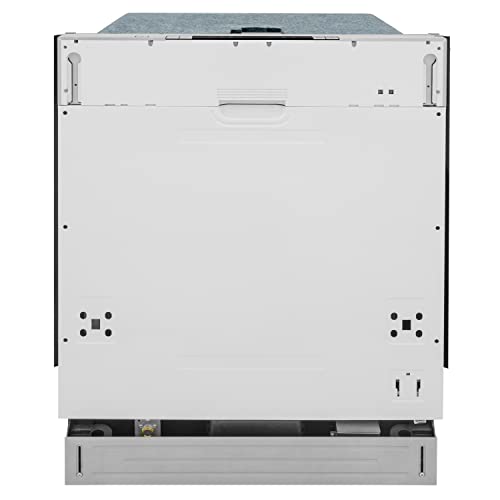
ZLINE sells attainable drama in ranges and hoods, and its dishwasher follows the same script: the headline feature is a stainless steel tub. That interior matters more than marketing usually admits. Stainless tubs resist the staining and odour absorption that plastic interiors accumulate, they tolerate high wash temperatures well, and they help condensation drying because the steel sheds heat differently once the cycle ends, encouraging moisture to settle on the tub walls rather than back onto plates.
The controls sit on the top edge of the door, which is the correct arrangement for a concealed machine: once your panel is fitted and the door closes, nothing electronic interrupts the cabinet line, and you read the controls only when the door is open. That also means cycle selection happens before closing, a small behavioural shift for households used to poking buttons on a visible front. Most people adapt within a week and then prefer the clean run they gained.
ZLINE’s listing keeps its claims narrow — format, control position, panel readiness, tub material — and this guide respects that narrowness. Capacity and noise figures are not stated in the title-level listing text we verified, so treat them as manual questions, not assumptions. Ask for the stated place settings, the decibel figure and the panel weight window before your cabinetmaker commits timber to the saw. A brand comfortable with drama should still be made to answer arithmetic.
- Format: 24-inch built-in, drop-down door, custom panel required
- Controls: top control, concealed when the door is shut
- Tub: stainless steel, per the listing
- Stated capacity: confirm in the manual before ordering a panel
- Stated noise: confirm the figure in the full specification
- Panel and handle: not included, sourced separately
Strengths
- Stainless tub brings durability, heat tolerance and better condensation behaviour than plastic interiors.
- Top controls keep the finished cabinet run completely uninterrupted.
- ZLINE’s design-led catalogue makes matching a wider kitchen package straightforward.
Trade-offs
- Key figures are absent from the headline listing, shifting homework onto the buyer.
- Top-edge controls cannot be adjusted mid-cycle without opening the door.
- The brand’s long-term dishwasher track record is shorter than its range record.
Best for: buyers who rank interior materials first and are happy to verify the remaining figures in the manual.
Not suited for: anyone who wants every number on the sales page before speaking to a cabinetmaker.

ASKO 24in Panel Ready Dishwasher — Largest stated capacity
Seventeen place settings is an assertive number, and ASKO prints it right in the listing for the DFI776XXLSOF. Place-setting counts follow a standardised test load, so the figure is best read comparatively: against the KoolMore’s stated fourteen, this Swedish-designed machine claims roughly a fifth more room in the same 24-inch hole. In practice that headroom shows up as space for the awkward citizens of a real wash — the roasting pan, the tall stockpot, the serving platters that turn loading into furniture rearrangement in smaller tubs.
ASKO’s heritage is Scandinavian commercial laundry and dish care, a background that tends to produce machines built like equipment rather than appliances: steel where rivals use plastic, doors with deliberate heft, interiors designed for service access. The listing identifies this model with ASKO’s Style control family, the brand’s design-forward line, which suits panel-ready duty because the visible contribution of the machine shrinks to almost nothing while the interior engineering does the talking.
Capacity this generous sharpens the panel question rather than softening it. A bigger tub usually means a full-size door, and the custom panel for it must still respect ASKO’s stated weight limits so the door’s springs and hinges can balance a front that may be solid timber. Confirm the permissible panel dimensions and weight with the installation manual, and tell your cabinetmaker the capacity story too — wide doors on frameless cabinetry sometimes need a conversation about the filler strips and reveals either side.
- Format: 24-inch built-in, drop-down door, custom panel required
- Stated capacity: 17 place settings per the listing
- Control family: Style, per the listing
- Model reference: DFI776XXLSOF
- Stated noise: verify the figure in the full specification
- Panel and handle: not included, sourced separately
Strengths
- The largest stated capacity here, valuable for big households and enthusiastic cooks.
- A commercial-equipment heritage suggests construction intended for long service.
- Standardised capacity counting makes its headline figure meaningfully comparable.
Trade-offs
- Premium positioning usually travels with premium parts and service pricing.
- Dealer and service coverage varies by region more than mass-market brands.
- Running half-empty wastes the point; small households may rarely fill it.
Best for: large families and heavy entertainers who load roasting pans as a matter of routine.
Not suited for: couples in compact kitchens who would run a mostly empty tub most nights.

Bosch SHV78DM3N Panel Ready — Quietest on paper
Forty-two dBA, as the listing states, is genuinely quiet territory. At that level a running dishwasher recedes behind conversation, behind a television in the next alcove, behind the ordinary percussion of a kitchen being tidied. Bosch has spent decades making quiet its signature battleground, using insulation, brushless pumping and careful water routing to shave decibels, and the SHV78DM3N sits in the fully integrated branch of that effort: controls concealed, front entirely yours, the machine’s presence announced mainly by clean dishes.
The listing also calls this model a smart dishwasher, meaning it belongs to Bosch’s connected generation. Connectivity in a concealed appliance has one underrated virtue: when the controls hide behind a panel, status can travel to a phone instead — cycle progress, notifications when a run finishes, alerts that deserve attention. None of that replaces opening the door and looking, but in a kitchen designed to hide its machinery, a machine that reports itself is philosophically consistent.
Two cautions keep this pick honest. First, decibel figures are produced under test conditions that differ between manufacturers, so the Bosch’s stated 42 dBA proves it belongs to the quiet class rather than guaranteeing it beats a rival’s 44 in your tiled room; hard surfaces return sound to you regardless of insulation. Second, fully integrated models lean on small signals — a floor-projected indicator or an app ping — to say they are running, precisely because they are too quiet to hear and too hidden to see. Some households love that discretion. Others keep opening the door mid-cycle on a silent machine.
- Format: 24-inch fully integrated built-in, custom panel required
- Stated noise: 42 dBA per the listing
- Connectivity: smart model, per the listing
- Controls: concealed by design in the fully integrated layout
- Stated capacity: confirm the figure in the full specification
- Panel and handle: not included, sourced separately
Strengths
- The lowest stated noise figure in this lineup, suited to open-plan living.
- Smart status reporting compensates elegantly for controls hidden behind a panel.
- Bosch’s service network and parts pipeline are among the deepest in dish care.
Trade-offs
- Decibel comparisons across brands rest on differing test setups, so shop the class, not the digit.
- A machine this discreet can be opened mid-cycle by guests who never heard it running.
- Connected features add setup steps and an app account to a kitchen appliance.
Best for: open-plan homes where the dishwasher runs while life happens in the same room.
Not suited for: buyers who distrust apps on principle and want a purely mechanical appliance.

Fisher & Paykel DishDrawer Panel Ready — The drawer alternative
Everything else in this guide folds down. The DishDrawer pulls out. Fisher & Paykel’s DD24STI9 is a single integrated drawer, in the Tall variant per its listing, that opens toward you at roughly bench height and accepts its own custom panel on the drawer front. Loading happens from above, standing upright, without the crouch-and-reach into the back corners of a deep tub that defines the conventional machine. For backs that complain, for wheelchair users, and for anyone who has unloaded a low dishwasher while holding a toddler, that posture difference is not a gimmick; it is the product.
The mechanics reshape everything downstream. A drawer seals at the top with a lid that lowers inside the unit when it closes, the wash happens in a shallow basin, and the whole load sits in one layer rather than stacked racks. Capacity is therefore smaller — one drawer of dishes, closer to a half-load of a full tub — and this guide will not pretend otherwise. A household of two running daily cycles may find the rhythm perfect: fill through the day, run at night, never bend. A family of six will find themselves running it constantly or wishing for the second drawer configuration this single model is not.
Panel work also changes character. The custom front here dresses a drawer, not a hinged door, so it travels horizontally and must clear the cabinetry beside it as it slides; alignment is about tracks and reveals rather than hinge balance, though Fisher & Paykel still publish panel specifications that your cabinetmaker must follow exactly. The Tall designation signals a drawer deep enough for larger plates, which softens the format’s traditional weakness with big dinnerware — verify the internal height against your largest plates before ordering, because drawer depth, not width, is where this design earns or loses your trust.
- Format: single DishDrawer, pull-out drawer, custom panel required
- Variant: Tall single drawer, per the listing
- Loading: from above at bench height, no drop-down door
- Capacity: one drawer load — smaller than a full-height tub
- Controls: integrated layout behind the custom front
- Panel and handle: not included, sourced separately
Strengths
- Ergonomic loading removes the deep bend that conventional machines demand twice daily.
- Small, frequent loads suit couples and reduce the wait to fill a full tub.
- A genuinely different format for kitchens where the standard door swing causes problems.
Trade-offs
- Per-cycle capacity is the smallest here; big households will run it far more often.
- Oversized items that a tall tub swallows may simply not fit a drawer’s depth.
- The format’s parts and service knowledge are more specialised than mainstream machines.
Best for: small households, accessibility-led kitchens and anyone whose back negotiates with low appliances.
Not suited for: large families or entertainers whose wash includes stockpots and party platters.

Summit Appliance 24 in. Custom Panel Ready T — Small-brand contender
Summit Appliance occupies the specialist shelf of the American appliance market, building compact and niche machines for apartments, medical settings and awkward spaces the giants ignore. Its panel-ready dishwasher applies that mindset to the standard brief: a 24-inch built-in, top controls, a front awaiting your cabinet panel, and a stated noise figure of 47 dB in the listing. That number lands at the audible-but-reasonable end of this group — you will know it is running in a quiet house, which some owners honestly prefer.
The listing’s tail mentions an EN designation, consistent with Summit’s habit of serving specification-driven buyers who read compliance lines. Nothing about this machine shouts, and that restraint is its pitch: where kitchen projects involve a competent local appliance dealer, Summit often appears on the quote as the sensible alternative when flagship brands are back-ordered or priced beyond the project’s appetite. Panel-ready work rewards that dealer relationship, because the same people often coordinate with your cabinet shop.
Due diligence matters more here than with the giants. Confirm the full specification — capacity, panel weight window, water and electrical requirements — from Summit’s documentation rather than the abbreviated listing, and ask the dealer who services the brand within your postcode and how parts are sourced. A smaller maker’s machine can serve beautifully for years; the homework simply shifts from comparing advertisements to verifying support, which is arguably where it always belonged.
- Format: 24-inch built-in, drop-down door, custom panel required
- Controls: top control, per the listing
- Stated noise: 47 dB figure per the listing
- Maker: Summit Appliance, a specialist compact-appliance brand
- Stated capacity: confirm the figure in the full specification
- Panel and handle: not included, sourced separately
Strengths
- A credible alternative when major brands are scarce or stretch the budget.
- Top controls preserve the uninterrupted cabinet line like the bigger names.
- Specialist maker with a long compact-appliance catalogue behind this model.
Trade-offs
- The stated 47 dB is the loudest figure printed among these six listings.
- Service coverage depends heavily on your local dealer, so verify it in advance.
- Listing detail is abbreviated; the manual carries most of the real specification.
Best for: projects with a good local dealer who knows the brand and can support it.
Not suited for: remote buyers far from any Summit service agent who need guaranteed coverage.
How Do the Six Compare Side by Side?
Read the table with the honesty rules in mind: figures appear only where a listing states them, and a dash means the sales page left the question to the manual.
| Pick | Standout trait | Watch out for |
|---|---|---|
| KoolMore 24in Panel Ready Dishwasher | 14 settings and 45 dB stated, UL and Energy Star certified | Thinner residential service network |
| ZLINE Panel Ready Dishwasher | Stainless steel tub with concealed top controls | Capacity and noise left to the manual |
| ASKO 24in Panel Ready Dishwasher | 17 place settings stated — the capacity leader | Premium service pricing, regional coverage varies |
| Bosch SHV78DM3N Panel Ready | 42 dBA stated, smart and fully integrated | So discreet it gets opened mid-cycle |
| Fisher & Paykel DishDrawer Panel Ready | Drawer loading at bench height, Tall variant | Smallest per-cycle capacity by design |
| Summit Appliance 24 in. Custom Panel Ready T | Specialist-brand 24-inch with top controls | 47 dB stated — the loudest figure here |
What Does Panel-Ready Actually Mean, Beyond the Brochure?
It means the manufacturer ships you everything except the face. Behind the plain front of a panel-ready machine sits a door structure with mounting points, brackets and a balancing system calibrated for a panel of a defined size and weight. Your cabinet side supplies that face: a slab or framed panel in the kitchen’s door style, finished on all edges, drilled to the template in the installation manual. When visitors open your dishwasher, they pull on your cabinetry, and the machine simply comes along for the ride.
Confusion starts because three neighbouring ideas share vocabulary. A panel-ready machine accepts a full custom front. A partially integrated machine shows its own control strip and accepts a partial panel below it. A stainless model with a flat door accepts nothing at all. Only the first of these belongs in a kitchen planned around invisibility, which is why this guide screened listings for explicit custom-panel language rather than trusting photographs.
Why Does the Panel’s Weight Deserve So Much Respect?
A dishwasher door is a balanced system. Springs and hinges are tuned so the door — plus its intended panel — hovers where you leave it instead of slamming down or drifting shut. Every manufacturer therefore publishes a weight window for the custom panel, and the handle counts toward that total because the door cannot tell timber from hardware. A panel below the window can make the door spring upward eagerly; one above it can creep downward, strain hinges and eventually distort the very alignment you paid a cabinetmaker to perfect.
Practical consequences follow. Solid timber and stone-clad fantasies weigh more than the framed panels most kitchens use, and a heavy handle adds a surprising share. Give the cabinetmaker the weight window before materials are chosen, weigh the finished panel if there is any doubt, and remember that paint, lacquer and years of kitchen humidity all nudge the number. The manual’s window is not a suggestion with wiggle room; it is the physics of the door you will open ten thousand times.
Who Should Actually Fit the Panel, and When?
A cabinetmaker, or the fitter supplied by your cabinet company — that is the honest answer this guide will keep repeating. Fitting a panel involves drilling to a template without piercing the visible face, mounting brackets squarely, adjusting the door’s balance, and aligning the panel’s edges with neighbouring doors to a tolerance measured in millimetres. Plumbers connect water and waste; electricians handle circuits; neither trade signs up for furniture-grade alignment, and a misaligned panel cannot be fixed by tightening a hose.
Sequence matters as much as skill. The machine should be installed, levelled and test-run before the panel goes on, because levelling feet and connections are easier to reach naked. The panel is then fitted, the door balance checked with the panel’s real weight aboard, and the toe-kick resolved last. Projects that panel first and install second tend to meet their cabinetmaker twice, and the second meeting is never the cheerful one.
How Do You Measure the Opening Before Ordering Anything?
Start with the cavity, not the catalogue. Measure its width at the top, middle and bottom, because old kitchens lean; measure height from finished floor — not subfloor — to the underside of the counter; and measure depth while accounting for pipes or sockets that steal inches at the back. A standard 24-inch machine assumes a cavity close to that width with specific clearances the manual spells out, and the panel’s own dimensions come from the same manual’s template, not from the door beside it.
Then measure the journey. Hallway widths, stair turns and door frames between the street and the cavity have ended more appliance plans than any specification sheet. Finally, measure your largest plates and tallest glasses. Standard tubs swallow dinner plates comfortably, yet the DishDrawer’s depth is a hard ceiling: if your chargers or stemware exceed it, no amount of clever loading will negotiate, and a conventional door model becomes the honest choice.
What Changes When the Dishwasher Is a Drawer?
Almost every habit. Loading a drawer means arranging one layer of dishes in a shallow basin from above, closer to packing a suitcase than stacking shelves. There is no lower rack to slide out over an open door, no upper rack height puzzle, and no door serving as a loading platform that toddlers can sit on. The seal works differently too: the drawer’s lid closes down inside the unit, so the front panel never carries water pressure, and the drawer can be opened mid-cycle with less drama than a door full of hot spray.
The trade is arithmetic. One drawer holds roughly what one generous rack-level of a tub holds, so the machine suits households whose dish production is modest or continuous. Two-person homes often thrive on the rhythm; they load breakfast, add lunch, run the drawer while cooking dinner. Homes producing a roast dinner for eight produce a queue. Fisher & Paykel sell double-drawer configurations elsewhere in the range, but this guide’s pick is the single Tall drawer, and it should be chosen as exactly that.
How Should You Read Decibel Figures Without Fooling Yourself?
Decibels are logarithmic, which scrambles intuition: a machine stating 42 dBA is not slightly quieter than one stating 47, it is meaningfully quieter, roughly the difference between a library hush and a refrigerator’s hum heard across a room. Use the figures in this guide — 42 for the Bosch, 45 for the KoolMore, 47 for the Summit, each as listed — to sort picks into quiet classes, then stop. Cross-brand digits were captured under differing conditions, microphone positions and load states, so a two-point gap proves a class difference, not a verdict.
Your room also votes. Stone floors, bare walls and handle-less cabinetry reflect sound efficiently, while rugs, upholstery and a timber ceiling absorb it. The panel itself participates: a well-fitted custom front adds a layer of mass between the tub and your ears, which is one quiet dividend of panel-ready design that stainless-front owners never collect. Judge the system — machine, panel, room — rather than worshipping a single number.
Are Place Settings a Useful Way to Compare Capacity?
Within limits, yes. A place setting is a standardised bundle of plates, bowls, cutlery and glassware defined by test protocols, so when ASKO states seventeen and KoolMore states fourteen, both numbers were earned against the same imaginary dinner service. That makes the comparison more trustworthy than marketing terms like family-size. Where the system creaks is real life: nobody loads seventeen identical settings, and the roasting tin, mixing bowl and saucepan that dominate actual washing follow no protocol.
Treat the figure as a proxy for interior volume and rack generosity, then interrogate your own habits. Households cooking from scratch generate bulky, awkward loads where flexible racks matter more than setting counts. Households eating simply generate many small items where count rules. And remember the drawer stands outside this currency entirely — its capacity is better judged by standing at it, imagining your day’s dishes inside, which is why showrooms still earn their existence.
Where Do the Controls Hide, and Does It Matter at Midnight?
On top-control machines — the ZLINE and Summit here, and the fully integrated Bosch by design — the controls live on the door’s upper edge, visible only when open. You choose a cycle, close the door, and the kitchen returns to looking like furniture. The midnight consequence is status blindness: with the door shut there may be only a small indicator, a projected light, or an app notification to say whether the machine is washing, finished, or waiting for someone to press start.
Households solve this in different ways. Some adopt a ritual — the person who loads also starts, immediately, every time. Connected models like the Bosch shift status to a phone, which suits people already living there. Others discover that a discreet end-of-cycle chime, where fitted, ends most arguments. What does not work is assuming you will remember; concealed appliances punish assumption, and a load discovered unwashed at breakfast is the tuition everyone pays once.
How Does the Toe-Kick Finish the Illusion?
The strip beneath the door decides whether visitors read the run as cabinetry or as appliances in costume. Many panel-ready installations continue the kitchen’s own toe-kick material across the dishwasher’s base, sometimes on a panel supplied or specified by the manufacturer, sometimes fabricated by the cabinetmaker to match. The catch is mechanical: a dishwasher door swings down and forward, and its lower edge — or the drawer front travelling outward — needs clearance that a fixed furniture plinth never anticipated.
Manuals specify the permitted toe-kick depth and height for exactly this reason. Follow them, and test the door through its full arc before final sign-off, with the actual panel fitted. A door that kisses the plinth on day one will worry a groove into it by day ninety. This is the smallest, cheapest detail in the whole project and the one most likely to be improvised on installation day, which is precisely why it deserves a line in your cabinetmaker’s written scope.
What Should You Decide About Handles Before the Panel Is Drilled?
The handle is the only part of the machine you will touch daily, and panel-ready machines leave it entirely to you: no handle is included with any pick in this guide. Match the kitchen’s other hardware in finish and projection, then think like an engineer. The handle’s fixings pass through the custom panel into the door’s mounting points, so its bolt spacing and screw length interact with panel thickness; a handle chosen after drilling is a handle chosen from whatever fits the holes.
Weight returns here too, because a long solid bar pull can add a meaningful share of the panel’s weight allowance. Position matters as well: on a drop-down door the handle sits along the panel’s top edge, while the DishDrawer’s pull must suit a horizontal tug repeated for years. Decide the handle when you decide the panel, hand both to the cabinetmaker together, and nobody will be drilling hopeful extra holes in finished timber.
How Do You Care for a Dishwasher That Wears Your Cabinetry?
The machine’s care is ordinary — filters rinsed, spray arms checked, seals wiped — but the panel adds a wooden guest to a wet appliance. Steam escapes when a door opens at cycle’s end, and it rises straight into the panel’s lower edge and the counter above. Panels in wet zones should be finished on every face and edge, including the ones nobody sees, because unfinished timber drinks that steam nightly. A panel that swells even slightly will telegraph the change through widening gaps and a door that no longer sits flush.
Chemicals deserve the same respect. Clean the panel with whatever your cabinetmaker specifies for the kitchen’s finish, never with the degreasers aimed at stainless appliances. Keep an eye on the floor beneath during the first weeks; a concealed machine hides small leaks better than it hides dishes, and early drips caught by a weekly glance cost a washer, while drips discovered by a swollen panel cost a panel. Concealment is a style, not an excuse to stop paying attention.
When Does a Panel-Ready Machine Not Make Sense?
Rentals head the list: landlords rarely fund custom cabinetry for a tenant’s appliance, and the panel stays behind when you leave. Tight timelines argue against it too, because the appliance, the cabinetmaker and the finisher must move in sequence, and any delay idles the others. Kitchens planned around a professional stainless aesthetic gain nothing from concealment — the panel would imitate a material the owner actually prefers exposed.
Frequent movers and serial renovators should also hesitate. A custom panel is married to one kitchen’s dimensions, door style and finish batch; it does not travel, and it rarely matches the next kitchen even if the machine does. In those lives, a good conventional dishwasher is not a compromise but the correct tool. Panel-ready design rewards people building a kitchen they intend to keep, and it quietly taxes everyone else.
How Do You Plan Water, Power and Drainage for a Hidden Machine?
The services behind a panel-ready dishwasher are identical to those behind any built-in: a hot water feed, a trapped drain connection, and an electrical supply that meets local code, which in many jurisdictions means a dedicated circuit or a specific outlet arrangement in the neighbouring cabinet. What concealment changes is access. Once the panel is fitted and the machine levelled into its cavity, every connection lives in the dark, so the quality of the initial plumbing matters more than it does on a machine you can drag out on a whim.
Three habits separate calm installations from wet ones. First, new braided supply lines and fresh seals at install time, because reusing tired hoses to save an hour is the classic false economy. Second, a test cycle run before the panel goes on, watched with a torch, while joints are still visible and reachable. Third, knowing where the water shut-off lives and confirming that a person can reach it without tools at midnight. None of this is glamorous. All of it is cheaper than refinishing a swollen cabinet floor, and your plumber and cabinetmaker should agree on who performs the test run before either of them arrives.
What Should You Check in the First Week of Living With One?
Treat the first week as a commissioning period rather than a honeymoon. Run the machine at different times of day and stand in the next room: does the stated quiet class match your tiled, echoing reality? Open the door slowly after a cycle and watch where the steam travels; if it rolls straight into an unfinished panel edge or a vulnerable counter seam, that is information, not ambience. Check the door’s balance with the panel fitted — it should hold position midway without drifting in either direction — and run a hand along the reveals on both sides after a hot cycle, feeling for panels that shift as materials warm.
Loading deserves the same deliberate attention. Every tub and the drawer each have a geometry they reward: tall items along the sides in a conventional rack, nothing tall enough in the drawer to foul its closing lid, cutlery distributed rather than nested. Photograph a load that washed perfectly; it sounds precious until the morning you are staring at a rearranged puzzle before coffee. By the end of the week you should know your machine’s sounds, its cycle times and its one annoying habit, because every appliance has exactly one, and peace comes from having met it early.
How Do You Brief a Cabinetmaker So the Panel Fits First Time?
Arrive with paper, not enthusiasm. The brief that works contains the manufacturer’s panel template with its exact dimensions, the permitted weight window, the handle’s fixing centres, the toe-kick clearances, and a photograph of the neighbouring doors showing the reveal widths your kitchen uses. Add the finish specification — including the instruction that every edge and the rear face be sealed — and the date the machine will be installed and test-run, because the panel fitting should be booked after that milestone, not before it.
Agree the small decisions in the same conversation. Grain direction on a slab panel should follow the run of the kitchen, not the convenience of the board it was cut from. The panel’s top edge needs a profile your fingers will appreciate, because that edge is where your hand lands when the handle is not the first thing you grab. If the kitchen uses applied end panels or decorative legs nearby, say whether the dishwasher panel should echo them. And settle who supplies the mounting brackets and screws — they normally arrive with the machine, yet confirming beats discovering an empty bag on fitting day.
Finally, ask for the offcut. A spare piece of the same finished material, stored flat somewhere dry, is the cheapest insurance a renovation can buy: it lets a future repairer match finish, lets a replacement panel be colour-checked without removing the original, and settles arguments about what the finish actually was. Cabinetmakers expect the request. Kitchens that skip it regret it exactly once, years later, at the worst possible moment.
What Mistakes Do Buyers Make Most Often?
The canonical error is assuming the panel comes in the box. It does not — not with these six, not with the category generally — and projects have stalled at installation because a beautiful machine arrived faceless and no cabinetmaker had been booked. The second error is commissioning the panel from the neighbouring door’s measurements instead of the manufacturer’s template; similar is not identical, and reveals expose the difference mercilessly.
Weight mistakes follow: panels ordered in heavy materials, handles added as an afterthought, doors that drift or strain within a season. Third comes trade confusion, where a plumber is expected to perform furniture alignment and a cabinetmaker is blamed for plumbing. Fourth, buyers compare decibel digits across brands as though they were stopwatch times. Fifth, drawer shoppers skip the plate test and discover their chargers exceed the drawer’s depth. Every one of these errors is cheap to avoid on paper and expensive to avoid in timber.
Final Recommendation
Start by deciding which question your kitchen is really asking. If it asks for written reassurance — capacity, noise and certifications printed in the listing — the KoolMore 24in Panel Ready Dishwasher is the calm answer, a machine whose paperwork arrives before its personality. If the room asks for silence above all, because the sofa shares its air, the Bosch SHV78DM3N Panel Ready carries the strongest stated claim and the service depth to back a long ownership. Capacity hunters should look at the ASKO’s stated seventeen settings, materials-first buyers at the ZLINE’s steel tub, dealer-led projects at the Summit, and backs that refuse to bend at the drawer.
Whichever name wins, the project’s success will be decided less by the badge than by the sequence around it: manual first, panel commissioned to template and weight, handle chosen before drilling, cabinetmaker booked before delivery day. The Fisher & Paykel DishDrawer Panel Ready deserves its place in that final conversation precisely because it asks whether the door itself was ever necessary. Choose the machine whose compromises match your household’s actual habits, and the hidden dishwasher will reward you the way good joinery does — by disappearing completely, leaving only the kitchen you meant to build.
Frequently Asked Questions
Is the decorative panel included with any of these dishwashers?
No. Every pick in this guide is sold ready to accept a custom panel that you commission from a cabinetmaker or order through your cabinet supplier, and the handle is a separate purchase as well. Budget and schedule both items alongside the appliance itself, not as finishing touches afterwards.
Can I fit the panel myself if I am handy?
Manufacturers design the mounting for competent installation, and a meticulous owner with the template, the correct brackets and patience can succeed. The risk is not mechanical failure but alignment: reveals that sit a few millimetres off will bother you daily for years. Most owners reasonably conclude that cabinet-grade fitting belongs to the cabinet trade.
Why does the manual limit how heavy my panel can be?
Because the door’s springs and hinges are balanced for a defined total weight, panel plus handle included. Too light and the door springs up eagerly; too heavy and it creeps downward, strains its hinges and loses alignment. The window in the manual is the range within which the door behaves as engineered.
Does a DishDrawer hold as much as a normal dishwasher?
No, and it does not try to. A single drawer carries roughly one layer of dishes — think a generous single rack rather than a whole tub — so it suits smaller households or frequent small cycles. Measure your largest plates against its internal depth before choosing it, because depth is its hard limit.
How quiet is quiet enough for an open-plan kitchen?
Machines stating figures in the low-to-mid forties, as the Bosch and KoolMore do here, generally disappear behind conversation and television. Treat cross-brand digits as class indicators rather than exact rankings, and remember that hard floors and bare walls return sound no matter how well the tub is insulated.
What should I confirm before my cabinetmaker starts cutting?
The panel dimensions from the manufacturer’s template, the permitted weight window, the handle’s fixing pattern, the toe-kick clearances and whether your chosen model needs any ventilation or reveal allowances at its sides. With those five answers in writing, the panel can be built once and built correctly.
Related Guides
Planning the rest of the kitchen and beyond? Readers comparing finishes for a concealed run often continue to Best Top Mount Granite Composite Kitchen Sinks when the sink must hold its own beside new cabinetry, then to Best Hair Drying Towels for the bathroom side of the renovation, and finally to Best Cordless Vacuums for Hardwood and Carpet for keeping the new floors worthy of the cabinets above them.


