What's inside
- Key Takeaways
- Quick Picks
- How Did We Judge High-End Hoods Without Ever Mentioning Money?
- How Do the Six Hoods Compare on Airflow, Filters and Controls?
- What Does CFM Mean at Your Hob, in Plain Terms?
- Why Do Baffle Filters Belong in a High-End Hood?
- Ducted or Ductless: What Changes Besides the Air?
- How High Above the Hob Should a Wall Hood Hang?
- What Noise Should You Expect at Each Speed?
- How Do You Keep a Hood Performing in Year Five?
- How Does a Chimney Hood Change a Kitchen’s Design?
- What Should You Ask an Installer Before the Hood Arrives?
- How Do Hood Lights Change the Cooking Itself?
- What Is Make-Up Air, and Should a Home Cook Care?
- How Should You Clean Stainless Steel Without Ruining It?
- When Is 900 CFM Too Much Hood?
- How Do You Live With a Hood During a Kitchen Renovation?
- How Does the Hood You Choose Affect Cooking With Gas?
- What Should You Test in the First Week With a New Hood?
- How Do Open-Plan Kitchens Change the Hood Brief?
- How Do You Decide Between Two Hoods With Similar Airflow?
- What Mistakes Do Range Hood Buyers Make Most Often?
- Final Recommendation
- Frequently Asked Questions
- Related Guides
As an Amazon Associate I earn from qualifying purchases. This post may contain affiliate links at no extra cost to you.
cottageverdict.com is reader-supported. When you buy through links on our site, we may earn an affiliate commission.
Where to buy: every hood below is sold through Amazon, and the names in the Quick Picks table, the detailed sections and the comparison table link to the listings, so you can check price on Amazon and confirm duct size, chimney height and filter type before ordering. The best high-end wall mounted range hoods earn the adjective in metal and airflow, not in marketing: capture area, CFM delivered through real ductwork, baffle filtration, and controls that still work with greasy fingers.
High-end, as this guide uses the word, is a set of physical qualities. A stainless chimney with some heft to it. Filters made of baffled steel that can go in the dishwasher for a decade, rather than mesh that sags and clogs. A fan whose highest setting moves serious air and whose lowest is quiet enough for a conversation. Lighting that shows the pan rather than decorating the ceiling. Nothing in that definition requires a number with a currency sign in front of it, and none appears here.
All six picks are 36-inch wall-mount chimney hoods, and all six are convertible between ducted and ductless installation by their listings. That convertibility deserves an honest sentence early: ducted out is always the stronger configuration, carrying heat, moisture and odour out of the house entirely, while ductless recirculation through charcoal filters only filters some grease and smell and returns the air — and its heat — to the room. This guide scores every hood as a ducted hood first, because that is what high-end means, and treats ductless as a fallback for kitchens where a duct truly cannot run.
Consider, finally, the cook’s-eye view that ties the six together: every one of these hoods hangs in the same place, over the same square metre of heat and steam, and will be judged there three times a day. The guide that follows is written from that spot — hands busy, pan loud, plume rising — because a hood is not really a specification or a silhouette. It is the weather system of the kitchen, and it should be chosen like one.
Key Takeaways
- High-end here means construction and capture: stainless chimneys, baffle filters, strong CFM and lighting that serves the cook.
- Airflow spans 380 CFM to 900 CFM across the guide as listed; the right figure depends on your hob and your duct run, not on appetite for numbers.
- Every pick is ducted/ductless convertible, but ducted installation is the configuration these hoods were designed to excel in.
- Dishwasher-safe filters appear across the range, and baffle designs outlast mesh under heavy cooking.
- Controls divide into push-button, touch and gesture sensing — a real difference when your hands are covered in marinade.
- Measure the ceiling, plan the duct and read the mounting range before falling for any silhouette in this guide.
- A hood is bought twice over: once as a silhouette on the wall, and once again as the duct run and the regular cleaning discipline that together let it perform nightly.
- The cheapest airflow in any kitchen is a pan placed on the back burner, directly beneath the hood’s deepest capture.
Quick Picks
| Pick | Badge | Why it earns its place |
|---|---|---|
| 36in Wall Mount Hood 700 CFM | Best All-Round High-End Hood | A 700 CFM stainless chimney hood with push-button control, dishwasher-safe filters and an LED strip light. |
| IKTCH 36in Wall Mount Hood 900 CFM | Most Powerful Pick | The airflow leader at 900 CFM, with gesture sensing and touch control plus adjustable lights. |
| Cosmo Vista 36in Wall Mount Hood | Best Baffle-Filter Classic | A 380 CFM ducted hood with permanent dishwasher-safe baffle filters, push buttons and a backdraft damper. |
| Tiesay 36in Wall Mount Hood | Best Mid-Range Airflow | A 450 CFM chimney hood with three-speed fan and LED light, convertible between ducted and ductless. |
| Zomagas 36 inch Range Hood, Wall Mounted Ven | Best Three-Baffle Design | A stainless hood with three baffle filters, push-button control and a three-speed fan. |
| VIKIO HOME 36 Inch Wall Mount Range Hood 580 | Best Quiet Touch-Control Hood | A 580 CFM hood with low-noise positioning, touch control, three speeds and LED lights. |
How Did We Judge High-End Hoods Without Ever Mentioning Money?
Listings were interrogated for the four things that decide a hood’s working life. First, airflow as stated: 900 CFM on the IKTCH, 700 CFM on the opening pick, 580 CFM on the VIKIO HOME, 450 CFM on the Tiesay and 380 CFM on the Cosmo Vista, with the Zomagas listing declining to headline a figure and being described here by its filters and controls instead of an invented number. Second, filtration: baffle filters, named explicitly on the Cosmo and the Zomagas, were credited as the high-end choice for heavy cooking, while dishwasher-safe filters of any design were noted as the maintenance feature that decides whether a hood is cleaned or merely admired.
Third came the duct story. Every hood here converts between ducted and ductless, so the guide asked how each would be installed in a serious kitchen: ducted, with the shortest, straightest run the building allows, because elbows and long runs tax CFM heavily. Fourth, controls and light were judged at the hob, mid-recipe: push buttons that can be found by touch, touch panels that want a clean finger, and the IKTCH’s gesture sensing, which answers the greasy-hand problem by removing contact altogether. A hood is used three times a day with dirty hands; its interface should respect that.

36in Wall Mount Hood 700 CFM — Best All-Round High-End Hood
This hood opens the guide because it assembles the high-end checklist without drama. Seven hundred CFM as listed is serious airflow for a domestic hob — enough to capture the plume from a full-throated stir-fry or a four-burner Sunday — delivered through a stainless chimney that reads as kitchen architecture rather than appliance. Three speeds, chosen by push buttons, cover the realistic range from a simmering stock to a searing steak.
Push buttons deserve their paragraph. In a kitchen, the operator’s hands are wet, floured or slick, and a physical button can be found by touch, pressed with a knuckle and confirmed by feel. Touch panels are prettier and gesture controls are cleverer, but the button is the interface that never misunderstands a greasy thumbprint. On a hood expected to serve for a decade of daily cooking, that reliability is a luxury feature in work clothes.
The LED strip light and dishwasher-safe filters complete the working brief. A strip throws an even wash across the whole hob instead of two pools of light with a shadow between, and filters that go in the dishwasher get cleaned — which is the entire secret of a hood that still performs in year five. Convertible ducting keeps the ductless fallback available, though this guide’s advice stands: duct it out if the building allows, and let the 700 CFM do the job it was built for.
- Airflow: 700 CFM, per the listing
- Width and body: 36-inch stainless steel chimney
- Controls: 3-speed push-button control
- Filters and light: dishwasher-safe filters, LED strip light
Strengths
- Strong airflow with simple, tactile controls
- Even LED strip lighting across the hob
- Filters clean in the dishwasher, so they get cleaned
Trade-offs
- Push buttons look plainer than touch panels
- Ductless mode cannot match ducted capture
- Chimney height must suit your ceiling, so measure first
Best for: keen home cooks wanting serious capture with unfussy controls.
Not suited for: kitchens where a duct run is genuinely impossible.
Confirm the chimney’s adjustable height range on the listing against your ceiling and hob distance before ordering: Check price on Amazon

IKTCH 36in Wall Mount Hood 900 CFM — Most Powerful Pick
Nine hundred CFM is the largest figure in this guide, and the IKTCH wears it as a headline for a reason. That is airflow for the cook who sears on cast iron, woks over full flame and renders duck fat without flinching — the cooking styles whose plumes defeat lesser hoods and perfume the whole house. With a short, well-planned duct run, a hood of this capacity does not merely reduce kitchen odours; it changes which dishes a household is willing to cook on a weeknight.
The controls answer the obvious objection to powerful hoods, which is that their owners never use the top speeds because the interface fights them mid-recipe. Gesture sensing lets a cook wave a hand — a floury, oily, entirely occupied hand — to command the fan, while the touch panel handles the deliberate adjustments. Two adjustable lights let the illumination be aimed at the pans rather than sprayed at the room, a small refinement that daily cooks notice nightly.
Power asks for honesty about noise and ducting. Any fan moving this much air will be audible at full tilt, and a long or kinked duct run will tax the figure before the air leaves the building, so the installation plan matters as much as the specification. Give this hood the duct it deserves and it is the performance pick of the six; starve it of ducting and its advantage narrows to the controls and the lights, which remain considerable.
- Stated airflow: 900 CFM
- Width and body: 36-inch stainless chimney, model IKP02-36
- Controls: gesture sensing plus touch control panel
- Lighting: two adjustable lights as listed
Strengths
- Highest airflow in this guide for heavy cooking
- Gesture control works with occupied, messy hands
- Adjustable lights aim illumination at the pans
Trade-offs
- Full power is audible, as all high airflow is
- Needs a generous duct run to deliver its figure
- Touch panel prefers a cleaner finger than cooking allows
Best for: high-heat cooks whose current hood loses to the wok.
Not suited for: gentle simmerers, for whom the power is mostly unused.
Plan the duct route before ordering and check the listing’s duct requirements, because this hood’s figure assumes a proper run: Check price on Amazon

Cosmo Vista 36in Wall Mount Hood — Best Baffle-Filter Classic
The Cosmo Vista makes the connoisseur’s argument: that what happens to the air after capture matters as much as the capture itself. Its permanent baffle filters are the centrepiece — stainless baffles that force greasy air to change direction, shedding its fat into channels, and then go in the dishwasher and come back like new. Baffles are the filtration of commercial kitchens, and in a home that fries and sears regularly, they outlast and outperform mesh by a distance that grows with every month of cooking.
At 380 CFM as listed, its airflow is the most modest in this guide, and this guide will not inflate it. For a standard electric or modest gas hob, in a kitchen where the cooking is enthusiastic but not industrial, 380 CFM through a clean baffle and a short duct is entirely competent — and honest airflow through good filters beats a heroic figure strangled by clogged mesh. The three fan speeds and push-button controls keep the operation as unfussy as the maintenance.
Small engineering courtesies complete the picture: a backdraft damper to stop outside air and weather sauntering down the duct on windy nights, LED lighting for the hob, and stainless construction throughout. This is the hood for the buyer who reads spec sheets for the components rather than the headline, and who would rather own the best-made modest hood than the loudest claim in the catalogue.
- Airflow figure: 380 CFM, as listed
- Filters: permanent dishwasher-safe baffle filters
- Controls: push-button, three fan speeds
- Extras: backdraft damper and LED lighting as listed
Strengths
- Baffle filters handle heavy grease and wash clean
- Backdraft damper keeps weather out of the duct
- Straightforward controls and durable construction
Trade-offs
- 380 CFM is modest for very high-heat cooking
- Baffle filters are heavier to handle than mesh
- Ducted design expects a proper duct installation
Best for: regular fryers and searers who value filtration over raw CFM.
Not suited for: the highest-output hobs, which need more airflow.
Baffle filters are removed for washing, so check the listing’s filter dimensions and your dishwasher’s capacity to receive them: Check price on Amazon
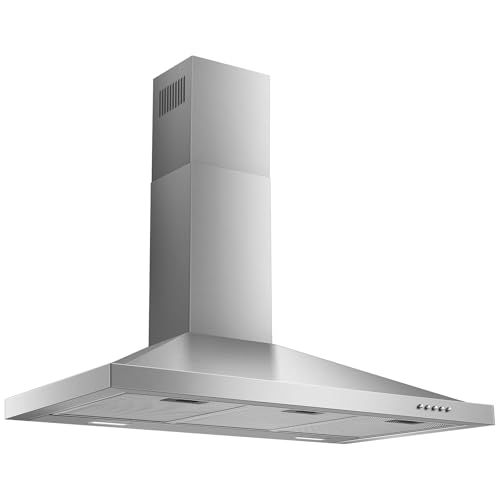
Tiesay 36in Wall Mount Hood — Best Mid-Range Airflow
The Tiesay occupies the sensible middle of this guide’s airflow range at 450 CFM as listed, and the middle is where most real kitchens live. A household cooking nightly on a standard hob — pasta water boiling, a pan sauce reducing, something in the oven — generates steam and odour in quantities that 450 CFM, honestly ducted, clears without effort or theatre. Not every kitchen needs the IKTCH’s artillery, and a hood sized to its actual work runs quieter at its everyday speeds.
Chimney-style in stainless steel, it brings the architectural look that makes a wall-mount hood a kitchen’s centrepiece rather than its apology. Three fan speeds and LED lighting cover the daily brief, and the convertible duct design keeps the installation options open for kitchens where the duct run is a negotiation with the building rather than a simple vertical line.
What the Tiesay asks in return is the same honesty as its siblings: in ductless mode it will filter and recirculate, which helps with grease and some odour but returns heat and moisture to the room, so the ducted route remains the recommendation wherever it can be achieved. Judged as a ducted hood — the basis of this whole guide — it is the balanced buy: enough airflow for real cooking, in the classic form, without paying in noise for power that would go unused.
- Rated at 450 CFM by the listing
- Width and body: 36-inch stainless chimney style
- Fan and light: three-speed exhaust fan, LED light
- Installation: ducted/ductless convertible as listed
Strengths
- Airflow matched to everyday family cooking
- Classic chimney presence in stainless steel
- Convertible installation keeps options open
Trade-offs
- Heavy searing pushes it towards its top speed
- Ductless mode returns heat to the kitchen
- Filter type is less emphasised than baffle rivals
Best for: nightly family cooking on a standard hob.
Not suited for: wok-heavy kitchens needing maximum capture.
Compare the listing’s chimney dimensions with the space between your hob and ceiling, the measurement every wall-mount buyer must make: Check price on Amazon

Zomagas 36 inch Range Hood, Wall Mounted Ven — Best Three-Baffle Design
The Zomagas leads with its filters: three baffle pieces across its 36-inch width, where many rivals fit two. More baffle sections mean the grease-laden air meets more directional changes across the hood’s full span, and — the domestic detail that matters monthly — each individual filter is smaller and lighter to lift down and fit in the dishwasher or sink. Anyone who has wrestled one enormous greasy filter out of a hood at arm’s height will understand why three pieces is a design decision worth a paragraph.
Its listing does not headline a CFM figure, and this guide follows the listing’s example by describing the hood through what it does state: stainless wall-mount construction, ducted or ductless installation, push-button control and a three-speed exhaust fan. That restraint is worth more than an invented number. Buyers for whom airflow is the deciding metric have five stated figures elsewhere in this guide; buyers who prioritise filtration architecture will find this hood’s argument made in steel.
Energy-saving LED lighting and push-button simplicity round out a hood pitched at cooks rather than gadget-lovers. In ducted form its baffles will earn their keep with every frying session; in ductless form it shares the honest limits of recirculation described throughout this guide. As with the Cosmo, this is filtration-first buying, and households that cook oily food often will feel the benefit in a cleaner kitchen ceiling as much as in the air.
- Filters: three baffle filters as listed
- Width and body: 36-inch stainless wall-mount hood
- Controls: push-button, three-speed exhaust fan
- Lighting: energy-saving LED as listed
Strengths
- Three smaller baffles are easier to remove and wash
- Baffle filtration suits greasy, frequent cooking
- Simple push-button operation with dirty hands
Trade-offs
- No CFM figure is headlined in the listing
- Ductless mode shares recirculation’s limits
- Three filters mean three pieces to handle at cleaning time
Best for: frequent fryers who clean filters often and lift them solo.
Not suited for: buyers who choose primarily by a stated CFM figure.
Since airflow is not headlined, read the listing’s full specification carefully and match its stated details against your hob: Check price on Amazon

VIKIO HOME 36 Inch Wall Mount Range Hood 580 — Best Quiet Touch-Control Hood
The VIKIO HOME makes quiet its headline companion to power: 580 CFM as listed, with low noise named in the very title of the product. That pairing addresses the most common complaint about capable hoods, which is that their owners avoid the higher speeds because conversation dies beneath them. A hood engineered to be used at full setting, in a kitchen where people talk, is worth more than a stronger hood that lives its life on speed one out of politeness.
Touch control gives it the sleek face that open-plan kitchens ask for, where the hood is visible from the sofa and its front panel is part of the room’s furniture. Three speeds and LED lights complete a specification aimed at the modern kitchen’s double life: serious cooking station by evening, architectural object the rest of the day. Stainless construction keeps it in this guide’s high-end definition, and the convertible ducting keeps the installers’ options open.
The touch panel’s known weakness — it prefers a reasonably clean fingertip — is the honest trade for the looks, and in practice most cooks operate the hood before their hands are in the food or after a rinse. Ducted, with its airflow delivered through a sane run, this is the hood for households that entertain from the kitchen and refuse to shout over their own extractor.
- 580 CFM of airflow, per the maker
- Noise: low-noise design as listed
- Controls: touch control, three-speed fan
- Lighting and body: LED lights, stainless steel, convertible ducting
Strengths
- Strong airflow with low noise as a stated aim
- Sleek touch panel suits open-plan kitchens
- Three speeds cover simmer to sear
Trade-offs
- Touch controls dislike greasy fingertips
- Ductless mode cannot equal ducted performance
- Full capture still depends on duct quality
Best for: open-plan kitchens where the cook hosts and converses.
Not suited for: cooks who operate everything by knuckle and feel.
Touch panels and steam are daily companions, so review the listing’s control placement against your hob’s busiest burners: Check price on Amazon
How Do the Six Hoods Compare on Airflow, Filters and Controls?
| Pick | Badge | Key detail | Best for |
|---|---|---|---|
| 36in Wall Mount Hood 700 CFM | Best All-Round High-End Hood | Airflow: 700 CFM, per the listing | keen home cooks wanting serious capture with unfussy controls. |
| IKTCH 36in Wall Mount Hood 900 CFM | Most Powerful Pick | Stated airflow: 900 CFM | high-heat cooks whose current hood loses to the wok. |
| Cosmo Vista 36in Wall Mount Hood | Best Baffle-Filter Classic | Airflow figure: 380 CFM, as listed | regular fryers and searers who value filtration over raw CFM. |
| Tiesay 36in Wall Mount Hood | Best Mid-Range Airflow | Rated at 450 CFM by the listing | nightly family cooking on a standard hob. |
| Zomagas 36 inch Range Hood, Wall Mounted Ven | Best Three-Baffle Design | Filters: three baffle filters as listed | frequent fryers who clean filters often and lift them solo. |
| VIKIO HOME 36 Inch Wall Mount Range Hood 580 | Best Quiet Touch-Control Hood | 580 CFM of airflow, per the maker | open-plan kitchens where the cook hosts and converses. |
What Does CFM Mean at Your Hob, in Plain Terms?
CFM — cubic feet per minute — is the volume of air a hood moves, and it is best understood as the size of the invisible net the hood casts over the hob. Cooking sends up a plume of heat, steam, grease and odour that expands as it rises; the hood must move air faster than the plume spreads, or the edges escape into the room. A gentle simmer needs a small net. A wok over full power, or four burners running beneath a Sunday roast’s accompaniments, needs a large one, which is why this guide’s range runs from 380 to 900.
The figure on the box is the hood’s best behaviour, achieved in test conditions. Your kitchen will tax it: every elbow in the duct, every extra metre of run, every clogged filter subtracts from what arrives at the hob. That is why installation and maintenance appear in this guide as often as specifications — a 580 CFM hood on a short straight duct with clean baffles will out-capture a 900 CFM hood strangled by flexi-duct and grease. Buy the figure your cooking needs, then protect it with the duct it deserves.
Why Do Baffle Filters Belong in a High-End Hood?
A baffle filter works by rudeness: it forces the rising air to slam through a series of sharp direction changes, and the grease, too heavy to follow, strikes the steel and drains into a channel. Mesh filters, by contrast, strain the air through a fine net that gradually becomes the thing it catches — a grease mat that strangles airflow and drips on anniversaries. For light cooking the difference is academic. For a household that fries, sears and stir-fries weekly, baffles are the difference between a hood that performs in year five and one that performs in the showroom.
Baffles also clean like equipment rather than laundry. Stainless sections go into a hot dishwasher cycle and return bare, month after month, without sagging or fraying. The Cosmo builds its whole identity around permanent baffles, and the Zomagas splits them into three manageable pieces; both approaches beat the disposable-filter economy. When this guide calls a hood high-end, the filters it can keep for a decade are a large part of what the word means.
Ducted or Ductless: What Changes Besides the Air?
Ducted installation removes the problem from the building. Heat, steam, grease vapour and odour are carried outside, which is why a ducted hood leaves a kitchen genuinely fresher and why every hood in this guide is assessed in that configuration first. It also removes moisture — the invisible load that condenses on windows and feeds mould in corners — which recirculation cannot touch at all. Where a duct can run, even with some carpentry and compromise, it repays the effort for the life of the kitchen.
Ductless mode is the honest fallback for flats and listed buildings where no duct may pass. The hood filters grease through its baffles or mesh, passes the air through charcoal to reduce odour, and returns it — warm and moist — to the room. Charcoal filters saturate and must be replaced on schedule or the odour reduction quietly stops. It is better than no hood by a wide margin, and it is not the same product as its ducted self. Buy the convertible hood for the fallback if you must, but plan for the duct if you possibly can.
How High Above the Hob Should a Wall Hood Hang?
Height is a negotiation between capture and cook. Hang a hood too high and the plume expands beyond its reach before arriving, especially from the front burners; hang it too low and tall cooks meet its edge with their foreheads while pans lose their elbow room. The listing for your chosen hood states its intended mounting range, and that range — measured from hob to hood underside — should be treated as an engineering instruction rather than a suggestion, with the ceiling and chimney extension checked against it before ordering.
Front-burner behaviour is the detail most buyers miss. A plume rises vertically, but kitchen air moves: a door opening, a window ajar, the cook’s own movement all push it. Deeper hoods and stronger airflow forgive more of this drift, which is one reason keen cooks over-specify slightly. Whatever hood you choose, cook on the back burners when a dish is at its smokiest and let geometry help the hood — the cheapest CFM you will ever buy is a pan placed where the capture is strongest.
What Noise Should You Expect at Each Speed?
A hood’s quietest speed should be a background presence — the level at which a stock can simmer all afternoon under extraction nobody notices. Its highest speed will always be audible, because moving hundreds of cubic feet of air per minute through metal ducting makes sound as surely as a river makes noise over stones. The honest comparison is not silent versus loud, but usable versus avoided: a hood whose top speed you tolerate will be used at top speed, and a hood that gets used captures.
Design and installation decide much of it. Rigid, smooth ducting sings less than corrugated flexi-duct; a fan working against clean filters and a short run works easier and quieter than one straining against blockages. The VIKIO HOME’s low-noise positioning speaks to exactly this, but every hood here will reward a clean filter and a sane duct with a calmer voice. Judge noise after installation is planned, not from a showroom’s concrete floor.
How Do You Keep a Hood Performing in Year Five?
The maintenance programme fits on an index card. Filters out and washed on a rhythm set by your cooking — monthly for heavy fryers, quarterly for gentle households — because a clogged filter taxes airflow more than any other single factor. The hood’s underside and the grease channel wiped while warm, so residue lifts instead of setting. The duct’s exterior cap checked occasionally for nests and flaps that stick, and the backdraft damper’s freedom confirmed, a detail the Cosmo’s inclusion of one reminds us matters.
Charcoal filters, for ductless users, are the consumable with a calendar: they saturate invisibly and stop reducing odour long before they look tired, so replacements belong on a schedule rather than on suspicion. Keep that small discipline and a stainless chimney hood is close to a fit-and-forget appliance — which, given that it hangs above the most demanding square metre in the house, is a remarkable thing to be able to say.
How Does a Chimney Hood Change a Kitchen’s Design?
A wall-mounted chimney hood is the rare appliance that is also architecture. It occupies the wall above the hob with a vertical statement in stainless steel, gives the cooking zone a centre, and — in kitchens without wall cabinets on that run — becomes the thing the room is organised around. That presence is why the high-end definition in this guide includes heft and finish: a flimsy chimney wobbles visually as well as physically, and the eye can tell the difference from the doorway.
It also disciplines the rest of the design. Splashbacks are chosen to meet it, lighting plans bend around its LEDs, and the hob beneath it inherits some of its seriousness. Households renovating around one of these hoods often find the kitchen’s whole material palette clarifying itself — steel, stone, timber — because the hood has already cast the first vote. Buy the hood whose looks you can commit a wall to, because a wall is exactly what you are committing.
What Should You Ask an Installer Before the Hood Arrives?
Ask where the duct will run, in metres and elbows, and what diameter it will be along its whole length — the answers predict the hood’s real performance better than its box does. Ask how the chimney will meet your ceiling height, whether an extension is needed, and who supplies it. Ask where the electrical feed will come from and whether the wall behind the hob needs reinforcement or a mounting rail, because a steel chimney is not a picture frame and should not be hung like one.
Finally, ask about the exit: where the duct leaves the building, what cap and damper it will wear, and how weather and birds will be kept out of it. A good installer answers these questions with a tape measure in hand and treats them as the job itself, not as preliminaries. The hood is the visible tenth of the purchase; the duct is the working nine-tenths, and the conversation before the drill comes out is where its quality is decided.
How Do Hood Lights Change the Cooking Itself?
Cooking is judged by eye more than by any other sense — the colour of a roux, the blister on a pepper, the moment butter foams and turns — and all of it happens in the hob’s pool of light. A hood’s lighting is therefore a cooking tool, not a courtesy. The LED strip on the 700 CFM pick washes the whole surface evenly; the IKTCH’s two adjustable lights can be aimed at the pans in play; both approaches beat the single dim bulb that older hoods treated as an afterthought and cooks treated as a rumour.
Good hob light also changes safety in small ways: a boil-over seen early is a ring turned down in time, and the true colour of cooking oil tells an attentive cook its temperature before a thermometer would be believed. When comparing hoods, stand the specification beside your own cooking: if your meals are judged by colour — and most good meals are — the lighting line in the listing deserves the same weight as the airflow line.
What Is Make-Up Air, and Should a Home Cook Care?
A powerful hood does not only remove air; it removes the room’s air, hundreds of cubic feet of it every minute, and that air must be replaced from somewhere or the house pushes back — doors grow heavy, the hood’s capture falters, and in homes with open-flued appliances the replacement air can arrive down flues it should not. Building rules in some regions therefore ask for make-up air provision alongside very powerful extraction, and the 900 CFM end of this guide is where a home cook should at least know the phrase.
For most houses and most hoods here, an open window or the home’s ordinary leakage replaces the air without ceremony, and the practical symptom of a problem is simply a hood that seems weaker than its figure. If your kitchen is new, tight and highly insulated, raise the question with your installer when choosing between the guide’s airflow tiers; it is a five-minute conversation that prevents a puzzling disappointment. Knowledge, in extraction as in cooking, is mostly about knowing which variable you changed.
How Should You Clean Stainless Steel Without Ruining It?
Stainless steel asks for one discipline: follow the grain. Wipe and polish in the direction of the brushed lines, with a soft cloth, and the chimney keeps its even lustre; scrub across the grain with anything abrasive and the surface collects a crosshatch of fine scratches that no later kindness can remove. Warm water and a drop of washing-up liquid handle the weekly film; the greasy week after a frying festival wants a dedicated stainless cleaner and patience rather than pressure.
Fingers are the daily enemy, especially around push buttons and touch panels at hand height, and a microfibre cloth kept in the nearest drawer is the entire countermeasure. The underside, where vapour condenses and grease gathers, deserves the same cloth while the metal is still warm from cooking, when residue lifts easily. Treat the hood’s skin as you would a good knife — wash, dry, no heroics — and it will look like the kitchen’s centrepiece for as long as it performs like one.
When Is 900 CFM Too Much Hood?
When the cooking never asks for it. A household whose hob life is pasta, porridge and the occasional omelette will run a 900 CFM hood on its lowest speed forever, having bought capture capacity that exists only as noise potential. Oversized hoods also pull harder on a home’s air, with the make-up air considerations described above, and their larger motors and chimneys ask more of the wall and the duct. Power is a tool; like a chef’s knife, it should fit the hand and the work.
The honest sizing question is not how much airflow you can buy but how much plume you make. Count your smokiest regular dish, not your most ambitious imaginable one. Christmas dinner is one day; the Tuesday stir-fry is the design brief. Households that wok twice a week should buy the IKTCH without a flicker of guilt, and households that poach should let the Cosmo or the Tiesay serve them in peace.
How Do You Live With a Hood During a Kitchen Renovation?
Sequence is everything. The hood’s duct route should be settled before walls close and ceilings are boarded, because retrofitting a straight, short run through finished rooms is where budgets go to be humbled. If the kitchen is being built around the hood, order early enough that the chimney’s dimensions can govern the wall and the splashback, rather than arriving to find the architecture has already voted. Protect the stainless from site dust and plaster, which are abrasives wearing disguises.
Where the hood replaces an older unit in a finished kitchen, measure the existing duct before choosing: a new hood that can adopt the old run, or adapt to it honestly, saves days. And keep the old hood working until the new one’s duct is proven — a household mid-renovation is already eating enough takeaways without volunteering for more. The finish line is a hood whose capture you have tested with the smokiest dish you own, on the day the installer leaves, while adjustments are still a conversation rather than a callout.
How Does the Hood You Choose Affect Cooking With Gas?
A gas hob adds its own exhaust to the room’s burden: alongside the cooking plume, the burners themselves produce heat, moisture and combustion gases that the hood is expected to clear. That is one reason gas households traditionally specify extraction generously and why the upper half of this guide’s airflow range exists. It is also why capture at the front burners matters so much on gas, where a big stockpot on the front ring sends its steam on the longest journey to the hood’s edge.
None of this makes gas cooking a problem to solve so much as a specification to respect. A ducted hood, honestly installed, handles a gas hob’s whole output as a matter of routine, and the combination of open flame and strong extraction is the classic professional kitchen arrangement for a reason. Ductless households on gas should be especially clear-eyed: recirculation returns the burners’ moisture to the room, which is another argument, added to all the others in this guide, for finding a way to run the duct.
What Should You Test in the First Week With a New Hood?
Cook your smokiest dish and watch the plume like a hawk. Does the hood gather it from the front burners, or does the plume’s edge spill past the canopy when a door opens? Run each speed and learn its voice, so the household settles on honest settings rather than avoiding the top one. Boil a full kettle beneath it and watch where the steam goes; steam is the visible stand-in for everything else the hood must carry away.
Then do the dull tests that predict the years: remove and wash the filters, so the knack is learned while the manual is still findable; operate the controls with wet hands and with a knuckle; check the lights against your most colour-critical dish. A hood that passes its first week with this kind of attention will rarely surprise you later, and any shortcoming found now is an installer’s conversation rather than a season’s grievance.
How Do Open-Plan Kitchens Change the Hood Brief?
When the kitchen shares its air with the living room, the hood becomes a household appliance rather than a room appliance. Cooking odour that would once have been a kitchen’s private business now reaches the sofa, the curtains and the guests, and extraction stops being about the cook’s comfort and becomes about the whole home’s evening. That shift pushes open-plan buyers up the airflow range and, just as strongly, towards the hoods designed to be tolerated at working speeds — the low-noise argument the VIKIO HOME makes.
It also elevates the hood’s looks from preference to necessity. A chimney hood in an open plan is visible from where people read, watch and talk, for years. Sleek touch panels and clean stainless lines earn their place in that setting in a way they cannot in a closed kitchen, and the lighting the hood throws becomes part of the room’s evening ambience. Buy an open-plan hood as furniture and ventilation in a single decision, because that is what it will be.
How Do You Decide Between Two Hoods With Similar Airflow?
When two hoods state similar figures — the 700 CFM opener and the 580 CFM VIKIO HOME are closer in practice than their numbers suggest once a real duct has taxed both — the decision moves to filtration, interface and voice. Ask which filters you would rather wash monthly for a decade, which controls your hands will operate happily mid-recipe, and which hood’s sound at working speed your household will tolerate without turning it down. Those three answers predict satisfaction far better than a spec-sheet tiebreak.
Then let the kitchen itself vote. A closed kitchen forgives a plainer interface and rewards raw capture; an open plan rewards quiet and looks; a household of fryers rewards baffles above all. The six hoods here were chosen so that each of those kitchens finds its answer among them, and the similarity of their airflow is precisely what makes the secondary qualities — the ones you will touch daily — the honest grounds for choosing.
What Mistakes Do Range Hood Buyers Make Most Often?
The expensive mistake is buying CFM and starving it. A powerful hood attached to a long, kinked, undersized duct delivers a fraction of its figure and all of its noise, and the disappointed owner blames the hood. Plan the duct run — short, straight, rigid, correctly sized — with the same care as the hood choice, and treat the two as one purchase.
A second error is hanging the hood at a height chosen by eye. Too high and capture fails no matter the specification; too low and the kitchen becomes hostile to its own cook. The listing’s mounting range exists because engineers measured the plume; use a tape measure and obey it.
Finally, buyers forget the filters until the ceiling tells them. A hood with clogged filters is decoration with a fan attached. Baffles in the dishwasher on a rhythm, charcoal replaced on schedule in ductless homes — the whole of hood ownership is in that sentence, and it is a small price for air you can cook in.
A fourth mistake is choosing the hood last, after the kitchen is designed and the budget is spoken for. Extraction decided at the end inherits whatever wall, duct route and ceiling height the other decisions left behind, and even an excellent hood cannot fully recover from a bad inheritance. Put the hood on the first page of the plan, where its duct can be short and its chimney can be the centrepiece it wants to be.
Final Recommendation
For the complete high-end brief in one hood, start with the 36in Wall Mount Hood 700 CFM: 700 CFM, push-button certainty and dishwasher-safe filters under an LED strip. The IKTCH 36in Wall Mount Hood 900 CFM is the power pick, its 900 CFM and gesture control built for the highest-heat cooking, while the Cosmo Vista 36in Wall Mount Hood is the filtration connoisseur’s choice, its permanent baffles worth more than a louder headline figure.
The Tiesay balances airflow and classic form for nightly family cooking, the Zomagas splits its baffles into three liftable pieces for the frequent fryer, and the VIKIO HOME pairs 580 CFM with low noise and a touch panel for open-plan life. Every one is a stainless chimney hood that earns the high-end label in construction; the differences are in airflow, filtration and interface, which is to say in the things you will actually use.
Plan the duct before you fall for the hood, hang it at the height the engineers intended, and wash the filters like you mean it — do those three things and the hood you choose from this page will still be clearing the air, quietly and completely, when the kitchen around it has been repainted twice.
Frequently Asked Questions
How much CFM do I actually need?
Match the hood to the hob and the cooking. Gentle to moderate cooking on a standard hob is well served by the 380–450 CFM models here; enthusiastic frying and searing suits the 580–700 CFM range; sustained high-heat wok and cast-iron work is what the 900 CFM IKTCH exists for. A short, straight duct lets any figure perform closer to its listing.
Are baffle filters better than mesh?
For greasy, frequent cooking, yes. Baffles separate grease by forcing the air through direction changes, they do not clog the way mesh does, and stainless baffles wash in a dishwasher and last for years. Mesh is adequate for light cooking but gradually loads with grease and strangles airflow between cleans.
Can I install one of these hoods without a duct?
All six are listed as ducted/ductless convertible, so yes — but understand the trade. Ductless recirculation filters grease and reduces odour through charcoal, yet returns heat and moisture to the room, and its charcoal filters need scheduled replacement. Ducted installation is the stronger configuration wherever the building allows it.
Why does my hood’s real performance feel lower than its CFM?
Usually the duct and the filters, not the fan. Long runs, sharp elbows, corrugated flexi-duct and clogged filters each subtract from the figure the listing promises. Shorten and straighten the run, keep filters clean, and cook on the back burners for the smokiest work; the improvement is often dramatic.
Gesture control or push buttons — which is better?
They solve different problems. Push buttons can be operated by touch with messy hands and give physical confirmation, as on the 700 CFM pick and the Cosmo. Gesture sensing, on the IKTCH, removes contact altogether, which is brilliant mid-recipe. Touch panels, like the VIKIO HOME’s, look sleekest and prefer a cleaner fingertip.
Do I need an electrician or a builder to install a wall hood?
Most households use both trades in miniature: the hood mounts to the wall and connects to a duct run, which is building work, and it needs a proper electrical feed, which is an electrician’s territory. A single experienced kitchen installer often covers both, but the duct route and the power supply should both be planned before the hood is unboxed.
Related Guides
A serious hood anchors a serious kitchen, and the guides below cover the surfaces and appliances that share the room with it. Best Cordless Vacuums for Hardwood and Carpet Best Cotton Area Rugs for Living Rooms Best Top Mount Granite Composite Kitchen Sinks



[…] the kitchen, and the guides below cover the ventilation above the hob and the appliances beside it. Best High-End Wall Mount Range Hoods Best Fleece-Lined Men’s Slippers Best Panel-Ready […]