What's inside
- Key Takeaways
- Quick Picks
- How Did We Choose These Cold Press Juicers?
- How Do the Six Juicers Compare Side by Side?
- What Is the Real Difference Between 43, 65 and Higher Auger Speeds?
- How Do You Get the Best From Leafy Greens and Fibrous Produce?
- What Mistakes Do New Juicer Owners Make Most Often?
- How Should You Clean a Cold Press Juicer Without Dreading It?
- Which Produce Should You Buy for Juicing, and How Should You Store It?
- How Much Juice Should a Household Actually Make at Once?
- What Should You Do With the Pulp?
- How Do You Choose Between the Three Omega Models?
- When Does a Wide-Chute or Self-Feeding Machine Earn Its Premium?
- What Does a Week of Juicing Actually Look Like in a Real Kitchen?
- How Should You Juice for Children Without Turning It Into a Sugar Habit?
- What Noise, Vibration and Counter Behaviour Should You Expect?
- How Do Nut Milk and Sorbet Change the Value Calculation?
- How Should the First Fortnight With a New Juicer Be Spent?
- How Should You Store a Juicer So It Gets Used Instead of Admired?
- What Running Costs Follow a Juicer Home?
- Final Recommendation
- Frequently Asked Questions
- Related Guides
As an Amazon Associate I earn from qualifying purchases. This post may contain affiliate links at no extra cost to you.
cottageverdict.com is reader-supported. When you buy through links on our site, we may earn an affiliate commission.
Where to buy: the six machines below are sold through Amazon, and the names in the Quick Picks table, the review headings and the comparison table link to their own listings, so you can check price on Amazon and confirm the feed size, motor speed and container set before ordering. Readers searching for the best juicer machines for healthy life style usually want one honest thing: a machine that turns a market bag of produce into fresh juice often enough that the habit sticks.
Every pick in this guide is a slow, cold-press style machine, because that is where this category has settled for home kitchens. An auger turns at tens of revolutions per minute rather than thousands, pressing produce against a strainer instead of shredding it at blade speed. The practical consequences are quieter running, juice that separates less dramatically, pulp that leaves drier, and a machine that asks to be fed at a walking pace rather than a sprint.
Three of the six wear the same badge, Omega, and they are close relatives, so this guide distinguishes them by the details their listings actually state: the original vertical model at 43 RPM with its three-stage auger, the wide mouth model with its 3-inch hopper and two speeds at 120 watts, and the Cold Press 365 at 65 RPM in white. No differences have been invented between them beyond those printed facts, because cousins deserve honest family descriptions.
Against the Omega trio stand three different answers. Ninja brings a NeverClog design with total pulp control and one-touch programmes. AMZCHEF and TUUMIIST bring the new self-feeding, wide-chute school, with 5.4 and 6.5 inch openings that swallow whole fruit and, in the TUUMIIST case, a 3-in-1 brief that reaches into nut milk and sorbet. The divide in this guide is really about mornings: how much chopping your routine will tolerate before the kettle has even boiled.
A note on language belongs here. Fresh juice is a pleasure and a practical way to use up produce; this guide makes no medical claims for it, promises no detox, cure or transformation, and treats the healthy lifestyle phrase in the keyword as what it honestly is: a household habit of making fresh drinks at home, with the fibre question, the sugar question and the cleaning question all discussed plainly in the sections that follow.
The reviews are organised around the decisions a buyer actually faces, in the order they face them. First the machine and its stated specification, then the produce it will meet in a real week, then the unglamorous trio that decides ownership: feeding, cleaning and storing. If you already know your chute width and your batch size, the comparison table will settle your shortlist quickly; if you are still deciding what kind of juicing household you are, the sections after the reviews are where that question gets its honest answer.
Key Takeaways
- All six picks are slow cold-press machines; none is a high-speed centrifugal juicer.
- The three Omega models divide by stated details: 43 RPM original, 3-inch wide mouth two-speed, and 65 RPM Cold Press 365.
- Ninja NeverClog adds total pulp control, two programmes and a 24oz jug with a 36oz pulp container.
- AMZCHEF 5.4 inch and TUUMIIST 6.5 inch chutes feed whole fruit and cut morning prep sharply.
- TUUMIIST 3-in-1 brief extends to nut milk and sorbet, with a 100oz capacity for batch juicing.
- This guide claims fresh flavour and habit value only, never medical outcomes.
Quick Picks
| Pick | Badge | Why it earns its place |
|---|---|---|
| Omega Vertical Cold Press Juicer | Best Classic 43 RPM Omega | The original vertical Omega: 43 RPM, a three-stage auger, automatic pulp ejection and a no-drip tap, in silver at 150 watts. |
| Omega Wide Mouth Juicer | Best Omega for Whole Produce | The wide mouth Omega: a 3-inch hopper, two-speed slow juicing and a space-saving vertical body at 120 watts, in black. |
| Omega Cold Press 365 Juicer | Best Everyday White Omega | The Cold Press 365: a 65 RPM vertical Omega with a three-stage auger and a BPA-free container, 150 watts in white. |
| Ninja NeverClog Cold Press Juicer | Best Pulp Control | Ninja JC151: a 150W high-torque auger, total pulp control, two one-touch programmes, a 24oz jug and a 36oz pulp container. |
| AMZCHEF Cold Press Juicer | Best Self-Feeding Value | A 5.4 inch whole-fruit self-feeding slow juicer in stainless steel, with triple strainers and a large auger. |
| TUUMIIST Cold Press Juicer | Best 3-in-1 Batch Machine | A 3-in-1 smart-touch machine with a 6.5 inch wide chute, a 100oz capacity, for juice, nut milk and sorbet. |
How Did We Choose These Cold Press Juicers?
The shortlist began with mechanism. Every pick had to be a slow masticating or cold-press design, because the comparison the reader is making lives inside that family: auger speed, feed size, pulp handling and cleaning. High-speed centrifugal machines were left to their own guide, where their speed and their noise can be judged on their own terms.
Listing facts were treated as the specification. Auger speeds of 43 and 65 RPM, a 3-inch hopper, wattages of 120 and 150, jug and pulp container sizes, chute widths of 5.4 and 6.5 inches: those printed details are what the reviews compare, and where a listing is silent, the review stays silent rather than borrowing a specification from a sibling model. That discipline matters most inside the Omega family, where the three machines look alike in photographs.
Morning friction carried the second vote. A juicer is used at the least forgiving hour of the day, and the difference between a narrow chute that wants every apple quartered and a self-feeding hopper that takes produce whole is the difference between a habit and a cupboard ornament. Feed design therefore weighs as heavily here as motor figures.
Cleaning closed the selection. Dishwasher-safe parts, strainers that rinse without a forensic brush, and assemblies that come apart in seconds were favoured, because the literature of abandoned juicers is written entirely in the language of washing-up. A machine cleaned in three minutes gets used on Wednesday; a machine cleaned in fifteen gets used on birthdays.

Omega Vertical Cold Press Juicer — Best Classic 43 RPM Omega
This is the reference Omega, the vertical cold press design around which the family is organised, and its listing states its identity in numbers: a 43 RPM slow masticating action, a three-stage auger, 150 watts, in silver. Forty-three revolutions per minute is a deliberate crawl, and the three-stage auger is the reason for it, crushing, mixing and pressing in sequence so the juice leaves through the strainer and the pulp leaves dry enough to crumble.
Two details define its daily manners. Automatic pulp ejection means the machine does not need stopping and emptying mid-session; pulp exits continuously into its container while juice flows from the spout. The no-drip tap closes that spout between glasses, which sounds minor until the first morning a centrifugal-style dribble has decorated the worktop and the floor in beetroot. Quiet operation, claimed in the listing, is the third manner, and at 43 RPM it is a credible one.
The feed discipline is the classic trade: a vertical chute of the older school asks for produce cut to sensible pieces and fed at the auger pace, with leafy greens happiest when bundled or alternated with something firm. Owners who accept that rhythm get the most proven design in this guide, in a compact vertical footprint that lives on the counter rather than colonising it.
- Speed: 43 RPM slow masticating
- Auger: three-stage design per the listing
- Power: 150 watts
- Pulp: automatic ejection, continuous juicing
- Spout: no-drip tap; finish silver
Strengths
- Proven vertical design with dry pulp output
- No-drip tap keeps the worktop clean
- Quiet, compact and counter-friendly
Trade-offs
- Narrower feed asks for more chopping
- Feeding pace is set by the slow auger
- Leafy greens need bundling technique
Best for: patient juicers wanting the classic Omega design and driest pulp. Not suited for: households wanting whole fruit dropped in uncut.

Omega Wide Mouth Juicer — Best Omega for Whole Produce
The wide mouth model answers the classic Omega criticism directly, with a 3-inch hopper stated in its listing. Three inches swallows a small apple whole, takes cucumber and carrot lengths without the quartering ritual, and changes the emotional arithmetic of a weekday morning: the juicer stops being a project and becomes an appliance. The body stays compact and vertical, in black, so the convenience does not cost extra counter.
Two-speed slow juicing is the second stated distinction, and it maps onto produce families. The gentler speed suits soft and leafy material, where a patient press coaxes more from spinach, soft pears and soaked greens; the firmer speed drives roots and hard fruit through with authority. At 120 watts the motor is the modest member of the Omega trio on paper, and its work is done by gearing and patience rather than by wattage theatre.
Choose this Omega when the chopping board is your obstacle and the Omega name is your comfort. It keeps the vertical cold-press character, the dry pulp and the quiet manners of the family, and spends its novelty entirely on the mouth. Households juicing mostly hard produce in volume may still prefer the original auger story; households juicing breakfast against the clock will not look back.
- Feed: 3-inch wide mouth hopper
- Speeds: two-speed slow juicing
- Power: 120 watts
- Body: compact vertical, space-saving design
- Finish: black
Strengths
- Three-inch hopper cuts prep dramatically
- Two speeds for soft and hard produce
- Compact footprint keeps the counter usable
Trade-offs
- Lowest wattage figure of the Omega trio
- Wide mouth still prefers sensible feeding
- Black finish shows pale pulp dust
Best for: busy mornings wanting Omega character without the chopping. Not suited for: purists who want the original three-stage auger story.

Omega Cold Press 365 Juicer — Best Everyday White Omega
The Cold Press 365 is the third Omega in this guide and its listing distinguishes it with a number and a colour: 65 RPM and white. Sixty-five revolutions per minute sits a step quicker than the 43 RPM original while remaining firmly in slow-press territory, and the three-stage auger it shares with its silver sibling keeps the crush-mix-press sequence that produces dry pulp and a calm, steady juice flow.
The BPA-free container named in the listing is the detail health-conscious households look for first, and it is stated plainly here rather than implied. At 150 watts the 365 matches the original on power, and its white finish suits the bright, Scandinavian end of kitchen design where the black wide-mouth model would sit like a chess piece at a christening.
Position the 365 honestly inside its family: it is the everyday, modern-finish Omega, a touch faster than the classic, with the container material declared. A buyer choosing between the three Omegas is really choosing a feed width, a speed and a colour, and the 365 wins when the answer is a standard chute, a brisker press and a white machine beside a white kettle.
- Speed: 65 RPM slow masticating
- Auger: three-stage design per the listing
- Power: 150 watts
- Container: BPA-free per the listing
- Finish: white, compact vertical body
Strengths
- Brisker 65 RPM press than the classic model
- Three-stage auger for dry pulp
- BPA-free container stated in the listing
Trade-offs
- Standard chute still asks for some chopping
- White finish shows beetroot enthusiasm
- Close in spirit to its silver sibling
Best for: households wanting the modern white Omega for daily juicing. Not suited for: whole-fruit feeders, who should take the wide mouth model.

Ninja NeverClog Cold Press Juicer — Best Pulp Control
Ninja enters the slow juicing room with an engineer complaint and a control freak gift. The complaint is clogging, the fibrous jam that stalls augers on celery, ginger and leafy loads, and the JC151 answers it in its name: NeverClog, built around a 150 watt high-torque auger designed to power through fibrous fruits and vegetables rather than surrendering to them. Torque, not speed, is the correct currency for that job.
The gift is Total Pulp Control. Pulp in juice is a household schism, some drinkers wanting silk and others wanting body, and the Ninja lets the machine settle the argument per glass rather than per purchase. Two one-touch programmes remove the guesswork for standard loads, and the container arithmetic is printed honestly: a 24oz juice jug and a 36oz pulp container size the session for one or two generous servings before a rinse.
Charcoal is the finish, dishwasher-safe parts are the cleaning story, and the whole machine has the designed-for-real-kitchens feel Ninja brings to its blenders. Its jug is the smallest session capacity in this guide, which couples and solo juicers will call right-sizing and families will call a refill. For fibrous green-juice devotees, this is the most persuasive non-Omega in the room.
- Model: JC151 per the listing
- Power: 150W high-torque auger
- Programmes: two one-touch programmes
- Pulp: Total Pulp Control per the listing
- Containers: 24oz jug, 36oz pulp container; dishwasher-safe parts
Strengths
- High-torque auger built for fibrous loads
- Pulp control settles the household texture debate
- Dishwasher-safe parts ease the cleaning
Trade-offs
- Jug size means refills for family sessions
- Programmes suit standard loads best
- Charcoal finish only, per the listing
Best for: green-juice drinkers juicing fibrous produce for one or two. Not suited for: large families juicing a market bag in one session.

AMZCHEF Cold Press Juicer — Best Self-Feeding Value
AMZCHEF represents the self-feeding school, and its headline is a dimension: a 5.4 inch opening that takes whole fruit, loaded into a hopper that feeds the auger itself. The morning this designs for is specific: produce washed, dropped in, and juiced while the cook does something else with both hands. For households whose juicing habit died at the chopping board, that automation is not a luxury; it is the entire product.
Stainless steel construction, triple strainers and a large auger fill out the listing. The triple strainer arrangement works at the clarity end of the juice spectrum, catching more of the fine solids for a smoother pour, while the large auger gives the self-feeding mechanism something substantial to feed. High yield is claimed in the listing language, and the honest translation is that slow pressing of whole produce, skin-adjacent nutrients and all, leaves little in the pulp bucket.
Easy cleaning is claimed too, and self-feeders live or die by it, because a hopper mechanism adds surfaces that a simple chute does not have. Households should weigh the prep minutes saved against the rinse minutes added, and for most busy families the exchange is favourable. This is the value disruptor of the guide: the wide-mouth convenience at a challenger brand pitch.
- Feed: 5.4 inch whole-fruit self-feeding hopper
- Body: stainless steel slow masticating design
- Strainers: triple strainer arrangement
- Auger: large auger per the listing
- Cleaning: easy-clean design per the listing
Strengths
- Whole fruit loading transforms morning prep
- Self-feeding frees both hands during juicing
- Triple strainers pour a smoother juice
Trade-offs
- Hopper mechanism adds parts to rinse
- Challenger brand support is a longer question
- Whole-fruit juicing includes cores and rinds by default
Best for: families wanting hands-free loading and smooth juice. Not suited for: minimalists who prefer the fewest possible parts.
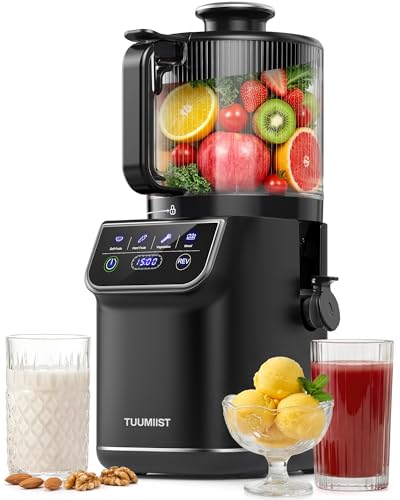
TUUMIIST Cold Press Juicer — Best 3-in-1 Batch Machine
TUUMIIST takes the wide-chute idea to its logical end: 6.5 inches of opening, the widest in this guide, on a 3-in-1 machine whose brief runs beyond juice into nut milk and sorbet. The smart touch controls and the 100oz large capacity complete a specification aimed at batch households, the Sunday juicers who fill bottles for the week and the families for whom a sorbet course justifies an appliance on its own.
The nut milk function deserves its sentence, because it changes the machine economics. Soaked almonds or oats pressed through a cold-press system emerge as a credible homemade milk, and a household buying plant milk weekly may find this function, not the juice, pays for the counter space. Sorbet from frozen fruit is the party trick that turns the same hardware towards dessert, and children who will not drink a green juice will queue for a mango sorbet they watched the machine make.
Scale is the caution. A 100oz batch machine is a commitment of counter and cupboard, and its wide chute invites the same whole-fruit questions as the AMZCHEF: cores, rinds and pips enter the press unless the cook intervenes. Easy cleaning is claimed in the listing, and a machine of this ambition needs it. For the batch-juicing, milk-making, sorbet-serving household, nothing else here attempts as much.
- Type: 3-in-1 cold press machine
- Feed: 6.5 inch wide chute
- Capacity: 100oz large capacity per the listing
- Controls: smart touch operation
- Functions: juicing, nut milk and sorbet per the listing
Strengths
- Widest chute in the guide for whole produce
- Nut milk and sorbet widen the brief usefully
- Large capacity suits weekly batch juicing
Trade-offs
- Largest footprint and storage demand here
- Batch scale is wasted on a daily single glass
- Many functions mean more parts to master
Best for: batch juicers who also want nut milk and sorbet. Not suited for: solo drinkers wanting one small glass each morning.
How Do the Six Juicers Compare Side by Side?
| Pick | Feed style | Speed or power note | Standout trait |
|---|---|---|---|
| Omega Vertical Cold Press Juicer | Vertical chute | 43 RPM, 150W | Three-stage auger, no-drip tap |
| Omega Wide Mouth Juicer | 3-inch wide mouth | Two speeds, 120W | Whole produce in an Omega body |
| Omega Cold Press 365 Juicer | Vertical chute | 65 RPM, 150W | BPA-free container, white finish |
| Ninja NeverClog Cold Press Juicer | Chute with pusher | 150W high-torque | NeverClog design, pulp control |
| AMZCHEF Cold Press Juicer | 5.4 inch self-feeding | Slow masticating | Triple strainers, large auger |
| TUUMIIST Cold Press Juicer | 6.5 inch wide chute | Smart touch | 3-in-1 with 100oz capacity |
Read the feed column as a morning-personality test. The chute machines ask for a knife and two minutes; the wide mouths ask for a wash and a drop; the self-feeder asks only for loading. None of those is the correct answer in the abstract, because the correct answer is the one your household will still be performing in February, when the resolution has faded and the habit has to run on convenience alone.
The Omega trio occupies the first three rows because they share a design philosophy, and their stated differences, 43 versus 65 RPM, standard versus 3-inch feed, silver versus white versus black, are the honest axes of choice between them. The Ninja competes on fibre handling and pulp choice, while the two wide-chute challengers compete on automation and scope.
What Is the Real Difference Between 43, 65 and Higher Auger Speeds?
Auger speed in a cold press juicer is a philosophy expressed in revolutions. At 43 RPM, the original Omega turns slowly enough that produce is crushed and pressed rather than torn, oxidation is limited by the calm handling, and the machine runs quietly enough for a sleeping household. At 65 RPM, the Cold Press 365 keeps the same philosophy with a brisker working pace, trading a little of that meditative calm for a shorter session.
What the numbers do not do is scale linearly with juice quality. Both speeds sit far below the thousands of RPM of a centrifugal machine, and the juice differences between them are subtle beside the differences made by produce freshness, feeding pace and strainer design. Buyers should read 43 versus 65 as a choice between the classic press and the modern press, not as a quality league table.
Feeding pace matters more than either figure. Any slow juicer overloaded with produce crammed against its will will back up, strain and produce foamy, pulpy juice, whatever its rating. Feed at the rate the auger clears, alternate hard and soft pieces, and both Omega speeds reward you with the dry pulp and steady stream the design promises.
How Do You Get the Best From Leafy Greens and Fibrous Produce?
Greens are the cold press examination paper. Spinach, kale and wheatgrass carry little free water and love to wrap an auger in a fibrous blanket, so technique decides the result: roll leaves into tight bundles, feed them between pieces of apple, carrot or cucumber that give the auger something to grip, and finish with a firm piece to push the green through. The juice that emerges is small in volume and intense in flavour, which is the honest nature of greens.
Celery and ginger, the other fibrous tests, reward the high-torque approach the Ninja NeverClog is built around, and they reward every machine when cut into short lengths across the fibre rather than fed in long strings. Long fibres are the clog material of this category; a thirty-second date with the chopping board is the cheapest anti-clog feature ever sold.
Expectation management completes the technique. A kilo of spinach yields a modest glass, and that glass is a concentrate to be lengthened with apple, cucumber or citrus rather than a failure to be apologised for. Households that learn the greens ratio early keep juicing; households that expect a litre from a bag of leaves conclude the machine is broken and retire it.
What Mistakes Do New Juicer Owners Make Most Often?
The first mistake is the January mistake: buying for a fantasy routine of dawn celery juice and discovering by March that the machine requires washing by a person who is late for work. The cure is honesty at purchase. If your mornings hold five spare minutes, buy the feed width that fits inside them, which is why the wide mouth and self-feeding picks exist in this guide beside the classic chute machines.
The second mistake is juicing only fruit and calling it a health habit. Fruit juice without its fibre is a sweet drink, pleasant and fresh, but a vegetable-anchored juice with fruit as the flavouring is the glass this category is really for. This guide makes no medical claims either way; it simply notes that a carrot, cucumber and greens base with an apple through it tastes like a garden, while four oranges taste like a soft drink with better branding.
The third mistake is letting pulp sit. A juicer left unwashed until evening grows a strainer crust that turns a three-minute rinse into a fifteen-minute excavation, and two or three such evenings retire more juicers than any motor failure. Rinse the parts under the tap the moment the glass is poured, while everything is still wet, and the machine stays a pleasure instead of becoming a penance.
How Should You Clean a Cold Press Juicer Without Dreading It?
The golden rule is water first, soap rarely, immediacy always. Disassemble over the sink, rinse each part as it comes off, and run the strainer under a strong stream while turning it, which clears most pulp before any brush is needed. A soft brush kept beside the sink for the strainer mesh finishes the job in seconds; a strainer left to dry with pulp in its holes is the one part of juicing that genuinely deserves its grim reputation.
Dishwasher-safe parts, as the Ninja listing offers, move the whole routine into the machine, though a quick rinse first still pays, because pulp baked through a hot wash cycle can set rather than lift. Self-feeding hoppers, as on the AMZCHEF and TUUMIIST, add surfaces that want the same immediate rinse; the prep they save is repaid partly in washing, and the exchange still favours them on a busy morning.
Dry the parts on the draining board and reassemble loosely rather than sealing a damp machine into a cupboard. A juicer stored dry smells of nothing, which matters when the next load is melon. Once a month, a soak in warm water with a little bicarbonate lifts the mineral and pigment films that beetroot and carrot leave behind on pale plastics.
Which Produce Should You Buy for Juicing, and How Should You Store It?
Juicing is the natural home of the cosmetically imperfect. Wonky carrots, oversized cucumbers, apples with a bruise to trim and the beetroot nobody roasted all juice exactly as well as their beautiful siblings, at a fraction of the price, and a market-end-of-day bag is the traditional fuel of a serious juicing household. Firmness is the quality that matters, because tired, bendy produce presses poorly and tastes of the fridge.
Store for the auger, not for the photograph. Roots keep in the salad drawer, greens want a damp cloth and a box, and citrus lives happily on the counter for the week it will be used. Wash everything as it is loaded rather than in advance, since washed produce ages faster, and cut away only the genuinely damaged parts; skins on carrots and apples carry flavour the strainer was designed to separate from the juice anyway, once washed well.
Freeze the surplus with intention. Frozen fruit serves the TUUMIIST sorbet function, frozen greens portions drop into a morning juice without a shopping trip, and a freezer that holds the juicing surplus turns a market glut into a month of cheap, fresh glasses. The household that buys for the juicer on purpose rarely lacks something worth pressing.
How Much Juice Should a Household Actually Make at Once?
Fresh juice is at its best within the hour, good within the day if it is sealed full to the brim and refrigerated, and a shadow of itself by the third day whatever the storage. That chemistry argues for the session sizes the machines here are built around: the Ninja 24oz jug for the daily glass or two, the Omega verticals for a family round, and the TUUMIIST 100oz capacity for the deliberate batch that will be drunk across a weekend by many mouths.
Batch juicers should fill their bottles completely, because the air gap is where oxidation does its work, and a squeeze of lemon across a batch is the traditional, honest preservative. Label the bottles with the day, drink the oldest first, and let the calendar rather than optimism decide when a batch is finished.
The deeper answer is rhythm over volume. A modest glass made fresh four mornings a week delivers more of everything this habit promises, flavour, freshness and the quiet satisfaction of a routine kept, than a heroic litre made on Sunday and abandoned by Wednesday. Choose the machine whose session size matches the rhythm you will actually keep.
What Should You Do With the Pulp?
Cold press pulp is an ingredient wearing a disguise. Carrot and apple pulp folds into muffin and cake batters, vegetable pulp enriches a soup or a stock, and ginger and citrus pulp can be simmered into a syrup or a marinade before it is composted. A household that cooks will find the pulp bucket shortens the walk to the compost bin by way of the stove, and the juice habit starts to look like a whole-produce system.
Be honest about the fibre story while you are at it. The pulp is where much of the produce fibre lives, which is why this guide describes juice as one part of a produce-rich kitchen rather than a replacement for eating vegetables. A pulp used in baking returns some of that fibre to the plate in the most enjoyable possible form, which is a muffin.
What cannot be cooked can still be used. Pulp freezes in trays for stock, feeds a wormery with enthusiasm and composts faster than whole scraps because the machine has done the shredding. The only true waste in a juicing household is pulp left to sour in an unwashed container, which returns us, as everything in this category does, to the rinse-it-now rule.
How Do You Choose Between the Three Omega Models?
Start with the feed. If the chopping board is your enemy, the 3-inch wide mouth model settles the question in its name, and its two speeds add a flexibility the others do not state. If you juice greens and roots in the classic manner and value the most proven design, the 43 RPM original with its three-stage auger and no-drip tap is the family elder and behaves like it.
Then read the numbers that remain. The Cold Press 365 offers 65 RPM and a BPA-free container in white, which makes it the modern everyday choice where the container material is a stated priority and the kitchen is pale. Power figures, 150 watts for the original and the 365 against 120 for the wide mouth, matter less than the gearing philosophy all three share.
Finally, admit that colour is a legitimate decider between near-identical machines. Silver, black and white sit differently beside your kettle and your cabinets, and a juicer lives on the counter in full view, used daily. When the specifications converge, buy the one whose presence pleases you, because pleasure is a genuine component of whether a habit survives.
When Does a Wide-Chute or Self-Feeding Machine Earn Its Premium?
The premium is measured in minutes and in honesty. A 5.4 or 6.5 inch chute removes most chopping from most produce, and a self-feeding hopper removes the standing-and-pushing as well. Across a daily habit those minutes compound into the difference between a routine that survives a busy season and one that quietly stops in November, which is the most expensive outcome a juicer can have.
Whole-fruit juicing carries its own questions, and the reviews name them: cores, pips and rinds enter the press unless the cook edits them out, apple pips and citrus rind change flavour in quantity, and a wise operator still halves citrus and removes the parts nobody wants in the glass. Wide means less chopping, not no judgment, and the machines reward a cook who loads thoughtfully rather than indiscriminately.
The premium fails to earn itself in one household: the deliberate juicer who enjoys the ritual, juices twice a week in unhurried batches and owns good knives. That cook should buy the classic auger story and spend the difference on produce. Everyone else should price their mornings honestly and let the chute width follow.
What Does a Week of Juicing Actually Look Like in a Real Kitchen?
Monday is the market-bag glass: whatever came home cheap and firm, carrot, apple, cucumber and a lemon, pressed while the kettle boils. Tuesday might skip, because real habits have gaps and a machine that demands daily perfection will be abandoned by a household that cannot provide it. Wednesday is the greens glass, small and intense, built from the spinach that needs using and lengthened with pear.
The weekend is where the batch machines justify themselves. A TUUMIIST load on Saturday fills bottles for the house and a sorbet for the evening, while a couple with the Ninja make two glasses each and rinse the machine in the time the toast takes. Neither pattern is the correct one; both are the kind of pattern that survives contact with real life, which is the only test this category ultimately sets.
Notice what the week never contains: a dawn spent chopping for twenty minutes, a strainer soaking in reproach, or a juice made from guilt. The households that keep juicing build the habit around the machine they bought, the feed it accepts and the minutes they truly have, which is why this guide spends so many words on mornings and so few on motor mythology.
How Should You Juice for Children Without Turning It Into a Sugar Habit?
Children vote for colour and sweetness, and a wise juicing household negotiates rather than surrenders. Start with the glasses they already love, orange and apple, then let the vegetable fraction arrive by stealth and by naming: carrot joins the orange and the glass stays orange, cucumber joins the apple and the glass stays green-gold and mild. The machine is neutral in this diplomacy; the recipe is the parent work.
The sorbet function on the TUUMIIST changes the negotiation entirely, because frozen fruit pressed into a sorbet is dessert by any child definition, made of fruit and nothing else unless the cook adds it. A household that can produce mango sorbet on demand has a different conversation about treats from one negotiating over a freezer cabinet of bought tubs.
Keep the fibre honesty from the earlier sections in family form: juice is a drink, not a vegetable portion, and the pulp muffins and the whole fruit on the table complete the picture. Children who watch produce become juice learn where drinks come from, which may be the most durable thing a juicer ever teaches a household.
What Noise, Vibration and Counter Behaviour Should You Expect?
Slow juicers are the quiet end of the juicing world, and the Omega listing claim of quiet operation reflects the physics: an auger turning at tens of RPM with a geared motor simply has less to shout about than a blade at twenty thousand. What you hear is work rather than speed: a crunch as a carrot meets the auger, a creak under a hard load, a hum that rises and falls with the feeding.
Vibration follows load, not brand. A machine pressing beetroot will walk a polished worktop by millimetres if its feet are smooth and the surface is wet, which is one more reason the rinse-and-dry discipline around the juicing station matters. A mat under the machine, or simply dry feet on a dry counter, keeps the juicer in its parish through the hardest root.
Early mornings are the real test. A household with a baby, a night-shift sleeper or thin walls should weight the quiet claims heavily and favour the slowest, steadiest designs, juicing the loud produce, the roots and the frozen sorbet fruit, at sociable hours. The greens and soft fruit that make up most weekday glasses are quiet work on any machine here.
How Do Nut Milk and Sorbet Change the Value Calculation?
A juicer that only juices is a single-purpose appliance, and single-purpose appliances must fight for their counter. The TUUMIIST 3-in-1 brief, juice, nut milk and sorbet from one cold-press system, changes the fight: the machine that makes the morning glass also makes the almond milk for the porridge and the sorbet that ends the dinner, and each additional weekly use dilutes the purchase across more of the household life.
Nut milk through a press is a soaked-and-pressed process: nuts or oats soaked until soft, fed with water at a ratio the cook learns by taste, and the result is a fresh milk with a short fridge life and a clean ingredient list the household wrote itself. The pulp, again, is a baking ingredient, so the litre of almond milk arrives with a tray of something for the oven as its by-product.
Sorbet is the simplest of the three: frozen fruit, thawed for a few minutes until the auger can bite, pressed into a soft-serve texture that wants eating immediately. Households should buy the 3-in-1 for the functions they will genuinely rotate weekly, not for a catalogue of possibilities, because an unused function is just weight. Used weekly, each function is a reason the machine never migrates to the cupboard.
How Should the First Fortnight With a New Juicer Be Spent?
Keep a small notebook by the machine, or a note on the phone, and record the glasses that pleased the house: the produce, the rough proportions and the machine settings where they exist. Juicing has a learning curve measured in about six sessions, after which the household ratios, two carrots to an apple, a bundle of greens to a cucumber, become reflex. The notebook shortens that curve and prevents the repeated purchase of a combination nobody liked.
Watch the pulp with a diagnostician eye. Wet, sloppy pulp in week one usually means feeding too fast or produce too soft for the speed chosen; dry, crumbly pulp means the machine and the operator have found each other. Adjust the pace before adjusting the opinion of the machine, because most early disappointment in this category is a feeding lesson wearing a product review costume.
Finally, time the full routine once, honestly, from produce out of the fridge to parts drying on the rack. That number, not the motor specification, is your juicer true cost, and it tells you whether the habit fits your mornings or whether the machine needs a different slot in the day, an evening batch, a weekend ritual. Match the routine to the life and the fortnight ends with a habit; mismatch them and it ends with an advertisement for a second-hand juicer.
How Should You Store a Juicer So It Gets Used Instead of Admired?
A juicer has two homes available: assembled on the counter, or in pieces in a cupboard. Only one of those homes leads to juice on a Wednesday. The vertical Omegas earn their counter claim with a footprint smaller than a kettle base, and even the larger wide-chute machines should be judged by whether a permanent station exists for them, with the containers nested and the pusher in its place, ready in under a minute.
Cupboard storage is not a death sentence if it is organised like a kit: one shelf, one box for the small parts, the strainer visible rather than buried. What kills the habit is archaeology, the five-minute excavation through baking tins to find the pulp container. Households without counter room should measure the cupboard route honestly and choose the machine whose parts they can keep together without a system.
Cable and container discipline finish the station. A juicer whose jug lives in the dishwasher and whose cable trails into the knife drawer starts every session with two small frustrations, and small frustrations compound into abandoned habits faster than any single large one. Give the machine a complete, boring, ready home and it will repay the shelf space in glasses.
What Running Costs Follow a Juicer Home?
A slow juicer has no filters to replace and no blades to sharpen, so its consumable is produce, and produce is where the honest budgeting belongs. A daily glass built from market carrots, cucumbers and apples costs a fraction of a bought juice habit; a daily glass built from out-of-season berries and imported greens costs more than the machine did by spring. The juicer rewards the seasonal shopper and taxes the aspirational one.
Electricity is negligible at these wattages and durations; a 150 watt motor running for five minutes is a rounding error beside the kettle beside it. Parts wear is the slow cost: strainers eventually scar, seals eventually tire, and the brands with catalogues, Omega and Ninja among them, make those replacements a purchase rather than a bereavement. Challenger machines ask the usual faith and repay it with lower entry prices.
The final cost is counter rent, paid in the space the machine occupies every day whether it juices or not. That rent is why this guide keeps returning to habit: a juicer used four times a week is the cheapest appliance in the kitchen per use, and a juicer used four times a year is the most expensive ornament the house owns.
Final Recommendation
For most households the balanced first juicer here is the Omega Wide Mouth Juicer, because its 3-inch hopper removes the obstacle that kills the habit while keeping the Omega cold-press character. Purists and greens devotees should take the Omega Vertical Cold Press Juicer at 43 RPM, and fibrous-load juicers the Ninja NeverClog Cold Press Juicer with its pulp control.
The AMZCHEF serves families who want self-feeding smoothness, the TUUMIIST serves batch households adding nut milk and sorbet, and the white Cold Press 365 serves the everyday Omega buyer. Every one of them asks the same covenant in return: rinse the parts now, feed at the auger pace, and juice vegetables with the fruit, not instead of them.
Keep that covenant for a month and the machine stops being a purchase and becomes the sound of the kitchen waking up, a slow auger turning market produce into the freshest glass of the day.
Frequently Asked Questions
Is cold press juice healthier than centrifugal juice?
This guide makes no medical claims for either. Cold pressing is slower and quieter, handles greens better and typically leaves drier pulp; centrifugal juicing is faster and louder. Choose on produce, noise, cleaning and habit, and treat any stronger promise, from any seller, with polite scepticism.
What is the difference between the 43 RPM and 65 RPM Omega models?
Both are slow vertical cold press machines with three-stage augers and 150 watt motors per their listings. The original runs at 43 RPM in silver with a no-drip tap; the Cold Press 365 runs at 65 RPM in white with a BPA-free container. The wide mouth model is the third sibling, with a 3-inch hopper and two speeds at 120 watts.
Can these juicers handle leafy greens?
Yes, with technique. Roll greens into bundles, alternate them with firm produce like apple or carrot, and cut celery and ginger across the fibre. The Ninja high-torque design is built with fibrous loads in mind. Expect modest volumes from greens; they are concentrates, not bulk juice sources. A handful of mint or parsley through the same bundle lifts a plain apple and cucumber glass into something a café would name, which is the pleasant end of the greens learning curve.
Do wide-chute juicers really take whole fruit?
Within their stated widths, yes: 3 inches on the Omega wide mouth, 5.4 on the AMZCHEF and 6.5 on the TUUMIIST. Sensible editing still applies: halve citrus, remove large stones, and remember that cores and rinds will be pressed too if they are loaded.
How long does fresh juice keep?
Best within the hour, good the same day if the bottle is filled to the brim, sealed and refrigerated. Batch juicers should label bottles and drink the oldest first. Juice that has sat for days has lost the freshness that justified the machine, whatever it still contains. Separation in the fridge is normal for cold press juice and is cured by a shake, not by concern; a juice that has turned fizzy or sour, though, belongs down the sink, and the batch size should shrink accordingly next weekend.
Is a juicer hard to clean?
Only if it is left. Rinsed immediately, most parts here clean in a few minutes, and dishwasher-safe designs like the Ninja shorten that further. The strainer is the part that punishes delay, so rinse it first and the rest of the routine stays painless. Keep the little brush that ships with most machines beside the sink rather than in a drawer, because a tool within reach gets used and a tool in a drawer becomes a rumour.
Related Guides
For the citrus specialists, the floors under the juicing station and the taps at the sink, continue with Best Professional Orange Juicers, Best Steam Cleaners for Tile Floors and Area Rugs and Best Faucets for Undermount Bathroom Sinks.


