What's inside
- Key Takeaways
- Quick Picks
- How Did We Choose These Hard Sole Slippers for Women?
- The Six Pairs, Reviewed One by One
- How Do the Six Pairs Compare Side by Side?
- What Should You Look for in a Hard Sole Slipper?
- How Do You Get Used to a Firmer Sole?
- Which Floors Make a Hard Sole Worth It?
- Hard Sole, Firm Sole or Outdoor Sole — What Do the Words Mean?
- How Should Hard Sole Slippers Fit Compared with Soft Ones?
- When Is a Bootie Better Than a Slip-On?
- How Do Hard Soles Change Stairs, Night Trips and Busy Kitchens?
- What Mistakes Do Buyers Make with Hard Sole Slippers?
- Final Recommendation
- Frequently Asked Questions
- Related Guides
As an Amazon Associate I earn from qualifying purchases. This post may contain affiliate links at no extra cost to you.
cottageverdict.com is reader-supported. When you buy through links on our site, we may earn an affiliate commission.
Where to buy: all six pairs below are listed on Amazon, and their names link to their listings from the Quick Picks table, the review headings and the comparison table, so you can check price on Amazon and verify your size band before ordering. The best hard sole slippers for women solve a problem that soft slippers pretend does not exist: modern homes are not carpeted wall to wall any more. Kitchens are tile, hallways are timber, bathrooms are stone, and the doorstep, the bins and the dog all live on the other side of a door that a fabric sole was never built to cross. A hard sole turns a slipper from bedroom clothing into household footwear.
Hard, in this guide, means a formed sole with outdoor intent: a hard bottom stated outright, a sturdy or anti-skid rubber sole, or an indoor-outdoor construction that can take a dry pavement and a damp bathroom floor in the same morning. It does not mean a plank. Every pair here still bends, still cushions, and still feels like a slipper at midnight — the difference lives underneath, where a soft slipper offers foam and fabric and these offer structure and grip.
Women’s hard-sole slippers also carry a styling burden men’s pairs escape. They get worn in front of neighbours, at the school gate’s first metre, and on video calls where a bootie reads as intentional and a matted plush slipper reads as surrender. The six below were chosen to look deliberate: booties, tidy moccasin shapes and clean two-tone designs, in place of novelty shapes that announce themselves as nightwear.
A note on language before the reviews: where a listing uses a comfort term such as arch support as part of its product description, this guide reports it as a feature the maker claims for the product’s shape — nothing here promises any effect on feet, posture or pain, because a slipper listing cannot carry that weight and neither can a review. What can be judged honestly is sole construction, lining, grip and fit, and those are the terms the reviews below are written in.
Sizing in this category runs in bands more often than single sizes, and several picks below are listed in a two-size band such as 7–8 or 9–10. Where a band is all the listing offers, the review says so, because a band that suits a size 7 foot will feel different on a size 8, and hard soles forgive a loose fit even less than soft ones do.
There is one more reader this guide quietly serves: the woman who has been told by her own floors that her current slippers are finished. Foam soles rarely die dramatically; they thin at the heel, twist at the toe, and begin to feel like standing on the floor itself with a layer of cloth in between. If your old pair’s lining is intact but your feet feel every tile edge through it, the sole has retired before the slipper has, and that is precisely the failure this category was built to postpone.
Key Takeaways
- A hard sole is about where a slipper can walk: tile, timber, doorsteps and damp bathroom floors, not just carpet.
- Only the first pick states a hard bottom outright; the others earn their place with sturdy, anti-skid or rubber indoor-outdoor soles, and each review says which.
- Memory foam appears in four of the six pairs, so cushioning is not the sacrifice it used to be when choosing a firmer sole.
- Two bootie styles trade quick entry for ankle coverage, which matters in draughty houses and on cold stairs.
- Three pairs are machine washable according to their listings, a rare and useful trait in footwear with structured soles.
- Most of these are sold in two-size bands, so check where your foot falls inside the band before ordering.
Quick Picks
| Pick | Badge | Why it is here |
|---|---|---|
| ULTRAIDEAS Women’s Memory Foam Slippers Hard Bottom | Best True Hard Bottom | The one listing that says hard bottom in plain words, with a fur lining and a non-slip sole over memory foam. |
| LongBay Women’s Bootie Slippers Indoor Outdoor | Best Bootie Coverage | A tweed bootie with a fluffy collar and a sturdy non-slip sole, for cold ankles and colder stairs. |
| GOEWY Cozy Slippers for Women Indoor Outdoor | Best Washable All-Rounder | Closed toe, anti-skid sole, faux fur softness and machine washable, in the most giftable formula here. |
| HUXMEYSON Slippers for Women Anti-Skid Rubber Sole | Best Rubber Sole Grip | Warm memory foam house slippers built on an anti-skid rubber sole for indoor and outdoor wear. |
| RockDove Women’s Two-Tone Memory Foam Slipper | Best Lightweight Classic | The tidy two-tone slip-on from a specialist slipper brand, non-slip, washable and easy to live with. |
| Dearfoams Women’s Alpine Moritz Outdoor Bootie Slipper | Best Outdoor Bootie | An alpine-styled outdoor bootie from Dearfoams, the most shoe-like silhouette in the six. |
How Did We Choose These Hard Sole Slippers for Women?
The first test was the sole itself, read directly from each listing. A pair qualified by stating a hard bottom, a sturdy sole, an anti-skid rubber sole, or an explicit indoor-outdoor build — the four honest ways this category describes structure underfoot. Pairs whose soles were described only as soft or flexible were set aside, however cosy their uppers looked, because they answer a different question than the one this guide’s title asks.
The second test was warmth with structure. A hard sole on a thin, cold slipper produces footwear that feels like a shoe and chills like a sandal, so each pick had to bring a lining story too: fur lining, plush fleece, faux fur or a bootie collar that covers the ankle. The six below all pair their soles with genuine insulation, in different weights for different houses.
Third came the realities of ownership. Machine washability was noted wherever a listing claims it, because slippers with structured soles are often assumed to be unwashable and three of these are not. Size bands were recorded exactly as listed. And the set was spread across shapes — two booties, three classic slip-ons, one alpine outdoor design — because the right hard-sole slipper for a woman who mostly crosses a kitchen differs from the right one for a woman whose mornings include a frosty doorstep and a waiting dog.
The Six Pairs, Reviewed One by One

ULTRAIDEAS Women’s Memory Foam Slippers Hard Bottom — Best True Hard Bottom
Most slippers in this category circle the word “hard” with euphemisms; this listing simply says it. Hard bottom, fur lined, non-slip sole, indoor outdoor — the ULTRAIDEAS title is a small masterpiece of saying what the product is. Underneath a memory foam insole, that hard bottom gives the pair a planted, shoe-like stance on tile and timber, and it is the reason this pick leads the guide: if the phrase in the title is what you typed into a search box, this is the pair that answers it most literally.
The fur lining changes the character of the hard sole completely. A firm base can read as cold and clinical; wrapped in a fur-lined upper, the same structure reads as a warm shoe that happens to live indoors. The combination suits the woman who is on her feet at home — cooking, tidying, carrying laundry across hard floors — more than the woman who mostly sits, because structure earns its keep in motion and merely adds weight at rest.
The listing gives black in a 9–10 band, and that band deserves respect: memory foam compresses to your foot, but a hard sole does not stretch to it, so a size 9 foot and a size 10 foot will report different experiences of the same pair. If you fall at the top of the band and like thick socks, read the listing’s size guidance carefully before ordering rather than assuming the foam will make room.
Expect the first evenings to feel firmer than a plush slipper’s first evenings, and expect the hundredth evening to feel almost identical to the tenth — that consistency is precisely what a hard bottom buys. Where soft slippers decline gradually from lovely to shapeless, a structured pair holds its line, and owners tend to replace them out of boredom or a worn lining rather than a collapsed sole.
One more household pattern suits this pair particularly well: the home worker whose day is a circuit between desk, kitchen and door for deliveries. That circuit is mostly standing and short walks on hard floors, exactly the load a hard bottom is built for, and exactly the load that leaves soft-slipper wearers with tired feet by evening without their ever having “walked” anywhere. The fur lining keeps the desk hours cosy while the sole handles the circuit hours, and black is the right colour for a pair that will meet doorstep dust daily.
- Sole: hard bottom with a non-slip brief, stated in the listing
- Insole: memory foam, stated in the listing
- Lining: fur lined, per the listing
- Colour and size listed: black, 9–10 band
- Use stated in listing: indoor and outdoor
Strengths
- The clearest hard-sole claim in the guide, stated without euphemism
- Fur lining keeps a structured sole from feeling cold or clinical
- Non-slip intent suits the tile and timber floors that motivate the purchase
Trade-offs
- Firmer first impression than plush slippers, by design
- Two-size band asks care from feet at the top of the range
- Listing does not claim machine washability, so care is spot-cleaning
Best for: women who stand and walk a lot at home on hard floors and want a sole that behaves like a shoe’s.
Not suited for: anyone shopping for a soft, squishy slipper to curl up in.

LongBay Women’s Bootie Slippers Indoor Outdoor — Best Bootie Coverage
The LongBay bootie starts from a different observation: in a cold house, feet are not the only things that get cold — ankles do, and a low slipper leaves them in the draught. The listing describes a tweed upper, a fluffy collar, and a cozy plush fleece lining inside a slipper boot, finished with a sturdy non-slip sole rated by its maker for indoor and outdoor wear. It is the most covered design in this guide, and for women whose homes have cold stairs or a permanently chilly hallway, that coverage is the entire argument.
Tweed is a shrewd upper choice for a bootie. It looks like a garment rather than nightwear, it hides the lint and pet hair that black plush advertises, and it pairs with leggings and loungewear without the visual apology of a novelty slipper. The fluffy collar does the cosy signalling at the ankle while the fleece does the actual insulating around the foot, a division of labour that keeps the boot from looking like a ski accessory.
The sturdy sole matters more on a bootie than on a low slipper, because booties get worn further: down the path, to the garage, across the patio. The listing also claims machine washability, which is genuinely unusual in a structured bootie and worth having, since a fleece-lined boot worn daily through winter will eventually need more than airing. The listed band is 7–8 in black; women between bands should weigh the fleece, which compresses, against the sole, which does not.
Entry is the honest cost. A bootie asks for a pull where a slip-on asks for a step, and at 3 a.m. that difference is real. Women who get up in the night frequently may prefer the slip-ons in this guide and keep the bootie for waking hours, when its warmth and coverage are worth the extra two seconds at the door of the bedroom.
Think, too, about who else in the house benefits. A bootie with a real sole is the pair a woman reaches for when a child is ill at midnight, when the heating fails, when the dog needs the garden in February — the moments when a house is coldest and a slipper is most honestly footwear. The tweed upper also travels well between generations: it is the design least likely to be refused by a teenager borrowing them or a grandmother receiving them, because it reads as a garment both of them might have chosen.
- Upper: tweed with a fluffy collar, per the listing
- Lining: plush fleece, stated in the listing
- Sole: sturdy and non-slip, indoor-outdoor, per the listing
- Care: machine washable, stated in the listing
- Colour and size listed: black, 7–8 band
Strengths
- Ankle coverage solves the cold-draught problem low slippers ignore
- Tweed upper looks deliberate and hides lint and pet hair well
- Machine washable despite the structured sole and fleece lining
Trade-offs
- Slower to pull on than any slip-on in this guide
- Warmest construction here; too warm for mild houses in spring
- Bootie height will not suit women who dislike anything around the ankle
Best for: women in cold, draughty houses who want coverage, structure and a sole that can leave the house.
Not suited for: quick nighttime trips, warm homes, or anyone who hates pull-on footwear.

GOEWY Cozy Slippers for Women Indoor Outdoor — Best Washable All-Rounder
The GOEWY listing reads like a checklist assembled by someone who has read a thousand slipper complaints: memory foam, an anti-skid sole, fuzzy soft faux fur, a warm lining, slip-on entry, lightweight build, a closed toe, machine washable. It is important to be precise about that fur: the listing says faux fur, and this review says faux fur too. Faux pile is a legitimate choice — it washes well, dries fast and asks nothing of sheep — but it should be bought knowingly, and the listing, to its credit, labels it plainly.
The closed toe deserves emphasis because it divides this category. Open and low-vamp designs are cooler and faster; a closed toe keeps the whole foot in the warm zone and protects toes from furniture legs, which matters in a slipper worn for housework rather than for sitting. Combined with the anti-skid sole, the GOEWY formula is aimed squarely at the woman who wears slippers as her working footwear from breakfast to bedtime and crosses every floor type in the house daily.
Machine washability is the quiet headline. Slippers absorb more household life than any other footwear — kitchen splashes, bathroom damp, the general dust of floors — and most structured pairs can only be wiped and aired. A pair that can go through a wash and come back is a pair whose second winter smells like its first, and for a gift purchase, which the listing explicitly courts, washability removes the main long-term objection to giving someone footwear they will live in.
Lightweight is the final piece of the formula and easy to overlook. Hard soles add grams; a design that keeps the total light avoids the clomping, tiring feel that puts some women off structured slippers entirely. If your hesitation about this category is weight rather than firmness, this is the pair engineered around your objection.
The gift logic deserves one more sentence, because this pair is so clearly built for it. A washable, closed-toe, grippy slipper in a friendly faux fur finish is the rare footwear present that does not require knowing anything exotic about the recipient beyond her size and her floor type. It also suits the spare-room drawer: a house pair for guests that can be washed between visitors is a small luxury that hosts quietly appreciate, and the lightweight build means two pairs take the drawer space of one pair of booties.
- Sole: anti-skid, stated in the listing
- Insole: memory foam, stated in the listing
- Upper detail: fuzzy soft faux fur, warm lining, per the listing
- Toe: closed, slip-on entry
- Care: machine washable, stated in the listing
Strengths
- Most complete everyday formula here: grip, foam, closed toe and washability together
- Faux fur is honestly labelled and brings easy care with the cosy look
- Lightweight build counters the heaviness people expect from structured soles
Trade-offs
- Faux fur will not breathe or mould like genuine shearling does
- Closed toe runs warmer than low-vamp designs in heated homes
- Listing does not use the words hard bottom, so the sole is firm by design rather than by slogan
Best for: women who wear slippers all day at home and want one washable pair that handles every floor.
Not suited for: anyone specifically wanting genuine fur or shearling against the foot.

HUXMEYSON Slippers for Women Anti-Skid Rubber Sole — Best Rubber Sole Grip
HUXMEYSON’s listing puts its argument in the sole: warm memory foam house slippers on an anti-skid rubber sole, for indoor and outdoor wear. Rubber is the material that built trust in this category, because it is what shoes use, and an anti-skid rubber outsole behaves predictably on the surfaces that embarrass foam soles — wet bathroom tile, a rained-on doorstep, the smooth concrete of a garage. If grip is the reason you are reading a hard-sole guide at all, this is the most direct answer in the six.
The upper half of the formula is conventional in the best sense: warm, comfy, memory foam. There is no bootie collar and no alpine styling, just a house slipper shape with a serious sole under it. That plainness is a virtue for women who want the function without a new look, and it makes the pair the easiest in this guide to hand to a mother or a mother-in-law whose tastes you know are traditional.
Rubber soles do bring two honest consequences. They are typically the firmest-feeling underfoot in this line-up, because rubber transmits the floor more faithfully than a thick foam midsole, and they can mark time audibly on hard floors — a soft tread-clap rather than a silent glide. Neither is a flaw; both are the price of a sole that behaves like a shoe’s, and most buyers who prioritise grip pay it gladly.
Wear pattern is where this pair should shine over a season. Rubber abrades slowly and evenly, while foam soles compress into the shape of a gait and stay there. A woman who walks with a heavier heel strike will flatten a soft slipper’s heel in a month; a rubber outsole spreads that same month across a surface built for it. For daily, all-house wear on mixed floors, that durability argument is the HUXMEYSON’s real claim.
There is a seasonal argument for rubber that rarely gets made. In autumn, when doorsteps turn slick with wet leaves and bathroom floors stay damp longer, grip stops being an abstract specification and becomes the difference between a confident stride and a careful shuffle. A woman who has spent one autumn shuffling will understand this pair’s entire design in a single morning. Conversely, in a dry, carpeted summer the HUXMEYSON is more slipper than the house needs — which is an argument for owning it as the wet-season pair rather than an argument against it.
- Sole: anti-skid rubber, stated in the listing
- Insole: memory foam, stated in the listing
- Positioning in listing: warm house slippers, indoor and outdoor
- Lining material detail: not stated in the listing beyond a warm design
- Shape: classic house slipper
Strengths
- Rubber outsole gives the most shoe-like grip on wet and smooth surfaces
- Slow, even sole wear suits heavy daily use across mixed floors
- Traditional shape makes it the easiest gift in the guide
Trade-offs
- Firmest underfoot feel here; the floor comes through more than with foam soles
- Can be faintly audible on hard floors where foam soles are silent
- Listing is brief on lining detail, so warmth is described only generally
Best for: women whose priority is grip on wet tile, doorsteps and garage concrete.
Not suited for: anyone who wants the softest, quietest underfoot feel above all else.

RockDove Women’s Two-Tone Memory Foam Slipper — Best Lightweight Classic
RockDove makes slippers and only slippers, and its original two-tone design is the closest thing this category has to a standard-issue pair: a slip-on memory foam house slipper, described in its listing as indoor/outdoor, non-slip, machine washable, lightweight and skin-friendly. The two-tone eggplant colourway in the listed 7–8 band is characteristic — a darker sole-side tone that hides floor dust, a softer upper tone that keeps it feminine without going pastel.
Within a hard-sole guide, this pair represents the moderate end, and it is included deliberately. Its listing promises an indoor/outdoor non-slip sole rather than a hard bottom, so the structure here is about versatility and grip rather than maximum firmness. Plenty of women searching this category actually want exactly that: a slipper that can cross a patio and survive a wet kitchen floor, while still feeling like a slipper in the evening. The RockDove is that pair, and pretending otherwise would mis-sell the ULTRAIDEAS above to people who would be happier here.
The washable, lightweight formula also makes this the travel-friendly pick of the six. It packs flatter than the booties, dries faster than the fleece-lined pairs, and suits the woman who keeps a dedicated pair at a second home, a caravan or a daughter’s house. Skin-friendly is the listing’s own phrase for the lining feel; the practical translation is an upper chosen to be worn barefoot without rubbing, which is how most owners will wear it.
Longevity expectations should be set by the formula: memory foam and a versatile sole deliver comfort and convenience first, and a heavier daily walker will wear this pair out sooner than the rubber-soled HUXMEYSON. Bought with that understanding — as the light, washable, everywhere pair rather than the indestructible one — it is easy to recommend.
Consider the RockDove as the diplomat of the six. It offends no taste, fits no extreme, and answers the moderate version of every question in this guide: moderate structure, moderate warmth, easy care, easy looks. Diplomats get overlooked in round-ups that reward extremes, but households run on moderate purchases, and the pair that gets worn every day because it is simply easy beats the specialist pair that waits for its perfect conditions. If you are buying your first structured slipper and feel unsure how much firmness you want, this is the low-regret place to start.
- Sole: indoor/outdoor, non-slip, per the listing
- Insole: memory foam, stated in the listing
- Colour and size listed: eggplant, 7–8 band
- Care: machine washable, stated in the listing
- Build note in listing: lightweight, skin-friendly lining feel
Strengths
- Balanced formula that still feels like a slipper while crossing a patio
- Washable and light enough to serve as a travel or second-home pair
- Two-tone design hides floor dust on the sole side elegantly
Trade-offs
- Moderate structure; not the firm hard bottom the first pick offers
- Foam-first build wears faster under heavy daily mileage
- Low vamp gives no ankle warmth in cold houses
Best for: women who want indoor-outdoor versatility without giving up a soft slipper feel.
Not suited for: buyers who want the firmest, most shoe-like sole in the guide.
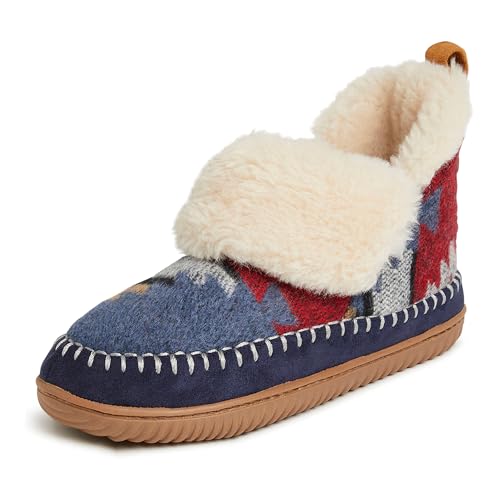
Dearfoams Women’s Alpine Moritz Outdoor Bootie Slipper — Best Outdoor Bootie
Dearfoams has made house footwear for generations, and the Alpine Moritz is its argument that a slipper can dress like a boot. The listing describes an outdoor bootie slipper in an alpine style, in navy multi, in a 9–10 band. Where the LongBay bootie reads as a cosy garment, the Moritz reads as footwear: a structured bootie silhouette that a woman can wear to the kerb, the woodpile or the corner shop’s doorstep without the visual negotiation that a plush slipper requires.
The listing includes the words arch support in the product’s name, and this review handles that phrase carefully: it is the maker’s description of the footbed’s shaped profile, a raised contour under the arch rather than a flat insole. That is all that is claimed here — a shape you can feel, which some wearers strongly prefer and others dislike. Nothing in this guide asserts that any slipper treats, corrects or prevents anything, and readers choosing footwear for a diagnosed condition should take advice from a clinician rather than from a slipper listing, this one included.
As the outdoor-leaning bootie, the Moritz makes most sense in houses where the indoors and outdoors blur: farmhouses, cabins, homes with a porch that functions as a room, and anywhere a woman steps out a dozen times a day for animals, gardens or grandchildren. The alpine styling earns compliments in those settings precisely because it looks intentional, and navy multi hides the evidence of that lifestyle better than any pale plush could.
The trade-offs mirror the LongBay’s with a different accent. Entry takes a pull, warmth runs high, and the structured build is more than a warm, carpeted flat requires. But for the woman whose current slippers keep dying at the doorstep — soles soaked, uppers ruined by dew — an outdoor bootie is not an extravagance; it is the first pair actually designed for her day.
The Moritz also answers a present-buying problem specific to this category: how to give a woman slippers that do not look like an afterthought. A bootie with alpine detailing, from a heritage house-footwear brand, in a deep navy that suits winter clothing, presents as a considered gift rather than a pharmacy purchase. Add the outdoor capability and it suits the recipient whose life the giver actually knows — the gardener, the dog owner, the cabin goer — which is what makes any present land. Size remains the one gamble, and the 9–10 band should be matched against her shoe size, not guessed from her height or her old slippers.
- Style: alpine outdoor bootie, per the listing
- Footbed note: maker’s description includes an arch support profile
- Colour and size listed: navy multi, 9–10 band
- Brand: Dearfoams, a long-established house footwear maker
- Entry: pull-on bootie
Strengths
- Most shoe-like silhouette here, presentable well beyond the front door
- Bootie coverage and outdoor intent suit blurred indoor-outdoor routines
- Shaped footbed profile for wearers who dislike flat insoles
Trade-offs
- Pull-on entry is slower than the slip-ons for nighttime trips
- More structure and warmth than a carpeted flat can use
- Shaped footbed is a preference, not a universal comfort win
Best for: women in houses where slippers routinely step outside, who want them to look like boots.
Not suited for: anyone wanting a light slip-on, or choosing footwear for a medical condition.
How Do the Six Pairs Compare Side by Side?
| Pick | Sole, as listed | Lining | Washable | Shape |
|---|---|---|---|---|
| ULTRAIDEAS Women’s Memory Foam Slippers Hard Bottom | Hard bottom, non-slip | Fur lined | Not claimed | Slip-on |
| LongBay Women’s Bootie Slippers Indoor Outdoor | Sturdy, non-slip | Plush fleece | Yes | Bootie |
| GOEWY Cozy Slippers for Women Indoor Outdoor | Anti-skid | Faux fur, warm lining | Yes | Closed-toe slip-on |
| HUXMEYSON Slippers for Women Anti-Skid Rubber Sole | Anti-skid rubber | Warm build | Not claimed | Classic slipper |
| RockDove Women’s Two-Tone Memory Foam Slipper | Indoor/outdoor, non-slip | Skin-friendly lining | Yes | Two-tone slip-on |
| Dearfoams Women’s Alpine Moritz Outdoor Bootie Slipper | Outdoor bootie build | Bootie coverage | Not claimed | Alpine bootie |
What Should You Look for in a Hard Sole Slipper?
Begin with the words the listing actually uses for its sole, because this category speaks in gradations. Hard bottom is the strongest claim. Anti-skid rubber is a grip claim with a shoe material behind it. Sturdy and indoor/outdoor are versatility claims. Each is honest in the six above, but they are not interchangeable, and the woman who needs to cross a wet patio daily should buy the rubber or hard-bottom language, not the versatility language.
Then think about flex. A good hard sole bends at the ball of the foot and resists twisting through the middle; a bad one either planks entirely or folds like cardboard. You cannot test this from a listing, but you can read the shape: booties and moccasin builds with a defined sole unit, like the pairs here, generally flex where feet flex, while the cheapest structured slippers are a single rigid slab. If a pair arrives feeling like a plank, that is a return, not a break-in project.
Lining weight is the third decision, and it is really a house-temperature decision. Fur and fleece linings in this guide are for houses that run cool; the lighter RockDove formula suits heated homes. Finally, weigh washability honestly against your life. A washable pair worn daily will be washed, and will stay pleasant; an unwashable pair worn daily will be aired, and will not, entirely. Neither answer is wrong, but they are different ownership experiences wearing the same title.
How Do You Get Used to a Firmer Sole?
The transition from soft slippers surprises people, so manage it like breaking in shoes. Wear the new pair for the active parts of the day first — cooking, tidying, errands around the house — and keep the old plush pair for the armchair week one. Most wearers stop noticing the firmness within days, because what the foot actually registers is the absence of the wobble and slide it had been correcting for, hundreds of tiny times a day, on the old pair.
Socks are a useful dial during the transition. A thin sock takes the edge off a new hard sole’s first evenings and keeps a fresh lining cleaner while it settles; bare feet give the truer long-term read. Judge the pair at the end of week two, not at the end of the first evening, and judge it on the floors that motivated the purchase — the bathroom tile at dawn is the honest test, not the bedroom carpet.
One adjustment is worth making deliberately: retire the old soft pair to a single role instead of the bin. Many converts keep the plush pair for reading in bed or for guests, and the structured pair for everything vertical. Two pairs worn in rotation also rest each other’s linings, which quietly extends both lives — a small household system that costs nothing once the new pair has arrived.
Care for a hard sole is mostly neglect, happily. Wipe the sole when it has been outside so grit does not get ground into timber floors, let a wet pair dry at room temperature rather than on a radiator, and wash only the pairs whose listings invite it, on a gentle cycle, air-dried. Structured soles dislike tumble-dryer heat as much as leather does, and air drying overnight costs nothing.
Which Floors Make a Hard Sole Worth It?
Tile is the strongest case. It is cold, it is hard, it is frequently wet in exactly the rooms where slippers are worn, and it destroys foam soles by compression while giving them nothing to grip. A hard or rubber sole answers all four complaints at once, which is why kitchen-heavy households convert to this category and rarely go back.
Timber and laminate make the grip case. Both are smooth, both are common, and both are where soft slippers slide at the heel on stairs and in hallways. Stone and concrete, in porches, utility rooms and older houses, make the insulation case: a structured sole is a thermal break between your foot and a floor that pulls heat all winter. Carpet, honestly, makes almost no case at all — and if your home is carpeted throughout and warm, the moderate RockDove end of this guide, or even a soft slipper, may serve you better than the firmest pair here. A guide that admits its own boundary is worth more than one that does not.
Hard Sole, Firm Sole or Outdoor Sole — What Do the Words Mean?
Buyers trip over this category’s vocabulary because three different ideas share one shelf. A hard sole, strictly, is about the sole unit’s resistance to flexing and compression: it holds its shape under your weight, so your foot rests on a stable platform. A non-slip or anti-skid claim is about the surface of that unit: tread and material chosen to grip rather than glide. An indoor-outdoor claim is about durability and water tolerance: the sole will not soak, stain or disintegrate when it meets a doorstep. The strongest pairs in this guide combine all three ideas, but a pair can honestly offer one without the others, and the reviews above keep the three separate for every pick.
Why does the distinction matter in practice? Because the failure modes differ. A versatile sole without real grip still slides on wet tile. A grippy sole without outdoor durability still soaks through at the doorstep. A hard platform without either still strands you at the bathroom door. Naming which property your household actually needs — stability for long standing, grip for wet rooms, durability for a blurred indoor-outdoor life — turns a vague search into a short list, and it is why this guide’s comparison table records the sole language of each listing rather than awarding every pair the same adjective.
How Should Hard Sole Slippers Fit Compared with Soft Ones?
Fit matters more here, for a mechanical reason: a soft slipper’s sole compresses and its upper stretches, so the pair quietly adjusts to a mediocre fit. A structured sole holds its dimensions, which means the fit you buy is the fit you keep. Judge a hard-sole pair by three points. The heel should sit without lifting clear of the footbed at each step. The toes should have a thumbnail of room, because the sole will not shorten. The midfoot should feel held rather than gripped — held is the sole’s shape working, gripped is a size too small announcing itself.
Bands complicate this, so use the band’s logic rather than fighting it. If your size is the lower number in a lined pair’s band, the lining will fill the difference and then compress toward your foot. If your size is the higher number, there is no reserve left, and thick winter socks may push the fit from snug to wrong. When a household owns both a lined winter pair and a lighter pair, it is common and sensible for the two to be different bands. Feet, like the houses in this guide, are seasonal.
When Is a Bootie Better Than a Slip-On?
The bootie question is really a question about what your ankles do all winter. In houses with cold air pooling at floor level — older houses, houses with exterior doors that open often, houses where the bedroom sits over an unheated space — the gap between a low slipper’s top and a trouser hem is a genuine cold channel, and closing it changes how warm the whole body feels, because ankles carry blood close to the skin. That is the LongBay and the Moritz’s shared argument, and it is strongest in exactly the houses where heating is most expensive to run harder.
The slip-on’s counter-argument is rhythm. A slip-on serves a life of constant small transitions: in and out of bed, in and out of the shower’s orbit, shoes off at the desk and on for the kitchen. Each transition costs a bootie a bend and a pull, and across a day those seconds accumulate into the reason a bootie ends up worn only in the evenings while a slip-on lives on the foot. Neither answer is better in the abstract. The honest method is to count your transitions for one ordinary day; households above a dozen usually end up slip-on households with a bootie reserved for the coldest weeks, and there is no shame in owning the answer in two parts.
How Do Hard Soles Change Stairs, Night Trips and Busy Kitchens?
Stairs are where the category earns its reputation in ordinary households. A soft slipper on a stair tread can roll at the edge or slide at the heel, and most people have felt the small internal flinch that follows. A structured sole with a defined edge and a grippy surface removes most of that negotiation, and a closed or bootie shape removes the rest by keeping the slipper attached to the foot rather than balanced on it. Nobody should treat any slipper as climbing equipment, and a handrail remains a handrail’s job — but the difference between a sole that holds a tread and one that skates on it is the difference between thinking about your feet and forgetting them, which is the entire point of house footwear.
Night trips make the same argument at lower speed. The route from bed to bathroom crosses the coldest, smoothest floors in the house at the moment the walker is least alert, and it is usually done in the slipper that lives by the bed. That is an argument for keeping your grippiest pair — here, the rubber-soled HUXMEYSON or the hard-bottomed ULTRAIDEAS — in the bedside role even if a prettier pair handles the daytime, and for preferring slip-on entry in that role, since nobody pulls on a bootie cheerfully at 4 a.m.
Busy kitchens reward a third property: a sole that does not absorb spills. Foam and fabric bottoms drink a splash and carry it around the house; a formed sole sheds it and wipes clean at the sink. In a cooking household, that hygiene difference compounds daily, and it is the unglamorous reason so many cooks end up in this category permanently.
What Mistakes Do Buyers Make with Hard Sole Slippers?
The classic mistake is buying the slogan instead of the sole. A shopper reads “indoor outdoor” on a soft slipper, wears it to a wet doorstep, and concludes the category is a fraud. Read the sole language the way the reviews above do — hard bottom, rubber, sturdy, versatile are four different promises — and buy the one your floors require.
The second mistake is sizing by hope inside a two-size band. A foot at the very top of a band, in a lined pair, with evening swelling, is a recipe for a heel that lifts and a sole that slaps. If you sit between bands, the lining’s compressibility argues for the smaller band in fleece and faux fur pairs, and the listing’s own size guidance should settle arguments this paragraph cannot.
Third, buyers wear hard soles like wellingtons. Outdoor intent in a slipper means doorsteps, patios, bins and garages in ordinary weather — not puddles, mud or a soaked garden. Every pair here is still a slipper, with a slipper’s upper, and treating the sole as a licence to garden in the rain ruins uppers that were never the weak point.
Finally, some buyers expect a firm sole to feel plush on day one and return the pair by day three. Firmness is the feature. The comfort of this category arrives as stability, warmth without sweat, and a pair that feels the same in month six as in week one — judge it on those terms, over a fortnight, on your hardest floor.
Final Recommendation
Start where the title starts: the ULTRAIDEAS Women’s Memory Foam Slippers Hard Bottom is the most literal answer to this search, pairing a stated hard bottom with fur lining and foam, and it is the default recommendation for hard-floored homes. If grip on wet surfaces is your sharpest need, take the HUXMEYSON Slippers for Women Anti-Skid Rubber Sole and its shoe-material outsole. If your house blurs into its garden all day, the Dearfoams Women’s Alpine Moritz Outdoor Bootie Slipper dresses and works like the boot it imitates, while the LongBay serves cold ankles, the GOEWY serves the wash-everything household, and the RockDove serves anyone who wants the gentlest version of the idea. Pick the sole language that matches your wettest floor, and the pair will feel chosen rather than gambled on. The right hard sole disappears under a whole day of ordinary life, and that quiet reliability is what you are actually buying.
Frequently Asked Questions
Are hard sole slippers good for walking to the mailbox?
Yes, within slipper limits. The pairs here with hard bottoms, rubber soles or outdoor bootie builds are designed for doorsteps, paths and driveways in ordinary weather. They are not rain footwear, and their uppers remain slipper uppers, so keep the trip short and the pavement mostly dry.
Will a hard sole damage timber floors?
A clean hard sole is generally kinder to timber than the grit trapped under a fabric sole, because rubber and formed soles do not pick up and grind debris the way textile bottoms do. The habit that protects floors is wiping soles after outdoor trips, whatever the slipper.
Are these slippers a substitute for supportive shoes?
No. A shaped footbed, where a listing describes one, is a comfort feature of the product’s design. Slippers are household footwear, not medical devices, and anyone managing a foot condition should choose footwear with professional advice rather than from a review of house shoes.
How do I choose between two size bands?
Consider the lining and the time of day. Lined pairs compress and give room over the first weeks, so a foot between bands usually settles into the smaller one; unlined or lightly lined pairs give less, arguing for the larger. Trying on in the evening, when feet are at their largest, gives the truest answer.
Can hard sole slippers be machine washed?
Only where the listing says so. Three of the six here — the LongBay, the GOEWY and the RockDove — claim machine washability; the others should be spot-cleaned and air-dried. Heat is the enemy of structured soles, so even washable pairs should dry in air, not in a dryer.
Should I wear socks with hard sole slippers?
Either works, and the choice is a warmth and fit dial rather than a rule. Socks add a layer that suits the lightly lined pairs in winter and can take up the extra room in a band whose lower size is yours. Bare feet give the truest read of a memory foam insole and suit the fur and fleece linings, which were designed to be the layer against the skin. Many owners end up seasonal about it, which is the natural answer.
How long do hard sole slippers last compared with soft ones?
The sole is rarely what retires them. Structured and rubber soles outlast foam soles comfortably, so the limiting parts become the lining, which compresses and thins, and the upper’s seams. A washable pair usually stays pleasant longest because its lining can be refreshed rather than merely aired. Expect the firm pairs here to hold their shape through seasons where a plush pair would have twisted and flattened.
Do hard sole slippers feel heavy?
They feel firmer rather than dramatically heavier, and the lightest designs here are built to keep the total weight close to a soft slipper’s. What most wearers notice after a week is not weight but stability: the foot stops sliding inside the slipper on smooth floors.
Related Guides
If the hard-sole idea appeals but your household is unisex or shared, the broader category is covered in Best Indoor Outdoor Slippers. For readers furnishing the rest of a house that works hard, Best Offset Smokers for Bargain covers the garden end of value hunting, and Best Alarm Clocks with Radios finishes the bedside that these slippers will be parked beside.


