What's inside
- Key Takeaways
- Quick Picks
- How We Chose These Picks
- What Makes a Chair a Club Chair, Exactly?
- The Six Club Chairs in Detail
- Where Should a Club Chair Actually Sit in a Room?
- Comparing the Six: Silhouette, Skin and Setting
- What Goes Wrong When People Buy Club Chairs?
- Faux Leather, Linen or Leather: Living with Each Skin
- Small Room, Big Chair: Making the Proportions Work
- Assembly Day and the First Week: What to Check
- Ottomans, Footstools and the Completion of the Chair
- Building the Reading Corner Around the Chair
- Guests, Gatherings and the Chair Everyone Chooses
- The Club Chair at Work: Home Offices and Visitor Duty
- Final Recommendation
- Frequently Asked Questions
- Related Guides
As an Amazon Associate I earn from qualifying purchases. This post may contain affiliate links at no extra cost to you.
cottageverdict.com is reader-supported. When you buy through links on our site, we may earn an affiliate commission.
Where to buy: every chair in this guide links to its Amazon listing, where you can check price on Amazon and confirm the upholstery, dimensions and whether the chair is sold singly or as a pair before ordering. Club chairs are bought by eye as much as by specification, so use the listing photographs at full size — the silhouette is the product.
The best club chairs do a job no other seat in the house quite does: they give one person a complete, enclosed place to be. A club chair is defined by its wrap — a low, deep seat enclosed by a back and arms that run together in one continuous embrace, descended from the leather chairs of old Parisian clubs and translated since into every fabric and budget. It is the chair for the corner by the lamp, the chair a guest makes for within a minute of arriving, the chair that turns a spare stretch of living room into a reading address with its own weather.
Every chair in this guide is a fixed chair. That is a deliberate line, held throughout: no swivels, no recliners, no mechanisms — just framed, upholstered, four-legged club chairs that sit where you put them and age where they sit. Readers who want rotation should look at swivel accent chairs instead; this page is for the stillness end of the market, where the differences are silhouette, upholstery and build honesty. The six below include a pair of mid-century faux leather chairs sold as a set of two, two tufted barrel designs, a plain fabric club chair in an uncommon light blue, a full Chesterfield with rolled arms, and two brown chairs — one with a lumbar pillow and wood legs, one with nailhead trim — that between them cover most of what “club chair” can mean at sensible tiers.
A word about value, since this category invites it. A club chair’s price buys three things: the frame you cannot see, the foam you feel in month six rather than minute one, and the upholstery work — tufting, piping, nailheads — that is done by hand or not at all. The listings here are positioned in the accessible tiers, and the reviews judge them in those terms: not against a heritage leather club chair costing many times more, but against the honest question of whether each chair gives a well-shaped, well-finished seat for the tier it occupies.
Key Takeaways
- All six chairs here are fixed, framed club chairs — no swivel or recline mechanisms anywhere in this guide.
- The Yaheetech pick is a set of two faux leather chairs, the only pair here; the other five are single chairs.
- Tufting is the category’s signature craft: the BELLEZE, LEVNARY, HUIMO and Blissabod all use it, each with a different silhouette.
- Upholstery splits between faux leather (Yaheetech, Blissabod), leather (LEVNARY, as listed) and fabrics (BELLEZE linen, Tafton fabric, HUIMO upholstery).
- Wood legs and wood arms recur across the guide — check the listing photographs for the finish against your floor.
- A club chair is a one-person enclosure; pairs flank a fireplace or a sofa, singles claim a corner.
Quick Picks
| Pick | Badge | Why it earns its place |
|---|---|---|
| Yaheetech Faux Leather Accent Club Chairs, Set of 2 | The instant pair | Two mid-century club chairs with sloped backs and wood arms, sold together for symmetrical rooms. |
| BELLEZE Barrel Club Chair, Tufted | Barrel embrace | A tufted barrel silhouette in grey linen fabric that wraps a reader in one continuous curve. |
| Christopher Knight Home Tafton Fabric Club Chair | The quiet classic | An unadorned fabric club chair in light blue for rooms that want calm rather than ceremony. |
| LEVNARY Leather Chesterfield Club Chair | Full Chesterfield | Tufted leather, rolled arms, mid-century single sofa presence — the traditional club chair, whole. |
| HUIMO Tufted Upholstered Club Chair | Pillow included | Tufted upholstery with a lumbar pillow and solid wood legs, aimed at reading nooks. |
| Blissabod Faux Leather Club Chair with Nailhead Trim | Detailed finish | Nailhead trim and a thick seat cushion bring tailored detail to a faux leather frame. |
How We Chose These Picks
We chose these chairs the way a room chooses them: silhouette first, upholstery second, story third. Silhouette, because a club chair is bought as a shape in a room — the barrel’s unbroken curve, the Chesterfield’s rolled ceremony, the mid-century pair’s clean slope — and a shape that fights your room’s other furniture loses no matter how comfortable the seat. The six shapes here were picked to be genuinely different from one another, so that a reader can shop by the outline they want rather than by six versions of the same chair in different colours.
Upholstery second, because it decides both the chair’s daily feel and its maintenance life. Faux leather wipes clean and suits households with sticky fingers and shedding dogs; the listing for the LEVNARY describes leather, with the presence that material brings; linen and fabric options breathe better in warm rooms and read softer in bedrooms. The reviews take each material on its own terms and name the trade-offs plainly, including where a listing is brief — the Tafton’s title, for instance, gives fabric and colour and little else, and its review says what can and cannot be concluded from that.
Story third: where a chair is meant to live. Every listing here names its rooms — living room, bedroom, reading nook, office — and the reviews test those claims rather than repeat them. A chair pitched at small living rooms is judged on footprint; a chair pitched at reading is judged on whether its arms and back support a long chapter. What we excluded matters as much: swivel club chairs exist in this market, some of them handsome, but they belong to a different guide’s argument, and mixing them in would blur the one promise this page makes — fixed chairs, honestly compared.
What Makes a Chair a Club Chair, Exactly?
The definition is in the arms. In a club chair, the back and arms form one enclosing gesture — the arms are high, padded and continuous with the back’s curve or line, so the sitter is held inside a single upholstered shell rather than perched between separate parts. The seat is low and deep by dining standards, the whole chair sits close to the ground on short legs, and the effect is of a small room for one person. Accent chairs borrow pieces of this language, but a chair with thin open arms, a tall back or a dining posture is an accent chair wearing club clothes.
That enclosure is the comfort and the constraint. A club chair supports a reader’s elbows at book height, gives a conversationalist somewhere to lean a forearm, and makes a small person feel held and a large person feel — this must be said — occasionally hemmed. Seat width between the arms is the measurement that decides it, and it is worth checking on any listing against the household’s broadest regular sitter, because a club chair that pinches is a chair that gets admired and avoided. The barrel designs in this guide enclose most completely; the mid-century Yaheetech pair, with their sloped backs and wood arms, enclose least and breathe most.
The style’s durability across a century of interiors comes from that same enclosure reading at any budget. In hide, in linen, in faux leather, the silhouette announces the same intention: sit here, stay a while, the room can wait. Readers furnishing a whole evening around that intention — film nights especially — often pair a club chair’s stillness with something that reclines, and our guide to Best Zero-Gravity Chairs covers the folding loungers that take over when the film starts and formality ends.
The Six Club Chairs in Detail
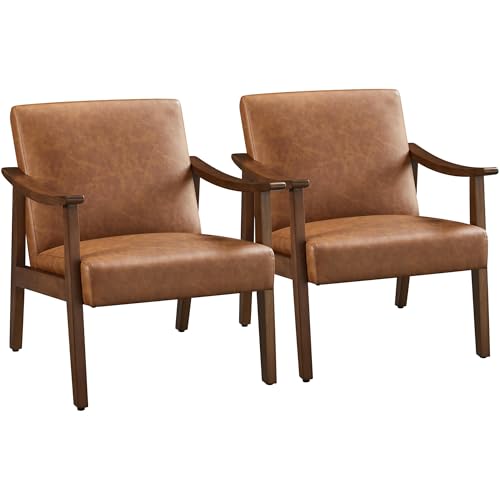
Yaheetech Faux Leather Accent Club Chairs, Set of 2 — The instant pair
Sold as a set of two, the Yaheetech chairs solve the problem that quietly doubles the cost of most club chair plans: rooms usually want a pair. Flanking a fireplace, facing a sofa, making a conversation group of a bare stretch of living room — club chairs work in twos, and a matched set removes the risk of ordering a second chair months later from a changed production run. The design is mid-century in accent: brown faux leather cushions, supportive sloped backrests per the listing, and sturdy wood arms that give the chairs their period outline and a cool, hard contrast to the padded seat.
The wood arms deserve their own sentence, because they change the chair’s daily character. Upholstered arms are for sinking into; wood arms are for resting a forearm, a book or a cup’s saucer edge on, and they wear decades better than padding under that traffic. The listing positions the pair for small living rooms, offices and reading nooks, and the footprint logic holds — two chairs of moderate scale furnish a seating group without a sofa’s commitment, an arrangement renters and first flats should consider seriously. Faux leather in brown is the practical classic: it wipes, it forgives, and it sits comfortably alongside wood floors and wool rugs without demanding the room dress up to its level.
- Sold as: set of 2 chairs
- Upholstery: faux leather, brown
- Back: supportive sloped backrests, per the listing
- Arms: sturdy wood arms
- Buying route: sold through the Yaheetech Faux Leather Accent Club Chairs, Set of 2 Amazon listing — check price on Amazon
Strengths
- A matched pair in one order, matched in dye and finish in a way repeat orders cannot promise.
- Wood arms wear better than padded arms and suit the mid-century outline honestly.
- Moderate scale suits the small living rooms the listing names.
Trade-offs
- Two chairs arrive whether your room wanted a pair or a single statement.
- Wood arms are firm resting places, less forgiving for a full sideways curl-up.
- Faux leather will not develop the patina that makes old club chairs romantic.
Best for: pairs of chairs flanking a fireplace or sofa, small living rooms, offices and reading nooks furnished in one decision.
Not suited for: buyers wanting one large statement chair, or anyone set on fully upholstered arms.

BELLEZE Barrel Club Chair, Tufted — Barrel embrace
The barrel chair is the club idea distilled: back and arms as a single continuous curve, like the inside of the barrel it is named for, and BELLEZE’s version wraps that curve in tufted linen fabric in grey. The listing calls it a modern, comfy upholstered accent barrel arm chair with sturdy legs, for bedroom and living room — and the bedroom is worth dwelling on, because a barrel chair’s compact, armless-looking footprint makes it the club chair most at home in a bedroom corner, where a full Chesterfield would hold court too loudly.
Tufting on a curve is the craft test of this design. Buttons pulled into a curved back must sit evenly or the whole chair looks homemade, and the barrel silhouette gives tufting nowhere to hide. In grey linen the effect is tailored rather than plush — a chair that reads calm in daylight and holds its own next to a bed’s worth of textiles. The continuous arm curve supports a reader’s elbows at an even height all the way around, which is the barrel’s ergonomic party trick: wherever you shift, the arm is there. What it will not do is give a tall sitter a high back to rest a head on; the barrel’s embrace ends at the shoulders, by design.
- Form: barrel club chair, continuous curved back and arms
- Upholstery: tufted linen fabric, grey
- Legs: sturdy legs, per the listing
- Rooms named in the listing: bedroom, living room
- Buying route: sold through the BELLEZE Barrel Club Chair, Tufted Amazon listing — check price on Amazon
Strengths
- The continuous curve supports elbows at every shifted position, a reader’s quiet luxury.
- Grey linen reads calm and tailored, suiting bedrooms where leather would loom.
- The barrel footprint is compact for the enclosure it delivers.
Trade-offs
- The back ends at shoulder height; head-resters should look at taller designs.
- Linen fabric asks for prompt spill attention that faux leather forgives.
- A single chair only — pairs must be ordered as two, with the usual matching caveat.
Best for: bedroom reading corners, grey-toned living rooms, and readers who shift position often.
Not suited for: tall sitters wanting head support, or spill-heavy family rooms.

Christopher Knight Home Tafton Fabric Club Chair — The quiet classic
The Tafton’s listing is the briefest in this guide — a fabric club chair in light blue, from Christopher Knight Home — and its review will honour that brevity by separating what is known from what is merely likely. Known: the brand, the category, the fabric upholstery and the colour. Light blue is the interesting fact. Club chairs default to browns and greys because they are safe; a light blue club chair is a deliberate room decision, the piece that gives a neutral living room its one soft note of colour and a bedroom its calm. In a guide of brown chairs, the Tafton is the palate cleanser.
What the brevity means practically is that the listing page itself must do more work for this chair than for its rivals: check the dimensions there, the leg material, the assembly involved, because the title carries none of it. That is not a disqualification — plenty of good furniture is sold under short titles — but it changes the buying motion from comparison to verification. Judge the Tafton on the silhouette in its photographs and the colour in your room’s light, order it as the quiet classic it presents itself as, and let its understatement be the point: not every club chair needs tufting, trim or a story. Some rooms simply need a well-shaped blue chair.
- Upholstery: fabric, per the listing
- Colour as listed: light blue
- Brand line: Christopher Knight Home
- Form: fabric club chair, fixed
- Buying route: sold through the Christopher Knight Home Tafton Fabric Club Chair Amazon listing — check price on Amazon, and confirm dimensions there
Strengths
- The only light colour in the guide, for rooms tired of brown and grey.
- An unadorned silhouette suits calm, modern rooms where tufting would fuss.
- Fabric upholstery breathes better than faux leather in warm rooms.
Trade-offs
- The listing title is brief; dimensions and leg details must be verified on the page.
- Light fabric shows marks sooner and asks for gentler treatment than dark faux leather.
- No craft details — tufting, trim, pillow — for buyers who shop by them.
Best for: light, calm interiors; bedrooms and living rooms wanting one soft colour note; buyers who prefer quiet to ceremony.
Not suited for: households needing specifications up front, or high-traffic rooms where light fabric lives dangerously.

LEVNARY Leather Chesterfield Club Chair — Full Chesterfield
If the club chair has a cathedral, this is it. The LEVNARY is a Chesterfield in the full sense the listing claims: leather upholstery in dark brown, deep tufting, rolled arms at the same height as the back, presented as a mid-century modern single sofa chair for home, bedroom and reading room. The Chesterfield formula — the scroll arms, the buttoned expanse, the low-slung seat — has survived two centuries of fashion because it makes a room feel established the day it arrives, and a single chair of it does that work without the sofa-sized commitment.
Leather is the material headline and should be weighed as such. The listing describes the chair as leather; that brings the category’s traditional virtues — a surface that wipes, ages and develops character rather than merely wearing — and its traditional duties, namely occasional conditioning and a room that does not bake it in direct sun. The rolled arms give the Chesterfield its conversational posture: a forearm rests along the scroll as naturally as on a bar counter, which is no accident of ancestry. As the guide’s most traditional and most substantial single chair, it is the pick for the reader who wants the club chair idea whole, undiluted by modern simplification — and who has the floor space and the doorway width to welcome it.
- Style: Chesterfield, rolled arms, tufted
- Upholstery: leather, dark brown, per the listing
- Form: single sofa chair, fixed
- Rooms named in the listing: home, bedroom, reading room
- Buying route: sold through the LEVNARY Leather Chesterfield Club Chair Amazon listing — check price on Amazon
Strengths
- The complete traditional club chair: scroll arms, deep tufting, leather.
- Leather ages with character rather than simply wearing out.
- Single-chair presence strong enough to anchor a room’s whole seating story.
Trade-offs
- The most substantial footprint and presence here; small rooms will feel chaired.
- Leather asks for basic care and shade from direct sun.
- Its formality can bully a casual room’s other furniture into looking underdressed.
Best for: traditional living rooms, reading rooms, and buyers who want the club chair archetype itself.
Not suited for: small or minimalist rooms, or anyone wanting a light, movable accent.

HUIMO Tufted Upholstered Club Chair — Pillow included
The HUIMO’s listing does something the others do not: it mentions the sitter’s lower back. This tufted upholstered club chair in brown comes with a lumbar pillow and solid wood legs, and is pitched at living rooms, bedrooms and reading nooks. The pillow is a small inclusion with an outsized effect on how the chair is used. Club chairs are deep by design, and depth is exactly what shorter sitters and upright readers struggle with — the pillow shortens the seat to the sitter, turning a sink-in chair into a sit-in chair when the book is long and the posture matters, then comes out when the evening’s plan is a film and a slump.
Solid wood legs, stated plainly in the listing, are the other honest detail: they ground the chair’s traditional look, they are the leg type least likely to wobble theatrically on uneven floors, and they make the chair’s underside easy to clean around. The tufting keeps the club ceremony while the brown upholstery keeps the peace with most rooms. Taken together the HUIMO reads as the thoughtful middle of this guide — neither the Chesterfield’s full ceremony nor the Tafton’s silence, but a tufted chair with two practical kindnesses included in the box.
- Upholstery: tufted, brown, per the listing
- Included per the listing: lumbar pillow
- Legs: solid wood
- Rooms named in the listing: living room, bedroom, reading nooks
- Buying route: sold through the HUIMO Tufted Upholstered Club Chair Amazon listing — check price on Amazon
Strengths
- The lumbar pillow adapts a deep seat to upright readers and shorter sitters.
- Solid wood legs are stated plainly and suit the traditional silhouette.
- Tufted ceremony at a middle-of-the-guide level of formality.
Trade-offs
- The pillow is one more loose piece for households that lose cushions to sofas.
- Brown upholstery joins a crowded colour field in this guide.
- Deep-seat design still favours loungers when the pillow is out.
Best for: readers who sit upright for long chapters, reading nooks, and anyone shorter who finds club chairs too deep.
Not suited for: minimalists who dislike loose pillows, or buyers wanting a swivel’s flexibility.
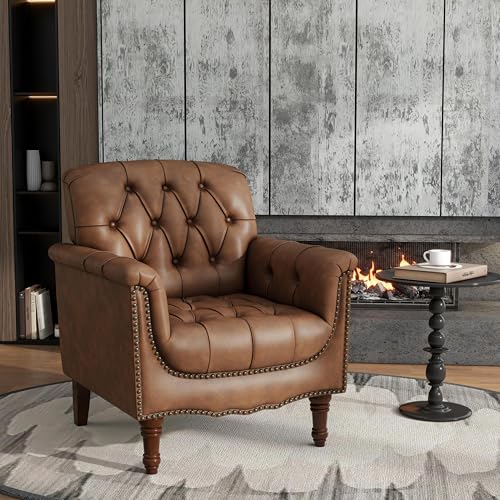
Blissabod Faux Leather Club Chair with Nailhead Trim — Detailed finish
Nailhead trim is furniture’s tailoring: a line of individual metal studs following a chair’s edge, doing no structural work whatsoever and all of the impression work. The Blissabod builds its case on that detail — a tufted faux leather accent chair in brown with nailhead trim, wood legs and a thick seat cushion, in a mid-century modern club chair frame, for living room, bedroom and office. The trim traces the silhouette the way piping traces a suit, and at conversational distance it is the detail that makes visitors assume the chair cost more than the tier it sits in.
The thick seat cushion is the comfort counterpart to the trim’s ceremony, and the pairing is well judged: a chair that looks tailored should not sit like a park bench. Faux leather keeps the whole proposition in the wipe-clean, accessible world — this is ceremony you can own with a dog in the house. The office positioning in the listing is worth taking seriously too; a club chair with this much finish works as the visitor’s chair in a home office or the principal’s chair in a small professional room, where its message — settled, deliberate, slightly formal — is an asset rather than an eccentricity.
- Upholstery: faux leather, tufted, brown
- Detail: nailhead trim; wood legs
- Seat: thick seat cushion, per the listing
- Rooms named in the listing: living room, bedroom, office
- Buying route: sold through the Blissabod Faux Leather Club Chair with Nailhead Trim Amazon listing — check price on Amazon
Strengths
- Nailhead trim delivers tailored presence that photographs and visits above its tier.
- A thick seat cushion backs the looks with sit-down comfort.
- Faux leather keeps the ceremony wipe-clean and household-proof.
Trade-offs
- Trim is a taste commitment; minimal rooms may find it fussy.
- Faux leather, again, will not patina like the Chesterfield’s hide story.
- The formal finish can make a very casual room’s other pieces look scruffy.
Best for: home offices, formal-leaning living rooms, and buyers who shop by finishing details.
Not suited for: ultra-minimal interiors, or anyone who wants upholstery with zero ornament.
Where Should a Club Chair Actually Sit in a Room?
A club chair is a destination, and destinations need an approach, a light and a reason. The classic placements survive because they work: angled in a corner with a floor lamp behind the shoulder and a small table within reach, the chair becomes a reading cell that the rest of the room respects. Facing a sofa across a low table, a pair of club chairs completes the conversation square that sofas alone leave open on one side. Beside a fireplace — not so close that upholstery bakes — a single club chair claims the room’s oldest good seat, and the household’s reading, thinking and dog-adjacent sitting will migrate there within a week.
Angles matter more than distances. A club chair squared flat against a wall looks like storage; the same chair turned thirty degrees into the room looks like an invitation, because its enclosure faces the room’s life rather than its skirting board. Leave enough space behind a barrel or Chesterfield for the silhouette to be seen — these chairs are sculpture from behind as much as seating from the front, and a chair jammed against a bookcase wastes half its purchase price. In bedrooms, the chair earns its floor by doubling as the dressing seat and the reading seat; in living rooms, by being the one seat that is always somebody’s favourite and never the spare.
Households furnishing the whole room at once should sequence honestly: sofa first for capacity, club chairs second for character, and the soft extras last. This page’s six handle the corner-and-pair decisions in detail. And for the practical background of a hard-working home — the throws, covers and upholstery that cycle through the wash — the laundry guides elsewhere on the site keep the same honesty about machines as this page keeps about chairs, starting with Best Top-Load Washers That Don’t Go Unbalanced for households whose loads include more than clothes. Those loads, in a house with this much upholstery, tend toward the bulky — blankets, throws and cushion covers in constant rotation — which is where our guide to Best High-Capacity Clothes Dryers earns its place in the same planning conversation, sized for exactly the loads soft furnishings generate.
Comparing the Six: Silhouette, Skin and Setting
| Chair | Silhouette | Upholstery as listed | Sold as |
|---|---|---|---|
| Yaheetech Faux Leather Accent Club Chairs, Set of 2 | Mid-century, sloped back, wood arms | Faux leather, brown | Set of 2 |
| BELLEZE Barrel Club Chair, Tufted | Barrel, continuous curve | Linen fabric, grey, tufted | Single |
| Christopher Knight Home Tafton Fabric Club Chair | Classic club, unadorned | Fabric, light blue | Single |
| LEVNARY Leather Chesterfield Club Chair | Chesterfield, rolled arms | Leather, dark brown, tufted | Single |
| HUIMO Tufted Upholstered Club Chair | Traditional club, wood legs | Upholstered, brown, tufted, lumbar pillow | Single |
| Blissabod Faux Leather Club Chair with Nailhead Trim | Mid-century club, nailhead trim | Faux leather, brown, tufted | Single |
Two patterns stand out from the table. Brown dominates — four of the six chairs — because the club chair’s ancestry is brown and the market follows it; the grey linen BELLEZE and the light blue Tafton are the deliberate exceptions, and rooms in lighter palettes should start there. And only the Yaheetech solves the pair problem in a single order, which is worth real money and matching certainty in rooms planned symmetrically.
What Goes Wrong When People Buy Club Chairs?
The measurement mistake leads the list, in two forms. Buyers measure the chair’s width and forget its depth — club chairs are deep, and a chair that fits the wall’s width can still swallow the walkway in front of it. And they forget the width between the arms, the measurement the sitter actually lives inside, which no headline dimension advertises. Measure both, and sit in a comparable chair somewhere with a tape measure’s findings in hand before ordering for a broad-shouldered household.
The second mistake is upholstery by photograph. Faux leather, linen and leather behave differently under a household’s actual life — sun, spills, claws, denim dye — and a chair chosen for its staged photograph may spend its real life under a throw hiding the evidence. Choose the material for the room’s worst day, not its best photograph. Third, buyers place the chair and never move it again, even when the room tells them the corner is wrong; a club chair is light enough to audition in two corners across a week, and the right corner doubles its use. Fourth, in a guide-specific trap: readers fall for a swivel club chair elsewhere after reading here, then wonder why the room’s still corner feels restless — rotation is a different pleasure, and mixing the two intentions in one chair usually serves neither.
Finally, pairs. The second chair ordered six months later is the classic heartbreak — a dye lot shifted, a production run tweaked — and it is why the Yaheetech’s set-of-two and the discipline of ordering pairs together, whatever the model, appear in this guide’s advice more than once. Symmetry is perishable; buy it while it is guaranteed.
Faux Leather, Linen or Leather: Living with Each Skin
The upholstery decision outlives every other in this guide, because you will touch the chair’s skin ten thousand times and its silhouette only with your eyes. Faux leather — the Yaheetech pair and the Blissabod — is the household material: it wipes clean after the incidents that family rooms specialise in, it does not absorb odours, and it asks nothing seasonally. Its honest limits are that it can feel cool-then-sticky across a summer evening, that it will eventually show wear as surface change rather than character, and that no guest will ever mistake it for hide at touching distance. For homes with children, dogs or a relaxed attitude to drinks, those limits are worth every bit of the forgiveness.
Linen and fabric — the BELLEZE’s grey linen and the Tafton’s light blue — trade that forgiveness for texture and temperature. Fabric breathes, so a summer reader does not stick; it reads softer in a room, especially a bedroom; and it takes dye beautifully, which is why the guide’s two non-brown chairs are both fabric. The duties are promptness with spills, a vacuum with an upholstery tool as a weekly habit, and a realistic view of sunlight, which fades fabric unevenly across a chair parked half in a window’s beam. Households that eat in their chairs should choose fabric with their eyes open; households that read in them will love it daily.
Leather — the LEVNARY’s dark brown — is the long game. It wipes nearly as easily as faux leather, then does something no substitute does: it changes with use into a record of use, softening where hands rest and deepening in tone, so that a ten-year-old leather club chair looks more itself than a new one. The price of that character is care — occasional conditioning, shade from baking sun, and the acceptance of scratches as biography rather than damage. Buyers who keep furniture for a decade and like objects that testify to their lives should weigh the Chesterfield heavily; buyers who redecorate in cycles will never collect leather’s payoff and should take the faux or fabric chairs without a backward glance.
Small Room, Big Chair: Making the Proportions Work
The fear that a club chair is too much chair for a small room is half right: the wrong club chair is. Bulk in a chair is mostly visual, and visual bulk is decided by legs and lines more than by raw dimensions. A chair that shows its legs — the HUIMO’s solid wood, the Blissabod’s wood legs, the Yaheetech’s wood arms lifting the eye — reads lighter than a skirted chair of identical size, because the floor shows through beneath it and the room keeps its sense of continuous space. Light colours lighten further, which is the Tafton’s quiet superpower in a small pale room, and a single chair angled in a corner takes less visual room than the same chair squared against a wall, because the corner’s dead space does the absorbing.
What small rooms cannot absorb is the pair-plus-sofa-plus-everything plan. Choose the seating the room’s life actually needs: many small living rooms live better with two club chairs and a small table than with a sofa nobody stretches on and chairs nobody sits in. The Yaheetech set exists for exactly that arithmetic. Large rooms have the opposite problem — a single club chair can look like a rumour — and there the Chesterfield’s mass or a confident pair earns its keep, with the chairs grouped close enough to converse rather than scattered as upholstered islands. In both directions, the tape measure is the stylist: an hour with the chair’s footprint taped on the floor tells you more than a month of imagining.
Assembly Day and the First Week: What to Check
Most chairs at these tiers arrive needing their legs attached and little more, and the ten minutes that takes is the cheapest quality control you will ever perform. Attach legs on a soft surface so the upholstery is not the thing touching the floor, tighten each leg fully before standing the chair up, then sit and shift your weight deliberately: a new chair should feel planted, and any rock at this stage is a leg a quarter-turn short, not a personality trait. Run a hand along the tufting and seams while the chair is new and returnable — buttons should sit evenly, seams should run straight, and nailhead trim, where fitted, should follow its line without a wander that your eye will find every evening for years.
The first week teaches the household the chair’s real dimensions. Watch where people actually sit in it — the club chair bought for reading that becomes the gaming chair has told you something true about your room — and watch the light: a chair placed for the morning photograph may spend its evenings in shadow, and moving a lamp is cheaper than moving your habits. Faux leather and fabric both benefit from an early decision about throws: a washable throw over the seat takes the daily wear and the pet’s tenancy, and can be chosen to argue charmingly with the chair’s brown. Decide it in week one, while the chair is pristine, rather than in month six, when the throw becomes a cover-up.
Ottomans, Footstools and the Completion of the Chair
A club chair plus somewhere to put your feet is a recliner that never needed a mechanism, and many owners complete the chair that way within the year. The pairing rule is height: a footstool or ottoman should sit a little below the chair’s seat height, so the legs rest with a gentle downward slope rather than propped level or jacked up. In fabric terms, the ottoman need not match — a contrasting pouffe or a leather stool beside a fabric chair looks collected rather than mistaken — but it should share the chair’s level of formality, because a Chesterfield with a bean-bag footrest is a sentence that does not parse.
Households short on space should note the storage ottoman’s double duty: feet up in the evening, blankets inside by morning, and an emergency seat when the room fills. It is the one accessory that can make a single club chair serve a small flat almost as flexibly as a pair. What an ottoman cannot fix is a chair whose seat itself is wrong for its sitter — depth and arm height are the chair’s own decisions, made at purchase — so treat the footstool as the completion of a good choice, never as the rescue of a poor one.
Building the Reading Corner Around the Chair
A club chair becomes a reading chair when three supporting actors are cast correctly. The lamp goes behind and slightly to the side of the reader’s shoulder, high enough that its light falls on the page rather than into the eyes, and warm enough that evening pages do not look like office documents. The table goes on the reader’s dominant-hand side, close enough that a cup is set down without a lean, because a lean per chapter is a posture tax nobody notices until the evening ends. And the books themselves need a home within arm’s reach — a small stack on the table, a basket beside the chair — because a reading corner that requires standing to fetch the next chapter is a reading corner that hosts shorter sessions.
Sound and temperature finish the set. A corner away from the television’s axis gets the household’s quiet without demanding silence, and a throw within reach covers the hour when the room cools and the chapter is too good to leave for a jumper. None of this costs much, and all of it multiplies the chair: the difference between a club chair that is sat in daily and one that is admired weekly is almost never the chair. It is whether the corner around it was finished. Buyers choosing between the guide’s chairs for this purpose should weight the BELLEZE’s even arm support and the HUIMO’s pillow heavily, since both were designed, in effect, by readers.
Guests, Gatherings and the Chair Everyone Chooses
Every household with a club chair learns the same social fact within the first gathering: it becomes the contested seat. Guests read a room’s chairs the way they read its menu, and the enclosed, single, obviously comfortable chair is the one claimed first and surrendered last. Hosts can use this knowledge kindly — placing the club chair where an older guest will find its arms genuinely helpful for sitting and rising, since a club chair’s firm arms are leverage, not just upholstery — or strategically, angling it toward the conversation’s centre so its occupant is included rather than enthroned apart.
There is a hosting argument for the pair here that goes beyond symmetry. Two club chairs give a gathering two good seats instead of a sofa’s gradient of good and middling places, and they let a host offer the room’s best experience to two guests at once — a small arithmetic of generosity that the Yaheetech set makes unusually affordable. When the gathering ends, the chairs return to their daily work without having been “the party furniture,” which is the final virtue of buying real chairs rather than occasion pieces: the room’s best seats are its everyday seats, and the guests were simply lent them.
The Club Chair at Work: Home Offices and Visitor Duty
Two chairs in this guide name the office in their listings, and the use deserves a moment’s thought because it changes which chair wins. As a visitor’s chair, a club chair sends a message a mesh task chair cannot: the meeting matters, sit properly, stay for the real conversation. Its arms give a guest the composed posture that difficult discussions go better in, and its presence upgrades a spare-room office into a room that receives people. As the principal’s own thinking chair — the second seat every good office needs, away from the desk’s screen gravity — the club chair hosts the reading, planning and phone-call hours that a task chair does badly, and workers who add one routinely report the desk chair’s tyranny loosening.
The cautions are practical. A club chair is not a desk chair: it sits low, it does not roll to the keyboard, and nobody should write a report from one. It is the office’s other seat, and offices small enough to hold only one chair should keep the task chair and let the club chair wait for a bigger room. Where two chairs fit, though, the pairing of task chair and club chair is the home office’s most civilised arrangement — and of this guide’s six, the Blissabod’s tailored finish and the Yaheetech pair’s professional brown are the two that walk into a working room most naturally.
Final Recommendation
Start with the room’s plan. If the plan is a pair — and for living rooms it usually is — the Yaheetech set is the guide’s most efficient answer: two matched mid-century chairs with wood arms and wipe-clean faux leather, furnishing a conversation group in one order. If the plan is one significant chair, the LEVNARY Chesterfield is the archetype whole and undiluted, the chair that makes a room feel established; give it the space and shade it asks for and it will out-serve everything else here.
Between those poles, choose by temperament: the BELLEZE barrel for the reader who shifts and curls, the Tafton for the calm light room, the HUIMO for the upright reader who will genuinely use its pillow, and the Blissabod for the room that wants its tailoring visible. Every chair on this page stays where you put it, wraps one person completely, and asks nothing but a good corner and a lamp — which is the whole, honourable promise of the club chair, kept six different ways.
Frequently Asked Questions
What is the difference between a club chair and an accent chair?
Enclosure. A club chair’s back and arms form one continuous, padded embrace around a low, deep seat; an accent chair is any decorative side chair, often with open or slender arms and a more upright posture. Many chairs are sold with both labels, so judge by the silhouette — high continuous arms and a deep seat — rather than by the name on the listing. A useful test in a showroom or photograph: if you can imagine the chair at a dining table without it looking absurd, it is an accent chair; a true club chair looks faintly ridiculous anywhere but its corner, because it was designed for nowhere else.
Are club chairs comfortable for long reading sessions?
The good ones are built for exactly that, with two conditions. The seat depth must suit your legs — shorter readers benefit from a lumbar pillow like the HUIMO’s, which shortens the effective depth — and the arms should meet your elbows at book height, which the barrel’s continuous curve does particularly evenly. Add a lamp over the shoulder and a club chair will hold a reader for a whole evening.
How do I care for faux leather club chairs?
Wipe with a soft cloth and mild soapy water, dry the surface, and keep the chair out of prolonged direct sun, which is faux leather’s main ageing enemy. Attend to spills promptly even though the material forgives them, and avoid abrasive cleaners that dull the finish. Treated that way, faux leather’s practical life in a busy household is long and undemanding.
Should I buy one club chair or a pair?
Decide by the room’s geometry. A single chair claims a corner and serves a reader; a pair completes a seating group, flanks a fireplace or faces a sofa, and gives a living room its symmetry. If a pair is even possibly in your future, order both together — dye lots and production runs drift, and a matched pair bought at once is the only guaranteed match.
Do any of these chairs swivel or recline?
No — deliberately. Every chair in this guide is a fixed, framed club chair, because this page compares the still end of the market on its own terms. Swivel accent chairs are a pleasure of their own and are covered in their own guide; mixing the two here would blur the comparison readers come to this page to make.
How much space does a club chair need around it?
Allow the chair’s own footprint plus roughly half a metre in front for legs and rising, and enough side clearance that the arms are not grazing walls or shelves — the enclosure is the pleasure, and a chair wedged in loses it. In practice a corner measuring about a metre and a half square hosts a club chair, a small table and a reader in complete comfort, which is why the type suits small rooms far better than its plump reputation suggests.
Will a club chair suit a tall or broad sitter?
Check two measurements on the listing: the seat width between the arms, which is the space the sitter actually occupies, and the back height, which decides whether the chair supports the shoulders or the head as well. Broad sitters should favour the more open designs — the Yaheetech’s wood-arm mid-century shape encloses least — while the barrel and Chesterfield silhouettes wrap closest and should be measured most carefully against the household’s largest regular reader.
What room suits a club chair best?
Any room with a corner, a lamp and a person who reads, thinks or converses: living rooms first, then bedrooms, reading nooks and home offices, which is the same list the listings themselves give. The chair asks for roughly a metre square of floor including its approach, a light source at the shoulder, and a small surface within reach — furnish those three and the chair does the rest.
Related Guides
For the complete seating picture — sofas’ companions, dining chairs and every other way a living room seats its people — our guide to Best Living Room Chairs surveys the whole room, and this page’s six club chairs are its still, upholstered heart.
One last encouragement, whichever of the six you choose: give the chair its corner properly — the lamp, the small table, the thirty-degree angle into the room’s life — before you judge it. Club chairs are unusually sensitive to placement, because their whole design assumes a world arranged around one seated person. Arrange that world, even roughly, and a good club chair stops being a purchase and becomes the household’s most quietly contested piece of territory, which is the surest sign that the choice was right. It is also, not coincidentally, the seat from which the room itself will look best — club chairs have been improving rooms from inside their corners for a hundred years, and the six on this page are ready to continue that long and honourable tradition in yours, one well-lit corner at a time, starting this very week, ideally.


