What's inside
- Key Takeaways
- Quick Picks
- How We Chose These Picks
- Specification Ledger: What Each Title Actually States
- Which Steam Job Does Your Laundry Actually Need?
- How Should You Run a Steam Cycle for the Best Result?
- What Does Steam Cost in Time and Energy?
- Errors That Waste a Steam Machine’s Ability
- How Do Steam Machines Behave in Small and Unusual Spaces?
- How Does Steam Interact With Different Fabrics?
- What Should You Verify on a Steam Machine’s Cycle Chart?
- Pairing a Steam Washer With the Right Dryer Habits
- How Do You Maintain Steam Performance Over Years?
- When Steam Is the Wrong Purchase Entirely
- What Do the Six Picks Reveal About Where Laundry Design Is Heading?
- A Worked Week: Running These Machines the Way Their Designers Imagined
- How Should Renters and RV Owners Read This Guide Differently?
- What Questions Should You Ask a Seller Before Ordering?
- How Do You Judge Whether Steam Is Working in Your Own Machine?
- Sorting the Details: Detergent, Water Hardness, and Steam
- What Does a Steam Programme Do Minute by Minute?
- How Should You Budget Time Around Longer Steam Cycles?
- One More Distinction: Steam in the Wash Versus Steam in the Dryer
- Final Recommendation
- Frequently Asked Questions
- Related Guides
As an Amazon Associate I earn from qualifying purchases. This post may contain affiliate links at no extra cost to you.
cottageverdict.com is reader-supported. When you buy through links on our site, we may earn an affiliate commission.
Where to buy: Each linked machine below leads to its Amazon listing, where you can check price on Amazon and confirm the steam programme names on the seller’s specification panel before you commit.
Steam changes what a wash cycle can attempt, and the best front-load washers with steam use that vapour in distinct ways that this guide separates carefully. In some machines steam is a stain treatment applied to loosen soil before the main wash; in others it relaxes wrinkles at the end of a cycle; in compact machines it appears inside hygiene programmes aimed at bedding and children’s clothes. Those are not interchangeable promises, and the six verified listings below are reviewed strictly on the steam role their own titles name. Buyers who also need a hot, high-agitation top-load routine for workwear should read our companion guide to Best Top-Load Washers With Sanitizing alongside this one, because the two formats solve different laundry problems.
One boundary governs everything that follows: steam in a washer is a laundry tool, not a medical device. It helps detergent lift stains, softens fibres so wrinkles release, and supports hotter, more thorough washing of towels and bedding. This guide makes no claim beyond what the listing titles support, and where a title names a sanitize programme, as one compact pick here does, we report the programme name as the maker states it and leave the household to judge its place in their routine. With that honesty in place, steam is genuinely useful, and the differences between these six machines are worth understanding in detail.
Key Takeaways
- Kenmore’s steam is a stain removing treatment in both the full-size metallic silver model and the compact white model, paired with Accela Wash speed.
- KoolMore’s 4.5 cubic foot machine combines steam with a Water Plus function and a quiet inverter motor across twelve cycles.
- The CONTOURE 24-inch RV washer names fifteen programmes including sanitize and quick wash, with half-load detection to save water.
- Muhub’s compact pairs steam and hygiene cycles with an inverter motor for tight closets and rental units.
- The COMFEE entry is a washer dryer combo: its steam care washes, and its drying is ventless combo drying in the same drum, not a separate dryer.
Quick Picks
| Pick | Badge | Why it stands out |
|---|---|---|
| Kenmore 4.5 Front Load Washer Metallic Silver | Best full-size steam | Stain removing steam treatment, Accela Wash, touch controls, and ENERGY STAR certification. |
| KoolMore FLW-5CWH Front Load Washer | Best steam plus water control | Steam and Water Plus functions, quiet inverter motor, and a 20-minute quick wash in a 27-inch frame. |
| CONTOURE WH-2200W 24in Washer with Steam | Best compact programme range | Fifteen programmes including sanitize and quick wash, 1400 RPM spin, and half-load detection. |
| Muhub 2.5 Compact Washer Inverter | Best small-space hygiene focus | Steam and hygiene cycles with an inverter motor, aimed at bedding and children’s clothes. |
| Kenmore 2.2 Compact Front Load Washer | Best compact wrinkle care | Wrinkle relaxing steam treatment with Express and Accela Wash in a 2.2 cubic foot cabinet. |
| COMFEE 24in Washer Dryer Combo Steam Care | Best single-drum solution | Steam care washing plus overnight ventless combo drying in one 24-inch machine. |
How We Chose These Picks
The verified pool for this article required one thing above all: the word steam, or a steam-named programme, in the listing title itself. That rule sounds strict, and it is meant to be. Steam has become a marketing garnish in laundry, attached to machines where it plays a minor end-of-cycle role, so this guide only admits listings whose titles present steam as a defining function and then reads each title closely to establish which steam job the machine actually claims. Stain treatment, wrinkle relaxing, hygiene cycles, and steam care are reported as distinct roles throughout, and no pick is credited with a role its title does not name.
Size balance shaped the final six. Two full-size or near-full-size machines, the Kenmore metallic silver and the KoolMore, serve family laundry rooms. Four compact machines serve the spaces where steam is hardest to find: a 24-inch RV and closet class represented by the CONTOURE and the COMFEE combo, and the small apartment class represented by the Muhub and the compact Kenmore. That spread matters because steam’s value changes with context — a family needs it for stained volume, a small household needs it because a compact drum gives soil nowhere to hide, and an RV owner needs programmes that manage bedding in a machine the size of a dishwasher.
We also recorded the supporting specifications each title offers: spin speed where stated, cycle and programme counts, motor type, voltage, and efficiency certification. Those figures appear in the spec boxes exactly as the titles give them, and the comparison table gathers them in one place. Where a title is silent on a figure buyers often want, such as an exact spin speed for the Kenmore models, the review says to confirm it on the listing rather than filling the gap with a plausible number.

Kenmore 4.5 Front Load Washer Metallic Silver — Best full-size steam
The metallic silver Kenmore is the full-size reference point for steam washing in this guide. Its 4.5 cubic foot drum matches the largest family loads in the set, and its title names the combination that defines it: a stain removing steam treatment, Accela Wash to reduce laundry time, touch controls, and ENERGY STAR certification. The finish matters more than finishes usually do, because metallic silver hides the minor scuffs of a working laundry room better than gloss white and pairs with the darker dryer finishes many households already own.
Stain removing steam works by raising the temperature and moisture around fibres early in the cycle, loosening dried and set-in soil so the detergent phase can lift it instead of merely wetting it. On grass, blood-adjacent sports stains, collar grime, and food splashes that have dried into cotton, that head start is the difference between a clean garment and a faded ghost of the stain. Accela Wash then serves the opposite need, compressing the everyday loads that are not stained at all. A machine that can slow down intelligently for the worst laundry and speed up for the routine is a machine matched to a real week, and that dual character is why this Kenmore leads the guide.
- Capacity and finish: 4.5 cu. ft. front load, metallic silver
- Steam role: stain removing steam treatment
- Speed system: Accela Wash, touch controls
- Efficiency: ENERGY STAR Certified per listing title
- Where to buy: the Kenmore 4.5 Front Load Washer Metallic Silver listing on Amazon — check price on Amazon
Strengths
- Steam aimed squarely at stains, the job families ask about most.
- Full-size drum keeps bedding and towel loads in single cycles.
- Certified efficiency tempers the cost of hotter steam cycles.
Trade-offs
- Touch controls divide opinion among users who prefer a positive dial.
- Steam cycles run longer than the quick programmes impatient users default to.
- Full-size cabinet needs a full-size laundry space, measured honestly.
Best for: families whose laundry includes sports kits, workwear, and regular stain battles at full volume.
Not suited for: closet installations, where its cabinet simply will not fit regardless of its virtues.
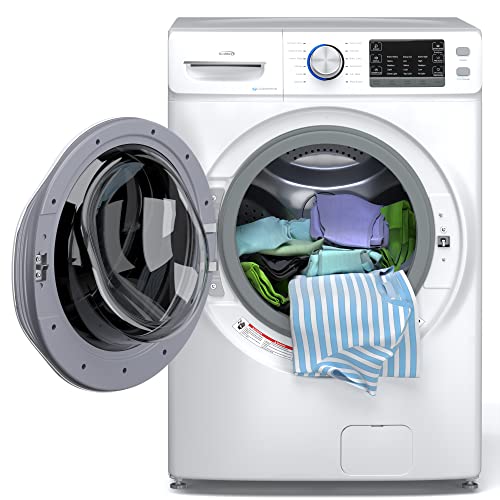
KoolMore FLW-5CWH Front Load Washer — Best steam plus water control
KoolMore’s FLW-5CWH is the specification-richest listing in this guide: a 27-inch, extra-large 4.5 cubic foot front-loader on 120V with a quiet inverter motor, steam and Water Plus functions, a 20-minute quick wash, and twelve washing cycles. Each element of that title earns discussion. The inverter motor is the foundation, because inverter drives vary speed smoothly rather than switching abruptly, which is how a machine earns a quiet description while still spinning a full drum hard. Quiet here is not a luxury in the homes this machine suits — laundry near bedrooms, open-plan flats, and houses where the wash runs in the evening.
Water Plus is the thoughtful companion to steam. Some loads — a single thick blanket, a bundle of hoodies — trap air and ride above a front-loader’s shallow water, emerging underwashed at the centre. A function that raises the water level for those loads answers the most legitimate criticism of front-load washing, and pairing it with steam gives the user two distinct levers: more water for bulky absorption problems, more heat and vapour for soil problems. The 20-minute quick wash then covers the third everyday case, the lightly worn load needed tomorrow. Twelve cycles is fewer than some rivals advertise, but the named functions here are unusually purposeful.
- Capacity and size: 27-inch frame, 4.5 cu. ft., model FLW-5CWH, 120V
- Motor: quiet inverter motor per listing title
- Functions: steam and Water Plus, 20-minute quick wash
- Cycles: 12 washing cycles
- Where to buy: the KoolMore FLW-5CWH Front Load Washer listing on Amazon — check price on Amazon
Strengths
- Water Plus answers the bulky-load weakness of front-load design directly.
- Inverter motor supports the quiet claim with the right technology.
- Quick wash at twenty minutes suits genuine daily rhythms.
Trade-offs
- No efficiency certification is named in the listing title.
- Twelve cycles is a smaller menu than fifteen-programme rivals.
- Buyers must confirm steam programme details on the listing’s cycle chart.
Best for: households that wash bulky items often and run laundry near living and sleeping space.
A poor fit for: buyers who want a certified-efficiency badge as a non-negotiable purchase condition.

CONTOURE WH-2200W 24in Washer with Steam — Best compact programme range
The CONTOURE WH-2200W compresses a remarkable programme list into a 24-inch RV-ready cabinet: steam, a 1400 RPM spin, fifteen wash programmes including sanitize and quick wash, an LED display, and half-load detection that saves water. It is the only pick here whose title names a sanitize programme, and this guide reports that exactly as stated — a programme name on the maker’s list — while reminding readers that programme names describe the maker’s cycle design and should be weighed as laundry features, not as clinical guarantees. For an RV or a small flat, the practical meaning is a dedicated hot, thorough programme for towels and bedding in a machine that fits a 24-inch slot.
The 1400 RPM spin is the other figure that matters, because compact machines often spin gently and leave clothes wet, punishing small dryers and air-drying racks. At 1400 RPM, extraction is serious, and in an RV where drying space is a folding rack, that dryness is the feature owners will praise weekly. Half-load detection completes the picture: small households rarely generate full drums, and a machine that senses a half load and trims water accordingly stops punishing economical habits. Stackable design lets it pair upward with a compact dryer where the slot allows.
- Size and model: 24 in, model WH-2200W, white, stackable
- Spin: 1400 RPM per listing title
- Programmes: 15, including sanitize and quick wash, plus steam
- Sensing: half-load detection saves water; LED display
- Where to buy: the CONTOURE WH-2200W 24in Washer with Steam listing on Amazon — check price on Amazon
Strengths
- Broadest programme list in the compact class here, sanitize included by name.
- Fast spin genuinely helps RV and flat drying realities.
- Half-load detection rewards small, frequent washing.
Trade-offs
- Compact drum limits bedding size despite the strong programme list.
- RV installations must confirm vibration tolerance on the mounting floor.
- Programme names should be read on the maker’s chart before relying on them.
Best for: RV owners and small-flat households wanting full programme ambition in a 24-inch machine.
Not the right match for: families expecting to wash king bedding at home every week.

Muhub 2.5 Compact Washer Inverter — Best small-space hygiene focus
Muhub’s 2.5 cubic foot compact makes its pitch in its title with unusual directness: an inverter motor, and steam and hygiene cycles described as lifting set-in stains from bedding and kids’ clothes while fitting tight closets and rental units. The pairing of steam with a named hygiene cycle is the point. In a small drum, loads are dense, water is shallow, and a hygiene programme that manages temperature and time deliberately gives parents and bedding-washers a setting designed for the loads they worry about, rather than a normal cycle asked to improvise.
The inverter motor supports the closet-and-rental brief in two ways: smoother speed control for quieter running against thin walls, and gentler starts that suit the less rigid floors of rental units and upstairs closets. At 2.5 cubic feet this remains a small machine, honest about its scale — it will wash a child’s bedding set or a week of one person’s clothes beautifully and will not pretend to swallow a family duvet. Within that scale, its steam-plus-hygiene combination is the most purpose-built offering in this guide, and renters who cannot modify plumbing will appreciate a compact that asks for nothing exotic.
- Capacity: 2.5 cu. ft. compact front load, white finish
- Motor: inverter motor per listing title
- Steam role: steam and hygiene cycles for bedding and kids’ clothes
- Intended spaces: tight closets and rental units
- Where to buy: the Muhub 2.5 Compact Washer Inverter listing on Amazon — check price on Amazon
Strengths
- Hygiene cycle named alongside steam, aimed at bedding and children’s loads.
- Inverter running suits thin walls and upstairs rental closets.
- Compact footprint fits spaces standard machines cannot enter.
Trade-offs
- Small drum caps load size firmly, whatever the cycles promise.
- No spin speed is stated in the title, so confirm extraction on the listing.
- Less service history behind the brand than the biggest laundry names.
Best for: parents in small homes and renters who want a deliberate hygiene programme at compact size.
Poorly suited to: households whose weekly wash includes multiple bulky bedding sets.

Kenmore 2.2 Compact Front Load Washer — Best compact wrinkle care
The compact Kenmore takes steam in a different direction from its full-size sibling: its title names a wrinkle relaxing steam treatment, supported by Express and Accela Wash and touch controls, in a 2.2 cubic foot ENERGY STAR certified cabinet. Wrinkle relaxing steam is an end-of-cycle art — vapour relaxes fibres so creases fall out more easily in drying and ironing — and in a compact machine aimed at apartments and small households, it answers the reality that small homes rarely have space for elaborate ironing setups. Work shirts and blouses emerge easier to finish, which is a weekly quality-of-life gain out of proportion to the feature’s modest billing.
Express and Accela Wash matter at this size because compact owners wash frequently in small loads and resent long cycles for three shirts. Certified efficiency suits the same households, who are often metering utilities carefully in rentals and flats. The honest limits are capacity and stain ambition: this steam relaxes wrinkles rather than attacking set-in stains, and 2.2 cubic feet is a one-or-two-person drum. Households whose problem is grass stains rather than creases should look at the full-size Kenmore or the Muhub’s hygiene pairing instead, and readers managing whole-household volume may prefer the throughput thinking in our guide to Best Washers for Septic Systems, where low water per load is the organising principle.
- Capacity: 2.2 cu. ft. compact front load, white finish
- Steam role: wrinkle relaxing steam treatment
- Speed systems: Express and Accela Wash, touch controls
- Efficiency: ENERGY STAR Certified per listing title
- Where to buy: the Kenmore 2.2 Compact Front Load Washer listing on Amazon — check price on Amazon
Strengths
- Wrinkle-focused steam suits work wardrobes in small homes.
- Two speed systems keep frequent small loads from eating the evening.
- Certified efficiency in the smallest cabinet in this guide.
Trade-offs
- Steam role is wrinkle care, not the stain treatment of the full-size model.
- Smallest drum here; couples only, and modest loads at that.
- Touch controls again ask for dry hands and patience.
Best for: professionals in compact homes whose laundry problem is creases, not stains.
A weak match for: anyone washing family bedding or heavily soiled loads regularly.

COMFEE 24in Washer Dryer Combo Steam Care — Best single-drum solution
The COMFEE must be introduced as what it is: a 24-inch washer and dryer combo of 2.7 cubic feet, whose steam care serves the wash side, and whose drying is ventless combo drying in the same drum. That distinction shapes every expectation. A combo washes and then dries without transferring the load, which is transformative in a dorm, a studio, or a small flat with no vent and no space for two machines — set it before bed and the overnight dry programme named in the title returns finished laundry by morning. The trade is time and capacity: ventless drying is slower than a vented standalone dryer, and a combo dries best at partial loads.
The title also claims a no-shaking front-load character, which in combo machines matters doubly because the same drum must spin wash water out and then tumble for hours of drying; stability is comfort in a small living space. Steam care in this context supports the wash programmes of a machine aimed at small, frequent loads — gym kit, work clothes, bedding for one — rather than family volume. Judge it as a space solution with steam-assisted washing, and it is compelling; judge it as a family laundry replacement, and its 2.7 cubic feet will disappoint. Households weighing a combo against a pair should also read the salon-scale discussion in Best Washers and Dryers for a Salon and Spa, where duty cycle limits are spelled out for heavier use.
- Configuration: 24 in washer dryer combo, 2.7 cu. ft., dorm white
- Steam role: steam care on the wash side
- Drying: ventless combo drying, overnight dry programme named
- Character: full-automatic, no-shaking front load per listing title
- Where to buy: the COMFEE 24in Washer Dryer Combo Steam Care listing on Amazon — check price on Amazon
Strengths
- Washes and dries in one drum with no vent and no transfer.
- Overnight programme fits dorm and studio rhythms perfectly.
- Steam care supports the small, frequent loads combos serve best.
Trade-offs
- Ventless drying takes longer than a vented standalone dryer.
- Drying works best below the full wash capacity.
- One machine means no washing while a dry cycle runs.
Best for: dorms, studios, and one-person households where space and venting rule out a pair.
Not suited for: families, who will queue loads behind long combo cycles all weekend.
Specification Ledger: What Each Title Actually States
| Model | Size / Capacity | Steam role | Other stated figures |
|---|---|---|---|
| Kenmore 4.5 Metallic Silver | 4.5 cu. ft. | Stain removing treatment | Accela Wash, ENERGY STAR |
| KoolMore FLW-5CWH | 27 in / 4.5 cu. ft. / 120V | Steam function | Water Plus, 12 cycles, 20-min quick wash, inverter motor |
| CONTOURE WH-2200W | 24 in | Steam | 1400 RPM, 15 programmes incl. sanitize, half-load detection |
| Muhub 2.5 Inverter | 2.5 cu. ft. | Steam and hygiene cycles | Inverter motor |
| Kenmore 2.2 Compact | 2.2 cu. ft. | Wrinkle relaxing treatment | Express and Accela Wash, ENERGY STAR |
| COMFEE Combo | 24 in / 2.7 cu. ft. | Steam care (wash side) | Ventless combo drying, overnight dry |
Which Steam Job Does Your Laundry Actually Need?
Start from the failure you keep seeing in the laundry basket. If clean clothes still carry the shadow of stains, you need steam as a pre-treatment force, and the full-size Kenmore’s stain removing treatment is the clearest answer here, with the Muhub’s hygiene pairing as the compact alternative. If clothes emerge clean but creased beyond what a shake and a hanger can fix, you need steam as a relaxing finish, and the compact Kenmore is the only pick here whose title names that exact job. If your problem is bulky loads riding dry above shallow water, steam is not your answer at all — the KoolMore’s Water Plus is, with its steam as a supporting function.
If your problem is that bedding and towels never feel thoroughly washed in a small machine, programme design matters more than the word steam: the CONTOURE’s named sanitize programme and the Muhub’s hygiene cycle are deliberate hot, long programmes for exactly those loads, while a general steam function on a normal cycle is a lighter touch. And if your problem is architectural — no vent, no second footprint — the COMFEE’s combo format is the answer and its steam care is a welcome bonus on top. Matching the steam job to the laundry failure, rather than buying the word steam in the abstract, is the method that runs through every verdict in this guide.
How Should You Run a Steam Cycle for the Best Result?
Steam works on contact and time, so load discipline decides its success. Fill the drum to about two-thirds for steam stain work, because an overpacked drum shields the centre of the load from vapour entirely. Treat the worst stains before loading by working a little detergent into the fabric, then let the steam phase loosen what remains; steam is a powerful assistant to detergent, not a substitute for it. Choose the programme that names steam or the stain function explicitly rather than assuming every hot cycle steams — on these machines the steam role lives in specific programmes listed on the maker’s cycle chart.
Unload promptly when a wrinkle-relaxing cycle finishes, because relaxed fibres set into whatever shape they cool in, and a shirt left balled in the drum for three hours will crease as if steam never happened. Hang or fold within minutes and the benefit survives. For hygiene and sanitize-named programmes, respect the full cycle time; shortening them defeats their design, which relies on sustained temperature. Finally, descale and clean the machine on schedule, because steam generation and hot programmes alike suffer when residue builds in the system.
What Does Steam Cost in Time and Energy?
Honesty about cost improves satisfaction. A steam stain cycle runs longer and hotter than a quick wash, using more energy per load; a wrinkle-relaxing phase adds minutes at the end of a cycle. The correct accounting compares that cost against the alternative: rewashing a stained load doubles its cost entirely, and ironing a wardrobe of creased shirts consumes time and energy that a relaxing steam phase largely replaces. Used on the loads that need it and skipped on the loads that do not, steam is economical. Used as a default on everything, it is an expensive habit, which is why the speed systems in this guide — Accela Wash, Express, the 20-minute quick wash, quick programmes on the CONTOURE — deserve equal billing: the smartest steam owners are also quick-wash owners, choosing per load.
Errors That Waste a Steam Machine’s Ability
The commonest error is expecting steam to rescue an overloaded drum; vapour cannot penetrate a packed mass, and the centre items emerge untouched. The second is using steam programmes for loads that only needed a quick wash, then concluding the machine is slow. The third is neglecting the water supply and cleaning routine, so steam performance fades gradually and the owner blames the concept rather than the maintenance. The fourth, specific to combos, is filling the COMFEE to its full wash capacity and then asking its ventless drying to finish the same mass quickly; dry in partial loads and the machine keeps its promises. Each error is a habit, not a defect, and each is correctable in a week of deliberate loads.
How Do Steam Machines Behave in Small and Unusual Spaces?
Three of these six machines live in the 24-inch world of RVs, dorms, and closet slots, and that world has its own physics. Floors flex, walls are thin, and water supply and drainage are often shared or improvised. Inverter motors and balance sensing earn their keep there, as do half-load detection systems that trim water to the load actually present. Ventless combo drying solves the hardest architectural problem — no vent route — at the cost of time. Owners in these spaces should level obsessively, because a small machine on a flexing floor at 1400 RPM will announce every millimetre of error, and should keep loads modest, because compact drums balance best well inside their stated capacity.
Full-size steam machines in ordinary laundry rooms have the easier life, but they still reward the basics: a solid floor, correct levelling, hoses in good condition, and a door seal wiped weekly. Steam programmes add heat and moisture to the machine’s working environment, which makes the leave-the-door-ajar habit more important, not less. None of this is burdensome; it is the standard front-load routine with the volume turned up slightly, and households already practising it will find steam machines entirely familiar.
How Does Steam Interact With Different Fabrics?
Cotton tolerates steam best and benefits most, because its fibres swell with moisture and release soil readily when hot, which is why towels, bedding, and cotton workwear are the canonical steam loads. Linen behaves similarly and emerges from a relaxing steam phase notably easier to press. Wool is the caution case: heat, moisture, and agitation together are the recipe for felting, so wool belongs on a dedicated gentle programme with steam kept to whatever that programme itself specifies, never on a hot stain cycle borrowed from the cotton routine. Synthetics sit between the two — steam helps them release wrinkles and odours, but excessive heat can set creases or glaze delicate finishes, so medium settings and prompt unloading matter.
Elastic is the silent consideration in modern wardrobes. Gym kit, underwear, and fitted clothing rely on elastane fibres that heat degrades gradually, shortening the garment’s useful life long before the fabric itself wears out. Steam programmes used occasionally on genuinely stained gym kit are a fair trade; steam used on every load of it is not. The households that get the longest life from both machine and wardrobe treat steam as a targeted instrument — hot and thorough for the cotton loads that dominate family laundry, restrained for the synthetic and elastic loads that dominate adult wardrobes.
What Should You Verify on a Steam Machine’s Cycle Chart?
Before buying any pick here, open the maker’s cycle chart on the listing and answer four questions. Which programmes actually use steam, and at what stage — beginning, middle, or end? Can steam be added to an everyday cycle or does it live only inside dedicated programmes? What is the temperature and duration of the hygiene or sanitize-named programme? And which programmes forbid steam for delicate fabrics? The answers separate machines whose steam is a flexible tool from machines whose steam is a single fixed performance, and both can be right — a fixed, well-designed stain programme may suit a family better than flexible options nobody learns to use.
Also verify the mundane figures the titles leave open: exact spin speeds where unstated, the dimensions with the door open, and the water supply requirements. Compact steam machines in RVs and rentals must match the available supply and drainage, and a 24-inch slot measurement should be confirmed with the machine’s own dimension figures rather than the category label. These checks take minutes on a listing page and prevent the returns and improvisations that give compact laundry a bad name.
Pairing a Steam Washer With the Right Dryer Habits
A steam washer changes what arrives at the dryer. Loads leave the drum hotter, more thoroughly extracted on the strong spins these machines offer, and — after a relaxing steam phase — smoother than a conventional wash delivers. Dryer habits should adapt: check loads earlier, because thoroughly spun laundry dries faster than expected and over-drying wastes the energy the washer saved and bakes creases into relaxed fibres. Shake garments out as they transfer, since the minutes between washer and dryer decide whether the wrinkle benefit survives.
For households air-drying, steam’s contribution is even clearer. A 1400 RPM extraction leaves bedding and towels light enough for a rack to finish in hours, and wrinkle-relaxed shirts hung straight from the drum often skip ironing entirely. The COMFEE combo folds this whole question into one drum, trading speed for the absence of transfer altogether — laundry that never needs moving between machines, at the price of longer total cycles and smaller effective batches.
How Do You Maintain Steam Performance Over Years?
Steam systems reward the standard front-load routine plus one addition: mineral awareness. In hard-water homes, scale builds wherever water is heated, and steam generation involves heated water by definition. Follow the maker’s descaling guidance on schedule, wipe the gasket and dispenser as with any front-loader, and run the cleaning cycle monthly. Owners who skip descaling notice the fade as weaker steam and longer cycles months before anything fails outright, and the fix at that stage is still cheap.
Keep the water supply healthy as well: inlet filters catch sediment that would otherwise reach valves and steam pathways, and they deserve the same monthly glance as the drain pump filter. Hoses age regardless of use and should be replaced on a schedule rather than after a leak, a rule that matters doubly for machines installed in RVs, upstairs closets, and rental units where a leak’s damage outruns its discovery. Document the routine on a card inside a nearby cupboard and the machine’s second owner — or your future self — inherits the knowledge intact.
When Steam Is the Wrong Purchase Entirely
Some households should skip this category, and a trustworthy guide says so. If your laundry is dominated by delicates, wool, and elastic-heavy sportswear washed cool and gentle, steam’s heat-centred talents address problems you do not have, and a gentle-cycle specialist serves you better. If your water is very hard and you know you will not descale, steam performance will fade and frustrate. If your laundry pain is actually drying — no vent, slow dryer, damp climate — the combo format or a better dryer solves more than any washer feature. Steam is a powerful answer to stains, creases, and thorough hot washing; it is not a universal upgrade, and the picks above are strongest in the hands of households whose laundry matches their design.
What Do the Six Picks Reveal About Where Laundry Design Is Heading?
Read together, these listings trace a clear direction. Steam has escaped the premium tier and now appears in 2.2 cubic foot compacts and RV machines, which means small-space households are no longer asked to choose between size and capability. Inverter motors have followed the same path, bringing quiet, controlled running to closets and rentals. Sensing — half-load detection, load-aware water — is replacing fixed cycles with measured responses to the actual load. And the combo format keeps maturing as the architectural answer for homes that cannot vent or cannot fit a pair.
For buyers, the practical meaning is that the old hierarchy — big machine, many features; small machine, few — no longer holds. The correct question is the one this guide opened with: which steam job, at which size, for which laundry failure. Answer that and the six picks sort themselves, because each was verified, specified, and reviewed against exactly that standard.
A Worked Week: Running These Machines the Way Their Designers Imagined
Monday’s load is school and work clothes, lightly worn, needed again by Friday at the latest — that is a quick or Accela-style programme’s home ground, twenty to forty minutes, no steam, medium spin. Wednesday brings gym kit and towels, the week’s honest dirt, and here the steam stain treatment or a hygiene programme earns its longer runtime, with hot water doing deliberate work on cotton and body oils. Friday’s bedding load tests capacity and spin: full-size drums take it whole, compact drums take it in two sensible halves, and the strong spins on offer here leave it nearly rack-dry.
The weekend’s problem load — the stained tablecloth, the sports kit left in a bag since Tuesday, the work shirts with collar grime — is steam’s showcase, pre-treated briefly, loaded loosely, and given the full programme without apology. Notice what this week never does: it never steams the Monday load out of habit, never quick-washes the Wednesday load out of impatience, and never overloads the Friday drum out of optimism. That discipline, more than any specification in the table above, is what owners of these machines describe when they say the laundry simply comes out better than it used to.
How Should Renters and RV Owners Read This Guide Differently?
Renters should weight installation reversibility and noise through walls above raw capacity, which elevates the inverter-driven compacts and argues for confirming lease terms on appliance installation before ordering. RV owners should weight spin extraction and programme breadth in a fixed 24-inch slot, confirm the floor’s tolerance for a 1400 RPM spin, and treat half-load detection as a water-tank feature, not a luxury, because every litre saved is a litre not hauled. Both groups should photograph the installation space, keep packaging until the first successful week of washes, and confirm return logistics for large items before the purchase, since their margin for a wrong machine is thinner than a homeowner’s.
Homeowners with a conventional laundry room read the same six picks in the opposite order: capacity and stain power first, then the supporting cast of speed systems and certified efficiency. The guide’s structure serves both readings deliberately — spec boxes state the figures, verdicts name the households, and no pick is praised in terms that would mislead the other audience into buying it.
What Questions Should You Ask a Seller Before Ordering?
Ask which programmes use steam and whether steam can be combined with the everyday cycle you will use most. Ask for the exact exterior dimensions including door swing, the spin speed of the specific model where the title omits it, and the delivery and installation terms for your postcode and floor level. For the COMFEE, ask how drying capacity relates to wash capacity on the programmes you plan to use overnight. For the CONTOURE, ask about mounting and stabilising for vehicle installation. Sellers who answer precisely are telling you something about the support you will receive later; sellers who cannot answer a dimension question are telling you something else, equally useful.
How Do You Judge Whether Steam Is Working in Your Own Machine?
Judge by outcomes you can see, on a fair test. Take two similar stained cotton items — pillowcases with sunscreen marks, tea towels with dried food splashes — and wash one on the steam stain programme and one on the standard hot programme, with the same detergent dose. Compare them dry, in daylight. Steam that earns its name shows a visible difference on set-in marks, and no difference at all is information too: it may mean the load was packed too tight for vapour to circulate, the stain needed pre-treatment, or the programme chosen does not apply steam where you assumed. Work through those causes before judging the machine.
For wrinkle-relaxing steam, the fair test is a work shirt washed, steamed, unloaded promptly, and hung — compared against the same shirt from a non-steam cycle. For hygiene programmes, judge by freshness after drying and by how towels feel after a week of the routine, not by any single dramatic load. Owners who test deliberately in the first fortnight learn their machine’s real map of programmes, which is worth more than any review, including this one, because it is drawn from their own water, wardrobe, and habits.
Sorting the Details: Detergent, Water Hardness, and Steam
Steam programmes concentrate the effects of your water and detergent choices. Hard water dulls steam’s stain work by binding detergent before it reaches the fabric, and it scales heated pathways over time; households in hard-water areas should consider a softening routine and strict descaling as part of steam ownership, not optional extras. Soft water makes detergent foam enthusiastically, and overdosing in a steam cycle leaves residue that the vapour then bakes into fibres — measure to the lower line and adjust by results. Powder detergents dissolve best in the hot programmes where steam lives; liquids suit the cooler quick cycles. Matching the detergent form to the programme family is a small discipline with outsized results, and it costs nothing beyond attention.
What Does a Steam Programme Do Minute by Minute?
Understanding the sequence explains the loading rules. In a stain-treatment design, the machine first wets and heats the load, introducing steam while the drum turns slowly, so vapour reaches every layer that is not shielded by overpacking. Detergent then works in the main wash phase against soil the steam has loosened, and the temperature profile is held long enough for chemistry to finish what heat began. In a wrinkle-relaxing design, steam arrives near the end, after cleaning is complete, and the drum tumbles gently while fibres soften; the critical minutes are the ones after the cycle ends, when prompt unloading lets those fibres cool smooth. Hygiene and sanitize-named programmes extend the hot phase deliberately, trading time for thoroughness on the loads — bedding, towels, children’s clothes — where households ask for exactly that trade.
None of these sequences survives contact with a drum stuffed to the door. Steam is a gas-phase helper in a water-based process; it needs pathways through the load. The two-thirds loading rule repeated through this guide is not caution for its own sake but the physical condition of the feature working at all, and owners who respect it report the results the programmes were designed to give.
How Should You Budget Time Around Longer Steam Cycles?
Steam households plan laundry in two lanes. The fast lane — quick wash, Express, Accela-style programmes — carries the daily traffic and finishes inside an hour. The slow lane carries one or two deliberate loads a week: the stained, the bulky, the bedding, run when the household is home and unhurried, often alongside other chores. Trying to force all laundry through the slow lane breeds resentment of the machine; trying to force it all through the fast lane breeds rewashes. The two-lane habit, written on a note inside the laundry cupboard if necessary, is the operating system every pick in this guide was designed to run.
One More Distinction: Steam in the Wash Versus Steam in the Dryer
Because dryers also advertise steam, buyers sometimes merge the two in their minds and credit a washer with a dryer’s tricks. Dryer steam typically refreshes dry clothes and relaxes wrinkles without washing them. Washer steam, the subject of every pick here, works inside a wet cleaning process: loosening soil, supporting hot thorough programmes, or relaxing fibres at the end of a wash. A household whose real wish is to refresh suits between wears needs the dryer function; a household whose wish is cleaner, less creased laundry from the wash itself needs the machines in this guide. Several laundry pairs offer both, and the wisest buyers decide which side of the pair does which job before paying for either, so the two steam claims never blur into one expensive assumption.
That clarity also protects against disappointment in the combo. The COMFEE’s steam care is a wash-side feature, and its drying is ventless combo drying without a separate dryer-steam claim in its title; expecting it to refresh dry suits like a steam dryer would misread the listing entirely. Read each title as this guide has read them — literally, feature by feature — and the machine that arrives will be the machine you thought you bought.
A final practical note on expectations: steam narrows the gap between home laundry and the results people remember from a good commercial wash, but it does not erase the difference between a cared-for garment and a neglected one. Sort honestly, mend the dosing, keep the machine clean, and steam becomes the finishing advantage on a system that already works. Neglect the system and steam becomes an expensive passenger. Every pick in this guide rewards the first household and forgives the second only partially, which is as it should be — the machines were verified carefully, and they deserve owners who meet them halfway in daily practice at home together.
Final Recommendation
Buy the steam job, not the steam word. For family stain work at full size, the metallic silver Kenmore pairs its stain removing treatment with speed and certified efficiency, and it is this guide’s default answer. The KoolMore is the thinking alternative, adding Water Plus and inverter quiet to a full-size drum. In compact spaces, choose the CONTOURE for programme breadth and spin, the Muhub for its hygiene pairing, the compact Kenmore for wrinkle care, and the COMFEE when one drum must wash and dry without a vent. Households that match steam to the failure in their own laundry basket will find these machines genuinely transformative, while the vapour itself, rising through a well-loaded drum on a Saturday morning, does the quiet work it was named for.
Frequently Asked Questions
Does steam replace detergent or pre-treating?
No. Steam loosens soil so detergent can lift it, and the worst stains still benefit from detergent worked in before loading. Think of steam as preparation and assistance, never as a substitute for chemistry.
Is the sanitize programme on the CONTOURE a medical claim?
It is a programme name stated in the listing title, describing the maker’s hot, thorough cycle design for laundry. This guide reports it as a laundry feature and makes no clinical claims for it.
How does the COMFEE combo dry if it has no vent?
It uses ventless combo drying in the same drum, condensing moisture rather than exhausting hot air outside. That solves venting and space problems, and it takes longer than a vented dryer, especially on full loads.
Which pick is best for work shirts that crease?
The compact Kenmore, whose title names a wrinkle relaxing steam treatment. Unload and hang shirts promptly after the cycle so the relaxed fibres set smooth.
Do steam cycles use much more energy?
They run hotter and longer than quick cycles, so yes per load — but a rewash costs more, and an ironing session costs time as well. Reserve steam for loads that need it and quick programmes for the rest.
Can a 24-inch machine really wash bedding?
Single and double bedding in modest bundles, yes, especially with the CONTOURE’s spin extracting water thoroughly. King-size duvets exceed compact drums and belong to full-size machines or a laundromat visit.
If I rent, can I install a compact steam washer myself?
Often yes for the freestanding compacts here, provided the lease permits an appliance on the existing supply and drainage and the machine connects without altering plumbing. Confirm with the landlord in writing, keep the original fittings, photograph the connections before and after, and choose an inverter model for the sake of the neighbours below. Where permission is refused, a combo on an existing connection is sometimes the easier conversation because it changes nothing about venting.
Why does my steam cycle take so much longer than the display first suggested?
Steam programmes include heating and holding phases that estimates sometimes present optimistically, and sensing systems extend phases when the load is large or heavily soiled. Judge the programme by its finished result and plan it in the slow lane of the week; if times grow steadily over months, check descaling and inlet filters before assuming a fault.
Should bedding always use the hottest programme available?
Not always. Cotton sheets and towels thrive on hot, thorough programmes, and those are the loads hygiene cycles were designed for. Down, wool blankets, and anything with elastic or delicate filling need their own gentler settings, and forcing them through the hottest programme shortens their life. Read the care label as the authority and the cycle chart as the tool, and let the label win whenever the two seem to argue.
What is the single best habit for a new steam washer owner?
Load to two-thirds every time, choose the programme by the job rather than by habit or by hope, and unload wrinkle cycles promptly while the fibres are still warm and willing to settle smooth on the hanger. That trio of habits delivers most of what steam promises, and it costs nothing but attention during the first month while it becomes routine.
Related Guides
For a broader look at ventless and compact laundry thinking from our earlier verified coverage, see Best Front-Load Washers That Don’t Mold, which tackles the gasket-care side of front-load ownership in depth.


