What's inside
- Key Takeaways
- Quick Picks
- How We Chose These Picks
- Why Do Large Rooms Defeat Air Conditioners That Look Powerful Enough?
- Large-Room Line-Up Compared
- How Should You Place a Big Unit So the Whole Room Benefits?
- What Electrical and Structural Checks Come Before a Large Unit?
- How Do Cooking and Gathering Loads Change a Large Room’s Needs?
- When Is a Second Smaller Unit Smarter Than One Large One?
- Which Large-Room Cooling Mistakes Waste the Most Money?
- How Should a Large Room Be Cooled Through a Heatwave Week?
- Final Recommendation
- Frequently Asked Questions
- Related Guides
As an Amazon Associate I earn from qualifying purchases. This post may contain affiliate links at no extra cost to you.
cottageverdict.com is reader-supported. When you buy through links on our site, we may earn an affiliate commission.
Where to buy: the six large-room machines below are each sold through their own Amazon listing, linked in the Quick Picks table and beneath every detailed review, where you can check price on Amazon before ordering.
Large rooms expose weak cooling honestly. A small bedroom forgives an undersized unit because the volume is modest and the door closes; a thirty-foot living room with an open kitchen at one end and a wall of glass at the other forgives nothing. The best air conditioners for large rooms are therefore the ones whose stated coverage survives contact with real architecture: high ceilings, cooking loads, afternoon sun, and air that would rather wander down a hallway than stay where it was cooled. Every coverage figure in this guide comes from the listings themselves, and they run from 700 square feet up to 1,000 square feet per the titles — numbers large enough that the differences between window and portable formats, and between headline and corrected ratings, genuinely decide outcomes.
Format is the first fork. Four of the six picks are window units, which deliver their rated capacity without the portable penalty and suit rooms with a suitable window on an exterior wall. Two are portables, chosen because they print their corrected SACC figures in their titles: the Midea Duo at 12,000 BTU SACC against a 14,000 headline, and the BLACK+DECKER at 8,000 BTU SACC against a 12,000 headline. Those corrected numbers are the ones a large room will actually experience, and this guide plans around them wherever they exist. One electrical warning belongs at the top rather than in a footnote: the largest window unit here, the 18,000 BTU LG, runs on 230/208V per its title. It will not plug into an ordinary household outlet, and that single fact eliminates it for many rooms before its impressive coverage is even considered.
The other discipline is zoning. Even a unit honestly rated for a large stated area cools the air mass it can reach, and an L-shaped great room has corners that no single machine governs well. Placement, throw direction, and the management of doors and curtains decide whether a big room feels uniformly comfortable or merely has one cold end. Those topics get their own sections below, because in large rooms they are worth more than the gap between adjacent models. Buyers whose large space is actually a whole small home, rather than one grand room, should read this guide alongside Best Air Conditioners for Small Homes, where the ductless room-by-room answer is weighed on its own terms.
Our Top Picks
Key Takeaways
- Stated coverage in these titles runs from 700 to 1,000 square feet; treat each figure as the maker’s ceiling for a favourable room, not a guarantee for a glass-walled one.
- The LG 18,000 BTU unit needs 230/208V per its title — confirm the circuit exists before falling for its 1,000 square foot claim.
- Portables must be planned by SACC: 12,000 BTU SACC for the Midea Duo and 8,000 BTU SACC for the BLACK+DECKER, against headlines of 14,000 and 12,000.
- Four window units anchor this list because window architecture delivers rated capacity without a hose penalty.
- In large rooms, placement and throw routinely matter more than the difference between two adjacent models.
Quick Picks
| Pick | Badge | Why it earns its place |
|---|---|---|
| LG 14,000 BTU Window AC | Best straightforward big-room window unit | A 115V window unit whose title claims 700 square feet, with three cooling and fan speeds and auto restart. |
| GE 14,000 BTU Wi-Fi Window AC | Best connected window workhorse | A 14,000 BTU Wi-Fi window unit described by its listing as energy-efficient cooling for large rooms, with app or remote control. |
| LG 18,000 BTU Window AC With Heat | Best maximum coverage | The largest rating here, claiming 1,000 square feet with a heat mode — on a 230/208V supply, per its title. |
| Midea Duo 14,000 BTU Portable AC With Heat | Best portable for big spaces | An inverter portable stating 12,000 BTU SACC, with heat up to 550 square feet and voice-assistant compatibility. |
| BLACK+DECKER 12,000 BTU Smart Portable AC (BPACT12WT) | Best movable mid-large option | A smart 3-in-1 portable stating 8,000 BTU SACC and a coverage claim up to 550 square feet. |
| LG 14,000 BTU DUAL Inverter Window AC | Best inverter efficiency at scale | A dual inverter window unit claiming 800 square feet on 115V, with ENERGY STAR wording and ThinQ control in its title. |
How We Chose These Picks
The threshold was a stated large-room claim. Each pick’s title either prints a coverage figure of 550 square feet or more, or describes the unit explicitly as cooling for large rooms, as the GE’s title does. Models whose titles promised only modest rooms were excluded regardless of brand, because a large-room guide that pads itself with mid-size machines teaches its readers to undersize. Within the threshold, window and portable formats were balanced deliberately: window units for their delivered capacity, portables for rooms where a window installation is impossible, with the portables required to print a SACC figure so their real capacity could be compared honestly.
Electrical requirements were treated as a selection fact, not a detail. The 18,000 BTU LG’s 230/208V supply is flagged in its review’s first paragraph and again in the comparison table, because discovering a voltage requirement at installation time is the most preventable failure in this category. Heat modes were credited where titled — the big LG and the Midea Duo — since a large room that needs cooling in July often needs tempering in January, and a single window opening serving both seasons is worth real money and effort. Claims are quoted from titles throughout; where a title gives two numbers, as the first LG does with its 700 square foot headline and a further mention of rooms up to 800, the review plans around the more conservative reading.
What was left out matters too. Single-room portables below the SACC threshold, however popular, cannot hold a genuinely large room and were excluded rather than ranked low. So were through-wall and sleeve units, a different installation class that large-room shoppers with existing sleeves should research separately. The six that remain each have a defensible claim on a big space, stated in their own listings.
Why Do Large Rooms Defeat Air Conditioners That Look Powerful Enough?
Volume is the quiet variable. Coverage figures assume ordinary ceiling heights, but large rooms are exactly where ceilings rise — vaulted living rooms, double-height entries, converted barns and warehouses. A room of 700 square feet under a twelve-foot ceiling holds half again the air of the same floor under an eight-foot ceiling, and the machine must cool all of it, repeatedly, as warm air stratifies overhead and cool air pools where people actually sit. Buyers with tall rooms should mentally shrink every coverage claim in this guide before comparing, and should favour the top of the capacity range rather than its middle.
Glass is the second variable. Large rooms earn their sense of space from large windows, and a west or south wall of glass admits a solar load through the afternoon that can rival the room’s entire cooling budget. The unit then fights not the room’s air but the sun’s schedule, losing ground until sunset regardless of its rating. Curtains, exterior shading, and starting the machine before the glass heats up are worth more, in such rooms, than the step from one model to the next. Outdoor cooking spaces attached to these rooms add their own spill of heat through open doors — a load worth remembering when reading the ventilation territory covered by Best Outdoor Range Hoods, where moving hot air at its source is the entire subject.
Occupancy is the fourth variable, and it is the one most often forgotten because the room is measured while empty. A large room’s purpose is gathering: family evenings, guests, a dog the size of a child, a television and its companions radiating gentle heat for hours. Each body in the room is a small heater that never switches off, and a space designed for eight people carries a load its floor plan never mentions. Buyers whose large room is a social room should treat its hosted headcount as part of the specification and choose from the top of this guide’s range rather than its entry point.
The third variable is shape. A square room is one climate; an L-shaped great room is two climates sharing a machine, and the leg of the L receives whatever air wanders around the corner, which is to say the warmest air in the space. Owners of such rooms should place the unit so its throw runs down the longer leg, assist the corner with a quiet circulation fan, and accept that the far leg will run a degree or two warmer — or plan a second, smaller unit for it from the start, as the commercial spaces discussed in Best Commercial Deck Ovens plan their own heat loads zone by zone rather than hoping one appliance averages out.

LG 14,000 BTU Window AC — Best straightforward big-room window unit
This LG is the uncomplicated centre of the list: a 14,000 BTU window unit on a standard 115V supply, claiming 700 square feet in its title, with three cooling and fan speeds, electronic controls, a remote, and auto restart. Its title also contains a further reference to rooms up to 800 square feet; this guide plans around the 700 figure as the conservative reading and mentions the second number only so buyers comparing listings are not confused by it. On a normal household circuit, in a normal large living room, this is the machine that asks the fewest questions.
Three speeds suit the large room’s day. The highest handles the late-afternoon recovery, when the room has absorbed a day of sun and the household returns; the lower speeds hold the evening without the air blast that makes a television room unpleasant. Auto restart matters at this scale because a big room reheats slowly but also re-cools slowly — an outage that leaves the unit off through a hot afternoon hands the owner an evening of catch-up that a resuming unit would have prevented.
As a fixed-speed window unit it will cycle in the conventional pattern, and in a room at the small end of its range that cycling is noticeable. Its natural home is the room that genuinely needs most of its capacity: the combined living and dining space, the finished basement gathering room, the large primary suite with a sitting area. Matched to such a room, it is the value anchor of this guide — big, simple, and honest about its numbers.
Longevity thinking suits this pick. A fixed-speed window unit of a mainstream size is among the most understood appliances in the home: filters rinse in the sink, the control board is simple, and any technician has met its cousins a hundred times. For a large room in a house the owners expect to keep, that ordinariness is a form of insurance. The exotic options in this guide earn their places on capability, but the household that values a decade of unremarkable service from its biggest room will recognise this LG as the conservative heart of the list.
- Cooling capacity: 14,000 BTU per the title
- Coverage claim: 700 sq ft in the title, with a further mention of rooms up to 800 sq ft
- Supply: 115V per the title
- Controls: 3 cooling and fan speeds, electronic controls, remote, auto restart
- Where to buy: the LG 14,000 BTU Window AC listing on Amazon — check price on Amazon
Strengths
- Standard 115V supply avoids the dedicated-circuit question entirely.
- Three fan speeds map onto the recover-then-hold rhythm of a large room’s day.
- Auto restart protects a big room’s slow thermal mass from outage setbacks.
Trade-offs
- Fixed-speed cycling is more noticeable in rooms at the smaller end of its range.
- The title’s two coverage figures require the conservative reading this guide applies.
- No heat mode, so the window it occupies earns nothing in winter.
Best for: large living rooms and gathering spaces on ordinary circuits that need capacity without complications.
Not suited for: mid-size rooms, where its capacity overshoots and its cycling intrudes.
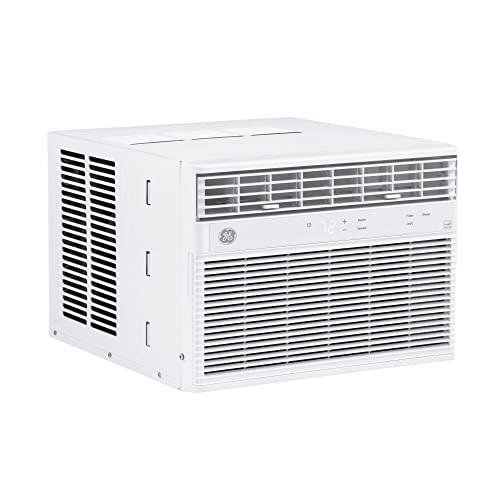
GE 14,000 BTU Wi-Fi Window AC — Best connected window workhorse
GE’s entry pairs the same 14,000 BTU class with connectivity. Its title describes a Wi-Fi enabled window unit offering energy-efficient cooling for large rooms, controllable by remote or smartphone app, with an easy install kit. Notably, the title prints no square-foot figure, so none is claimed here; the large-room designation is the maker’s own framing, and buyers should weigh it alongside the explicitly figured alternatives in this guide. What the GE adds over the LG above is the connected layer — scheduling, remote adjustment, and the ability to start a big room’s long cool-down before anyone arrives home.
That head-start capability matters more in large rooms than anywhere else. A big room’s thermal mass means the difference between starting at noon and starting at six is the difference between an evening in a settled room and an evening spent catching up. App control converts the unit from a reactive appliance into a scheduled one, and for a household whose large room hosts predictable gatherings — Friday family nights, weekend guests — the schedule becomes the feature that justifies the model.
The install kit in the title deserves its mention because large window units are heavy, and a kit designed for the chassis reduces the improvisation at the window. Two people should still plan the lift. Once seated and sealed, the GE settles into the workhorse role: connected enough for a modern household, conventional enough in its cooling hardware to be understood by any installer or future owner.
The household pattern this GE fits is the scheduled home. Its app control rewards owners who live by routines — the room pre-cooled for the homework hour, the weekend lie-in protected by a timer, the holiday week handled by a vacation setting rather than a neighbour’s favour. Households that run their cooling by hand, reacting to how the room feels, will use a fraction of what distinguishes this model and should honestly prefer the figured certainty of the LG picks. Matching the control philosophy to the household’s actual habits is the unglamorous core of this particular choice.
- Cooling capacity: 14,000 BTU per the title
- Coverage: described in the title as cooling for large rooms; no figure stated
- Format: window unit, Wi-Fi enabled
- Control: remote or smartphone app per the title; easy install kit included
- Where to buy: the GE 14,000 BTU Wi-Fi Window AC listing on Amazon — check price on Amazon
Strengths
- App scheduling suits the long lead times a large room’s cool-down requires.
- The included install kit respects the reality of fitting a heavy chassis.
- Maker-described large-room positioning matches the 14,000 BTU class of its figured rivals.
Trade-offs
- No coverage figure in the title means buyers cannot verify its ceiling against their floor plan.
- Connected features add nothing for a household that runs its cooling manually.
- As with the LG, there is no heat mode for the cold season.
Best for: large rooms in connected households that will genuinely use scheduling and remote starts.
A poor fit for: households that want a printed coverage figure to plan against before spending.
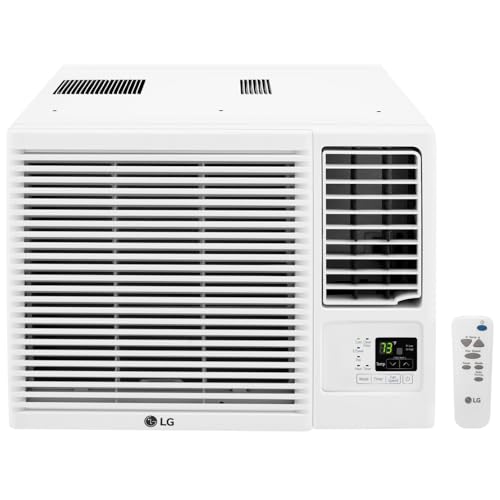
LG 18,000 BTU Window AC With Heat — Best maximum coverage
The ceiling of this guide, in every sense: an 18,000 BTU window unit whose title claims cooling for 1,000 square feet and adds a heat mode, with a remote, two speeds, and a 24-hour timer. It also runs on 230/208V, and that requirement is stated in this review’s opening because it governs everything else. A room with a suitable high-voltage circuit — often present where an older large unit or an electric heater once lived — gains the strongest single-window option here. A room without one needs an electrician’s visit priced into the decision, or a different pick.
Where the circuit exists, the case is compelling. One thousand square feet of claimed coverage addresses the true great room: open kitchen, dining, and living in one volume, perhaps over a garage or across the back of a house. The heat mode then keeps the same opening useful through winter, tempering the largest and often draughtiest room in the home. Two speeds is a modest control set for this class, but at this capacity the machine’s work is mostly about presence — being big enough that the room’s peaks never outrun it.
Buyers should also weigh the installation honestly. A unit of this size and weight is a two-person, plan-the-afternoon job, with a window and frame that must be verified as sound enough to carry it. None of that is a defect; it is the nature of the largest category of window cooling. Households unwilling to commit to it will be happier with the 14,000 BTU class and a zoning strategy, and this guide’s final recommendation says so plainly.
There is a property-value angle to this pick that smaller units cannot claim. A great room with a properly installed, high-capacity unit and the circuit to support it reads, to a buyer or an appraiser, as a solved problem — the largest space in the house demonstrably comfortable in both seasons. The same room with a struggling mid-size machine reads as an expense waiting to happen. Owners within a few years of selling should weigh that perception honestly: the circuit work this LG may require is the kind of invisible infrastructure that purchasers reward, precisely because they cannot see it and therefore assume the worst when it is absent.
- Cooling capacity: 18,000 BTU per the title
- Coverage claim: cools 1,000 sq ft per the listing
- Supply: 230/208V per the title — a dedicated high-voltage circuit is required
- Extra mode: heat, with remote, 2 speeds, and 24-hour timer per the title
- Where to buy: the LG 18,000 BTU Window AC With Heat listing on Amazon — check price on Amazon
Strengths
- The largest stated coverage in this guide addresses genuine great rooms.
- Heat mode makes the big window opening a year-round asset.
- Capacity headroom means peak afternoons are absorbed rather than endured.
Trade-offs
- The 230/208V requirement excludes any room without that circuit already fitted.
- Size and weight make installation and seasonal removal a planned two-person task.
- Two speeds offer coarse control for a machine of this sophistication elsewhere.
Best for: great rooms up to its stated coverage where a 230/208V circuit is present or worth adding.
Not the right match for: standard-circuit rooms, renters, or any window whose frame cannot carry the class.

Midea Duo 14,000 BTU Portable AC With Heat — Best portable for big spaces
The Midea Duo is the portable that large-room buyers should benchmark against. Its title states 14,000 BTU and then the figure that matters: 12,000 BTU SACC, described as high efficiency, from an inverter portable that also heats — with heat coverage stated up to 550 square feet — and works with Alexa and Google Assistant, with smart and remote control. A 12,000 BTU SACC rating is exceptional territory for a portable; it places this machine’s real delivered cooling within reach of the window units above, while keeping the portable freedoms of placement and removal.
The inverter is central to the design’s large-room manners. Rather than blasting and resting, it can run at part load for hours, which suits a big room’s long evening occupancy and avoids the temperature saw-tooth that fixed-speed portables produce at this scale. The heat function extends the same logic into the cold months for the room it serves, and voice control through the named assistants fits the hands-full reality of a kitchen-adjacent great room.
Portable caveats persist in proportion. The hose arrangement must be fitted with the usual care, the unit occupies a large footprint of expensive floor, and the cooling coverage should be planned from the SACC figure rather than from the heat figure or the headline. But for the renter of a loft, the owner of a sunroom with no suitable window sash, or anyone whose large room cannot accept a window unit, the Duo is the strongest honest answer in this guide.
The Duo also reframes what a portable can be in a finished room. Inverter portables of this class are designed as semi-permanent residents rather than seasonal guests: fitted once, sealed properly, scheduled through the app, and left to govern their room for months. Owners should adopt that mindset at installation — this is not the machine to drag between floors weekly, and treating its window fitting as a one-time craft project rather than a recurring chore is how its performance stays at the level its SACC figure promises. In a large room, installation quality is a specification, and this model rewards it most.
- Cooling capacity: 14,000 BTU headline / 12,000 BTU SACC per the title
- Heat coverage claim: heat up to 550 sq ft per the listing
- Format: inverter portable with heat
- Control: smart and remote control, Alexa and Google Assistant per the title
- Where to buy: the Midea Duo 14,000 BTU Portable AC With Heat listing on Amazon — check price on Amazon
Strengths
- A 12,000 BTU SACC figure gives it real, comparable standing against window units.
- Inverter operation suits long large-room evenings without saw-tooth temperatures.
- Heat extends its usefulness through the cold season in the room it serves.
Trade-offs
- Footprint and hose presence are considerable in a furnished great room.
- Cooling coverage must be inferred from SACC; the title’s figured claim covers its heat mode.
- It remains a portable, with a window kit to fit and a panel to seal each season.
Best for: large rooms that cannot take a window unit but need portable capacity with honest numbers.
Poorly suited to: small or mid-size rooms, where its real capacity and bulk both overshoot.

BLACK+DECKER 12,000 BTU Smart Portable AC (BPACT12WT) — Best movable mid-large option
BLACK+DECKER’s 12,000 BTU smart portable states 8,000 BTU SACC and a coverage claim of rooms up to 550 square feet in its title — the second honest portable in this guide, and the more movable interpretation of large-room cooling. As a smart 3-in-1 with cooling, fan, and dehumidifier modes, it covers the large room that is big but not grand: the generous living room of a smaller house, the finished basement, the primary suite with a sitting area. Planned at its SACC figure, expectations align with physics, and the unit’s smart controls let it pre-cool those spaces on a schedule.
The dehumidifier mode earns a mention specific to large lower rooms. Basements and ground-floor family rooms run damp, and a portable that can be wheeled to the damp corner for a drying day, then returned to cooling duty, is solving two of the large-room owner’s problems with one appliance. It will not replace a standalone dehumidifier in a chronically wet basement — no mode does — but for seasonal damp it is genuinely useful capacity already in the house.
Against the Midea Duo, this pick trades peak SACC for a simpler proposition. Buyers whose room sits near the 550 square foot claim and whose climate is moderate will find it sufficient and easier to live with; buyers at the top of the range, or in severe heat, should step up to the Duo’s corrected figure or to a window unit. The ranking between them is a sizing question, and this guide has tried to make the sizing evidence — SACC against SACC — as plain as the titles allow.
Think of this BLACK+DECKER as the large-room guide’s utility player. It will not anchor a great room, and this guide has not pretended otherwise, but the long tail of real housing is full of rooms that are merely biggish — the 400-to-550 square foot family rooms, dens, and finished basements where a window unit cannot go and the Duo would be excess. For those rooms its published SACC figure, smart scheduling, and three-mode flexibility form a complete and honestly bounded answer. Buying it for the room it actually fits is a success story; buying it for a great room is how disappointment gets manufactured.
- Cooling capacity: 12,000 BTU headline / 8,000 BTU SACC per the title
- Coverage claim: rooms up to 550 sq ft per the listing
- Format: smart portable, 3-in-1 cool, fan, and dehumidifier
- Control: smart features per the title family, with remote operation
- Where to buy: the BLACK+DECKER 12,000 BTU Smart Portable AC (BPACT12WT) listing on Amazon — check price on Amazon
Strengths
- Published SACC and coverage figures allow honest planning for mid-large rooms.
- Mobility lets one machine serve cooling and seasonal drying duties in different corners.
- Smart scheduling suits rooms used at predictable times, like family rooms and basements.
Trade-offs
- Its 8,000 BTU SACC is the floor of this guide’s large-room class, not its middle.
- Severe climates or glass-heavy rooms will expose that floor quickly.
- No heat mode, unlike the Duo above it in the portable ranking.
Best for: mid-large rooms up to its stated claim in moderate exposures, especially lower-ground spaces.
A weak match for: great rooms at the top of this guide’s range, where the Duo or a window unit belongs.
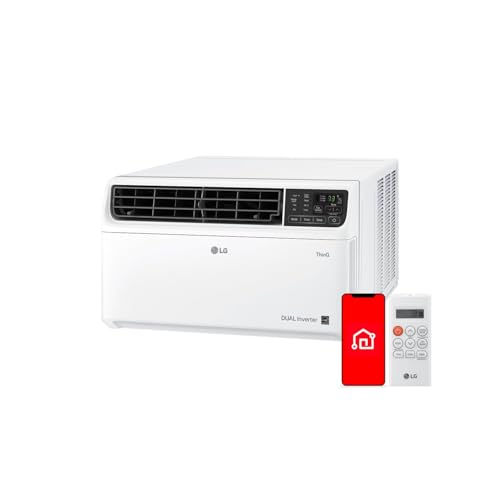
LG 14,000 BTU DUAL Inverter Window AC — Best inverter efficiency at scale
The second LG window unit takes the opposite route to the first: same 14,000 BTU class, but built around a dual inverter and claiming the larger coverage figure of 800 square feet, on a standard 115V supply, with ENERGY STAR wording in its title and control through LG ThinQ, Amazon Alexa, and Hey Google. For the large room that will run its cooling for long hours — the open-plan main space of a house in a hot climate — the inverter’s part-load behaviour is the argument: long, modulated running that holds temperature evenly and treats the machine’s hardest work gently.
The 800 square foot claim should be read as the maker’s figure for favourable conditions, as with every coverage number in this guide, but the combination supporting it is coherent: inverter capacity that can sustain output without the fixed-speed unit’s rest periods effectively enlarges the room a 14,000 BTU machine can hold through an afternoon. Smart control via ThinQ and the voice assistants completes the pattern of a unit designed to be scheduled and then ignored, which is how main-room cooling should feel.
Against its fixed-speed sibling, the choice is about hours. A large room cooled for a few evening hours in a mild climate gains little from inverter sophistication. A large room cooled from late morning to bedtime, all summer, in a hot region, is exactly the duty cycle the dual inverter was built for — and the ENERGY STAR wording in the title, reported here as the listing’s own claim, will matter most to precisely that high-hour household.
One more consideration separates the two LG window units: sound character, discussed qualitatively because neither title publishes a figure. A fixed-speed machine announces its cycles; an inverter, once the room is at temperature, settles into a steadier background presence. In a room used for conversation, television, and music across long evenings, that steadiness is a quality-of-life feature that specification tables undervalue. Households sensitive to it — and main rooms concentrate exactly the activities that notice it — should count it alongside the efficiency argument when choosing between the siblings.
- Cooling capacity: 14,000 BTU dual inverter per the title
- Coverage claim: cools 800 sq ft per the listing
- Supply: 115V per the title
- Certification wording: ENERGY STAR as stated in the title; works with LG ThinQ, Alexa, and Hey Google
- Where to buy: the LG 14,000 BTU DUAL Inverter Window AC listing on Amazon — check price on Amazon
Strengths
- Dual inverter running suits the long daily duty cycles of main living spaces.
- The largest figured coverage among the 115V window picks here.
- Full smart-home compatibility covers app, voice, and platform control preferences.
Trade-offs
- Low-hour households pay for inverter sophistication they will rarely exercise.
- The 800 square foot claim still assumes a favourable room; glass and vaults erode it.
- No heat mode, so winter leaves this window opening idle.
Best for: hot-climate main rooms with long daily cooling hours and a smart-home setup to schedule them.
Not suited for: occasionally used rooms, where the simpler fixed-speed LG is the proportionate spend.
Large-Room Line-Up Compared
| Model | Format | Rating as titled | Coverage as titled | Deciding detail |
|---|---|---|---|---|
| LG 14,000 BTU Window AC | Window | 14,000 BTU | 700 sq ft | 115V, 3 speeds, auto restart |
| GE 14,000 BTU Wi-Fi Window AC | Window | 14,000 BTU | Large rooms, no figure | Wi-Fi app control |
| LG 18,000 BTU Window AC With Heat | Window | 18,000 BTU | 1,000 sq ft | 230/208V supply, heat mode |
| Midea Duo 14,000 BTU Portable AC With Heat | Portable, inverter | 14,000 / 12,000 SACC | Heat up to 550 sq ft | Highest portable SACC here |
| BLACK+DECKER 12,000 BTU Smart Portable AC (BPACT12WT) | Portable | 12,000 / 8,000 SACC | Up to 550 sq ft | 3-in-1 with dehumidifier |
| LG 14,000 BTU DUAL Inverter Window AC | Window, dual inverter | 14,000 BTU | 800 sq ft | ENERGY STAR wording, ThinQ |
How Should You Place a Big Unit So the Whole Room Benefits?
Throw is the governing idea. A window unit or portable should discharge along the room’s longest axis, so the cooled air travels the full space before it mixes and sinks, rather than pooling against the opposite wall a few feet away. In practice that usually means the short wall of a rectangular room, aimed down its length, with the seating arranged in the middle distance rather than directly beneath the blast or marooned beyond its reach. Louvres angled slightly upward let cold air arc across the ceiling and descend gently at the far end, which is where the room’s most-used chairs often sit.
Portable placement follows the same physics with one addition: the hose is part of the throw. Every foot of hose inside the room is a warm radiator the machine must overcome, so the portable belongs at the window nearest the room’s long axis, with the hose run as the maker intended and no extension improvised from hardware-store ducting. Owners tempted to place the unit centrally for symmetry should resist; in large rooms, the machine’s convenience is a rounding error beside the cost of a long hose and a compromised throw.
Obstructions deserve an audit before installation day. A tall bookcase or an entertainment unit placed in the throw path creates a permanent warm shadow behind it, and no capacity upgrade fixes a shadow. Walk the room, imagine the air’s route, and move the one piece of furniture that blocks it. Ceiling fans, run in their summer direction, then finish the distribution job the unit starts, evening out the vertical stratification that tall rooms suffer from. The combination of a correctly aimed unit and a fan routinely outperforms a larger unit aimed carelessly — one of the few genuine bargains in this category.
What Electrical and Structural Checks Come Before a Large Unit?
Start at the panel. The 18,000 BTU LG’s 230/208V requirement is the obvious check, but the 115V units at this size also deserve respect: a 14,000 BTU window machine is among the largest loads on a household circuit, and a circuit shared with a kitchen or a home office invites nuisance trips on the hottest afternoons, when every load peaks together. Knowing which circuit the window’s outlet belongs to, and what else lives on it, is a five-minute investigation that prevents a summer of resets. Where a new circuit is being added anyway, an electrician can advise whether the high-voltage route — and with it the largest pick in this guide — becomes available.
Renters of large spaces face a narrowed version of this checklist. The circuit question still applies — a portable on a shared, loaded circuit trips breakers as faithfully as a window unit does — but the structural questions become permission questions instead. A renter should confirm that a window kit panel is acceptable, that the floor beneath a portable is protected, and that any condensate arrangement cannot stain or leak. The Duo and the BLACK+DECKER were ranked with that household explicitly in mind: full large-room credibility with nothing screwed into the building.
Structure is the second check. These are the heaviest appliances most windows will ever carry. The sash, sill, and frame must be sound, the support arrangement the maker specifies must be followed rather than improvised, and the slight outward tilt that drains condensate must be set deliberately. A large unit installed level or, worse, tilted inward will weep water into the wall. None of this is advanced work, but at this size the cost of skipping it scales with the machine, and the time to discover a rotten sill is before the unit is hanging in the opening.
How Do Cooking and Gathering Loads Change a Large Room’s Needs?
The open-plan large room almost always contains a kitchen, and a kitchen at full dinner service is a heat source of the same order as the afternoon sun. Ovens, hobs, dishwashers venting steam, and a table of guests together can add the equivalent of a small room’s entire load in the space of an hour — precisely the hour the household most wants comfort. A unit sized exactly to the empty room’s afternoon will spend every dinner party falling behind. Owners who host regularly should buy for the hosted room: one class of headroom, or a routine of pre-cooling the space hard before cooking begins so the thermal mass of the furnishings absorbs the party’s peak.
Pre-cooling is the professional’s trick borrowed from commercial kitchens and halls. Cold walls, floors, and furniture are a battery; charging that battery in the quiet afternoon lets the room coast through the evening’s load with the machine in maintenance rather than recovery. Every pick in this guide with a timer or an app — which is most of them — can execute the strategy. The difference between a room that hosts well and one that hosts stuffily is usually this schedule, not a larger compressor bought in frustration after the third uncomfortable gathering.
When Is a Second Smaller Unit Smarter Than One Large One?
Geometry decides. A long, subdivided space — a great room with a distinct reading nook, a basement with a workshop corner, an L-shaped plan — often serves its occupants better with a large unit governing the main volume and a modest second unit holding the annex, each running in its efficient range. Two machines also degrade gracefully: if one fails in a heatwave, the household retreats to the cooled zone rather than losing the whole floor. The costs are real — two installations, two filters, two windows committed — which is why the single large unit remains the default recommendation for squarish, open rooms.
The annex strategy pairs naturally with this guide’s smaller siblings elsewhere in the batch: the main room takes a pick from this list, while the annex takes a mid-size unit chosen by the same honest-rating discipline. What owners should avoid is the improvised version — one large unit plus a bargain portable bought mid-August for the corner, mismatched in capacity and control philosophy. Planned pairs work; panic pairs merely coexist.
Which Large-Room Cooling Mistakes Waste the Most Money?
The expensive mistake is buying capacity for the floor plan and ignoring the ceiling, the glass, and the shape, then buying a second machine in August to fix the first decision. The second is discovering the 230/208V requirement with the unit already in the driveway. The third is planning a portable by its headline in a room large enough that the SACC correction changes the answer — the two portables here were chosen precisely because their titles let a buyer avoid that error.
Fourth, owners underuse scheduling. A large room cooled reactively — switched on when the household arrives to a hot space — spends every evening in expensive catch-up; the same room on a timer or app schedule spends those evenings in cheap maintenance. Fifth, households forget that a large room’s unit is also its largest filter, and a clogged filter on a 14,000 BTU machine wastes more capacity than the same neglect on a small one. The pattern across all five is identical: the machine was fine, the plan around it was not.
How Should a Large Room Be Cooled Through a Heatwave Week?
A single hot day tests capacity; a heatwave week tests strategy. By the third day the building’s structure is heat-soaked — walls, floors, and roof all storing warmth that they release into the rooms overnight — and a unit that coped on day one can appear to fade by day four without anything being wrong with it. The counter-strategy is continuity: keep the room in a defended band around the clock rather than letting it swing, because re-cooling a heat-soaked structure costs far more runtime than holding a cooled one. Timers and app schedules exist for exactly this discipline, and the inverter picks here are built for the long, low holding pattern a heatwave rewards.
Households should also triage the home during a heatwave rather than defending every room equally. Close off the least-used spaces, concentrate the large room’s comfort where the family actually gathers, and let bedrooms be handled at night by their own arrangements. The large room’s machine, relieved of the hallway and the spare room, will hold its zone with capacity to spare. Heatwaves end; the households that planned for them remember a warm week, while the households that improvised remember an emergency — and usually an expensive purchase made inside it.
Final Recommendation
Let the room’s wiring and windows narrow the field
, then let its hours decide. On an ordinary circuit, the fixed-speed LG is the honest default for a large room, the dual inverter LG is the upgrade for long daily running, and the GE serves households that will use its app scheduling. Where a 230/208V circuit exists, the 18,000 BTU LG with heat is the single strongest window answer in this guide. Where no window unit can go, the Midea Duo’s 12,000 BTU SACC makes it the portable to beat, with the BLACK+DECKER as the mid-large alternative. Size a great room generously, place the machine thoughtfully, and the largest space in the house becomes the easiest one to keep — a verdict the room’s occupants will feel every single evening of the summer.
Frequently Asked Questions
Is a single unit ever enough for a 900 square foot open plan?
Only one pick here claims that territory — the 18,000 BTU LG, at 1,000 square feet per its title, on a 230/208V circuit — and even its claim assumes a favourable room. Vaulted ceilings, heavy glass, or an L-shaped plan can each push a space of that size toward a two-unit answer. Treat the claim as eligibility, not as a promise, and plan placement with the zoning advice above.
Why do the portables here show two different BTU numbers?
The larger is the traditional ASHRAE laboratory figure; the smaller SACC figure is the Department of Energy’s adjusted rating accounting for the heat and air leakage a portable adds to its own room. For planning a large room, SACC is the number that predicts performance — 12,000 for the Midea Duo, 8,000 for the BLACK+DECKER — and the gap between the two figures is exactly why this guide insists on printing both.
Can I run a 14,000 BTU window unit on a normal outlet?
The 115V models in this guide are designed for household circuits, but a unit of this size should ideally sit on a circuit without heavy companions. Check what else shares the circuit before the season. The exception is the 18,000 BTU LG, which per its title requires 230/208V and will not run from a standard outlet at all.
Does an inverter actually help in a room this size?
Its advantage grows with runtime. In a main room cooled for many hours daily, modulated running holds temperature more evenly and avoids the repeated full-power restarts of a fixed-speed machine. In a room used a few hours a week, the same technology has little time to repay its complexity, which is why this guide keeps a fixed-speed pick as its default recommendation.
How do I read a coverage claim that appears twice with different numbers?
Occasionally a listing states coverage in two places with two figures — the first LG in this guide headlines 700 square feet and elsewhere mentions rooms up to 800. The disciplined response is to plan around the smaller figure and treat the larger as the maker’s optimism for ideal conditions. If the smaller figure still fits your room, the discrepancy is harmless; if your room needs the larger figure to work, choose a different model whose conservative number covers you.
Should a finished basement use the same sizing as a living room?
The floor-area arithmetic is the same, but the loads differ in your favour and against it. A basement is earth-sheltered, so its cooling load per square foot is lower, while its humidity is usually higher — which favours a pick with a useful dehumidifier mode, like the BLACK+DECKER portable here, and long gentle running over brute capacity. Measure the space, respect the SACC figures, and expect the basement to be the easiest large room in the house to keep comfortable.
What if my large room has no suitable window?
Then the decision narrows to the portables, and the Midea Duo’s 12,000 BTU SACC is the figure to beat. Fit its window kit meticulously, aim its throw down the room’s long axis, and assist distribution with a ceiling fan. If the room defeats even that — extreme glass, extreme ceiling — the honest next step is a ductless system rather than a second portable.
Related Guides
Measure the room twice — once for its floor, once for its life — and the second measurement is the one that should choose the machine.
A last word on expectations: a large room cooled well does not feel like a small room cooled well. The air is more layered, the far corners run a touch warmer, and the machine is a more noticeable presence in the space’s life. Owners who accept that character — and choose capacity, placement, and scheduling to manage it — end the summer satisfied with any of the six machines above. Owners chasing the uniformity of a hotel suite from a single window opening will keep shopping past every honest product in the category.
Large rooms often sit within larger projects, and the daylight side of the same problem — how a big open space is furnished and lit — rewards the same measure-first thinking. Readers planning the whole space will find the closest companion reading in Best Air Purifiers for 800 Square Feet, where another appliance category confronts exactly this question of one machine against a genuinely big volume of air, and reaches the same conclusion this guide has argued throughout: honest ratings, conservative planning, and placement treated as part of the specification rather than as an afterthought discovered during the first heatwave.


