What's inside
- Key Takeaways
- Quick Picks
- How Did We Choose These 8,000 BTU Air Conditioners?
- What Is CEER, and Why Does It Matter at 8,000 BTU?
- Which Rooms Does 8,000 BTU Serve Best?
- How Do the Six 8,000 BTU Air Conditioners Compare?
- How Do You Install an 8,000 BTU Unit Properly?
- Should a Medium Room’s Unit Also Heat?
- How Does Smart Control Change a Living Room’s Cooling?
- What Does a Season of Medium-Room Cooling Cost?
- What Does Living at 8,000 BTU Feel Like?
- What Mistakes Do 8,000 BTU Buyers Make?
- Final Recommendation
- Frequently Asked Questions
- Related Guides
As an Amazon Associate I earn from qualifying purchases. This post may contain affiliate links at no extra cost to you.
cottageverdict.com is reader-supported. When you buy through links on our site, we may earn an affiliate commission.
Where to buy: the best 8,000 BTU air conditioners in this guide are window units sold on Amazon, and each pick’s name links to its listing so you can confirm the CEER, the voltage and whether the model adds heat before ordering. Eight thousand BTU is the medium-room class, the size that cools the living room of a flat or the big bedroom without apology, and its listings reward close reading.
Eight thousand BTU is where window cooling grows up. The class serves rooms up to about 350 square feet, the living rooms, open-plan kitchen-diners and generous primary bedrooms where a household’s evenings actually happen, and it does so with features the smaller classes ration: WiFi as a near-standard, inverter drive at the top, heat modes appearing for the first time in this series’ window guides, and efficiency figures, CEER values, printed in at least one listing for buyers who read them. Six machines, six manufacturers’ philosophies, one honest capacity.
The capacity itself deserves its usual clarification. Window units are rated on delivered cooling, so the 8,000 on these boxes is the 8,000 your room receives, with no portable-style SACC discount lurking beneath. That honesty makes the class’s arithmetic clean: roughly twenty BTU per square foot of ordinary room brings you to 350 square feet, and the listings’ claims, LG’s carefully stated 350 square feet for a room of fourteen by twenty-five among them, can be taken at face value in a way portable claims never can.
What separates the six, then, is everything else. Two add heat and become four-season appliances. One brings inverter drive and an Energy Star rating. One publishes a 12.2 CEER, the efficiency number that decides what a summer of evenings costs. All but the plainest carry remotes and most carry WiFi, because a living-room machine is adjusted by a roomful of people and increasingly by the household’s voice. The analyses below take each machine’s own brief seriously before judging it.
Installation also grows up at this size. These are heavier cabinets that overhang the sill more substantially, reward a support bracket and a second pair of hands, and draw enough current to deserve a thought about the circuit they will share. None of that is forbidding, and every pick here is a standard 115V appliance, yet the household that plans the lift, the bracket and the socket in advance will install in an hour what the improvising household installs in a weekend.
Our Top Picks
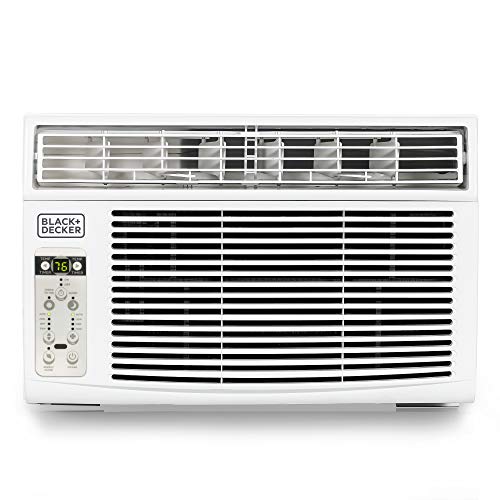 BLACK+DECKER Window Air Conditioner 8000 BTU8000 BTU15.75 x 18.54 x 13.39 inches46.95 poundsCheck on Amazon
 ROVSUN 8000 BTU Window Air Conditioner with Heat8000BTU-115V24.02 x 19.76 x 15.16 inchesCheck on Amazon
Key Takeaways
- Every pick serves rooms up to about 350 square feet, with rated capacity delivered honestly, window-unit style.
- CEER is the efficiency figure that matters here; one listing publishes 12.2, and the inverter Midea carries Energy Star.
- Heat appears twice in this class, on the Midea and the ROVSUN, turning summer machines into four-season ones.
- WiFi and app control are close to standard at this size, because living-room machines serve a roomful of adjusters.
- Plan the lift, the bracket and the circuit: 8,000 BTU cabinets are the first in the series that demand it.
- 115V throughout this guide, so no special wiring, only an honest socket and an unshared heavy load.
Quick Picks
| Pick | Badge | Why it earns its place |
|---|---|---|
| LG 8000 BTU Window AC | Best Mainstream Benchmark | 115V cooling for a stated 350 square feet, electronic control with remote, three speeds and auto restart. |
| Frigidaire 8000 BTU with Remote | Best Quiet Mainstream Pick | The brand’s quiet brief with remote, eco mode, three fan speeds and auto restart at full medium-room size. |
| Midea 8000 BTU Smart Inverter Window AC with Heat | Best Inverter With Heat | Smart inverter drive, heat and dehumidifier, Energy Star rated, for rooms up to 350 square feet. |
| GE 8000 BTU WiFi | Best Connected Legacy Pick | WiFi control by app or remote and an easy install kit, in an energy-efficient medium-room cabinet. |
| BLACK+DECKER BD08WT6 | Best Published Efficiency | Model BD08WT6 with remote, three cooling speeds and a stated 12.2 CEER for rooms to 350 square feet. |
| ROVSUN 8000 BTU with Heat | Best Value Four-Season Pick | 4-in-1 cool, heat, dehumidify and fan with app and voice control, timer and eco mode at 115V. |
How Did We Choose These 8,000 BTU Air Conditioners?
Each pick is a verified 8,000 BTU window unit from the site’s product pool, claiming the class’s 350 square feet, with the listing stating its distinguishing equipment plainly enough to be checked on delivery. Selection then composed a deliberate spread of the class’s live questions: inverter versus fixed drive, heat versus cooling only, published efficiency versus implied, and the mainstream names versus the value challengers who increasingly set the feature agenda at this size.
Two heat-equipped machines were included because the feature changes the purchase’s economics fundamentally at this capacity, and two WiFi-forward models because living rooms are where smart control stops being a toy. The remaining places went to the class’s benchmark mainstream unit and its most efficiency-transparent value entry, so that every kind of buyer in a medium room can find their argument made and answered in the analyses that follow.
What Is CEER, and Why Does It Matter at 8,000 BTU?
CEER, the combined energy efficiency ratio, divides a window unit’s delivered BTU by the watts it draws, standby included, producing the single number that predicts what a summer of cooling costs. Higher is cheaper to run, and at 8,000 BTU the differences stop being trivial, because a medium room’s machine runs for long evening hours across a whole season. The BLACK+DECKER in this guide publishes 12.2 CEER in its listing, a strong figure stated where buyers can use it, and this guide wishes more listings followed that example.
Inverter drive approaches the same problem from the machine’s side. The Midea here modulates its compressor instead of cycling it, and carries an Energy Star rating as the listing’s evidence, which in practice means a machine that spends most hours at the partial speeds where efficiency lives. Fixed-speed rivals answer with lower purchase prices, and the honest comparison is seasonal: premium paid once against watts saved nightly, in a room whose hours of use the household knows better than any guide can.
Standby draw, the silent term inside CEER, deserves a mention in a WiFi class. A connected machine sips power all year to stay reachable, which is negligible per day and real per decade, and one more reason the efficiency figure that includes standby is the honest one. None of this should paralyse a purchase; it should simply move efficiency from the footnotes to the shortlist criteria, where at this size it belongs.
Which Rooms Does 8,000 BTU Serve Best?
The listings converge on 350 square feet, and LG’s version of the claim, a room of fourteen by twenty-five feet, is a useful picture: a proper living room, a large bedroom with space for more than a bed, a studio’s whole world. These are the rooms whose comfort defines a home’s hospitality, and the class sizes for them with a little headroom, which is the correct way to size anything, since a machine working within itself is quieter, steadier and longer-lived than one at its limit.
The usual referees apply. A 350-square-foot room open to a kitchen inherits the kitchen’s cooking heat and behaves larger; a room of the same size in a shaded basement behaves smaller; ceilings above the standard eight feet add volume the floor plan hides. Two of those burdens together argue for the next class up, while none of them argues for enjoying this class’s headroom across a long summer of evenings.
Occupancy is the third referee, and living rooms fail it most often: a film night with six people adds six small heaters to the room the machine sized for two. Headroom absorbs guests, which is a practical argument for this class over the 6,000 in homes that entertain, and a reminder that the correct size is the one that serves the room’s fullest evening, not its emptiest afternoon.

LG Window Air Conditioner 8000 BTU — Best Mainstream Benchmark
LG’s 8,000 BTU unit is the class’s reference machine, and its listing reads like a model of how to state a specification: 115V, 350 square feet with the room dimensions spelled out as fourteen by twenty-five, electronic control with remote, three cooling and fan speeds, auto restart, and a quiet-operation brief. Nothing is exaggerated and nothing essential is missing, which in this market is itself a competitive advantage, because the buyer can plan the room, the circuit and the installation from the listing alone.
Three speeds are the working heart of a living-room machine’s manners. The top gear pulls a room down when the household arrives home to a hot flat, the middle holds an evening’s company, and the low gear keeps a film’s dialogue intelligible while the room stays cool, the specific courtesy that separates a living-room air conditioner from a merely powerful one. Auto restart guards the arrangement through summer storms, resuming duty without a midnight expedition to the window.
LG’s scale in room cooling underwrites the unglamorous virtues: a control layout a guest can decode, filters and parts that remain findable, and a cabinet whose fit and finish survive being handled twice a year for a decade. Against the inverter Midea it concedes ultimate efficiency and quiet; against the value entries it concedes price; against everyone it holds the centre, which is exactly where a benchmark should stand.
For the household buying its first medium-room unit, or replacing a tired one with no appetite for experiments, the LG is the purchase that needs no defending at the family council. It will cool the stated room, behave through storms, speak clearly to visitors, and still be supportable when the remote finally needs replacing. Benchmarks earn their status by making every other machine in the guide explain itself, and this one does.
The LG’s afterlife is worth noting: benchmark machines from giant makers hold their value and their usefulness across households, because the next owner can still find the remote, the filter and the manual’s wisdom online. Buying the reference model is partly buying that long tail, and in a class of decade-long appliances the tail is a real portion of the value.
- Capacity (listing): 8,000 BTU, 115V
- Coverage claim: 350 sq ft (14 x 25 room)
- Controls: electronic with remote
- Speeds: 3 cooling and fan speeds
- Recovery: auto restart
Strengths
- Model clarity in the listing itself
- Three speeds suit living-room life
- Maker’s scale and support
Trade-offs
- No heat mode
- Fixed-speed drive, no inverter savings
- Premium over value rivals
Best for: living rooms and large bedrooms wanting the safe centre. Not suited for: buyers needing winter heat from the window.
Measure your room against the listing’s own 14 by 25 picture. Check price on Amazon.
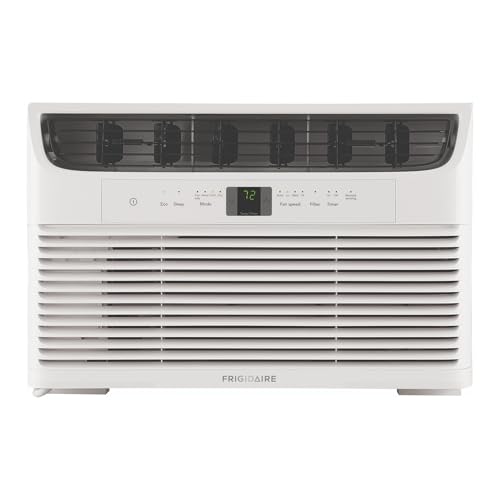
Frigidaire 8000 BTU Window AC with Remote — Best Quiet Mainstream Pick
Frigidaire scales its bedroom philosophy up to the living room without changing its mind: quiet operation as the headline, a remote for the sofa, eco mode to rest the fan and trim the meter, three fan speeds and auto restart. In a 350-square-foot room the philosophy matters differently than in a bedroom, because the machine now shares the room with conversation, music and television, and a unit that can cool without becoming the evening’s loudest participant is worth real money to the people on the sofa.
Eco mode’s value grows with room size and run hours. A medium room holds temperature with long, lazy rests, and a fan that stops instead of stirring converts those rests into genuine quiet and genuine savings simultaneously. The three speeds complete the social brief: assertive for the arrival pull-down, moderate for dinner, and low for the film, each reachable from the remote without anyone leaving their seat or raising their voice over the machine.
Set against its own smaller siblings elsewhere in this series, the pattern is consistency; set against the LG benchmark, the Frigidaire argues that manners outrank marginal specification differences in a room people talk in. It concedes the Midea’s inverter and heat, and the ROVSUN’s app-forward value, and counters with the mainstream virtues executed attentively, which for most living rooms is the correct hierarchy of virtues.
Owners should give eco mode its customary fortnight of trust before judging, because its stop-start quiet feels unfamiliar for two evenings and then becomes the standard other machines are unfavourably compared against. That adaptation curve is the signature of a feature designed around real rooms rather than showroom demonstrations, and it is why this Frigidaire, size for size, is the guide’s recommendation for the sociable room.
Frigidaire’s living-room machine also handles the dinner-party test with grace: the pull-down speed for a room filling with guests, the low gear for the meal itself, and the remote passing hand to hand like a talking stick. Appliances that behave well in company are rarer than appliances that behave well alone, and this one’s specification reads as if its designers host dinners themselves.
- Capacity (listing): 8,000 BTU
- Coverage claim: up to 350 sq ft
- Controls: remote control
- Modes: eco mode, 3 fan speeds
- Recovery: auto restart, quiet brief
Strengths
- Quiet brief for sociable rooms
- Eco mode saves and silences
- Consistent Frigidaire bedroom-to-living-room line
Trade-offs
- No heat or inverter
- Eco rhythm takes getting used to
- Mainstream price
Best for: living rooms where conversation competes with cooling. Not suited for: four-season rooms needing heat.
Judge eco mode after a fortnight, not the first evening. Check price on Amazon.

Midea 8000 BTU Smart Inverter Window AC with Heat — Best Inverter With Heat
This Midea is the class’s most complete single appliance: an inverter window unit that cools, heats and dehumidifies, carries an Energy Star rating in its listing, speaks to smart controls and a remote, and serves the full 350 square feet. Where the U-shaped 6,000 BTU model innovated in architecture, this machine innovates in scope, arguing that a medium room’s window should host one machine that answers the room’s climate in every month, not merely its hottest ones.
Inverter drive in a living room pays its dividend in steadiness. The temperature stops oscillating around the set point, the compressor’s voice settles to a low continuity the ear files as background, and the Energy Star rating testifies that the efficiency is certified rather than asserted. Add heat, delivered by heat-pump logic with its well-known efficiency advantage over resistance heating in mild and moderate cold, and the machine’s year-round occupancy of the window starts to look less like an appliance and more like infrastructure.
The dehumidifier mode completes the trio for the rooms this class serves, which include the damp-prone ground-floor living room and the flat whose windows mist in October. A machine that can dry a room in the shoulder months protects furnishings and finishes while it waits for summer, and it will be used, which is more than can be said for many a headline feature.
The cautions are proportionate: this is the class’s premium territory, its electronics are its complexity, and its heat, like all heat-pump warmth, softens in severe cold where it becomes a supplement rather than a system. For the household whose medium room is too hot in August and too cold in January, none of that outweighs the central fact: one window, one machine, four seasons answered, and this is the only pick here that can say it with an inverter’s refinement.
The Midea’s dehumidifier mode, in a ground-floor flat, can quietly become its most-used function, running through the damp months while the cooling waits for summer and the heat waits for winter. A machine used in eleven months justifies its window in a way a three-month appliance cannot, and that utilisation, more than any single specification, is the flagship’s deepest argument.
- Capacity (listing): 8,000 BTU
- Coverage claim: up to 350 sq ft
- Drive: smart inverter
- Modes: cool, heat, dehumidifier
- Rating: Energy Star, electronic controls, remote
Strengths
- Cooling, heating and drying in one
- Inverter steadiness with Energy Star
- Smart control included
Trade-offs
- Class premium pricing
- Heat softens in severe cold
- Electronics are the complexity
Best for: medium rooms uncomfortable in both summer and winter. Not suited for: cooling-only rooms on a strict budget.
Count the room’s cold weeks to value the heat mode honestly. Check price on Amazon.

GE Window Air Conditioner 8000 BTU WiFi — Best Connected Legacy Pick
GE’s 8,000 BTU entry makes its case on connection and confidence: WiFi control through a smartphone app alongside the remote, an easy install kit, and a listing that promises energy-efficient cooling for medium rooms from one of the oldest names in the business. The household this serves is the one that wants the living room cool before they reach home, the schedule set from the sofa, and the whole arrangement backed by a maker whose support number has been answered for generations.
App control in a living-room machine is genuinely different from app control in a bedroom. The room is used by everyone, its schedule is the household’s schedule, and starting the pull-down from the train, the office or the school run converts the machine from an appliance you operate into a climate that simply obtains when people arrive. GE’s implementation rides on the brand’s established smart platform rather than a novelty app, which matters in year three when novelty apps are abandonware.
The easy install kit deserves its sentence at this size, because an 8,000 BTU cabinet is the first in this series heavy enough to make installation a planned event, and a kit that organises the fitting lowers the event’s temperature considerably. Combined with the brand’s documentation, the GE asks the least courage of any pick here on installation day, a virtue that should not be underestimated in a class of two-person lifts.
Against the field, the GE concedes the Midea’s inverter and heat and the BLACK+DECKER’s published CEER, and counters with the connected legacy proposition entire. For households already living in GE’s appliance ecosystem, or simply valuing a famous name behind a connected product, it is the natural centre of their shortlist, and its medium-room brief is executed without a weak line in the listing.
GE’s app platform carries one advantage that only appears in year two: it is still there, updated, when the household adds a second connected appliance or replaces a phone. Connected features are promises about the future, and a legacy maker’s promises are collateralised by its whole business in a way a novelty app’s never can be. That, as much as the cooling, is what the GE premium purchases.
- Capacity (listing): 8,000 BTU
- Class position: cooling for medium rooms
- Controls: WiFi app and remote
- Install: easy install kit
- Character: energy-efficient positioning
Strengths
- Established smart platform
- Easy install kit at a heavy size
- Legacy support behind a connected product
Trade-offs
- No heat mode
- No published CEER in the listing
- Fixed-speed drive
Best for: connected households wanting a legacy badge. Not suited for: buyers who want heat or inverter drive.
Pair the app during week one while returns are painless. Check price on Amazon.
BLACK+DECKER Window Air Conditioner 8000 BTU — Best Published Efficiency
BLACK+DECKER’s BD08WT6 earns its place in this guide with a single act of transparency the rest of the shelf should copy: its listing publishes a 12.2 CEER. That number lets a buyer do real arithmetic about a summer’s running cost instead of trading in adjectives, and 12.2 is a strong figure for the class, evidence that the machine’s refrigeration is efficient in the measured, standby-inclusive sense the CEER standard demands. In a guide that keeps asking listings to show their work, this one does.
The rest of the specification is the class’s competent standard, executed plainly: remote control, three cooling speeds and a fan-only function, for rooms up to 350 square feet. Fan-only mode is the under-sung member of that list, because on mild evenings a room often needs air movement rather than refrigeration, and a machine that can provide the first without the second saves its compressor for the nights that need it.
BLACK+DECKER’s position in window cooling is that of the tool brand turned appliance maker, and the machine’s character follows: functional, documented, unembarrassed about being equipment. It concedes smart connectivity to the GE and voice ecosystems to the ROVSUN, and answers with the efficiency figure and a price that usually reflects its value engineering. For the buyer who reads CEER first, and there should be more of them, the shortlist starts here.
Ownership advice is correspondingly practical: verify the CEER’s promise in the only court that matters, a normal month’s bill in a normal summer, keep the filter on its monthly rhythm so the rated efficiency survives contact with dust, and let the fan-only mode carry the mild weeks. A machine bought on a number deserves to be run on evidence, and this one invites exactly that discipline.
The BLACK+DECKER’s fan-only mode deserves a final commendation for the shoulder seasons, when the room needs the feeling of air more than the fact of refrigeration. Owners who learn to use fan-only on mild evenings extend the compressor’s rest, trim the bill and discover that comfort is often movement wearing temperature’s clothing, a lesson this whole class teaches in its better machines.
- Capacity (listing): 8,000 BTU
- Coverage claim: up to 350 sq ft
- Efficiency: 12.2 CEER stated
- Model: BD08WT6
- Controls: remote, 3 cooling speeds, fan only
Strengths
- Published 12.2 CEER for real arithmetic
- Fan-only mode for mild evenings
- Competent standard specification
Trade-offs
- No WiFi or voice control
- No heat mode
- Brand is a value engineer, not a premium name
Best for: efficiency readers and running-cost watchers. Not suited for: smart-home households wanting app control.
Track the first full month’s usage against your old unit’s habits. Check price on Amazon.
ROVSUN 8000 BTU Window AC with Heat — Best Value Four-Season Pick
ROVSUN’s 8,000 BTU machine is the value end’s answer to the Midea’s flagship argument, and it is startlingly complete: four modes spanning cool, heat, dehumidify and fan, app and voice control compatible with Alexa and Google, a timer, eco mode and a standard 115V supply, for rooms of 350 square feet. A few seasons ago that specification at a challenger brand would have been dismissed as a misprint; today it is the pressure that keeps the famous names honest, and it deserves analysis rather than condescension.
The heat mode is the headline because it changes the purchase’s category, from summer appliance to four-season infrastructure, at a value position. A spare room that hosts guests in both August and December, a flat whose heating is expensive or erratic, a home office over a garage: these are the rooms where a window machine that warms as well as cools collapses two purchases into one and earns its window twelve months a year.
App and voice control at this level should be tested rather than assumed, and the week-one protocol from this series’ portable guides applies unchanged: pair everything, test the voice commands the household will actually use, run heat as well as cooling through a full cycle, and keep the packaging until the verdict is in. Challenger brands reward that diligence because their machines are usually better than their documentation, and the gap closes fastest in the first week.
Set against the Midea inverter, the ROVSUN concedes drive-train refinement and the Energy Star testimony; set against the cooling-only mainstream, it offers two extra seasons and a connected control set. Buyers whose room genuinely needs heat and whose budget genuinely prefers value will find this the most consequential pick in the guide, provided the week-one tests are passed with the same rigour applied to any flagship.
ROVSUN’s eco mode and timer, at its price, quietly demolish the argument that value machines are crude machines. The feature set’s completeness means the week-one tests, not the specification, are where its verdict is written, and a challenger that invites testing on equal terms with flagships is a challenger that has understood the assignment of this entire category.
- Capacity (listing): 8,000 BTU with heat, 115V
- Coverage claim: 350 sq ft
- Modes: cool, heat, dehumidify, fan (4-in-1)
- Controls: app and voice, Alexa/Google
- Functions: timer and eco mode
Strengths
- Four seasons at a value position
- App and voice control included
- Eco mode and timer complete the set
Trade-offs
- Challenger brand support unknowns
- Fixed-speed character beside the inverter
- Documentation thinner than giants’
Best for: guest rooms and flats needing heat and cooling on a budget. Not suited for: buyers who need a giant’s service network.
Run the heat mode through a full cycle in week one. Check price on Amazon.
How Do the Six 8,000 BTU Air Conditioners Compare?
| Pick | Listing headline | Room fit | Defining trait |
|---|---|---|---|
| LG 8000 BTU Window AC | 8,000 BTU, 115V | 350 sq ft stated | Benchmark specification |
| Frigidaire 8000 BTU with Remote | 8,000 BTU with remote | Up to 350 sq ft | Eco mode, quiet brief |
| Midea 8000 BTU Smart Inverter Window AC with Heat | 8,000 BTU inverter | Up to 350 sq ft | Heat plus Energy Star |
| GE 8000 BTU WiFi | 8,000 BTU WiFi | Medium rooms | App control, easy install |
| BLACK+DECKER BD08WT6 | 8,000 BTU, 12.2 CEER | Up to 350 sq ft | Published efficiency figure |
| ROVSUN 8000 BTU with Heat | 8,000 BTU with heat | 350 sq ft | 4-in-1 app and voice value |
Capacity and coverage are unanimous, so the trait column carries the decision: a benchmark, a quiet specialist, an inverter flagship with heat, a connected legacy machine, an efficiency publisher and a four-season value challenger. Read down that column and the class’s six philosophies are visible at a glance, which is more than most shelves offer at any size.
How Do You Install an 8,000 BTU Unit Properly?
Plan the installation as a two-person job with a bracket decision made in advance. The cabinet’s weight and overhang at this size reward a support bracket under the outdoor half, both for the sill’s sake and for the machine’s drainage slope, and many buildings and insurers quietly require one. Measure the window, confirm the sash’s travel, assemble the kit on the floor first, and the lift itself becomes the shortest part of the afternoon.
Slope and seal remain the twin commandments, now with more at stake because the machine moves more air and the room is bigger. The cabinet tilts gently outward so condensate leaves by the designed path, the side panels and foam close every gap the dusk-light test can find, and the sash is secured so the window cannot be raised from outside. A medium room’s machine that leaks air is cooling the street at living-room prices, and the CEER you paid for evaporates through the gap.
Commission the machine like the connected appliance most of these are. Pair the app, name the room, set one sane schedule, test the remote’s full range and, on the heat models, run the heating through a cycle while the weather still forgives experiments. An hour of commissioning in June is the difference between a climate system and a box that cools, and at this class’s prices the household has paid for the system.
Should a Medium Room’s Unit Also Heat?
The question arrives in this series’ window guides for the first time at this size, because this is where heat-equipped window units become common, and it deserves the same honest treatment the portable guide gave it. A heat-pump window unit warms with the efficiency of moved heat rather than generated heat, which in mild and moderate cold makes it one of the cheapest ways to make a single room comfortable, and in a flat with expensive or inadequate heating it can be transformative for one room’s life.
The limits are physical and should be respected in the decision. Heat-pump output declines as outdoor temperatures fall, so in a hard winter the window unit becomes the room’s supplement and comfort-keeper rather than its sole defence, and households in cold climates should buy it as such. Condensate and defrost behaviour in heat mode also differ from cooling, and the manual’s winter pages deserve reading in October rather than January.
If the room is a summer problem only, the cooling-only picks spend the same money on the season that matters and the decision is easy. If the room is the cold one, the one with the closed door all winter, then the Midea and ROVSUN analyses above are the most important paragraphs in this guide, because a machine that returns a room to the household for twelve months has a value no summer-only arithmetic can capture.
How Does Smart Control Change a Living Room’s Cooling?
A bedroom’s smart control serves one sleeper; a living room’s serves a household, and the difference shows in which features matter. Scheduling follows the family’s day rather than an individual’s night, geofenced or app-started pull-downs greet the first arrival home, and voice control earns its keep precisely because the room’s occupants have their hands full of dinner, children and conversation. The GE and ROVSUN here, and the smart Midea, all speak to that shared life.
The failure mode to avoid is the cathedral of automation: routines stacked on routines until nobody remembers why the machine starts at four. One schedule that matches the household’s real rhythm, one voice command everyone knows, and a remote that remains the court of final appeal will outperform any elaborate system by the only metric that matters, which is whether the room is comfortable without anyone thinking about it.
Privacy and longevity deserve their brief mention in a connected class. Buy machines whose apps ride on maintained platforms, keep the physical controls fully authoritative, as every pick here does, and the connected layer remains what it should be: a convenience laid over a sound appliance, never a dependency that can strand a good machine when a server somewhere is switched off.
What Does a Season of Medium-Room Cooling Cost?
The honest answer is a range built from the variables this guide has named: the machine’s CEER or inverter efficiency, the room’s sun and insulation, the set point the household negotiates, and the hours the room is actually occupied. What can be said firmly is that at this size the differences between an efficient machine run wisely and an ordinary machine run carelessly are large enough to matter on a household budget, which is why the efficiency sections above are written as economics rather than as virtue.
The cheapest watts remain the ones never demanded. Blinds on the afternoon glass, a door policy for the cooled room, a set point a degree warmer paired with moving air from the fan speeds these machines all carry: each trims the compressor’s hours more cheaply than any technology. The households with the lowest bills in this class are rarely the ones with the fanciest machine; they are the ones whose habits cooperate with a good one.
Finally, count the avoided costs on the other side of the ledger. A medium room cooled properly hosts the summer’s evenings at home instead of in restaurants and cinemas, protects sleep before working days, and keeps heat-vulnerable family members safe in the room they love. Against those entries, the electricity line, managed with the discipline above, is usually the smallest number in the story.
What Does Living at 8,000 BTU Feel Like?
It feels like the house’s centre of gravity returning indoors for the summer. The living room, abandoned in past Julys for whichever corner caught a breeze, becomes again the place where evenings happen, and the machine that performs that restoration disappears into the room’s furniture so completely that guests often fail to notice it until they remark on the comfort.
It feels social. A cooled living room hosts: film nights regain their audience, grandparents stay for dinner, the board games come out. The machine’s real output, measured across a season, is not degrees but gatherings, and owners who doubt the purchase in the abstract rarely doubt it after the first Saturday it makes possible.
It feels negotiated, in the way of all shared climates. The household’s thermostat treaty, who runs hot, who reaches for a blanket, what the display may say during a film, gets written in the first fortnight and then holds for years. Machines with remotes that everyone can work and schedules nobody resents produce the most durable treaties, which is a specification no listing has yet learned to print.
It feels heavier in October, whatever the household decides. Store the unit and the lift is a two-person ceremony; leave it and the winterising is a cover and a seal. Either way the class’s physicality reminds its owners that real cooling is real machinery, and that the comfort of August was earned by an object with weight, which somehow makes the comfort more respectable.
It feels, in the heat models, like a room reclaimed twice. The living room that was too hot in summer and too cold in winter, the room with the door always shut, opens for the whole year, and the household’s map of itself expands by 350 square feet. Few purchases redraw a home’s usable geography so completely for so little structural violence.
And it feels educational in the way this whole series keeps discovering: a season at this size teaches CEER from the bill, inverter steadiness from the ear, and sizing from the one afternoon the sun won. Owners graduate from this class knowing their home’s thermal character intimately, which is knowledge every later decision, insulation, windows, a split system, will spend wisely.
A medium room’s machine also becomes the household’s ambassador to its guests’ homes. Visitors who sleep well in the spare room or linger comfortably through a film night go home and reconsider their own hot rooms, and more than one purchase in this class can be traced to a single well-cooled evening elsewhere. Comfort, properly delivered, is contagious in the best way.
The class teaches a final economic lesson about headroom. A machine bought exactly at a room’s requirement spends its life at full stretch, ageing audibly; a machine bought with a margin spends its life composed. The small price of that margin, paid once, buys quiet, steadiness and years, which is why this guide’s sizing advice always rounds toward the room’s hardest evening rather than its average one.
And so the medium class closes as the series’ centre of gravity: big enough to matter, honest enough to trust, and varied enough that six genuine philosophies share one capacity. Whatever a household learns here about its rooms will serve it at every size above and below, which is the deepest service a buying guide can perform.
There is a maintenance rhythm specific to this size that deserves recording: the exterior half of a medium unit collects a season’s worth of street in its fins, and a gentle autumn cleaning, soft brush, low-pressure rinse where the manual allows, returns the machine to its rated self for storage. Owners who skip it store a slightly worse machine each year and blame the calendar for what was only ever dust.
The living room’s machine also curates the household’s relationship with the outdoors. On the summer’s best evenings, the cooled room competes with the garden, and the wise household lets the garden win, switching the machine off and throwing the windows open. An appliance that knows when it is not needed, and owners who know it too, mark the difference between cooling as a tool and cooling as a reflex.
Heatwave planning at this size has a social protocol worth adopting: the cooled living room becomes the household’s designated refuge, with the vulnerable, the very old, the very young and the heat-exhausted pet all holding right of residence. Deciding that in advance, in May, turns a machine into a plan, and a plan is what a heatwave actually tests.
Owners upgrading from the compact classes notice one more change: the remote stops being a toy and becomes infrastructure, because the room is bigger, the window is further from the sofa, and nobody crosses 350 square feet to change a fan speed. Keeping that remote findable, charged with fresh batteries and resident in one agreed place becomes genuine household policy at this size.
The class’s cabinets, finally, mark the house. A medium window unit is visible from the street, and its condition, level, clean, sealed or sagging and streaked, tells the neighbourhood a story about the household inside. Five minutes with a cloth at installation and at removal keeps that story flattering, a trivial cost for the appliance that fronts the home all summer.
If a household can buy only one serious cooling appliance, this class is where the money does the most work: the room it serves is the room the household shares, the hours it runs are the hours everyone is awake to enjoy, and its headroom absorbs the guests, the heatwaves and the cooking that smaller classes cannot. That centrality is the medium class’s quiet claim to being the best value in this entire series.
And the last lesson is about succession. A well-kept 8,000 BTU machine that is eventually outgrown, by a move, a renovation or a split system, passes to the next household with most of its life intact, because nothing in its design is fragile except neglect. Buying it well is therefore a kindness to a stranger as well as a service to oneself, which is a pleasant note on which to leave any appliance.
One more habit separates contented owners in this class: they decide the machine’s winter identity in advance. Stored or covered, heating or resting, the unit whose October is planned never becomes the unit discovered damp and forgotten in January. The plan costs a calendar entry and repays it in the machine’s condition every single spring.
The medium room also teaches the value of a single degree. Households that experiment honestly, one degree warmer with the fan a step higher, routinely find comfort unchanged and the compressor’s hours visibly shortened. That experiment, run once in the first summer, pays out in every summer after, and it is available to every pick in this guide regardless of price.
So the class rests its case: six machines, one honest capacity, and a decision that turns on seasons, efficiency and manners rather than on cooling itself. A household that knows which of those it is buying for has already made the hard part of the choice.
What Mistakes Do 8,000 BTU Buyers Make?
Medium rooms forgive sizing errors less than small ones and reward installation care more, so this class’s classic mistakes concentrate on fit, circuits and seasons.
- Attempting a one-person installation of a cabinet this size, risking the lifter, the sill and the machine in a single optimistic moment.
- Skipping the support bracket under a heavy overhang, then chasing drainage problems and cabinet rattle that the bracket would have prevented.
- Ignoring CEER and inverter efficiency at the one size where long evening hours make running costs genuinely significant.
- Buying cooling-only hardware for the room that is also the house’s coldest in January, and shopping again within the year.
- Judging a challenger-brand four-season machine on its cooling alone in week one, without ever running the heat cycle inside the return window.
Final Recommendation
Let the room’s calendar and company decide. The sociable living room’s machine is the Frigidaire 8000 BTU with Remote, all quiet manners and eco discipline; the four-season room’s flagship is the Midea 8000 BTU Smart Inverter Window AC with Heat, inverter-driven and Energy Star rated; and the benchmark against which both should be measured is the LG 8000 BTU Window AC, whose listing states its room, its speeds and its intentions with unmatched clarity. The connected legacy, the published CEER and the value four-season challenger each complete a shelf without a weak seat.
Carry this closing thought into the purchase: at 8,000 BTU the cooling is table stakes, so buy the efficiency you can verify, the seasons you actually suffer and the manners your room’s life demands, and the medium room will repay you every evening of the year.
Frequently Asked Questions
Is 8,000 BTU enough for a living room with a kitchen attached?
It depends on how attached. A kitchenette’s occasional kettle is easily absorbed by the class’s headroom; a full cooking kitchen in daily use adds a heat load that can push an open-plan space past what 8,000 BTU holds on the busiest evenings. Cook earlier, vent the kitchen’s heat at source, and the class usually copes; cook nightly for a crowd, and size up.
What does 12.2 CEER mean for my bill?
CEER divides delivered cooling by total watts drawn, so 12.2 describes an efficient machine whose summer of evenings will cost noticeably less than a low-CEER rival’s, all else equal. It will not produce a number for your bill by itself, since hours, set point and tariff rule that, but as a comparison between two machines in the same room it is the most honest figure a listing can offer.
Can an 8,000 BTU unit run on a normal outlet?
Yes. Every pick in this guide is a standard 115V appliance where the listings state voltage, designed for ordinary household sockets. Respect the draw nonetheless: plug directly into the wall, avoid power strips, and keep the circuit’s other heavyweights, kettles, heaters, irons, from sharing the compressor’s busiest moments.
Is window-unit heat a replacement for central heating?
For one room in mild or moderate cold, it can be the room’s main warmth, efficiently delivered. In severe cold its output fades and it becomes a supplement, keeping the room comfortable alongside the house system rather than instead of it. Buy it as a room-saver with a long season, not as a whole-house heating plan, and it will never disappoint you.
How much heavier is this class to install?
Enough to change the plan: two people, a decided bracket, a clear path and an unhurried hour. The cabinets overhang more, weigh more and punish improvisation more than the compact classes do, yet the job remains entirely within an ordinary household’s competence when it is treated as the small project it is rather than as a lift to be winged.
Do I need WiFi in a window air conditioner?
Need is too strong, but at this size the case is real: the room is shared, its schedule is the household’s, and starting the pull-down before anyone arrives is a daily pleasure rather than a novelty. Every connected pick here keeps full physical controls, so WiFi remains a layer of convenience over a sound appliance, which is the only terms on which it should ever be bought.
Related Guides
For the next step in cooling and the kitchen’s hardest-working appliances, these guides continue the series: Best 9,000 BTU Split System Air Conditioners, Best 3-Rack Dishwashers and Best Bosch Dishwashers.


