What's inside
- Key Takeaways
- Quick Picks
- How Did We Choose Dishwashers for an 18-Inch Cutout?
- How Do the Six Slim Machines Compare on the Published Facts?
- Why Choose 18 Inches Instead of a Standard Dishwasher?
- How Should You Measure an 18-Inch Cutout Before Ordering?
- What Fits in an 18-Inch Dishwasher — and What Does Not?
- How Much Does Noise Matter in a Small Kitchen?
- Which Cycles and Drying Methods Actually Matter at This Size?
- How Do You Install a Slim Built-In Without Regretting It?
- What Does Living With an 18-Inch Machine Change Day to Day?
- When Should You Choose a Countertop or Portable Instead?
- How Does an 18-Inch Machine Handle a Dinner Party?
- What Should You Budget Beyond the Purchase of a Slim Dishwasher?
- How Long Should a Slim Dishwasher Last, and What Decides It?
- What Mistakes Ruin an 18-Inch Dishwasher Purchase?
- Final Recommendation
- Frequently Asked Questions
- Related Guides
As an Amazon Associate I earn from qualifying purchases. This post may contain affiliate links at no extra cost to you.
cottageverdict.com is reader-supported. When you buy through links on our site, we may earn an affiliate commission.
Where to buy: all six machines below are sold through Amazon, and their names in the Quick Picks table, the detailed reviews and the comparison table link to their listings so you can check price on Amazon and confirm the exact cutout dimensions before ordering. The best 18-inch dishwashers exist for a specific kitchen geometry: a run of cabinets with a slim gap that a standard 24-inch machine cannot fill, in a home whose dishes still arrive at family speed.
An 18-inch dishwasher is not a shrunken compromise so much as a different answer to the same question. It washes a genuine load — every pick in this roundup is an 8-place-setting built-in machine — inside a cabinet width that suits small kitchens, galley layouts, in-law suites, rental flats and the narrow end of a kitchen island. For the households that need one, the alternative is not a bigger dishwasher; it is the sink, forever.
The six finalists divide along the lines that actually matter at this size: how quietly they run in a small home where the kitchen is never far from the sofa or the bed, whether the tub is stainless steel, how the racks handle tall glasses and awkward pans in a cavity with no spare inches, and which cycles and drying methods each maker includes. One pick even fits a third rack into the slim format, which would have sounded like a parlour trick a few years ago.
Measure before you fall in love, though. An 18-inch machine needs its cutout confirmed — width, height and depth, plus the water, drainage and electrical provisions behind it — and this guide returns to measurement repeatedly, because at this size a quarter-inch misunderstanding is the difference between a Saturday installation and a month of emails.
Key Takeaways
- Every pick here is an 8-place-setting built-in; at 18 inches, rack design matters more than raw capacity claims.
- Stainless steel tubs dominate this group and are worth preferring for drying performance, odour resistance and longevity.
- Published noise figures at this size range from the high forties to the low fifties in decibels — meaningful in studio-sized homes.
- A third rack exists even at 18 inches: the Sharp in this group fits one in, transforming cutlery and utensil handling.
- Heated dry and high-temperature wash options separate the full-featured picks from the honest basics.
- Confirm the cutout three ways — width, height, depth — and the services behind it before any slim dishwasher is ordered.
Quick Picks
| Pick | Badge | Why it earns its place |
|---|---|---|
| Sharp SDW4523MS 18-Inch | Best Overall 18-Inch Pick | Sharp brings a third rack, a published 47 dB figure, six cycles and a stainless finish to the slim format |
| COMFEE’ 18-Inch Built-In | Best for Small Apartments | COMFEE’ pairs a stainless tub with heated dry, an adjustable top rack and a published 52 dB rating |
| Midea 18-Inch Built-In | Best High-Temperature Wash | Midea adds a high-temp wash to six cycles and heated dry in a black, apartment-friendly cabinet |
| EdgeStar BIDW1802SS 18-Inch | Most Established Slim Name | EdgeStar’s BIDW1802SS is a long-running 18-inch, 8-place-setting built-in from a compact-appliance specialist |
| Honeywell 18-Inch, 8 Place Settings | Best Black Finish Option | Honeywell offers six programmes, a stainless tub and Energy Star certification in a black cabinet |
| SPT SD-9254SSB 18-Inch | Best Heated-Drying Value | SPT combines heated drying, six programmes and a stainless tub in an Energy Star slim machine |
How Did We Choose Dishwashers for an 18-Inch Cutout?
We fixed the non-negotiables first: a true 18-inch built-in format, a stainless steel interior where the maker offers it, and a full 8-place-setting capacity, because a slim machine that holds five settings is a countertop appliance wearing a cabinet door. All six finalists clear that bar, which let the comparison move to the interesting differences rather than the disqualifying ones.
Noise received unusual weight, because slim dishwashers live in small homes. In a studio or a compact flat, the dishwasher runs within earshot of the bed, the desk and the television simultaneously, so a published decibel figure — and the gap between 47 and 52 dB is genuinely audible — became a ranking criterion rather than a footnote. Where a maker publishes no figure, we noted the omission instead of guessing.
Rack intelligence came next. In a cavity this narrow, the difference between a good evening and a frustrating one is whether tall glasses fit without tilting, whether the top rack adjusts for a stockpot below, and whether cutlery has a home that does not steal a quarter of the lower rack. The Sharp’s third rack and the COMFEE’ adjustable top rack are therefore headline findings, not garnish.
Finally we weighed cycles and drying as a pair. Six wash programmes is the group’s standard; what separates the picks is how they dry — heated dry, high-temperature final rinses, or simpler condensation — and how honestly each maker describes it. Plastics, as every dishwasher owner learns, are the examination that drying systems either pass or fail.

Sharp SDW4523MS 18 Inch Built-In Dishwasher — Best Overall 18-Inch Pick
The Sharp SDW4523MS is the machine that refutes the assumption that slim means basic. Its listing publishes the group’s most complete specification: 18-inch built-in format, stainless steel finish, a noise figure of 47 dB, a third rack, 8 place settings and six wash cycles. Any one of those would be unremarkable at 24 inches; assembled inside an 18-inch cavity, they describe the most capable small dishwasher in this roundup by a clear margin.
The third rack is the finding to dwell on. In a standard machine it is a convenience; in a slim machine it is a capacity strategy, because the cutlery basket it replaces would otherwise consume a disproportionate share of the narrow lower rack. Flatware, utensils and long tools lie flat up top, plates and pans gain room below, and the 8-place-setting rating becomes easier to achieve in real mixed loads rather than in the manufacturer’s place-setting geometry alone.
At 47 dB the Sharp also respects the small-home reality that shaped our criteria: this is a machine that can run during a film or after bedtime in a compact flat without negotiation. Combined with six cycles in a stainless format, it asks the fewest compromises of any pick here — the natural first choice for a household that will use its slim dishwasher as its only dishwasher, daily, for years.
- Cabinet fit: slim built-in, stainless steel finish
- Capacity: 8 place settings as listed
- Racking: third rack fitted — rare at this width
- Noise: 47 dB published by the maker
- Cycles: six wash cycles
- Best role: sole dishwasher in a small household
Strengths
- Third rack transforms slim-format loading
- Lowest published noise figure in this group
- Complete specification with nothing important omitted
Trade-offs
- Premium position within the 18-inch class
- Third rack slightly reduces top-rack glass height
- Stainless finish shows fingerprints in bright light
Best for: small households wanting full-size features inside a slim cabinet gap.
Not suited for: buyers who load very tall stemware in the top rack every day.

COMFEE’ 18 Inch Built-in Dishwasher — Best for Small Apartments
COMFEE’ has built its name on compact appliances that respect small homes, and its 18-inch built-in shows the specialisation. The listing assembles the features an apartment kitchen actually needs: Energy Star and NSF credentials, a stainless steel tub, 8 place settings, six washing cycles, heated dry, an adjustable top rack and a published noise figure of 52 dB aimed, the maker says, at apartments and small kitchens. That is a specification written by someone who knows where the machine will live.
The adjustable top rack is the practical star. Slim cavities punish rigid racking because the load mix in a small household varies wildly — two mugs and a saucepan one night, the full aftermath of a dinner for friends the next. A top rack that moves lets the machine swallow a tall pot below or tall glasses above as the evening demands, and it is the feature owners of fixed-rack slim machines most often wish they had bought.
Heated dry completes the apartment case. Small kitchens have no spare counter for a draining rack of plastics and lunch boxes, so a machine that actively dries earns its electricity. At 52 dB the COMFEE’ is not the quietest here — the Sharp holds that title — but it is honest about the figure, and for most flats it sits comfortably below the level that disturbs a neighbouring room.
- Cabinet fit: slim built-in with a steel interior
- Capacity: 8 place settings as listed
- Cycles: six washing cycles
- Drying: heated dry included
- Racking: adjustable top rack
- Noise: 52 dB published; Energy Star and NSF noted
Strengths
- Adjustable rack suits wildly varying small-household loads
- Heated dry suits kitchens without draining space
- Credentials and noise figure published plainly
Trade-offs
- Louder on paper than the Sharp at 47 dB
- Brand sits in the value tier beside premium names
- Silver finish is the listed option here
Best for: apartment dwellers who need one flexible machine for every kind of load.
Not suited for: open-plan studio sleepers who rank silence above all else.

Midea 18 Inch Built-in Dishwasher — Best High-Temperature Wash
Midea’s 18-inch entry distinguishes itself with temperature. Alongside the expected six washing cycles, 8 place settings and stainless steel tub, the listing specifies heated dry and a high-temp wash — a pairing aimed at the loads small households actually worry about: baby bottles, chopping boards, the pan that held raw chicken, the lunch boxes that come home faintly suspect. In a compact kitchen without room for soaking tubs and sterilising rituals, a machine that can bring genuine heat to the problem earns its place.
The black finish is a considered choice rather than a default. Slim dishwashers often land in kitchens that were designed around black appliances, in rental properties where the other machines are black, or at the end of an island where a black panel disappears into shadow cabinetry. Midea offers that coordination in a format where finish choice is usually an afterthought, and the listing explicitly frames the machine for apartments and even RV-adjacent small spaces.
Judged against the group, the Midea trades the Sharp’s third rack and the COMFEE’ adjustable rack for its thermal emphasis — a fair exchange for households whose loads skew hygienic rather than voluminous. Its maker positions it as a slim, quiet machine for small spaces; no decibel figure is headlined in the listing, so buyers in studios should treat noise as an unknown and weigh the high-temperature case on its own considerable merits.
- Cabinet fit: slim built-in wearing a black finish
- Capacity: 8 place settings as listed
- Tub: stainless steel interior
- Cycles: six washing cycles
- Thermal features: heated dry and high-temp wash
- Energy: Energy Star certified per the listing
Strengths
- High-temp wash suits hygiene-critical loads
- Heated dry included for plastics and boxes
- Black finish coordinates with black appliance suites
Trade-offs
- No third rack or stated rack adjustment
- Noise figure not published in the listing
- Black shows dust and water marks readily
Best for: small households whose loads include bottles, boards and lunch boxes needing real heat.
Not suited for: buyers who need a published quiet rating for an open-plan bedroom kitchen.

EdgeStar BIDW1802SS 18 Inch Built-In Dishwasher — Most Established Slim Name
EdgeStar built its reputation on compact appliances — wine coolers, portable machines, small-space refrigeration — and the BIDW1802SS is its statement in this category: an 18-inch-wide built-in dishwasher with 8 place settings, in stainless, from a maker for whom the slim format is the main business rather than a sideline. Longevity in a niche matters; a model that has served the small-kitchen market for years accumulates a track record that a freshly launched rival cannot print on a carton.
The specification philosophy here is restraint. The listing states the format, the capacity and the configuration and declines to festoon the machine with claims, which suits buyers who distrust feature inflation. What you are purchasing is a purpose-built slim built-in from a specialist, with the racking and programmes a household needs for daily loads, installed in the standard 18-inch cavity that kitchen designers have used for decades.
That restraint defines the trade-offs honestly. Shoppers wanting a third rack should look at the Sharp; those wanting a published noise figure or an adjustable rack have their candidates above. The EdgeStar’s case is the specialist’s case: correct dimensions, proven format, a maker who will still understand the machine when you call about it in five years. In a category where the appliance must fit a hole exactly, that steadiness is worth real money.
- Cabinet fit: the standard slim width
- Capacity: 8 place settings as listed
- Maker: compact-appliance specialist EdgeStar
- Model: BIDW1802SS, stainless presentation
- Installation: standard slim built-in cavity
- Best role: like-for-like slim replacement
Strengths
- Specialist maker with a long slim-format record
- Straightforward, claim-free specification
- Ideal like-for-like replacement dimensions
Trade-offs
- Listing is spare on cycles and feature detail
- No third rack or published noise headline
- Fewer headline features than the Sharp or COMFEE’
Best for: replacing a dead 18-inch machine with a proven equivalent from a specialist.
Not suited for: feature hunters who want the newest racking ideas in the slim format.

Honeywell 18 Inch Dishwasher 8 Place Settings — Best Black Finish Option
Honeywell’s 18-inch machine competes on completeness in a black cabinet: 8 place settings, six washing programmes, a stainless steel tub and UL/Energy Star credentials, per its listing. The brand will be familiar from thermostats and air treatment, and its presence in the slim dishwasher market gives buyers who coordinate on black finishes a second credible option beside the Midea — with a programme count and tub specification that match the group’s full-featured tier.
Six programmes at this width is not a vanity metric. Small households wash stranger mixtures than large ones — a couple of pans and the week’s glasses, a full roast aftermath, delicate ceramics inherited and used daily — because there is no second machine and no spare rack space to segregate loads by temperament. A genuine spread of programmes lets the cycle fit the load instead of the load enduring the cycle, and the stainless tub supports the hotter programmes without the odour retention that plastic interiors develop over years.
Choose the Honeywell when the kitchen’s design language is black and the household’s loads are varied. It lacks a headlined noise figure and the rack innovations of the Sharp and COMFEE’, so it wins on the roundedness of its core specification rather than on a single spectacular feature — a respectable way to win, and the right answer for many real kitchens.
- Cabinet fit: slim built-in wearing a black finish
- Capacity: 8 place settings as listed
- Programmes: six washing programmes
- Tub: stainless steel interior
- Credentials: UL and Energy Star per the listing
- Best role: black suites with varied loads
Strengths
- Full programme count for mixed small-household loads
- Stainless tub supports hotter, hygienic cycles
- Black finish from a widely recognised brand
Trade-offs
- No published noise figure in the listing
- No third rack or stated adjustable racking
- Brand’s dishwasher record is shorter than its thermostat fame
Best for: black-appliance kitchens needing a complete slim specification.
Not suited for: buyers ranking machines by published quietness alone.
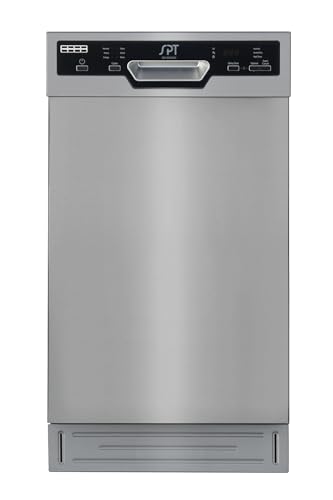
SPT SD-9254SSB 18 Inch Built-In Dishwasher — Best Heated-Drying Value
The SPT SD-9254SSB makes its case with a cluster of practical inclusions: heated drying, Energy Star standing, six wash programmes, 8 place settings and a stainless steel tub, all inside the standard 18-inch built-in format. SPT — Sunpentown — is another compact and small-appliance specialist, and the specification reads like a checklist assembled from owners’ most common regrets about basic machines: things not drying, programmes not suiting the load, interiors staining and holding smells.
Heated drying is the inclusion to underline. At 18 inches, many households run the machine daily and unload it straight into cupboards; a heated dry cycle that leaves plastics and tubs genuinely ready to put away changes the machine from a washer into a finisher. Combined with the stainless tub — which sheds water better than plastic and resists the odour cycle — the SPT’s specification is quietly aimed at daily-use satisfaction rather than showroom drama.
It concedes the innovations: no third rack, no published decibel headline, no adjustable rack in the listing. What it offers instead is the complete classic specification at the slim size, from a maker that specialises in exactly this class of appliance. For a buyer replacing an ageing slim machine and wanting the same idea executed properly, that is a compelling and honest proposition.
- Cabinet fit: slim built-in, stainless presentation
- Capacity: 8 place settings as listed
- Programmes: six wash programmes
- Drying: heated drying included
- Tub: stainless steel interior
- Energy: Energy Star per the listing
Strengths
- Heated drying tackles the plastics problem directly
- Complete classic specification at the slim size
- Specialist small-appliance maker behind it
Trade-offs
- No third rack or rack-adjustment headline
- Noise figure not published in the listing
- Design is conservative beside the Sharp
Best for: daily users who want the classic full specification, done properly, at 18 inches.
Not suited for: shoppers chasing the newest racking or the lowest published decibels.
How Do the Six Slim Machines Compare on the Published Facts?
| Pick | Badge | Capacity and cycles | Distinguishing evidence |
|---|---|---|---|
| Sharp SDW4523MS 18-Inch | Best Overall 18-Inch Pick | 8 settings, six cycles | Third rack; 47 dB published |
| COMFEE’ 18-Inch Built-In | Best for Small Apartments | 8 settings, six cycles | Adjustable top rack; heated dry; 52 dB |
| Midea 18-Inch Built-In | Best High-Temperature Wash | 8 settings, six cycles | High-temp wash plus heated dry |
| EdgeStar BIDW1802SS 18-Inch | Most Established Slim Name | 8 settings, built-in | Specialist maker’s long-running model |
| Honeywell 18-Inch, 8 Place Settings | Best Black Finish Option | 8 settings, six programmes | Stainless tub; black cabinet |
| SPT SD-9254SSB 18-Inch | Best Heated-Drying Value | 8 settings, six programmes | Heated drying; stainless tub |
Why Choose 18 Inches Instead of a Standard Dishwasher?
The honest answer is geometry. Kitchen cabinets come in standard widths, and a run that leaves an 18-inch gap cannot accept a 24-inch machine no matter how superior that machine might be. The choice facing the owner of such a kitchen is not slim versus standard; it is slim versus no dishwasher at all, and against that alternative an 8-place-setting built-in looks less like a compromise and more like a rescue.
Some kitchens choose the slim format deliberately. A small household in a well-designed flat may prefer to give eighteen inches to dishes and the saved six inches to a wider drawer stack, a wine fridge or a bin pull-out that gets used fifty times a day. Dishwasher capacity that exceeds a household’s daily production is wasted volume wearing a stainless door; the right size, run daily, beats the grand size run twice a week on freshness, smell and energy alike.
There are also buildings where the slim format is the only built-in that fits the plumbing reality: galley kitchens in period conversions, studio flats carved from larger houses, granny annexes and garden rooms with kitchenettes. In each case the 18-inch machine brings real automation — heated water, proper detergent chemistry, hygienic temperatures — to a space that would otherwise wash by hand indefinitely.
The final reason is rhythm. A slim machine fills fast and runs often, which suits households that cook daily in small quantities. Loads never sit long enough to bake on, the machine’s contents turn over like a laundry hamper rather than a warehouse, and the kitchen stays in a state of washed equilibrium that a half-empty standard machine, waiting days for a full load, never quite achieves.
How Should You Measure an 18-Inch Cutout Before Ordering?
Width first, and measure it in three places — top, middle and bottom of the opening — because cabinet runs are rarely perfectly parallel and the smallest measurement is the truth. An 18-inch machine is built to slide into a nominal 18-inch space with small clearances; a cutout that pinches to seventeen and three-quarter inches at the back will stop an installation cold. Write the three numbers down and compare them with the manufacturer’s stated requirements, not with the product’s marketing name.
Height is the measurement buyers forget. The opening under a worktop must clear the machine’s full height including its adjustment range, and flooring changes matter: if new tiles or boards have been laid since the kitchen was built, the effective height may have shrunk below the standard the original machine enjoyed. Measure from the finished floor to the underside of the worktop, and check the listing’s height specification against that figure, not against memory.
Depth decides whether the door closes flush and the machine connects. Measure from the front face of the cabinets to the back wall, then check for obstructions — pipes, sockets, skirting — that steal inches at exactly the height where the machine’s services run. A slim dishwasher that protrudes an inch because a pipe crosses its path is a daily annoyance manufactured by a skipped measurement.
Finally, audit the services themselves. A built-in needs a water supply with a shutoff, a drain route and an electrical supply that meet local code and the maker’s instructions. In older kitchens these may need a plumber’s hour before the machine arrives. Arranging that hour in advance is the difference between an installation and an installation-shaped delay.
What Fits in an 18-Inch Dishwasher — and What Does Not?
Set expectations by the place setting. The standard setting — dinner plate, side plate, bowl, glass, cup and cutlery — is the unit of the 8-place rating, and real households can indeed wash a day’s dishes for three or four people in one load when the load is mostly tableware. The slim machine’s talent is tableware; its examination subject is everything else.
Cookware is where rack design earns its keep. A stockpot consumes the lower rack’s heart; a roasting tray may fit only at an angle that shadows the spray; oven shelves and extractor filters are usually hand-wash items at this size. This is why the adjustable and third racks in this group matter so much: they convert the awkward mixed load from a jigsaw with no solution into a puzzle that merely requires thought. Households that cook with many large pans should plan a rota — tonight the machine takes the tableware, the big pan soaks — rather than expecting miracles.
Glassware height is the third frontier. Tall stems need the top rack’s clearance, which a third rack slightly reduces and an adjustable rack can restore by dropping. Measure your tallest everyday glass against the rack specifications if the listing gives them, and remember that the daily glass matters more than the ceremonial one used twice a year, which can be washed by hand on its birthdays without tragedy.
The freeing realisation is that an 18-inch machine does not need to fit everything. It needs to fit the daily eighty percent — plates, bowls, mugs, cutlery, the frying pan, the saucepan — and to do it every day without argument. Judged on that duty, every pick in this guide is a complete appliance, not a toy version of one.
How Much Does Noise Matter in a Small Kitchen?
Noise scales with proximity. A dishwasher in a large house runs behind a closed door at the end of a corridor; a slim dishwasher in a small flat runs within a few metres of the sofa, the desk and the pillow, sometimes all three at once. The published figures in this group — 47 dB for the Sharp, 52 dB for the COMFEE’ — describe a real, audible difference across that short distance, roughly the difference between a machine you converse over and one you raise your voice above on its loudest cycle.
Decibels are logarithmic, so five points is not five percent; it is a clearly perceptible step. But context disciplines the numbers. A household that runs the machine while out, or during dinner’s own clatter, will never hear the difference that a studio sleeper, running it overnight from three metres away, will hear every single night. Match the noise budget to the running pattern, not to an abstract preference for quiet.
Installation writes part of the noise story too. A machine levelled properly, seated fully into its cavity with insulation blankets correctly placed, behaves measurably better than the same machine rocking slightly and drumming against a cabinet side. Several decibels of real-world noise are not in the appliance at all — they are in the fitting, which is one more reason the measurement sections of this guide deserve their length.
Where a listing publishes no figure, treat the machine as an unknown and decide whether your home can afford an unknown. For a utility-room installation the answer is easily yes; for a bed-sit’s only appliance, the published 47 dB of the Sharp is worth money, and pretending otherwise would be a disservice dressed as neutrality.
Which Cycles and Drying Methods Actually Matter at This Size?
Of the six programmes most of these machines offer, three will do ninety percent of a household’s work: the auto or normal cycle for daily loads, an intensive or high-temp option for pans and hygiene loads, and a quick or eco cycle for lightly soiled tableware when time or conscience presses. The remaining programmes — glass care, soak, rinse-and-hold — are occasional instruments. Judge a machine by the quality of its main three rather than the poetry of its full list.
Drying divides into philosophies. Heated dry, offered by the COMFEE’, Midea and SPT here, spends electricity to leave plastics and tubs cupboard-ready — valuable in small kitchens with no draining space. Condensation drying on a stainless tub spends nothing and works beautifully on ceramics and glass while leaving plastic beaded. Neither is wrong; the question is whether your loads are plastic-heavy lunch-box loads or ceramic-heavy tableware loads, and the honest answer decides which philosophy to buy.
High-temperature washing, the Midea’s distinguishing feature, belongs to hygiene rather than drying. Bottles, boards and anything that met raw meat benefit from genuine heat that a standard cycle may not reach, and households with infants or immune concerns should weight it heavily. It is also the cycle that justifies a stainless tub’s premium, since steel tolerates a lifetime of thermal enthusiasm without absorbing odours between loads.
The meta-lesson is to shop for your worst regular load, not your average one. Average loads wash acceptably in anything here; the load that defines satisfaction is the Sunday roast aftermath, the baby-bottle batch or the dinner-party glassware. Buy the machine whose cycles were designed for your hardest ordinary week.
How Do You Install a Slim Built-In Without Regretting It?
Preparation is the installation. Before the machine arrives, confirm the cutout measurements one final time, clear the under-sink area, locate the water shutoff and make sure it actually turns, and photograph the existing connections. If a previous machine is being replaced, its removal teaches you where every service runs — information worth having before the new machine is halfway into the cavity and a hose turns out to be two inches short.
Levelling is the step amateurs rush and professionals linger on. A dishwasher out of level pools water, racks roll when they should rest, doors seal imperfectly and noise multiplies through the cabinet. Adjust the feet until the machine sits true in both planes, then slide it home and check again, because cabinets are not always as square as the level assumes. Ten patient minutes here repay themselves at every wash for a decade.
Connections deserve the same deliberation: water in, drain out with the correct high loop or air gap your local code requires, and electrical supply as the manufacturer instructs. Run the machine empty on a rinse cycle before pushing it fully home and fitting the door panel, watching every joint with a dry hand and a torch. A leak discovered at this stage is a fitting to tighten; discovered in November, it is a floor to replace.
If any part of the job exceeds your competence — particularly electrical work — a professional installer’s fee is the cheapest component in the entire project. The slim format attracts DIY enthusiasm because the machine is light and the space is small, but water under pressure respects neither. Know which steps are yours and which are a tradesperson’s, and the installation becomes the satisfying half-day it should be.
What Does Living With an 18-Inch Machine Change Day to Day?
The first change is cadence. A slim machine fills by the end of most days, so it runs daily rather than in twice-weekly campaigns. Dishes stop accumulating in the sink because the machine is always nearly ready; the kitchen’s resting state becomes clear counters rather than a pending wash. Households moving from hand-washing describe this rhythm change, not any single feature, as the transformation.
The second change is loading discipline. With no spare inches, the machine rewards a household system: cutlery sorted as it lands, plates scraped and racked in size order, the awkward item placed first while space remains. This sounds like regimentation and feels, after a fortnight, like a well-run drawer — everything has a home and the home is obvious. The third-rack and adjustable-rack picks widen the system’s tolerance considerably.
Running costs settle into a pleasant pattern. A slim machine heats less water per cycle than a standard one, and daily full loads are more efficient per item than the half-loads a big machine tempts owners into. Against that, more cycles per week narrows the gap; the honest summary is that a right-sized machine run full is the cheapest configuration a household can own, and 18 inches is the right size for more households than the market assumes.
Finally, there is the social change: the small kitchen stops apologising. Guests in a galley flat watch a real dishwasher open in the cabinet run and recalibrate what a compact kitchen can do. The slim machine is not the consolation prize of kitchen design — fitted well and chosen honestly, it is the correct appliance, and correctness is a satisfaction that outlasts novelty.
When Should You Choose a Countertop or Portable Instead?
The built-in slim machine assumes a cutout and services. Where neither exists — a rented flat with a continuous run of landlord cabinets, a historic kitchen that cannot be altered, a temporary home — the countertop machine answers instead, sitting by the sink and draining into it. It holds fewer settings and surrenders counter space, but it asks nothing of the building, which in some homes is the entire question.
Portable full-height machines on casters occupy the middle ground: real capacity, no installation, but a footprint that must live somewhere and a hose ritual at every wash. In a spacious rental kitchen they can out-serve an 18-inch built-in; in the small kitchens this guide addresses, the floor space they consume is usually the scarcest resource in the room.
The deciding audit is honest measurement of three things: the cabinet run’s spare width, the counter’s spare depth and the floor’s spare square metres. Most small kitchens can spare exactly one of the three. An 18-inch gap in the run points to the built-ins here; a deep counter corner points to a countertop model; a utility alcove points to a portable. Let the room, not the catalogue, choose the format.
Households expecting to move soon should also weigh departure. A built-in is a fixture that stays with the kitchen and may add rental or resale appeal; a countertop or portable leaves with you. Neither answer is wrong, but the buyer who has considered the exit owns the machine more completely than the one who discovers the question at moving time.
How Does an 18-Inch Machine Handle a Dinner Party?
The dinner party is the slim machine’s public examination, and the strategy is sequencing rather than capacity. Run the machine once before guests arrive so every serving piece starts clean, then treat the evening as two loads: the cooking load, washed during the meal while the kitchen is already warm and occupied, and the table load afterwards. A machine that turns over mid-evening never faces the mountain that defeats it on paper.
Loading order matters more than loading volume. The roasting pan and the largest saucepan claim their territory first, while the rack is empty and every position is available; tableware fills around them with the flexibility that remains. Hosts who load in arrival order — glasses first because they came to hand — end up holding a greasy pan over a full machine at midnight, conducting the exact negotiation the machine was bought to abolish.
The third-rack Sharp and the adjustable-rack COMFEE’ show their worth on these nights, absorbing the carving knife, the serving spoons and the tall gravy-streaked glasses that break lesser loading plans. But even the classic-specification picks manage a party for six with the two-load rhythm, which suggests the honest conclusion: the slim machine’s party limit is set less by its cavity than by its owner’s willingness to run it twice.
And there is a social dividend to the quick turnover. A host who can promise guests a kitchen reset by dessert is a host who cooks more ambitiously, because the washing-up no longer scales with the menu. The slim machine, properly rhythm’d, does not restrict the household’s hospitality; it underwrites it.
What Should You Budget Beyond the Purchase of a Slim Dishwasher?
The machine’s ticket is the beginning of an honest budget, not its total. Installation may require a plumber’s or electrician’s visit if services need creating or moving; a door panel or handle to match the kitchen’s cabinetry can add a further sum for integrated presentations; and the removal of an old machine occasionally carries a disposal fee. None of these is large, but together they can add a meaningful percentage to a slim appliance’s modest price, and the buyer who has listed them in advance is never ambushed.
Running costs at this size are gentle. A slim machine heats less water per load than a standard one, and modern Energy Star models — several picks here carry the credential — sip electricity by the standards of even a decade ago. Detergent is the recurring consumable, and slim machines reward correct dosing: an over-dosed small tub rinses poorly and wastes money twice, once in powder and once in the extra rinse the load demands.
Maintenance is mostly time rather than money. Filters need regular rinsing, spray arms benefit from an occasional check for blocked jets, and the door seal appreciates a wipe before grit turns it into a leak path. Budget ten minutes a month and the machine’s repair horizon recedes; neglect them and the first engineer’s visit will cost more than every filter rinse of the machine’s life combined would have taken.
Finally, keep the paperwork. Warranty documents, the installer’s invoice and a note of the exact model designation live best in one envelope in the kitchen drawer. Small appliances in small kitchens serve for a long time, and the household that can produce its machine’s biography on demand gets faster help, fairer warranty treatment and an easier sale of the property when the day eventually comes.
How Long Should a Slim Dishwasher Last, and What Decides It?
A well-kept built-in at this size should serve a small household for the better part of a decade, and the variables that decide whether it does are mostly in the owner’s hands rather than the factory’s. Water hardness heads the list: hard water scales heating elements, clouds glassware and stiffens seals, and a household in a hard-water area that uses the machine’s salt system properly — where one is fitted — or an appropriate detergent regime will measurably extend the appliance’s comfortable life.
Loading habits come next. A machine habitually forced shut on an overfilled rack strains its door, its racks and its spray arms in small increments that accumulate into failures. The slim format tempts overloading precisely because its cavity is precious, which is why the loading discipline described earlier in this guide is a longevity practice as much as a cleaning one. A load washed twice costs less than a rack replaced once.
Cleaning the machine itself is the third variable, and the most neglected. Filters rinsed monthly, spray-arm jets checked for the occasional seed or shard, door seals wiped before grit abrades them — these are the whole liturgy, and they take less time across a year than a single repair visit takes in an afternoon. Machines that die young in small kitchens usually die dirty, in the specific sense that a blocked filter made a pump work against resistance for a thousand cycles.
Finally, there is the installation’s long shadow. A machine levelled at fitting, with sound hoses and a drain routed correctly, avoids the vibration and backflow stresses that shorten lives invisibly. Longevity, in other words, is largely purchased on installation day and maintained in five-minute instalments — which is good news, because it means the decade of service is a decision the owner gets to make.
What Mistakes Ruin an 18-Inch Dishwasher Purchase?
Ordering by the marketing name instead of the cutout. ’18-inch’ is a class, not a measurement; the manufacturer’s stated dimensions and your three width readings decide the fit, and they must be compared before money moves.
Assuming slim means half capacity. These are 8-place-setting machines that handle a small household’s full day; buyers who treat them as toys under-load them, run them half-empty and conclude wrongly that the format is inefficient.
Forgetting the door swing and the walkway. A slim machine in a galley kitchen opens into the only passage; check that the open door and a person can coexist, ideally before the machine is plumbed in.
Ignoring the drying question until the first plastic load. If your household runs on lunch boxes and tubs, buy heated dry now. Condensation systems are excellent — for the loads they suit — and no technique fully converts one philosophy into the other.
Skipping the levelling to save ten minutes. Noise, pooling, rolling racks and poor sealing all trace back to a machine that was never set true. It is the cheapest performance upgrade in the entire purchase and it costs only patience.
Letting a missing noise figure slide in a studio flat. Where the machine sleeps in the same room as its owner, a published decibel rating is a necessity, not a luxury — choose from the picks that publish one.
Final Recommendation
For most small kitchens the Sharp SDW4523MS is the complete answer: a third rack, the group’s lowest published noise figure and six cycles inside the slim format make it the machine that asks the fewest compromises. The COMFEE’ runs it closest for apartment life, with its adjustable rack and heated dry, while the Midea serves hygiene-led households with its high-temperature wash and the Honeywell covers black suites with a full programme list. The EdgeStar and the SPT remain the specialist, classic-specification choices — the former for a proven like-for-like replacement, the latter for heated drying done properly.
The shortlist in one breath: the Sharp SDW4523MS 18 Inch Built-In Dishwasher for the complete slim specification, the COMFEE’ 18-Inch Built-In for apartment flexibility, and the SPT SD-9254SSB 18-Inch for heated drying in the classic mould.
Whichever of the six earns your cutout, measure the space three ways, level the machine like the result depends on it, and buy for your hardest ordinary load rather than your easiest. An 18-inch dishwasher chosen that way stops being the small option and becomes, quite simply, the right one — the compact kitchen’s quiet proof that capacity was never the same thing as width.
Frequently Asked Questions
How much does an 18-inch dishwasher actually hold?
All six machines here are rated at 8 place settings, which in practice covers a full day’s tableware for a household of three or four, plus serving pieces, when loaded with reasonable care. Cookware competes for the same space, so a pan-heavy day may need the largest pot washed by hand or held for the next load. Rack design — a third rack or an adjustable upper rack — makes the rated capacity easier to reach with real mixed loads.
Will an 18-inch dishwasher fit my existing cutout?
Only measurement can say, and it is worth taking those measurements twice, on different days if the kitchen is old enough for its cabinets to have settled unevenly, because the cost of the second reading is a minute and the cost of trusting the first one blindly can be a machine that almost fits. Measure the opening’s width at the top, middle and bottom, its height from the finished floor to the worktop’s underside, and its depth to any obstruction, then compare all three with the manufacturer’s stated dimensions for the model — not with the ’18-inch’ class name. Also confirm the water supply, drain route and electrical provision behind the opening before ordering.
Are slim dishwashers much louder than standard ones?
Not inherently. The published figures in this group run from 47 dB for the Sharp to 52 dB for the COMFEE’, which overlaps the range of full-size machines. What differs is proximity: slim machines live in small homes where the listener is always nearby. Levelling the machine carefully and seating it fully into the cavity removes much of the installation noise that owners mistakenly blame on the appliance.
Is a stainless steel tub worth it at this size?
Yes, for most households. Stainless tubs resist odours and staining over years of use, shed water in a way that helps condensation drying, and tolerate high-temperature cycles without complaint. Every pick in this guide offers a stainless interior, which reflects the material’s standing in this class; at 18 inches, where the machine may serve for a decade in a small kitchen, the tub is no place to economise.
Can an 18-inch dishwasher handle baby bottles and hygiene loads?
Yes, with the right cycle. Look for a high-temperature wash — the Midea in this group specifies one alongside heated dry — or an intensive programme, and load bottles so spray reaches inside them. The stainless tubs fitted across this group tolerate the heat involved. Always follow both the machine’s guidance and the bottle manufacturer’s own washing instructions.
Do I need a professional to install a slim built-in?
The mechanical fitting is within a confident DIYer’s reach, but the services decide. If water, drainage and electrical provisions already exist in the correct positions, installation is mostly levelling and connection; if any service must be created or moved — especially electrical work — use a qualified tradesperson and follow local code. Run an empty test cycle and check every joint for leaks before the machine is pushed fully home.
Related Guides
Slim-format thinking continues across our kitchen coverage, from drawer dishwashers to finish-matched built-ins and the sealing machines that keep a small kitchen’s stores in order — explore Best 2-Drawer Dishwashers, Best Black Stainless Steel Dishwashers, Best Industrial Vacuum Sealers.