What's inside
- Key Takeaways
- Quick Picks
- How Did We Divide Builders From Rescuers?
- What Does a Costume Ask That a Dress Never Does?
- The Honest Limits of Handheld Machines, Stated Once and Clearly
- A Field Guide to Cosplay Fabrics and What Each One Demands
- Planning a Build Backwards From the Convention Date
- The Build Anchor and Its Travel Companions, Compared
- How Do You Pack a Repair Kit That Actually Saves a Costume?
- Where Do Cosplay Sewers Most Often Go Wrong?
- Moving and Storing the Costume Between Events
- Final Recommendation
- Frequently Asked Questions
- Related Guides
As an Amazon Associate I earn from qualifying purchases. This post may contain affiliate links at no extra cost to you.
cottageverdict.com is reader-supported. When you buy through links on our site, we may earn an affiliate commission.
Where to buy: each machine below is sold through its own Amazon listing, linked at its name in the quick-picks table and again above its review, so you can check price on Amazon and compare the kit contents — several picks here are valued as much for what is in the box as for the machine itself. The best sewing machines for cosplay are really two different purchases wearing one title, and this guide refuses to pretend otherwise. Building a costume — the months of patterning, fitting and fabric-wrangling at home — wants a real, full-size machine. Wearing a costume — the convention weekend, the photoshoot, the seam that lets go in a hotel corridor at nine in the morning — wants a repair kit that travels. One pick below is the anchor: a full-size computerized machine for the build. The other five are the away team: portable and handheld machines sized for a suitcase, a tote bag or a hotel drawer, reviewed honestly for the light work they can do and clearly fenced off from the heavy work they cannot.
That fence matters more in cosplay than in any other sewing category, because cosplay fabrics are theatrical liars. A costume may stack craft foam against faux leather over a lining, glue gems beside seams, and ask to be repaired in a corridor with an audience forming. Handheld machines — the little battery stitchers that close this list — are genuinely useful citizens of that world: they tack, they rescue, they close a hem for one more photograph. They are not construction equipment, and on a heavy, multi-layered costume they will stall, skip and finally refuse, usually at the moment of maximum embarrassment. This guide states each tool’s territory plainly, because a cosplayer who knows exactly what their repair kit cannot do packs the needle and thread that covers the gap.
One more framing note before the picks. Cosplay sewing is garment sewing with the difficulty turned sideways — unusual fabrics, armour-adjacent structures, deadline pressure measured in convention dates — and many of its skills transfer directly from classic dressmaking. Readers building their first full costume may also find the family-machine perspective in Best Beginning Sewing Machines for Kids surprisingly relevant, since the mini machines in that guide share DNA with several portables here, and its safety-first framing suits any household where young fans sew alongside adults.
Key Takeaways
- This category splits in two: one full-size anchor machine for building costumes, and portable or handheld machines for travel repair — buy for the role, not the fantasy.
- The Brother CP100X is the build machine; its listing title is unusually terse, so this guide credits it with its class and role, not invented specifications.
- Handheld stitchers are single-purpose rescue tools for light fabrics and temporary fixes; heavy, layered costume work will defeat them, and this guide says where that line sits.
- Kit contents are a real feature in this category: the handheld picks carry 42-piece, 112-piece and 153-piece kits that function as a whole convention repair station.
- Dual power — battery or plug — recurs across the portable picks, and it is the feature that decides whether a repair happens in a green room, a car park or a hotel bathroom.
- The costume you can repair in ten minutes is the costume that survives the weekend; plan the kit when you plan the build.
Quick Picks
| Machine | Badge | What each brings |
|---|---|---|
| Brother CP100X Computerized Sewing and Quilting Machine | The build anchor | The full-size computerized machine in this guide — the one the costume is actually constructed on, at home, before the event. |
| Rxmeili Portable 12-Stitch Sewing Machine | The travel tabletop | A twelve-stitch portable with a 42-piece kit, two speeds and battery-or-plug power for a hotel-room sewing station. |
| Gobreezy Portable Mini Sewing Machine with Extension Board | The extended mini | Twelve stitches, dual speeds and an extension board that gives small costume pieces a fighting chance to feed straight. |
| Handheld Sewing Machine (Mini Electric) | The pocket rescuer | A handheld quick-stitching machine for mending on the body, in the corridor, in the taxi — light fabrics, fast fixes. |
| Hand Held Sewing Machine with Leather Storage Case and 112-Piece Kit | The kitted traveller | A handheld machine travelling inside a full repair wardrobe: 112 pieces including needles, threads and heavy-duty scissors. |
| Hand Held Sewing Machine with Wooden Sewing Box and 153-Piece Kit | The full station | The largest kit here — 153 pieces in a wooden box, with a power adapter — a dressing-room repair station in one carry. |
How Did We Divide Builders From Rescuers?
The screening began with a refusal: no handheld machine would be described, even by implication, as a costume-construction machine. That single rule organised everything else. Picks were sorted by role first — build, travel-tabletop, pocket rescue — and judged within their role. A handheld is not a failed sewing machine any more than a multitool is a failed workshop; it is a tool whose value is measured in the repairs it makes possible in places no full-size machine will ever be. Judged that way, kit contents, power flexibility and size become first-order features, and stitch counts become what they honestly are at this scale: a short menu for light work.
For the anchor role, the requirement was equally plain: a full-size computerized sewing and quilting machine from a major maker, the class of machine on which garments — including fantastical ones — are genuinely built. The CP100X’s title is the briefest in this guide, stating its name and class and nothing else, and this review follows the site’s standing discipline: what the title does not state, the review does not invent. Its specification box therefore points to the manufacturer documentation for the numbers, while the surrounding text explains, from the craft side, why a machine of its class is the anchor and what work belongs on it.
Budget honesty ran through the sorting as well. Cosplay spending competes with fabric, wigs, props and the event tickets themselves, and a guide that pretended the machine budget were unlimited would mislead its readers in the direction of their other crafts. The structure recommended here — one anchor, one travel layer matched to how you attend — is deliberately the minimum complete system, and every pick above it in elaborateness is presented as an upgrade to a working system, never as the entry fee. A cosplayer with the anchor and a hand-sewing wallet is fully equipped; everything else in this guide is convenience, speed and insurance, valuable exactly in proportion to how much of each your event calendar consumes.
The final screen was event realism. Cosplay repairs happen under fluorescent lights, on carpet, in costume, with an audience, against a schedule. Machines were credited for the features that serve that reality — battery operation when sockets are occupied by phone chargers, kits that include the scissors and needles a repair actually consumes, storage that keeps the whole station in one grab — and not credited for virtues that only exist at a home desk. A cosplay guide that ignores the corridor is a dressmaking guide in a costume, and this site already publishes an honest dressmaking guide.
What Does a Costume Ask That a Dress Never Does?
Begin with the materials list, which reads like a dare: stretch fabrics beside rigid ones, faux fur with a pile that swallows seam lines, vinyl and faux leather that show every needle hole, organza that is mostly air, craft foam that must be attached to cloth, and trims — braid, gems, LED strips — that arrive after the sewing is supposedly finished. A costume machine spends its life changing character: delicate on the cape’s lining at noon, structural on the bodice by two, and sewing through a sandwich of fabric, interfacing and foam offcuts by evening. That is the argument for the full-size anchor having a computerized bench with range, and for the home build being planned in fabric order — lightest assemblies first, while patience and needles are fresh.
Structure is the second difference. Costumes hold shapes that bodies do not: tails, ears, sculpted shoulders, skirts engineered to defy gravity for photographs. Boning channels, wired hems and foam understructures all pass under the needle, and each punishes a machine that cannot sew slowly and exactly. Fitting, too, runs on a different clock — a costume is fitted for movement, posing and a full day of wear, often on a body that will be dancing, queueing and sweating in it, which argues for seams sewn with more generosity and reinforcement than a dress that lives for an evening.
Comfort engineering is the quiet third difference, and veterans plan for it as seriously as for accuracy to the reference art. A costume worn for ten hours is a garment under occupational conditions: seams at the inner arm and seat take thousands of flex cycles, waistbands share their load with belts and props, and anything that chafes at minute ten is a wound by hour six. Flat, well-finished seams, linings where the reference allows them, and closures placed where the body does not bend are the difference between a costume that is worn and a costume that is endured. Sew the inside for the wearer, not the camera, and the camera will reward you anyway — a comfortable cosplayer photographs better than a suffering one at every hour of the day.
Then there is the deadline physics. A dress can be finished next week; a costume is finished by the convention or it is a story about failure. That pressure is why this guide treats the repair kit as part of the build rather than an afterthought: the costume’s second machine — the portable in the hotel room, the handheld in the tote — is what converts deadline panic into a ten-minute fix. Professional cosplayers plan for failure with the serenity of stage managers. This list is built to let a beginner do the same.
The Honest Limits of Handheld Machines, Stated Once and Clearly
Handheld stitchers work by a simple mechanism: you guide the little machine along the edge by hand, and it lays a single-thread chain stitch as it travels. Understand that stitch and you understand both the magic and the fence. The magic: a fallen hem, a gaping side seam on light fabric, a detached trim, a torn cape — each can be closed in minutes, on the body or off it, without threading a machine or finding a table. The fence: a chain stitch can unravel if the end is not secured, the machine has no feed dogs to move fabric evenly, thick stacks resist its small motor and short needle stroke, and anything structural — a strap, a bodice seam under tension, layered foam-and-fabric assemblies — is beyond its honest capacity.
So the rule for the corridor is triage. Handheld for the cosmetic and the temporary: hems, trims, light seams, a patch over a tear, the fix that needs to survive photographs and the journey home. Hand-and-needle for the structural: a strap re-anchored with proper stitches, a zipper coaxed and pinned, a foam piece re-glued and tacked. Full machine for everything else, back at base. Cosplayers who internalise that triage stop having costume emergencies; they have costume maintenance, which is a calmer and more photogenic condition. The three handheld picks below differ mainly in what travels with them — and in this category, the entourage is half the tool.

Brother CP100X Computerized Sewing and Quilting Machine — The build anchor
Every other pick in this guide exists to serve the work this one does. The CP100X is a full-size computerized sewing and quilting machine from Brother — and that, in its entirety, is what its listing title states. No stitch count, no speed figure, no foot inventory appears in the title, and this guide’s rule is absolute: those numbers live in the manufacturer documentation, and a reader comparing benches should pull them from there rather than from any review’s imagination, including this one. What can be said on the evidence is the class itself, and the class is the point. A full-size computerized machine is the tool on which a costume is patterned, fitted and finished: the bodice seams, the cape’s long runs, the appliqué, the buttonholes and closures, the topstitching that sells the character at photograph distance.
Why does the anchor matter so much in cosplay specifically? Because costume builds are long. A serious costume is twenty to sixty hours of sewing across weeks, on fabrics that change character daily, and the machine at the centre of that marathon must be the one whose feeding, stitch formation and temperament never become the story. Computerized control earns its keep in the repetitive precision work costumes are full of — identical decorative rows, duplicated panels for symmetric armour trim, closures that must match on both sides of a front. The quilting half of its designation matters too: quilted doublets, padded armour and channelled fabrics are costume staples, and a machine at home with layered, padded assemblies is a machine at home in a cosplay workroom. Buy the anchor first, learn it deeply, and let the travellers below be its supporting cast.
- Machine class: full-size computerized sewing and quilting machine, as stated in the listing title
- Stitch count, speed and foot inventory: not stated in the listing title — consult the manufacturer documentation for the full specification
- Role in this guide: the home construction machine for complete costume builds
- Where to buy: the Brother CP100X Computerized Sewing and Quilting Machine listing on Amazon — check price on Amazon
Strengths
- A genuine full-size build machine — the only pick here that constructs whole costumes.
- Computerized class suits the repetitive precision of panels, trims and matched closures.
- Quilting capability covers padded and layered costume structures.
Trade-offs
- The title’s terseness means specification homework is part of the purchase.
- It stays home: the convention itself still needs the travellers below.
- Full-size commitment is wasted on cosplayers who only ever repair bought costumes.
Best for: makers building costumes from pattern to photoshoot, season after season. Not suited for: repair-only cosplayers, whose money belongs in the kits below instead.
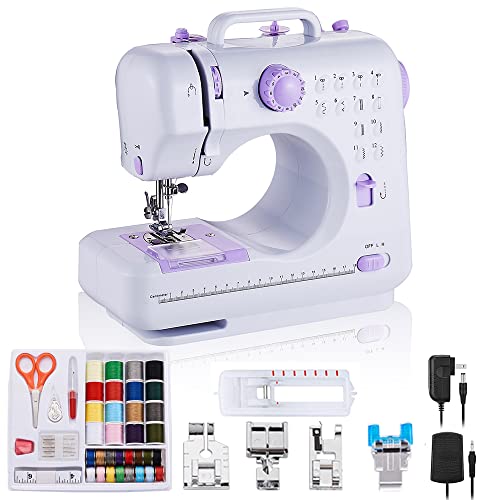
Rxmeili Portable 12-Stitch Sewing Machine — The travel tabletop
The Rxmeili occupies the guide’s middle territory: a real, if miniaturised, sewing machine — twelve stitches, two speeds, a foot pedal, a sewing light and a storage drawer — powered by battery or plug-in, and travelling with a forty-two-piece sewing kit. That combination sketches its station precisely: the hotel-room table, the night before the event, where a costume gets its final fitting adjustments and its medium repairs. Twelve stitches on a mini is a working wardrobe — straight stitch for seams, zigzag for edges and stretch, the basics of construction — and the foot pedal matters more than it sounds, because it leaves both hands for the fabric, which is how real sewing happens even at miniature scale.
Battery-or-plug power is the feature that decides this machine’s usefulness at an event. Hotel rooms ration sockets; green rooms share them; a machine that can run on batteries for the twenty minutes a repair takes is a machine that gets used. The storage drawer and kit keep the entourage together — needles, thread, the small consumables — and the pink finish will either charm its owner or be forgiven for the machine’s manners. Its limits are the mini class’s limits: costume pieces must be fed in sections, heavy stacks are beyond it, and a full build belongs on the anchor. As the second machine in a cosplayer’s life — the one that travels so the costume can too — it is the most complete proposition here.
- Stitch count: 12 stitches, as the title states it
- Speeds: 2 speeds, per the listing title
- Power: battery or plug-in, listed in the title
- Operation: a foot pedal comes with it, the title confirms
- Kit: 42-piece sewing kit included, in the seller’s title; sewing light and storage drawer also stated
- Fabric ceiling: the listing title sets no layer figure — treat as light-to-medium costume fabrics and verify heavier work against the manufacturer documentation
- Where to buy: the Rxmeili Portable 12-Stitch Sewing Machine listing on Amazon — check price on Amazon
Strengths
- A genuine two-handed sewing experience — pedal, light, drawer — in travel size.
- Dual power makes it independent of the hotel socket lottery.
- The 42-piece kit covers the consumables a repair weekend actually consumes.
Trade-offs
- Mini scale means large costume pieces are fed in patient sections.
- Heavy layered assemblies remain the anchor machine’s work.
- Twelve stitches serve construction basics, not decorative range.
Choose it for: the travelling build-and-repair station — final fittings and medium fixes on site. Pass if: your events are day trips where a handheld kit covers the realistic failures.

Gobreezy Portable Mini Sewing Machine with Extension Board — The extended mini
The Gobreezy’s title leads with its distinguishing furniture: an extension board, wrapped around a portable mini with twelve built-in stitches, dual speeds with a foot pedal, a “heavy duty” self-description, hand-held capability and a complete sewing kit for adults and kids. The extension board is the detail a cosplayer should notice. Mini machines fail at feeding because the workpiece has nowhere to rest; a board that extends the bed gives a cape panel or a sleeve a surface to lie on, and feeding straightens accordingly. For the small-to-medium pieces that dominate travel repairs — and for the accessory-scale sewing, pouches, hats and gloves, that fills a cosplayer’s between-events life — that surface is a genuine capability, not a garnish.
The title’s “heavy duty” phrase deserves the guide’s customary caution: in the mini class, such words describe intention rather than a rated capacity, and no layer or weight figure accompanies the claim, so this review credits the Gobreezy with its stated features — stitches, speeds, board, kit — and assigns it the mini class’s honest territory of light and medium work. Within that territory it is well found: dual speeds for control, a pedal for two-handed sewing, hand-held flexibility for the odd spot fix, and a complete kit so the station arrives whole. Families where a young cosplayer shares the machine will appreciate the adults-and-kids framing; everyone will appreciate that the board makes it sew like a bigger machine than the suitcase believes.
- Stitch count: 12 built-in stitches, in the listing’s own wording
- Speeds: dual speeds with foot pedal, per the listing
- Work surface: extension board included, per the title
- Kit: complete sewing kit included, listed in the title
- Capacity: the listing title’s “heavy duty” wording carries no rated figure — the manufacturer documentation is the authority for layer limits
- Where to buy: the Gobreezy Portable Mini Sewing Machine with Extension Board listing on Amazon — check price on Amazon
Strengths
- The extension board fixes the mini class’s feeding weakness at its root.
- Pedal, dual speeds and hand-held mode give it three working postures.
- A complete kit makes it a self-contained small-projects station.
Trade-offs
- Capacity claims in the title are unquantified; heavy costume stacks stay at home on the anchor.
- The board adds a flat item to pack, however slim.
- Its talents top out at accessory scale and travel repair, by design.
Suits: cosplayers whose travel repairs involve real pieces, not just hems — and home accessory sewing between events. Skip it if: a pocket-sized handheld covers your realistic repair list and luggage space is absolute.

Handheld Sewing Machine (Mini Electric) — The pocket rescuer
Here the guide crosses into handheld territory, and the framing from the limits section applies in full. This mini electric handheld — presented for beginners and adults, for quick stitching on clothes mending, DIY crafts, home and travel — is a single-thread chain-stitch rescuer. Its stage is the moment a costume fails in public: the hem that drops as you cross the lobby, the trim that surrenders during photographs, the lightweight seam that pops when a pose gets ambitious. In those moments its virtues are the only ones that matter — it is there, in the tote; it starts in seconds; it closes the failure well enough for the costume to finish its day with dignity.
Its debits are the class’s debits, stated without varnish. It will not sew a bodice. It will not pierce a foam-and-fabric sandwich or anchor a strap that bears weight. Its stitch, unsecured, can walk backward out of the fabric if the end is pulled — finish every rescue with a knot or a few hand stitches, and treat the fix as a ticket home, not a repair for the archive. The title promises quick stitching for mending and crafts, and judged exactly on that promise, the little machine delivers. Cosplayers who buy it as a rescuer will love it; cosplayers who buy it as a builder will learn the difference in public, which is the expensive classroom this guide exists to close.
- Type: handheld mini electric sewing machine, the title confirms
- Stated uses: clothes mending, DIY crafts, home and travel quick stitching, from the listing title
- Stitch system and power source: not detailed in the listing title — check the manufacturer documentation for battery and stitch specifics
- Structural work: outside this class’s honest capacity — straps and load-bearing seams belong to hand-sewing or the anchor machine
- Where to buy: the Handheld Sewing Machine (Mini Electric) listing on Amazon — check price on Amazon
Strengths
- Instant, anywhere rescue for hems, trims and light seams.
- Small enough to live permanently in the costume’s travel tote.
- Beginner-simple: the learning curve is measured in minutes.
Trade-offs
- Chain-stitch fixes are temporary unless the ends are secured by hand.
- Thick, layered or structural costume work defeats it completely.
- No feed system means seam quality depends entirely on the guiding hand.
Best for: the emergency layer of a cosplay kit — light, fast, forgiving fixes. Not suited for: any part of building the costume it rescues.

Hand Held Sewing Machine with Leather Storage Case and 112-Piece Kit — The kitted traveller
This handheld’s argument is its entourage: the machine travels in an orange leather storage case with a 112-piece sewing kit — assorted needles, threads and heavy-duty scissors named in the title. Read that as a repair philosophy. The experienced cosplayer knows the machine is rarely the whole fix: the fix is the machine plus the right thread colour, plus needles for the hand-sewn anchor stitches, plus scissors that can actually cut a frayed strap end cleanly. A kit that assembles all of that in one case, grabbable on the way out of the door, removes the most common failure of travel repair, which is not mechanical at all — it is the missing consumable, discovered in the corridor.
The machine itself shares the handheld class’s mechanism and limits, and this review applies the same fence: light fabrics, temporary-to-good fixes, ends secured by hand, structural work referred to needle-and-thread or the anchor. The case earns a sentence of its own — a leather storage case is a durable, findable, throw-it-in-the-car object in a way a cardboard box never is, and repair kits survive on being findable. For the cosplayer whose events involve a car boot and a changing room rather than a flight and a hotel, this kitted traveller is the most practical form the handheld idea takes: not the smallest, but the most complete at the moment of need.
- Type: hand held sewing machine for adults and beginners, per the seller’s title
- Case: orange leather storage case included, in the seller’s title
- Kit: 112-piece sewing kit with assorted needles, threads and heavy-duty scissors, per the listing
- Power and stitch details: not specified in the listing title — the manufacturer documentation carries them
- Where to buy: the Hand Held Sewing Machine with Leather Storage Case and 112-Piece Kit listing on Amazon — check price on Amazon
Strengths
- The 112-piece kit makes the fix complete: machine, threads, needles and real scissors in one case.
- A leather case survives travel in a way packaging never does.
- Covers the hand-sewing half of corridor triage with its needle assortment.
Trade-offs
- Handheld limits apply in full — light work, secured ends, no structure.
- The kitted case is bulkier than a bare handheld in a tote.
- Thread colours in any kit are a starting set; signature colours still travel separately.
Choose it for: car-based event travel and dressing-room repair stations. Pass if: your kit must fit a handbag, where the bare handheld above is the honest size.

Hand Held Sewing Machine with Wooden Sewing Box and 153-Piece Kit — The full station
The largest entourage in the guide closes the list: a handheld machine with a wooden sewing box and a 153-piece kit, a power adapter included, and heavy-duty scissors named among the contents. One hundred and fifty-three pieces is not a repair kit so much as a sewing station that happens to travel — the full consumable wardrobe of needles, threads, fasteners and tools that a costume weekend can draw on, organised in a wooden box that will look at home on a dressing table and survive being the group’s shared resource. The power adapter deserves its line: it frees the handheld from battery anxiety during a long repair session at a base table, which is where this station will mostly live — the hotel room or dressing room hub, rather than the tote.
Its role, then, is the base-camp version of the handheld idea: the kit a cosplay group shares, the station a parent sets up for a household of young fans, the box that makes a weekend’s worth of costumes maintainable. The machine inside obeys the same physics as its smaller siblings — light fabrics, temporary fixes, secured ends — and this guide will not inflate it for travelling in grander company. What the box changes is everything around the machine: no repair fails for want of a needle, a matching thread, a pin, a spare anything. For group cosplay, where five costumes share one corridor and one schedule, that completeness is the difference between a maintenance station and a lucky dip.
- Type: mini portable handheld sewing machine for adults and beginners, as printed in the title
- Storage: wooden sewing box included, per the title
- Kit: 153-piece sewing kit, listed in the title
- Power: power adapter included, from the listing title
- Scissors: heavy-duty scissors included, in the seller’s title
- Where to buy: the Hand Held Sewing Machine with Wooden Sewing Box and 153-Piece Kit listing on Amazon — check price on Amazon
Strengths
- The most complete repair station here — 153 pieces organised in a wooden box.
- The adapter suits long base-camp repair sessions without battery rationing.
- Built for sharing: a group’s or a family’s whole weekend in one box.
Trade-offs
- A station, not a pocket tool — it travels by car and lives on a table.
- The handheld machine inside keeps the class’s light-work limits.
- Groups must still agree whose costume gets the corridor triage first.
Suits: cosplay groups, families and dressing-room base camps. Skip it if: you travel light and solo, where the smaller kits match the mission.
A Field Guide to Cosplay Fabrics and What Each One Demands
Faux fur arrives first in many builds and teaches the first lesson: cut it from the back, through the backing only, so the pile survives at full length, and expect every seam to shed a blizzard that the machine’s bobbin area will collect — brush the machine out after fur sessions as a religious observance. Sew pile-to-pile with the fur combed away from the seam line, and accept that the mini and handheld machines in this guide meet only the thinnest furs socially; a full fursuit body is anchor-machine work with long stitches and patience, or it is not machine work at all.
Vinyl and faux leather teach the second lesson: holes are forever, a fact this site’s leather guide explores in depth, so seams are clipped rather than pinned, stitch lengths run long to avoid perforating a tear line, and a foot that glides — or a layer of tissue that tears away afterward — replaces the standard foot that grips and drags. Stretch fabrics teach the third: the seam must be able to move as the body does, which means stretch stitches, ballpoint needles and an unforced hand, and it means the little portables, whose stitch menus include the basics, can genuinely contribute to simple stretch pieces at home. Foam, the fourth teacher, is rarely sewn through at all in serious builds — it is glued, or sandwiched and caught at edges — and any machine asked to pierce a thick foam stack is being asked outside its design; the anchor handles thin foam-fabric sandwiches at slow speed, and everything thicker belongs to adhesives and hand work. A cosplayer who learns these four lessons owns most of the craft’s material wisdom; the rest is decoration.
Decoration itself is the fifth column: braid, sequin trim, appliqué, painted details and lights. Machine-sewn appliqué wants a satin stitch and stabiliser; trims want slow, guided rows; anything electronic wants its channels and pockets planned into the seams before the garment closes. None of this is exotic, but all of it rewards the build order this guide keeps repeating — decorate panels while they are flat and separate, on the anchor, at home — because the same work attempted on a closed garment, or in a corridor, is how good costumes acquire their visible regrets.
Planning a Build Backwards From the Convention Date
Experienced cosplayers schedule like theatre companies: the event date is immovable, so the plan is built backwards from it. The final week is reserved — not hoped — for fittings, repairs rehearsal and packing, which means construction must be complete before it begins. The week before that belongs to decoration and closures, the operations that cannot be rushed without showing it. Patterning and the toile sit at the plan’s head, weeks out, because every later stage inherits their accuracy. Written down, the schedule looks pessimistic; lived, it is the difference between a costume finished in a glow of competence and one finished at 3 a.m. in a state the photographs can detect.
Build in fabric order within that schedule. The structural base — bodice, base layers, anything other pieces attach to — comes first, because trims and armour need something true to fasten to. Light, slippery and white fabrics are sewn while the workroom is clean and the sewer is fresh; the fur and foam stages, which redecorate the room as a by-product, come later in the sequence. Fittings are scheduled, not squeezed: one at the toile, one at the base garment, one in full costume with shoes and props, because a costume’s behaviour is only fully revealed at full assembly. And the repair kit is assembled at the final fitting, from the costume’s actual materials and fasteners, while every offcut and spare is still on the table — the kit built from the build is the kit that saves the weekend, and the machines in this guide are sized to fill it at every scale from a tote to a base camp.
The Build Anchor and Its Travel Companions, Compared
| Machine | Role | Power, per title | Kit, per title |
|---|---|---|---|
| Brother CP100X | Home build anchor | Full-size machine; details per documentation | — |
| Rxmeili Portable 12-Stitch | Travel tabletop | Battery or plug-in | 42-piece kit |
| Gobreezy Portable Mini | Travel tabletop with board | Dual speeds, foot pedal | Complete sewing kit |
| Handheld (Mini Electric) | Pocket rescue | Per documentation | — |
| Hand Held + Leather Case | Kitted rescue | Per documentation | 112-piece kit, leather case |
| Hand Held + Wooden Box | Base-camp station | Power adapter included | 153-piece kit, wooden box |
How Do You Pack a Repair Kit That Actually Saves a Costume?
Pack for the failures your costume has already shown you in fittings, then for the classics. The classics list is short and unglamorous: a seam under arm or seat that takes movement stress; hems that meet floors, escalators and other people’s feet; fasteners — hooks, snaps, velcro — that were sewn in optimism; straps and belts that bear real loads; and trim attached in the final week, which is attached, historically, in a hurry. Against that list, the kit assembles itself: the handheld or portable machine for seams and hems on light fabrics; needles and strong thread in the costume’s colours for anything structural; safety pins in quantity, the cosplayer’s true emergency service; fashion tape and a mini glue option for trim; spare fasteners matching the costume’s own; and a small pair of real scissors, because the difference between a repair and a mutilation is usually the cutting tool.
Rehearse the kit once at home. Deliberately sew a test rescue with the handheld on your costume’s lightest fabric, learn how its stitch secures and how it behaves at a seam crossing, and time yourself fixing a dropped practise hem. Ten rehearsed minutes convert the corridor performance from improvisation into routine. And pack the kit where the costume’s owner can reach it without unpacking the costume — a kit at the bottom of the case under the armour is a kit that exists theoretically. The machines above cover the mechanical half of this discipline at every scale from pocket to base camp; the other half is the packing list, and it is written the night before, not the morning of.
A word for makers whose costumes lean into surface decoration — badges, insignia, embroidered crests and personalised panels. That work has its own machinery and its own planning horizon, explored in Best Embroidery Machines for Custom Designs: designs are digitised, hooped and stitched at the build stage, at home, on equipment made for it — one more reason the anchor-and-travellers structure of this guide reflects how costumes are really made and maintained.
Where Do Cosplay Sewers Most Often Go Wrong?
The founding error is buying the rescuer as the builder — attempting a first costume on a handheld or mini because the price felt kind, and meeting the fence described above at the first layered seam, usually a week before the event. The second error is its mirror: building beautifully on a full-size machine and travelling with no repair capability at all, so a ten-minute failure becomes a costume retired at noon. This guide’s whole structure exists to prevent that pair of mistakes; the anchor and the kit are one purchase decision, not two.
Third, cosplayers sew costumes the way dresses are sewn, in fashion fabrics only, and discover foam, vinyl and thermoplastics at the eleventh hour with a needle selection meant for cotton. Test every new material on the anchor machine with its proper needle before it joins the build. Fourth, fittings get skipped because the character “doesn’t move much” — then the costume meets stairs, queues and a full day of gravity. Fit for the day, not the mirror. Fifth, the repair kit is packed by hope rather than by the costume’s own failure list, and the one fastener the costume actually uses is the one at home in a drawer. And a final, domestic note: a hotel room or bedroom that has hosted a build weekend — pins in the pile, foam dust, thread in every corner — deserves a proper reset afterward; the combined machines surveyed in Best Upholstery and Carpet Cleaner Machines are the relevant companions for readers whose sewing space is also their living space.
Moving and Storing the Costume Between Events
A costume’s life is mostly storage and transport punctuated by performance, and both deserve the same planning as the build. Transport flattens, creases and abrades: structured pieces travel in their own rigid containers where possible, delicate trims face inward, and the repair kit rides on top — accessible without excavation — because the journey itself is a leading cause of the damage the kit exists to fix. Garment bags lie; a costume with architecture should travel as upright as the vehicle allows, and anything with paint, gems or foam should never be the layer something else rests on.
Storage is slower violence of the same kinds. Foam oxidises and crumbles over years, elastic quietly dies, white fabrics yellow in the wrong light, and a costume folded on its own seams for a year will present those seams as creases at the next wearing. Hang what can hang on padded support, box what cannot with acid-free tissue at the folds, and store the repair kit with the costume rather than with the sewing room — future-you, packing in a hurry, will not assemble the marriage. Before each event, give the costume a maintenance session on the anchor machine: re-sew the tired seams properly, replace the elastic that has given its notice, and retire the corridor chain-stitch fixes into real repairs. That session is where the two halves of this guide — the build machine and the rescuers — shake hands, and a costume that receives it annually can serve for a decade of conventions.
Final Recommendation
Buy the structure, not a machine. If you build costumes, the CP100X-class anchor comes first and the travellers are chosen by how you attend events: the Rxmeili for the hotel-room table, the Gobreezy where pieces need a board to feed on, the bare handheld for a tote, the kitted handhelds for car travel and group base camps. If you only wear and repair bought costumes, skip the anchor without guilt and put the money into the most complete kit your luggage allows. Either way, rehearse one rescue at home, pack by your costume’s own failure list, and secure every chain stitch you lay in anger — the corridor rewards the prepared, and the photographs will never know there was a corridor at all.
Frequently Asked Questions
Can I build a whole costume on a handheld sewing machine?
No, and this guide would be failing you if it hedged. A handheld lays a single-thread chain stitch, has no feed system, and cannot handle the layered, structural, multi-fabric work a costume is made of. It can rescue light seams and hems temporarily, which is a valuable and honourable job. Construction belongs on a full-size machine like the anchor pick — or, for very simple costumes in light fabrics, on a portable tabletop machine used patiently at home. Match the tool to the build and both will serve you well.
What fabrics can the portable mini machines here actually handle?
Their honest territory is light-to-medium costume fabrics: cotton and polycotton panels, light satins, organza with care, thin stretch fabrics for simple pieces, and the accessory scale of sewing — pouches, gloves, hats, sashes. Where a costume turns heavy — foam sandwiches, faux-leather assemblies, multi-layer bodices — the minis reach their fence, and the work belongs on the anchor. The listings set no layer ratings, so for a specific stack, the manufacturer documentation and a test on your actual fabrics are the authorities.
How do I stop a handheld chain stitch from unravelling?
Secure the end as if the stitch were a rumour: leave a tail, knot it, or run a few hand stitches over the last centimetre to lock it, and do the same at the start if the seam will be stressed. Treat every handheld fix as semi-permanent — engineered to survive the event and the trip home, then re-sewn properly on the full-size machine before the costume’s next outing. That two-stage discipline is how experienced cosplayers keep corridor repairs from becoming next month’s bigger failure.
Is a computerized machine worth it for cosplay, or is mechanical fine?
Mechanical machines build excellent costumes; cosplayers did so for decades. Computerized control repays its premium in the repetitive precision costumes are full of — matched decorative rows, duplicated symmetric panels, identical closures — and in the stitch variety that mixed-media builds consume. The anchor in this guide is computerized because the guide’s readers tend to build season after season; a first-costume maker on a sound mechanical machine is making no mistake at all, provided the machine is full-size and honestly fed.
Can I use these portable machines for everyday sewing at home?
For the light end of everyday sewing, yes — the travel tabletops hem curtains’ worth of light fabric, mend clothes and sew simple crafts perfectly respectably, and many owners buy them for exactly that double life. The boundary is the same one this guide draws for costumes: the moment everyday sewing turns to jeans-weight seams, layered quilts or garment construction in earnest, the portable is out of its parish and a full-size machine is the tool. Households that sew occasionally and lightly may never cross that boundary; households that do will feel it immediately, and should budget the anchor accordingly.
What should I do when a costume tears somewhere a machine cannot reach?
Reach for the needle — hand-sewing is the repair kit’s silent partner, which is why the kitted picks’ needle assortments matter. A ladder stitch closes a seam invisibly from the outside; a few strong bar-tacks re-anchor a strap; a patch appliquéd over a tear can become a design feature by lunchtime. Practise those three hand techniques before the event, on scrap, and there is no location on a costume that counts as unreachable.
Why do my costume seams show in photographs when they look fine in the mirror?
Because the camera is a stricter fitting room than the eye. Flash and convention-hall lighting rake across surfaces, turning a slightly puckered seam into a shadowed ridge and exposing every place a trim line wanders. The defences are built at home: seams pressed with the seriousness dressmakers give them, topstitching sewn slowly with a guide so it runs metronome-true, and a test photograph — phone, flash, arm’s length — at the final fitting, reviewed with the zoom your audience will use. Defects found in that photograph are found while the anchor machine is still set up, which is the only cheap moment to find them.
Should I bring the portable machine to a one-day event?
Bring the layer of kit the costume’s fragility justifies. A robust costume in simple fabrics, worn for one day within reach of home, travels well with a handheld and a hand-sewing wallet. A costume with known weak points, a long day, a journey home in costume, or a group depending on one kit argues for the travel tabletop — the Rxmeili or the Gobreezy — set up wherever the group is based. The deciding question is not the event’s size but the cost of the costume retiring early: the more irreplaceable the day, the more machine it deserves in support.
How do I keep white or light-coloured costumes clean through a convention?
Prevention travels lighter than cure: a clear barrier under hems that meet floors, care sitting on unknown surfaces, and a spot-clean the moment a mark lands rather than at the hotel. At home afterward, wash by the gentlest method the fabrics allow — many costume pieces are hand-wash citizens, and the guide linked in Related Guides below covers the hand-washing machines that suit delicate, structured garments that no drum should meet.
Related Guides
Costumes that survive the weekend still have to survive the wash, and structured or delicate pieces often belong in water you control by hand: our guide to Best Hand Clothes Washers covers the gentle end of garment care for exactly those builds. The kids’ sewing and custom-design embroidery guides linked in the body above round out the circle for households where the next generation of makers is already reaching for the machine.


