What's inside
- Key Takeaways
- Quick Picks
- How Did We Choose Machines for the Youngest Sewers?
- The Supervision System: Rules That Make the Machine Safe Enough
- Hand Sewing First? The Case for a Needle Before a Machine
- Signs a Child Is Ready — and Signs the Machine Should Wait
- Looking After the Machine Together: Maintenance as Part of the Craft
- Six First Machines, Compared for Families
- What Should a Child’s First Five Projects Be?
- Where Do Families Most Often Go Wrong With a First Machine?
- Final Recommendation
- Frequently Asked Questions
- Related Guides
As an Amazon Associate I earn from qualifying purchases. This post may contain affiliate links at no extra cost to you.
cottageverdict.com is reader-supported. When you buy through links on our site, we may earn an affiliate commission.
Where to buy: every machine in this guide is sold through its own Amazon listing, linked at its name in the quick-picks table and again above its review, so you can check price on Amazon and read what each kit contains before choosing. Before anything else in this guide, the safety frame — because the best beginning sewing machines for kids are chosen by adults, for children, and that ordering of responsibilities shapes every recommendation below. A child’s first sewing machine is a real machine with a real needle, and it should be introduced the way a first bicycle or a first kitchen knife is introduced: with an adult present, with rules agreed before the excitement starts, with the machine living in a shared space rather than a bedroom, and with the understanding that supervision is not a phase to be outgrown quickly but the medium in which the whole first year of sewing happens. Choose the machine by age and temperament, sew together, unplug and store the machine as part of the ritual, and the craft becomes what it should be — one of childhood’s great competence-builders, learned safely at a family table.
Within that frame, honesty about claims matters as much here as anywhere on this site. Of the six verified listings below, exactly two state a safety or age element in their own titles: one machine includes a finger guard, named in its title, and one is a first machine explicitly made for kids ages 8 and up, also stated in its title. Those two facts are reported where they belong, in those picks’ reviews. The other four machines make no such claim in their titles, and this guide does not invent safety features for them; they are assessed as beginner machines — on simplicity, size, kit and supervision-friendliness — which is the basis on which an adult should actually choose. A machine does not become child-appropriate by being small or pink; it becomes appropriate by being matched, by an adult, to a child, a workspace and a set of habits.
What follows, then, is a guide for the adult holding the purse and the responsibility. The picks are all mini or portable beginner machines with kits — the class the market offers for this purpose — read for how they support supervised learning: dual speeds that let an adult set a gentle pace, foot pedals that teach real machine control, extension tables that keep small projects stable, and kits that arrive with enough thread, fabric and notions for the first projects to begin the day the box opens. Sewing with children is slow, funny and occasionally wonky, and the right machine is the one that makes an adult want to sit down and do it again next weekend.
Key Takeaways
- Safety comes first and is an adult’s system, not a machine feature: supervision, a shared workspace, agreed rules and unplugged storage frame every pick in this guide.
- Only two titles here state a safety or age element — a finger guard on the KPCB Tech machine and an ages 8+ designation on the Made By Me first machine — and only those two are credited with one.
- Dual speed appears across the list and is the feature adults will use most: it lets the supervising adult set the pace while the child learns control.
- Kits matter for momentum: the picks carry 122-piece, 45-piece and 42-piece kits, plus fabric bundles, so first projects start immediately.
- Extension tables recur for a reason — a stable, level surface is what lets small hands guide fabric instead of chasing it.
- Every machine here is a beginner mini; children who catch the bug will graduate to a family machine, and that is a success, not a flaw.
Quick Picks
| Machine | Badge | Its strongest claim |
|---|---|---|
| CraftBud Mini Sewing Machine for Beginners, Adults and Kids | The family starter | A 122-piece kit, dual speed, extension table and a guide book — the most complete first-sewing package in the guide. |
| Made By Me My Very Own Sewing Machine (Ages 8+) | The designated first machine | A battery-powered first machine whose title states ages 8+, arriving with fabric, thread, a measuring tape and stuffing for first projects. |
| KPCB Tech Sewing Machine for Beginners with Finger Guard | The guarded option | The one title here that names a finger guard, bundled with fabrics, a 42-piece kit and an extension table. |
| Sewing Machine for Beginners & Kids (12 Stitch Patterns) | The teaching machine | Twelve stitch patterns, a two-speed pedal and a 45-piece kit, framed by its maker for teaching a daughter or granddaughter to sew. |
| Beginner Sewing Machine for Kids & Adults (2-Speed Mini) | The giftable mini | A two-speed mini with foot pedal and extension table, sized for simple mending and first crafts at a shared table. |
| Pllieay Sewing Machine for Beginners (12 Stitches, Reverse) | The project kit | Twelve stitches with reverse sewing, two speeds, double thread, cotton fabric and a storage bag for a put-away sewing habit. |
How Did We Choose Machines for the Youngest Sewers?
The first screen was the safety frame itself, applied as a reading discipline: titles were checked word by word for what they actually claim, and only claims present in the title — a finger guard, an age designation — were carried into the reviews as safety facts. Everything else an adult cares about was assessed as design rather than as safety certification: Is the machine small enough for a child to sit at properly, with feet reaching a pedal on a stool if needed? Does it offer a low speed an adult can set and lock the lesson into? Does it sew forward and backward, because securing a seam’s ends is a real skill children should learn correctly from the start? Does the kit include the consumables for a first project, so the teaching begins with sewing rather than with a shopping trip?
The second screen was teachability. A child’s first machine is a curriculum disguised as an object. The best of them make the core operations visible and few: thread a path, wind a bobbin, choose a stitch, sew a line, reverse to lock it. Machines whose titles promise a manageable stitch count — twelve patterns recurs here, and it is a good number for a learner — scored over hypothetical machines promising hundreds, because a child who can name every stitch on the machine owns the machine in a way a child scrolling menus does not. Guide books, included fabric and starter projects counted heavily, because the first finished object — however wonky — is the hook the whole craft hangs on.
A word, too, about colour and character, because adults choose with their eyes before their judgement wakes up. Several machines in this class arrive in friendly colours and cheerful styling, and there is nothing wrong with a machine a child is proud to own — pride of ownership is a real ingredient in whether the machine gets used. But styling was treated here as the last criterion, never the first: a governed speed, a real pedal, a stable table and a complete kit will decide the child’s experience long after the colour has become invisible through familiarity. Buy the specification; enjoy the colour as the bonus it is.
The third screen was the adult’s experience, because supervised crafts survive on adult goodwill. Machines were favoured if they could be set up quickly at a kitchen table, packed away completely (a storage bag appears in this list and earns its mention), and shared between siblings or between a child and a sewing adult without a turf war. A first machine that becomes a household’s mending station after the child’s first year has justified itself twice.
The Supervision System: Rules That Make the Machine Safe Enough
No machine in this guide — not even the two whose titles carry a safety or age element — supervises a child. Adults do that, and the system is simple enough to state on an index card taped to the wall. The machine lives in a shared space and is used there. An adult is in the room, and for the first projects at the table, while the sewing happens. Hands guide fabric from the sides, never in front of the needle; when fingers must go near the needle area, the machine is stopped and the foot is off the pedal. The machine is unplugged — or its batteries removed, where that is the design — when the session ends, and needles, pins and scissors return to their storage as part of tidying, counted like chess pieces.
Seating belongs in the safety frame too, unglamorous as it sounds. A child perched on a cushion tower, feet dangling nowhere near the pedal, will sew with their whole body compensating — shoulders up, eyes at the wrong height, hands arriving at the needle from above rather than from the sides. The correct arrangement is boring and transformative: a chair at the right height for the table, a box or stool under the feet so the pedal foot rests supported, and the machine placed squarely in front rather than at a picturesque angle. Five minutes of furniture adjustment buys a year of better posture and calmer hands, and it is the cheapest safety feature in this entire guide.
Pace is the second half of the system, and it is why dual speed matters so much in these titles. Set the machine to its low speed for the first months. A slow machine forgives the two beginner errors that cause most childhood sewing tears — the fabric that wanders while the eyes are on the needle, and the startle when the pedal is pressed harder than intended. Straight lines on paper, then on fabric scraps, then on a real project: the progression is old because it works, and a machine that can be governed to a crawl makes the progression teachable. As the child’s control grows, speed becomes a reward that is earned visibly, which children, in this author’s observation of the species, respect far more than speed that is simply available.
The third element is project choice, which is a safety feature in disguise. First projects should be flat, straight-seamed and finishable in one sitting: a drawstring bag, a pillowcase, a simple stuffed shape (one pick below arrives with stuffing for exactly this), an apron for a beloved toy. Curves, zippers, stretch fabrics and anything worn close to the body belong to the second season. A child whose first three projects all finished is a child who sews for life; a child whose first project defeated them has been taught a different lesson entirely, and it was the adult’s project choice that taught it.

CraftBud Mini Sewing Machine for Beginners, Adults and Kids — The family starter
The CraftBud’s title describes a household machine as much as a child’s one — a mini for beginners, adults and kids — and its specification is the fullest starter package in this guide: a 122-piece sewing kit, portability, dual speed, an extension table, a foot pedal, a built-in light and a guide book. Read that list as a first month of sewing, pre-assembled. The guide book matters more than its line in the title suggests: a child learning alongside a non-sewing parent, or a grandparent returning to the craft after forty years, needs the instructions to live outside anyone’s memory, and a book in the box means the first session starts with fabric rather than with a video search.
The 122-piece kit is the other half of the welcome. Kits at this scale typically gather the whole consumable universe of a beginner — threads, needles, bobbins, measuring and marking tools, fasteners — and their real function is momentum: any project in the guide book can begin the day the machine arrives. The extension table gives small projects a stable field, the dual speed gives the supervising adult the pace control the safety system asks for, and the built-in light makes the needle area honestly visible, which is a teaching feature as much as a convenience. As a first machine for a child sewing with family — which is how this guide believes children should sew — the CraftBud is the most completely considered package here.
- Kit: 122-piece sewing kit accessories, as stated in the listing title
- Speeds: dual speed, per the listing title
- Work surface: extension table included, listed in the title
- Starting and stopping: foot pedal supplied, as titled
- Lighting: built-in light, in the seller’s title
- Learning material: guide book included, per the listing
- Safety or age designation: none stated in the listing title — this is a beginner machine for supervised family use
- Where to buy: the CraftBud Mini Sewing Machine for Beginners, Adults and Kids listing on Amazon — check price on Amazon
Strengths
- The most complete first-month package: kit, book, table, light and pedal in one box.
- Dual speed gives the supervising adult real pace control.
- Framed for the whole family, so it survives as a household machine after year one.
Trade-offs
- No age designation or guard is claimed in the title; the supervision system carries the safety, as it should.
- A 122-piece kit needs an organising session or it becomes a 122-piece floor.
- Mini scale sets the usual ceiling: this is a learning machine, not a garment factory.
Best for: families starting sewing together, with a child learning at a shared table. Not suited for: anyone shopping for a machine a young child would use alone — no machine in this guide is that, by design.
Made By Me My Very Own Sewing Machine (Ages 8+) — The designated first machine
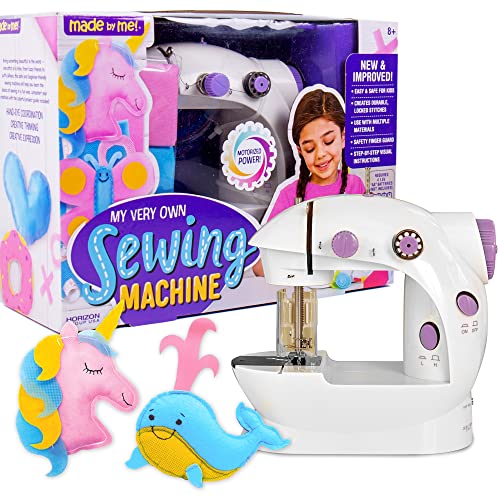
The Made By Me machine is the list’s purpose-built childhood artifact: a portable, battery-powered first sewing machine for kids ages 8 and up — the age designation stated in its own title, and the only explicit age guidance in this guide. Its box is a first-projects kit as much as a machine: fabric, thread, a measuring tape and stuffing are included, which tells you the intended curriculum — a child opens the box and makes a stuffed something, start to finish, as the first act of their sewing life. Battery power suits the supervised-table system neatly: the machine works wherever the family gathers, with no cord trailing across the workspace, and removing the batteries is a clean, visible end-of-session ritual a child can own.
Expectations should be set by the design’s own framing. This is a first machine in the toy-adjacent, craft-kit tradition: its projects are small, soft and forgiving, its pace is a child’s pace, and its success is measured in finished stuffed animals and pillow-scale triumphs rather than in garments. For the eight-to-eleven window it names, that is not a limitation — it is the correct shape of an introduction, especially for a child whose interest is real but unproven. The child who exhausts this machine’s possibilities has given the family perfect information: graduate them to a full beginner machine with their name on the gift tag, and let this one pass to a younger sibling, for whom it will be, correctly, enormous.
- Age designation: kids ages 8+, stated in the listing title — the only explicit age guidance in this guide
- Power: portable, battery powered, per the title
- Included project materials: fabric, thread, measuring tape and stuffing, listed in the title
- Stitch count and speed settings: not detailed in the listing title — the manufacturer documentation carries the specifics
- Where to buy: the Made By Me My Very Own Sewing Machine (Ages 8+) listing on Amazon — check price on Amazon
Strengths
- The title’s ages 8+ designation lets adults match machine to child on stated guidance.
- Battery power fits the supervised, anywhere-table learning system.
- Included fabric and stuffing make the first finished project a same-day event.
Trade-offs
- Its ceiling is a first machine’s ceiling — keen children will graduate, by design.
- Battery operation means a household stock of batteries is part of ownership.
- Project scale is small and soft; garments are a later machine’s territory.
Choose it for: a first machine for a child in the stated age range, especially as a gift with a project inside. Pass if: the child is already sewing confidently and needs a real beginner machine’s range instead.
KPCB Tech Sewing Machine for Beginners with Finger Guard — The guarded option
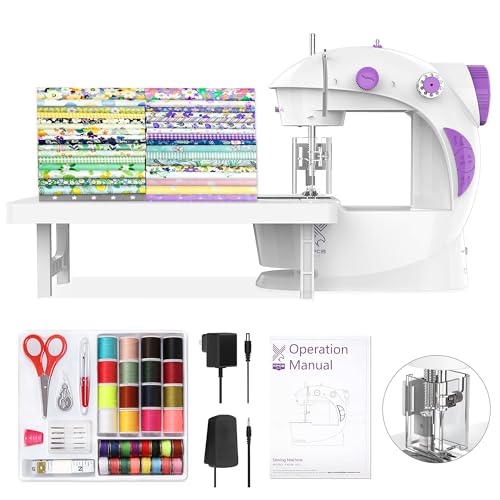
The KPCB Tech machine holds a unique line in this guide’s spec boxes: its title names a finger guard among its features — the only explicit safety hardware claim among the six listings — bundled into a mini beginner package with fabrics, a 42-piece kit, dual speed, a foot pedal, a US adapter and an extension table. A finger guard is a small shield around the needle area that makes it harder for a guiding finger to wander into the needle’s path. It does not supervise a child, and this guide will not let it be read as permission to relax the system described above; what it does is add a physical margin at the exact point where beginner attention is most likely to fail, and for many families that margin will be the deciding feature, reasonably.
The rest of the package supports the same philosophy of beginning well. Fabric bundles in the box mean the first projects are not hostage to a fabric-shop trip; the 42-piece kit covers the consumables; dual speed gives the adult the pace lever; the extension table stabilises the work. The US adapter note in the title is worth a buyer’s glance for households outside that plug standard. Taken whole, the KPCB is the pick for the family that has read the safety frame at the top of this guide, agrees with it, and wants the one machine whose maker has visibly thought about the same subject — while understanding that the guard is a seatbelt, and seatbelts accompany careful driving rather than replacing it.
- Safety hardware: finger guard included, stated in the listing title — unique among these six listings
- Kit: 42-piece kit and fabric bundles included, from the listing title
- Speeds: dual speed, in the seller’s title
- Controls: foot pedal, per the listing
- Work surface: extension table included, per the title
- Power: US adapter, listed in the title — households on other plug standards should note it
- Where to buy: the KPCB Tech Sewing Machine for Beginners with Finger Guard listing on Amazon — check price on Amazon
Strengths
- The finger guard adds a physical margin at the needle, the beginner’s danger point.
- Fabrics in the box make the first session a sewing session, not a shopping session.
- Dual speed and a pedal teach real machine control from the start.
Trade-offs
- The guard is a margin, not a supervisor; the family safety system still applies in full.
- The title gives no age designation, so matching to a child remains the adult’s judgement.
- Its kit, at 42 pieces, is generous but smaller than the CraftBud’s starting universe.
Right for: safety-conscious families who want hardware margin plus a complete starter bundle. Wrong for: anyone tempted to read the guard as a substitute for an adult in the room — it is not one.

Sewing Machine for Beginners & Kids (12 Stitch Patterns) — The teaching machine
This machine’s title contains the most touching piece of marketing in the guide: it describes itself as perfect for teaching a daughter or granddaughter to sew. Strip the sentiment and a well-judged teaching specification remains — a mini portable machine with twelve built-in stitch patterns, a two-speed foot pedal and a forty-five-piece sewing kit. Twelve patterns is the curriculum size this guide praised earlier: enough for straight seams, zigzag finishes, simple decorative rows and the grammar of garment and craft sewing, few enough that a child can learn every one by name and season. The two-speed pedal puts the pace decision in the adult’s hands and the control lesson in the child’s foot, which is where pedal discipline — the heartbeat of machine safety — is actually learned.
The intergenerational framing deserves respect rather than a smile, because it identifies how sewing is actually transmitted: at a table, in pairs, with the experienced sewer’s hands hovering and the learner’s hands on the fabric. A machine bought for that scene should be light enough to bring to the grandparent’s table or the grandchild’s, quick to set up, and complete in its box — all of which this package’s portability and kit promise. Its title makes no safety-hardware or age claims, and none are made for it here; its safety story is the supervision system, which its teaching design visibly assumes. For the family whose sewing tradition is about to change generations, this is the sentimental pick with a sound specification underneath the sentiment.
- Stitch patterns: 12 built-in stitch patterns, as the title states it
- Speeds: 2-speed foot pedal, from the listing title
- Kit: 45-piece sewing kit included, in the seller’s title
- Form: mini and portable, per the listing
- Safety or age designation: none stated in the listing title — a beginner machine for supervised teaching
- Where to buy: the Sewing Machine for Beginners & Kids (12 Stitch Patterns) listing on Amazon — check price on Amazon
Strengths
- A twelve-pattern bench sized exactly to a learner’s curriculum.
- Two-speed pedal teaches pace discipline — the core machine habit — from day one.
- Portability suits the grandparent-and-grandchild teaching circuit.
Trade-offs
- No guard or age statement in the title; adult judgement carries the matching.
- Mini scale caps project size, as with every pick here.
- Its charm is aimed at one teaching relationship; solo adult beginners may prefer the CraftBud’s book.
Suits: families passing sewing between generations, with an adult teacher in the scene. Skip it if: the child will mostly sew in a parent-and-child pair wanting the largest starter kit instead.

Beginner Sewing Machine for Kids & Adults (2-Speed Mini) — The giftable mini
The fifth pick is the list’s straightforward small machine: a two-speed mini for kids and adults, with a foot pedal and extension table, presented for DIY crafts and simple mending and framed as a birthday or Christmas gift. Its virtues are the mini class’s core virtues, cleanly stated: two speeds for governed learning, a pedal for real control, an extension table for stable work, and a size that lets the machine live in a cupboard and appear at the table in a minute. For the household whose child-sewing will be occasional — a holiday project, a school craft, a costume adjusted together — that quick-deploy character may matter more than any kit size, because crafts that require an expedition to set up quietly stop happening.
This review follows the guide’s discipline on claims: the title positions the machine for kids and adults and for simple work, and the assessment here rests on those stated features — size, speeds, pedal, table — rather than on any safety property, which the title does not specify and this guide does not assign. Within the supervision frame, it is a sensible instrument: small enough for a child to sit at correctly, governed enough for an adult to pace, and honest about its territory of crafts and mending. As a gift it has the great gift virtue of being immediately usable at a family table on the day it is unwrapped, with whatever fabric the house contains — a scrap-bin drawstring bag has launched more sewing lives than any grand project.
- Speeds: 2-speed mini machine, in the listing’s own wording
- Controls: foot pedal included, per the title
- Work surface: extension table included, listed in the title
- Stated uses: DIY crafts and simple mending, from the listing title
- Safety or age designation: not specified in the listing title — suitability is the supervising adult’s call
- Where to buy: the Beginner Sewing Machine for Kids & Adults (2-Speed Mini) listing on Amazon — check price on Amazon
Strengths
- Quick to deploy and quick to store — the occasional-craft family’s ideal rhythm.
- Two speeds and a pedal deliver the essential control lessons.
- Extension table included, which many minis omit.
Trade-offs
- No kit is enumerated in the title, so first-project consumables may be a separate basket.
- No stitch count is stated in the title; the documentation holds the curriculum details.
- Its territory is crafts and mending — garment ambitions will outgrow it.
Best for: occasional, supervised craft sewing and a gift that gets used the same day. Not suited for: a child with a serious, weekly sewing appetite, who deserves a fuller bench.

Pllieay Sewing Machine for Beginners (12 Stitches, Reverse) — The project kit
The Pllieay closes the list with a detail the other titles mostly leave implicit: reverse sewing, named in its own title alongside twelve built-in stitches, two speeds, double thread, a foot pedal, a storage bag and cotton fabric. Reverse is a small feature with an outsized teaching value. Locking a seam’s ends — sewing backward for a few stitches at the start and finish — is the difference between a seam that survives the washing machine and one that unravels in a child’s hands a week later, to a child’s disproportionate heartbreak. A machine that puts reverse in its title is a machine whose maker understands what beginners’ projects die of, and teaching the lock-stitch habit from the very first seam is among the kindest things an adult can do for a young sewer.
The rest of the package supports a tidy, project-based habit: cotton fabric in the box for the first makes, double thread for the standard two-thread sewing children will meet on every later machine, two speeds for the family pace system, and a storage bag that makes the end-of-session ritual — machine away, notions counted, table restored — a single gesture a child can perform and take pride in. Pllieay’s name will be familiar to craft-kit households from the hand-sewing world, and this machine reads as that world’s natural next step: the project kit that plugs in. For a child graduating from hand-sewing kits, or a family that wants the sewing corner to assemble and vanish like a board game, it is a thoughtfully complete answer.
- Stitch count: 12 built-in stitches, the title confirms
- Reverse sewing: included and named in the listing title — the seam-locking habit, taught early
- Speeds: 2 speeds, in the seller’s title; double thread sewing, per the listing
- Controls: foot pedal included, per the title
- Included extras: storage bag and cotton fabric, listed in the title
- Safety or age designation: none stated in the listing title — a beginner machine for supervised use
- Where to buy: the Pllieay Sewing Machine for Beginners (12 Stitches, Reverse) listing on Amazon — check price on Amazon
Strengths
- Reverse sewing foregrounded — the habit that makes children’s projects survive.
- Storage bag and included fabric make the set-up-and-put-away ritual complete.
- Twelve stitches and two speeds match the learner curriculum this guide recommends.
Trade-offs
- No guard or age claim in the title; matching remains the adult’s judgement, as throughout.
- Its kit is project-focused rather than encyclopaedic like the CraftBud’s.
- Mini-class ceilings apply: a keen child’s second machine will be a full beginner model.
Choose it for: tidy, project-based family sewing and children graduating from hand-sewing kits. Pass if: you want the largest possible starter universe in one box — that is the CraftBud’s crown.
Hand Sewing First? The Case for a Needle Before a Machine
Many sewing families swear by a hand-sewing season before any machine arrives, and the case is stronger than nostalgia. A child who has threaded a needle, tied a knot that held, and sewn a running stitch along a line understands viscerally what a machine does — the machine stops being magic and becomes what it is, a faster hand — and that understanding makes machine lessons shorter and safer, because the child already respects the needle as an object. Hand sewing also tests the two readiness qualities no machine can supply: the patience to finish a row of stitches, and the rule-following to put sharp things back where they live. A child who passes a hand-sewing season with pleasure has given the family reliable evidence; a child who finds it tedious may simply be a year younger than their enthusiasm, and the machine can wait in a way that costs nobody anything.
The counter-case deserves its hearing too. Some children — the mechanically fascinated, the ones who take clocks apart — are hooked precisely by the machine, and hand sewing first reads to them as a toll booth on the road to the interesting thing. For that child, a supervised machine start, at the lowest speed, on paper lines, may be the correct pedagogy, with hand sewing arriving afterward as the repair skill the corridor teaches. The guide’s position is the adult’s position throughout: know the child, choose the sequence, and let neither tradition nor marketing choose it for you. Both roads reach the same sewing table, and the machines in this guide will be waiting at the end of either.
Signs a Child Is Ready — and Signs the Machine Should Wait
Readiness announces itself in ordinary life before it ever reaches a sewing table. The ready child follows a multi-step instruction in the kitchen without the steps dissolving; stops a bicycle, a scooter, a game when told to stop, promptly and without negotiation; treats the household’s existing sharp and hot things — scissors, the oven, a parent’s tools — with the settled respect of habit rather than the thrill of prohibition; and can sit inside a absorbing task for the length of a first project, which this guide has deliberately kept to a single sitting. None of these signs mentions sewing. All of them are sewing signs, because machine sewing is ninety percent conduct and ten percent stitch.
The waiting signs are equally legible, and naming them is a kindness rather than a judgement: the child for whom “stop” is still a debate; the child whose fine-motor frustration melts down quickly, in a craft where the first hour is mostly wobble; the household whose adults cannot honestly promise a supervised first season, because a machine bought for supervision that will not happen is a machine bought under false pretences. In every such case the correct purchase is not a lesser machine but a later one — hand-sewing kits, weaving, and the other fibre crafts keep the making instinct fed until the calendar and the child agree. The machines in this guide are patient objects. They will be exactly as good next year, and the child will be readier, and the first drawstring bag will be the sweeter for the wait.
Looking After the Machine Together: Maintenance as Part of the Craft
A child’s machine teaches care as reliably as it teaches sewing, if the adult builds the rituals in from the first session. The end-of-session sequence — machine off and unplugged or batteries out, needle parked up, presser foot down on a scrap, lint brushed from the bobbin area with the little brush every kit contains, notions counted back into their box — takes four minutes and contains the whole philosophy of tools: they are put away as carefully as they are used, by the person who used them. Children rise to this ritual when it is treated as part of the craft rather than as tidying imposed after the fun; racing drivers, after all, are debriefed, and pilots run checklists, and a young sewer with a closing routine is in that company.
Needles deserve a specific household rule, stated once and kept: a bent, burred or dropped needle is a finished needle, replaced by an adult or under an adult’s eye, and the old one goes into a sharps pot — an old jar with a lid serves — never loose into a bin where small hands and bare feet go hunting. Bobbins are wound together, threads are kept in their kit rather than colonising the house, and the machine’s cover or bag goes on at the end of the ritual like a coat on a hook. None of this is fussiness. It is how a machine survives a childhood of enthusiastic use to be handed on, still sewing true, to the next beginner in the family — which, given the prices of memories, may be the best return on investment in this entire guide.
Six First Machines, Compared for Families
| Machine | Stitches (per title) | Kit (per title) | Stated safety or age element |
|---|---|---|---|
| CraftBud Mini | Not stated in title | 122-piece kit + guide book | None stated |
| Made By Me My Very Own | Not stated in title | Fabric, thread, tape, stuffing | Ages 8+, stated in title |
| KPCB Tech with Finger Guard | Not stated in title | 42-piece kit + fabric bundles | Finger guard, stated in title |
| Beginners & Kids (12 Patterns) | 12 stitch patterns | 45-piece kit | None stated |
| Kids & Adults 2-Speed Mini | Not stated in title | Not enumerated in title | None stated |
| Pllieay (12 Stitches, Reverse) | 12 built-in stitches | Cotton fabric + storage bag | None stated |
What Should a Child’s First Five Projects Be?
Sequence is the curriculum. Project one is a drawstring bag in a forgiving cotton: four straight seams, a casing, a cord — every core skill, nothing that can fail unforgivably, and a finished object that carries treasures by bedtime. Project two is a pillowcase or cushion cover, which teaches longer seams, corner pivoting and the pride of making something the house actually uses. Project three introduces a stuffed shape — the Made By Me’s included stuffing exists for this moment — where curves arrive gently and the seam allowances forgive enthusiasm. Project four is an apron or a simple tote, the first project with straps and a genuine user beyond the maker. Project five, by which time the young sewer has opinions, is their choice from a shortlist the adult vets for difficulty: choice is the reward that turns practice into a hobby.
Thread through all five the habits this guide has been building: set the speed low, lock every seam with reverse or a knot of backstitches, press or finger-press seams as you go, and finish the session with the tidy-away ritual. Let the child keep a small notebook of makes — date, project, one thing learned — because children who can see their own progress in writing persist through the frustrating middle projects that end so many crafts. And when a project fails, as one will, unpick it together without drama and name the lesson; a household where mistakes are tuition rather than shame is the true safety system, for sewing and for most other things worth learning.
Families whose children fall hard for making may eventually wander toward decoration — personalised pencil cases, named banners, embellished gifts — and that path has its own doorway in Best Embroidery Machines for Home Use, a guide written for the household machines that handle such work under the same adult-supervised discipline this guide has preached throughout.
Where Do Families Most Often Go Wrong With a First Machine?
The first error is buying by age on the box art rather than by the system around the child: a machine given to a child as a solitary bedroom toy, however mini, has been set up to fail or to frighten. The second is skipping the slow start — the first session at full speed, on a real project, with an audience — which manufactures the exact scare that ends sewing childhoods. Paper lines and scrap fabric exist to absorb that first hour’s wobbles. Third, adults sew the hard parts “to help”, and the child learns that the machine is where their work goes to be taken away; guide with words and a hovering hand, and let the wonky seam be the child’s own, because it is also their diploma.
Fourth, the consumables run out — the kit’s thread colours dwindle, the needles dull, the one bobbin is full of the wrong colour — and the craft stalls for want of small change. Keep a restocking habit: needles and bobbins are the pencils of this school. Fifth, storage fails: a machine that lives in its box in a high cupboard requires an adult expedition for every session, and sessions quietly stop. The storage-bag and table-top minis in this guide exist to defeat that gravity; give the machine a reachable home. Finally, a household note for craft-heavy homes: a sewing corner used by children sheds pins, thread and fabric scraps into every nearby carpet, and the family-scale cleanup machines surveyed in Best Carpet Cleaning Machines are the companions for readers whose craft table shares a room with the rest of life.
Final Recommendation
Start with the frame, then the machine. When the young sewer graduates — and the happiest outcome of any pick here is that they do — the family’s next conversation is about a machine of their own at full beginner scale, and the survey in Best Portable Sewing Machines maps that next step, from the lightest travel models to the fullest portable benches. Set the supervision system first — shared space, adult present, speed low, machine away at the end — and any pick in this guide becomes a good citizen of it. Within the frame: the CraftBud for the most complete family start, book and universe included; the Made By Me for a child squarely in its stated 8+ window who will bloom on a same-day stuffed project; the KPCB Tech where the finger guard’s extra margin settles the family’s mind; the twelve-pattern teaching machine for the grandparent-led apprenticeship; the giftable mini for occasional craft days; and the Pllieay where tidy projects and the reverse-stitch habit lead. Buy the one that matches your child’s age, your family’s rhythm and your honest supervision capacity — then sit down together, sew the drawstring bag, and let the smallest sewer in the house discover what their hands are for.
Frequently Asked Questions
What age can a child start machine sewing?
Only one listing in this guide states an age — the Made By Me machine, designated for kids ages 8 and up in its title — and this guide treats that as the maker’s guidance for that machine rather than a universal law. In practice, readiness is individual: the child who can follow the safety rules consistently, sit with a task, and keep hands where they were taught to keep them is ready for supervised sewing at the low speed, and the child who cannot yet is ready for hand sewing, which is a fine and traditional preparation. The adult who knows the child makes the call; the titles merely inform it.
Is a finger guard enough to let a child sew unsupervised?
No. A finger guard — the feature the KPCB Tech title names — is a physical margin at the needle, and margins are valuable, but no feature in any listing here converts a real sewing machine into an unsupervised toy. Supervision, governed speed, agreed rules and unplugged storage are the safety system; hardware assists it. Families should choose the guarded machine, if they choose it, as an addition to that system, never as a replacement for the adult in the room.
Mini machine or the family’s full-size machine for a beginner child?
Both paths work, and the choice is about control. A mini from this guide offers governed speeds, a small footprint at the child’s scale and a kit of their own — ownership that motivates. A family full-size machine, sewn on under the same supervision with its speed governed, offers a longer future and real-machine habits from the start, at the price of a more powerful tool in small hands. Many families do both in sequence: the mini as the child’s own first machine, graduation to the family machine as the second or third season’s ceremony.
Should the first machine be a gift, or chosen together?
Chosen together, where the child’s temperament allows surprises to be optional — and this guide says so knowing it argues with a thousand gift guides. A child who has sat at the table, seen the options, and pointed at the machine that will be theirs arrives at the first session with ownership already installed; the choosing is also the adult’s chance to talk through the safety frame as part of the excitement rather than as rules imposed afterward. Where a gift it must be — a grandparent at a distance, a birthday already themed — the Made By Me’s stated age window and the CraftBud’s complete-in-box readiness make them the safest gifts in this list, because both minimise the chance of a missing piece standing between the unwrapping and the first seam.
What fabrics should children start with?
Stable, medium-weight cottons — quilting cotton and similar — are the kind classroom: they stay where they are cut, feed without sliding, show stitches clearly for learning, and forgive unpicking. Avoid slippery fabrics, stretch knits, anything thick, and anything precious for the first season. Several picks here include cotton fabric or fabric bundles in the box, which is the right instinct; after those are sewn, a remnant-bin raid together is a rite of passage and a budgeting lesson in one outing.
How do I teach a child to use the foot pedal safely?
Unplugged first: let the child practise pedal pressure with the machine off, feeling where the response begins, the way driving instructors once taught clutch control in a parked car. Then, machine on, speed set low, sew lines on paper without thread — the pedal lesson isolated from fabric, needles’ thread and every other variable. Only then fabric. The goal is a foot that presses by intention rather than by startle, and ten unhurried minutes at the paper stage will repay themselves at every session that follows.
How do siblings share one machine without it becoming a feud?
By treating the machine like a piano rather than a toy: scheduled turns, a shared project shelf, and a house rule that the machine’s settings — especially its speed — are reset to the family default by whoever finishes. Give each child their own small kit box or pouch for personal projects and threads, even when the machine is shared; ownership of the work matters more than ownership of the tool. And let the older or more experienced child teach the younger one the closing ritual and the paper-lines lesson when their turn comes: teaching is the deepest form of learning, and a household where sewing is transmitted child-to-child has built something no purchase can replicate.
What if my child loses interest after a month?
Then the machine has still done honest work — a month of real sewing is a permanent deposit in a child’s sense of what hands can do, and interests shelved at nine have a way of returning at fifteen with a costume or a prom dress attached. Store the machine kindly, keep the kit complete, and leave the door open with an occasional shared project rather than a campaign. The picks in this guide were chosen partly for their second lives — as household mending machines and next-sibling starters — so a pause costs the family nothing but cupboard space.
Related Guides
A child’s sewing station deserves furniture at their scale, and readers setting up a craft corner will find our guide to Best Kids’ Desk Chairs a natural companion — the right chair and table height are, as this guide has argued throughout, part of the safety system rather than decoration. The portable-machine guide and the embroidery doorway linked in the body above complete the map for families whose youngest makers are already planning their next machine.


