What's inside
- Key Takeaways
- Quick Picks
- What Earned a Machine Its Place in a Home Guide?
- Six Makers, Three Philosophies: The Comparison
- What Actually Makes Homemade Ice Cream Taste Homemade?
- How Do You Store What You Churn?
- What Mistakes Do First-Time Churners Make?
- How Do You Clean and Keep a Churn Happy?
- Custard or Philadelphia: Which Base Should a Beginner Start With?
- How Do Sorbets and Frozen Yogurt Behave Differently?
- What Should a Churning Household Keep in Stock?
- How Does Altitude, Climate, and a Summer Kitchen Change Things?
- What Does a Year of Churning Actually Cost?
- How Do You Churn With Children Without Losing Your Mind?
- How Do You Develop a House Flavour?
- What About the Noise, the Mess, and the Counter?
- Can You Make Ice Cream for a Crowd Without the Bucket?
- How Long Do These Machines Last, and What Wears Out?
- Which Four Checks Prevent a Disappointing Delivery?
- How Does Homemade Compare With the Parlour, Honestly?
- Gelato, Soft Serve, and the Boundaries of This Guide
- What Does the First Month of Ownership Look Like?
- How Do You Serve It Like You Mean It?
- A Note on Sweetness, Since Every Household Asks
- What If the Freezer Is Already Full?
- Why Do People Who Churn Rarely Go Back?
- Final Recommendation
- Frequently Asked Questions
- Related Guides
As an Amazon Associate I earn from qualifying purchases. This post may contain affiliate links at no extra cost to you.
cottageverdict.com is reader-supported. When you buy through links on our site, we may earn an affiliate commission.
Every machine in this guide makes ice cream at home, but they divide into three philosophies of cold, and the best ice cream machines for home use are best understood by which philosophy suits your freezer, your patience, and your idea of a Saturday. The first philosophy pre-freezes a bowl: you keep an insulated bowl in the freezer, and when the mood strikes, the bowl’s stored cold churns your mixture. The second builds the cold in, with a compressor that freezes as it churns and asks nothing of your freezer at all. The third — represented here by the Ninja CREAMi — freezes the base solid first and then processes it into scoops on demand, a workflow closer to a food processor’s than to a churn’s.
Where to buy: the six picks are all sold on Amazon, linked in the table and at their headings below, and the sensible shopping order is philosophy first, capacity second, brand third. A household with a chest freezer and a planner’s temperament will thrive with a pre-frozen bowl; a household that decides on ice cream at 6 p.m. and wants it by 7 needs a compressor; a household that thinks in pints and experiments will understand the CREAMi immediately. All three roads end in homemade ice cream, which is to say in control — of sweetness, of ingredients, of the exact moment a mixture becomes dessert.
Capacities in this guide are quoted only where titles state them: two quarts, one and a half quarts, 2.1 quarts, four quarts, one quart. They are not interchangeable numbers. A quart of churned ice cream is roughly a family’s dessert tonight; four quarts is a gathering. Match the vessel to the table it will serve, and remember that homemade ice cream, churned fresh and eaten young, is a different pleasure from a tub kept for a month.
Key Takeaways
- Three freezing philosophies divide the six: pre-frozen bowls (both Cuisinarts), a built-in compressor (the Whynter), freeze-then-process (the Ninja CREAMi), plus a traditional bucket (the Nostalgia) and a self-churning compact (the Elite Gourmet).
- Stated capacities run from the Elite Gourmet’s 1 quart to the Nostalgia’s 4 quarts — choose by the table you actually serve.
- Only the Whynter’s title promises no pre-freezing via a built-in compressor; the ICE-21P1’s title states plainly that its bowl requires pre-freezing.
- The Elite Gourmet claims a sub-20-minute churn with no ice or salt needed, and includes 25+ recipes.
- The CREAMi’s 7-in-1 brief covers ice cream, gelato, sorbet, and milkshakes from bases you freeze ahead in its pints.
Quick Picks
| Maker | How it freezes | The household it suits |
|---|---|---|
| Cuisinart 2 Qt. Ice Cream Maker ICE-30BCP1 | Pre-frozen double-insulated bowl | The family default: two quarts, a heavy-duty motor, and a proper ingredient spout. |
| Cuisinart 1.5-Quart Ice Cream Maker ICE-21P1 | Pre-frozen bowl, one switch | The minimalist churn: one switch, an easy mix-in spout, and nothing to learn. |
| Ninja CREAMi 7-in-1 Ice Cream Maker NC301 | Freeze the base, then process | The experimenter who thinks in pints and wants seven programs from one machine. |
| Whynter Upright Ice Cream Maker 2.1 Qt ICM-201SB | Built-in compressor | The spontaneous household: no pre-freezing, an LCD display and timer, back-to-back batches. |
| Nostalgia Electric Ice Cream Maker 4 Qt (Wooden Bucket) | Traditional bucket, electric churn | The gathering host: four quarts in a vintage wooden bucket with an aluminium canister. |
| Elite Gourmet EIM1750 Self-Churning Electric 1Qt. Ice Cream Maker | Self-churning, no ice or salt | The small household: one quart in under twenty minutes, with a recipe collection included. |
What Earned a Machine Its Place in a Home Guide?
The first test was domestic honesty: a machine had to make sense in a real kitchen, with a real freezer, operated by a person who is also making dinner. Capacity, footprint, and the choreography around the churn — what must be frozen ahead, what must be washed after — all counted. The second test was title honesty: every number in the spec boxes below is a number the listing itself states, and where a title is silent about a detail buyers love to assume, the box says so in words.
The third test was range across the category’s real divides. A guide that recommended six pre-frozen bowls would be a catalogue, not a guide; the six here let a reader compare philosophies with actual purchasable examples of each. Readers whose frozen ambitions lean specifically toward the soft, swirled cone should continue to Best Domestic Soft Serve Ice Cream Machines after this one, since soft serve is its own discipline with its own hardware, and the overlap between the two categories is smaller than the names suggest.

Cuisinart 2 Qt. Ice Cream Maker ICE-30BCP1 — The family-size freezer bowl
The ICE-30 is the shape most people picture when they picture a home ice cream maker, executed at family scale: a two-quart double-insulated freezer bowl, a heavy-duty motor, and a large ingredient spout, in silver. Two quarts is the size that serves a family dessert with something left for tomorrow’s cones, and the freezer-bowl format is the category’s best-understood bargain — the machine stays simple and affordable because your freezer does the refrigerating, hours before the churn begins.
The ingredient spout deserves its mention, because it is the difference between ice cream and ice cream with things in it. A generous spout lets you rain in chocolate shards, nuts, or cookie rubble in the churn’s final minutes, when the mixture is thick enough to suspend them evenly instead of letting them sink. Households whose signature flavour involves a mix-in will use that spout every single batch, and the heavy-duty motor matters in exactly those final minutes too, when the mixture is at its thickest and a lesser motor begins to labour.
The discipline the format demands is freezer discipline: the bowl lives in the freezer, frozen solid, which means a household must surrender that shelf permanently to be always ready. Families who accept the arrangement call it the ice cream shelf and think no more about it; families who cannot spare the space should read the Whynter’s section with care.
- Capacity: 2 quarts, as stated in the title
- Freezing: double-insulated freezer bowl — freeze it ahead, per the format
- Motor: heavy-duty, per the title
- Mix-ins: large ingredient spout
- Where to buy: the Cuisinart ICE-30BCP1 — the maker is listed on Amazon, where its price can be checked before you decide.
Strengths
- Two full quarts — the family dessert size, with leftovers.
- A heavy-duty motor for the thick final minutes of the churn.
- The large spout makes mix-in flavours easy and even.
Trade-offs
- The bowl must live frozen in your freezer, permanently on standby.
- Back-to-back batches wait on re-freezing the bowl.
- Frozen yogurt and sorbet share the brief — plan freezer room for the bowl, not the results alone.
Best for: families with freezer space to dedicate. Not suited for: spontaneous churners or freezer-poor kitchens.

Cuisinart 1.5-Quart Ice Cream Maker ICE-21P1 — One switch, no ceremony
If the ICE-30 is the family default, the ICE-21 is the minimalist’s: one and a half quarts, one switch, a double-insulated bowl that the title says plainly requires pre-freezing, and an easy mix-in spout, in white. There is a real design intelligence in a machine with one switch. It cannot be mis-set, it intimidates nobody, and a grandparent, a teenager, or a guest can operate it without a briefing — which, in a home appliance, is a form of hospitality.
The capacity steps down by half a quart from its sibling, and the step is well judged for couples and small households: a batch is a dessert for two to four, eaten across a couple of days at its best, rather than a fortnight’s tub declining in the freezer. Ice cream made at home is at its peak young, and the smaller bowl quietly enforces the correct turnover.
The title’s honesty about pre-freezing is the purchase condition, again: the bowl must be frozen before the mixture meets it, so the ICE-21 rewards the household that thinks a day ahead about dessert. For that household it is close to perfect — the simplest path in this guide from a bowl of sweetened cream to a churned quart and a half of whatever flavour the week suggested.
- Capacity: 1.5 quarts, as stated in the title
- Operation: one switch
- Freezing: double-insulated bowl; the title states it requires pre-freezing
- Mix-ins: easy mix-in spout
- Where to buy: the Cuisinart ICE-21P1 — the maker is listed on Amazon, where its price can be checked before you decide.
Strengths
- One-switch operation that literally anyone in the house can run.
- A right-sized batch for couples and small families — eaten young, at its best.
- The same freezer-bowl simplicity as its larger sibling, in white.
Trade-offs
- Pre-freezing the bowl is mandatory; there is no same-evening improvisation.
- Smaller capacity means gatherings need the bucket or a second plan.
- One switch means one speed — no finesse settings to grow into.
Best for: couples and small households who plan dessert a day ahead. Not suited for: parties, or the resolutely spontaneous.

Ninja CREAMi 7-in-1 Ice Cream Maker NC301 — Freeze it first, then let the machine think
The CREAMi breaks the churn’s ancient logic and replaces it with a freezer-and-processor workflow: you freeze a base solid in its pint, and the machine’s program then shaves and churns that frozen block into ice cream, gelato, sorbet, or a milkshake at the touch of a button — seven functions in one, per the title, running “from healthy to indulgent”. Nothing about it resembles the bucket your grandparents used, and for a certain kind of cook that is exactly the recommendation.
The workflow’s genius is portioning and variety. Bases freeze in individual pints, so a household can keep three flavours in the freezer as raw material and finish each one on the evening it is wanted, in the quantity it is wanted. The low-sugar, high-protein, fruit-only experiments that churn awkwardly in a traditional bowl behave beautifully here, because the machine does not ask a base to freeze and aerate simultaneously — it asks only that the base freeze, and does the aerating itself, afterwards, with horsepower.
The trade is the mirror of the freezer-bowl discipline: the pints must be frozen ahead, level and patient, and the finished texture depends on the base having frozen fully before processing. Households wanting ice cream from a standing start should look at the compressor machine below. Households who meal-prep, who think in pints, and who want a sorbet on Tuesday and a gelato on Friday from one appliance will find the CREAMi the most modern idea in this guide.
- Programs: 7-in-1, per the title — ice cream, gelato, sorbet, milkshakes among them
- Method: bases are frozen first, then transformed by the machine
- Range: described in the title as running from healthy to indulgent
- Capacity: the title does not state a quart figure — its pints are the unit; confirm counts on the listing page
- Where to buy: the Ninja CREAMi NC301 — the maker is listed on Amazon, where its price can be checked before you decide.
Strengths
- Seven programs turn one machine into a frozen-dessert repertoire.
- Pint-by-pint workflow gives variety without batch commitment.
- Handles experimental bases — low sugar, high protein, fruit — gracefully.
Trade-offs
- Bases must freeze fully before processing; no instant gratification.
- The pint ecosystem becomes the household’s unit of planning.
- Not a churn — traditionalists may miss the ritual it replaces.
Best for: experimenters, small households, and pint planners. Not suited for: anyone wanting a big traditional batch from a standing start.
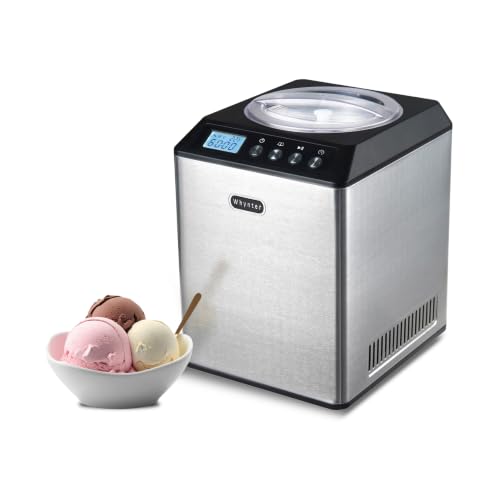
Whynter Upright Ice Cream Maker 2.1 Qt ICM-201SB — The compressor that asks nothing of your freezer
The Whynter is the guide’s answer to the freezer-space problem and the spontaneity problem in a single upright body: a built-in compressor means no pre-freezing is needed — the title repeats the promise twice, and it is the machine’s whole identity — wrapped around a 2.1-quart capacity with an LCD display and a timer. Decide at six, churn at six-oh-five, eat at seven: that is the ownership experience on offer, and no bowl machine can match it.
The compressor also unlocks the second batch. A freezer bowl must return to the freezer for many hours between churns; a compressor machine, once finished, can simply begin again, which transforms gatherings and recipe-testing afternoons alike. The timer and display suit that working rhythm — set the churn, attend to the rest of the meal, and let the machine mind its own cold.
The costs are the expected ones: a compressor machine is a more substantial appliance in size, weight, and price class than a bowl churn, and it earns a permanent counter or cupboard position rather than a casual one. For the household that will churn weekly and values impulse, the exchange is plainly worth it; for the twice-a-summer churner, the same money buys a bowl machine and a great deal of cream.
- Capacity: 2.1 quarts, as stated in the title
- Freezing: built-in compressor — no pre-freezing needed
- Controls: LCD display and timer
- Format: upright
- Where to buy: the Whynter ICM-201SB — the maker is listed on Amazon, where its price can be checked before you decide.
Strengths
- True spontaneity: no bowl to pre-freeze, no shelf surrendered.
- Back-to-back batches for parties and recipe development.
- The largest stated capacity of the modern machines here, with a timer to run it.
Trade-offs
- A compressor appliance’s size, weight, and price class.
- It claims permanent kitchen territory rather than occasional cupboard space.
- Over-specified for households that churn a few times a year.
Best for: frequent churners, the spontaneous, and the freezer-poor. Not suited for: occasional makers or the smallest counters.

Nostalgia Electric Ice Cream Maker 4 Qt (Wooden Bucket) — Four quarts the old-fashioned way
The Nostalgia is the guide’s gathering machine and its time capsule in one: four quarts of capacity — double the Cuisinart bowl — in a vintage wooden-bucket body with an aluminium canister, churning frozen yogurt or gelato as well as ice cream, with an electric motor doing the work arms once did. The wooden bucket is not a costume; the bucket format is the oldest home ice-cream architecture there is, and its survival into an electric model says something true about how well it suits a crowd.
Four quarts changes the social maths completely. This is the machine for the family reunion, the street party, the birthday where the ice cream is an event rather than a course. The electric drive removes the hand-crank labour that made the format a young person’s chore, while keeping the theatre: a wooden bucket on the lawn, a canister of something wonderful inside it, and a queue forming on reputation alone.
Its honest costs are storage and scale: a four-quart bucket is a cupboard commitment, and a full batch is a great deal of ice cream for an ordinary Tuesday. Households should buy it as what it is — the celebration machine, kept for the days that justify it — rather than as a daily churner, a role the smaller picks serve better.
- Capacity: 4 quarts, as stated in the title
- Body: vintage wooden bucket styling with an aluminium canister
- Drive: electric
- Also makes: frozen yogurt and gelato, per the title
- Where to buy: the Nostalgia 4 Qt — the maker is listed on Amazon, where its price can be checked before you decide.
Strengths
- Four quarts — the only true gathering size in the guide.
- Electric drive keeps the bucket tradition without the cranking.
- The wooden bucket is an event in itself at parties.
Trade-offs
- Storage for a bucket is a real cupboard negotiation.
- A full batch dwarfs a small household’s week.
- Traditional format, traditional fuss — not a weeknight appliance.
Best for: hosts, big families, and summer gatherings. Not suited for: small households or everyday churning.

Elite Gourmet EIM1750 Self-Churning Electric 1Qt. Ice Cream Maker — One quart, twenty minutes, no ice or salt
The Elite Gourmet closes the list at the opposite pole from the bucket: one quart, self-churning, electric, promising homemade ice cream, gelato, sorbet, and frozen yogurt in under twenty minutes with no ice or salt needed, and a library of 25+ recipes included, in mint. Read that specification as a small household’s manifesto. A quart is two to four servings; twenty minutes is a weeknight; no ice or salt is the removal of the traditional format’s two shopping chores at a stroke.
The included recipes matter more than they appear to. A first-time maker with a small machine faces the blank-page problem — what, exactly, goes in it? — and a recipe collection sized to the machine answers it with working quantities rather than with a four-quart formula and a prayer. Small machines live or die by whether their owners develop three or four beloved flavours, and a recipe library is how a manufacturer helps that happen.
The limits are the size itself: a quart will not serve a party, and a household that discovers a serious habit will outgrow it toward the Cuisinart or the Whynter. As a first machine, a small household’s machine, or a second machine for experiments, though, the EIM1750’s brief is the most frictionless in the guide — the shortest distance between wanting ice cream and eating it.
- Capacity: 1 quart, as stated in the title
- Churn time: under 20 minutes, per the title
- Method: self-churning electric; no ice or salt needed
- Included: 25+ recipes
- Where to buy: the Elite Gourmet EIM1750 — the maker is listed on Amazon, where its price can be checked before you decide.
Strengths
- Under twenty minutes from mixture to dessert, with no ice or salt to buy.
- A quart is the right size for small households and first experiments.
- Included recipes remove the new owner’s blank-page problem.
Trade-offs
- One quart will not serve a gathering.
- Serious habits will outgrow it toward the larger machines.
- A compact brief means a compact repertoire of settings.
Best for: small households, beginners, and weeknight dessert. Not suited for: parties or committed high-volume churners.
Six Makers, Three Philosophies: The Comparison
| Maker | Freezing philosophy | Stated capacity | Plan ahead? |
|---|---|---|---|
| Cuisinart ICE-30BCP1 | Pre-frozen bowl | 2 qt | Yes — the bowl lives frozen |
| Cuisinart ICE-21P1 | Pre-frozen bowl | 1.5 qt | Yes — title states pre-freezing required |
| Ninja CREAMi NC301 | Freeze base, then process | Pints (not stated in quarts) | Yes — bases freeze ahead |
| Whynter ICM-201SB | Built-in compressor | 2.1 qt | No |
| Nostalgia Bucket | Traditional bucket, electric | 4 qt | Gather the occasion |
| Elite Gourmet EIM1750 | Self-churning, no ice or salt | 1 qt | Under 20 minutes, per title |
The “plan ahead” column is the one to buy by. Every philosophy here makes excellent ice cream; they differ in when the work happens and what your freezer must surrender. Households that plan will never feel the bowl machines’ condition as a burden, and households that do not will feel it every single time — choose the philosophy that matches the household’s temperament, and the capacity that matches its table.
What Actually Makes Homemade Ice Cream Taste Homemade?
Three things, and the machine is only one of them. The first is the base: a mixture with enough fat and sugar in balance will churn silky in any of these six, while a thin, icy base will defeat the best compressor ever built. Beginners should begin with a cooked custard or a well-tested simple base, learn what the machine does to it, and only then start improvising — the included recipes with the Elite Gourmet, and the CREAMi’s programs, exist to shorten exactly that apprenticeship.
The second is temperature discipline. Mixtures should go into any churn cold — properly refrigerator-cold — because every degree the machine does not have to remove is a degree of texture you keep. The third is restraint with mix-ins and alcohol: add-ins belong in the final minutes, and spirits, which depress freezing, belong in smaller quantities than enthusiasm suggests. Master those three and the differences between these machines become matters of workflow, which is where this guide began: philosophy, capacity, temperament.
How Do You Store What You Churn?
Homemade ice cream is at its peak within days, and storage is about defending texture in the meantime. Press a layer of parchment or wrap directly onto the surface before lidding the container — the enemy is the air gap, where ice crystals and freezer flavours move in. Store containers at the back of the freezer, where the temperature is steadiest, rather than in the door’s daily weather. And let a hard-frozen quart sit at room temperature briefly before scooping; homemade ice cream freezes harder than commercial tubs, which are formulated with softness in mind, and five patient minutes is the difference between scooping and quarrying.
Households that churn often eventually meet the storage question at scale, which is where a dedicated freezer stops being an extravagance. The makers of quilts face the same arithmetic with fabric stashes, as readers of Best Janome Sewing Machines for Beginners will recognise: every beloved hobby eventually asks the house for one more shelf, one more drawer, one more cold corner to call its own.
What Mistakes Do First-Time Churners Make?
The classic error is the warm base: a mixture poured into the churn still warm from the stove or the counter, which stretches the churn, coarsens the texture, and — in a freezer bowl — can spend the bowl’s stored cold before the ice cream sets at all. Chill the base thoroughly, ideally overnight. The second error is overfilling: ice cream expands as it aerates, and a bowl filled to its brim will overflow or churn poorly; respect the stated capacity as a maximum for the mixture, not a target for the finished volume.
The third error is impatience at the finish. Freshly churned ice cream is soft-serve consistency by nature; it firms in the freezer over a few hours, a stage makers call ripening. Judging a machine by the softness of the churn’s final minute is like judging bread by the dough. And the fourth is the sugar swing — cutting sweetness drastically for virtue, then blaming the machine for an icy texture, when sugar is a structural ingredient in ice cream and not merely a flavouring. Adjust recipes gradually, and let the machine’s results teach you its dialect.
How Do You Clean and Keep a Churn Happy?
The rules are kind ones. Wash bowls, canisters, and dashers warm and promptly, because dried ice-cream base is a stubborn film; let freezer bowls return to room temperature before washing, and dry them completely before they go back into the cold, so frost does not build on their surfaces. Keep the compressor machine’s vents clear and its interior wiped, and store the bucket’s canister dry and lidless enough to stay sweet. None of the six asks for more than this attentiveness, and all of them repay it in years.
Storage of the machines themselves follows the household’s rhythm: bowl machines split their lives between freezer (the bowl) and cupboard (the base), the compressor takes a permanent post, and the bucket wants a shelf worthy of its size. Decide those homes before purchase, with a tape measure, and the machine will never become the kitchen’s awkward guest. The same measure-first discipline governs the alterations corner, as the guide to Best Sewing Machines for Alterations notes of free-arm machines and worktables alike — the right tool in the wrong footprint is a daily irritation wearing a good reputation.
Custard or Philadelphia: Which Base Should a Beginner Start With?
The two great families of home base divide by the egg. A custard base — yolks cooked gently with milk, cream, and sugar — churns into the richest, smoothest ice cream and forgives small errors with its body. A Philadelphia-style base skips the eggs entirely, relying on cream and sugar alone; it tastes brighter and more purely of its flavourings, and it shows icy faults more readily. Neither is superior; they are different instruments, and a new churner should make each once, in the same machine, and learn more from that pair of afternoons than from a month of reading.
Whichever you choose, cook and chill with patience. A custard wants gentle heat and no boiling, and both bases want a full chill — ideally overnight — before they meet the machine. The overnight rest is not superstition: flavours marry, the mixture’s temperature equalises, and the churn that follows is shorter and finer. Beginners who build the overnight habit into their rhythm will produce better ice cream from the humblest machine here than impatient cooks will from the finest.
How Do Sorbets and Frozen Yogurt Behave Differently?
Sorbet is the churn’s honesty test: with no fat to hide behind, its texture is decided by sugar concentration and fruit quality, and a good sorbet from ripe fruit is among the finest things any of these machines can make. The titles here name sorbet across the CREAMi and the Elite Gourmet’s briefs, and the format suits it — sorbet bases freeze hard and benefit from the ripening rest as much as ice cream does. Frozen yogurt sits between the worlds, tangy and lighter, and asks only for a yogurt you already like, since churning concentrates rather than disguises its character.
Both reward the same discipline as ice cream: cold base, correct capacity, patience at the ripening stage. Households with dairy sensitivities will find sorbet the gateway to the whole hobby, a point the vegan guide in this batch develops at length, since a great sorbet is not a substitute for anything — it is a destination.
What Should a Churning Household Keep in Stock?
Very little, which is the hobby’s charm. Cream and milk in their usual rotation; sugar; eggs if custard is the house style; vanilla and cocoa as the permanent flavouring shelf; and whatever fruit the season is proud of. A bag of chocolate meant for mix-ins, a jar of good jam for rippling, and nuts for the final minutes of the churn complete the working pantry. The machines ask for no proprietary consumables at all — no pods, no cartridges, no refills — which makes home ice cream one of the cheapest appliance hobbies to feed once the machine is home.
The freezer side of the pantry deserves one line: containers. Shallow, lidded, freezer-proof containers in quart and pint sizes, with a roll of parchment for surface protection, will serve every batch you make. Buy them once, in a small stack, and the hobby’s entire infrastructure is complete.
How Does Altitude, Climate, and a Summer Kitchen Change Things?
Ice cream is a cold-weather technology practised in warm rooms, and the room fights back. In a hot kitchen, everything the machine does takes longer: bowls warm faster out of the freezer, mixtures warm while you pour, and the churn’s final texture softens sooner. The countermeasures are humble — chill the mixture colder, work quickly, keep the machine away from the oven’s side of the room, and ripen the finished batch promptly rather than admiring it on the counter.
Compressor machines feel the room most honestly, since they must pump the kitchen’s heat somewhere; give the Whynter its ventilation space and it will not notice July. Freezer bowls feel it in the freezer itself, which works harder in summer and freezes the bowl more slowly after a door-open hour of family traffic. None of this is a barrier; it is simply the season’s terms, and a household that churns through a summer learns them in the first fortnight.
What Does a Year of Churning Actually Cost?
Cream is the budget, and it is a pleasant one. A quart of homemade ice cream consumes roughly a pint-to-quart of dairy, a handful of sugar, and flavourings measured in spoonfuls; even at generous shopping, the per-quart cost sits well below premium shop tubs and in another universe from parlour scoops. The machine’s price divides by batches with every churn, and frequent churners — the Whynter’s and CREAMi’s natural owners — amortise their appliances fastest, which is a fair argument for buying the machine your real frequency justifies rather than the cheapest object in the category.
The hidden saving is waste avoided: bases are made in the quantity the household eats, flavours follow the fruit that needs using, and the freezer stops accumulating half-tubs of commercial flavours nobody chose twice. A churning household’s dessert budget becomes legible in a way the ice-cream aisle never allowed.
How Do You Churn With Children Without Losing Your Mind?
By assigning the waiting a structure. Children can measure, pour through the spout at mix-in time, choose the flavour by vote, and perform the solemn duty of the first taste — while the machine’s churn and the freezer’s ripening happen at their own pace, explained once as the ice cream sleeping. The one-switch Cuisinart is the natural children’s machine for exactly this reason, and the bucket, at a gathering, turns the whole process into the party’s entertainment rather than its catering.
Safety is mostly temperature and patience: cold bowls and canisters are cold enough to warrant dry hands and adult handling, and the churn’s moving parts ask for the usual respect. None of it is beyond a supervised eight-year-old, and the payoff — a child who knows where ice cream comes from and what it costs in patience — is worth more than the dessert.
How Do You Develop a House Flavour?
Every churning household eventually converges on a signature — the flavour guests request and the cook can make half-asleep. It is rarely invented; it emerges, from the third or fourth batch, when a variation pleases out of proportion and gets repeated until it is perfected. The working method is a notebook: base, quantities, churn time, verdict, one change for next time. Change one variable per batch and the notebook becomes a map; change five and it becomes a diary of mysteries.
The machines divide helpfully here. The CREAMi’s pints let you test four variations in the freezer space of one batch, which is why experimenters gravitate to it. The bowl machines suit the slower, batch-by-batch refinement of a single recipe. Either way, the house flavour is the hobby’s real product, and it cannot be bought — only churned toward, patiently, one documented quart at a time.
What About the Noise, the Mess, and the Counter?
A churn is a gentle machine by kitchen standards — a motor’s hum and the dasher’s slow labour, nothing like a blender’s declaration of war. The mess, such as it is, concentrates in two places: the pour, where a cold mixture meets the bowl, and the transfer, where soft ice cream meets its container. Both are managed by the same habit — work over the sink or a tray, with the container ready before the churn stops. The counter cost is one machine’s footprint during the churn and none afterwards for the bowl machines, whose bases store small; the compressor and the bucket, as established, keep their territory permanently, and their owners should choose that territory deliberately.
Can You Make Ice Cream for a Crowd Without the Bucket?
Yes, with sequencing. The compressor Whynter churns batch after batch, so a party’s worth accumulates across an afternoon, each batch ripening in the freezer while the next churns. The CREAMi household pre-freezes a shelf of pints and processes them to order, which turns dessert into a small performance with flavours chosen per guest. Even a bowl machine can serve a crowd if the bowl rotation is planned — churn the day before, ripen overnight, and let the party day be about scooping rather than making.
What none of the smaller machines does gracefully is improvising a crowd’s worth from a standing start at the party’s beginning. That is the bucket’s one true superpower, and households whose entertaining style is spontaneous and numerous should weight it accordingly.
How Long Do These Machines Last, and What Wears Out?
The churn is a kind technology: low speeds, modest loads, no blades under stress. Motors in bowl machines typically outlast their bowls’ insulation, which can soften in performance over years of freeze-thaw life; compressor machines carry the same long-lived refrigeration as a small freezer, with the compressor as the component whose health decides the machine’s lifespan; the CREAMi’s moving parts work hardest per batch and reward owners who keep its components clean and dry between uses.
The practical guidance is unglamorous: treat seals and lids gently, never force a frozen-shut lid, let frozen parts warm before washing, and store everything dry. A home ice cream maker is among the longest-lived small appliances a kitchen can own, precisely because its work is slow and cold — the two conditions machinery likes best.
Which Four Checks Prevent a Disappointing Delivery?
Four checks, in the order they bite. First, dimensions against the shelf the machine or bowl must occupy — freezer bowls are wider than memory suggests, and compressor machines are taller. Second, what is actually in the box: how many bowls, pints, or canisters, since a second bowl or pint set is the upgrade every owner eventually wants and it is cheapest bought knowingly. Third, the cleaning instructions as the maker states them — which parts may be washed how — because a part that cannot be cleaned as your kitchen cleans will be cleaned resentfully. Fourth, for the CREAMi, the pint ecosystem: how many pints the box includes and what extras cost, since the pints are the workflow.
Beyond those, trust the title discipline this guide has modelled: capacities and times quoted here come from the listings themselves, and anything a listing does not state — a quart figure for the CREAMi, a churn time for the bowl machines — should be treated as unknown until the maker’s own documentation states it.
How Does Homemade Compare With the Parlour, Honestly?
The parlour wins on variety at a moment’s notice and on the theatre of the outing. Home churning wins on everything that happens more than once: the flavour tuned to your household’s palate, the sweetness set where you like it, the ingredients known by name, the second helping that costs pennies, and the particular pride of serving something whose entire supply chain was your kitchen. Most households do not replace the parlour; they demote it to a treat and promote the churn to the default, which is the correct hierarchy for a dessert eaten weekly.
There is also the matter of freshness, which no parlour can match on an ordinary evening: ice cream churned at six and eaten at eight, ripened just to scooping, is a texture commercial distribution cannot deliver at any price. That two-hour window is the home machine’s unanswerable argument, and every pick in this guide can put a household inside it.
Gelato, Soft Serve, and the Boundaries of This Guide
Several titles here name gelato, and it is worth a sentence of definition: gelato is churned slower, with less air, and served a little warmer than ice cream, which is why its flavour reads denser. A home machine that lists a gelato program or a gelato-suitable churn is offering that slower, denser register — an emphasis, not a different dessert. Soft serve is a different matter: it is defined by being dispensed soft, swirled, at serving temperature, from a machine built for the purpose, and it has its own guide in this batch rather than a borrowed corner of this one.
Frozen yogurt, named by the Cuisinart and the bucket alike, is the third citizen: tangier, lighter, and the most forgiving base a beginner can churn, since a good yogurt carries its own structure. A household unsure where to begin could do worse than begin there, with the machine’s first batch, before graduating to custard and ambition.
What Does the First Month of Ownership Look Like?
Week one is vanilla, and it should be: the plainest base reveals the machine’s character without anywhere to hide. Week two is the first variation — a fruit, a ripple, a mix-in through the spout. Week three is where the household’s preferences declare themselves and the freezer shelf gets reorganised around the hobby. By week four there is usually a flavour with a name, a container reserved for it, and strong opinions about ripening times. This arc is so reliable across households that it might as well be printed in the manuals.
The month also settles the machine’s logistics: where the bowl lives, when the bases get made, whose job the washing is. Households that assign those small things early keep churning for years; households that leave them vague find the machine migrating toward the back of a cupboard by autumn. The difference is never the machine. It is always the rhythm, and the rhythm is set in the first month.
How Do You Serve It Like You Mean It?
Warm the scoop in hot water between servings, as the parlours do, and the scooping turns from quarrying to carving. Serve in cold bowls when the weather is warm — a chilled bowl buys the dessert five extra minutes of dignity at the table. Portion with restraint and offer seconds: homemade ice cream is rich in a way commercial tubs dilute, and a modest first scoop with a promised second pleases more than a mountain that melts into soup at the edges. These are small stagecrafts, but dessert is theatre at least as much as it is cooking, and the churner’s theatre begins the moment the lid comes off.
A Note on Sweetness, Since Every Household Asks
Homemade ice cream should be mixed slightly sweeter than you want it to taste, because cold mutes sweetness: a base that tastes perfect at room temperature will taste subdued at serving temperature. This single fact explains most disappointing first batches and most triumphant second ones. Adjust in small steps, write the steps down, and trust the frozen spoon rather than the warm one. The same principle, inverted, applies to flavours like coffee and cocoa, whose bitterness also shifts with temperature — the notebook, again, is the instrument that turns these shifts from surprises into knowledge.
What If the Freezer Is Already Full?
Then the guide has already ranked your options for you, in the order of their freezer demands. The Whynter asks for nothing — its compressor is its own cold country. The CREAMi asks for shelf room for pints, which is real but modest and, crucially, is room that holds finished potential rather than a single bulky bowl. The Elite Gourmet’s compact brief asks least of all in spirit. The bowl machines ask the most and say so in their titles, and the bucket asks for an occasion’s worth of everything. A full freezer is not a verdict against home ice cream; it is a specification, and specifications are what this guide is for.
There is also the diplomatic solution many households discover in the first summer: the freezer gets reorganised once, honestly, and the space a churning habit needs turns out to have been occupied by forgotten tubs and optimistic leftovers all along. The ice cream shelf, once established, tends to defend itself.
Why Do People Who Churn Rarely Go Back?
Ask a household a year into the habit and the answer is seldom about savings. It is about authorship: the flavour that exists because they willed it, the dessert that carries a family’s preferences in its recipe the way a house style does, the summer evening that ends with something made rather than merely bought. Appliances mostly promise convenience, and these six deliver it in their different dialects — but the durable satisfaction they sell is competence, the feeling of a kitchen that can produce a small luxury from first principles whenever it chooses. That is why the churn, one of the oldest appliances in the home, keeps being reinvented by every generation of makers in this guide, from a wooden bucket to a machine that thinks in pints.
Final Recommendation
Families with a freezer shelf to spare should take the Cuisinart ICE-30 and its two honest quarts, its heavy-duty motor, and its generous spout for the mix-ins that turn a good churn into a household signature; couples should take the ICE-21 and its single switch, its right-sized batch, and its complete absence of anything to learn. Experimenters and pint planners should take the CREAMi, the spontaneous and freezer-poor should take the Whynter and its compressor, hosts should take the Nostalgia bucket and make an event of it, and small households starting out should take the Elite Gourmet’s twenty-minute quart. Whichever you choose, chill the base, respect the capacity, and eat the first batch young — homemade ice cream’s whole argument is freshness, and the first spoonful from your own churn will make it better than this page can. Then make the second batch a variation, the third a signature in progress, and let the machine settle into the kitchen’s calendar the way the good appliances do: not as a novelty awaiting its cupboard exile, but as the reason dessert at home stopped being something bought and became something made, on the evenings that matter and a good many that did not, until it did.
Frequently Asked Questions
How long does a freezer bowl need to freeze before churning?
Long enough to be frozen completely solid — in most home freezers that means many hours, and overnight is the reliable habit. The ICE-21P1’s title states that its bowl requires pre-freezing; treat a fully frozen bowl as the non-negotiable first ingredient of every bowl-machine batch.
Can a compressor machine really churn back-to-back batches?
Yes — that is the format’s structural advantage, since the cold is generated by the machine rather than stored in a bowl. The Whynter’s built-in compressor and timer suit exactly that rhythm, which is why it is the guide’s pick for gatherings and recipe-testing days.
Is the Ninja CREAMi a churn?
No, and it does not pretend to be. Its bases are frozen solid first and then processed into ice cream, gelato, sorbet, or milkshakes by its programs. The result is excellent and the workflow is its own; buy it for that workflow rather than as a substitute churn.
How much ice cream should I make for a dinner party?
Work backwards from servings: a quart generously serves four as a dessert course. A party of eight wants the Nostalgia’s four quarts or two batches from a two-quart machine — remembering that a freezer bowl needs re-freezing between batches, while the compressor Whynter does not.
Can I halve a recipe for a smaller machine?
Yes, and small machines reward it: a base scales down cleanly as long as the proportions stay intact, and a half batch in a one-quart machine churns exactly as its maker intended. What does not scale carelessly is the reverse — crowding a large machine with a tiny base can churn unevenly, since the dasher needs enough mixture to work against. Match the batch to the vessel, and when in doubt make the machine’s stated capacity your recipe’s target rather than your cookbook’s default yield.
Why is my homemade ice cream icy?
Usually the base: too little fat or sugar, a base that went in warm, or a churn that ran too long and too cold at the surface. Chill bases thoroughly, adjust sugar gradually rather than drastically, and ripen the finished batch in the freezer before judging it.
Related Guides
A household that churns regularly soon starts storing bases, pints, and finished quarts like a small dairy, and our guide to Best Mini Chest Freezers covers the compact freezers that give a churning habit its own cold territory. Give the ice cream its shelf, its containers, its notebook of improving recipes, and the main freezer can go back to its day job with the household’s blessing. Churning households tend to discover that the shelf was the last piece of infrastructure the hobby ever asks for — after the machine, the containers, and the cold corner are in place, the entire enterprise runs on cream, sugar, fruit, and the household’s own improving judgement, which is as it should be for a pleasure this old and this simple.


