What's inside
- Key Takeaways
- Quick Picks
- How Did We Assign Each Machine Its Role?
- Three Roles, Six Machines: The Alterations Map
- What Makes a Hem Look Professional Rather Than Homemade?
- How Do You Take In a Waistband Without Wrecking the Garment?
- Where Do Home Alterations Most Commonly Go Wrong?
- How Do You Hem Curtains So They Hang Like They Were Made That Way?
- What Should an Alterations Kit Contain Beyond the Machine?
- How Do You Learn Alterations in an Order That Builds Confidence?
- How Does Alteration Work Differ for Children’s Clothing?
- How Do You Decide Between Altering, Replacing, and Letting Go?
- What Does It Mean to Run Alterations as a Small Home Service?
- How Should You Store and Maintain Machines That Work Intermittently?
- Final Recommendation
- Frequently Asked Questions
- Related Guides
As an Amazon Associate I earn from qualifying purchases. This post may contain affiliate links at no extra cost to you.
cottageverdict.com is reader-supported. When you buy through links on our site, we may earn an affiliate commission.
All six picks link to their own Amazon pages from the tables and headings below, so finding one takes a click. Understanding what you are buying takes a moment longer, because alterations is not one job. It is three jobs wearing a single word: the professional’s blindstitched hem, invisible on the outside of a good trouser leg; the household’s steady diet of cuffs, sleeves, and pant legs shortened, lengthened, and taken in; and the five-minute rescue — the curtain hem that let go, the seam that split the morning it was needed. This guide assigns each pick to the job it can honestly do, and refuses, on your behalf, to let any of them impersonate the others.
That refusal matters most at the small end. The handheld and mini machines in this guide are genuinely useful, and their listings mostly say so in fair terms — quick repairs, hems, mending. What they cannot do is the structured, even, durable stitching that a tailor’s reputation or a wardrobe’s hard-wearing seams require, and a buyer who asks them to will conclude wrongly that alterations at home are a fraud. They are not; they are a craft with tiers, like everything else in this batch. At the top of this guide sits a dedicated blindstitch machine of the kind alteration shops use, because hemming is the single most common alteration on earth and a machine built only for it exists for a reason. In the middle sits a full portable machine whose free arm was practically designed around cuffs and sleeves. The rest are triage tools, and triage, done honestly, is honorable work.
One more framing before the picks: alterations reward fit knowledge at least as much as stitching power. Knowing where a hem should break over a shoe, how much ease a cuff needs, when a garment can be let out and when its seam allowances say no — that judgment is the tailor’s real product, and no machine in this guide supplies it. What the right machine supplies is the stitch the judgment calls for, at the moment it is called for, in your own home or shop. Readers whose ambitions grow toward full garment work should treat alterations as its own discipline with its own tools, rather than as a lesser form of dressmaking — the same fit-the-tool-to-the-task discipline that governs every equipment category we cover, from sewing benches to the machines in Best High-Traffic Carpet Cleaning Machines.
Key Takeaways
- Alterations splits into three roles — professional blindstitch hemming, household free-arm sewing, and handheld quick fixes — and each pick here serves exactly one of them well.
- The Cozyel RM-500 is a specialist: a desktop blindstitch hemmer with one needle and a pedal, built for the invisible hems shops charge for.
- The Brother XM2701’s free arm, named in its title for cuffs, sleeves, and pant legs, makes it the household alterations centerpiece.
- Handheld machines mend and tack; they do not tailor, and buying them for structural alterations ends in disappointment.
- Hemming dominates real alteration work, so hem quality — not stitch-count variety — is the figure of merit for most buyers.
- Fit judgment is the craft; the machine only executes it, so budget learning time alongside the purchase.
Quick Picks
| Alterations pick | Assigned role | The honest case |
|---|---|---|
| Cozyel RM-500 Portable Blindstitch Sewing Machine | The shop hemmer | A dedicated blindstitch machine for invisible hems at a volume home machines cannot match. |
| Brother XM2701 Portable Sewing Machine | The household centerpiece | Twenty-seven stitches and a free arm aimed squarely at cuffs, sleeves, and pant legs. |
| Portable Tabletop Beginner Mini Sewing Machine (Alterations) | The starter bench | A compact tabletop machine for quick repairs and beginner alterations at home. |
| Compact Handheld Sewing Machine for Home Alterations & Hems | The drawer rescue | A 0.84-pound double-thread mending device for pants, curtains, and fabrics in a hurry. |
| SINGER Stitch Sew Quick Portable Handheld Mending Machine | The name-brand handheld | Cordless, single-thread, and honest about fast repairs on curtains, bedding, and clothes. |
| Hand Held Sewing Machine with Wooden Sewing Box and 153-Piece Kit | The kit-in-a-box | A handheld machine arriving with a wooden sewing box and a 153-piece kit around it. |
How Did We Assign Each Machine Its Role?
We sorted by the alteration each machine can perform to a standard its owner would sign. The blindstitch test came first: a hem that catches the outer fabric so lightly that the right side shows nothing is a distinct mechanical art, performed by a curved needle and a stitch built to hide, and only a dedicated machine in this guide performs it as its native language. The free-arm test came second: cuffs, sleeves, and trouser legs are tubes, and a machine that lets a tube slip around its arm turns the commonest household alterations from a wrestling match into a routine. The triage test came third: for the split seam and the fallen curtain hem, the standard is not invisibility or durability under load but a repair that holds tonight, and handhelds were judged on that standard alone.
We also read every title for overreach, because this category invites it. A mini machine that promises quick repairs and beginner alterations is describing itself fairly; the same machine promising tailoring would not be. Where a listing’s language stayed inside its machine’s competence, we said so approvingly — honesty in a title is evidence about the seller as well as the product. Where specifications were absent from titles, the reviews flag the verification errand rather than filling the silence with invention.
Finally, we weighted the unglamorous center of the craft: hems. Industry wisdom and household experience agree that hemming — trousers, skirts, curtains, sleeves — is the alteration most people actually need, most often, by an enormous margin. A guide that sorted these machines by decorative stitch counts would mislead its readers; this one sorts by hem quality, tube handling, and rescue speed, in that order.

Cozyel RM-500 Portable Blindstitch Sewing Machine — The shop hemmer
The RM-500 is the only machine in this guide that a working alteration shop would recognize as one of its own: a portable desktop blindstitch hemmer, with one needle, a sewing controller pedal, and a wide table, whose listing also carries the broader words sewing and quilting machine and seamless sewing. Hold the hierarchy in that title correctly. The blindstitch is the profession; the rest is the listing’s hospitality. What this machine exists to do is produce hems whose stitches vanish on the garment’s public side — the hem on dress trousers, skirts, and drapes where a visible stitch line would cheapen the cloth.
Understand what that specialization buys in practice. A general machine hems with a straight or zigzag stitch that shows, however neatly, or with a blind-hem foot and stitch that approximate invisibility on forgiving fabrics. A dedicated blindstitch machine performs the genuine article at working speed, hem after hem, with the consistency a shop charging money requires and a household producing a family’s worth of trousers learns to love. The single needle is not a limitation but a declaration: this mechanism does one stitch, the hidden one, and its engineering budget went entirely into doing that stitch evenly through varying thicknesses as the pedal feeds it work.
Who should buy it? The home-based alterationist taking in hemming work, the serious home sewer whose household generates trousers and skirts in quantity, the drapery maker whose hems are seen by paying eyes. Who should not: anyone whose alterations are mostly seams, repairs, and adjustments rather than hems, because a one-stitch specialist leaves the rest of the craft to other machines. Pair it with a general machine — the XM2701 below is the natural partner — and the two together cover alterations more completely than either pretends to alone.
- Function stated in the title: blindstitch sewing machine, desktop blindstitch hemmer
- Needles stated: 1; control stated: sewing controller pedal
- Table stated: wide table included in the description
- Stitch repertoire beyond blindstitch: the title’s wider claims aside, treat this as a hemming specialist and verify any secondary use at the source
- The RM-500’s current price sits on its Amazon product page
Strengths
- Genuine blindstitch hems, invisible on the garment’s right side, at working pace.
- Desktop format with a wide table suits a permanent hemming station.
- Pedal control leaves both hands for guiding hems through the fold.
Trade-offs
- One stitch is the whole repertoire; seams and construction need another machine.
- Blindstitch technique — folding and feeding the hem — has its own learning curve.
- Its value concentrates entirely in hemming volume.
Best for: hemming specialists, home alteration businesses, and drapery work. Not suited for: general sewing, repairs, or anyone whose alterations are mostly seams.

Brother XM2701 Portable Sewing Machine — The household centerpiece
If the Cozyel is the specialist, the XM2701 is the general practitioner of alterations, and its title makes the match explicitly: a portable machine with 27 stitches, six sewing feet, an automatic needle threader, and a free arm for cuffs, sleeves, and pant legs. That last phrase is the most alterations-literate line in any title in this guide. The free arm — the narrow bed extension around which a tube of fabric slips — is the difference between hemming a sleeve in three calm minutes and hemming it in fifteen frustrated ones, and Brother prints the exact three jobs it serves.
Twenty-seven stitches is the right size of library for this craft: the straight stitches at varied lengths that seams and topstitching consume, zigzag for finishing and stretch, a blind-hem stitch for household hems that need to be neat rather than invisible, and buttonhole capability for the alterations that replace or move closures. Six feet cover the standard alterations toolkit — the zipper work when a waistband is rebuilt, the blind-hem guidance, the general foot that lives on the machine — and the automatic needle threader removes the small daily friction that matters more with every passing year of eyesight. Portability completes the household case: this is a machine that comes out to the kitchen table on alteration Sunday and returns to its shelf afterward.
Its limits are the honest limits of its class. It will not blindstitch like the Cozyel, sew heavy upholstery alterations happily, or survive being run as a shop’s sole machine under commercial volume. Within the household brief — a family’s clothing kept fitting, curtains kept at length, costumes adjusted, uniforms maintained — it is the most complete answer in this guide, and the pick most readers should start from.
- Stitches stated in the title: 27; feet stated: 6 sewing feet
- Free arm stated in the title, naming cuffs, sleeves, and pant legs as its work
- Threading stated: automatic needle threader
- Format stated: portable sewing machine
- To see the XM2701’s present terms, visit its Amazon listing
Strengths
- The free arm is purpose-matched to the commonest household alterations.
- A 27-stitch library sized to real alteration work rather than brochure depth.
- Automatic threading and portability suit an alterations-as-needed household rhythm.
Trade-offs
- Blind hems are approximated, not the dedicated machine’s invisible article.
- Heavy fabrics and commercial volume exceed its design brief.
- Six feet cover the standard kit; specialty alteration feet are later additions.
Best for: households altering their own clothing regularly, from hems to waistbands. Not suited for: shop-volume hemming or heavy upholstery alteration work.

Portable Tabletop Beginner Mini Sewing Machine (Alterations) — The starter bench
This gray tabletop mini describes itself with becoming modesty: a portable beginner machine for home use, compact and easy to use, for quick repairs, DIY crafts, and alterations, and giftable for beginners. Every word of that earns trust. It does not claim tailoring. It claims the entry level of the craft — the fallen hem re-secured, the simple seam closed, the first alteration attempted by someone deciding whether this skill is for them — and for that level, a small machine that lives on a tabletop and asks little of its owner is a rational design.
Place it correctly in the household ecology. The mini is the machine for the drawer-adjacent jobs: curtains shortened at a basic level, a tote’s strap reattached, a costume adjusted the night before it is worn. Its tabletop stability distinguishes it from the handhelds below — both hands can guide fabric while a pedal or switch drives — and that difference shows in seam straightness on anything longer than a few inches. What it will not give you is the free arm’s tube handling, a serious stitch library, or seams that survive load and laundering like a full machine’s; trousers hemmed here are hemmed adequately, and cuffs and sleeves will negotiate rather than glide.
As a gift and a gateway, though, it is well judged: the beginner who discovers a love of alterations on this machine graduates to the XM2701 with skills and enthusiasm intact, while the beginner who discovers the opposite has learned it at mini-machine cost. That is the correct economics of a first tool, and this guide scores it accordingly — as a beginning, honestly labeled.
- Format stated in the title: portable tabletop beginner mini machine, compact
- Jobs stated: quick repairs, DIY crafts, and alterations for home use
- Color stated: gray
- Stitch count and feet: the title does not enumerate them — check the product page before comparing
- Current terms for this mini are posted on its Amazon page
Strengths
- Honest entry-level positioning with no tailoring pretensions.
- Tabletop stability beats handheld control for longer seams.
- Compact size suits occasional alteration work in small homes.
Trade-offs
- No free arm, so cuffs and sleeves remain awkward negotiations.
- Seam strength and finish sit below full-machine standards.
- Specifications beyond the basics require product-page verification.
Best for: beginners and occasional quick repairs at home. Not suited for: regular family alterations or any seam that must carry load.
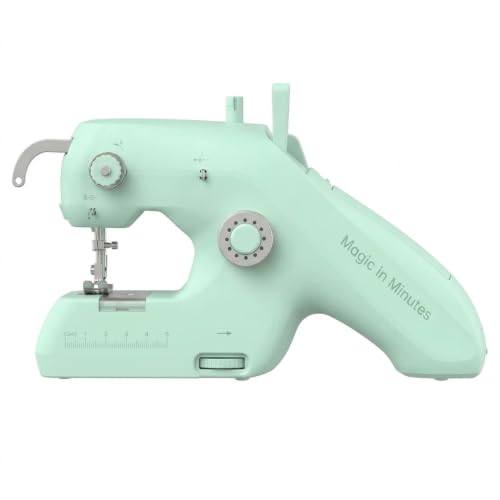
Compact Handheld Sewing Machine for Home Alterations & Hems — The drawer rescue
This handheld states its vital statistics with unusual precision: 0.84 pounds, double-thread, a mending device for pants, curtains, and fabrics. The weight is the headline a handheld should lead with, because the entire category lives or dies on being grabbable — a tool that lives in a drawer, travels in a bag, and comes out for the five-minute repair that would otherwise wait a month for the real machine to be set up. Double-thread construction is its second honest claim, distinguishing its stitch from the single-thread chain of the Singer below: two threads lock together in a way that survives handling better, which matters on the pants and curtains it names.
Use it as its title directs and it will not betray you. A curtain hem re-secured along a window’s width, a pant leg’s fallen hem tacked back into service, a fabric tear closed well enough to face the week — these are its parish, and within it the handheld format has one genuine advantage no bench machine can copy: it travels to the work. Curtains can be mended on the rod, in place, without unhanging, washing, and rehanging them; a bench machine, however superior its stitch, cannot follow you up the step stool.
The boundaries are equally clear, and this guide states them as firmly for this pick as for any: a handheld’s stitch is a mend, not a construction seam. It will not hem a wardrobe, take in a waistband, or produce the even, load-bearing stitching alterations are judged by when they are judged seriously. Buy it as the household’s first responder and it earns its drawer; buy it as a tailor and it will make you angry at the wrong target.
- Weight stated in the title: 0.84 lbs
- Thread system stated: double-thread mending device
- Jobs stated: pants, curtains, and fabrics; home alterations and hems
- Power and accessories: the title is silent — verify on the product page
- Check this handheld’s Amazon page for the live price
Strengths
- Featherweight format lives in a drawer and travels to the work.
- Double-thread stitching outlasts single-thread chain mending.
- Curtains can be repaired in place, on the rod, without unhanging.
Trade-offs
- Mending-grade stitches only; no structural or tailored work.
- One-handed control limits seam straightness on long runs.
- Accessories and power details need product-page confirmation.
Best for: quick hems and mends around the home, especially curtains in place. Not suited for: tailoring, waistbands, or any alteration expected to carry load invisibly.

SINGER Stitch Sew Quick Portable Handheld Mending Machine — The name-brand handheld
Singer’s Stitch Sew Quick is the handheld category’s establishment figure: a cordless portable mending machine for fast repairs on curtains, bedding, and clothes, single-thread, with bobbins and needles included. Its title is a small masterpiece of honest scoping. Fast repairs — not alterations, not tailoring, repairs. The fabrics named are the soft, forgiving kind. And single-thread is printed where a less confident seller would hide it, because Singer’s customers deserve to know the stitch they are buying: a chain-style mend that is quick to lay down and, by the same token, the least durable stitch architecture in this guide.
That candor clarifies the use case beautifully. This is the machine for the hotel-room hem, the dorm-room curtain, the bedding seam that split before guests arrive — repairs whose deadline is tonight and whose loads are gentle. Cordlessness is its working virtue: no outlet hunt, no cord across the bed, just the tool and the tear. The included bobbins and needles mean the drawer it lives in needs no supporting cast, and the Singer name brings a supply chain for those consumables that unbranded handhelds cannot promise.
Where the double-thread handheld above wins on stitch architecture, this one wins on ecosystem and clarity of purpose — and the guide’s verdict is that either is defensible, provided the buyer reads single-thread as the limitation it is. A chain mend that is pulled from its loose end can unravel with discouraging ease; on bedding and curtains that risk is acceptable, on a trouser hem that flexes ten thousand times a day it is not. Match the stitch to the stress and the little machine is a faithful servant.
- Format stated in the title: portable handheld, cordless
- Thread system stated: single-thread
- Jobs stated: fast repairs on curtains, bedding, and clothes
- Included stated: bobbins and needles
- The Stitch Sew Quick’s current offer is on its Amazon listing
Strengths
- Cordless freedom for repairs anywhere in the home or on the road.
- Listing states its single-thread nature plainly — no surprises.
- Included bobbins and needles plus a major brand’s consumables supply.
Trade-offs
- Single-thread chain mending is the least durable stitch here.
- Repairs only — it makes no pretense at alteration-grade work.
- Handheld control caps the length and straightness of any seam.
Best for: fast, gentle repairs to curtains, bedding, and light clothing. Not suited for: hems under daily stress or any structural mending.

Hand Held Sewing Machine with Wooden Sewing Box and 153-Piece Kit — The kit-in-a-box
The final pick sells an ecosystem in miniature: a hand held sewing machine with a wooden sewing box and a 153-piece sewing kit, a power adapter, and heavy-duty scissors, positioned for adults and beginners. Evaluate it as two purchases fused. The first is a handheld mender, subject to every handheld truth already stated — mending-grade stitches, one-handed control, triage work. The second is a household sewing kit of real substance: a wooden box that gives needles, threads, and notions a permanent home, over a hundred and fifty pieces of the small equipment mending actually consumes, and scissors described as heavy-duty, which anyone who has tried to cut denim with kit scissors will appreciate.
That second purchase may be the smarter half of the bundle. A remarkable share of home mending is done by hand — buttons, small tears, tacking, the seam that needs six stitches and not sixty — and a complete kit serves those jobs for years regardless of the handheld’s fate. The power adapter deserves its own nod: handhelds that run on batteries alone develop a talent for being flat at the moment of need, and an adapter option converts this one into a small bench tool when an outlet is near. For a beginner assembling a mending capability from nothing, the bundle’s completeness is its argument; for a household already owning a kit, the same completeness is redundancy, and the drawer-rescue handhelds above make the cleaner purchase.
Gift logic applies here too, as it did to the tabletop mini: this is the box you give someone setting up a first home, where the wooden box will sit in a cupboard for a decade being useful in small ways weekly. Judged as an alterations machine it is the slightest in this guide; judged as a mending household-in-a-box, it is oddly the most complete.
- Bundle stated in the title: wooden sewing box and 153-piece sewing kit
- Included stated: power adapter and heavy-duty scissors
- Format stated: mini portable handheld machine for adults and beginners
- Thread system and stitch details: not described in the title — read them on the product page
- See this kit’s Amazon page for its current selling terms
Strengths
- The 153-piece kit and wooden box build a complete mending household at once.
- A power adapter option cures the flat-battery failure of handhelds.
- Heavy-duty scissors are a genuinely useful inclusion for fabric work.
Trade-offs
- The machine itself remains a mending-grade handheld.
- Households with an existing kit pay for redundancy.
- Stitch specifications are unstated in the title and need checking.
Best for: first homes and gift buyers building a mending kit from zero. Not suited for: anyone seeking an alterations machine rather than a mending ecosystem.
Three Roles, Six Machines: The Alterations Map
| Pick | Role | Hem quality | Reach for it when |
|---|---|---|---|
| Cozyel RM-500 Portable Blindstitch Sewing Machine | Shop hemmer | Invisible blindstitch | Hems are the work, in quantity |
| Brother XM2701 Portable Sewing Machine | Household centerpiece | Neat blind-hem stitch | Cuffs, sleeves, and pant legs need doing properly |
| Portable Tabletop Beginner Mini Sewing Machine (Alterations) | Starter bench | Adequate and simple | Learning the craft or rescuing basics |
| Compact Handheld Sewing Machine for Home Alterations & Hems | Drawer rescue | Serviceable mend | A hem fell and the garment is needed today |
| SINGER Stitch Sew Quick Portable Handheld Mending Machine | Name-brand handheld | Quick chain mend | Curtains or bedding split before guests arrive |
| Hand Held Sewing Machine with Wooden Sewing Box and 153-Piece Kit | Kit-in-a-box | Mending grade | Building a mending capability from nothing |
What Makes a Hem Look Professional Rather Than Homemade?
Three things, and only the third is the machine. The first is measurement: a hem pinned at the wearer’s actual shoe break or the curtain’s actual sill, checked from a distance, in the posture and footwear the garment will live in. The second is pressing — the unglamorous iron work before and after stitching that decides whether a hem lies like a decision or like an accident. The third is the stitch itself, and here the tiers in this guide separate cleanly: the blindstitch machine’s invisible catch, the free-arm machine’s neat guided stitch, the handheld’s visible mend. A professional-looking hem is a measured, pressed hem whose stitch does not draw the eye; two of those three virtues are free, which is the most encouraging sentence in this entire guide.
Technique details compound. Match thread color to the fabric’s shadow tone rather than its highlight, and a visible stitch recedes. Keep the hem allowance even, because an uneven allowance telegraphs through any stitch as a wandering line. On trousers, protect the hem’s inner edge from shoe abrasion with hem tape or a slightly deeper fold, the alteration-shop habit that doubles a hem’s working life. And always — always — try the garment on before the final press, because the mirror is the only reviewer whose opinion the hem will ever actually face. Households that build these habits find their alteration work quietly mistaken for a tailor’s, whatever tier of machine produced it; households that skip them can own the Cozyel and still look homemade, a truth worth sitting with before spending. The same care-first logic governs the other workrooms in this batch’s coverage, right down to the refreshment station a busy sewing room eventually wants, as the machines in Best Small Coffee Machines remind us: setup and ritual decide outcomes more often than hardware does.
How Do You Take In a Waistband Without Wrecking the Garment?
Begin with the verdict before the stitch: open the waistband’s inner seam allowances and confirm the garment can give or take what you are asking. Taking in is usually possible where letting out is not, since it consumes fabric rather than requiring fabric that may not exist. Mark the new line with the garment worn and pinned by a second pair of hands if you can recruit them — waistbands are where self-fitting lies most fluently — and distribute the reduction across the side seams and back darts rather than gathering it all at the center back, which is how homemade alterations announce themselves.
Work on the free-arm machine tier if the garment matters: unpick only what the alteration needs, baste the new line by hand, try the garment again, and only then commit the machine stitch. Replace or rebuild the closure last, once the fit is proven, because buttons and hooks moved twice leave twice the evidence. Press the waistband as a tailor would, in sections, and hang the garment overnight before judging the result — fabric settles, and an alteration judged in the first hour is often judged wrong. None of this requires the blindstitch machine, and all of it is beyond the handhelds; waistbands are the household centerpiece’s home ground, and the honest answer to most ambitious alterations is the XM2701’s tier plus patience.
Where Do Home Alterations Most Commonly Go Wrong?
Overreach leads: the handheld bought for tailoring, the mini asked to rebuild a waistband, the beginner’s first project chosen as a beloved garment instead of a thrift-store rehearsal. Second is skipping the fitting — hemming by measurement alone, without the wearer’s posture, shoes, and habits in the room. Third is thread bravado: one spool, every fabric, every color, on the theory that stitching is invisible, which it is not. Fourth is neglecting the press, producing alterations that are dimensionally correct and visually rumpled. And fifth is irreversibility as a habit — cutting before basting, trimming seam allowances before the fit is proven — when the whole craft’s wisdom is to keep every decision reversible until the mirror has approved it. A sixth error completes the household list: altering in a hurry at the moment of need, the trousers hemmed in the twenty minutes before the event they are worn to, when every shortcut the craft forbids suddenly looks like a plan. Alterations done in panic carry panic’s signature — the uneven hem, the unpressed waistband, the stitch that lets go mid-occasion — and the household that alters on quiet weekends, ahead of need, discovers that the same work done calmly takes no longer and lasts immeasurably better. Schedule the wardrobe’s maintenance the way you schedule everything else you value, and the machines in this guide will do the rest.
How Do You Hem Curtains So They Hang Like They Were Made That Way?
Curtains forgive nothing about measurement and reward everything about patience, which makes them the perfect training ground for alteration discipline. Begin with the curtains hung, not folded on a table: fabric relaxes into its true length on the rod over several days, and a hem measured before that settling is a hem measured wrong. Mark the finished length in place, with the floor or sill as the reference the eye will actually use, and allow for the fabric’s character — linen and other natural fibers move with humidity across the seasons, a fact drapery professionals build into their hems and home alterers learn from one rainy month.
The hem itself wants weight and evenness. A generous fold, pressed crisply, gives the curtain the drape its bottom edge needs; skimpy hems curl and flutter like paper. On the machine side, long straight curtain hems are the one alteration where even a modest tier performs beautifully, because the work is flat, straight, and unhurried — the tabletop mini can produce a respectable curtain hem, and the XM2701’s guided stitch makes it easy, while the blindstitch machine earns its keep on the fine fabrics whose public side must show nothing. The handhelds’ one curtain superpower remains mending in place: a hem that has let go along one section can be re-secured on the rod, sparing the unhang-wash-rehang cycle entirely.
Finish as the professionals do: hang the curtains and live with them for a day before the final judgment, viewing them in morning and evening light, because hems are read by shadow as much as by sight. A hem that grazes where it should, breaks nowhere, and shows no stitching argument from across the room has passed the only examination that matters.
What Should an Alterations Kit Contain Beyond the Machine?
The machine stitches; the kit decides. Start with measurement in triplicate: a soft tape for bodies, a clear ruler for hems, and chalk or fabric markers in two colors, because the mark you cannot see is the alteration you cannot sew. Add the unpicking tools without which alterations are vandalism — a seam ripper with a fine point, small sharp scissors for threads, and the patience both tools exist to serve. Pins in quantity, a pincushion that lives where the fitting happens, and a pressing ham or rolled towel for coaxing curves under the iron complete the fitting bench.
Then the consumables that separate prepared households from improvising ones: thread in the wardrobe’s actual palette — black, navy, charcoal, stone, white, and the brown of the good boots — rather than a rainbow bought for its looks; spare needles in the sizes your fabrics use; hem tape for protecting trouser hems; fusible interfacing scraps for reinforcing waistbands and button areas; and a small stock of buttons, hooks, and elastic in the sizes your household’s clothing already wears. The 153-piece kit in this guide’s final pick covers much of this list in one box, which is precisely its value to a household starting from zero.
Store the kit where alterations happen, not where storage is tidy. The economics of home alteration turn on friction: a repair that requires excavating three cupboards waits until it becomes a replacement purchase, while a repair whose tools are at hand happens the evening it is noticed. Alterations, practiced as a household habit rather than an event, quietly return their machine’s cost in garments that keep fitting — the kit is what turns the machine from an appliance into that habit.
How Do You Learn Alterations in an Order That Builds Confidence?
The sensible syllabus runs from flat to tubular to fitted. Start flat: curtain hems and table linens, where the work is straight, the fabric forgiving, and the results immediately visible in a room you live in. Move to the simple tubes next — pant legs and sleeves on the free-arm tier — where the skills are marking evenly, stitching a circle without creeping, and pressing a hem that breaks correctly over a shoe. Only then approach the fitted work: waistbands, tapering, taking in seams, where the garment must be read as a structure and every decision kept reversible until the mirror approves.
Rehearse on the expendable. Every alterationist’s early history includes a garment sacrificed to education, and the wise arrange for theirs to come from a charity shop rather than a wardrobe. Buy three tired garments in your size and alter them completely — hem, taper, waist — and you will have purchased a course in the craft for the price of a pizza, with the failures costing nothing but thread. Keep the worst of them. It is the diploma.
Finally, learn the vocabulary of refusal, because alterations culture includes knowing when a garment cannot take what is asked: the sliver-thin seam allowance, the fabric whose nap runs against the alteration, the vintage piece whose value is its untouched state. A household alterer who can say this one should not be touched — and explain why — has graduated from operating a machine to practicing a craft, which was the destination all along.
How Does Alteration Work Differ for Children’s Clothing?
Children’s alterations run on a different clock from adults’, and households with growing children feel the difference in their machine choice. The dominant jobs are hems with a future: trousers and sleeves let down in stages as legs lengthen, which means the original alteration should be performed generously — deep hems, allowances preserved, nothing trimmed that a growth spurt will want back. The free-arm machine earns its place in family households precisely here, because a child’s cuff is the smallest tube in the house and the one most often adjusted. Speed matters differently too: the school-uniform hem is needed Monday, and an alteration setup that lives ready — machine threaded, kit at hand — is worth more than a superior setup that takes an hour to assemble.
Durability standards invert as well. A child’s hem will be outgrown before it wears out, so neat-and-quick beats invisible-and-perfect; the handheld and mini tiers find legitimate work here that this guide would deny them on adult tailoring, tacking a hem that needs to survive one term rather than one decade. The craft’s economics peak in these years: a household altering hand-me-downs and school clothes keeps garments in service across siblings, and the machine that enables it pays for itself in a currency of avoided purchases that any parent can count. When the children are grown, the same machine settles into the slower adult rhythm without missing a beat — which is why family buyers should weight the XM2701 tier, the one that spans both eras, over specialists bought for a single season of life.
How Do You Decide Between Altering, Replacing, and Letting Go?
Not every garment deserves its alteration, and the judgment is part of the craft this guide keeps circling. Alter when the fabric is sound, the fit fault is local — a hem, a waist, a taper — and the garment’s remaining life justifies the hour. The good coat with the wrong sleeve length, the trousers whose waist drifted with their owner’s, the dress one size of seam away from perfect: these are alteration’s home ground, and a home machine converts them from regrets into wardrobe at the cost of an evening. Replace when the fabric itself is failing — thinning elbows, worn seat, faded beyond dignity — because no stitch restores cloth, and altering a dying garment merely gives the failure a better fit. Let go, finally, when the garment’s only fault is that its owner has changed tastes; alterations fix fit, not affection, and the charity bag is the correct machine for that job.
There is a middle path worth naming: restyle. The dress that becomes a skirt, the trousers that become shorts for the garden, the curtain that becomes cushion covers — alterations in the generous sense, where the machine’s role expands from maintenance to reinvention. Households that practice it find their sewing skills compounding, because restyling teaches garment structure faster than repair ever does, and their wardrobes acquire the pleasantly unbuyable quality of things made from things. A guide to machines can only point at that door; the household walks through it with whatever tier it owns, a free Saturday, and a garment whose first life has honestly ended.
What Does It Mean to Run Alterations as a Small Home Service?
Some readers of this guide will take the natural next step and alter for others, and the machine logic shifts when the garments belong to strangers. Volume concentrates brutally on hems — a home service can build an entire practice on trousers, skirts, and curtains — which is where the Cozyel’s blindstitch stops being a luxury and becomes the service’s signature, the invisible finish customers describe to their friends. The general machine remains necessary for the seams, waistbands, and repairs that accompany the hems, so the two-machine bench described earlier in this guide is, in effect, the minimum viable alteration shop. Pricing follows the same honesty as everything else here: charge for the fitting, the pressing, and the risk as well as the stitching, because customers are buying the judgment that their garment will come back fitting, not the minutes a needle spent moving.
The service’s other asset is turnaround. A shop that hems by Thursday what arrived Monday owns its neighborhood, and turnaround is a function of setup — the hemming station standing ready, the kit stocked, the machine threaded — far more than of stitching speed. Home services also inherit the refusal vocabulary as a professional necessity: the garment that cannot be let out, the fabric that will not survive the alteration, the deadline no honest bench can meet. Said kindly and early, those refusals build the reputation that fills the order book; the alterations business, like the embroidery businesses elsewhere in this batch, is an order book with a machine attached, and never the other way around.
How Should You Store and Maintain Machines That Work Intermittently?
Alteration machines live an unusual life: intense weekends separated by quiet weeks, and their care should match that rhythm. Dust is the standing enemy of the idle machine, so a cover — even a cloth one — earns its place the day the machine arrives, and the bobbin area wants a brush-out after each working session rather than before the next one, because lint left sitting absorbs moisture and hardens into exactly the kind of obstruction that greets you mid-hem. Handhelds need their own small discipline: batteries removed or the adapter coiled with the tool, needles checked before they are needed rather than during the emergency that summoned them, and a home in the drawer where mending actually happens.
The full machine’s health check is a five-minute ritual worth adopting monthly: a test seam on scrap, through every stitch the month might need, listening for the sounds that announce developing trouble while there is still time to address them calmly. Thread, too, ages — spools kept in sunlight fade and weaken — so the kit’s palette should live in its box, and the wooden-box pick in this guide deserves a final nod on exactly that ground. Machines maintained this way are simply there when the alteration is, which, as this guide has argued from its first page, is the entire point of owning them.
Final Recommendation
Buy for the role your alterations actually occupy. If hems are your volume — a family’s trousers, a drapery sideline, alteration work for others — the Cozyel RM-500 is the professional answer and pairs naturally with a general machine. If alterations means keeping a household’s clothing fitting, week in and week out, the Brother XM2701 is this guide’s centerpiece recommendation, its free arm worth more than any stitch count in the category. Let the tabletop mini teach beginners, and let the three handhelds do the honorable triage they were built for, without asking them to be tailors. The wardrobe that fits is not built by the most expensive machine in this guide; it is built by the household that measured twice, pressed once, and chose the tool whose honest role matched the job in hand — and on the evidence of these six listings, that household is well supplied at every tier. Start where your garments actually fail, let the hems teach you the craft in their own order, and the first time a stranger assumes your trousers came from a tailor, you will know the alterations bench has quietly become one of the best-run departments in the house. Keep the bench set up, the kit stocked, and the iron warm in spirit if not in fact, and the wardrobe will take care of the rest. That is the quiet promise at the bottom of this whole category: not new clothes, endlessly, but the clothes you already love, kept fitting the person you currently are — hem by hem, cuff by cuff, season by season, for as long as the cloth itself holds out.
Frequently Asked Questions
Can a handheld sewing machine really alter clothes?
It can mend them — re-securing hems, closing small tears, tacking curtains — and for tonight’s emergency that is genuinely alteration enough. It cannot take in, let out, or tailor to a standard, because its stitch and its one-handed control were never built for that. The guide’s handheld picks are honest tools when their role is respected.
What is a blindstitch, and why does it need its own machine?
A blindstitch catches the hem fold and barely grazes the garment’s outer layer, so the public side of the fabric shows no stitch line. A dedicated machine performs it with a specialized mechanism at working speed and even depth; general machines approximate it with a blind-hem stitch and foot, neatly but visibly on close inspection.
Is the free arm really that important for alterations?
For the tube-shaped jobs — a cuff, a sleeve, a trouser leg — yes. Sliding the tube around the arm lets the machine stitch a circle calmly instead of the operator rotating a bunched garment under a flat bed. Since those three jobs dominate household alterations, the free arm is the single feature this guide weights most heavily after hem quality.
How do I know if a garment can be let out?
Open a seam allowance and look: letting out needs spare fabric inside the seams, and many modern garments are sewn with allowances too narrow to give anything. If the allowance is generous, a careful alteration is possible; if it is sliver-thin, no machine in this guide can manufacture cloth, and the honest answer is a different alteration — a added panel, a restyle — or none.
Should a beginner start with a mini or go straight to a full machine?
If alterations are a definite, recurring need — children growing, uniforms to maintain — go straight to the XM2701 tier and learn on the machine you will keep. If the interest itself is the experiment, the tabletop mini is the cheaper tuition, and everything learned on it transfers upward when the experiment succeeds. Readers outfitting a whole workroom at once will find the same start-where-you-are logic applied to frozen desserts in Best Vegan Ice Cream Machines — begin at the tier your actual habits justify.
How long should a home alteration take?
A practiced household hem runs fifteen to thirty minutes including fitting and pressing; a waistband alteration, an hour or more with its basting and re-fitting. Beginners should double every estimate without shame — the time is the tuition — and should distrust any workflow promising tailor’s results in five minutes, because the five-minute tools in this guide exist for mending, and mending is a different promise.
Do I need special needles for alterations?
Match the needle to the garment, as with all sewing: sharps for wovens, ballpoint for knits, a heavier needle for denim hems. Alterations meet a wider fabric range than most sewing — whatever the wardrobe contains — so a small assortment on hand, refreshed regularly, prevents the common beginner error of forcing one tired needle through every job it meets.
Related Guides
Alterations begin with machines that handle everyday sewing gracefully, so readers still equipping a first sewing corner will find a friendly starting map in Best Easy to Use Sewing Machines, the natural companion to this guide’s household tier.


