What's inside
- Key Takeaways
- Thirty Inches, Five Contenders
- What Did We Require Before Calling a Range “Pro-Style” With a Straight Face?
- How the Five Stack Up When You Read Only What Is Written
- Why Does “Pro-Style” Exist at All?
- What Must a Home Gas Line and Kitchen Provide for These Ranges?
- How Do You Keep Cast Iron Grates and Sealed Burners Working Like New?
- Which Buying Errors Follow 30-Inch Shoppers Home?
- Final Recommendation
- Frequently Asked Questions
- A Second Look: Which of These Five Fits Which Kitchen?
- How Should You Read Burner Claims Without a Single BTU in Sight?
- What Changes When the Oven Door Opens Every Day for a Decade?
- How Does a Range Choice Echo Through a Remodel Budget?
- What Does Responsible Gas Ownership Add to the Weekly Routine?
- Which Questions Should You Put to the Seller or Installer Before the Truck Rolls?
- How Does Your Cooking Change in the First Month on a Pro-Style Top?
- What Keeps Stainless Steel Looking Like Stainless Steel?
- Do Accessories and Add-Ons Change Which Pick Is Right?
- What Should Renters and Landlords Take From This Roundup?
- Related Guides
As an Amazon Associate I earn from qualifying purchases. This post may contain affiliate links at no extra cost to you.
**cottageverdict.com is reader-supported. When you buy through links on our site, we may earn an affiliate commission.**
A note on buying channels before anything else: each range below is sold through its Amazon listing, and that listing page — not this article — is where the current figure, the freight arrangement, and the fuel configuration get confirmed at checkout. Treat every “check price on Amazon” note here as an instruction to verify the exact variant in your cart, because gas appliances punish a wrong-variant order harder than almost anything else in the kitchen.
Now the honest premise, stated before any pick: most of the best 30-inch pro gas kitchen ranges sold to households are pro-style, not professional. That is not an insult; it is a category definition. A true commercial range is built for a restaurant line, assumes a commercial gas supply, commercial ventilation, and in many jurisdictions cannot legally or safely be installed in a home kitchen at all. What the five ranges below offer instead is the professional look and a meaningful slice of professional behavior — sealed burners, cast iron grates, convection ovens, metal knobs — engineered for residential gas lines, residential clearances, and residential insurance. Buyers who understand that distinction shop happily in this category. Buyers who expect a restaurant line in a box are the ones writing furious reviews in February.
Thirty inches is also the standard cutout in most American kitchens, which makes this the easiest width to install and the hardest to shop: every brand on earth competes here, titles inflate accordingly, and the word “professional” appears on listings whose own specification sheets describe an ordinary home range in a steel jacket. This roundup therefore reads each title the way a building inspector reads a permit — what is actually claimed, in writing, and what is merely implied by photography.
Key Takeaways
- “Pro” at 30 inches means pro-style for a home: restaurant looks and heavier hardware, residential gas and clearance requirements.
- Burner counts here run from four to five; grate material and convection matter more to daily cooking than the count alone.
- One brand in this group sells the same model through several color and fuel listings — only one of them is a pick, and the rest are explained in prose.
- Fuel flexibility is a real dividing line: some titles state natural gas and propane readiness outright, others leave it to the manual.
- The barest title in the group belongs to a range that may be excellent, but its listing asks you to verify nearly everything yourself.
Thirty Inches, Five Contenders
| Range | What makes it pro-style | Oven size the title gives |
|---|---|---|
| KOSTCH KOS-30RG03M — The pro-style anchor | Five burners and a professional freestanding format in stainless; check price on Amazon. | 4.55 cu. ft. |
| Magnificent Chef 30 Pro — Delivery-and-warranty standout | Cast iron grates, two burner speeds, and title-stated delivery plus warranty terms; check price on Amazon. | 4.0 cu. ft. |
| S Series 30 Pro Range — The minimalist listing | A professional freestanding claim with almost no further detail in the title; check price on Amazon. | Not stated in the listing title — verify with the manufacturer documentation |
| Pro-Style Slide-In Range — The design statement | Slide-in format, convection, and a red oven door that commits to a look; check price on Amazon. | Not stated in the listing title — verify with the manufacturer documentation |
| Cosmo Nebula 30 — Most complete burner kit | Five burners, a wok ring, fan circulation, and propane convertibility in one title; check price on Amazon. | 5 cu. ft. |
What Did We Require Before Calling a Range “Pro-Style” With a Straight Face?
Three things, all checkable from a title or a manual rather than from photography. First, burner hardware that goes beyond the stamped-steel minimum: sealed burners or cast iron grates, ideally both, because those are the parts a cook touches and cleans daily. Second, an oven with some claim to evenness — convection, fan circulation, or a stated capacity large enough to matter. Third, a format that reads as a deliberate appliance rather than a builder-grade box: freestanding professional styling or a true slide-in with finished front controls. Ranges failing all three were excluded no matter how aggressively their titles used the word professional.
Fuel honesty was the second filter. A gas range connects to natural gas or to propane, and conversion between them involves orifices and regulator adjustments that must match the manufacturer’s kit and instructions. Titles that state readiness for both fuels earned trust; titles silent on fuel earned a spec-box note telling you to verify, because assuming convertibility that does not exist strands a range in a garage. Readers who need the genuinely commercial end of the spectrum — ten burners, dual full ovens — will find it in our guide to Best 60-Inch Pro Ranges, which also explains why that class plays by different installation rules.
One structural note on this particular group: the lead pick’s maker sells its 30-inch model through multiple listings that vary by color and fuel. Those are the same machine wearing different jackets, so exactly one listing appears here as a linked pick and the variants are discussed in prose inside its section. Counting them as separate picks would pad the roundup and mislead the comparison.

KOSTCH KOS-30RG03M — The pro-style anchor
KOSTCH is the name that surfaces whenever 30-inch pro-style gas is discussed in online kitchen forums, and the title of this listing shows why: a professional freestanding range, five burners, a 4.55 cubic foot oven, and a fuel description that covers natural gas or liquid propane, in stainless steel. Five burners at 30 inches means a center burner sharing space with four corners, a layout that earns its keep when a griddle or an oval Dutch oven needs a home. The 4.55 cubic foot oven is mid-sized for the class — honest family capacity rather than a headline number — and the freestanding format means finished sides and placement freedom at the end of a counter run.
The variant situation needs plain language. This maker offers the same 30-inch model in other finishes and fuel configurations through separate listings, and a search will surface them side by side, all looking like different ranges. They are one model. The stainless natural-gas configuration linked here is the pick; a buyer who wants the same machine in another finish or set up for propane should understand they are shopping variants of the KOS-30RG03M, not competing products, and should compare them on configuration alone. That is also why this roundup contains five picks rather than a padded ten: the honest size of this market segment is smaller than search results pretend.
- Burners: 5, as printed in the listing title
- Oven capacity: 4.55 cu. ft. per the title
- Fuel: natural gas or liquid propane configurations exist for this model, per the title
- Format: professional freestanding, stainless steel
- Convection: the title does not claim it, so anyone shortlisting the KOSTCH KOS-30RG03M for multi-rack baking should check the manual before deciding
- When you order the KOSTCH KOS-30RG03M, match the fuel configuration in the cart to the line entering your kitchen — the variants make this check essential
Strengths
- Five burners at the standard width, with a center position for griddles and ovals.
- Fuel variants under one model make propane households servable without changing ranges.
- The professional freestanding format installs at a counter end without trim kits.
Trade-offs
- Variant listings invite an accidental wrong-configuration order.
- Convection is unclaimed in the title, which bakers must resolve in documentation.
- Mid-pack oven capacity will not impress buyers chasing the largest number.
Best for: cooks who want the canonical 30-inch pro-style layout and may need propane flexibility. Not suited for: anyone unwilling to double-check which variant is in the cart.

Magnificent Chef 30 Pro — Delivery-and-warranty standout
This listing competes on logistics as openly as on hardware, which is refreshing in a category where freight terms usually hide until checkout. The title states a 4.0 cubic foot space-saver oven, two ultra-fast and two fast burners, cast iron grates, readiness for either liquid propane or natural gas, delivery included, and a two-year warranty. Read that again: the seller is putting delivery and warranty duration in the headline, which tells you the intended customer is a household replacing a range at a distance — a rural home, a rental property, a second kitchen — where the appliance arriving intact and covered matters as much as its burner map.
The hardware story is coherent underneath the logistics. Four burners in two speed classes is the classic workhorse layout: high-output positions for boiling and searing, gentler ones for the sauce that must not scorch. Cast iron grates are the pro-style signal that actually matters daily, because they take the weight of a loaded Dutch oven without flexing and they survive a decade of pan traffic. The 4.0 cubic foot oven is the smallest stated in this group, consistent with the space-saver description, and buyers who regularly roast a large bird plus sides should measure their pans against that figure rather than discovering the limit in November.
- Oven capacity: 4.0 cu. ft., described in the title as a space-saver oven
- Burners: 2 ultra-fast and 2 fast, per the title
- Grates: cast iron, stated in the title
- Fuel: LP/NG ready, per the title
- Terms in the title: delivery included and a 2-year warranty are both claimed by the Magnificent Chef 30 Pro listing — confirm the details at checkout, where the Magnificent Chef 30 Pro order is finalized
Strengths
- Delivery and warranty terms stated up front, rare honesty in this category.
- Cast iron grates deliver the durability buyers actually mean by “pro.”
- Dual fuel readiness suits homes that may switch supply later.
Trade-offs
- Smallest stated oven here; big holiday loads need planning or a second appliance.
- Four burners, not five — no center position for a griddle.
- Space-saver proportions trade presence for fit in tight kitchens.
Best for: distance buyers and landlords who value delivery certainty and warranty length. Not suited for: high-volume entertainers who need the largest oven and a fifth burner.
S Series 30 Pro Range — The minimalist listing
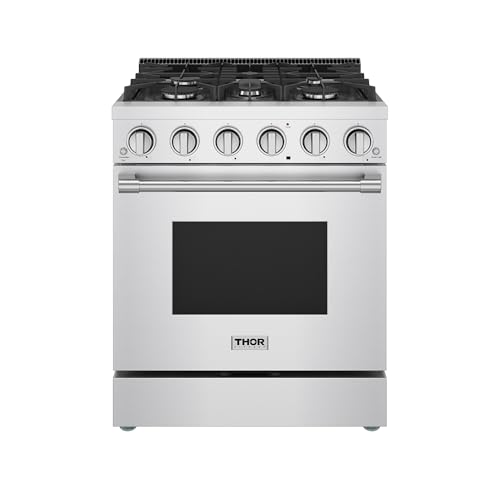
Eleven words. That is the whole title: a 30-inch S Series professional freestanding gas range. No burner count, no capacity, no grate material, no fuel statement. This pick remains in the roundup for two reasons. First, the S Series naming follows a convention buyers may recognize from commercial kitchen equipment, where series designations carry the specification in a model sheet rather than a headline. Second, its presence teaches the most useful shopping skill in this category: knowing what a listing has not told you, and pricing that uncertainty honestly against listings that state everything.
What can be said without inventing: it is a 30-inch freestanding gas range presented as professional, in a series the maker calls S. Everything else — how many burners, whether the oven convects, which fuels it accepts, what the grates are made of — must come from the listing’s detail sections or the manufacturer’s documentation, and a buyer should extract those answers in writing before ordering, ideally by saving the specification page the day the order is placed. If the answers come back strong, this could be the sleeper pick of the group. If a seller cannot produce them, the other four picks state their cases plainly enough that walking away costs nothing.
- Size and format: 30-inch freestanding gas range, per the title
- Series: S Series, described as professional in the title
- Burner count: not given in the title — the S Series 30 Pro Range requires a documentation check on this basic point
- Oven capacity: likewise absent from the title; treat any figure you need as unconfirmed until the S Series 30 Pro Range spec sheet supplies it
- Fuel configuration: not stated in the title either, so confirm gas type before the S Series 30 Pro Range is ordered
Strengths
- Series-based naming suggests a specification sheet exists for buyers who ask.
- Freestanding format keeps installation options open.
- No inflated claims in the title — nothing promised that must later be walked back.
Trade-offs
- The buyer does all the verification work the other listings do for them.
- Comparison shopping against stated-spec rivals is impossible from the title alone.
- Professional is asserted, not demonstrated, in the listing headline.
Best for: methodical buyers comfortable extracting a spec sheet before committing. Not suited for: anyone ordering against a deadline, like a failed range two days before a family visit.

Pro-Style Slide-In Range — The design statement
Most pro-style ranges whisper their ambition in brushed steel. This one says it in red. The title describes a 30-inch, four-burner, slide-in gas range with convection, in stainless steel with a red oven door — a combination aimed squarely at the kitchen that treats the range as the room’s focal point. The slide-in format matters beyond looks: front controls, no raised back panel, and a top edge designed to overlap the counter slightly, which keeps crumbs from vanishing into the gap and gives the built-in appearance renovators pay carpenters to fake around freestanding units.
Convection is claimed outright, which separates this pick from the KOSTCH and the S Series on the baking axis: fan-assisted heat for more even multi-rack results, the feature home bakers actually use weekly. Four burners rather than five is the honest trade for the slide-in format at this width and positioning, and for most households the missing center burner is a griddle position they would have used monthly at most. What the title does not state is oven capacity or fuel convertibility, so both belong on the verification list. And the red door deserves one practical note: it is a commitment. Cabinet hardware, textiles, and the eventual resale conversation will all orbit that color choice, so make it as a household, not as a solo impulse at midnight.
- Format: slide-in, front-control, per the title
- Burners: 4, stated in the title
- Oven: convection claimed in the title
- Finish: stainless steel with a red oven door, per the title
- Oven capacity: not printed in the title — measure your largest roaster against the figure in the manual for the Pro-Style Slide-In Range before ordering
- Fuel convertibility: also unstated in the title of the Pro-Style Slide-In Range; propane households must confirm a conversion path exists
Strengths
- True slide-in fit and finish, with the counter-overlap lip that seals the crumb gap.
- Convection stated plainly, not hinted.
- A genuine design identity in a category of stainless sameness.
Trade-offs
- The red door will polarize households and future buyers alike.
- Four burners cap simultaneous large-pan cooking.
- Capacity and fuel details require the documentation detour.
Best for: design-led renovations where the range is the room’s centerpiece and baking matters. Not suited for: neutral-kitchen traditionalists or five-burner cooks.
Cosmo Nebula 30 — Most complete burner kit
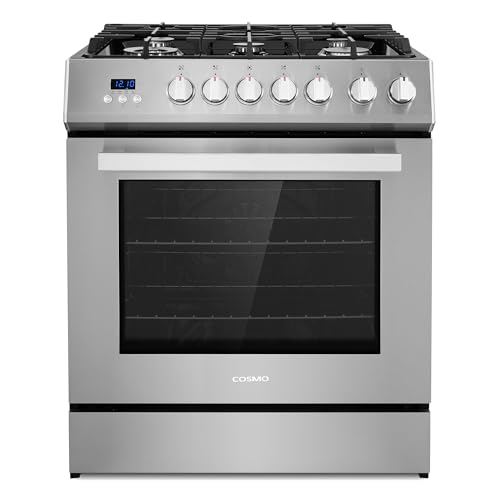
Cosmo’s Nebula title is the longest in this group because it has the most to say: a 30-inch range with a 5 cubic foot oven, five burners, convection, oven fan circulation, cast iron grates, a digital display with timer, liquid propane convertibility, and a wok ring. The wok ring is the detail that reveals the intended cook. A round-bottom wok on a flat grate is a wobbling compromise; a ring that cradles the wok and concentrates the flame is the difference between stir-frying and steaming vegetables in their own juice while the protein waits. Households that cook East and Southeast Asian dishes weekly will feel that accessory’s value immediately.
The 5 cubic foot oven is the largest stated in this roundup, and the title says “convection” and “oven fan circulation” in the same breath, describing the fan-assisted baking that evens out tray-to-tray differences. Cast iron grates complete the hardware picture, and the digital display with timer brings the control style closer to a modern electric range than to the all-knob commercial aesthetic — a genuine preference split among buyers, since some cooks want chunky metal knobs exclusively and others want a clock and a countdown they can read from across the room. Propane convertibility is stated, not implied, which rural buyers will appreciate after reading the S Series section above.
- Oven capacity: 5 cu. ft., the largest figure stated in this group
- Burners: 5, with a wok ring included per the title
- Grates: cast iron, stated in the title
- Oven system: convection with fan circulation, per the title
- Controls: digital display with timer, per the title
- Fuel: liquid propane convertible, stated outright — the Cosmo Nebula 30 makes its fuel story the clearest of the five, and the Cosmo Nebula 30 listing is where to confirm the conversion kit details
Strengths
- The wok ring serves a real cooking style most ranges only pretend to support.
- Largest stated oven paired with genuine convection.
- Nearly every question a buyer asks is answered inside the title itself.
Trade-offs
- Digital controls divide opinion among pro-style purists who want knobs only.
- A returning name from an earlier roundup cycle — the model is established rather than new.
- Five burners at this width still means modest spacing between large pans.
Best for: wok cooks, bakers, and propane households who want answers without a documentation hunt. Not suited for: minimalists who find a digital display on a gas range aesthetically wrong.
How the Five Stack Up When You Read Only What Is Written
| Range | Burner story | Fuel flexibility | Honest gap |
|---|---|---|---|
| KOSTCH KOS-30RG03M | 5 burners | NG or LP variants of one model | Convection unclaimed in title |
| Magnificent Chef 30 Pro | 2 ultra-fast + 2 fast, cast iron grates | LP/NG ready stated | Smallest stated oven at 4.0 cu. ft. |
| S Series 30 Pro Range | Not stated in the listing title — verify with the manufacturer documentation | Not stated in the listing title — verify with the manufacturer documentation | Almost everything needs verifying |
| Pro-Style Slide-In Range | 4 burners, convection oven | Not stated in the listing title — verify with the manufacturer documentation | Capacity unstated in title |
| Cosmo Nebula 30 | 5 burners, wok ring, cast iron grates | LP convertible stated | Digital controls split opinion |
The pattern across the table is the real review: at 30 inches, “pro” is a spectrum of evidence. The Cosmo and the KOSTCH document themselves; the Magnificent Chef documents its logistics as carefully as its hardware; the slide-in documents its design and convection while leaving capacity to the manual; and the S Series documents almost nothing, transferring the burden to you. None of that makes any of them a bad range — it makes them different purchases, suited to different appetites for verification. The same evidence-first habit transfers outdoors, incidentally: our test of claims in Best 4000 PSI Pressure Washers applies identical skepticism to pressure ratings, where inflated numbers can damage a deck instead of merely disappointing a baker.
Why Does “Pro-Style” Exist at All?
Because the genuine article mostly cannot come home. Commercial ranges assume commercial gas pressure, demand clearances and ventilation that residential codes rarely grant, and often lack the insulation and safety certifications a home insurer expects. The pro-style category is the industry’s negotiated settlement: the visual and tactile language of the restaurant line — heavy grates, sealed high-output burners, steel everywhere — wrapped around residential engineering. Judged as that settlement, the best models here succeed. Judged as restaurant equipment, everything at 30 inches fails, including the ones with the most aggressive titles. Keeping the settlement in mind is the single most reliable predictor of owner satisfaction in this category.
Within that settlement, the meaningful upgrades over a builder-grade range are specific: burners that sear harder and simmer lower, grates that do not flex, ovens that hold even heat across racks, and controls that survive a decade of greasy fingers. Every pick above delivers at least two of those four in writing. A range delivering none of them, whatever its photography suggests, is a costume, and this roundup excluded costumes even when their titles shouted loudest.
What Must a Home Gas Line and Kitchen Provide for These Ranges?
Gas work is licensed work in most jurisdictions, and this article will not pretend otherwise: a qualified installer or plumber should make the final connection, set the regulator for your fuel, and leak-test every joint. What a homeowner can do in advance is verify the shutoff valve behind the range exists and turns, confirm the line size matches the manual’s requirement, and decide the fuel question before the range ships — because converting a range on install day without the correct kit on hand turns a one-hour job into a two-week wait. Ventilation scales with burner output, so a hood that was adequate for a builder-grade range may lag behind five burners running together; plan the hood conversation in the same week as the range purchase, not after the first smoky sear sets off the alarm.
Clearances deserve the same respect. Pro-style ranges are insulated for residential installation, but the manuals still specify distances to combustible surfaces, and the slide-in pick adds its own requirement: counter edges at the right height for its overlap lip. Measure the cutout’s depth as well as its width, since front-control slide-ins sit differently than the freestanding unit they may replace. If the old range was electric and the gas line is new, budget for the line run itself — it is the most common surprise cost in this entire category, and no listing title will warn you about it. Buyers switching fuels entirely may also want to compare against our guide to Best 36-Inch Electric Ranges if a wider electric cutout is already on the renovation table.
How Do You Keep Cast Iron Grates and Sealed Burners Working Like New?
Grate care is a weekly two-minute habit disguised as a chore. Once the grates are cool, lift them — never drag them across the cooktop — wash off the fresh grease before it polymerizes under next week’s heat, and dry them fully, because cast iron left damp in a steamy kitchen will freckle with rust that then transfers to pan bottoms. Sealed burners forgive spills better than open designs, but the burner caps still need their ports kept clear; a clogged port announces itself as a lopsided flame and a ring of unburned gas smell that no cook should tolerate. Wipe the stainless with the grain, keep oven cleaner off the knobs and their markings, and the range that looked professional on delivery day will still look it in year five.
Ignition behavior is your early-warning system. A healthy burner lights promptly with a blue, steady flame. Persistent clicking, yellow tipping, or a burner that needs a match is a service call, not a personality trait, and catching it inside the warranty window is the difference between a free repair and a bill. Keep the manual’s troubleshooting page — most ignition faults are a mis-seated cap after cleaning, a thirty-second fix that owners mistake for a breakdown every day.
Which Buying Errors Follow 30-Inch Shoppers Home?
The classic is ordering the wrong fuel configuration — a mistake this category’s variant listings practically invite, and the reason the KOSTCH section above insists on a cart check. Second is assuming “professional” in a title confers commercial capability, then discovering the oven will not behave like a restaurant deck oven because it was never built to. Third is measuring width only, when slide-in depth and counter height decide the fit. Fourth is ignoring the hood until the kitchen fills with smoke. Fifth, and quietest, is choosing a bare-title listing without extracting its specifications first, then finding the burner count or capacity is not what the photography led you to hope. Every one of those errors is preventable with an hour of reading, which is considerably cheaper than a freight return.
Final Recommendation
Start with the Cosmo Nebula if you want the most questions answered before purchase — largest stated oven, convection, the wok ring, stated propane convertibility — or with the KOSTCH if five burners and the canonical pro-style format matter most and you accept the variant-check discipline. The Magnificent Chef is the logistics pick, the one whose delivery and warranty terms suit a purchase made at a distance, while the red-door slide-in is the choice when the kitchen’s design story leads and convection baking follows close behind. The S Series belongs on a shortlist only for buyers willing to do the documentation work its title declines to do. Whichever you choose, choose it as what it is — a residential range wearing professional clothes, judged on the evidence in its own listing — and it will cook like a partner rather than perform like a costume.
Frequently Asked Questions
Can I install a pro-style range on a standard home gas line?
Yes — that is precisely what pro-style means. These ranges are engineered for residential gas supply and clearances, unlike true commercial units. A licensed installer should still make the connection and confirm the line and regulator match the manual for your chosen fuel.
Are the different KOSTCH listings different ranges?
No. The maker sells the same 30-inch model through listings that vary by finish and fuel configuration. Only the stainless configuration is a linked pick here; the others are variants of one machine, so compare them on configuration, not as competing products.
Is a fifth burner worth giving up oven size for?
For most households, the center burner serves a griddle or an oval pot a few times a month, while oven capacity is tested every holiday. Cooks who griddle weekly should value the fifth burner; everyone else should weight the stated oven figures — 5 cubic feet on the Cosmo, 4.55 on the KOSTCH, 4.0 on the Magnificent Chef — more heavily.
What does LP convertible actually require?
A conversion kit with replacement orifices and a regulator adjustment, fitted per the manufacturer’s instructions, ideally by the installer who connects the range. “Convertible” in a title means the path exists; it does not mean the range switches fuels with a dial, and the kit’s inclusion should be confirmed on the listing before ordering.
Why does one pick have almost no specifications in its title?
Because that seller chose a series-name listing style. The S Series may have a full specification sheet behind it, but nothing beyond size, format, and fuel type can be claimed from the title, so this roundup claims nothing — and advises extracting the sheet in writing before purchase.
A Second Look: Which of These Five Fits Which Kitchen?
Picture the serious weeknight cook in a galley kitchen, the one who sears chicken thighs while a sauce reduces and rice rests. That cook lives on burner control and grate stability, and the KOSTCH’s five-burner map or the Cosmo’s wok-ready layout serves them directly; the oven is a supporting actor in their week. Now picture the household whose range works hardest on Sundays — a roast, two trays of vegetables, bread proofing in the ambient warmth. That household should weight the stated oven figures and the convection claims, which pushes the Cosmo and the red-door slide-in forward and asks hard questions of the slide-in’s unstated capacity before money moves.
The Magnificent Chef’s household is defined less by cooking style than by geography: a farmhouse an hour from the nearest appliance showroom, a rental duplex whose owner self-manages, a vacation property where a failed range ruins someone else’s holiday. For them, delivery included and a stated two-year warranty are not garnish — they are the product. The S Series household, meanwhile, is a researcher by temperament: the buyer who emails for the spec sheet, reads it, and either discovers a bargain or walks away informed. And the slide-in’s household is the renovator mid-design, holding paint swatches against a red door and enjoying the argument about it. Every one of these is a legitimate way to buy a range; the failures happen when a household buys a different household’s pick.
How Should You Read Burner Claims Without a Single BTU in Sight?
Notice what this roundup has not done: quoted burner power figures for picks whose titles do not state them. That restraint is deliberate, because burner output numbers are the most abused specification in the category — measured under differing conditions, quoted for the flagship variant, or copied between listings. What a title-level reader can assess honestly is structure. Two speed classes, as the Magnificent Chef states, tells you the maker designed distinct high and low roles. A wok ring tells you the Cosmo’s high burner is meant to concentrate flame under a curved base. Five burners tells you layout, not power. When raw output genuinely decides your purchase — you boil canning pots, you run a wok at full blast nightly — the figure to trust is the one in the manufacturer’s specification sheet for the exact model, and the S Series section above shows the working method: ask, in writing, before ordering.
Simmer behavior deserves equal billing with peak power and gets a tenth of the attention. The low end of a burner’s range decides whether a béchamel survives unattended and whether rice scorches at the edges. Titles rarely state minimum output, so the practical proxy is burner design: dedicated smaller burners, like the “fast” pair in a two-speed layout, generally simmer more kindly than a big burner throttled to its unstable edge. If your cooking is sauce-heavy, that structural clue outweighs any headline about speed.
What Changes When the Oven Door Opens Every Day for a Decade?
Ovens age at their hinges, their seals, and their igniters, in roughly that order of owner annoyance. A door that is opened twice daily accumulates thousands of cycles; a gasket that leaks heat makes the thermostat chase its tail and bakes unevenly long before it fails outright. None of that appears in a listing title, which is why the ownership advice in this category is behavioral rather than comparative: never use the open door as a shelf, clean seal channels when you wipe the cavity, and treat a slow-lighting oven as a warranty claim in waiting. The freestanding picks here put their doors through the same physics as any range; the slide-in’s convection fan adds one more moving part, balanced by the baking evenness it buys every week it works.
Knobs and controls age differently by material and placement. Front-mounted controls collect splatter and small-child attention in equal measure; a control lock, where fitted, is worth confirming in the manual for households with toddlers. Digital displays, like the Cosmo’s, trade mechanical simplicity for readability and timing precision, and they dislike steam directed at them — a kettle habitually boiled under the display is a small, avoidable cruelty. None of these are reasons to reject a pick; they are the operating manual for keeping whichever pick you choose feeling new.
How Does a Range Choice Echo Through a Remodel Budget?
The range is rarely the expensive part of a range purchase. Add the gas line work if the kitchen was electric, the hood upgrade that five burners justify, the counter adjustment a slide-in demands, and delivery beyond the threshold, and the project’s true cost can drift well past the listing figure. Sequencing protects the budget: choose the range before finalizing cabinetry, because the slide-in’s counter overlap and the freestanding models’ finished sides impose different cabinet decisions; confirm the hood after the range, sized to its real output; and hold a contingency for the shutoff valve that turns out to be older than the house’s last three owners. Renovators who run that sequence describe the range as the easy part. Renovators who reverse it describe the same purchase very differently.
What Does Responsible Gas Ownership Add to the Weekly Routine?
Burning gas indoors is a mature, manageable technology, and managing it well is mostly a matter of ventilation habits. Run the hood when burners run — not after the kitchen smells, but from the first minute — because combustion produces moisture and nitrogen compounds alongside the heat, and a hood vented outdoors removes both at the source. Keep a working carbon monoxide alarm in the home, as every safety authority advises for any fuel-burning appliance, and treat its chirp as information rather than nuisance. Once a season, look at your flames with fresh eyes: steady and blue is health; lazy, yellow, or lifting flames mean the burner wants cleaning or a technician, and the range will tell you this quietly for months before it tells you loudly.
Smell is the other instrument. A faint whiff at ignition is normal; a persistent gas odor with burners off is a leave-and-call situation, for the utility or emergency services first and the appliance brand second. Households new to gas sometimes fear they must choose between vigilance and relaxation, but the lived reality is simpler: the checks above take seconds, they fold into cooking itself, and within a month they are as automatic as preheating. The pro-style premium buys hardware; this small body of habits is what makes that hardware a pleasure instead of an anxiety.
Which Questions Should You Put to the Seller or Installer Before the Truck Rolls?
Ask the seller which exact model number and fuel configuration the order carries, and get the answer in the order confirmation rather than a chat window. Ask whether a conversion kit is included, available, or unnecessary for your fuel, and who performs the conversion if one is needed. Ask what delivery includes, in the vocabulary of the trade: curbside, threshold, room of choice, packaging removal, haul-away — five different promises wearing one word. Ask the installer, separately, whether the existing shutoff and line size satisfy the manual, and whether the anti-tip bracket and leveling are part of their visit. Each answer is cheap to obtain before the purchase and expensive to improvise after it, and a seller who answers all five crisply has told you something real about the support behind the listing.
Does a pro-style range need a bigger hood than a standard range?
It needs a hood matched to its total burner output and your cooking style. A household that mostly simmers can live with modest extraction; a household that sears nightly under five burners should size up and prefer a hood that captures at the front burners, vented outdoors. When in doubt, buy capture area and quiet operation over headline airflow.
Will a slide-in fit the cutout my freestanding range leaves?
Usually, with checks. Width is standard, but slide-ins expect counter surfaces at a compatible height for their overlap lip, and they sit with controls at the front rather than on a rear panel, which changes the backsplash relationship. Measure depth and counter height against the slide-in’s installation drawing before assuming a drop-in swap.
How Does Your Cooking Change in the First Month on a Pro-Style Top?
Cooks arriving from electric or from a gentle builder-grade gas range usually overshoot for two weeks. High-output burners bring water to a boil fast enough to change pasta timing habits, and they sear with an enthusiasm that turns “preheat the pan thoroughly” from a suggestion into a warning — the same skillet that needed five minutes on the old range may need two, and the first scorched garlic of the new regime is practically a rite of passage. The adjustment that matters most is learning each burner’s personality: which one truly simmers, which one runs hot at its middle settings, where the grate’s stable spots sit for a small saucepan. Cooks who keep a notebook for the first month — unglamorous, effective — end it with a mental map that makes the range feel custom-built.
Oven behavior asks for the same calibration. Convection models, like the Cosmo and the slide-in here, generally reward a modest temperature reduction and earlier checking than the still-air recipes assume, and they punish crowded trays less. Non-convection ovens reward patience and a single mid-oven thermometer reading taken during the first week. Either way, bake the recipe you know best before you bake the one that matters; the difference between the result and your memory of it is your unit’s signature, and every later recipe gets corrected against that signature automatically.
What Keeps Stainless Steel Looking Like Stainless Steel?
Fingerprints are the tax on the pro-style look, and the payment method is a microfiber cloth kept within arm’s reach, used with the grain, dampened with water for daily marks. Anything stronger belongs to the occasional deep clean, and anything abrasive belongs nowhere near the finish at all. Boil-overs should be lifted once the surface is cool enough to touch safely, because sugary spills carbonize into specks that later demand a scraper’s patience. Around the knobs, grease migrates on fingers; removing knobs for a wash — where the manual permits it — twice a year keeps the control panel reading as crisp as the day the range arrived. None of this is specialized knowledge, but households that adopt the routine in week one keep the showroom look, while households that postpone it spend a weekend in year two discovering how much harder the same job has become.
Do Accessories and Add-Ons Change Which Pick Is Right?
They can, at the margins. A five-burner top invites a two-burner griddle, and households that run weekend breakfasts for six will use one often enough to justify its storage space; the KOSTCH and Cosmo layouts host that accessory naturally, while four-burner owners should confirm a griddle can bridge their grate geometry before buying one. Wok cooking has already been discussed, but the mirror-image accessory deserves mention: a small-pot trivet or reducer ring for the espresso pot and the butter warmer, which on wide grates can sit unstably over a large burner. Simmer plates and heat diffusers form the third accessory class, rescuing delicate sauces on burners whose low end runs warm — a five-dollar solution that has saved more béchamel than any premium feature.
Inside the oven, a baking steel or stone changes bread and pizza outcomes more than the choice between these five ranges does, provided it fits — which returns, as everything in this category returns, to measuring the cavity against the manufacturer’s stated dimensions rather than the title’s rounded claims. The honest summary is that accessories reward a range whose basic geometry suits your pans, and punish one chosen on headline features; buy the geometry first and accessorize second.
How long do cast iron grates actually last?
Effectively the life of the range, if they are kept dry and never thermally shocked with cold water while hot. Porcelain-coated grates can chip if dropped on hard floors, and bare iron can rust if stored damp, but in ordinary service the grates on picks like the Magnificent Chef and the Cosmo will outlast igniters, seals, and probably the kitchen’s next repaint.
A closing word on value over time. Pro-style ranges hold their appeal in a kitchen because the look ages slowly — stainless and cast iron were the restaurant aesthetic thirty years ago and remain it today — and because the hardware that defines the category is the hardware that wears longest. A household that buys the evidence-backed pick for its actual cooking, installs it properly, and keeps the small habits described above is very unlikely to think about ranges again for a long while, which is the quiet outcome every appliance purchase is really chasing.
What Should Renters and Landlords Take From This Roundup?
A meaningful share of 30-inch pro-style purchases are made by property owners rather than cooks, and their calculus differs. Durability outranks delicacy: cast iron grates and mechanical controls survive tenant turnover better than touch panels, and a range whose parts are obtainable keeps a unit rentable. The Magnificent Chef’s stated warranty length speaks directly to this buyer, while the design-led slide-in, with its polarizing red door, is the riskiest landlord choice in the group — tenants who love it will care for it, and tenants who do not will not. For a landlord, the plainest evidence-backed pick, installed by a licensed fitter with the paperwork filed, is the purchase that stays invisible for a decade, and invisible is the highest compliment a rental appliance can earn.
Renters reading along, meanwhile, cannot usually replace a range at all — but they can steal this roundup’s method. Reading a title for what it actually claims, distinguishing a model from its variants, and asking for specifications in writing are skills that transfer to every appliance a landlord or seller describes to you, and they cost nothing but attention.
Finally, a word about timing. Range purchases made in panic — the old unit dead, guests arriving Friday — produce the worst outcomes in this category, because freight appliances cannot be rushed and variant errors multiply under pressure. If your current range is aging, the cheapest insurance is to do this reading now, choose a first and second pick while nothing is on fire, and keep the measurements of your cutout and gas line in a note on your phone. When the day comes, you will order calmly, verify the variant once, and be cooking again within the week — which is how the best 30-inch pro gas kitchen ranges are supposed to enter a kitchen: deliberately, on evidence, and without drama.
There is also a generational note worth making. Many buyers in this category learned to cook on a parent’s heavy restaurant-style range and are, consciously or not, shopping for that memory: the thunk of a cast iron grate, the authority of a metal knob, the indifference of the appliance to a dropped pan. The picks above that state their grate material and burner structure are the ones most likely to satisfy that memory, because the memory is tactile rather than visual. A range that merely photographs like the one in memory, while flexing and rattling in use, disappoints twice — once as an appliance and once as a souvenir.
And if the household includes a teenager learning to cook, a pro-style top is a genuinely good classroom: visible flame teaches heat in a way a glowing element never does, the grates forgive beginner clumsiness, and the controls respond instantly enough that cause and effect stay connected in a young cook’s mind. Supervise the first month, teach the hood habit and the flame check along with the knife skills, and the range becomes part of how the next generation learns — one more return on an appliance bought carefully and on evidence.
Keep the paperwork, too. Photograph the rating plate inside the oven door frame, save the order confirmation showing the exact variant, and file the installer’s invoice with the manual. If a warranty question ever arises, that small folder converts a week of archaeology into a single email, and it costs you ten minutes on installation day.
Related Guides
If the pro-style brief softens into a straightforward replacement search, our guide to Best 30 Freestanding Gas Ranges covers the wider 30-inch field without the professional styling premium, and it is the right comparison before you pay extra for the look.


